


 Скачать презентацию Technion — Israel Institute of Technology Department of
4a3a9b8505932329dd1e2e027ec5bd05.ppt
- Количество слайдов: 42
 Technion - Israel Institute of Technology Department of Electrical Engineering Signal and Image Processing Laboratory Self-dual Morphological Methods Using Tree Representation Alla Vichik Renato Keshet (HP Labs—Israel) David Malah 1
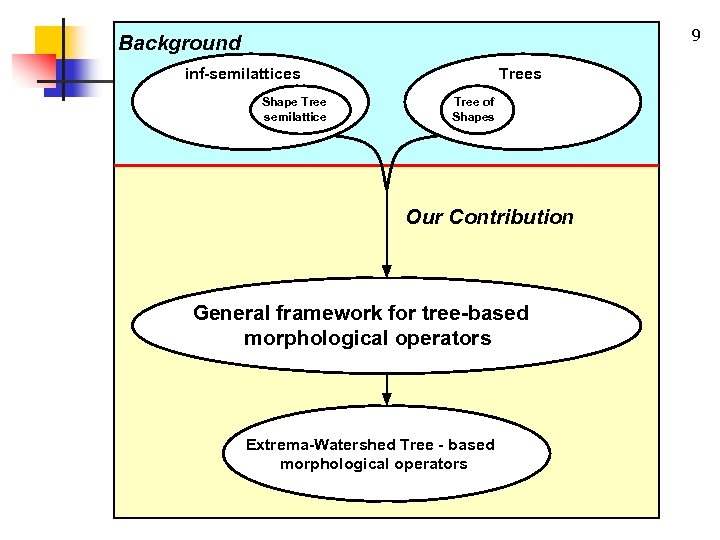
 Outline n This work introduces a general framework for tree-based morphological processing n n n Heart of the scheme: A complete inf-semilattice (CISL) on a tree-representation domain Given a tree, we show to use this CISL to process images Particular case n n Extreme-watershed tree Applications shown 2
 Trees in Image Processing n A common use of trees: n n n Represent flat zones of a given image by a tree scheme Prune tree branches Reconstruct the image Result: Connected filtering A couple of examples: n n Binary partition trees (P. Salambier and L. Garrido, 2000) Tree of Shapes (P. Monasse and F. Guichard, 2000) 3
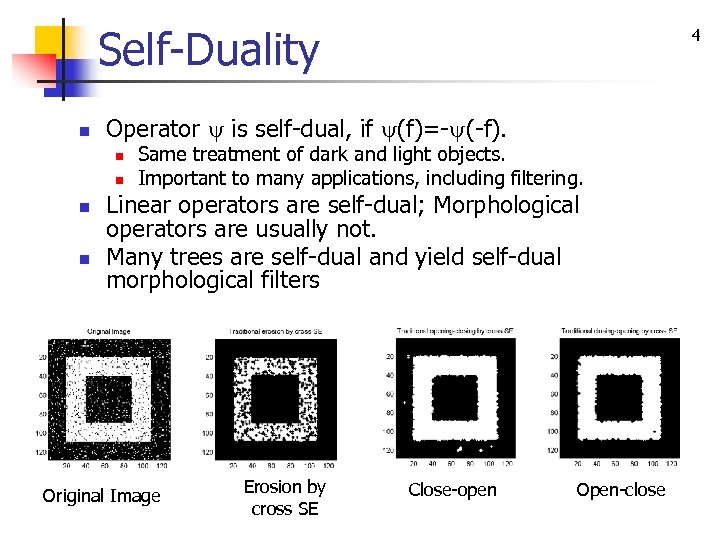 Self-Duality n Operator y is self-dual, if y(f)=-y(-f). n n 4 Same treatment of dark and light objects. Important to many applications, including filtering. Linear operators are self-dual; Morphological operators are usually not. Many trees are self-dual and yield self-dual morphological filters Original Image Erosion by cross SE Close-open Open-close
 The Problem n Trees do not yield morphological adjunctions, openings, closings, etc. n n n Usually connected filters Size criterion can not be implemented How to obtain self-dual adjunctions, using trees? 5
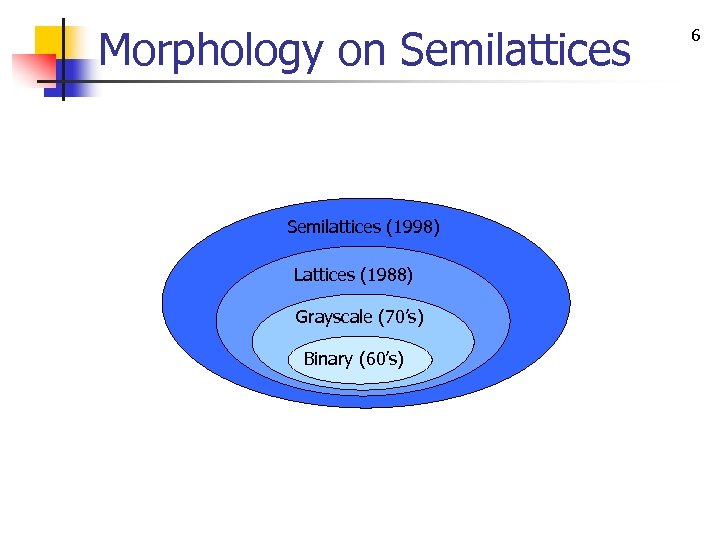 Morphology on Semilattices (1998) Lattices (1988) Grayscale (70’s) Binary (60’s) 6
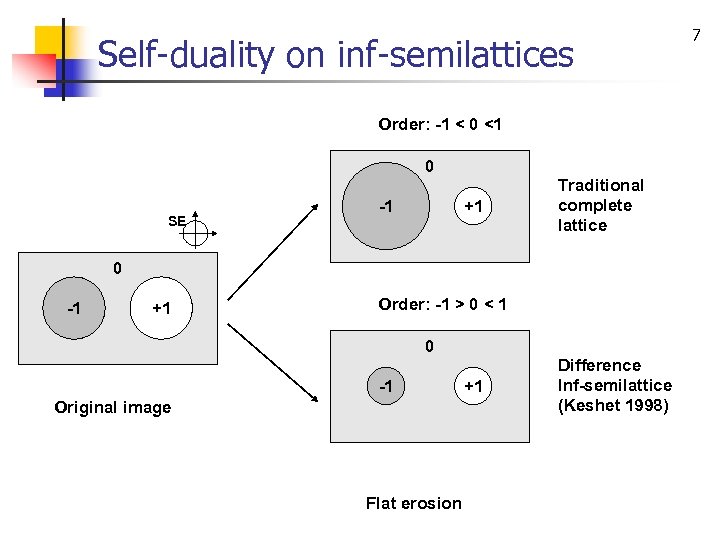 Self-duality on inf-semilattices Order: -1 < 0 <1 0 SE -1 +1 Traditional complete lattice 0 -1 +1 Order: -1 > 0 < 1 0 -1 Original image Flat erosion +1 Difference Inf-semilattice (Keshet 1998) 7
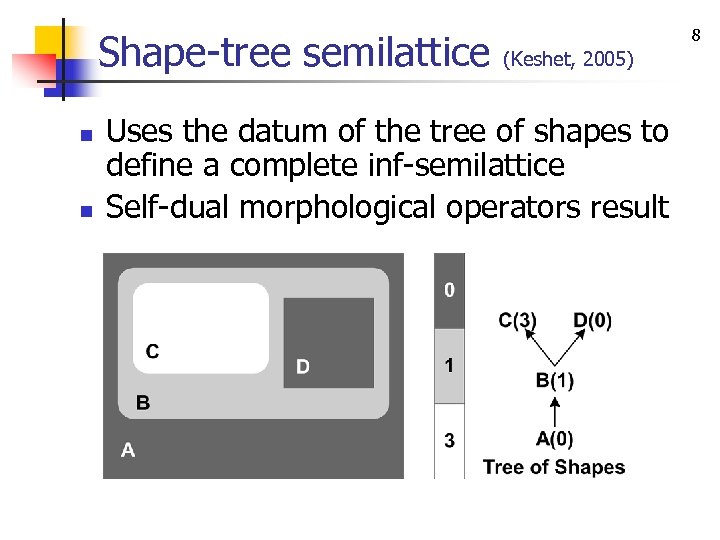 Shape-tree semilattice n n 8 (Keshet, 2005) Uses the datum of the tree of shapes to define a complete inf-semilattice Self-dual morphological operators result
 9 Background inf-semilattices Shape Tree semilattice Trees Tree of Shapes Our Contribution General framework for tree-based morphological operators Extrema-Watershed Tree - based morphological operators
 Tree-based morphology 10
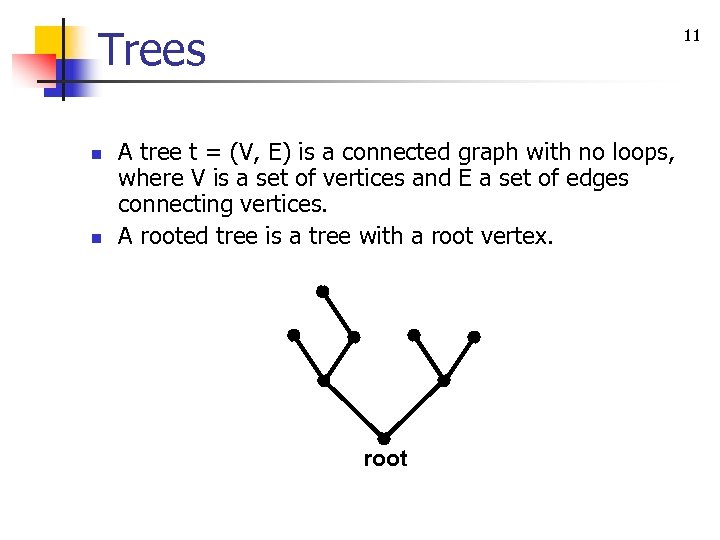 Trees n n 11 A tree t = (V, E) is a connected graph with no loops, where V is a set of vertices and E a set of edges connecting vertices. A rooted tree is a tree with a root vertex. root
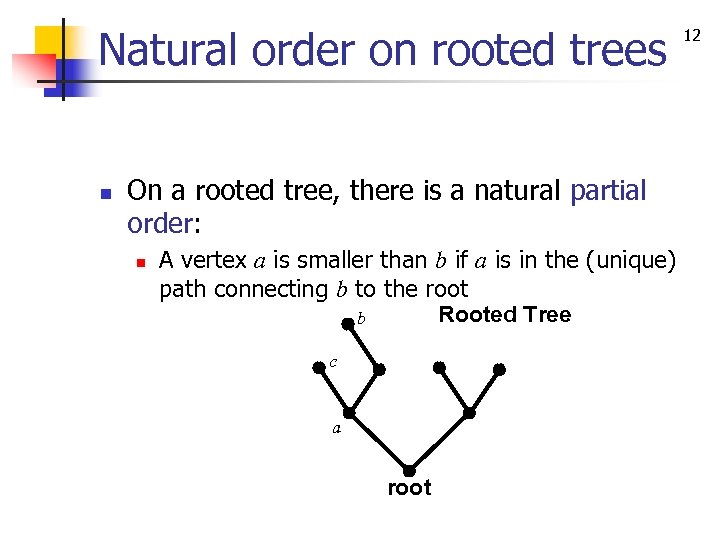 Natural order on rooted trees n On a rooted tree, there is a natural partial order: n A vertex a is smaller than b if a is in the (unique) path connecting b to the root Rooted Tree b c a root 12
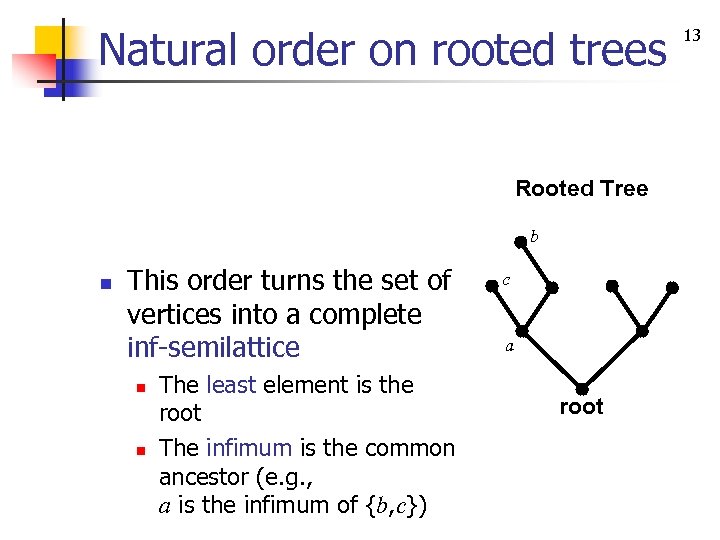 Natural order on rooted trees Rooted Tree b n This order turns the set of vertices into a complete inf-semilattice n n The least element is the root The infimum is the common ancestor (e. g. , a is the infimum of {b, c}) c a root 13
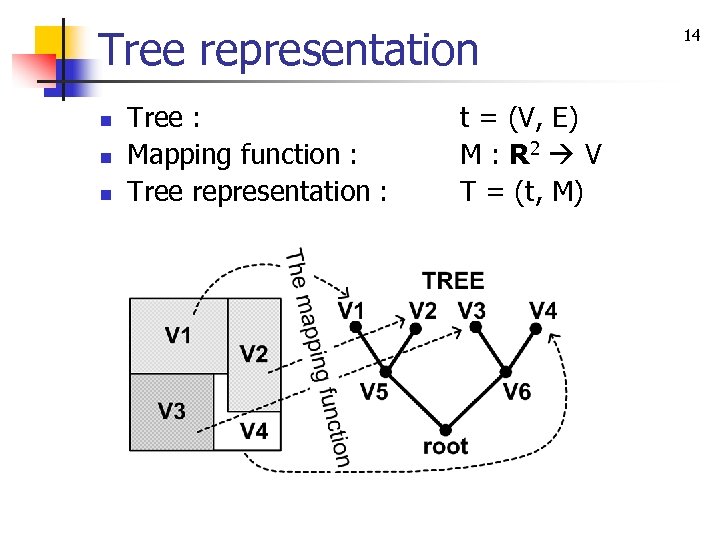 Tree representation n Tree : Mapping function : Tree representation : t = (V, E) M : R 2 V T = (t, M) 14
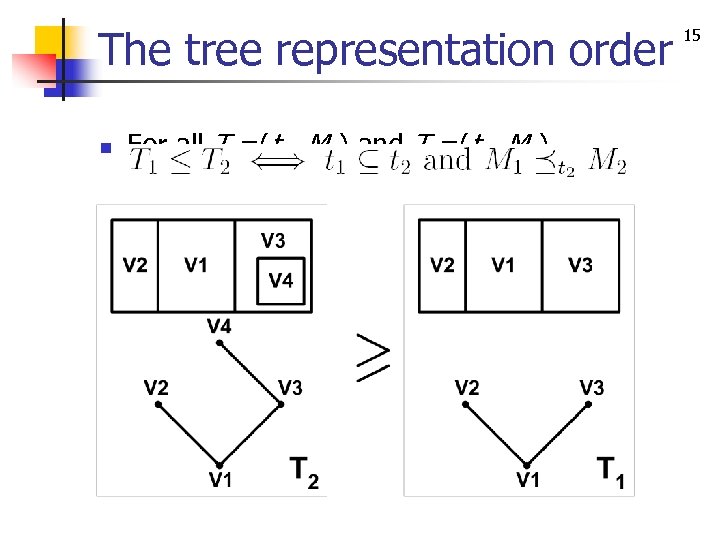 The tree representation order n For all T 1=(t 1, M 1) and T 2=(t 2, M 2) 15
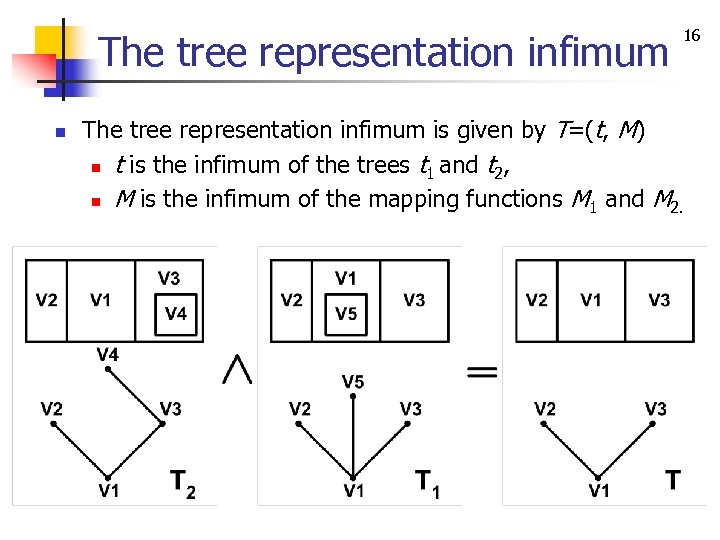 The tree representation infimum n 16 The tree representation infimum is given by T=(t, M) n t is the infimum of the trees t 1 and t 2, n M is the infimum of the mapping functions M 1 and M 2.
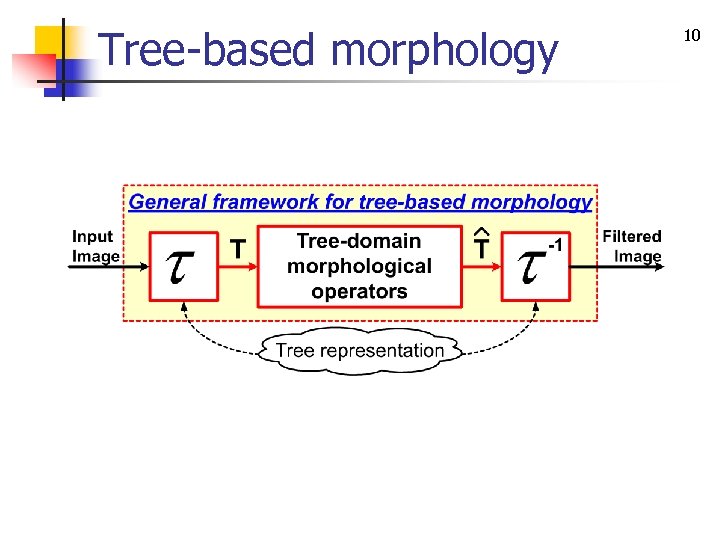
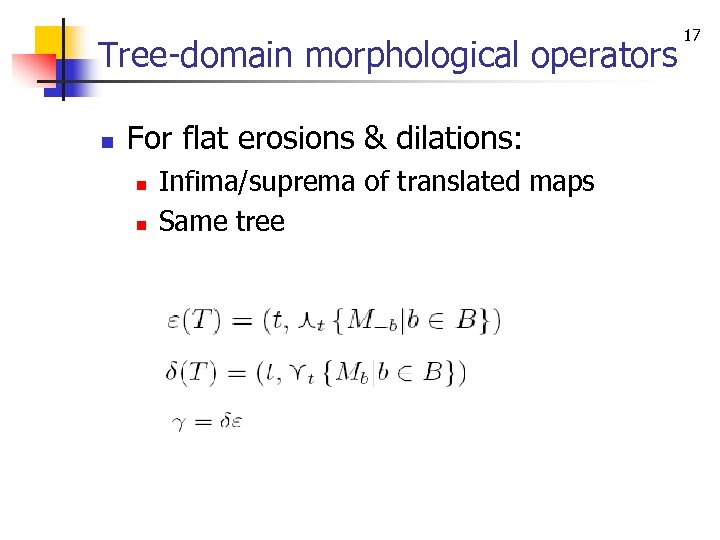 Tree-domain morphological operators n For flat erosions & dilations: n n Infima/suprema of translated maps Same tree 17
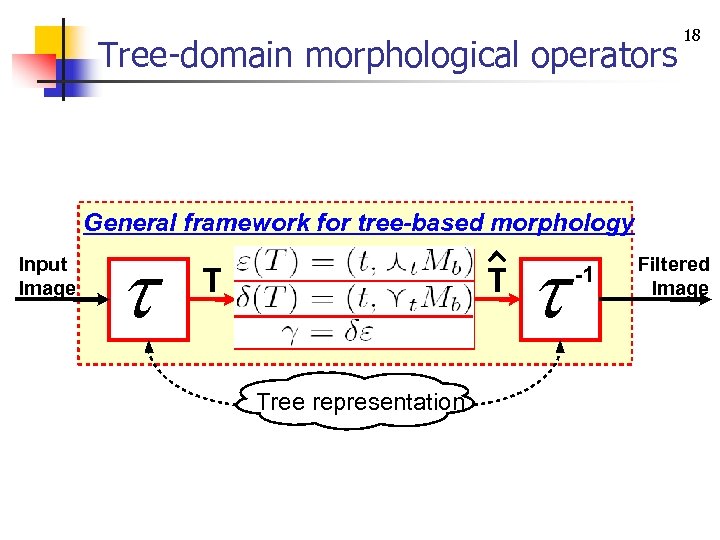 Tree-domain morphological operators 18 General framework for tree-based morphology Input Image t T T Tree representation t -1 Filtered Image
 Semilattice of images n 19 What we would like to have: A semilattice of images, associated to each tree transform n n The order of tree representation induces an order for images However, the inf-semilattice of tree representations does not necessarily induce an inf-semilattice of images For some trees (e. g. , the tree of shapes) an image semilattice is obtained For which trees we get an induced image semilattice? Issue under investigation
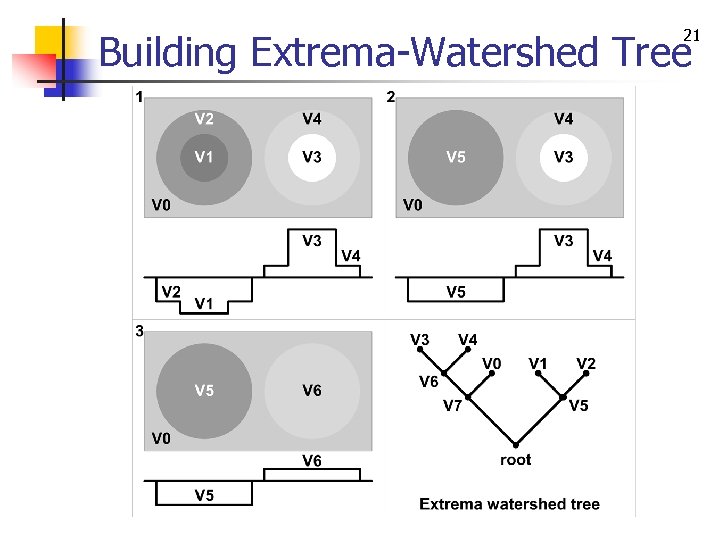
 Extrema-Watershed Tree n n 20 Example of new operators, obtained from the general framework Based on new self-dual treerepresentation, called Extrema-Watershed Tree (EWT). n n The tree is built by merging the flat zones. Smallest extrema (dark or bright) regions are merged in every step.
 21 Building Extrema-Watershed Tree
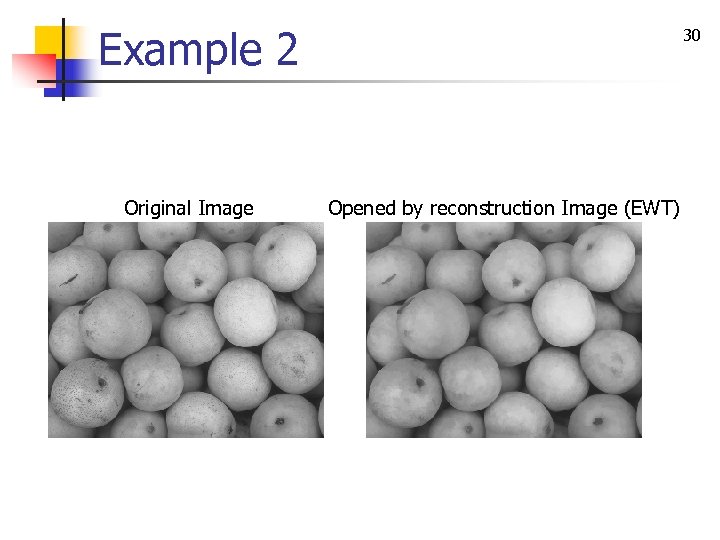
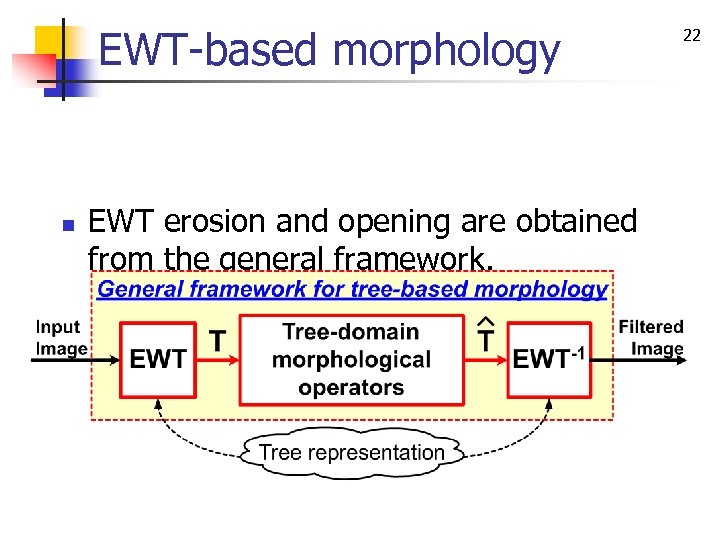 EWT-based morphology n EWT erosion and opening are obtained from the general framework. 22
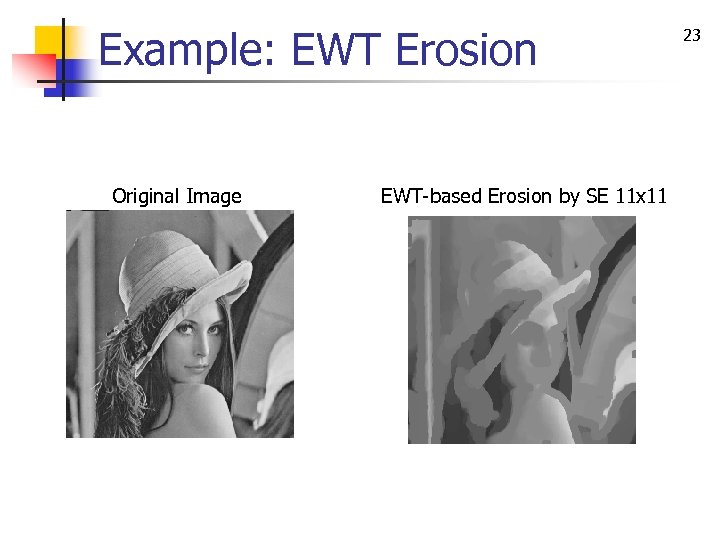 Example: EWT Erosion Original Image EWT-based Erosion by SE 11 x 11 23
 Properties of EWT n n Self-dual Implicit hierarchical decomposition n n Tree is created in watershed-like process Small area extrema are leaves Bigger flat zones are close to root Vertices connected in the tree usually have similar gray levels 24
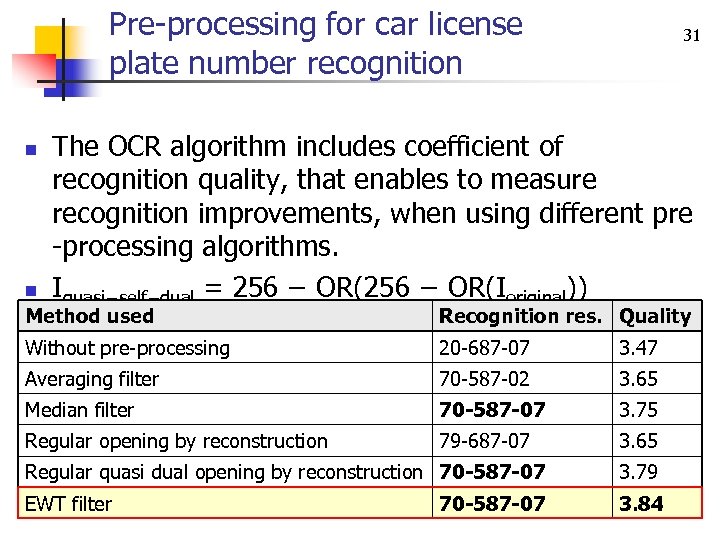
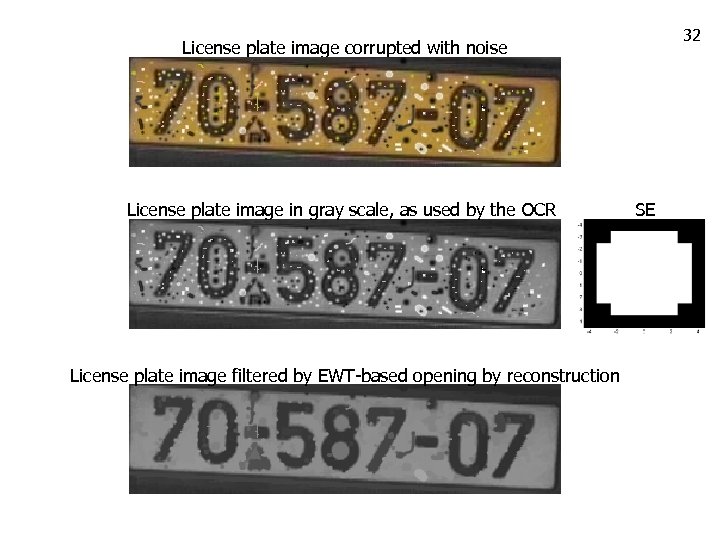
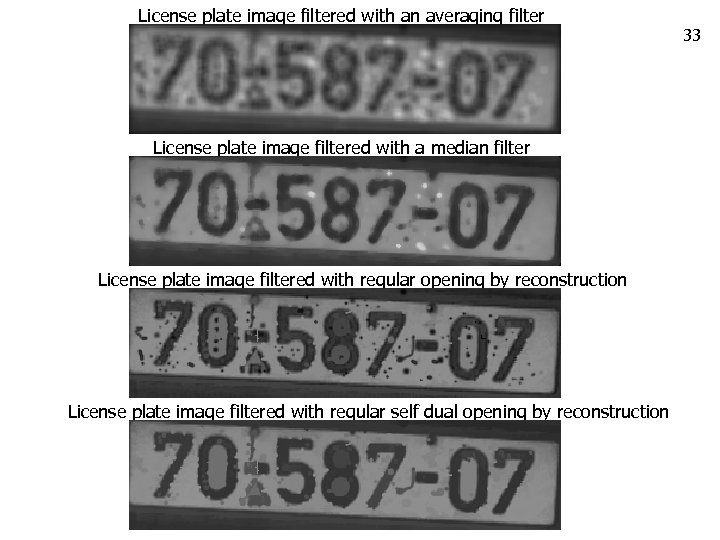
 Applications n Self-dual morphological preprocessing. Non-connected de-noising. n Opening by reconstruction: n n Pre-processing for car license plate number recognition Initial step for dust and scratch removal Potential for segmentation. 25
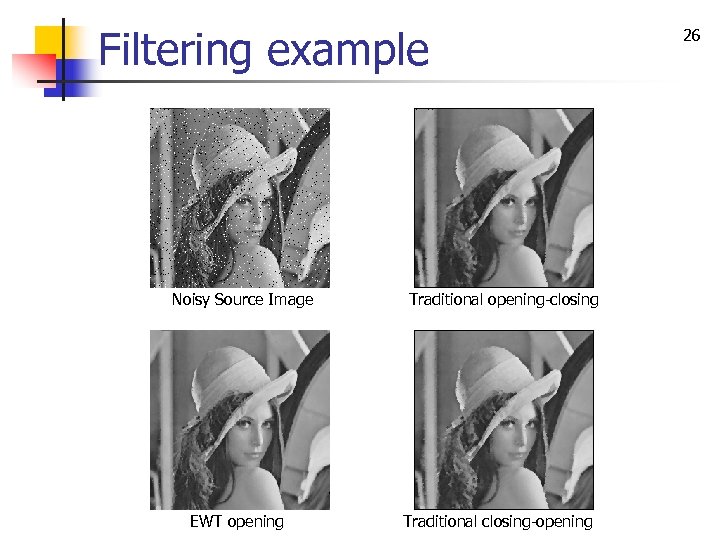 Filtering example Noisy Source Image EWT opening Traditional opening-closing Traditional closing-opening 26
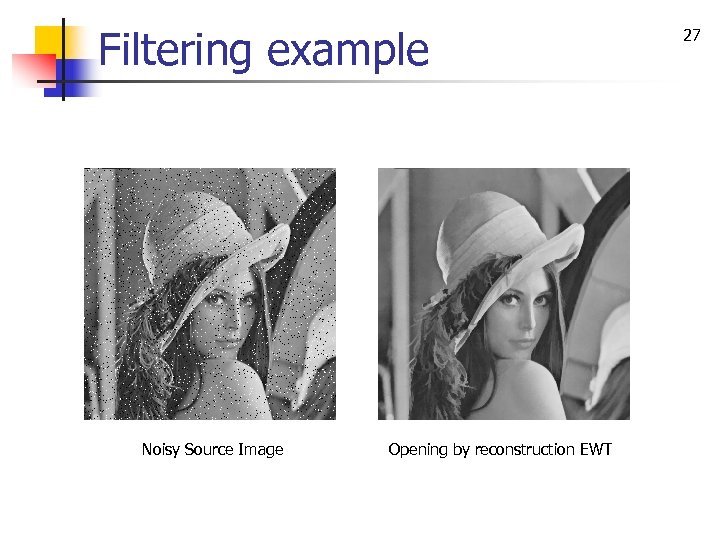 Filtering example Noisy Source Image Opening by reconstruction EWT 27
 Conclusions n We presented a general framework for treebased morphological image processing n n n 28 Given a tree representation, corresponding morphological operators are obtained Based on a complete inf-semilattices of tree representations Particular case n n Self-dual morphology based on a new tree – EWT Some applications are presented
 Thank you! 29
 Example 2 Original Image 30 Opened by reconstruction Image (EWT)
 Pre-processing for car license plate number recognition n n 31 The OCR algorithm includes coefficient of recognition quality, that enables to measure recognition improvements, when using different pre -processing algorithms. Iquasi−self−dual = 256 − OR(Ioriginal)) Method used Recognition res. Quality Without pre-processing 20 -687 -07 3. 47 Averaging filter 70 -587 -02 3. 65 Median filter 70 -587 -07 3. 75 Regular opening by reconstruction 79 -687 -07 3. 65 Regular quasi dual opening by reconstruction 70 -587 -07 3. 79 EWT filter 3. 84 70 -587 -07
 32 License plate image corrupted with noise License plate image in gray scale, as used by the OCR License plate image filtered by EWT-based opening by reconstruction SE
 License plate image filtered with an averaging filter License plate image filtered with a median filter License plate image filtered with regular opening by reconstruction License plate image filtered with regular self dual opening by reconstruction 33
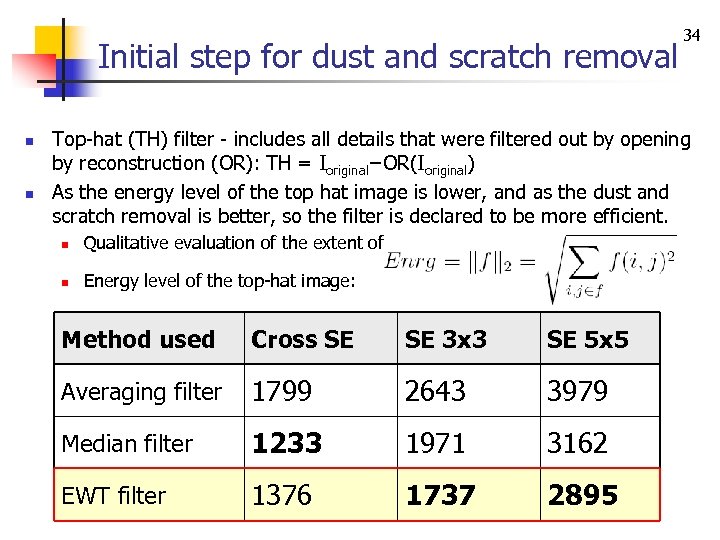 Initial step for dust and scratch removal n n 34 Top-hat (TH) filter - includes all details that were filtered out by opening by reconstruction (OR): TH = Ioriginal−OR(Ioriginal) As the energy level of the top hat image is lower, and as the dust and scratch removal is better, so the filter is declared to be more efficient. n Qualitative evaluation of the extent of dust and scratch removal n Energy level of the top-hat image: Method used Cross SE SE 3 x 3 SE 5 x 5 Averaging filter 1799 2643 3979 Median filter 1233 1971 3162 EWT filter 1376 1737 2895
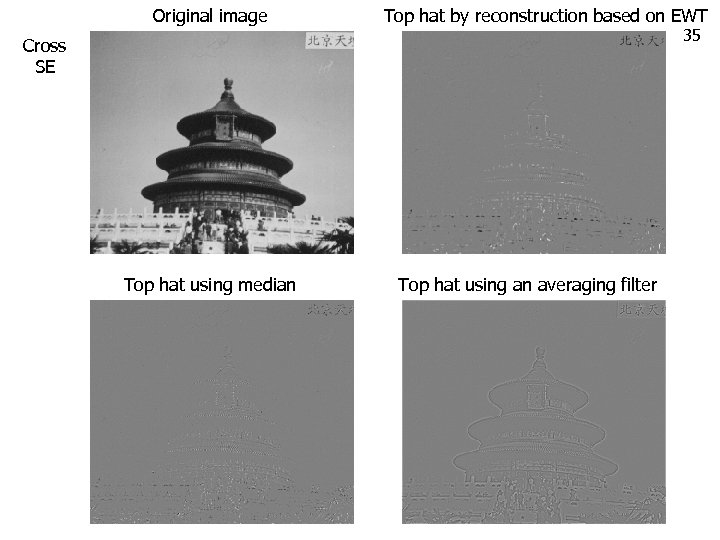 Original image Top hat by reconstruction based on EWT 35 Cross SE Top hat using median Top hat using an averaging filter
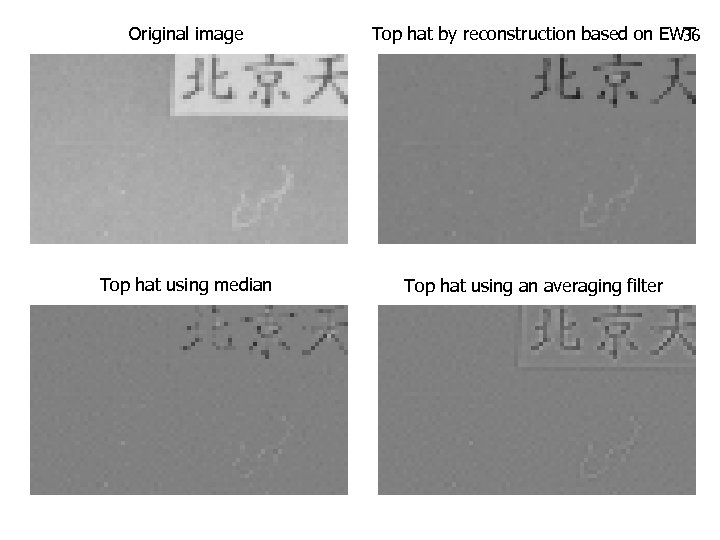 Original image Top hat by reconstruction based on EWT 36 Top hat using median Top hat using an averaging filter
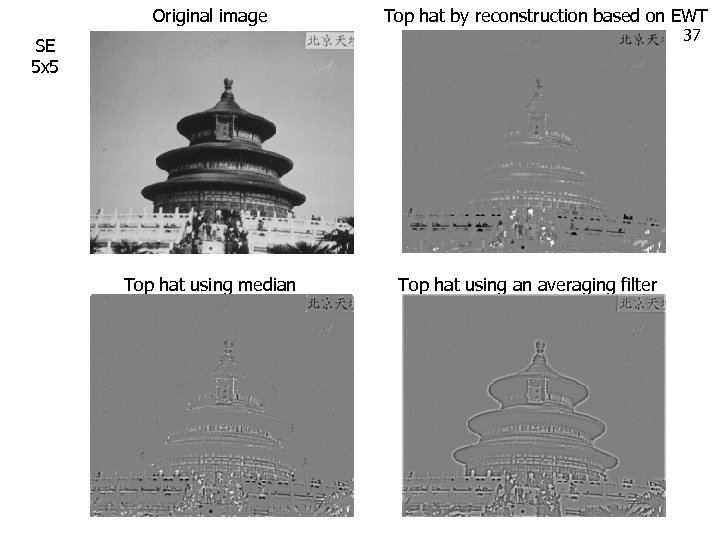 Original image Top hat by reconstruction based on EWT 37 SE 5 x 5 Top hat using median Top hat using an averaging filter
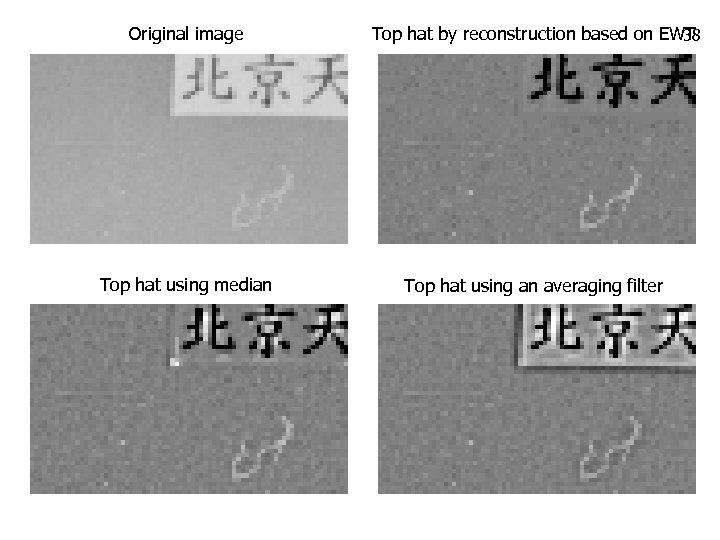 Original image Top hat by reconstruction based on EWT 38 Top hat using median Top hat using an averaging filter
 Further research topics n Finding necessary conditions for tree representation n n More applications based on general framework. n n n To assure existence of images semilattice, induced by trees semilattice. Developing more useful tree representations Further exploration of segmentation capability using trenches Real time implementation of the proposed algorithms. 39
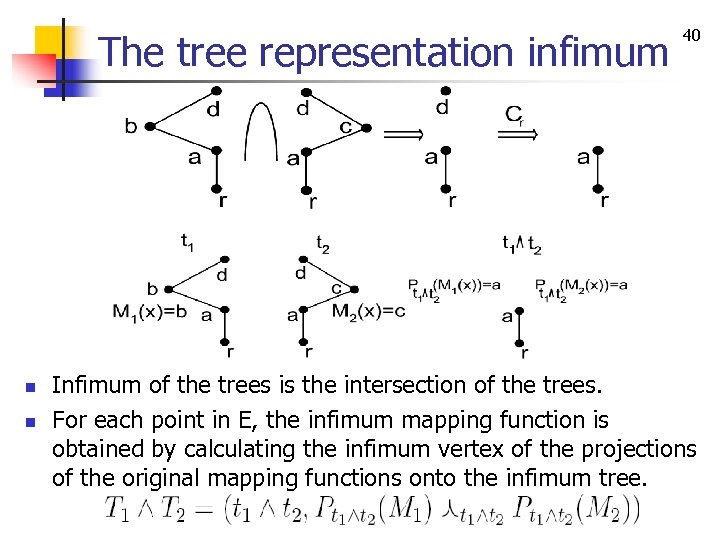 The tree representation infimum n n 40 Infimum of the trees is the intersection of the trees. For each point in E, the infimum mapping function is obtained by calculating the infimum vertex of the projections of the original mapping functions onto the infimum tree.
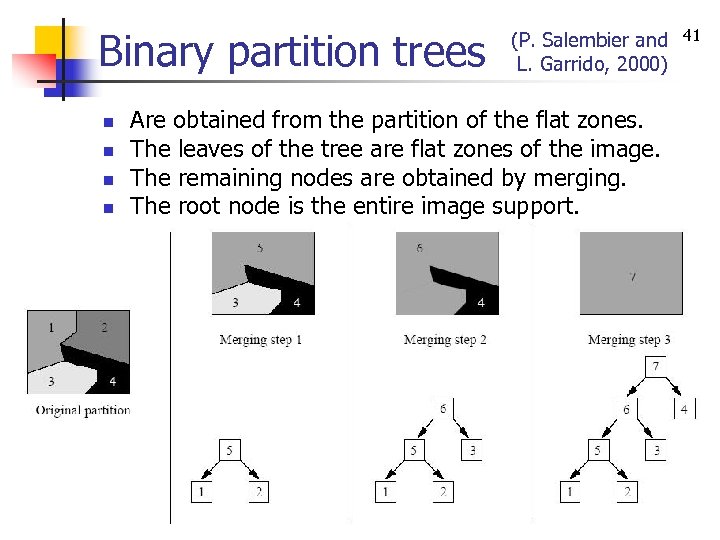 Binary partition trees n n (P. Salembier and L. Garrido, 2000) Are obtained from the partition of the flat zones. The leaves of the tree are flat zones of the image. The remaining nodes are obtained by merging. The root node is the entire image support. 41
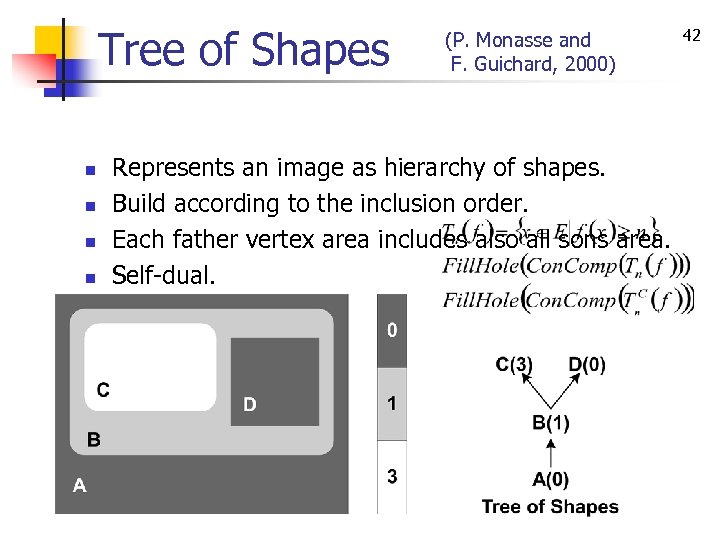 Tree of Shapes n n (P. Monasse and F. Guichard, 2000) Represents an image as hierarchy of shapes. Build according to the inclusion order. Each father vertex area includes also all sons area. Self-dual. 42