


 Скачать презентацию Technician Licensing Class These Power Point presentations are
9fbab81c89b52d53fd480deb419576b5.ppt
- Количество слайдов: 25
 Technician Licensing Class These Power Point presentations are available to individuals who register with The W 5 YI Group’s Ham. Instructor. com program. The presentations are provided by Master Publishing and The W 5 YI Group and include material that is covered by U. S. and International copyrights. They are intended solely for the use of Registered Instructors using the Gordon West, WB 6 NOA, Technician Class, General Class, and Extra Class study manuals to teach FCC Amateur Radio Licensing Classes. Registration through Ham. Instructor. com constitutes a Licensing Agreement between The W 5 YI Group and the registered instructor under which the instructor agrees not to copy or distribute the Power Point presentations to unauthorized users. 1
 Technician Licensing Class Your First Radio Valid July 1, 2014 Through June 30, 2018 2
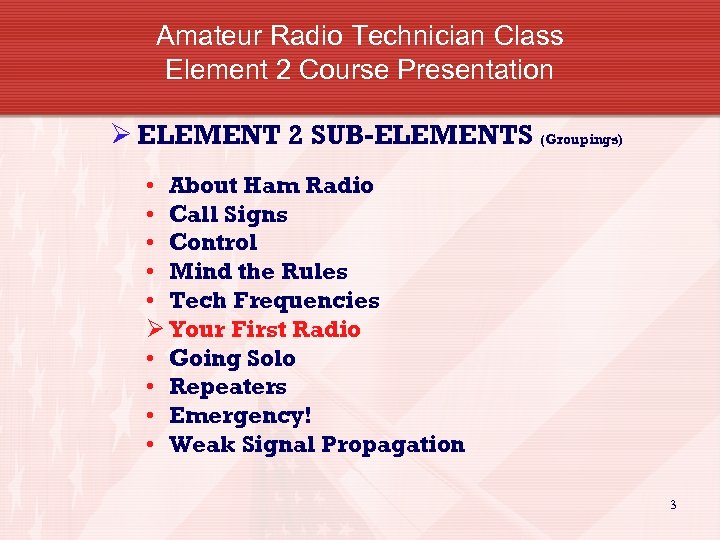 Amateur Radio Technician Class Element 2 Course Presentation Ø ELEMENT 2 SUB-ELEMENTS (Groupings) • About Ham Radio • Call Signs • Control • Mind the Rules • Tech Frequencies Ø Your First Radio • Going Solo • Repeaters • Emergency! • Weak Signal Propagation 3
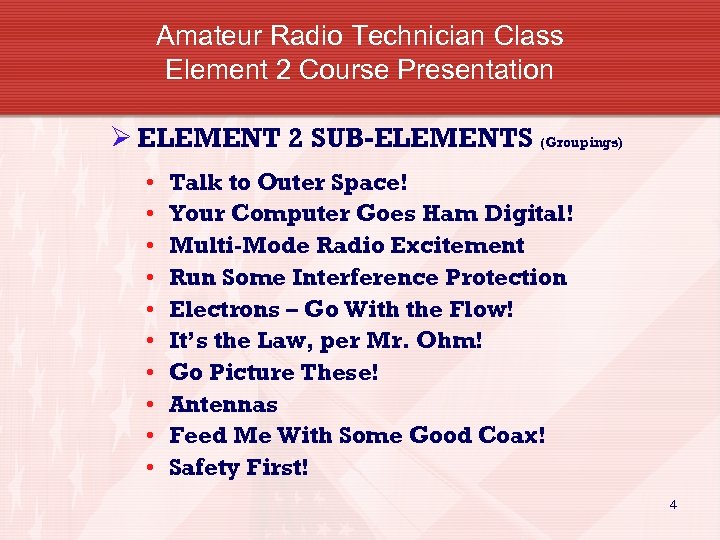 Amateur Radio Technician Class Element 2 Course Presentation Ø ELEMENT 2 SUB-ELEMENTS (Groupings) • • • Talk to Outer Space! Your Computer Goes Ham Digital! Multi-Mode Radio Excitement Run Some Interference Protection Electrons – Go With the Flow! It’s the Law, per Mr. Ohm! Go Picture These! Antennas Feed Me With Some Good Coax! Safety First! 4
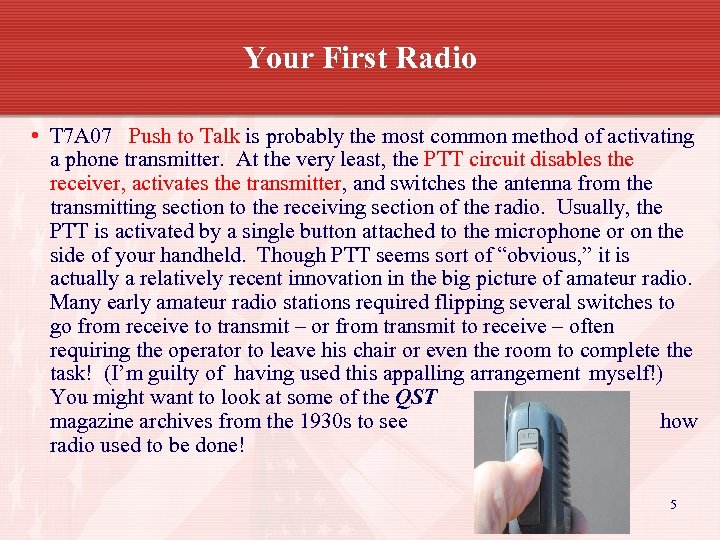 Your First Radio • T 7 A 07 Push to Talk is probably the most common method of activating a phone transmitter. At the very least, the PTT circuit disables the receiver, activates the transmitter, and switches the antenna from the transmitting section to the receiving section of the radio. Usually, the PTT is activated by a single button attached to the microphone or on the side of your handheld. Though PTT seems sort of “obvious, ” it is actually a relatively recent innovation in the big picture of amateur radio. Many early amateur radio stations required flipping several switches to go from receive to transmit – or from transmit to receive – often requiring the operator to leave his chair or even the room to complete the task! (I’m guilty of having used this appalling arrangement myself!) You might want to look at some of the QST magazine archives from the 1930 s to see how radio used to be done! 5
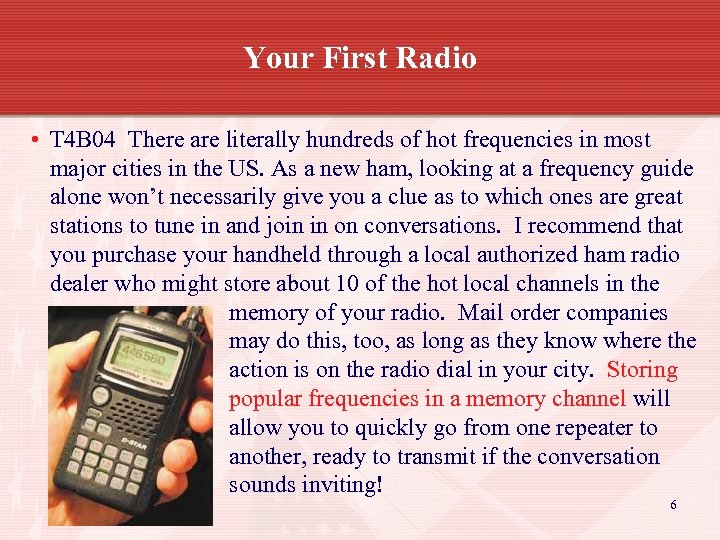 Your First Radio • T 4 B 04 There are literally hundreds of hot frequencies in most major cities in the US. As a new ham, looking at a frequency guide alone won’t necessarily give you a clue as to which ones are great stations to tune in and join in on conversations. I recommend that you purchase your handheld through a local authorized ham radio dealer who might store about 10 of the hot local channels in the memory of your radio. Mail order companies may do this, too, as long as they know where the action is on the radio dial in your city. Storing popular frequencies in a memory channel will allow you to quickly go from one repeater to another, ready to transmit if the conversation sounds inviting! 6
 Your First Radio • T 9 A 04 When you open up the box containing your new dual-band handheld, you’ll find a small “wall wart” battery charger, the rechargeable battery pack or a battery tray, an instruction manual, and the famous “rubber duck” antenna. This antenna is the bare minimum in getting a good signal out on the airwaves. It’s okay for transmitting simplex, direct from you to a buddy a mile away, but for reaching out to a repeater more than 5 miles away, the stock, factory-supplied rubber duck antenna is a compromise and is not as effective as a full sized antenna. (It’s approximately as effective as a full-sized dummy load). When you buy your new dual-band handheld, consider one of those flexible, 15 -inch, dualband antennas. It will do well out in the open. And for vehicle use, consider a magnetic-mount antenna as well. That magnetic-mount vehicle antenna comes with coax cable, and you need to be sure to get the right connector on the end of the cable that will screw or twist on to your new handheld. The vehicle antenna is full-sized, 7 but the rubber duck is not!
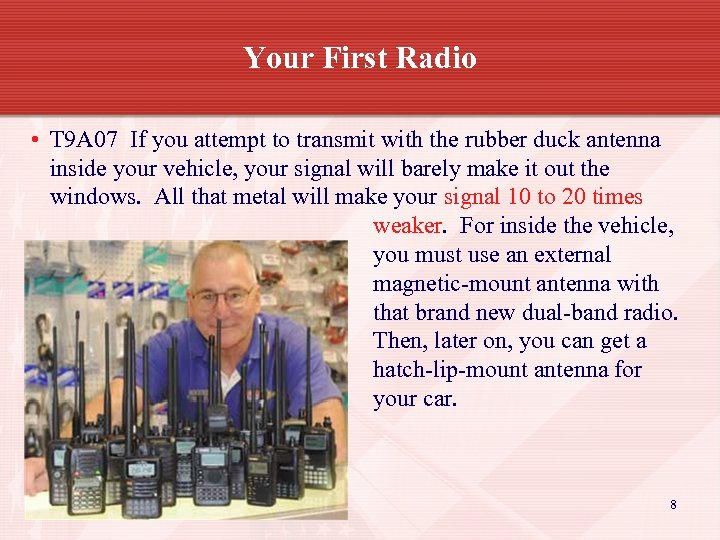 Your First Radio • T 9 A 07 If you attempt to transmit with the rubber duck antenna inside your vehicle, your signal will barely make it out the windows. All that metal will make your signal 10 to 20 times weaker. For inside the vehicle, you must use an external magnetic-mount antenna with that brand new dual-band radio. Then, later on, you can get a hatch-lip-mount antenna for your car. 8
 Your First Radio • T 7 A 10 As a new Technician Class operator, you’ll probably choose a dual-band handheld as your first radio. You can run this in your vehicle using an outside antenna with a magnetic mount and achieve great results! I would also suggest a filtered DC adaptor plug and a headset speaker/mic, too. If you really need more than the 5 watts of power that comes out of the handheld, you also could purchase an RF power amplifier that would boost the 5 watts to up to 100 watts power output. But I think you’ll find the outside antenna may be all you need for successful handheld operation from inside your vehicle. Antenna improvements should always be considered before increasing power, as they will also increase your receiving performance. And remember, you only pay for an antenna once, with a high power amplifier, you pay for it every time you turn it on! 9
 Your First Radio • T 8 A 04 We use frequency modulation (FM) on most VHF and UHF repeaters. • T 8 A 09 When we operate our 2 -meter, 1 -1/4 -meter, and 70 cm handheld using frequency modulation, the FM signal is between 10 and 15 k. Hz wide. With properly-adjusted equipment, 10 k. Hz total FM bandwidth is about normal. 10
 Your First Radio • T 2 B 05 How wide will your FM signal be on the air? That’s determined by the amplitude (height) of your modulating signal – your voice. The amplitude of the modulating signal is determined by how strongly you are speaking into your transceiver, which will determine the amount of carrier deviation. Sounds complicated, but after a while you’ll discover that you need to “close talk” your radio microphone or dual band handheld in order to get the proper amount of amplitude for your modulating signal. 11
 Your First Radio • T 2 B 06 You’re going to hear about areas of the US where all repeaters have been “narrow banded, ” allowing a modulation deviation of no greater than plus or minus 2. 5 k. Hz. If you run regular deviation, plus or minus 5 k. Hz, this will occupy too much bandwidth and that local narrow band repeater will not properly pass your transmitted signal, unless you speak very softly! • T 8 A 02 The majority of VHF and UHF communications uses frequency modulation, FM. This is the same mode that we use for VHF data packet communications, too, FM. 12
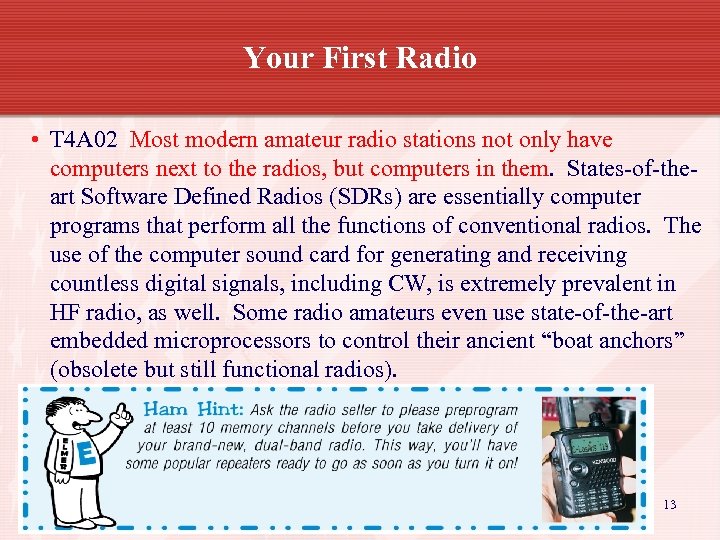 Your First Radio • T 4 A 02 Most modern amateur radio stations not only have computers next to the radios, but computers in them. States-of-theart Software Defined Radios (SDRs) are essentially computer programs that perform all the functions of conventional radios. The use of the computer sound card for generating and receiving countless digital signals, including CW, is extremely prevalent in HF radio, as well. Some radio amateurs even use state-of-the-art embedded microprocessors to control their ancient “boat anchors” (obsolete but still functional radios). 13
 Element 2 Technician Class Question Pool Your First Radio Valid July 1, 2014 Through June 30, 2018 14
 T 7 A 07 What is meant by the term “PTT”? A. Pre-transmission tuning to reduce transmitter harmonic emission B. Precise tone transmissions used to limit repeater access to only certain signals C. A primary transformer tuner use to match antennas D. The push to talk function which switches between receive and transmit 15
 T 4 B 04 What is a way to enable quick access to a favorite frequency on your transceiver? A. Enable the CTCSS tones B. Store the frequency in a memory channel C. Disable the CTCSS tones D. Use the scan mode to select the desired frequency 16
 T 9 A 04 What is a disadvantage of the "rubber duck" antenna supplied with most handheld radio transceivers? A. It does not transmit or receive as effectively as a full-sized antenna B. It transmits a circularly polarized signal C. If the rubber end cap is lost it will unravel very quickly D. All of these choices are correct 17
 T 9 A 07 What is a good reason not to use a "rubber duck" antenna inside your car? A. Signals can be significantly weaker than when it is outside of the vehicle B. It might cause your radio to overheat C. The SWR might decrease, decreasing the signal strength D. All of these choices are correct 18
 T 7 A 10 What device increases the low-power output from a handheld transceiver? A. B. C. D. A voltage divider An RF power amplifier An impedance network All of these choices is correct 19
 T 8 A 04 Which type of modulation is most commonly used for VHF and UHF voice repeaters? A. B. C. D. AM SSB PSK FM 20
 T 8 A 09 What is the approximate bandwidth of a VHF repeater FM phone signal? A. B. C. D. Less than 500 Hz About 150 k. Hz Between 10 and 15 k. Hz Between 50 and 125 k. Hz 21
 T 2 B 05 What determines the amount of deviation of an FM (as opposed to PM) signal? A. Both the frequency and amplitude of the modulating signal B. The frequency of the modulating signal C. The amplitude of the modulating signal D. The relative phase of the modulating signal and the carrier 22
 T 2 B 06 What happens when the deviation of an FM transmitter is increased? A. B. C. D. Its signal occupies more bandwidth Its output power increases Its output power and bandwidth increases Asymmetric modulation occurs 23
 T 8 A 02 What type of modulation is most commonly used for VHF packet radio transmissions? A. B. C. D. FM SSB AM Spread Spectrum 24
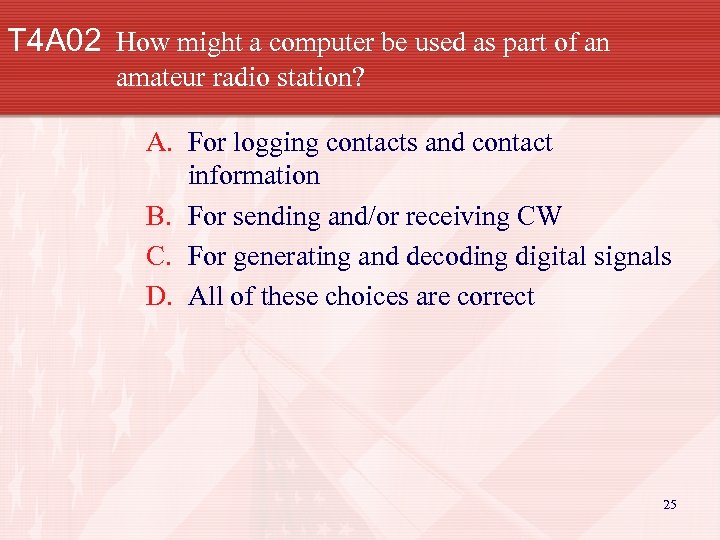 T 4 A 02 How might a computer be used as part of an amateur radio station? A. For logging contacts and contact information B. For sending and/or receiving CW C. For generating and decoding digital signals D. All of these choices are correct 25