


 Скачать презентацию Technician Licensing Class These Power Point presentations are
de0ae19f05560a27b7d140860a592f94.ppt
- Количество слайдов: 55
 Technician Licensing Class These Power Point presentations are available to individuals who register with The W 5 YI Group’s Ham. Instructor. com program. The presentations are provided by Master Publishing and The W 5 YI Group and include material that is covered by U. S. and International copyrights. They are intended solely for the use of Registered Instructors using the Gordon West, WB 6 NOA, Technician Class, General Class, and Extra Class study manuals to teach FCC Amateur Radio Licensing Classes. Registration through Ham. Instructor. com constitutes a Licensing Agreement between The W 5 YI Group and the registered instructor under which the instructor agrees not to copy or distribute the Power Point presentations to unauthorized users. 1
 Technician Licensing Class Feed Me With Some Good Coax! Valid July 1, 2014 Through June 30, 2018 2
 Amateur Radio Technician Class Element 2 Course Presentation Ø ELEMENT 2 SUB-ELEMENTS (Groupings) • • • About Ham Radio Call Signs Control Mind the Rules Tech Frequencies Your First Radio Going On The Air! Repeaters Emergency! Weak Signal Propagation 3
 Amateur Radio Technician Class Element 2 Course Presentation Ø ELEMENT 2 SUB-ELEMENTS (Groupings) • Talk to Outer Space! • Your Computer Goes Ham Digital! • Multi-Mode Radio Excitement • Run Some Interference Protection • Electrons – Go With the Flow! • It’s the Law, per Mr. Ohm! • Go Picture These! • Antennas Ø Feed Me With Some Good Coax! • Safety First! 4
 Feed Me With Some Good Coax! • T 7 C 12 Think of coaxial cable much like a garden hose – it takes the pressure from the water company, keeps it confined down the tube, and squirts it out the other end! Same thing with coaxial cable – it carries your transmitted RF signal from your radio and delivers it to the antenna. It also takes signals coming in from the antenna and delivers them to your radio – hopefully without leaks! 5
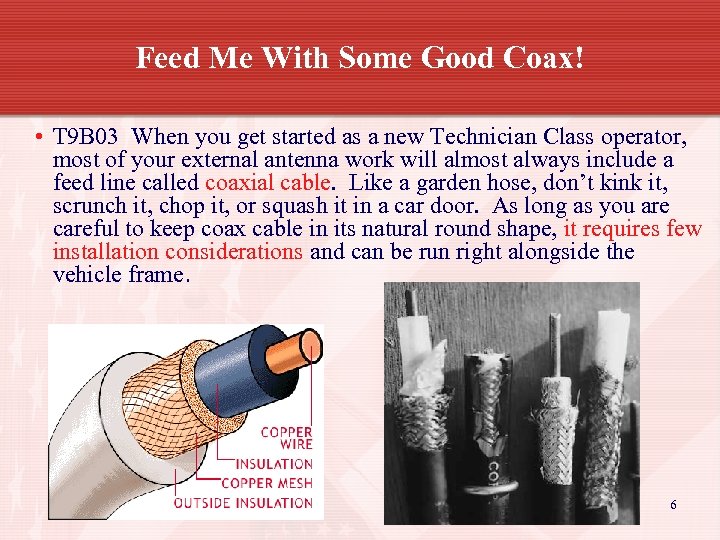 Feed Me With Some Good Coax! • T 9 B 03 When you get started as a new Technician Class operator, most of your external antenna work will almost always include a feed line called coaxial cable. Like a garden hose, don’t kink it, scrunch it, chop it, or squash it in a car door. As long as you are careful to keep coax cable in its natural round shape, it requires few installation considerations and can be run right alongside the vehicle frame. 6
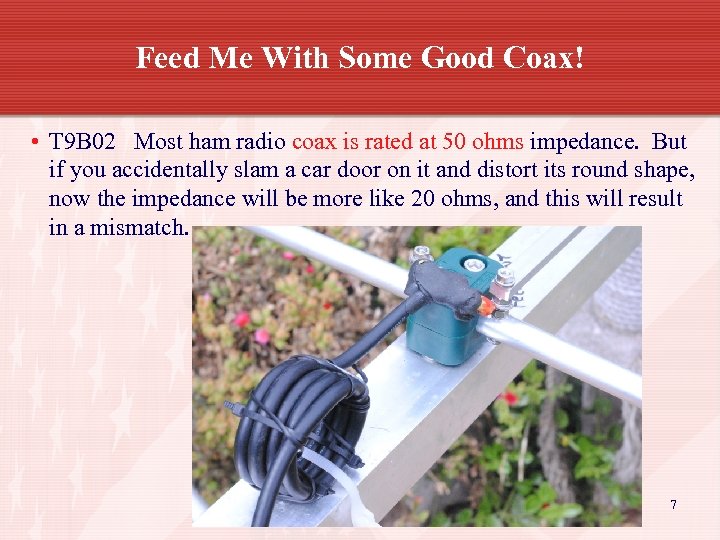 Feed Me With Some Good Coax! • T 9 B 02 Most ham radio coax is rated at 50 ohms impedance. But if you accidentally slam a car door on it and distort its round shape, now the impedance will be more like 20 ohms, and this will result in a mismatch. 7
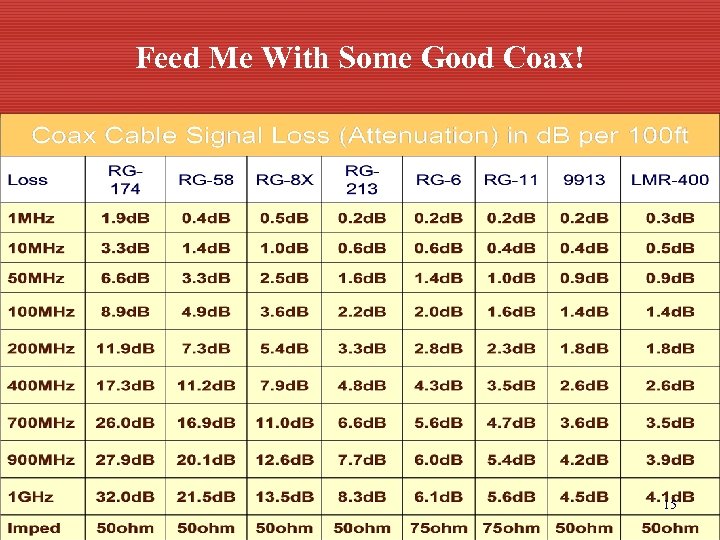
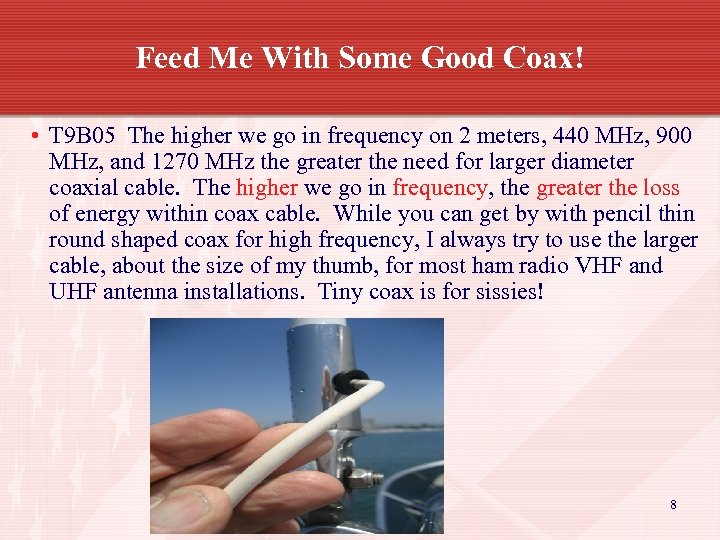 Feed Me With Some Good Coax! • T 9 B 05 The higher we go in frequency on 2 meters, 440 MHz, 900 MHz, and 1270 MHz the greater the need for larger diameter coaxial cable. The higher we go in frequency, the greater the loss of energy within coax cable. While you can get by with pencil thin round shaped coax for high frequency, I always try to use the larger cable, about the size of my thumb, for most ham radio VHF and UHF antenna installations. Tiny coax is for sissies! 8
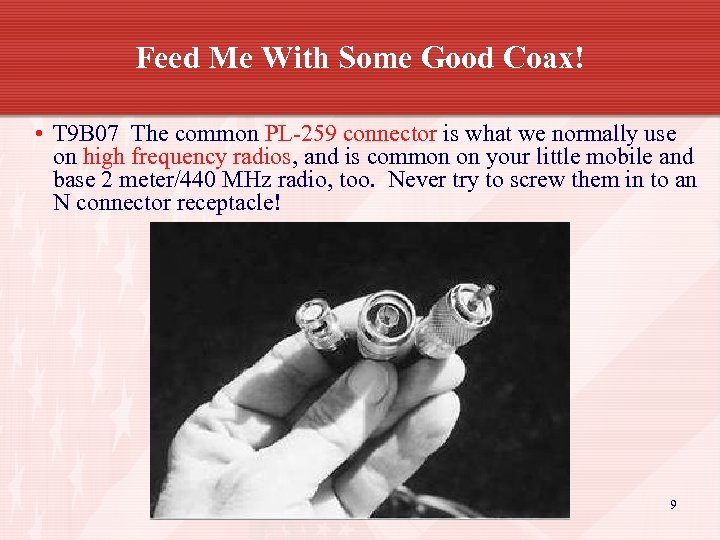 Feed Me With Some Good Coax! • T 9 B 07 The common PL-259 connector is what we normally use on high frequency radios, and is common on your little mobile and base 2 meter/440 MHz radio, too. Never try to screw them in to an N connector receptacle! 9
 Feed Me With Some Good Coax! • T 9 B 06 If you plan to operate above 400 MHz, such as working satellites on 70 cm, or at 1270 MHz, the antennas will usually accept only a type N connector. If you try to screw in a common PL-259 connector to a type N receiver, you will damage the antenna connection for life. Always look carefully to make sure you know the difference between the type N connector and the more common PL-259. Always use Type N above 400 MHz! 10
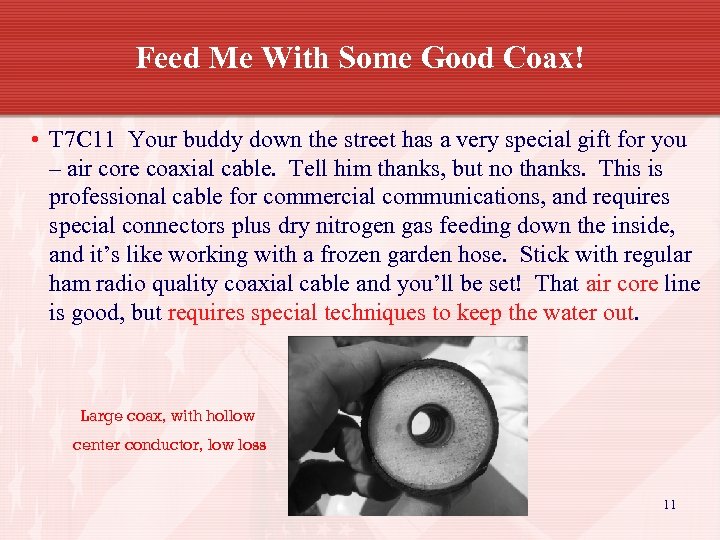 Feed Me With Some Good Coax! • T 7 C 11 Your buddy down the street has a very special gift for you – air core coaxial cable. Tell him thanks, but no thanks. This is professional cable for commercial communications, and requires special connectors plus dry nitrogen gas feeding down the inside, and it’s like working with a frozen garden hose. Stick with regular ham radio quality coaxial cable and you’ll be set! That air core line is good, but requires special techniques to keep the water out. Large coax, with hollow center conductor, low loss 11
 Feed Me With Some Good Coax! • T 7 C 09 Moisture getting into coax cable is the number one cause of a lousy signal on the air. Keep your coax dry. Always seal exposed coaxial cable connectors up at the antenna feed point. Regular coax PL 259 connectors are not water-tight. • T 9 B 08 Ok, you have that brand new antenna on the roof, and you are wearing your safety glasses and hard hat for roof safety. Good job. Before you step back to admire your work, double check for the edge of the roof, and also double check that you have completely sealed that PL-259 connector with a gooey substance called Coax Seal. This will keep the water out and prevent feed line losses. 12
 Feed Me With Some Good Coax! • T 7 C 10 Always buy professional-grade coaxial cable. Quality coax has an outer jacket that will not break down in ultraviolet light from the Sun. If you try to use old CB radio coax, the jacket may already be breaking down, allowing moisture to enter the cable. You’ll be off the air in an instant when the next rain hits! 13
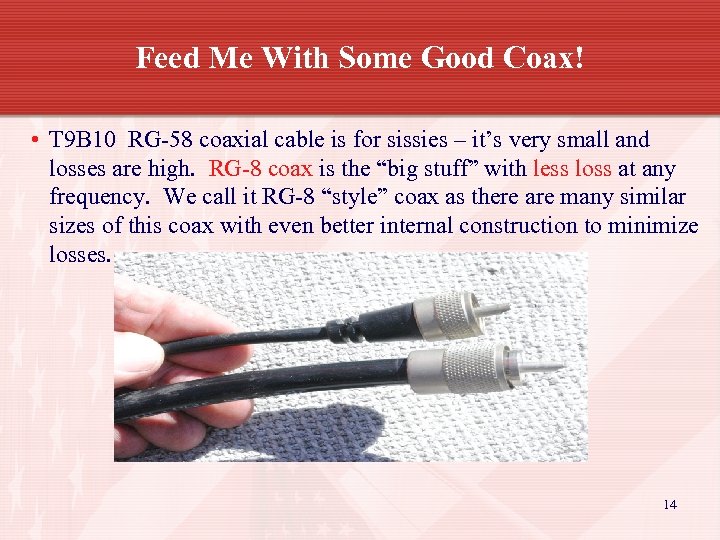 Feed Me With Some Good Coax! • T 9 B 10 RG-58 coaxial cable is for sissies – it’s very small and losses are high. RG-8 coax is the “big stuff” with less loss at any frequency. We call it RG-8 “style” coax as there are many similar sizes of this coax with even better internal construction to minimize losses. 14
 Feed Me With Some Good Coax! 15
 Feed Me With Some Good Coax! • T 9 B 11 If you’re getting real serious about operating with satellites – especially those in elliptical orbits thousands of miles out – you may wish to locate that guy down the street who had a spool of airinsulated hardline coax. Ask him for a hunk of it and let him do the connection, too. Air-insulated hardline is the ultra-ultra best for weak signal work on VHF and UHF, but requires a big deal in getting all the connectors properly soldered. 16
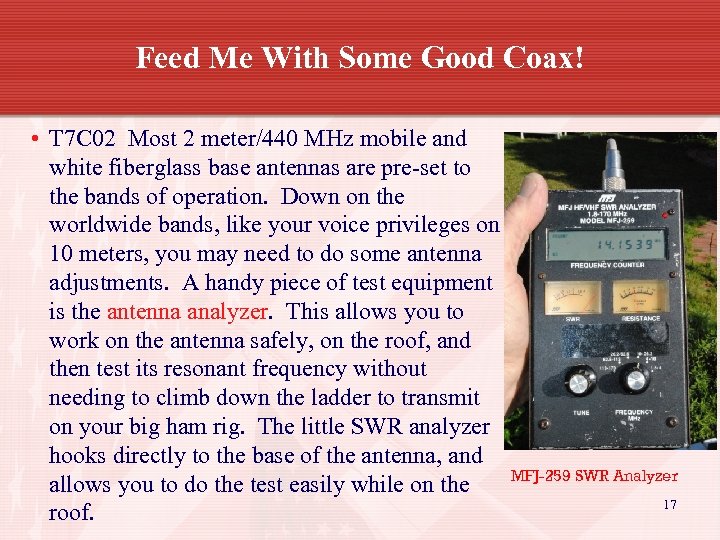 Feed Me With Some Good Coax! • T 7 C 02 Most 2 meter/440 MHz mobile and white fiberglass base antennas are pre-set to the bands of operation. Down on the worldwide bands, like your voice privileges on 10 meters, you may need to do some antenna adjustments. A handy piece of test equipment is the antenna analyzer. This allows you to work on the antenna safely, on the roof, and then test its resonant frequency without needing to climb down the ladder to transmit on your big ham rig. The little SWR analyzer hooks directly to the base of the antenna, and allows you to do the test easily while on the roof. MFJ-259 SWR Analyzer 17
 Feed Me With Some Good Coax! • T 7 C 03 If you decide to home brew your own antenna system, you’ll have fun! But you’ll need to obtain some additional test equipment, like a standing wave ratio (SWR) meter. This will allow you to test how well your antenna, which we call the load, is matched to the transmitter impedance as measured in your coax feed line. We would want both to be 50 ohms for a perfect 1: 1 impedance match. 18
 Feed Me With Some Good Coax! • T 4 A 05 In most situations, the SWR meter is most useful immediately after the transmitter, but before any antenna matching or tuning devices. The antenna tuner (if any), the transmission line, and the antenna proper form an antenna system, and the SWR meter is a good way to determine that the system is tuned and matched properly to the transmitter. However, there’s a lot more to antenna performance than SWR itself, and you should avoid “obsessing” about SWR as is common practice among newcomers and some “old timers” as well. 19
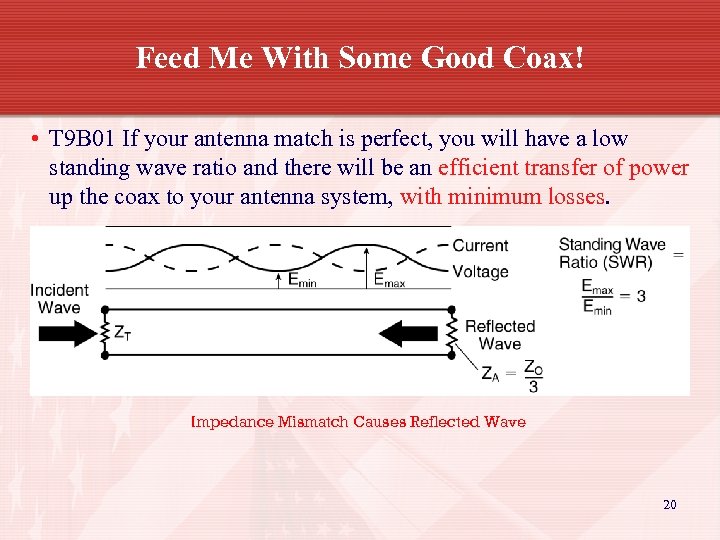 Feed Me With Some Good Coax! • T 9 B 01 If your antenna match is perfect, you will have a low standing wave ratio and there will be an efficient transfer of power up the coax to your antenna system, with minimum losses. Impedance Mismatch Causes Reflected Wave 20
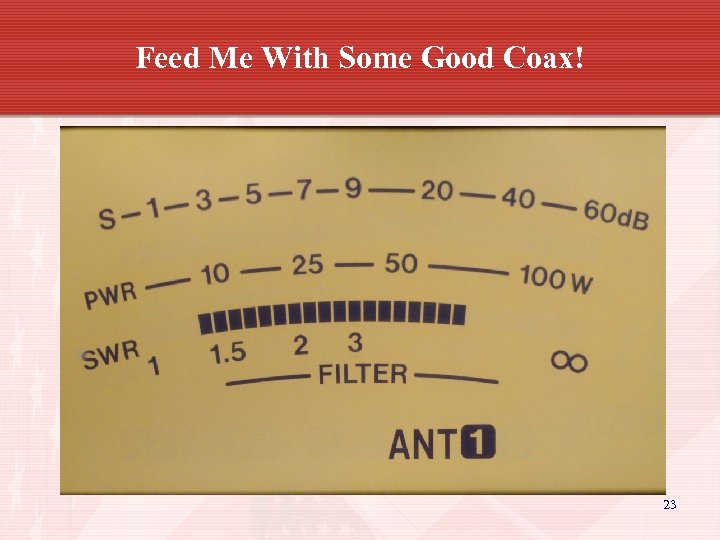
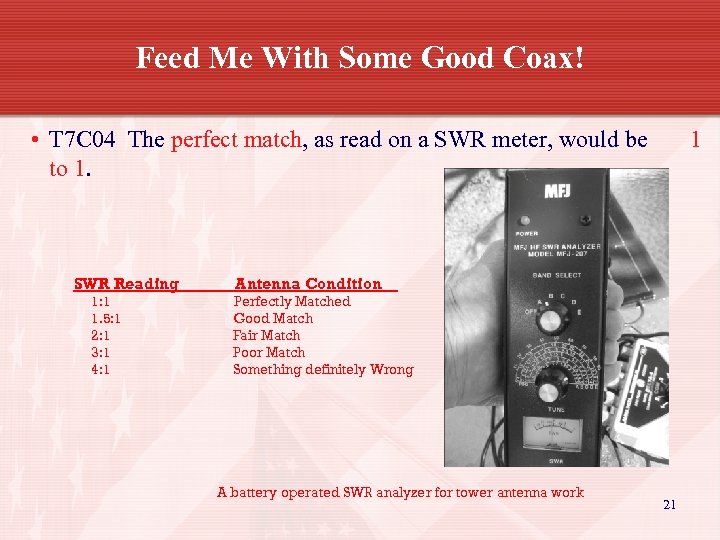 Feed Me With Some Good Coax! • T 7 C 04 The perfect match, as read on a SWR meter, would be to 1. SWR Reading 1: 1 1. 5: 1 2: 1 3: 1 4: 1 1 Antenna Condition Perfectly Matched Good Match Fair Match Poor Match Something definitely Wrong A battery operated SWR analyzer for tower antenna work 21
 Feed Me With Some Good Coax! • T 7 C 05 When you transmit into an external antenna with your handheld, you will notice that the radio chassis will get warm. This is normal on high power after about 45 seconds of transmitting. You would be cautioned never to use high power for continuous transmitting for more than a couple of minutes or else the unit gets very warm!! Handheld radios do not possess the circuitry to self-protect on overheat or high SWR. On a mobile single-band or dual-band radio, they, too, will begin to get warm on transmit; and if a bad antenna is detected with an elevated SWR, you will actually see the power output indicator on the mobile begin to “fold back. ” This “fold back” is automatic circuitry that limits power output to protect the solid-state transmitter device. It will normally reduce power with a SWR 22 higher than 2 to 1.
 Feed Me With Some Good Coax! 23
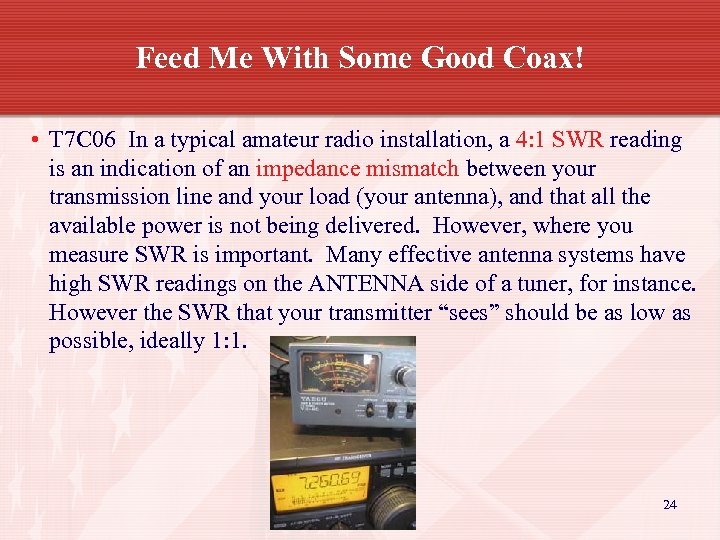 Feed Me With Some Good Coax! • T 7 C 06 In a typical amateur radio installation, a 4: 1 SWR reading is an indication of an impedance mismatch between your transmission line and your load (your antenna), and that all the available power is not being delivered. However, where you measure SWR is important. Many effective antenna systems have high SWR readings on the ANTENNA side of a tuner, for instance. However the SWR that your transmitter “sees” should be as low as possible, ideally 1: 1. 24
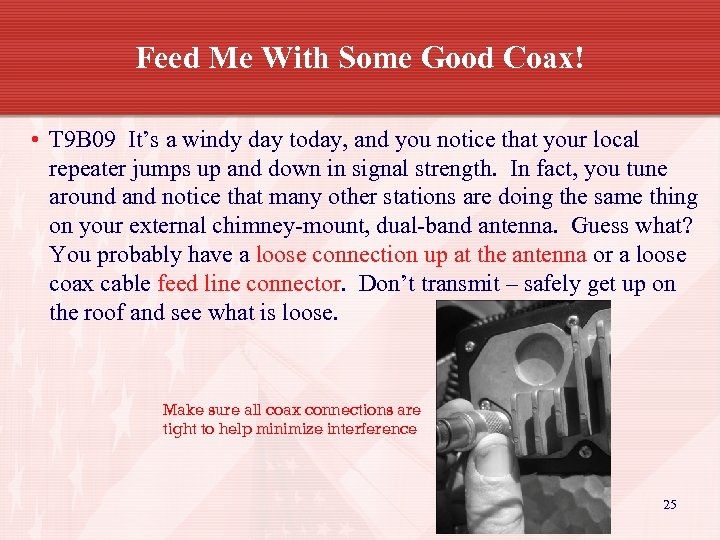 Feed Me With Some Good Coax! • T 9 B 09 It’s a windy day today, and you notice that your local repeater jumps up and down in signal strength. In fact, you tune around and notice that many other stations are doing the same thing on your external chimney-mount, dual-band antenna. Guess what? You probably have a loose connection up at the antenna or a loose coax cable feed line connector. Don’t transmit – safely get up on the roof and see what is loose. Make sure all coax connections are tight to help minimize interference 25
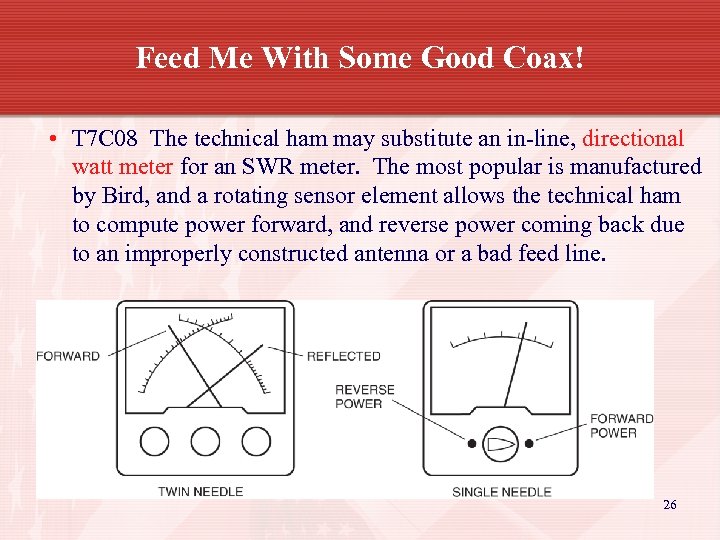 Feed Me With Some Good Coax! • T 7 C 08 The technical ham may substitute an in-line, directional watt meter for an SWR meter. The most popular is manufactured by Bird, and a rotating sensor element allows the technical ham to compute power forward, and reverse power coming back due to an improperly constructed antenna or a bad feed line. 26
 Feed Me With Some Good Coax! • T 7 C 07 If moisture creeps into an exposed coax cable connector in wet weather, some of your transmitted energy goes up into worthless heat at the connection point. Keep coaxial cable connectors covered, and make sure there is no nick in the outside jacket. • T 9 B 04 An antenna tuner will match your 6 - and 10 -meter transceiver to an antenna system that might not be perfectly tuned to the frequency on which you wish to operate. Antenna tuners are not normally found in 2 -meter/440 MHz systems. 27
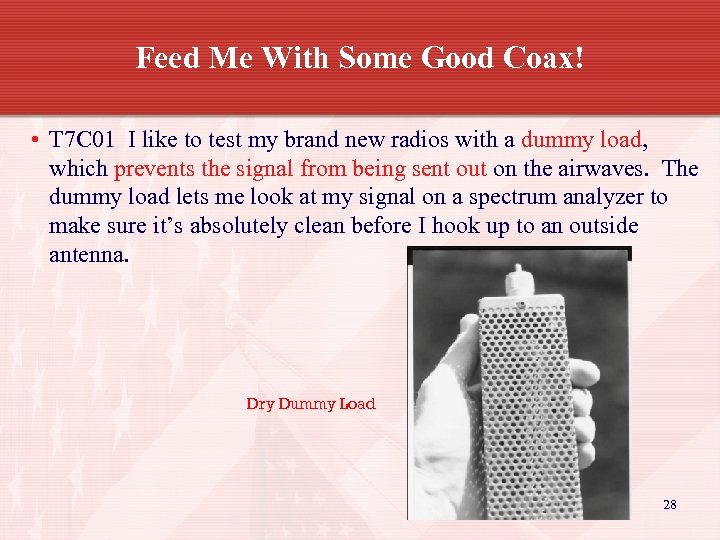 Feed Me With Some Good Coax! • T 7 C 01 I like to test my brand new radios with a dummy load, which prevents the signal from being sent out on the airwaves. The dummy load lets me look at my signal on a spectrum analyzer to make sure it’s absolutely clean before I hook up to an outside antenna. Dry Dummy Load 28
 Feed Me With Some Good Coax! • T 7 C 13 A dummy load is a necessary accessory for any ham shack, whether you buy one or build one. Extended tuning up on the air is one of the infallible hallmarks of a lid. Learn to use a dummy load; don’t be a dummy load! A dummy load consists of a non-inductive resistor of sufficient power rating to handle your transmitter power. “Official” non-inductive resistors can be expensive, but you can build a fairly effective dummy load from large clusters of small carbon resistors. You can even use a heat lamp (at least at HF frequencies) if you shield it properly, and use some method of properly matching it, such as a good antenna tuner. Keep in mind a heat lamp changes resistance radically with power, but with a good antenna tuner you can find the “sweet spot. ” Classic dummy loads such as the Heath “Cantenna” are available at nearly every swap meet and can handle a “full gallon” (FCC 1, 000 watts legal limit) of power for a while. 29
 Element 2 Technician Class Question Pool Feed Me With Some Good Coax! Valid July 1, 2014 Through June 30, 2018 30
 T 7 C 12 Which of the following is a common use of coaxial cable? A. Carrying dc power from a vehicle battery to a mobile radio B. Carrying RF signals between a radio and antenna C. Securing masts, tubing, and other cylindrical objects on towers D. Connecting data signals from a TNC to a computer 31
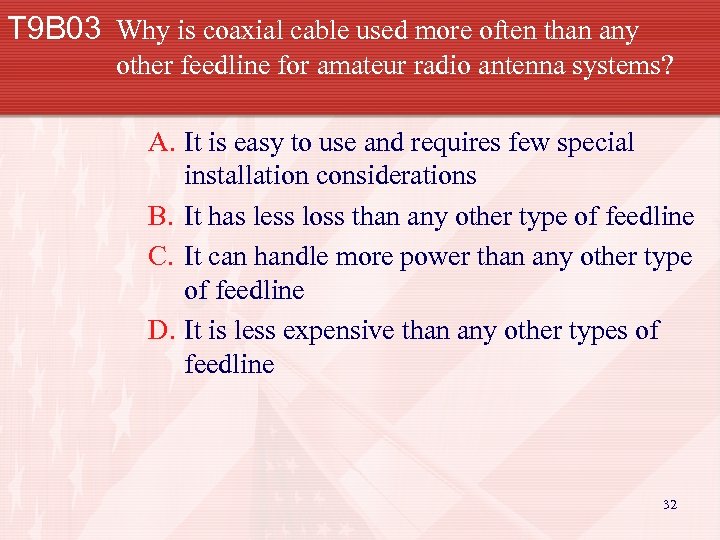 T 9 B 03 Why is coaxial cable used more often than any other feedline for amateur radio antenna systems? A. It is easy to use and requires few special installation considerations B. It has less loss than any other type of feedline C. It can handle more power than any other type of feedline D. It is less expensive than any other types of feedline 32
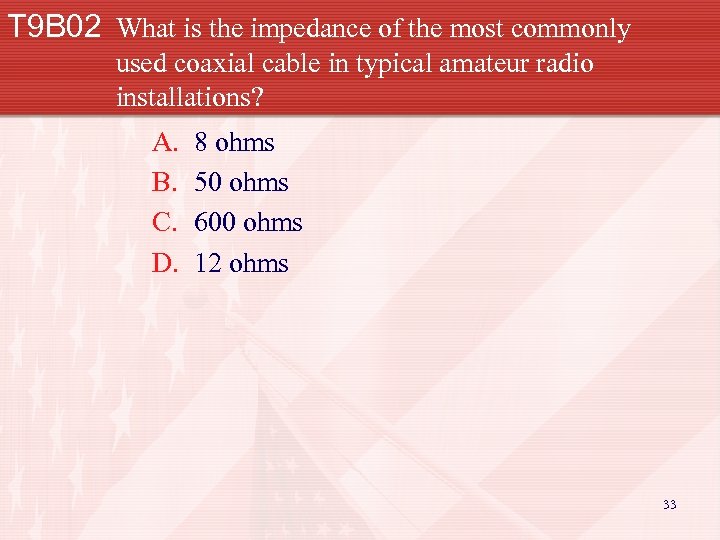 T 9 B 02 What is the impedance of the most commonly used coaxial cable in typical amateur radio installations? A. B. C. D. 8 ohms 50 ohms 600 ohms 12 ohms 33
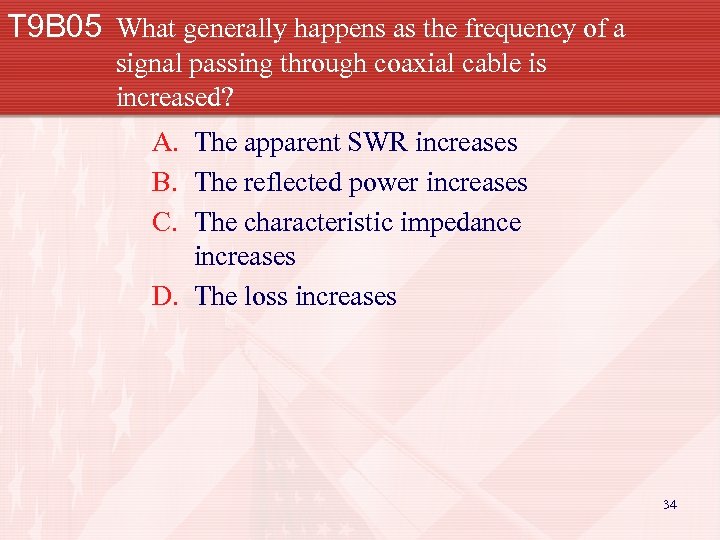 T 9 B 05 What generally happens as the frequency of a signal passing through coaxial cable is increased? A. The apparent SWR increases B. The reflected power increases C. The characteristic impedance increases D. The loss increases 34
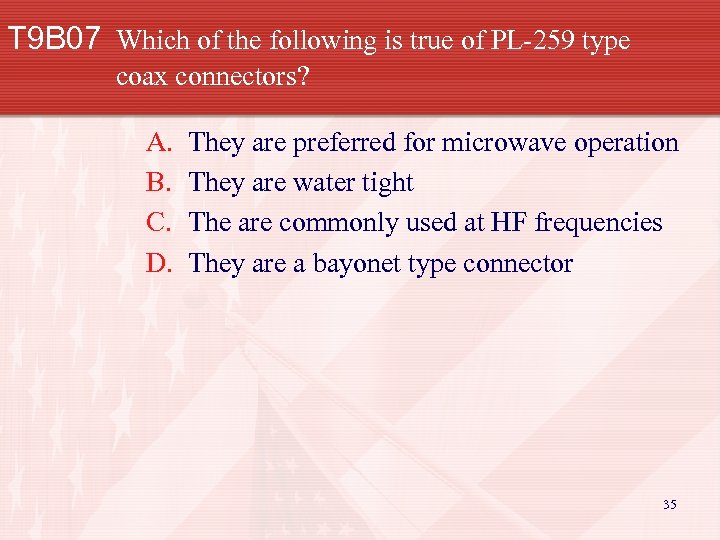 T 9 B 07 Which of the following is true of PL-259 type coax connectors? A. B. C. D. They are preferred for microwave operation They are water tight The are commonly used at HF frequencies They are a bayonet type connector 35
 T 9 B 06 Which of the following connectors is most suitable for frequencies above 400 MHz? A. B. C. D. A UHF (PL-259/SO-239) connector A Type N connector An RS-213 connector A DB-25 connector 36
 T 7 C 11 What is a disadvantage of air core coaxial cable when compared to foam or solid dielectric types? A. It has more loss per foot B. It cannot be used for VHF or UHF antennas C. It requires special techniques to prevent water absorption D. It cannot be used at below freezing temperatures 37
 T 7 C 09 Which of the following is the most common cause for failure of coaxial cables? A. B. C. D. Moisture contamination Gamma rays The velocity factor exceeds 1. 0 Overloading 38
 T 9 B 08 Why should coax connectors exposed to the weather be sealed against water intrusion? A. B. C. D. To prevent an increase in feedline loss To prevent interference to telephones To keep the jacket from becoming loose All of these choices are correct 39
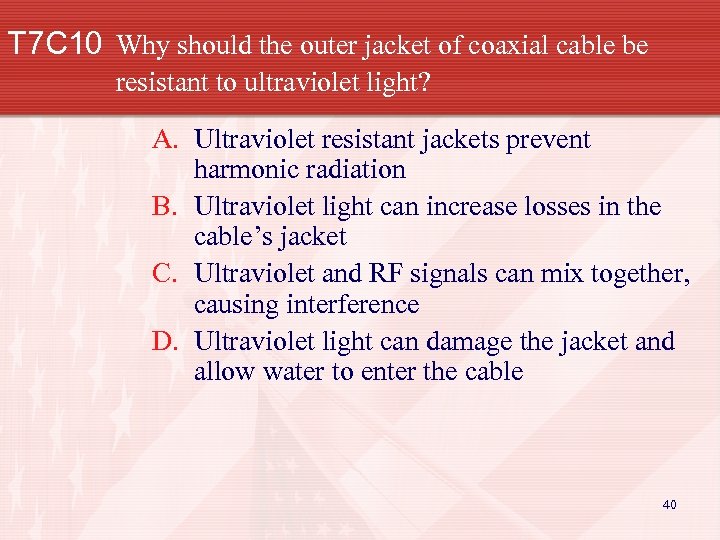 T 7 C 10 Why should the outer jacket of coaxial cable be resistant to ultraviolet light? A. Ultraviolet resistant jackets prevent harmonic radiation B. Ultraviolet light can increase losses in the cable’s jacket C. Ultraviolet and RF signals can mix together, causing interference D. Ultraviolet light can damage the jacket and allow water to enter the cable 40
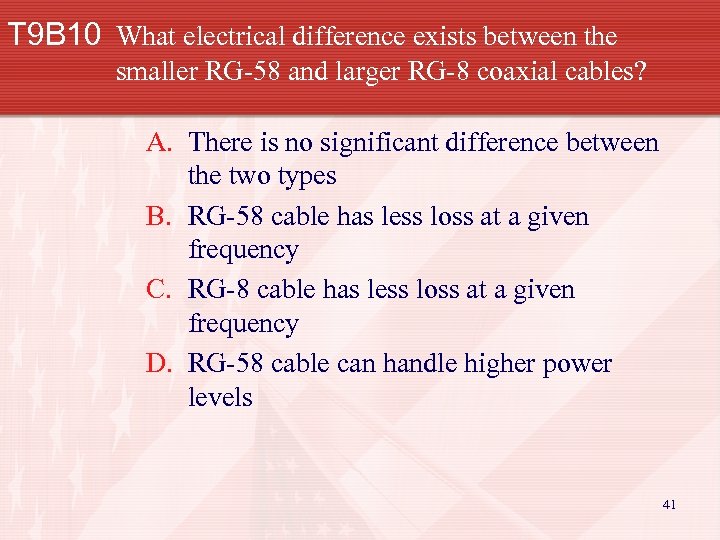 T 9 B 10 What electrical difference exists between the smaller RG-58 and larger RG-8 coaxial cables? A. There is no significant difference between the two types B. RG-58 cable has less loss at a given frequency C. RG-8 cable has less loss at a given frequency D. RG-58 cable can handle higher power levels 41
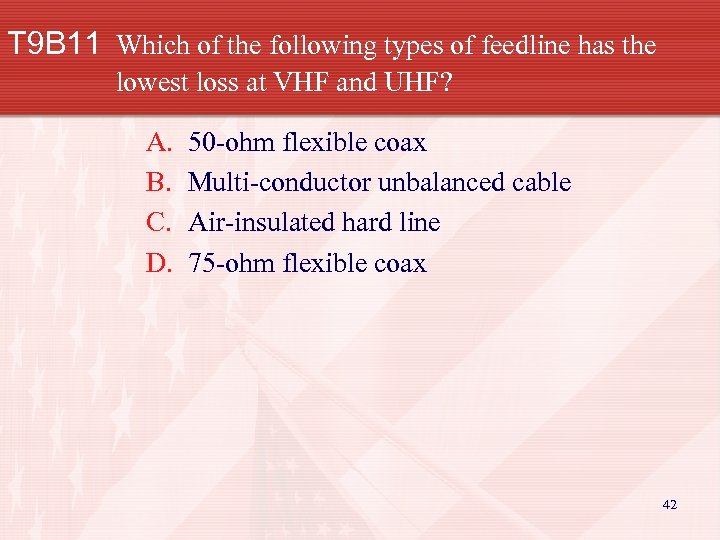 T 9 B 11 Which of the following types of feedline has the lowest loss at VHF and UHF? A. B. C. D. 50 -ohm flexible coax Multi-conductor unbalanced cable Air-insulated hard line 75 -ohm flexible coax 42
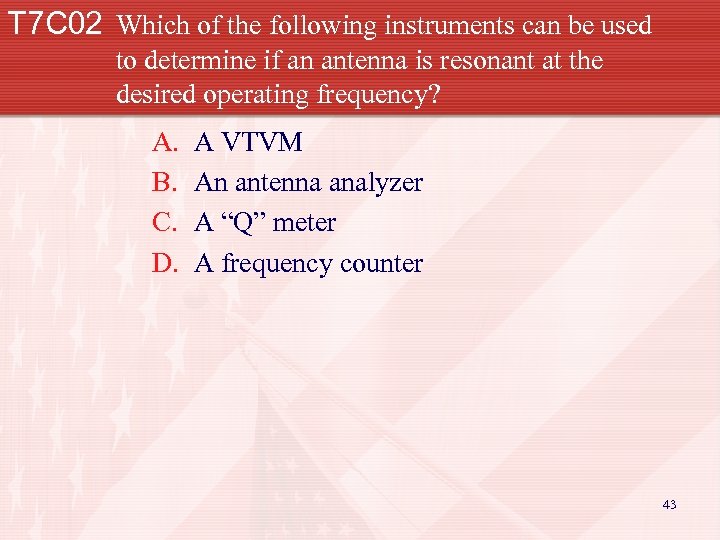 T 7 C 02 Which of the following instruments can be used to determine if an antenna is resonant at the desired operating frequency? A. B. C. D. A VTVM An antenna analyzer A “Q” meter A frequency counter 43
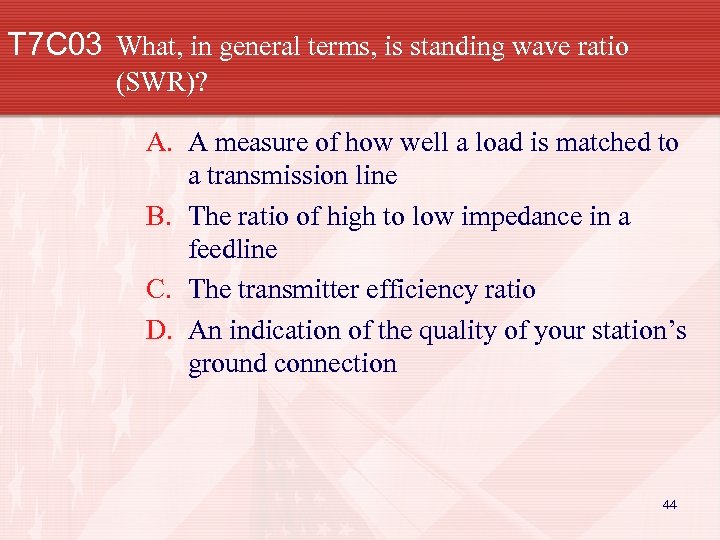 T 7 C 03 What, in general terms, is standing wave ratio (SWR)? A. A measure of how well a load is matched to a transmission line B. The ratio of high to low impedance in a feedline C. The transmitter efficiency ratio D. An indication of the quality of your station’s ground connection 44
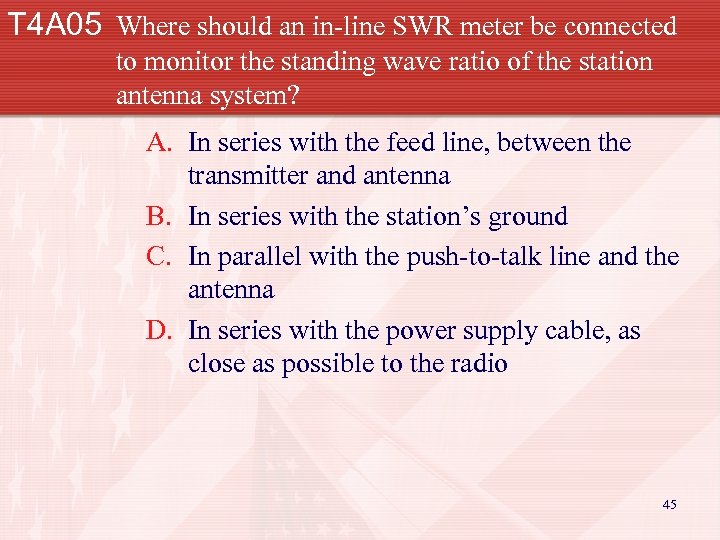 T 4 A 05 Where should an in-line SWR meter be connected to monitor the standing wave ratio of the station antenna system? A. In series with the feed line, between the transmitter and antenna B. In series with the station’s ground C. In parallel with the push-to-talk line and the antenna D. In series with the power supply cable, as close as possible to the radio 45
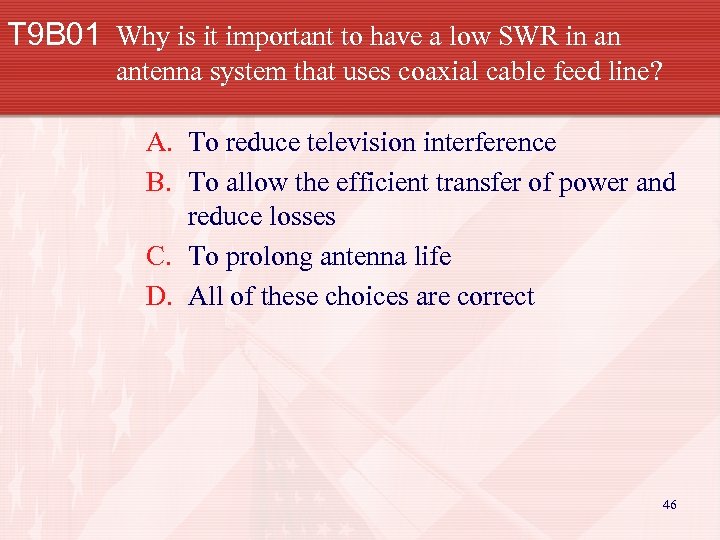 T 9 B 01 Why is it important to have a low SWR in an antenna system that uses coaxial cable feed line? A. To reduce television interference B. To allow the efficient transfer of power and reduce losses C. To prolong antenna life D. All of these choices are correct 46
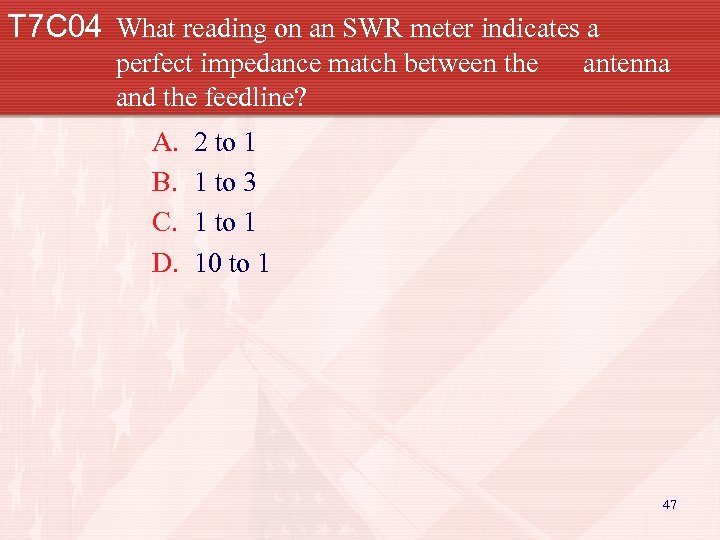 T 7 C 04 What reading on an SWR meter indicates a perfect impedance match between the and the feedline? A. B. C. D. antenna 2 to 1 1 to 3 1 to 1 10 to 1 47
 T 7 C 05 What is the approximate SWR value above which the protection circuits in most solid-state transmitters begin to reduce transmitter power? A. B. C. D. 2 to 1 1 to 2 6 to 1 10 to 1 48
 T 7 C 06 What does an SWR reading of 4: 1 mean? A. B. C. D. An antenna loss of 4 d. B A good impedance match An antenna gain of 4 An impedance mismatch 49
 T 9 B 09 What might cause erratic changes in SWR readings? A. The transmitter is being modulated B. A loose connection in an antenna or a feedline C. The transmitter is being over-modulated D. Interference from other stations is distorting your signal 50
 T 7 C 08 What instrument other than an SWR meter could you use to determine if a feedline and antenna are properly matched? A. B. C. D. Voltmeter Ohmmeter Iambic pentameter Directional wattmeter 51
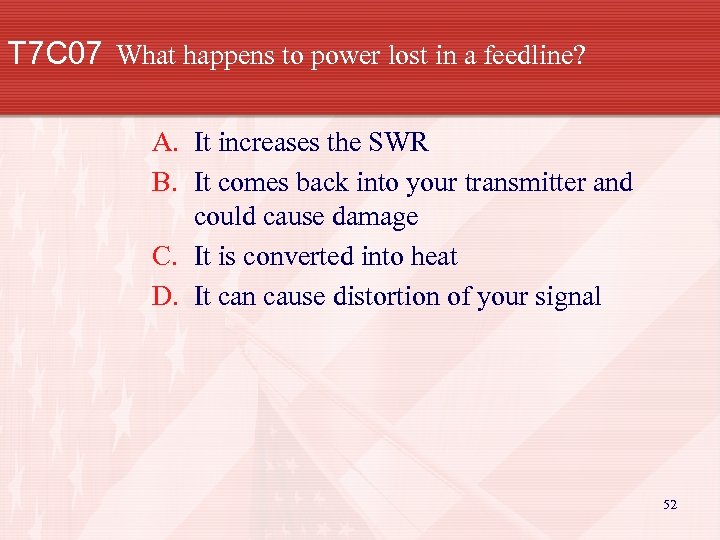 T 7 C 07 What happens to power lost in a feedline? A. It increases the SWR B. It comes back into your transmitter and could cause damage C. It is converted into heat D. It can cause distortion of your signal 52
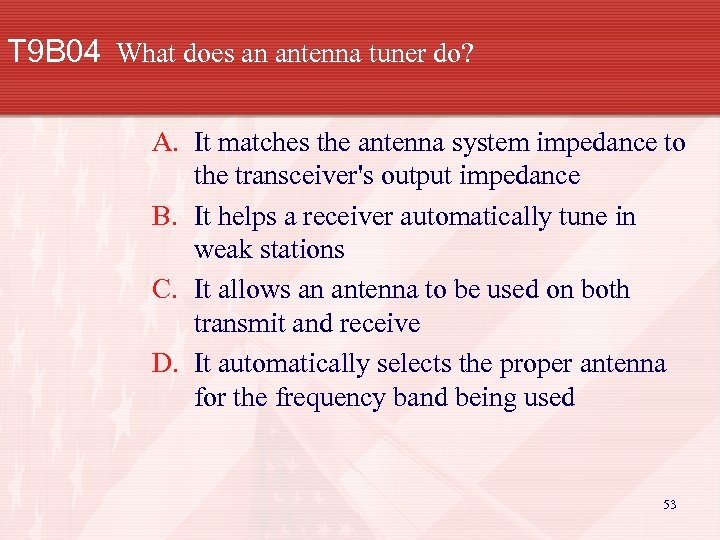 T 9 B 04 What does an antenna tuner do? A. It matches the antenna system impedance to the transceiver's output impedance B. It helps a receiver automatically tune in weak stations C. It allows an antenna to be used on both transmit and receive D. It automatically selects the proper antenna for the frequency band being used 53
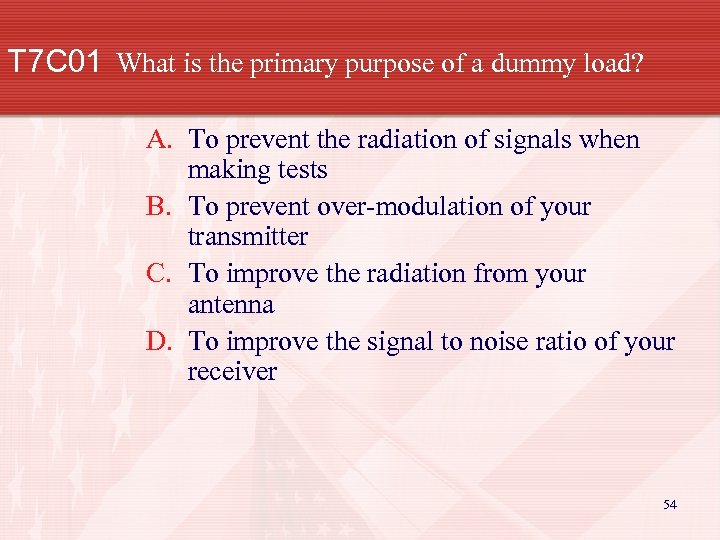 T 7 C 01 What is the primary purpose of a dummy load? A. To prevent the radiation of signals when making tests B. To prevent over-modulation of your transmitter C. To improve the radiation from your antenna D. To improve the signal to noise ratio of your receiver 54
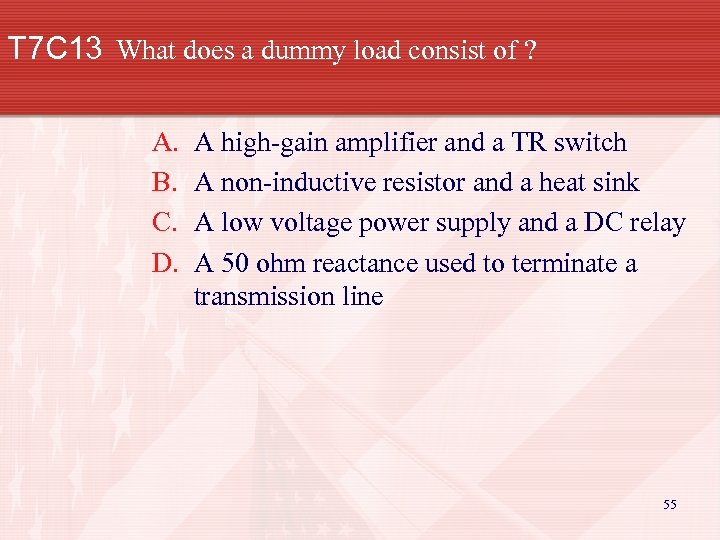 T 7 C 13 What does a dummy load consist of ? A. B. C. D. A high-gain amplifier and a TR switch A non-inductive resistor and a heat sink A low voltage power supply and a DC relay A 50 ohm reactance used to terminate a transmission line 55