


 Скачать презентацию Technician Licensing Class T 6 Valid dates July
baced1bc570b42e96dfb2c513fa1f396.ppt
- Количество слайдов: 79
 Technician Licensing Class “T 6” Valid dates: July 1, 2010 – June 30, 2014
 Amateur Radio Technician Class Element 2 Course Presentation Ø ELEMENT 2 SUB-ELEMENTS • T 1 - FCC Rules, descriptions and definitions for the amateur radio service, operator and station license responsibilities. • T 2 – Operating Procedures • T 3 – Radio wave characteristics, radio and electromagnetic properties, propagation modes • T 4 – Amateur radio practices and station set up • T 5 – Electrical principles, math for electronics, electronic principles, Ohm’s Law Ø T 6 – Electrical components, semiconductors, circuit diagrams, component functions • T 7 – Station equipment, common transmitter and receiver problems, antenna measurements and troubleshooting, basic repair and testing • T 8 – Modulation modes, amateur satellite operation, operating activities, non -voice communications • T 9 – Antennas, feedlines • T 0 – AC power circuits, antenna installation, RF hazards 2
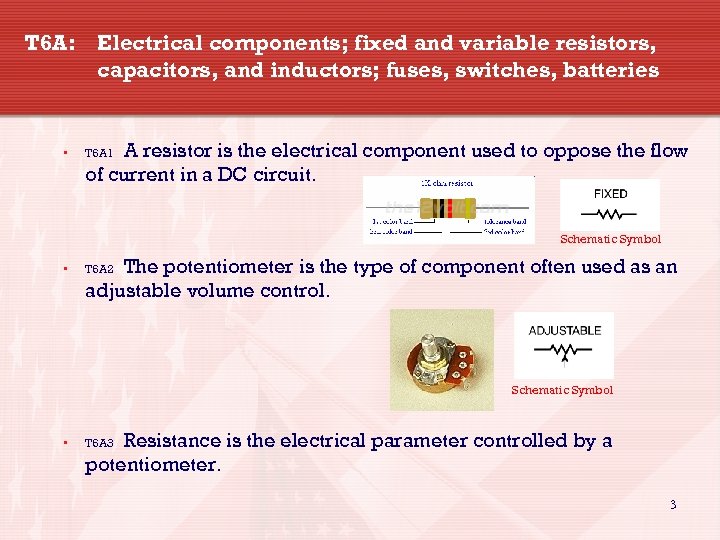 T 6 A: Electrical components; fixed and variable resistors, capacitors, and inductors; fuses, switches, batteries • A resistor is the electrical component used to oppose the flow of current in a DC circuit. T 6 A 1 Schematic Symbol • The potentiometer is the type of component often used as an adjustable volume control. T 6 A 2 Schematic Symbol • Resistance is the electrical parameter controlled by a potentiometer. T 6 A 3 3
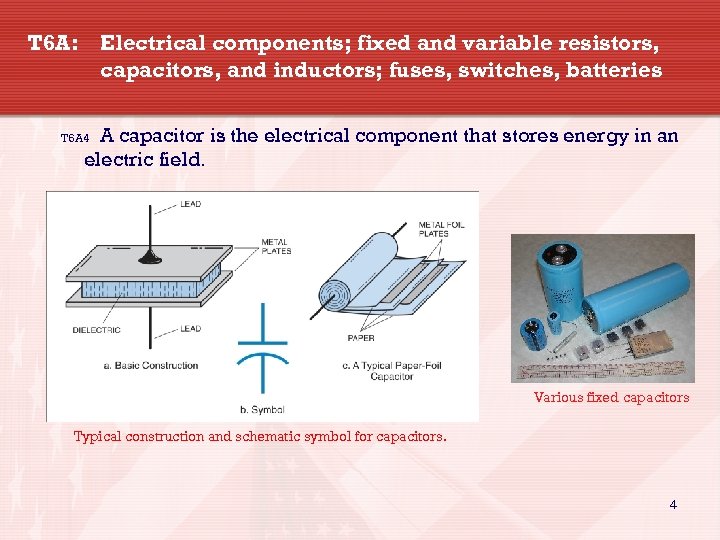 T 6 A: Electrical components; fixed and variable resistors, capacitors, and inductors; fuses, switches, batteries A capacitor is the electrical component that stores energy in an electric field. T 6 A 4 Various fixed capacitors Typical construction and schematic symbol for capacitors. 4
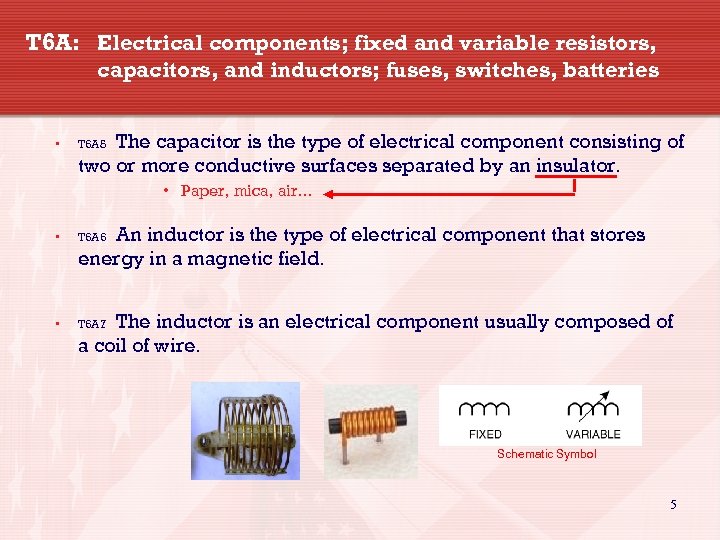 T 6 A: Electrical components; fixed and variable resistors, capacitors, and inductors; fuses, switches, batteries • The capacitor is the type of electrical component consisting of two or more conductive surfaces separated by an insulator. T 6 A 5 • Paper, mica, air… An inductor is the type of electrical component that stores energy in a magnetic field. • T 6 A 6 • T 6 A 7 The inductor is an electrical component usually composed of a coil of wire. Schematic Symbol 5
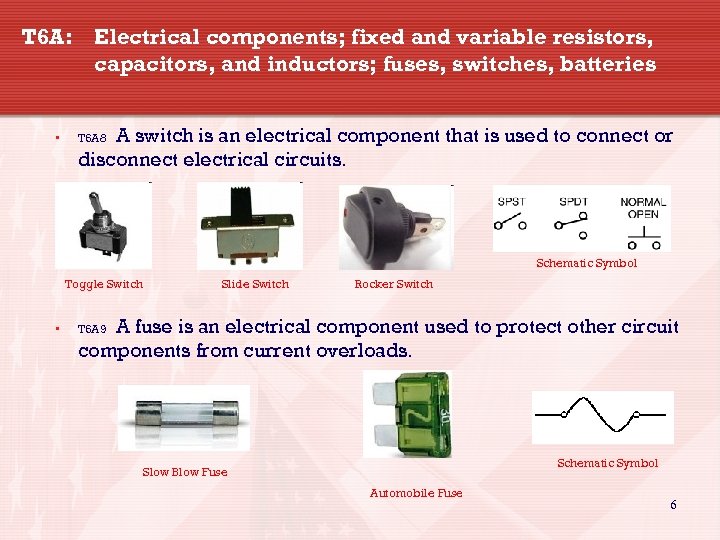 T 6 A: Electrical components; fixed and variable resistors, capacitors, and inductors; fuses, switches, batteries • A switch is an electrical component that is used to connect or disconnect electrical circuits. T 6 A 8 Schematic Symbol Toggle Switch • Slide Switch Rocker Switch A fuse is an electrical component used to protect other circuit components from current overloads. T 6 A 9 Schematic Symbol Slow Blow Fuse Automobile Fuse 6
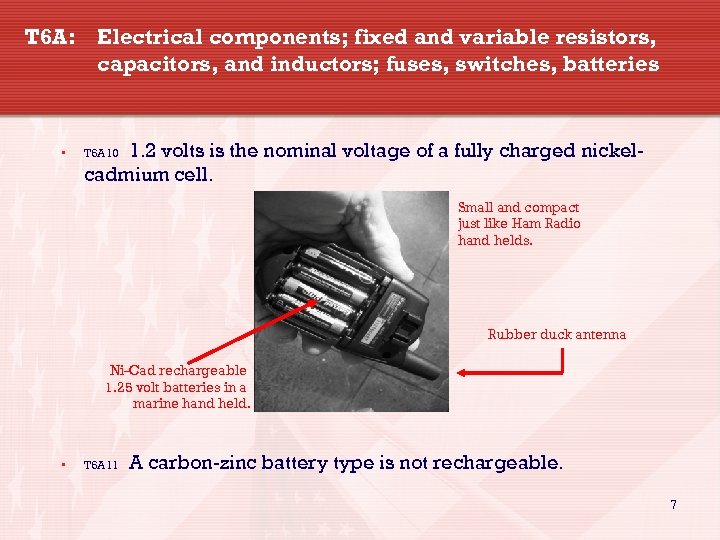 T 6 A: Electrical components; fixed and variable resistors, capacitors, and inductors; fuses, switches, batteries • 1. 2 volts is the nominal voltage of a fully charged nickelcadmium cell. T 6 A 10 Small and compact just like Ham Radio hand helds. Rubber duck antenna Ni-Cad rechargeable 1. 25 volt batteries in a marine hand held. • T 6 A 11 A carbon-zinc battery type is not rechargeable. 7
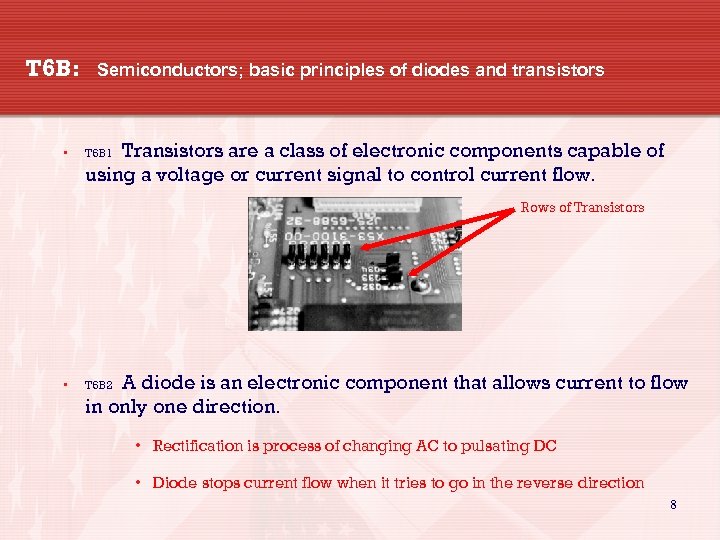 T 6 B: • Semiconductors; basic principles of diodes and transistors Transistors are a class of electronic components capable of using a voltage or current signal to control current flow. T 6 B 1 Rows of Transistors • A diode is an electronic component that allows current to flow in only one direction. T 6 B 2 • Rectification is process of changing AC to pulsating DC • Diode stops current flow when it tries to go in the reverse direction 8
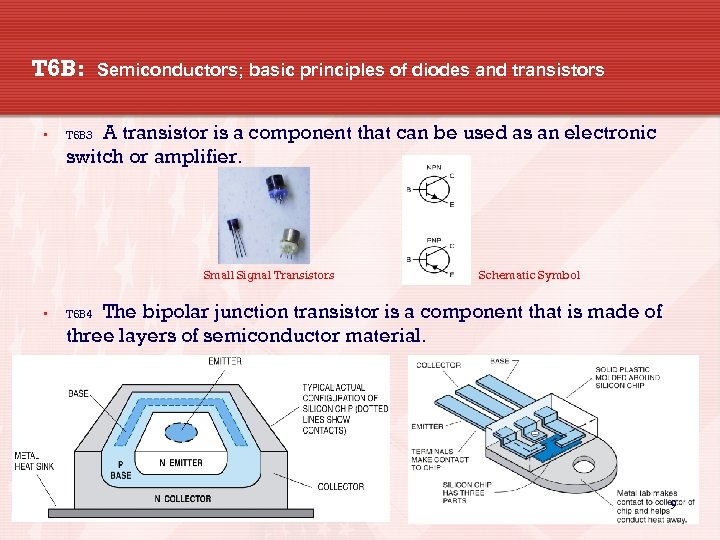 T 6 B: • Semiconductors; basic principles of diodes and transistors A transistor is a component that can be used as an electronic switch or amplifier. T 6 B 3 Small Signal Transistors • Schematic Symbol The bipolar junction transistor is a component that is made of three layers of semiconductor material. T 6 B 4 9
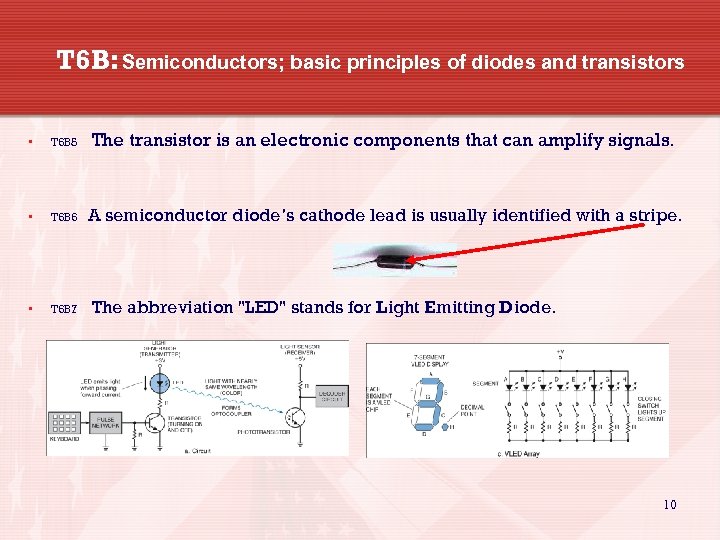 T 6 B: Semiconductors; basic principles of diodes and transistors • T 6 B 5 The transistor is an electronic components that can amplify signals. • T 6 B 6 A semiconductor diode’s cathode lead is usually identified with a stripe. • T 6 B 7 The abbreviation "LED" stands for Light Emitting Diode. 10
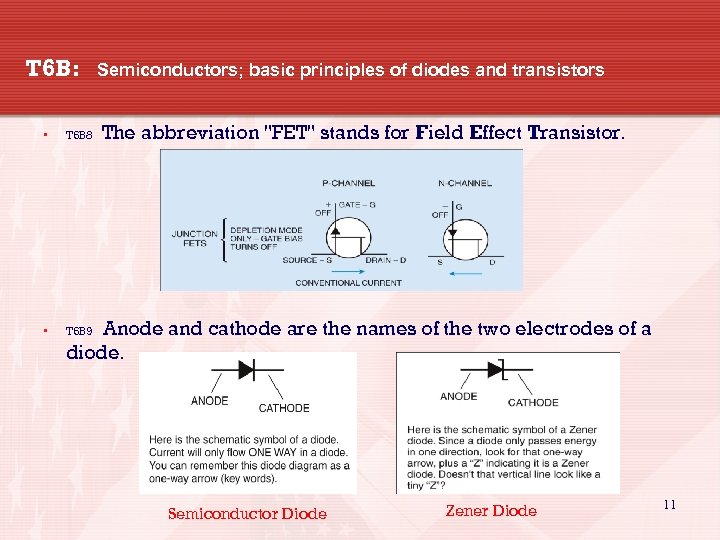 T 6 B: • T 6 B 8 • Semiconductors; basic principles of diodes and transistors The abbreviation "FET" stands for Field Effect Transistor. T 6 B 9 Anode and cathode are the names of the two electrodes of a diode. Semiconductor Diode Zener Diode 11
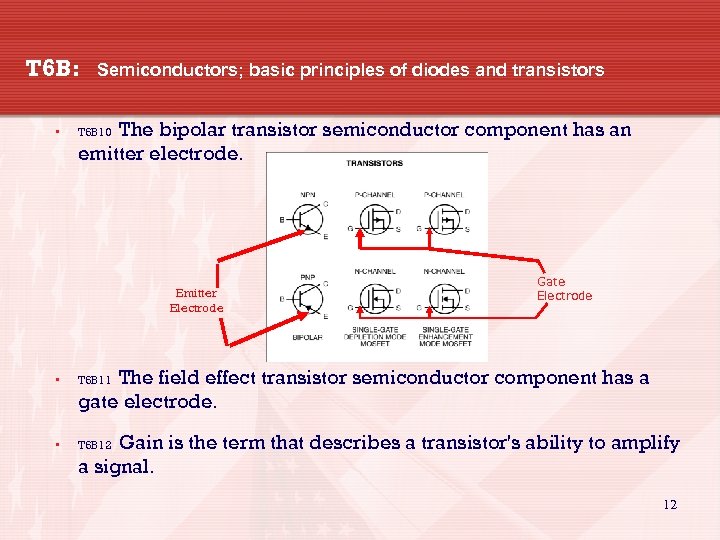 T 6 B: • Semiconductors; basic principles of diodes and transistors The bipolar transistor semiconductor component has an emitter electrode. T 6 B 10 Emitter Electrode Gate Electrode The field effect transistor semiconductor component has a gate electrode. • T 6 B 11 • T 6 B 12 Gain is the term that describes a transistor's ability to amplify a signal. 12
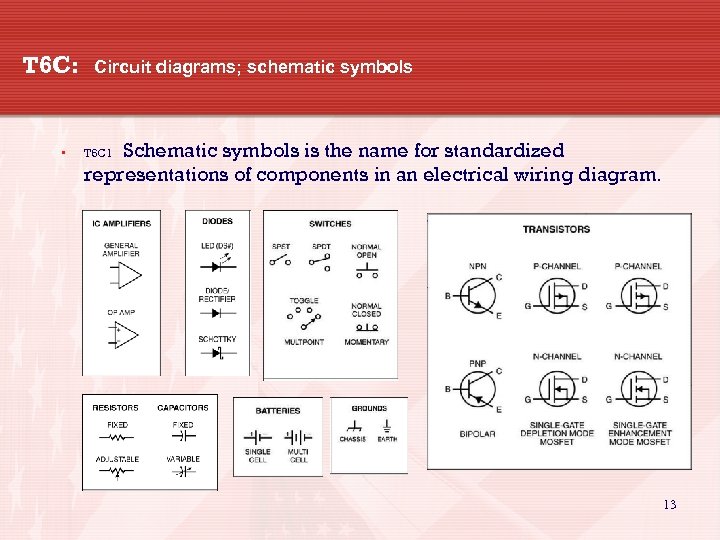 T 6 C: • Circuit diagrams; schematic symbols Schematic symbols is the name for standardized representations of components in an electrical wiring diagram. T 6 C 1 13
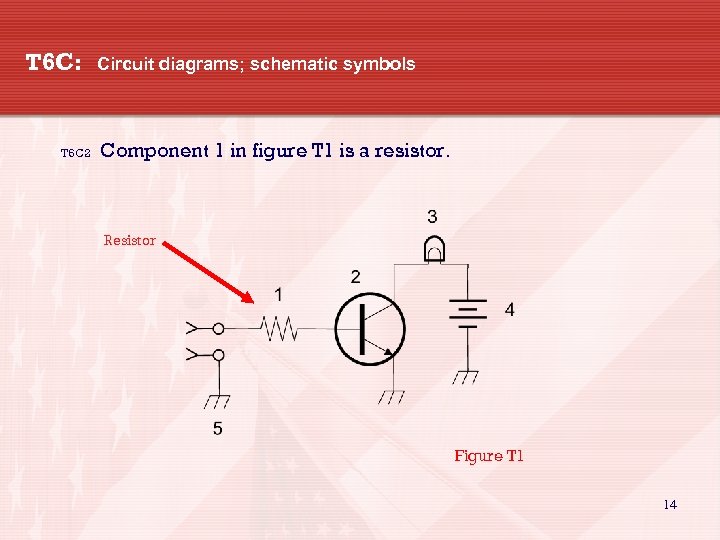 T 6 C: T 6 C 2 Circuit diagrams; schematic symbols Component 1 in figure T 1 is a resistor. Resistor Figure T 1 14
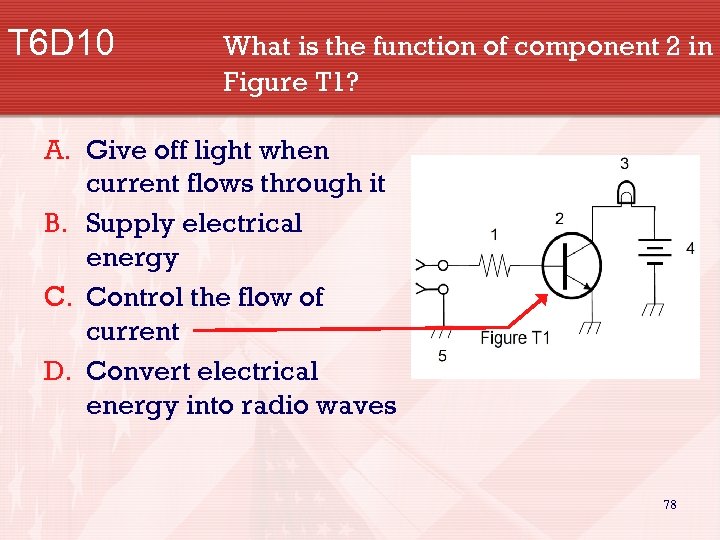
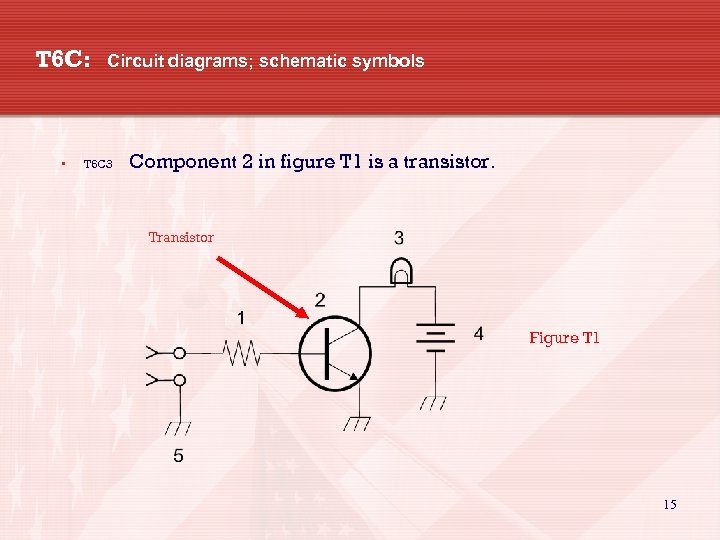 T 6 C: • Circuit diagrams; schematic symbols T 6 C 3 Component 2 in figure T 1 is a transistor. Transistor Figure T 1 15
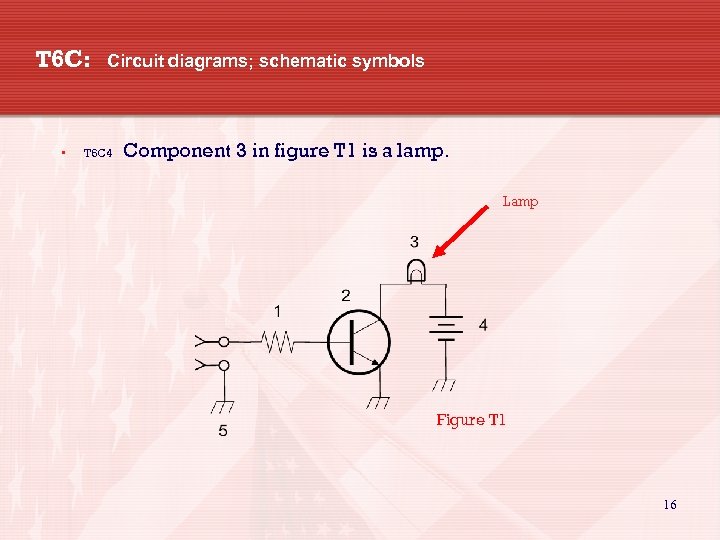 T 6 C: • Circuit diagrams; schematic symbols T 6 C 4 Component 3 in figure T 1 is a lamp. Lamp Figure T 1 16
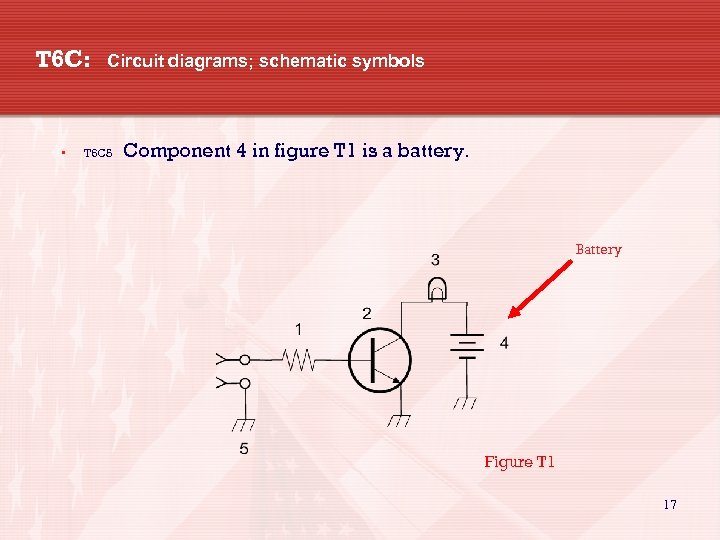 T 6 C: • Circuit diagrams; schematic symbols T 6 C 5 Component 4 in figure T 1 is a battery. Battery Figure T 1 17
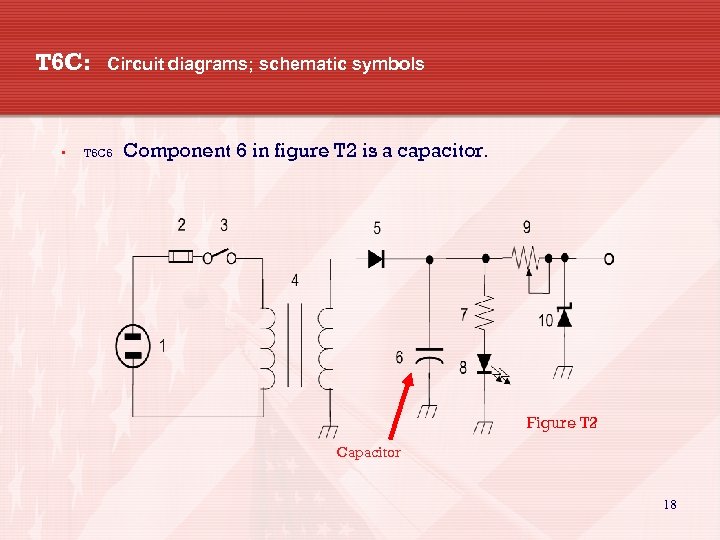 T 6 C: • Circuit diagrams; schematic symbols T 6 C 6 Component 6 in figure T 2 is a capacitor. Figure T 2 Capacitor 18
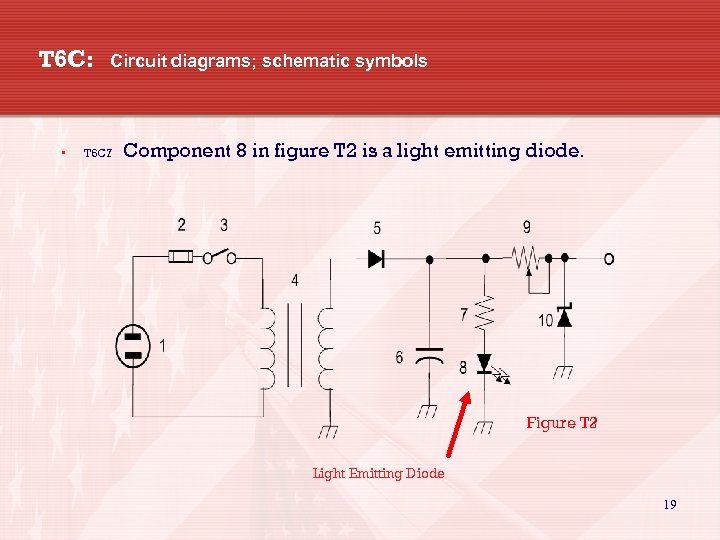 T 6 C: • Circuit diagrams; schematic symbols T 6 C 7 Component 8 in figure T 2 is a light emitting diode. Figure T 2 Light Emitting Diode 19
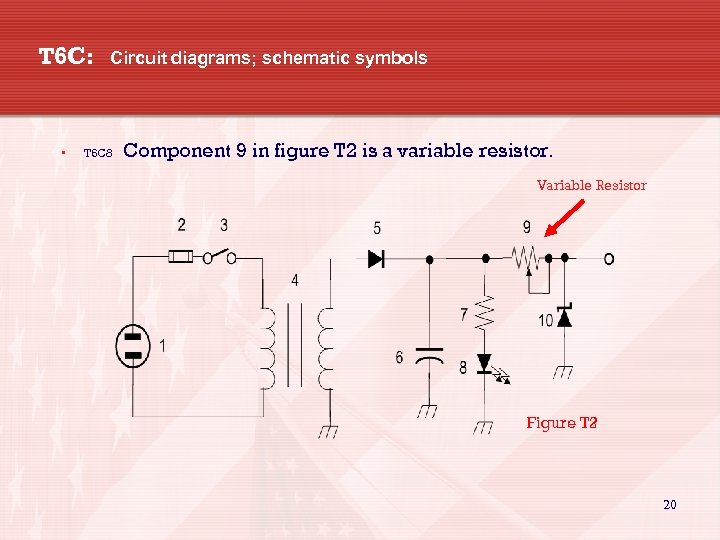 T 6 C: • Circuit diagrams; schematic symbols T 6 C 8 Component 9 in figure T 2 is a variable resistor. Variable Resistor Figure T 2 20
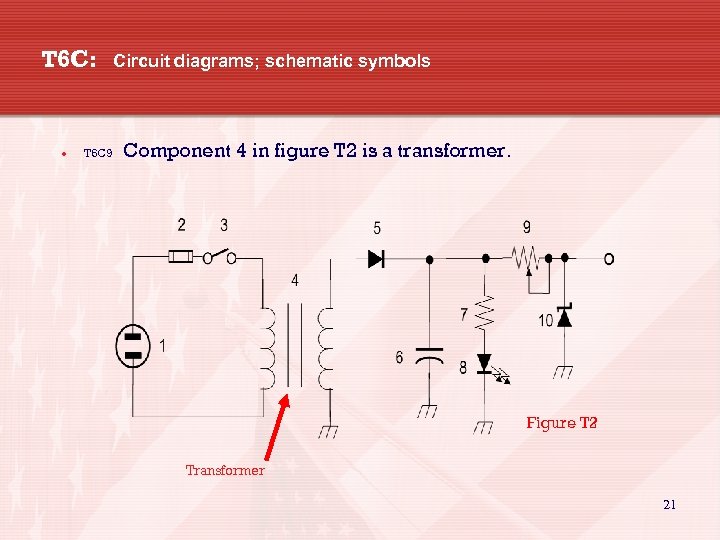 T 6 C: Circuit diagrams; schematic symbols T 6 C 9 Component 4 in figure T 2 is a transformer. Figure T 2 Transformer 21
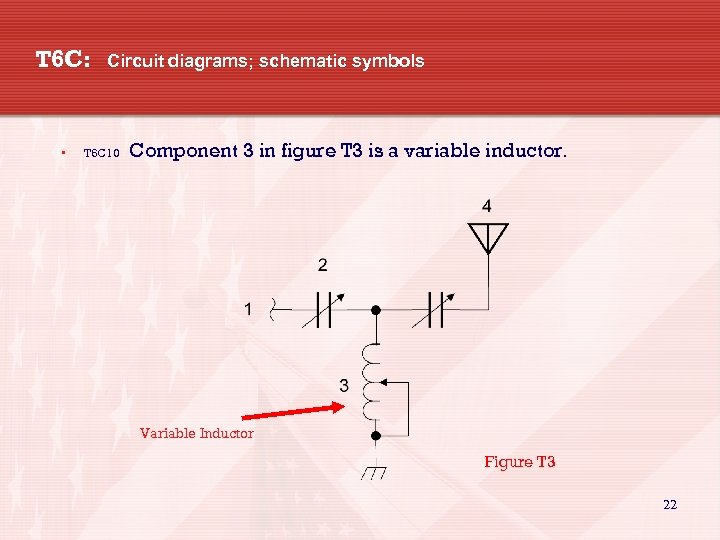 T 6 C: • Circuit diagrams; schematic symbols T 6 C 10 Component 3 in figure T 3 is a variable inductor. Variable Inductor Figure T 3 22
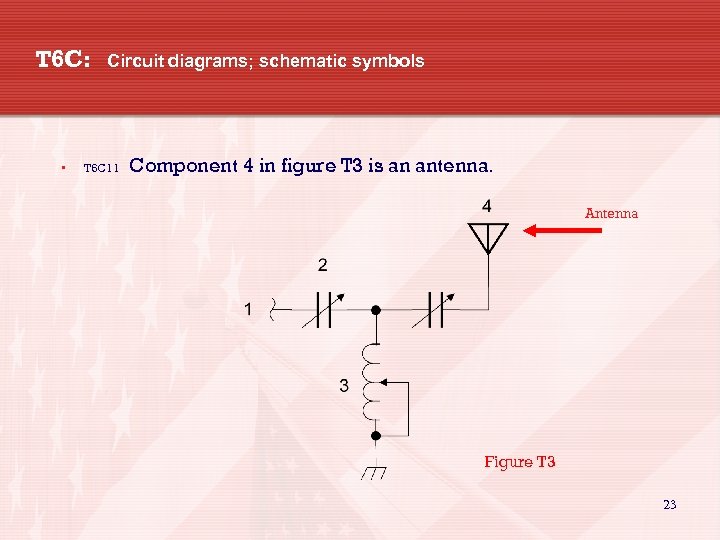 T 6 C: • Circuit diagrams; schematic symbols T 6 C 11 Component 4 in figure T 3 is an antenna. Antenna Figure T 3 23
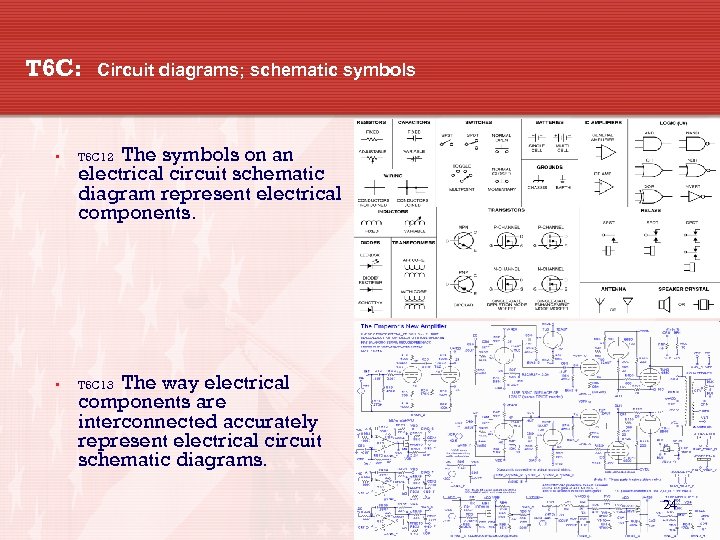 T 6 C: Circuit diagrams; schematic symbols The symbols on an electrical circuit schematic diagram represent electrical components. • T 6 C 12 • T 6 C 13 The way electrical components are interconnected accurately represent electrical circuit schematic diagrams. 24
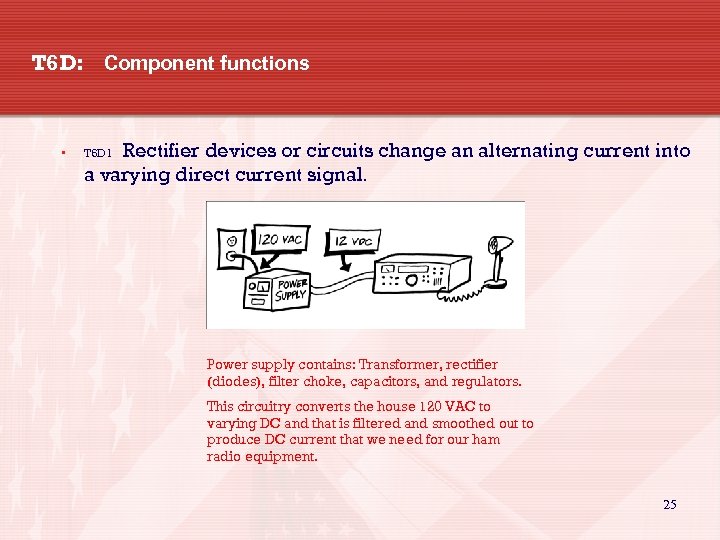 T 6 D: Component functions • Rectifier devices or circuits change an alternating current into a varying direct current signal. T 6 D 1 Power supply contains: Transformer, rectifier (diodes), filter choke, capacitors, and regulators. This circuitry converts the house 120 VAC to varying DC and that is filtered and smoothed out to produce DC current that we need for our ham radio equipment. 25
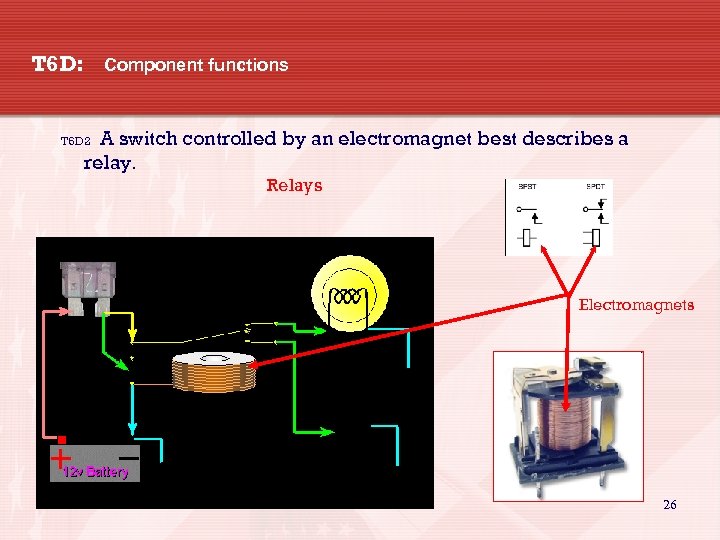 T 6 D: Component functions A switch controlled by an electromagnet best describes a relay. T 6 D 2 Relays Electromagnets 26
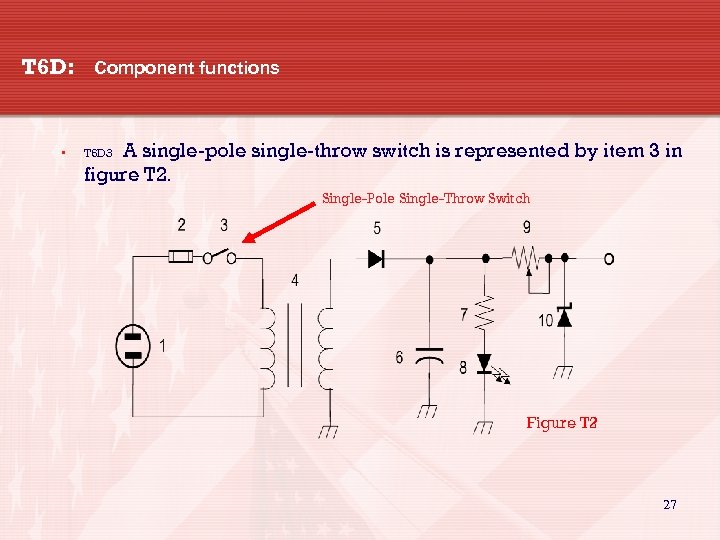 T 6 D: Component functions • A single-pole single-throw switch is represented by item 3 in figure T 2. T 6 D 3 Single-Pole Single-Throw Switch Figure T 2 27
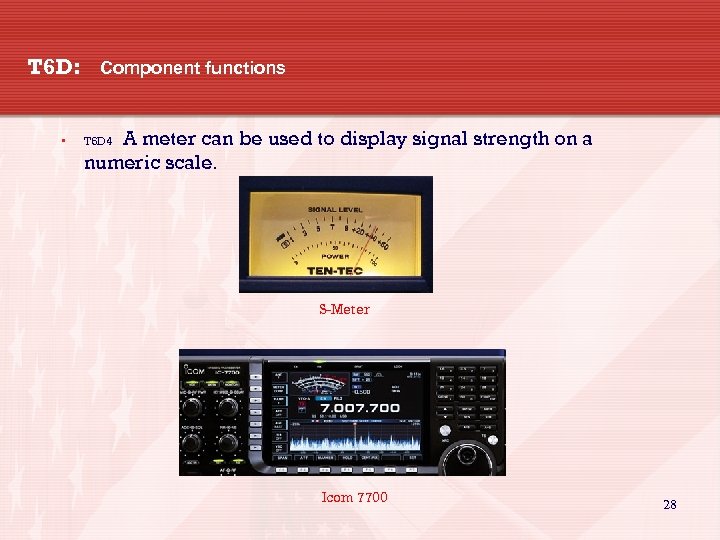 T 6 D: Component functions • A meter can be used to display signal strength on a numeric scale. T 6 D 4 S-Meter Icom 7700 28
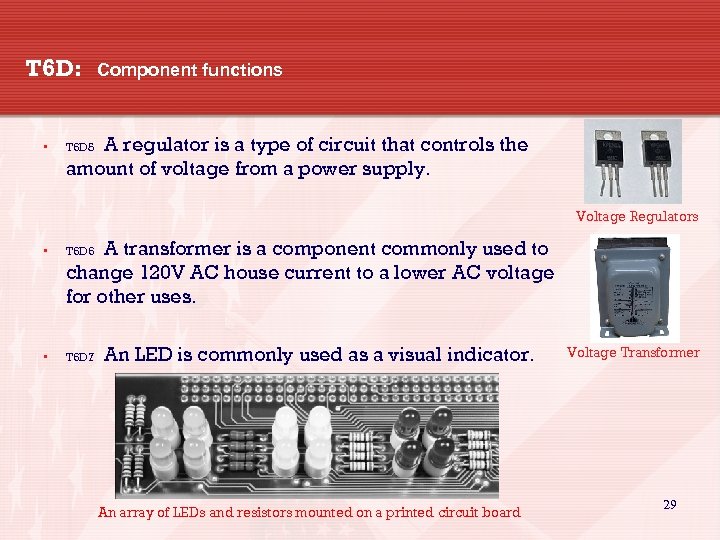 T 6 D: • Component functions A regulator is a type of circuit that controls the amount of voltage from a power supply. T 6 D 5 Voltage Regulators A transformer is a component commonly used to change 120 V AC house current to a lower AC voltage for other uses. • T 6 D 6 • T 6 D 7 An LED is commonly used as a visual indicator. An array of LEDs and resistors mounted on a printed circuit board Voltage Transformer 29
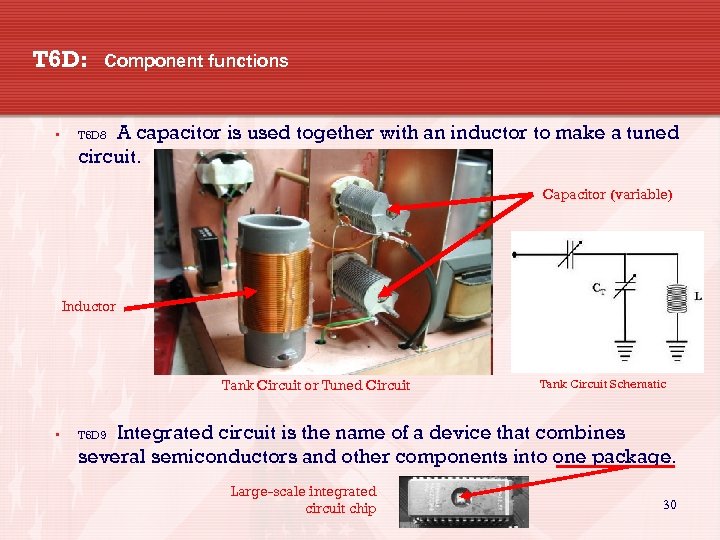 T 6 D: • Component functions A capacitor is used together with an inductor to make a tuned circuit. T 6 D 8 Capacitor (variable) Inductor Tank Circuit or Tuned Circuit • Tank Circuit Schematic Integrated circuit is the name of a device that combines several semiconductors and other components into one package. T 6 D 9 Large-scale integrated circuit chip 30
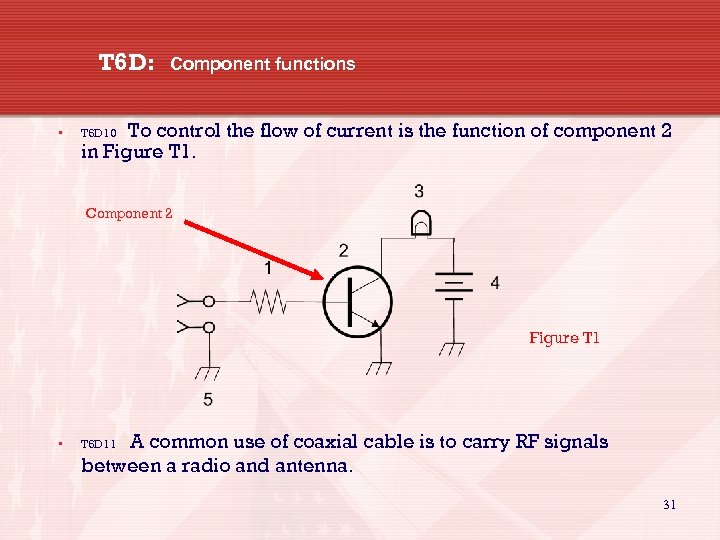 T 6 D: • Component functions To control the flow of current is the function of component 2 in Figure T 1. T 6 D 10 Component 2 Figure T 1 • A common use of coaxial cable is to carry RF signals between a radio and antenna. T 6 D 11 31
 Element 2 Technician Class Question Pool T 6 Electrical components, semiconductors, circuit diagrams, component functions [4 Exam Questions – 4 Groups] Valid July 1, 2010 Through June 30, 2014
 T 6 A 01 What electrical component is used to oppose the flow of current in a DC circuit? A. B. C. D. Inductor Resistor Voltmeter Transformer 33
 T 6 A 02 as an A. B. C. D. What type of component is often used adjustable volume control? Fixed resistor Power resistor Potentiometer Transformer 34
 T 6 A 03 controlled by A. B. C. D. What electrical parameter is a potentiometer? Inductance Resistance Capacitance Field strength 35
 T 6 A 04 energy A. B. C. D. What electrical component stores in an electric field? Resistor Capacitor Inductor Diode 36
 T 6 A 05 consists A. B. C. D. What type of electrical component of two or more conductive surfaces separated by an insulator? Resistor Potentiometer Oscillator Capacitor 37
 T 6 A 06 stores A. B. C. D. What type of electrical component energy in a magnetic field? Resistor Capacitor Inductor Diode 38
 T 6 A 07 A. B. C. D. What electrical component is usually composed of a coil of wire? Switch Capacitor Diode Inductor 39
 T 6 A 08 What electrical component is used to connect or disconnect electrical circuits? A. B. C. D. Zener diode Switch Inductor Variable resistor 40
 T 6 A 09 A. B. C. D. What electrical component is used to protect other circuit components from current overloads? Fuse Capacitor Shield Inductor 41
 T 6 A 10 A. B. C. D. What is the nominal voltage of a fully charged nickel-cadmium cell? 1. 0 volts 1. 2 volts 1. 5 volts 2. 2 volts 42
 T 6 A 11 Which battery type is not rechargeable? A. B. C. D. Nickel-cadmium Carbon-zinc Lead-acid Lithium-ion 43
 T 6 B 01 is What class of electronic components capable of using a voltage or current signal to control current flow? A. B. C. D. Capacitors Inductors Resistors Transistors 44
 T 6 B 02 current A. B. C. D. What electronic component allows to flow in only one direction? Resistor Fuse Diode Driven element 45
 T 6 B 03 used as A. B. C. D. Which of these components can be an electronic switch or amplifier? Oscillator Potentiometer Transistor Voltmeter 46
 T 6 B 04 of material? A. B. C. D. Which of these components is made three layers of semiconductor Alternator Bipolar junction transistor Triode Pentagrid converter 47
 T 6 B 05 Which of the following electronic components can amplify signals? A. B. C. D. Transistor Variable resistor Electrolytic capacitor Multi-cell battery 48
 T 6 B 06 cathode A. B. C. D. How is a semiconductor diode’s lead usually identified? With the word “cathode” With a stripe With the letter “C” All of these choices are correct 49
 T 6 B 07 stand A. B. C. D. What does the abbreviation "LED" for? Low Emission Diode Light Emitting Diode Liquid Emission Detector Long Echo Delay 50
 T 6 B 08 stand A. B. C. D. What does the abbreviation "FET" for? Field Effect Transistor Fast Electron Transistor Free Electron Transition Field Emission Thickness 51
 T 6 B 09 electrodes A. B. C. D. What are the names of the two of a diode? Plus and minus Source and drain Anode and cathode Gate and base 52
 T 6 B 10 an A. B. C. D. Which semiconductor component has emitter electrode? Bipolar transistor Field effect transistor Silicon diode Bridge rectifier 53
 T 6 B 11 a A. B. C. D. Which semiconductor component has gate electrode? Bipolar transistor Field effect transistor Silicon diode Bridge rectifier 54
 T 6 B 12 A. B. C. D. What is the term that describes a transistor's ability to amplify a signal? Gain Forward resistance Forward voltage drop On resistance 55
 T 6 C 01 A. B. C. D. What is the name for standardized representations of components in an electrical wiring diagram? Electrical depictions Grey sketch Schematic symbols Component callouts 56
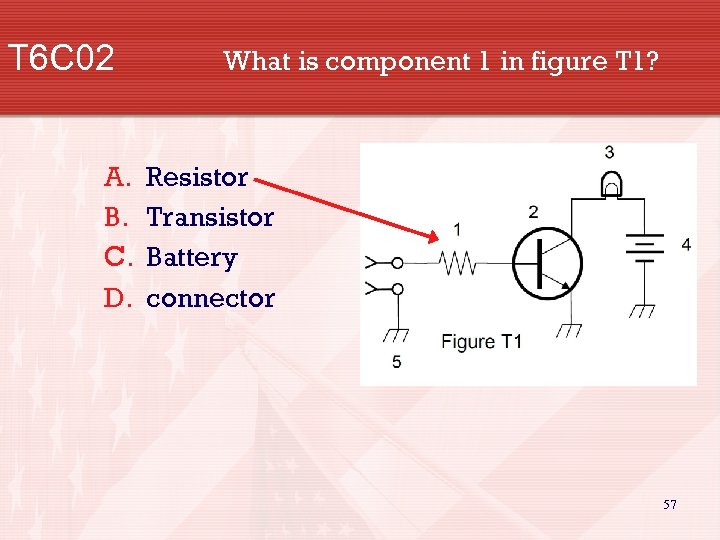 T 6 C 02 A. B. C. D. What is component 1 in figure T 1? Resistor Transistor Battery connector 57
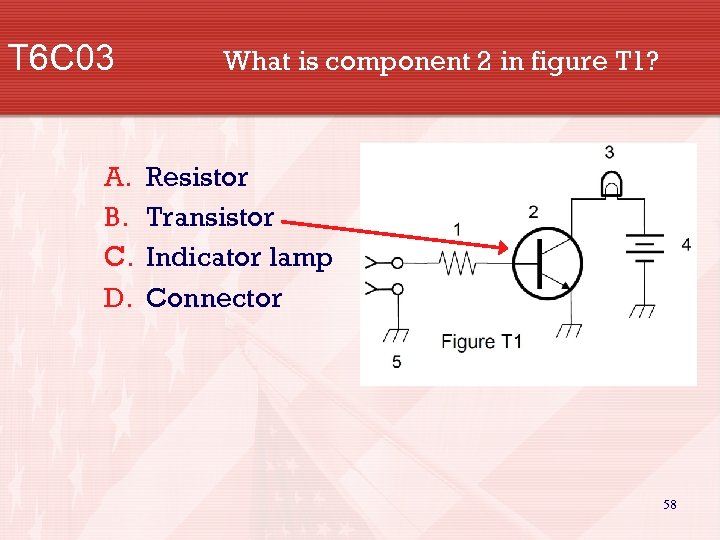 T 6 C 03 A. B. C. D. What is component 2 in figure T 1? Resistor Transistor Indicator lamp Connector 58
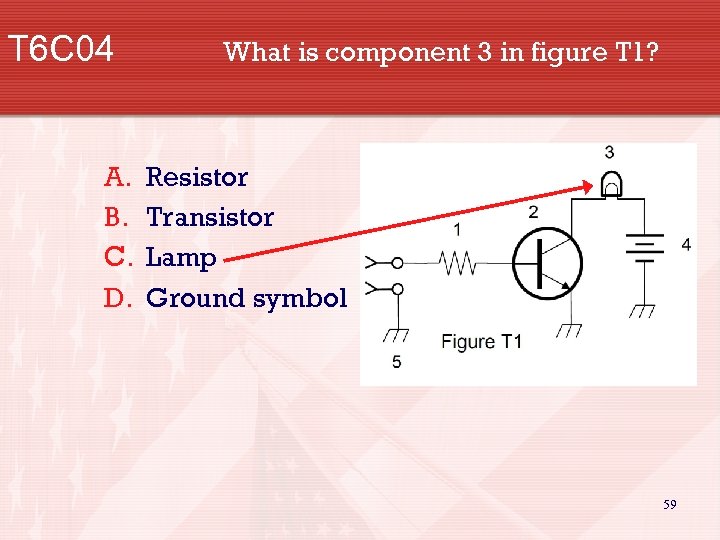 T 6 C 04 A. B. C. D. What is component 3 in figure T 1? Resistor Transistor Lamp Ground symbol 59
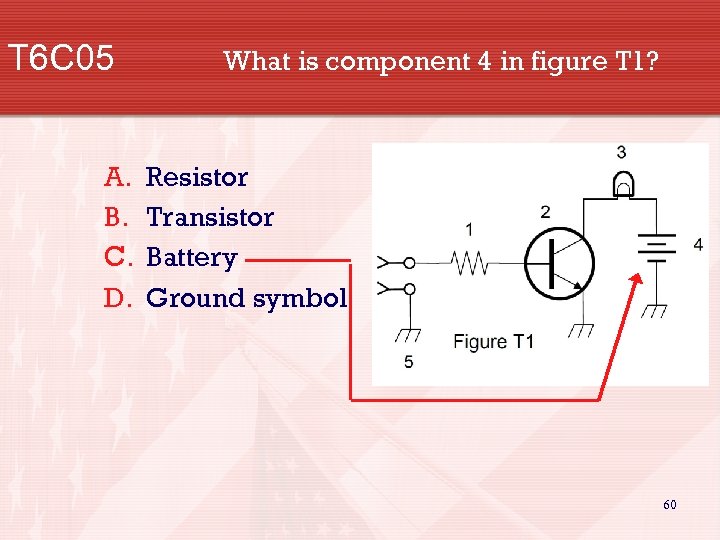 T 6 C 05 A. B. C. D. What is component 4 in figure T 1? Resistor Transistor Battery Ground symbol 60
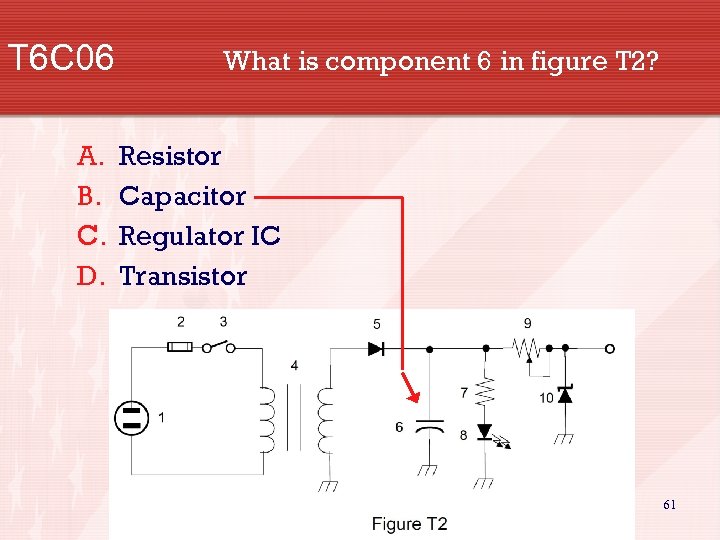 T 6 C 06 A. B. C. D. What is component 6 in figure T 2? Resistor Capacitor Regulator IC Transistor 61
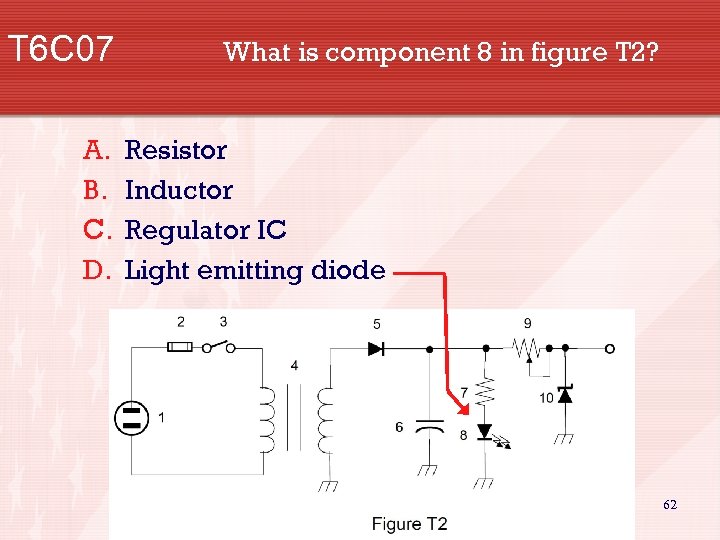 T 6 C 07 A. B. C. D. What is component 8 in figure T 2? Resistor Inductor Regulator IC Light emitting diode 62
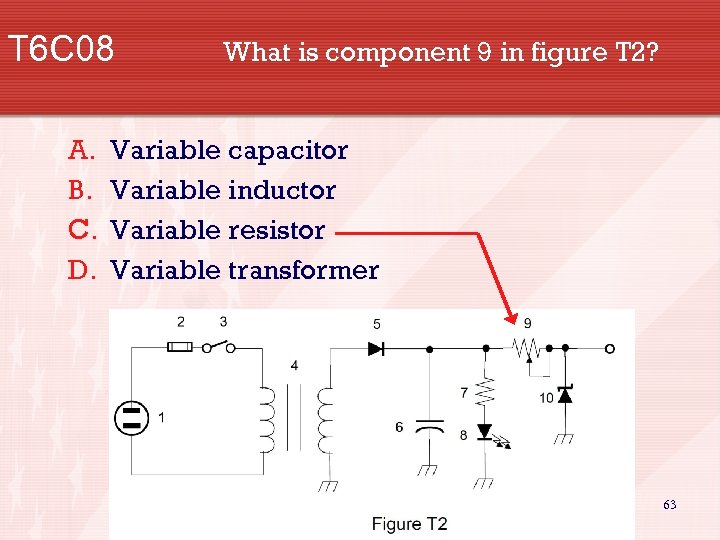 T 6 C 08 A. B. C. D. What is component 9 in figure T 2? Variable capacitor Variable inductor Variable resistor Variable transformer 63
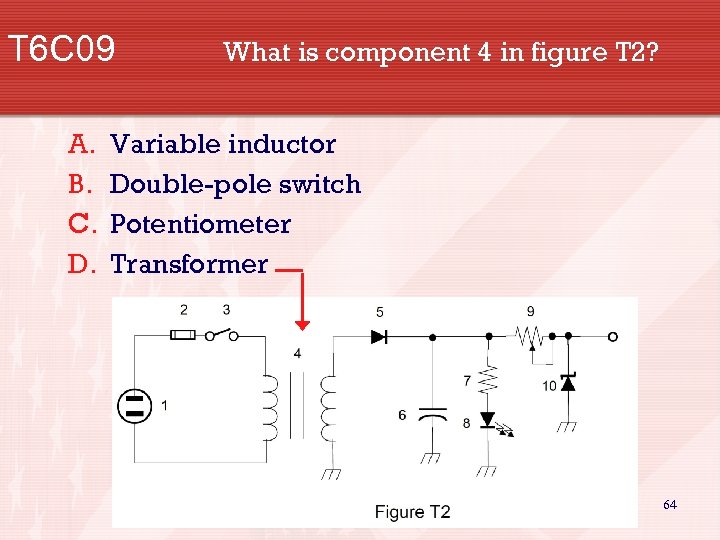 T 6 C 09 A. B. C. D. What is component 4 in figure T 2? Variable inductor Double-pole switch Potentiometer Transformer 64
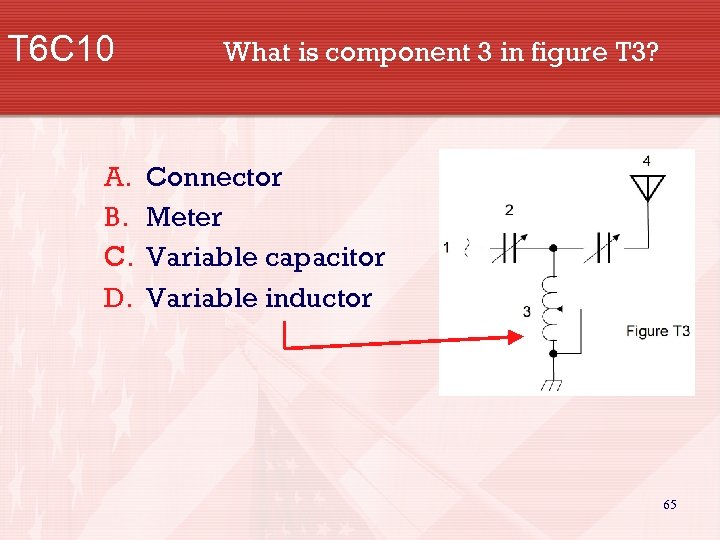 T 6 C 10 A. B. C. D. What is component 3 in figure T 3? Connector Meter Variable capacitor Variable inductor 65
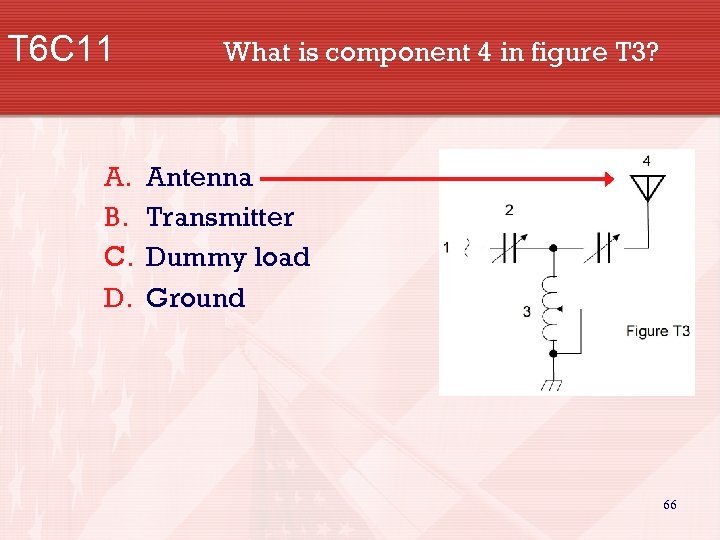 T 6 C 11 A. B. C. D. What is component 4 in figure T 3? Antenna Transmitter Dummy load Ground 66
 T 6 C 12 A. B. C. D. What do the symbols on an electrical circuit schematic diagram represent? Electrical components Logic states Digital codes Traffic nodes 67
 T 6 C 13 schematic A. B. C. D. Which of the following is accurately represented in electrical circuit diagrams? Wire lengths Physical appearance of components The way components are interconnected All of these choices 68
 T 6 D 01 circuits A. B. C. D. Which of the following devices or changes an alternating current into a varying direct current signal? Transformer Rectifier Amplifier Reflector 69
 T 6 D 02 A. B. C. D. What best describes a relay? A switch controlled by an electromagnet A current controlled amplifier An optical sensor A pass transistor 70
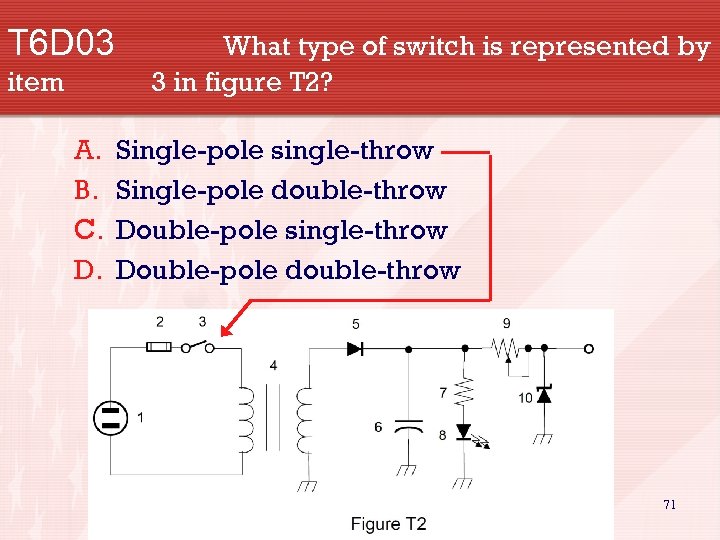 T 6 D 03 item A. B. C. D. What type of switch is represented by 3 in figure T 2? Single-pole single-throw Single-pole double-throw Double-pole single-throw Double-pole double-throw 71
 T 6 D 04 Which of the following can be used to display signal strength on a numeric scale? A. B. C. D. Potentiometer Transistor Meter Relay 72
 T 6 D 05 amount of A. B. C. D. What type of circuit controls the voltage from a power supply? Regulator Oscillator Filter Phase inverter 73
 T 6 D 06 lower A. B. C. D. What component is commonly used to change 120 V AC house current to a AC voltage for other uses? Variable capacitor Transformer Transistor Diode 74
 T 6 D 07 used A. B. C. D. Which of the following is commonly as a visual indicator? LED FET Zener diode Bipolar transistor 75
 T 6 D 08 together with circuit? A. B. C. D. Which of the following is used an inductor to make a tuned Resistor Zener diode Potentiometer Capacitor 76
 T 6 D 09 combines A. B. C. D. What is the name of a device that several semiconductors and other components into one package? Transducer Multi-pole relay Integrated circuit Transformer 77
 T 6 D 10 What is the function of component 2 in Figure T 1? A. Give off light when current flows through it B. Supply electrical energy C. Control the flow of current D. Convert electrical energy into radio waves 78
 T 6 D 11 Which of the following is a common use of coaxial cable? A. Carry dc power from a vehicle battery to a mobile radio B. Carry RF signals between a radio and antenna C. Secure masts, tubing, and other cylindrical objects on towers D. Connect data signals from a TNC to a computer 79