


 Скачать презентацию Technician License Course Chapter 3 Electricity Components and
83bb67d78586d9af3910294d5570f26f.ppt
- Количество слайдов: 97
 Technician License Course Chapter 3 Electricity, Components and Circuits Lesson Plan Module 6
 Electronics – Controlling the Flow of Current • To make an electronic device (like a radio) do something useful (like receive a signal), we need to control and manipulate the flow of current. • There a number of different electronic components that we use to do this.
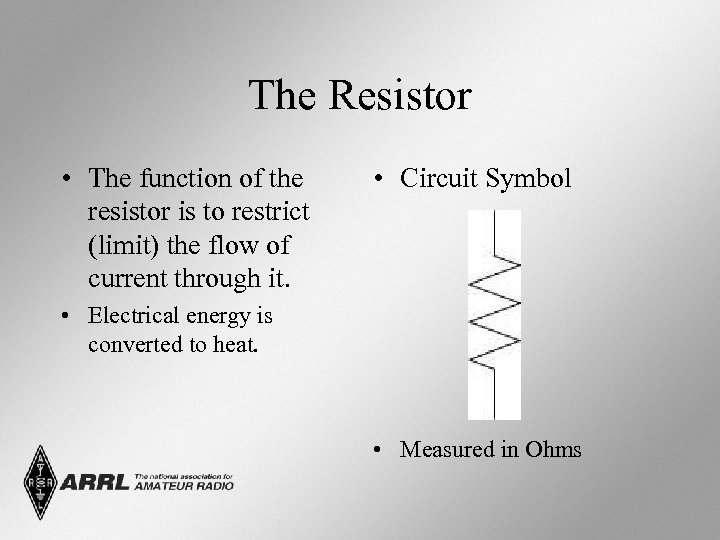 The Resistor • The function of the resistor is to restrict (limit) the flow of current through it. • Circuit Symbol • Electrical energy is converted to heat. • Measured in Ohms
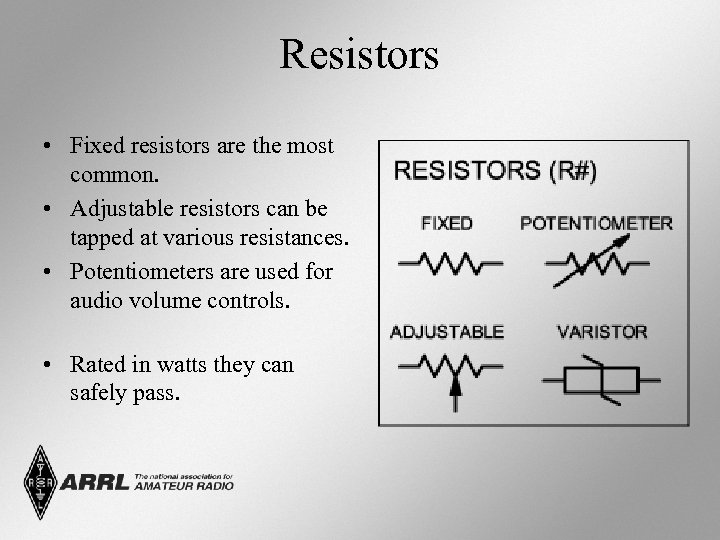 Resistors • Fixed resistors are the most common. • Adjustable resistors can be tapped at various resistances. • Potentiometers are used for audio volume controls. • Rated in watts they can safely pass.
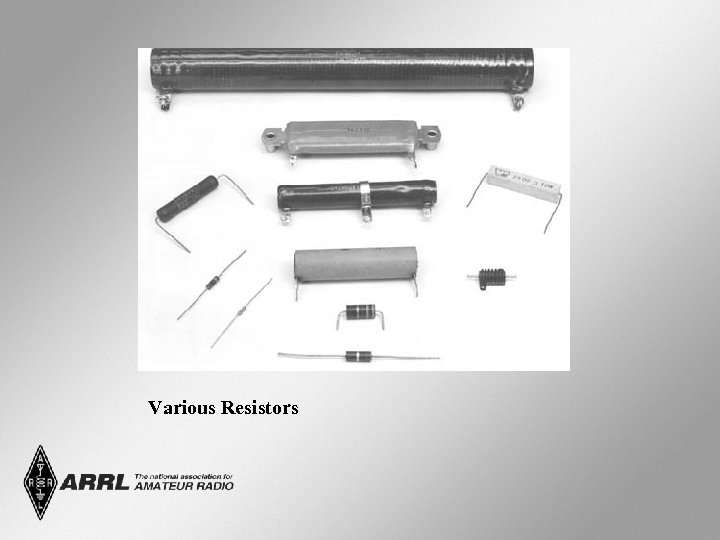 Various Resistors
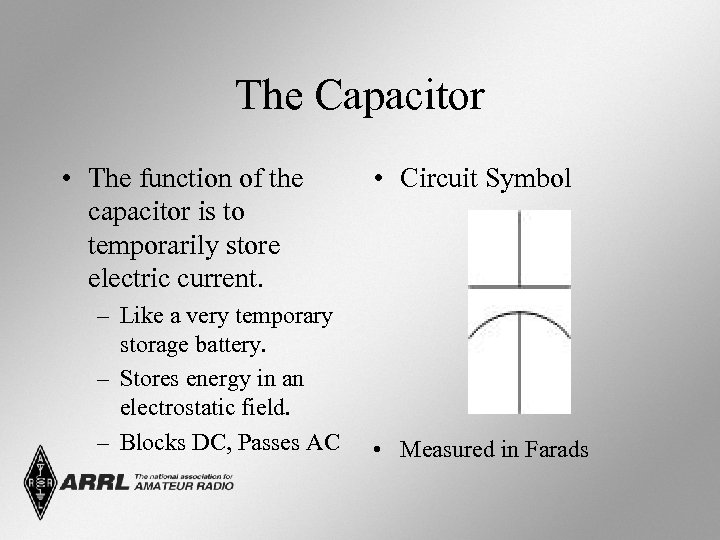 The Capacitor • The function of the capacitor is to temporarily store electric current. – Like a very temporary storage battery. – Stores energy in an electrostatic field. – Blocks DC, Passes AC • Circuit Symbol • Measured in Farads
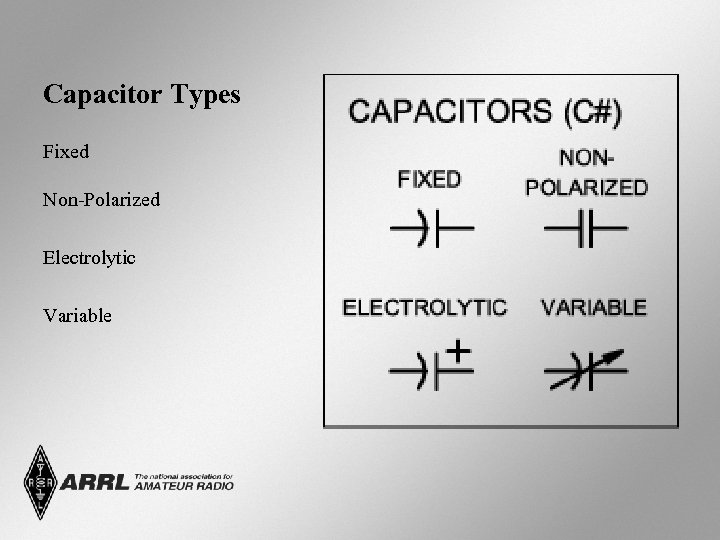 Capacitor Types Fixed Non-Polarized Electrolytic Variable
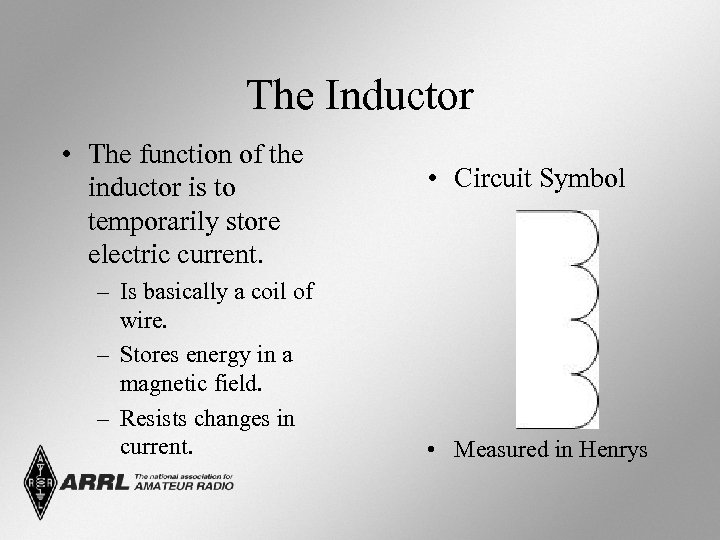 The Inductor • The function of the inductor is to temporarily store electric current. – Is basically a coil of wire. – Stores energy in a magnetic field. – Resists changes in current. • Circuit Symbol • Measured in Henrys
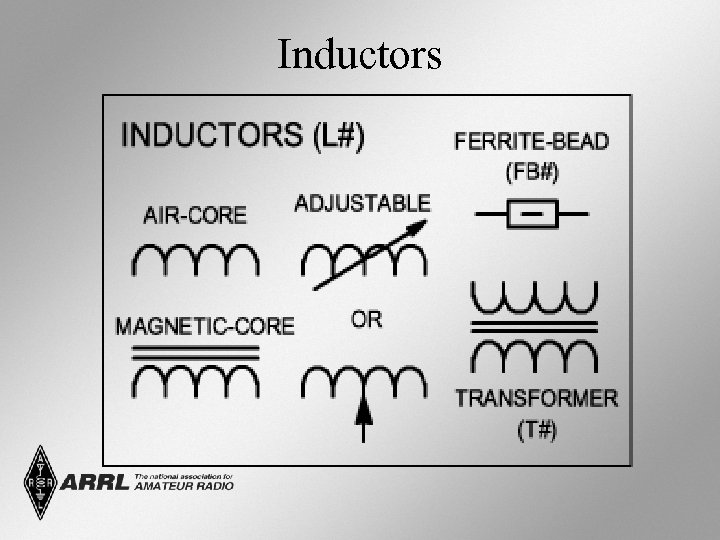 Inductors
 Reactance • Electrical current interacts with both capacitors and inductors. This interaction is called reactance, and varies with frequency. • Capacitors store energy in an electrostatic field. Capacitors oppose changes in voltage. • Inductors store energy in a magnetic field. Inductors oppose changes in current. • Reactance is measured in ohms.
 Resonance • Because capacitors and inductors store energy in different ways, the stored energy can actually cancel each other under the right conditions (at a particular frequency). – Capacitors – electric field – Inductors – magnetic field • Cancelled current = no reactance, just leaving resistance.
 Resonant Antenna • If an antenna is designed correctly, the capacitive reactance cancels the inductive reactance. • Theoretically, the resulting reactance is zero. – Leaving only resistance – meaning minimum impediment to the radio frequency currents flowing in the antenna and sending the radio wave into space.
 Antennas are Part Capacitor – Part Inductor – Part Resistor • Antennas actually have characteristics of capacitor, inductor and resistor electronic components. • Capacitors and inductors, because they store energy in fields, react differently to ac than dc. – Special kind of resistance to the flow of ac – called reactance.
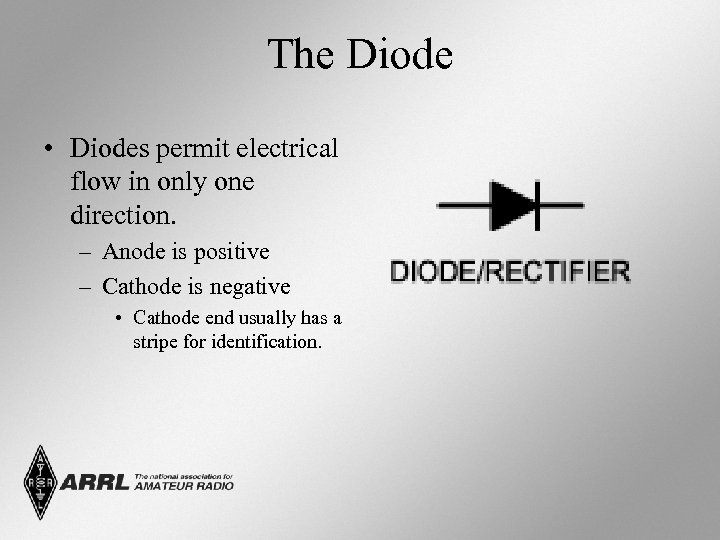 The Diode • Diodes permit electrical flow in only one direction. – Anode is positive – Cathode is negative • Cathode end usually has a stripe for identification.
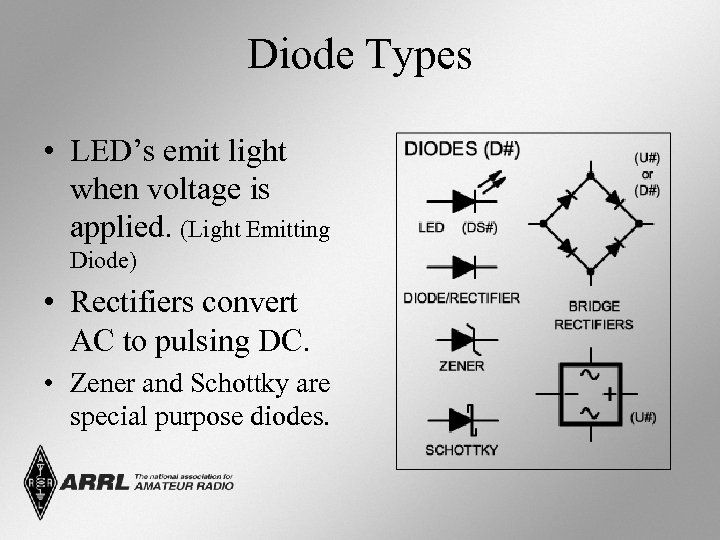 Diode Types • LED’s emit light when voltage is applied. (Light Emitting Diode) • Rectifiers convert AC to pulsing DC. • Zener and Schottky are special purpose diodes.
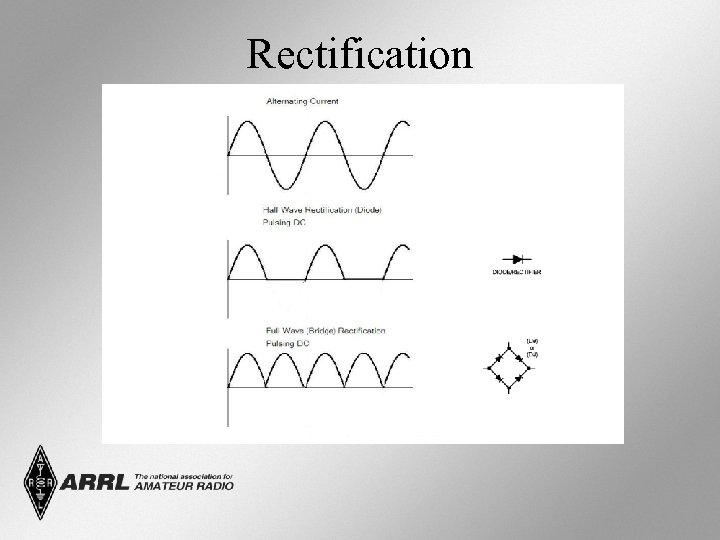 Rectification
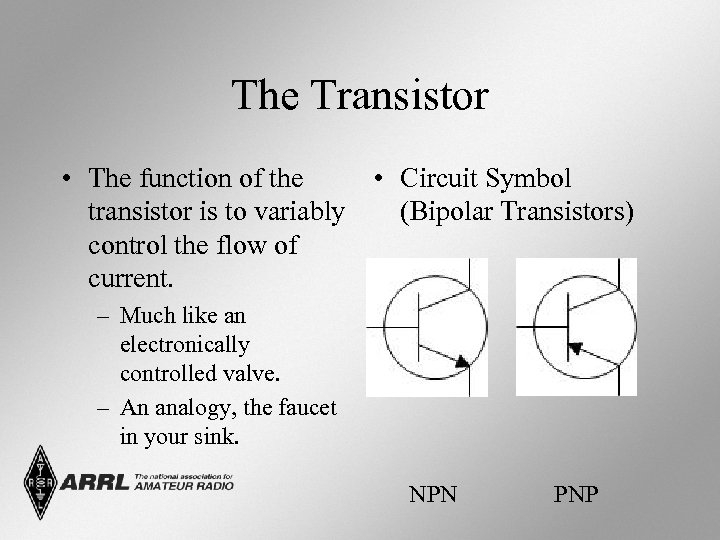 The Transistor • The function of the • Circuit Symbol transistor is to variably (Bipolar Transistors) control the flow of current. – Much like an electronically controlled valve. – An analogy, the faucet in your sink. NPN PNP
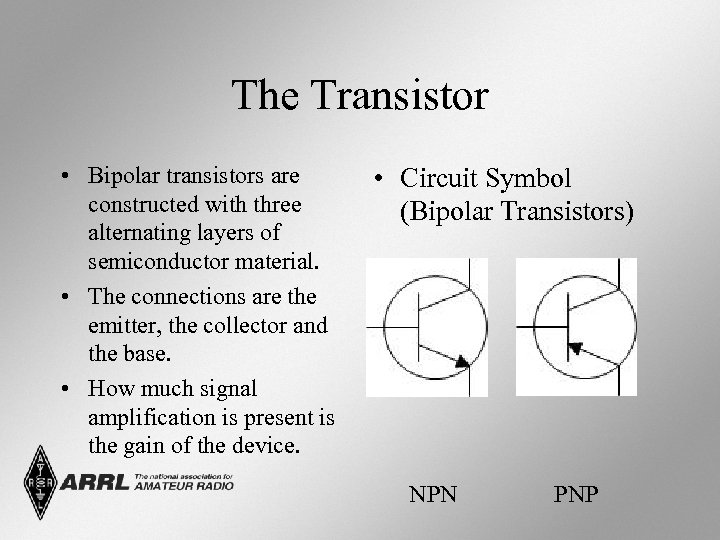 The Transistor • Bipolar transistors are constructed with three alternating layers of semiconductor material. • The connections are the emitter, the collector and the base. • How much signal amplification is present is the gain of the device. • Circuit Symbol (Bipolar Transistors) NPN PNP
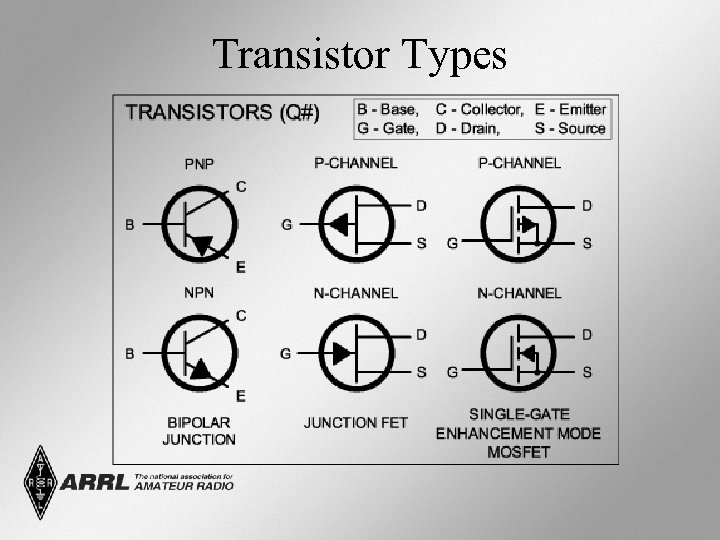 Transistor Types
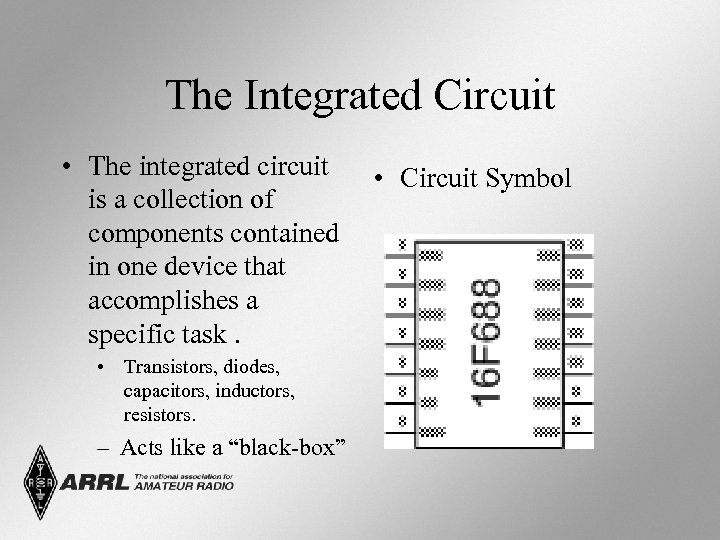 The Integrated Circuit • The integrated circuit is a collection of components contained in one device that accomplishes a specific task. • Transistors, diodes, capacitors, inductors, resistors. – Acts like a “black-box” • Circuit Symbol
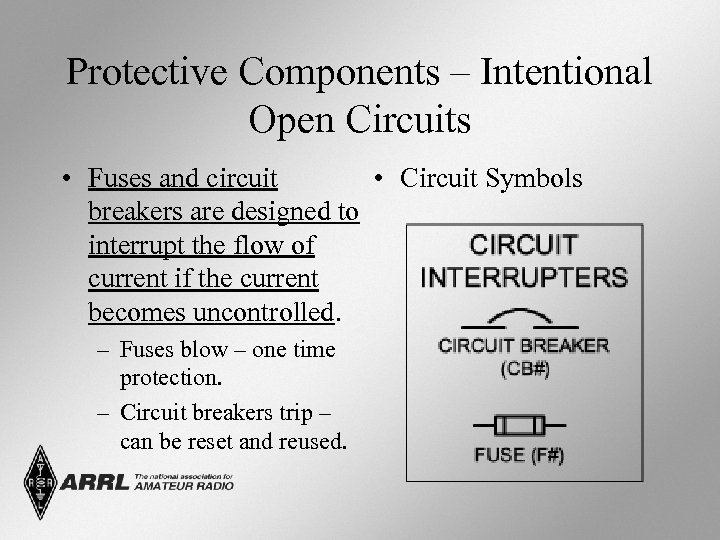 Protective Components – Intentional Open Circuits • Fuses and circuit • Circuit Symbols breakers are designed to interrupt the flow of current if the current becomes uncontrolled. – Fuses blow – one time protection. – Circuit breakers trip – can be reset and reused.
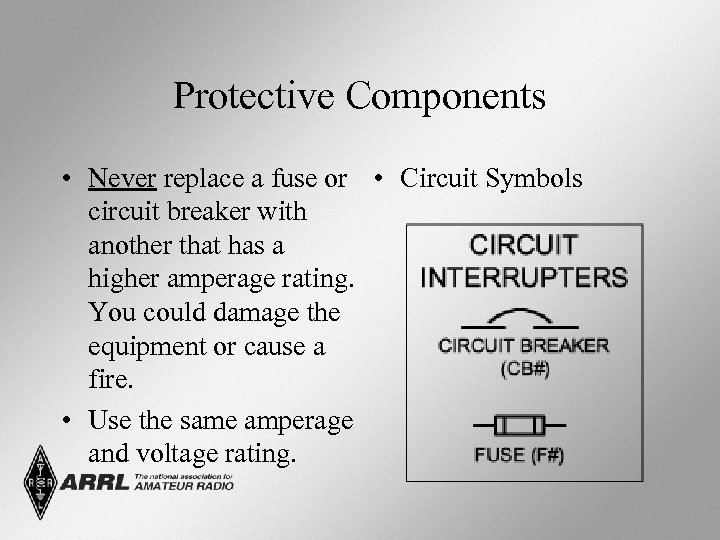 Protective Components • Never replace a fuse or • Circuit Symbols circuit breaker with another that has a higher amperage rating. You could damage the equipment or cause a fire. • Use the same amperage and voltage rating.
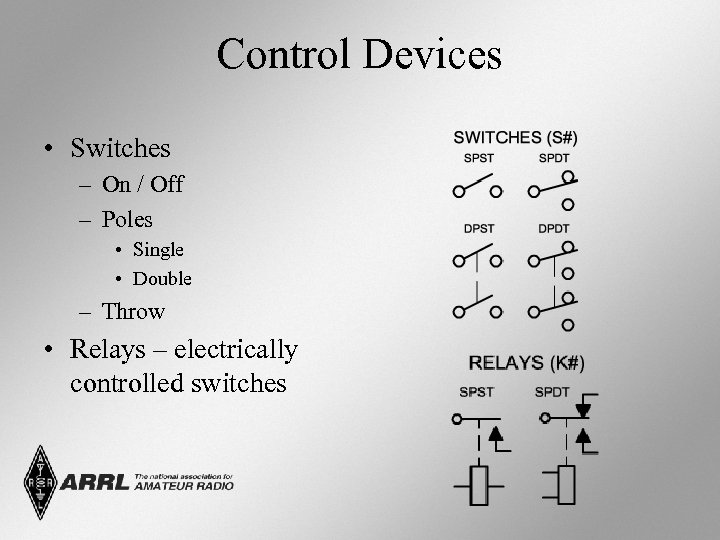 Control Devices • Switches – On / Off – Poles • Single • Double – Throw • Relays – electrically controlled switches
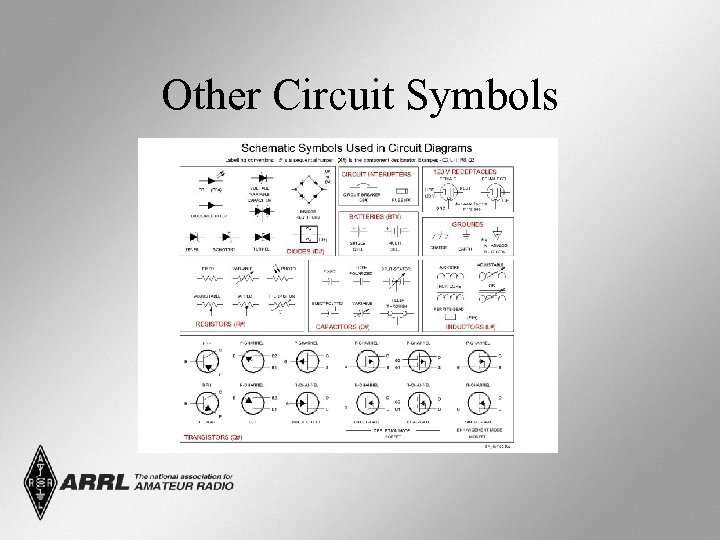 Other Circuit Symbols
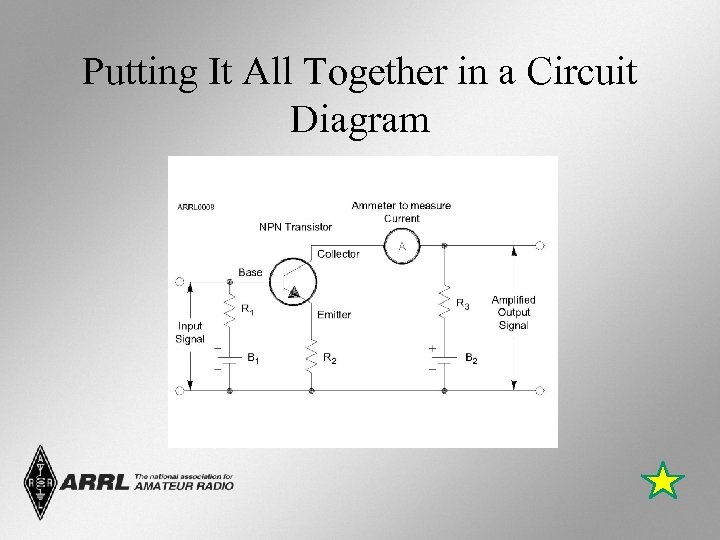 Putting It All Together in a Circuit Diagram
 What is the ability to store energy in an electric field called? (T 5 C 01) • • A. B. C. D. Inductance Resistance Tolerance Capacitance
 What is the ability to store energy in an electric field called? (T 5 C 01) • • A. B. C. D. Inductance Resistance Tolerance Capacitance
 What is the basic unit of capacitance? (T 5 C 02) • • A. B. C. D. The farad The ohm The volt The henry
 What is the basic unit of capacitance? (T 5 C 02) • • A. B. C. D. The farad The ohm The volt The henry
 What is the ability to store energy in a magnetic field called? (T 5 C 03) • • A. B. C. D. Admittance Capacitance Resistance Inductance
 What is the ability to store energy in a magnetic field called? (T 5 C 03) • • A. B. C. D. Admittance Capacitance Resistance Inductance
 What is the basic unit of inductance? (T 5 C 04) • • A. B. C. D. The coulomb The farad The henry The ohm
 What is the basic unit of inductance? (T 5 C 04) • • A. B. C. D. The coulomb The farad The henry The ohm
 What electrical component is used to oppose the flow of current in a DC circuit? (T 6 A 01) • • A. B. C. D. Inductor Resistor Voltmeter Transformer
 What electrical component is used to oppose the flow of current in a DC circuit? (T 6 A 01) • • A. B. C. D. Inductor Resistor Voltmeter Transformer
 What type of component is often used as an adjustable volume control? (T 6 A 02) • • A. B. C. D. Fixed resistor Power resistor Potentiometer Transformer
 What type of component is often used as an adjustable volume control? (T 6 A 02) • • A. B. C. D. Fixed resistor Power resistor Potentiometer Transformer
 What electrical parameter is controlled by a potentiometer? (T 6 A 03) • • A. B. C. D. Inductance Resistance Capacitance Field strength
 What electrical parameter is controlled by a potentiometer? (T 6 A 03) • • A. B. C. D. Inductance Resistance Capacitance Field strength
 What electrical component stores energy in an electric field? (T 6 A 04) • • A. B. C. D. Resistor Capacitor Inductor Diode
 What electrical component stores energy in an electric field? (T 6 A 04) • • A. B. C. D. Resistor Capacitor Inductor Diode
 What type of electrical component consists of two or more conductive surfaces separated by an insulator? (T 6 A 05) • • A. B. C. D. Resistor Potentiometer Oscillator Capacitor
 What type of electrical component consists of two or more conductive surfaces separated by an insulator? (T 6 A 05) • • A. B. C. D. Resistor Potentiometer Oscillator Capacitor
 What type of electrical component stores energy in a magnetic field? (T 6 A 06) • • A. B. C. D. Resistor Capacitor Inductor Diode
 What type of electrical component stores energy in a magnetic field? (T 6 A 06) • • A. B. C. D. Resistor Capacitor Inductor Diode
 What electrical component is usually composed of a coil of wire? (T 6 A 07) • • A. B. C. D. Switch Capacitor Diode Inductor
 What electrical component is usually composed of a coil of wire? (T 6 A 07) • • A. B. C. D. Switch Capacitor Diode Inductor
 What electrical component is used to connect or disconnect electrical circuits? (T 6 A 08) • • A. B. C. D. Zener diode Switch Inductor Variable resistor
 What electrical component is used to connect or disconnect electrical circuits? (T 6 A 08) • • A. B. C. D. Zener diode Switch Inductor Variable resistor
 What electrical component is used to protect other circuit components from current overloads? (T 6 A 09) • • A. B. C. D. Fuse Capacitor Shield Inductor
 What electrical component is used to protect other circuit components from current overloads? (T 6 A 09) • • A. B. C. D. Fuse Capacitor Shield Inductor
 What class of electronic components is capable of using a voltage or current signal to control current flow? (T 6 B 01) • • A. B. C. D. Capacitors Inductors Resistors Transistors
 What class of electronic components is capable of using a voltage or current signal to control current flow? (T 6 B 01) • • A. B. C. D. Capacitors Inductors Resistors Transistors
 What electronic component allows current to flow in only one direction? (T 6 B 02) • • A. B. C. D. Resistor Fuse Diode Driven element
 What electronic component allows current to flow in only one direction? (T 6 B 02) • • A. B. C. D. Resistor Fuse Diode Driven element
 Which of these components can be used as an electronic switch or amplifier? (T 6 B 03) • • A. B. C. D. Oscillator Potentiometer Transistor Voltmeter
 Which of these components can be used as an electronic switch or amplifier? (T 6 B 03) • • A. B. C. D. Oscillator Potentiometer Transistor Voltmeter
 Which of these components is made of three layers of semiconductor material? (T 6 B 04) • • A. B. C. D. Alternator Bipolar junction transistor Triode Pentagrid converter
 Which of these components is made of three layers of semiconductor material? (T 6 B 04) • • A. B. C. D. Alternator Bipolar junction transistor Triode Pentagrid converter
 Which of the following electronic components can amplify signals? (T 6 B 05) • • A. B. C. D. Transistor Variable resistor Electrolytic capacitor Multi-cell battery
 Which of the following electronic components can amplify signals? (T 6 B 05) • • A. B. C. D. Transistor Variable resistor Electrolytic capacitor Multi-cell battery
 How is a semiconductor diode’s cathode lead usually identified? (T 6 B 06) • • A. B. C. D. With the word “cathode” With a stripe With the letter “C” All of these choices are correct
 How is a semiconductor diode’s cathode lead usually identified? (T 6 B 06) • • A. B. C. D. With the word “cathode” With a stripe With the letter “C” All of these choices are correct
 What does the abbreviation “LED” stand for? (T 6 B 07) • • A. B. C. D. Low Emission Diode Light Emitting Diode Liquid Emission Detector Long Echo Delay
 What does the abbreviation “LED” stand for? (T 6 B 07) • • A. B. C. D. Low Emission Diode Light Emitting Diode Liquid Emission Detector Long Echo Delay
 What does the abbreviation “FET” stand for? (T 6 B 08) • • A. B. C. D. Field Effect Transistor Fast Electron Transistor Free Electron Transition Field Emission Thickness
 What does the abbreviation “FET” stand for? (T 6 B 08) • • A. B. C. D. Field Effect Transistor Fast Electron Transistor Free Electron Transition Field Emission Thickness
 What are the names of the two electrodes of a diode? (T 6 B 09) • • A. B. C. D. Plus and minus Source and drain Anode and cathode Gate and base
 What are the names of the two electrodes of a diode? (T 6 B 09) • • A. B. C. D. Plus and minus Source and drain Anode and cathode Gate and base
 Which semiconductor component has an emitter electrode? (T 6 B 10) • • A. B. C. D. Bipolar transistor Field effect transistor Silicon diode Bridge rectifier
 Which semiconductor component has an emitter electrode? (T 6 B 10) • • A. B. C. D. Bipolar transistor Field effect transistor Silicon diode Bridge rectifier
 Which semiconductor component has a gate electrode? (T 6 B 11) • • A. B. C. D. Bipolar transistor Field effect transistor Silicon diode Bridge rectifier
 Which semiconductor component has a gate electrode? (T 6 B 11) • • A. B. C. D. Bipolar transistor Field effect transistor Silicon diode Bridge rectifier
 What is the term that describes a transistor’s ability to amplify a signal? (T 6 B 12) • • A. B. C. D. Gain Forward resistance Forward voltage drop On resistance
 What is the term that describes a transistor’s ability to amplify a signal? (T 6 B 12) • • A. B. C. D. Gain Forward resistance Forward voltage drop On resistance
 What is the name for standardized representations of components in an electrical wiring diagram? (T 6 C 01) • • A. B. C. D. Electrical depictions Grey sketch Schematic symbols Component callouts
 What is the name for standardized representations of components in an electrical wiring diagram? (T 6 C 01) • • A. B. C. D. Electrical depictions Grey sketch Schematic symbols Component callouts
 Which of the following is accurately represented in electrical circuit schematic diagrams? (T 6 C 13) • A. Wire lengths • B. Physical appearance of components • C. The way components are interconnected • D. All of these choices are correct
 Which of the following is accurately represented in electrical circuit schematic diagrams? (T 6 C 13) • A. Wire lengths • B. Physical appearance of components • C. The way components are interconnected • D. All of these choices are correct
 Which of the following devices or circuits changes an alternating current into a varying direct current signal? (T 6 D 01) • • A. B. C. D. Transformer Rectifier Amplifier Reflector
 Which of the following devices or circuits changes an alternating current into a varying direct current signal? (T 6 D 01) • • A. B. C. D. Transformer Rectifier Amplifier Reflector
 Which best describes a relay? (T 6 D 02) • A. A switch controlled by an electromagnet • B. A current controlled amplifier • C. An optical sensor • D. A pass transistor
 Which best describes a relay? (T 6 D 02) • A. A switch controlled by an electromagnet • B. A current controlled amplifier • C. An optical sensor • D. A pass transistor
 Which of the following can be used to display signal strength on a numeric scale? (T 6 D 04) • • A. B. C. D. Potentiometer Transistor Meter Relay
 Which of the following can be used to display signal strength on a numeric scale? (T 6 D 04) • • A. B. C. D. Potentiometer Transistor Meter Relay
 What component is commonly used to change 120 V AC house current to a lower AC voltage for other uses? (T 6 D 06) • • A. B. C. D. Variable capacitor Transformer Transistor Diode
 What component is commonly used to change 120 V AC house current to a lower AC voltage for other uses? (T 6 D 06) • • A. B. C. D. Variable capacitor Transformer Transistor Diode
 Which of the following is commonly used as a visual indicator? (T 6 D 07) • • A. B. C. D. LED FET Zener diode Bipolar transistor
 Which of the following is commonly used as a visual indicator? (T 6 D 07) • • A. B. C. D. LED FET Zener diode Bipolar transistor
 Which of the following is used together with an inductor to make a tuned circuit? (T 6 D 08) • • A. B. C. D. Resistor Zener diode Potentiometer Capacitor
 Which of the following is used together with an inductor to make a tuned circuit? (T 6 D 08) • • A. B. C. D. Resistor Zener diode Potentiometer Capacitor
 What is the name of the device that combines several semiconductors and other components into one package? (T 6 D 09) • • A. B. C. D. Transducer Multi-pole relay Integrated circuit Transformer
 What is the name of the device that combines several semiconductors and other components into one package? (T 6 D 09) • • A. B. C. D. Transducer Multi-pole relay Integrated circuit Transformer
 What is the purpose of a fuse in an electrical circuit? (T 0 A 04) • A. To prevent power supply ripple from damaging a circuit • B. To interrupt power in case of overload • C. To limit current to prevent shocks • D. All of these choices are correct
 What is the purpose of a fuse in an electrical circuit? (T 0 A 04) • A. To prevent power supply ripple from damaging a circuit • B. To interrupt power in case of overload • C. To limit current to prevent shocks • D. All of these choices are correct
 Why is it unwise to install a 20 -ampere fuse in the place of a 5 ampere fuse? (T 0 A 05) • A. The larger fuse would be likely to blow because it is rated for higher current • B. The power supply ripple would greatly increase • C. Excessive current could cause a fire • D. All of these choices are correct
 Why is it unwise to install a 20 -ampere fuse in the place of a 5 ampere fuse? (T 0 A 05) • A. The larger fuse would be likely to blow because it is rated for higher current • B. The power supply ripple would greatly increase • C. Excessive current could cause a fire • D. All of these choices are correct