


 Скачать презентацию Technician License Class Chapter 7 Licensing Regulations
adf750be58223de5c4b1c4d928de45a9.ppt
- Количество слайдов: 183
 Technician License Class Chapter 7 Licensing Regulations
 Licensing Terms § Federal Communications Commission (FCC). § The FCC is the federal agency that: § Makes all of the rules that govern amateur radio in the United State & territories. § Issues station and operator licenses. § Enforces the rules.
 Licensing Terms § Part 97. § All of the FCC rules and regulations are found in Title 47 of the Code of Federal Regulations (CFR). § The primary rules governing the Amateur Radio Service are found in Part 97 of CFR Title 47. § Other parts of the FCC rules also affect amateur radio: § Part 2. § Part 15. § Part 17.
 Licensing Terms § Part 97. § Basis and purpose of the Amateur Radio Service. § The very first rule lays the foundation for the Amateur Radio Service by listing the 5 basic principles upon which amateur radio is founded. § Explains the “mission” of amateur radio. § Justifies the allocation of valuable RF spectrum to amateur radio.
 Licensing Terms § 97. 1 Basis and purpose. The rules and regulations in this part are designed to provide an amateur radio service having a fundamental purpose as expressed in the following principles: (a) Recognition and enhancement of the value of the amateur service to the public as a voluntary noncommercial communication service, particularly with respect to providing emergency communications. (b) Continuation and extension of the amateur's proven ability to contribute to the advancement of the radio art. (c) Encouragement and improvement of the amateur service through rules which provide for advancing skills in both the communication and technical phases of the art. (d) Expansion of the existing reservoir within the amateur radio service of trained operators, technicians, and electronics experts. (e) Continuation and extension of the amateur's unique ability to enhance international goodwill.
 Licensing Terms § Part 97. § Definitions. § Amateur service -- § 97. 3(a)(4) A radiocommunication service for the purpose of self-training, intercommunication and technical investigations carried out by amateurs, that is, duly authorized persons interested in radio technique solely with a personal aim and without pecuniary interest.
 Licensing Terms § Part 97. § Definitions. § Amateur operator -- § 97. 3(a)(1) A person named in an amateur operator/primary license station grant on the ULS consolidated licensee database to be the control operator of an amateur station. § Amateur station-- § 97. 3(a)(5) A station in an amateur radio service consisting of the apparatus necessary for carrying on radiocommunications.
 Licensing Terms § Types and Classes of Licenses. § Anyone can get a US amateur radio license. § Must pass written exam. § Must have US mailing address. § No other requirements or restrictions. § Exception – Cannot be a representative of a foreign government.
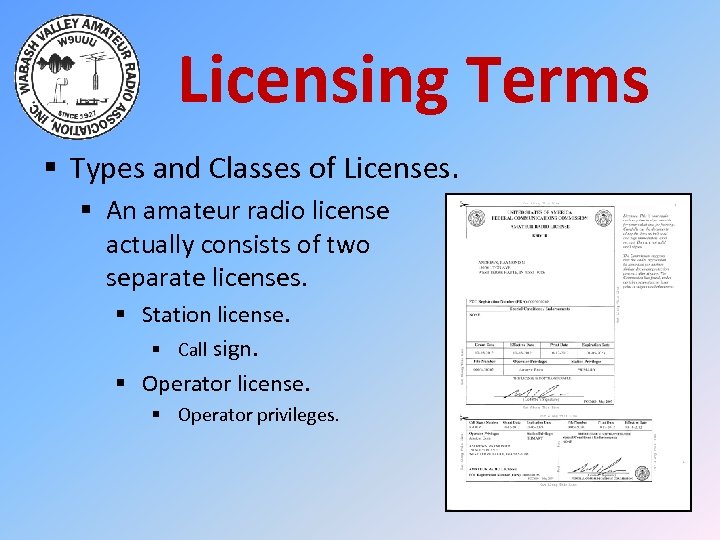 Licensing Terms § Types and Classes of Licenses. § An amateur radio license actually consists of two separate licenses. § Station license. § Call sign. § Operator license. § Operator privileges.
 Licensing Terms § Types and Classes of Licenses. § Types of station licenses. § Individual. § Club Station. § 4 or more members. § Operating privileges same as trustee. § Military Recreation Station. § RACES Station. § No longer issued.
 Licensing Terms § Types and Classes of Licenses. § Currently three classes of operator licenses are being issued: § Technician Class. § All privileges above 50 MHz. § Limited HF privileges. § General Class. § Privileges on all amateur bands. § Amateur Extra Class. § All amateur privileges.
 Licensing Terms § Types and Classes of Licenses. § Previous classes of operator privileges: § No new ones being issued, but existing licenses may be renewed. § Novice. § Entry-level license. § Limited CW privileges on 80 m, 40 m, 15 m, & 10 m. § Limited phone privileges on 10 m, 1. 25 m, & 23 cm. § Advanced. § More phone privileges than General Class.
 Licensing Terms § Types and Classes of Licenses. § Previous classes of operator privileges: § No longer exist. § Technician Plus. § Combination of Novice & Technician. § Converted to Technician Class. § Conditional. § Same privileges as General Class. § Converted to General Class.
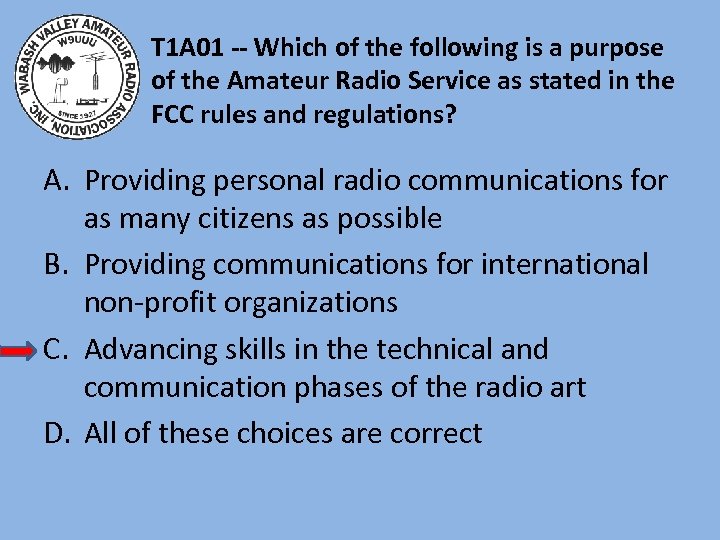 T 1 A 01 -- Which of the following is a purpose of the Amateur Radio Service as stated in the FCC rules and regulations? A. Providing personal radio communications for as many citizens as possible B. Providing communications for international non-profit organizations C. Advancing skills in the technical and communication phases of the radio art D. All of these choices are correct
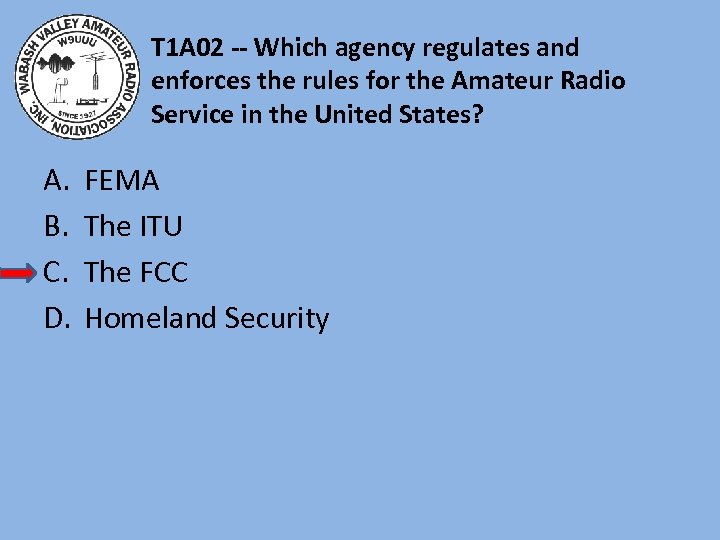 T 1 A 02 -- Which agency regulates and enforces the rules for the Amateur Radio Service in the United States? A. B. C. D. FEMA The ITU The FCC Homeland Security
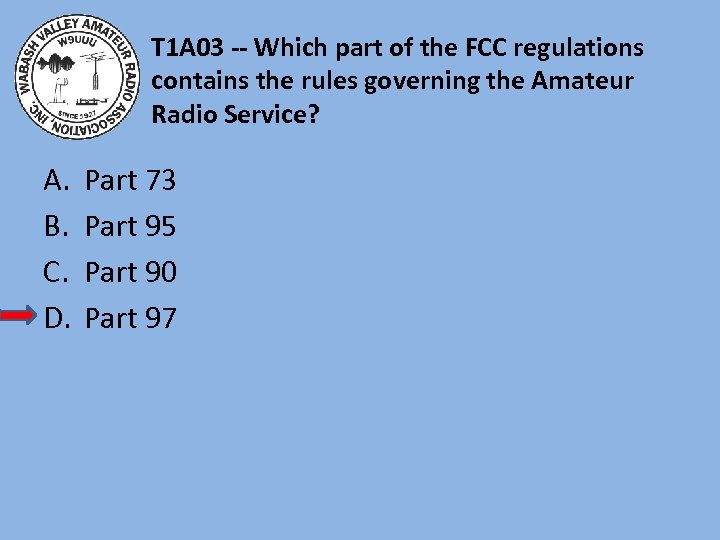 T 1 A 03 -- Which part of the FCC regulations contains the rules governing the Amateur Radio Service? A. B. C. D. Part 73 Part 95 Part 90 Part 97
 T 1 A 05 -- Which of the following is a purpose of the Amateur Radio Service rules and regulations as defined by the FCC? A. Enhancing international goodwill B. Providing inexpensive communication for local emergency organizations C. Training of operators in military radio operating procedures D. All of these choices are correct
 T 1 A 10 -- What is the FCC Part 97 definition of an amateur station? A. A station in the Amateur Radio Service consisting of the apparatus necessary for carrying on radio communications B. A building where Amateur Radio receivers, transmitters, and RF power amplifiers are installed C. Any radio station operated by a nonprofessional D. Any radio station for hobby use
 T 1 A 12 -- Which of the following is a permissible use of the Amateur Radio Service? A. Broadcasting music and videos to friends B. Providing a way for amateur radio operators to earn additional income by using their stations to pass messages C. Providing low-cost communications for start-up businesses D. Allowing a person to conduct radio experiments and to communicate with other licensed hams around the world
 T 1 C 13 -- For which licenses classes are new licenses currently available from the FCC? A. Novice, Technician, General, Advanced B. Technician, Technician Plus, General, Advanced C. Novice, Technician Plus, General, Advanced D. Technician, General, Amateur Extra
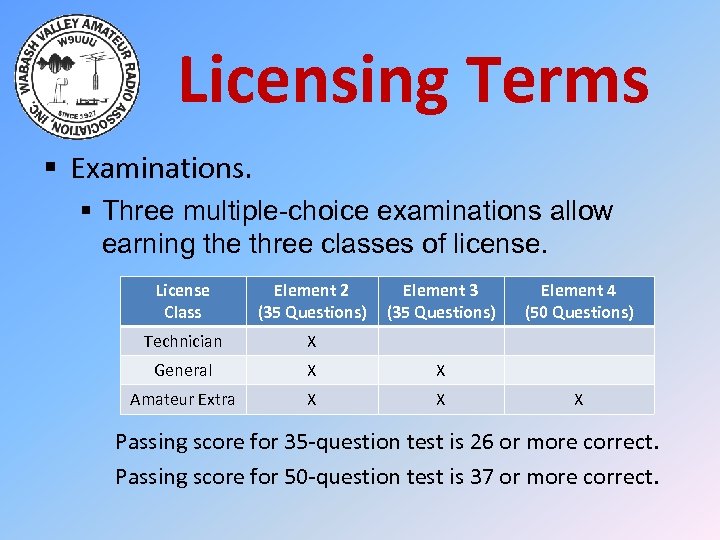 Licensing Terms § Examinations. § Three multiple-choice examinations allow earning the three classes of license. License Class Element 2 (35 Questions) Element 3 (35 Questions) Technician X General X X Amateur Extra X X Element 4 (50 Questions) X Passing score for 35 -question test is 26 or more correct. Passing score for 50 -question test is 37 or more correct.
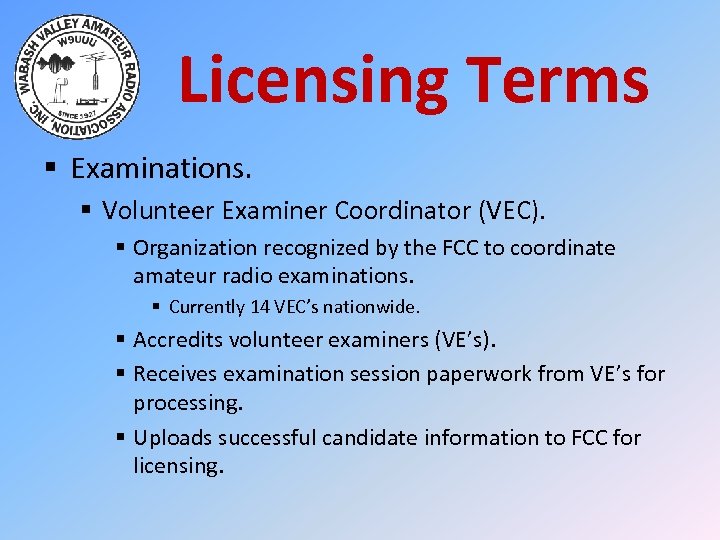 Licensing Terms § Examinations. § Volunteer Examiner Coordinator (VEC). § Organization recognized by the FCC to coordinate amateur radio examinations. § Currently 14 VEC’s nationwide. § Accredits volunteer examiners (VE’s). § Receives examination session paperwork from VE’s for processing. § Uploads successful candidate information to FCC for licensing.
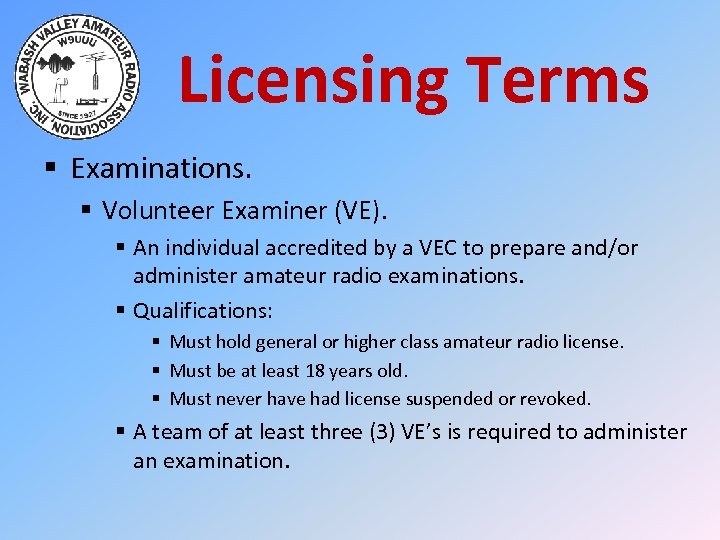 Licensing Terms § Examinations. § Volunteer Examiner (VE). § An individual accredited by a VEC to prepare and/or administer amateur radio examinations. § Qualifications: § Must hold general or higher class amateur radio license. § Must be at least 18 years old. § Must never have had license suspended or revoked. § A team of at least three (3) VE’s is required to administer an examination.
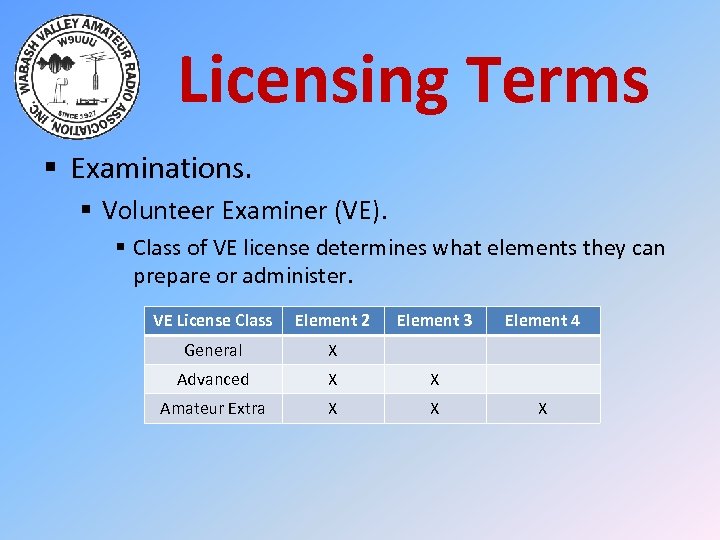 Licensing Terms § Examinations. § Volunteer Examiner (VE). § Class of VE license determines what elements they can prepare or administer. VE License Class Element 2 Element 3 General X Advanced X X Amateur Extra X X Element 4 X
 Licensing Terms § Examinations. § Taking the exam. § Find a nearby test session. § http: //www. arrl. org/find-an-amateur-radio-license-exam-session § http: //www. laurelvec. com/? pg=exams § Contact VE team to pre-register, if required. § Arrive at exam session location at the scheduled time. § Bring all required documents & materials.
 Licensing Terms § Examinations. § What to bring to the exam. § Photo ID. § Original of any existing license. § Some VEC’s require a photocopy in addition to the original. § Original & photocopy of any CSCE’s. § Copies of supporting documentation for element credit. § Cash or check for exam fee (if any). § Not all VEC’s charge a fee.
 Licensing Terms § Examinations. § What to bring to the exam. § Calculator memory must be cleared. § Cannot use calculator in cell phone. § Pen for filling out & signing application. § Pencils for filling out test answer sheets.
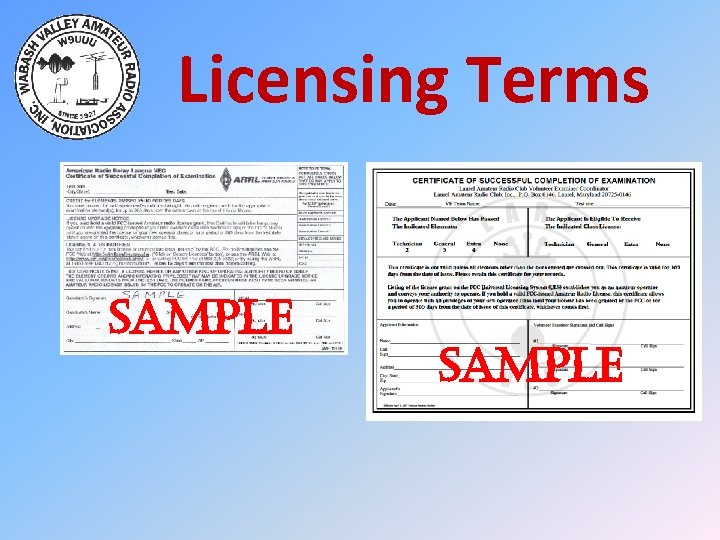
 Licensing Terms § Examinations. § Certificate of Successful Completion of Examination (CSCE). § Issued to certify that applicant has passed examination elements and/or earned a specific class of license. § Signed by 3 VE’s. § Signed by applicant.
 Licensing Terms SAMPLE
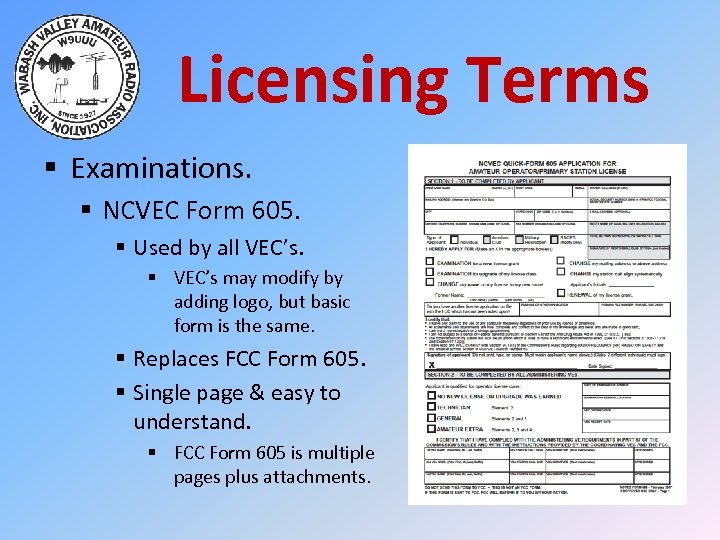 Licensing Terms § Examinations. § NCVEC Form 605. § Used by all VEC’s. § VEC’s may modify by adding logo, but basic form is the same. § Replaces FCC Form 605. § Single page & easy to understand. § FCC Form 605 is multiple pages plus attachments.
 Licensing Terms § Examinations. § Following test session, VE team will forward paperwork to VEC for processing. § VEC will check session paperwork & upload data on successful applicants to FCC for processing. § FCC processes data file & issues licenses.
 Licensing Terms § Examinations. § New licensees can operate as soon as a call sign is assigned by the FCC. § http: //fcc. gov/uls § Existing amateurs who upgrade can use their new privileges immediately. §
 Licensing Terms § Term of License and Renewal. § Licenses are issued for a term of 10 years. § Licenses may be renewed for additional 10 -year terms without re-examination. § No fee for renewal. § Cannot renew prior to 90 days before or later than 2 years after the expiration date. § 2 -year “grace period” allows renewal without having to take the examination again. § License is NOT valid during grace period.
 Licensing Terms § Term of License and Renewal. § FCC is no longer routinely issuing paper licenses. § Put your e-mail address on NCVEC Form 605 to get a. pdf file of your license e-mailed to you. § Duplicate license. § If you lose your license, you may request a duplicate from the FCC. § Letter direct to FCC. § NCVEC Form 605 at exam session.
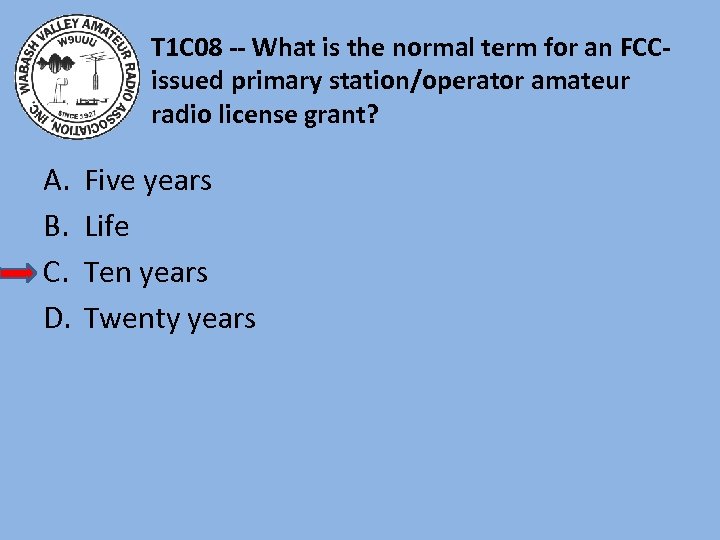 T 1 C 08 -- What is the normal term for an FCCissued primary station/operator amateur radio license grant? A. B. C. D. Five years Life Ten years Twenty years
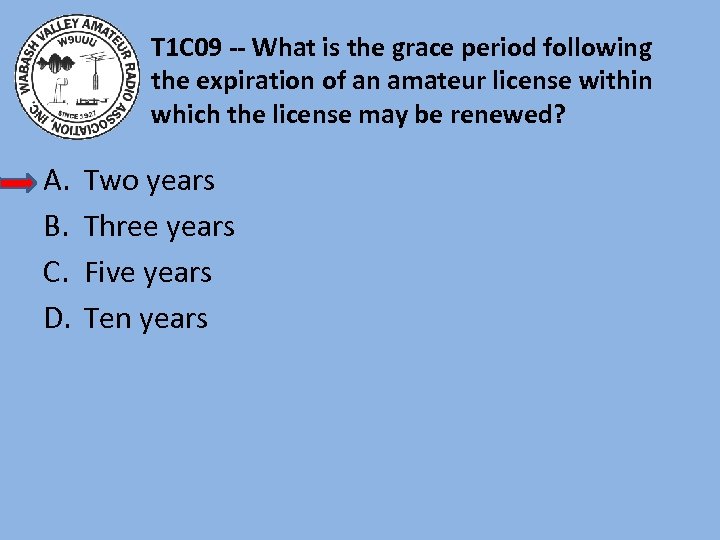 T 1 C 09 -- What is the grace period following the expiration of an amateur license within which the license may be renewed? A. B. C. D. Two years Three years Five years Ten years
 T 1 C 10 -- How soon after passing the examination for your first amateur radio license may you operate a transmitter on an amateur service frequency? A. Immediately B. 30 days after the test date C. As soon as your operator/station license grant appears in the FCC’s license database D. You must wait until you receive your license in the mail from the FCC
 T 1 C 11 -- If your license has expired and is still within the allowable grace period, may you continue to operate a transmitter on amateur service frequencies? A. No, transmitting is not allowed until the FCC license database shows that the license has been renewed B. Yes, but only if you identify using the suffix GP C. Yes, but only during authorized nets D. Yes, for up to two years
 Licensing Terms § Responsibilities. § Unauthorized operations. § The FCC requires that you secure your station against unauthorized or accidental operations. § Unlicensed family members are not permitted to operate your station when you are not present.
 Licensing Terms § Responsibilities. § Personal Information. § Mailing address. § The FCC requires that you maintain a current, valid mailing address or your license may be suspended or revoked. § Online via ULS. § NCVEC Form 605 via test session. § FCC Form 605 via mail to FCC. § FCC Registration Number (FRN). § Number used to identify you in the FCC database. § Social Security Number is required when registering.
 Licensing Terms § Responsibilities. § Station inspection. § You are required to make your station available for inspection at any time upon request by a representative of the FCC. § Equipment. § Logs. § Other documentation.
 T 1 C 07 -- What may result when correspondence from the FCC is returned as undeliverable because the grantee failed to provide the correct mailing address? A. Fine or imprisonment B. Revocation of the station license or suspension of the operator license C. Require the licensee to be re-examined D. A reduction of one rank in operator class
 T 1 F 13 -- When must the station licensee make the station and its records available for FCC inspection? A. At any time ten days after notification by the FCC of such an inspection B. At any time upon request by an FCC representative C. Only after failing to comply with an FCC notice of violation D. Only when presented with a valid warrant by an FCC official or government agent
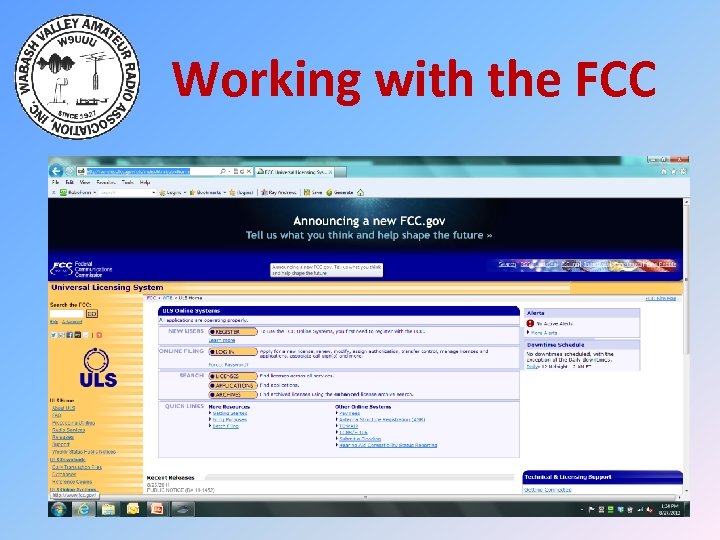
 Working with the FCC § The FCC ULS Website. § The Universal Licensing System (ULS). § Comprehensive database of all licenses issued by the FCC’s Wireless Telecommunications Bureau (WTB). § http: //wireless. fcc. gov/uls § By registering with the ULS, you can: § § § View your license information. Print your license. Modify your personal information (address, etc. ) Renew your license. Search other licenses.
 Working with the FCC § The FCC ULS Website. § Registering with the ULS. § You can register before you get your license. § You will be issued an FCC Registration Number (FRN). § If you have an FRN, always use your FRN and not your Social Security number on the NCVEC Form 605.
 Working with the FCC
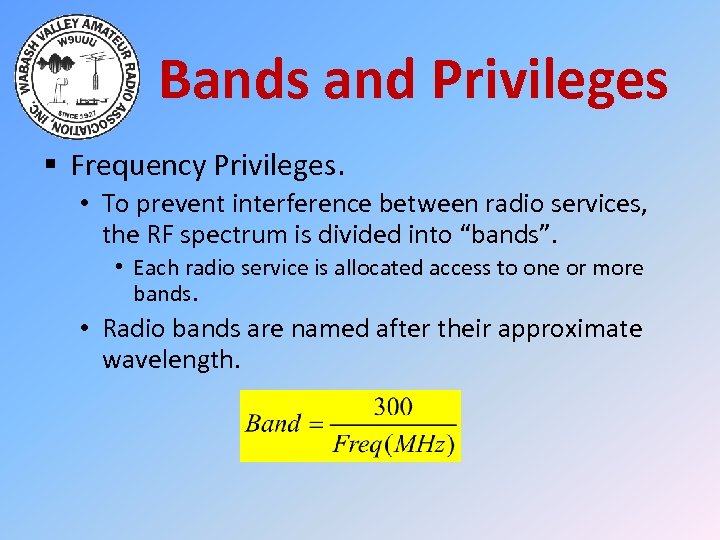 Bands and Privileges § Frequency Privileges. • To prevent interference between radio services, the RF spectrum is divided into “bands”. • Each radio service is allocated access to one or more bands. • Radio bands are named after their approximate wavelength.
 Bands and Privileges § Frequency Privileges. • Access to the various amateur radio bands is determined by the license class. • The Technician Class license. • Primarily gives access to VHF & UHF bands used for local communications and for experimentation. • Give some limited access to HF bands.
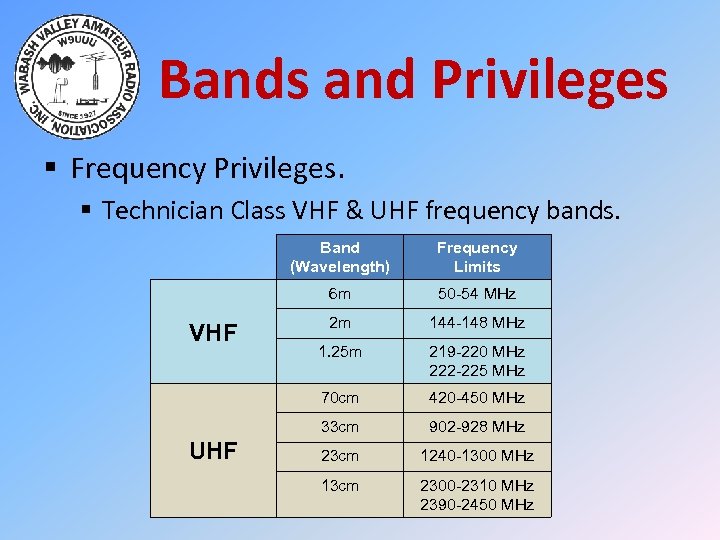 Bands and Privileges § Frequency Privileges. § Technician Class VHF & UHF frequency bands. Band (Wavelength) 6 m 2 m 144 -148 MHz 1. 25 m 219 -220 MHz 222 -225 MHz 420 -450 MHz 33 cm UHF 50 -54 MHz 70 cm VHF Frequency Limits 902 -928 MHz 23 cm 1240 -1300 MHz 13 cm 2300 -2310 MHz 2390 -2450 MHz
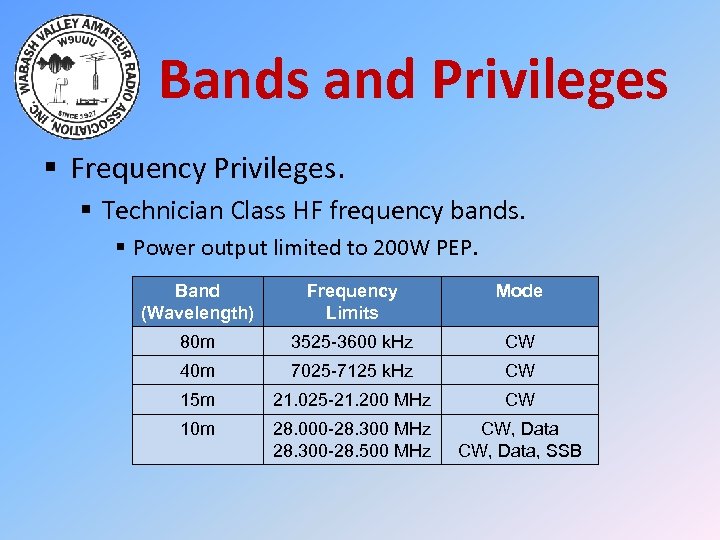 Bands and Privileges § Frequency Privileges. § Technician Class HF frequency bands. § Power output limited to 200 W PEP. Band (Wavelength) Frequency Limits Mode 80 m 3525 -3600 k. Hz CW 40 m 7025 -7125 k. Hz CW 15 m 21. 025 -21. 200 MHz CW 10 m 28. 000 -28. 300 MHz 28. 300 -28. 500 MHz CW, Data, SSB
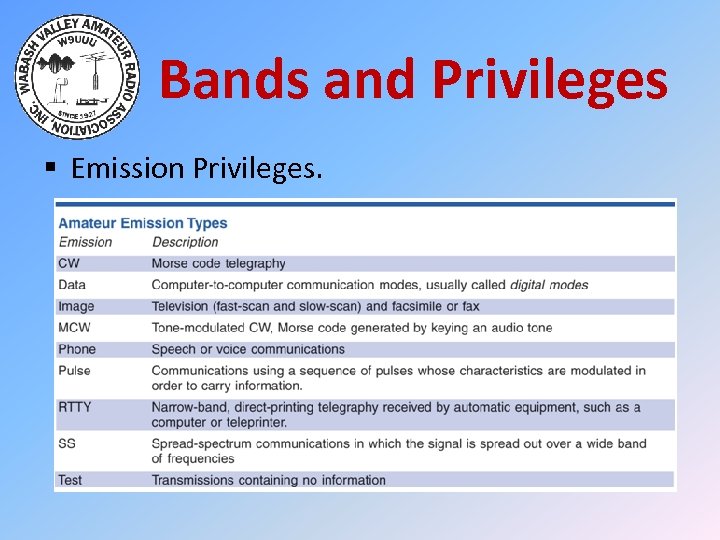 Bands and Privileges § Emission Privileges.
 Bands and Privileges § Emission Privileges. § On some bands, certain emissions may only be used in a specified portion of the band. § Bands with emission frequency limitations are: § HF -- 80 m, 40 m, 20 m, 17 m, 15 m, 12 m, & 10 m. § VHF -- 6 m, 2 m, 1. 25 m.
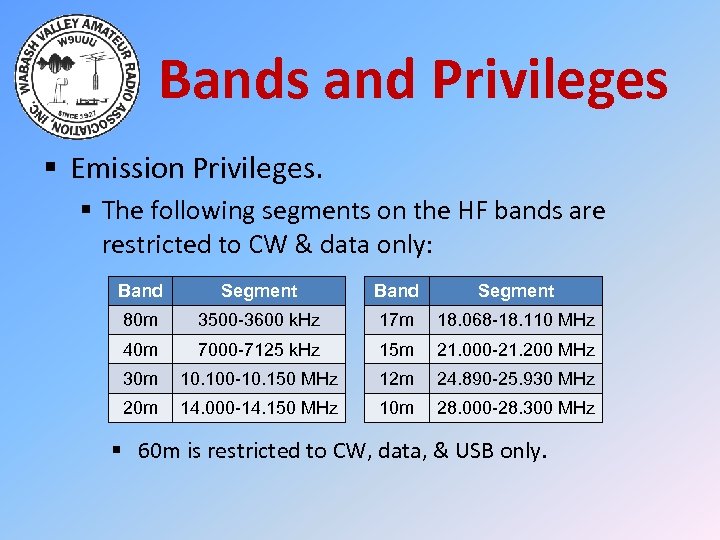 Bands and Privileges § Emission Privileges. § The following segments on the HF bands are restricted to CW & data only: Band Segment 80 m 3500 -3600 k. Hz 17 m 18. 068 -18. 110 MHz 40 m 7000 -7125 k. Hz 15 m 21. 000 -21. 200 MHz 30 m 10. 100 -10. 150 MHz 12 m 24. 890 -25. 930 MHz 20 m 14. 000 -14. 150 MHz 10 m 28. 000 -28. 300 MHz § 60 m is restricted to CW, data, & USB only.
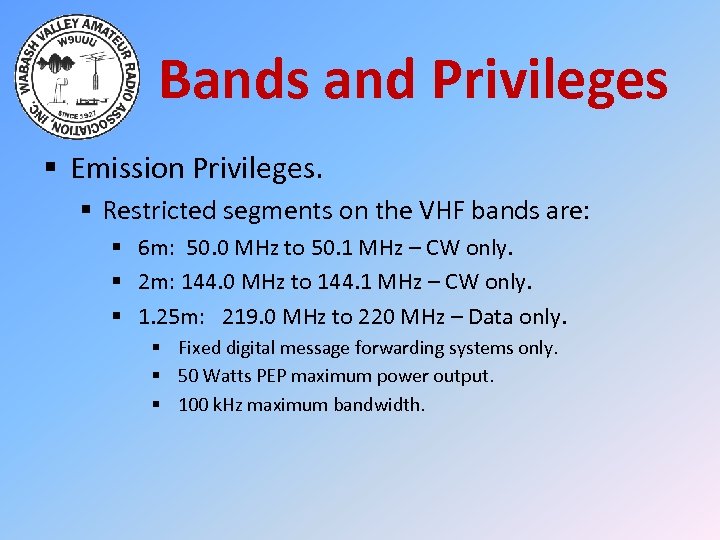 Bands and Privileges § Emission Privileges. § Restricted segments on the VHF bands are: § 6 m: 50. 0 MHz to 50. 1 MHz – CW only. § 2 m: 144. 0 MHz to 144. 1 MHz – CW only. § 1. 25 m: 219. 0 MHz to 220 MHz – Data only. § Fixed digital message forwarding systems only. § 50 Watts PEP maximum power output. § 100 k. Hz maximum bandwidth.
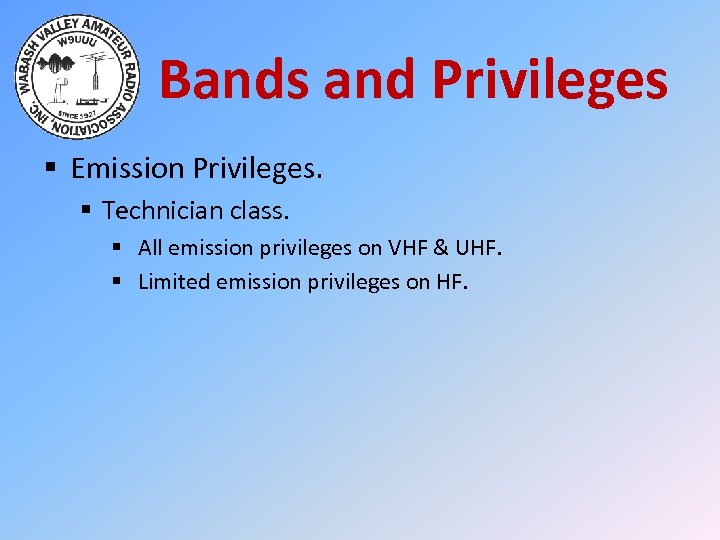 Bands and Privileges § Emission Privileges. § Technician class. § All emission privileges on VHF & UHF. § Limited emission privileges on HF.
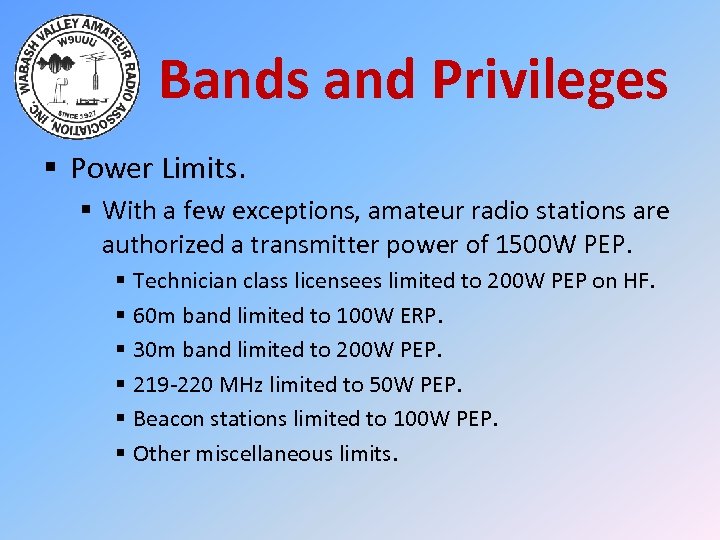 Bands and Privileges § Power Limits. § With a few exceptions, amateur radio stations are authorized a transmitter power of 1500 W PEP. § Technician class licensees limited to 200 W PEP on HF. § 60 m band limited to 100 W ERP. § 30 m band limited to 200 W PEP. § 219 -220 MHz limited to 50 W PEP. § Beacon stations limited to 100 W PEP. § Other miscellaneous limits.
 Bands and Privileges § Power Limits. § However, regardless of the maximum power allowed…. . § 97. 313(a) -- An amateur station must use the minimum transmitter power necessary to carry out the desired communications.
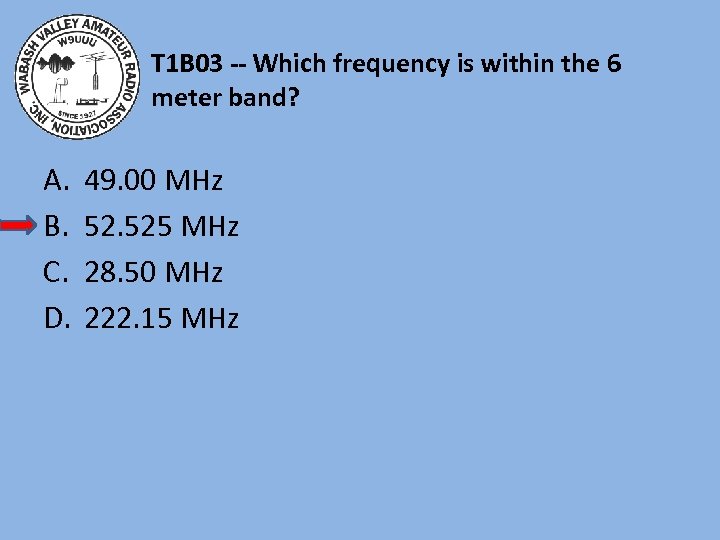 T 1 B 03 -- Which frequency is within the 6 meter band? A. B. C. D. 49. 00 MHz 52. 525 MHz 28. 50 MHz 222. 15 MHz
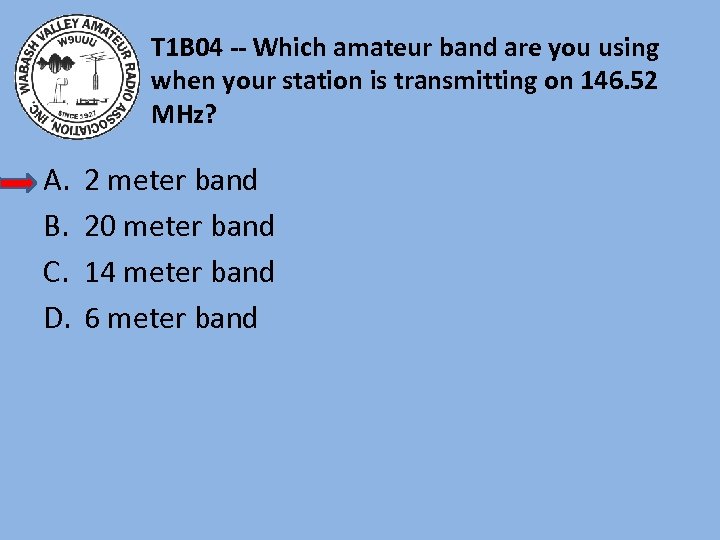 T 1 B 04 -- Which amateur band are you using when your station is transmitting on 146. 52 MHz? A. B. C. D. 2 meter band 20 meter band 14 meter band 6 meter band
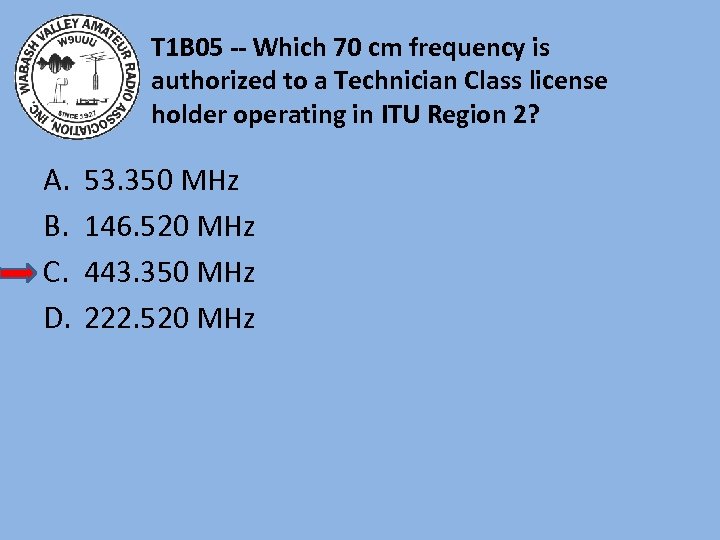 T 1 B 05 -- Which 70 cm frequency is authorized to a Technician Class license holder operating in ITU Region 2? A. B. C. D. 53. 350 MHz 146. 520 MHz 443. 350 MHz 222. 520 MHz
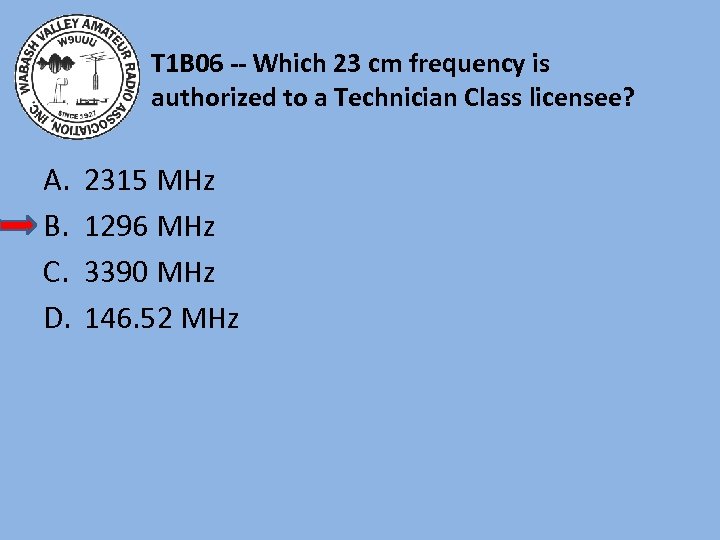 T 1 B 06 -- Which 23 cm frequency is authorized to a Technician Class licensee? A. B. C. D. 2315 MHz 1296 MHz 3390 MHz 146. 52 MHz
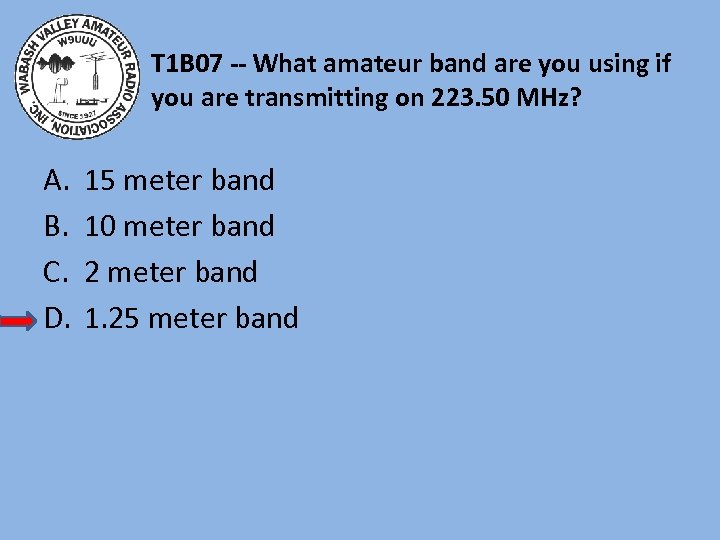 T 1 B 07 -- What amateur band are you using if you are transmitting on 223. 50 MHz? A. B. C. D. 15 meter band 10 meter band 2 meter band 1. 25 meter band
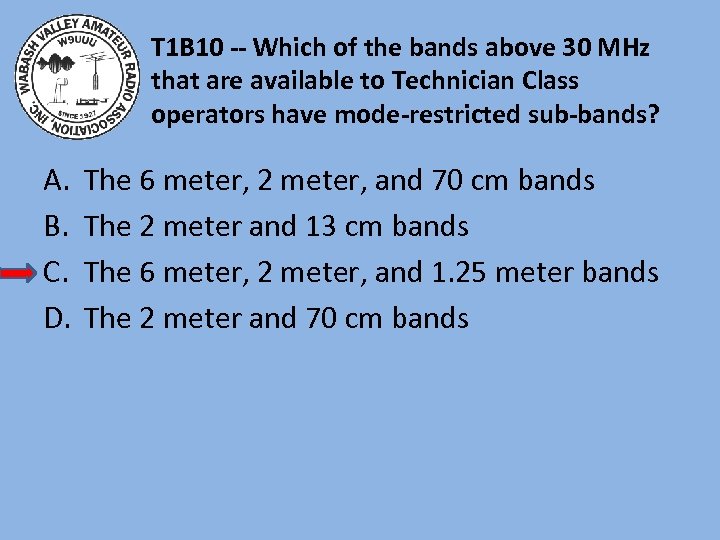 T 1 B 10 -- Which of the bands above 30 MHz that are available to Technician Class operators have mode-restricted sub-bands? A. B. C. D. The 6 meter, 2 meter, and 70 cm bands The 2 meter and 13 cm bands The 6 meter, 2 meter, and 1. 25 meter bands The 2 meter and 70 cm bands
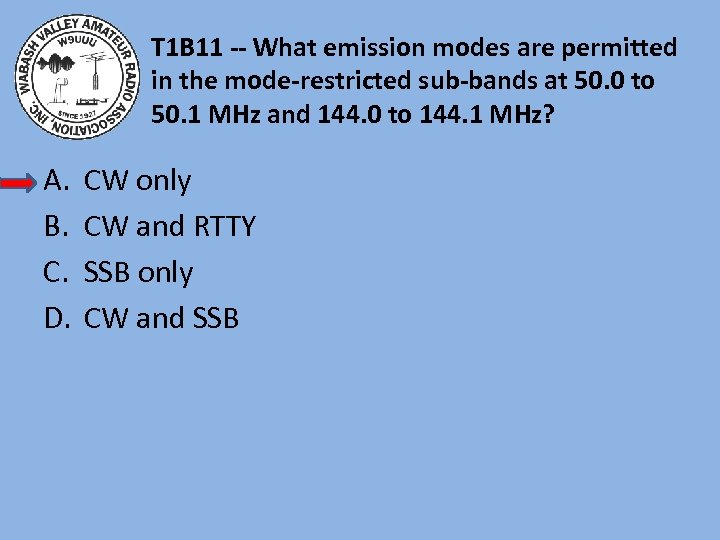 T 1 B 11 -- What emission modes are permitted in the mode-restricted sub-bands at 50. 0 to 50. 1 MHz and 144. 0 to 144. 1 MHz? A. B. C. D. CW only CW and RTTY SSB only CW and SSB
 T 1 B 13 -- Which emission may be used between 219 and 220 MHz? A. B. C. D. Spread spectrum Data SSB voice Fast-scan television
 T 2 A 11 -- Which of the following is an FCC rule regarding power levels used in the amateur bands, under normal, non-distress circumstances? A. There is no limit to power as long as there is no interference with other services B. No more than 200 watts PEP may be used C. Up to 1500 watts PEP may be used on any amateur frequency without restriction D. While not exceeding the maximum power permitted on a given band, use the minimum power necessary to carry out the desired communication
 Bands and Privileges § Primary & Secondary Allocations. § Some frequencies are shared with other services. § 60 m. § 30 m. § 70 cm & up. § Primary user. § Has priority on use of frequency. § Secondary user. § Must not cause interference to primary user. § Must accept interference from primary user.
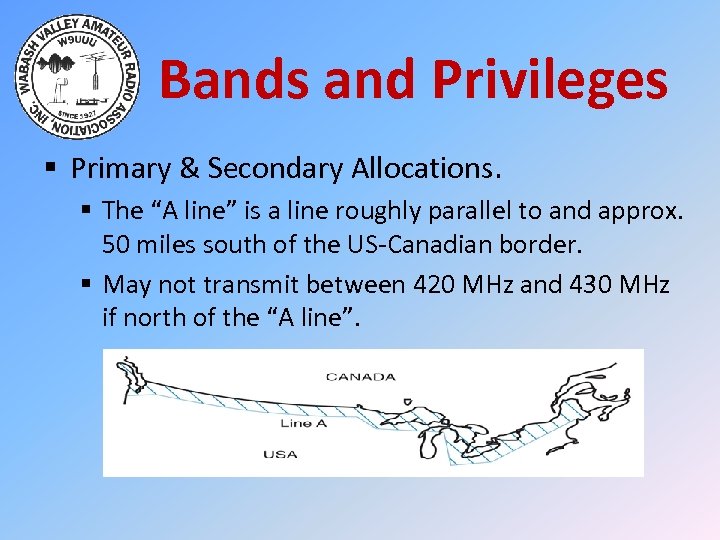 Bands and Privileges § Primary & Secondary Allocations. § The “A line” is a line roughly parallel to and approx. 50 miles south of the US-Canadian border. § May not transmit between 420 MHz and 430 MHz if north of the “A line”.
 Bands and Privileges § Band Plans. § Gentlemen’s agreements recommending certain portions of the band for certain types of operations. § Not part of FCC Rules, but…. § 97. 101(a) In all respects not specifically covered by FCC Rules each amateur station must be operated in accordance with good engineering and good amateur practice.
 Bands and Privileges § Repeater Coordination. § To avoid interference, VHF & UHF repeaters and auxiliary stations are “coordinated” by an individual or group of individuals selected by the repeater operators in a given area to assign repeater frequencies. § Coordination is not mandatory, but if interference occurs, the uncoordinated repeater is responsible for correcting the situation.
 T 1 A 08 -- Which of the following entities recommends transmit/receive channels and other parameters for auxiliary and repeater stations? A. B. C. D. Frequency Spectrum Manager Frequency Coordinator FCC Regional Field Office International Telecommunications Union
 T 1 A 09 -- Who selects a Frequency Coordinator? A. The FCC Office of Spectrum Management and Coordination Policy B. The local chapter of the Office of National Council of Independent Frequency Coordinators C. Amateur operators in a local or regional area whose stations are eligible to be auxiliary or repeater stations D. FCC Regional Field Office
 T 1 A 14 -- What must you do if you are operating on the 23 cm band learn that you are interfering with a radiolocation station outside the United States? A. Stop operating or take steps to eliminate the harmful interference B. Nothing, because this band is allocated exclusively to the amateur service C. Establish contact with the radiolocation station and ask them to change frequency D. Change to CW mode, because this would not likely cause interference
 T 1 B 08 -- Which of the following is a result of the fact that the amateur service is secondary in some portions of the 70 cm band? A. U. S. amateurs may find non-amateur stations in the bands, and must avoid interfering with them B. U. S. amateurs must give foreign amateur stations priority in those portions C. International communications are not permitted on 70 cm D. Digital transmissions are not permitted on 70 cm
 T 2 A 10 -- What is a band plan, beyond the privileges established by the FCC? A. A voluntary guideline for using different modes or activities within an amateur band B. A mandated list of operating schedules C. A list of scheduled net frequencies D. A plan devised by a club to indicate frequency band usage
 Questions?
 International Rules § Radio is international by its very nature. § The FCC only has jurisdiction in the US & territories. § Also on board US-registered ships or aircraft operating in international waters or airspace. § Each country regulates amateur radio operations in it own territory. § Who establishes international regulations?
 International Rules § International Telecommunications Union (ITU). § UN agency. § Administers international treaties & laws. § Frequency allocations. § Call sign block assignments. § World is divided into 3 regions. § All 50 US states are in region 2. § US territories are in regions 2 & 3.
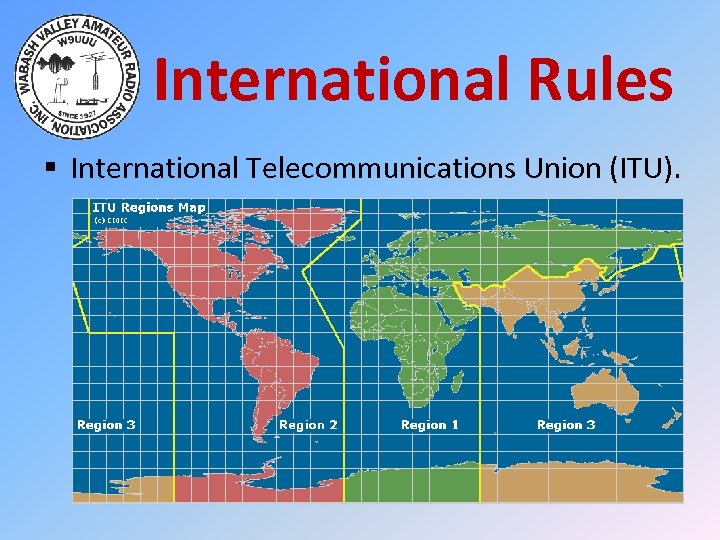 International Rules § International Telecommunications Union (ITU).
 International Rules § International Telecommunications Union (ITU). § Frequency allocations vary between regions. § e. g. -- 7. 200 -7. 300 MHz is allocated to the amateur service in ITU Region 2, but to the shortwave broadcast service in regions 1 & 3. § Radio rules change at region boundaries. § Regardless of citizenship. § Regardless of nation of registry of vessel or aircraft.
 International Rules § International Operating. § Operating in other countries can be a lot of fun. § 4 ways of accomplishing this: § Reciprocal operating agreement. § IARP. § CEPT. § Obtain license or permit foreign country.
 International Rules § Reciprocal Operating Authority. § Government-to-government agreement recognizing amateur radio licenses issued by the other country as valid for operating in their countries. § Carry copy of your US license. § No other documentation required. § Host country’s rules apply. § List of countries with reciprocal agreement with US: § http: //www. arrl. org/bilateral-reciprocal-agreements
 International Rules § International Amateur Radio Permit (IARP). § Allows US amateurs to operate in some Central American and South American countries. § Issued by a member society of the International Amateur Radio Union (IARU). § American Radio Relay League. § 2 classes of permit: § Class 1 permit equivalent to Amateur Extra class license. § Class 2 permit equivalent to Technician class license.
 International Rules § European Conference of Postal and Telecommunications Administrations (CEPT). § Allows US amateurs to operate in most European countries & territories. § Carry original US license. § Carry proof of US citizenship. § Passport. § Carry copy of CEPT agreement. § 2 classes of operation. § Same as IARP.
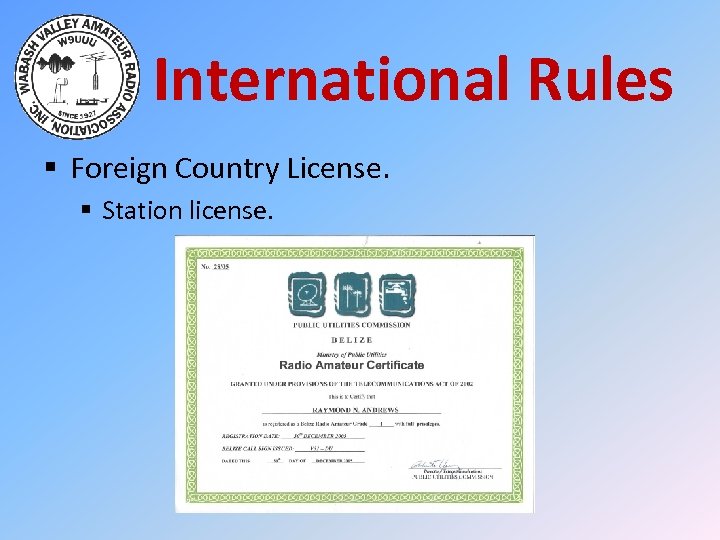
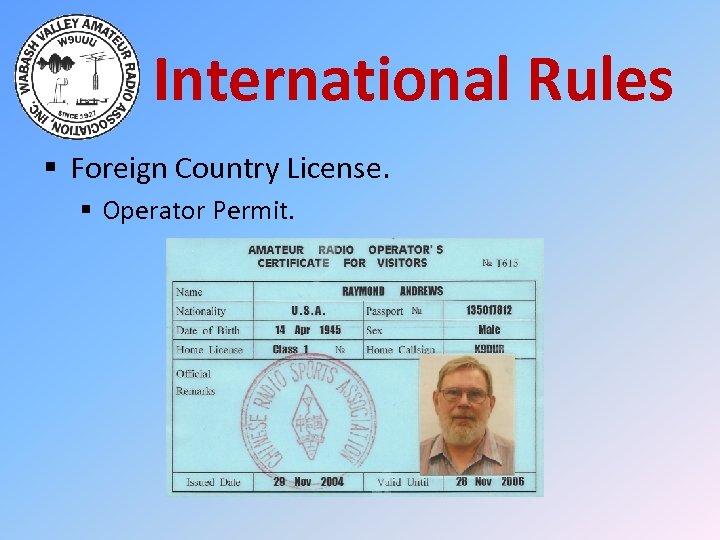
 International Rules § Foreign Country License. § Many countries will issue an amateur radio license based on a US license with no examination. § A call sign is issued for use while in the country issuing the license. § Fees vary from a few dollars to several hundred dollars. § Some countries will only issue an operator permit for use while in the country. § No call sign issued. § Must operate from an existing station in the country.
 International Rules § Foreign Country License. § Station license.
 International Rules § Foreign Country License. § Operator Permit.
 International Rules § Permitted Contacts and Communications. § Any amateur radio station may communicate with any other amateur radio station anywhere in the world. § Some countries do not allow amateur radio operations at all. § Some countries prohibit communications with amateurs in certain other countries. § Limited to remarks of a personal nature or related to the purposes of amateur radio.
 T 1 B 01 -- What is the ITU? A. An agency of the United States Department of Telecommunications Management B. A United Nations agency for information and communication technology issues C. An independent frequency coordination agency D. A department of the FCC
 T 1 B 02 -- Why are the frequency assignments for some U. S. Territories different from those in the 50 U. S. States? A. Some U. S. Territories are located in ITU regions other than region 2 B. Territorial governments are allowed to select their own frequency allocations C. Territorial frequency allocations must also include those of adjacent countries D. Any territory that was in existence before the ratification of the Communications Act of 1934 is exempt from FCC frequency regulations
 T 1 B 12 -- Why are frequency assignments for U. S. stations operating maritime mobile not the same everywhere in the world? A. Amateur maritime mobile stations in international waters must conform to the frequency assignments of the country nearest to their vessel B. Amateur frequency assignments can vary among the three ITU regions C. Frequency assignments are determined by the captain of the vessel D. Amateur frequency assignments are different in each of the 90 ITU zones
 T 1 C 03 -- What types of international communications are permitted by an FCClicensed amateur station? A. Communications incidental to the purposes of the amateur service and remarks of a personal character B. Communications incidental to conducting business or remarks of a personal nature C. Only communications incidental to contest exchanges, all other communications are prohibited D. Any communications that would be permitted by an international broadcast station
 T 1 C 04 -- When are you allowed to operate your amateur station in a foreign country? A. When the foreign country authorizes it B. When there is a mutual agreement allowing third party communications C. When authorization permits amateur communications in a foreign language D. When you are communicating with nonlicensed individuals in another country
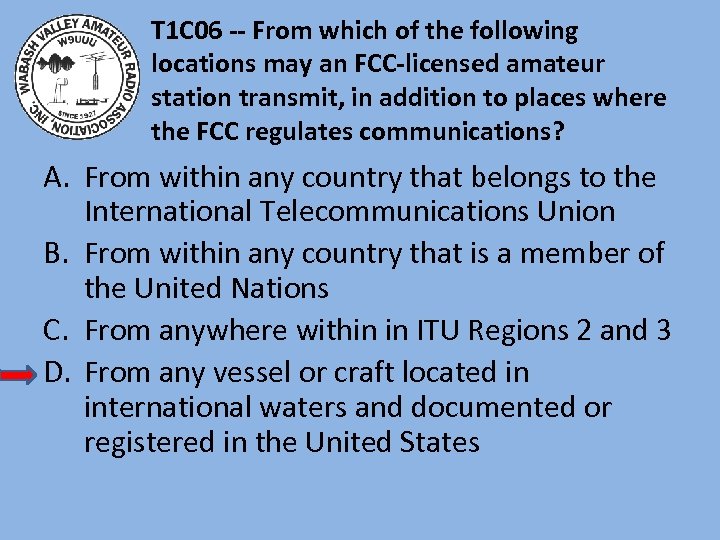 T 1 C 06 -- From which of the following locations may an FCC-licensed amateur station transmit, in addition to places where the FCC regulates communications? A. From within any country that belongs to the International Telecommunications Union B. From within any country that is a member of the United Nations C. From anywhere within in ITU Regions 2 and 3 D. From any vessel or craft located in international waters and documented or registered in the United States
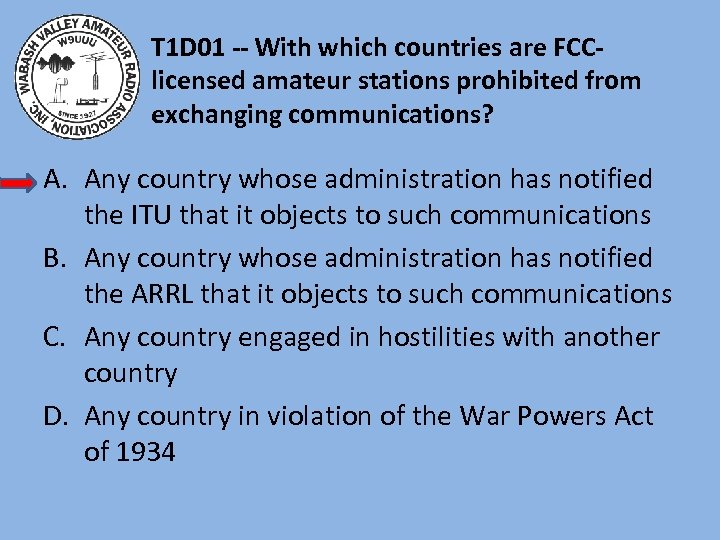 T 1 D 01 -- With which countries are FCClicensed amateur stations prohibited from exchanging communications? A. Any country whose administration has notified the ITU that it objects to such communications B. Any country whose administration has notified the ARRL that it objects to such communications C. Any country engaged in hostilities with another country D. Any country in violation of the War Powers Act of 1934
 Break
Break
 Call Signs § Call signs uniquely identify a radio station in each radio service. § Every country is assigned one or more blocks of call signs by the ITU. § Every call sign issued by that country, regardless of radio service, must begin with characters that fall within an assigned block. § Blocks assigned to the US are: § AAA-ALZ, KAA-KZZ, NAA-NZZ, & WAA-WZZ.
 Call Signs § Amateur radio call signs consists of 3 parts: § Prefix. § US = AA-AL, K, KA-KZ, N, NA-NZ, W, or WA-WZ. § Numeral. § US = 0 -9. § Suffix. § US = 1, 2, or 3 letters.
 Call Signs § US Call Districts and Call Signs. § In the US, the numeral in an amateur radio call sign denotes the call district where the amateur resides – maybe. § When a new license is issued, the numeral corresponds to the call district where the mailing address is located. § If you move to a different call district, you do not have to change your call sign. § You can get a vanity call with any numeral regardless of where you live.
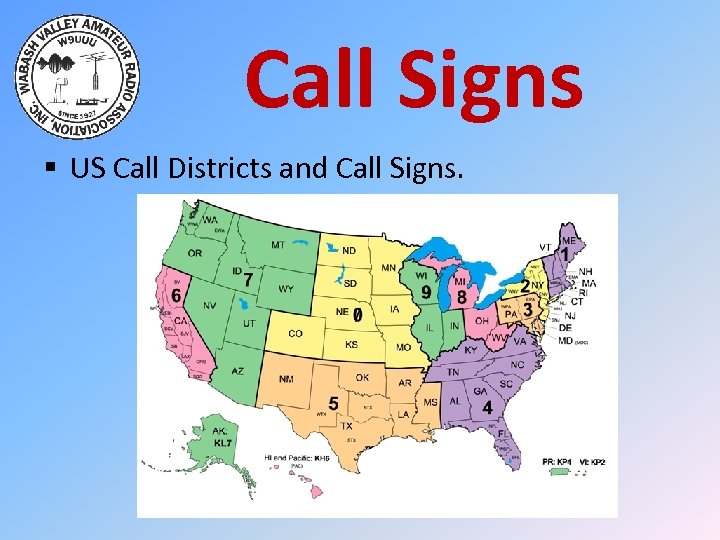 Call Signs § US Call Districts and Call Signs.
 Call Signs § US Call Districts and Call Signs. § The format of a US amateur call sign is tied to the license class. License Class Group Format Amateur Extra A, B, C, or D A 1 x 2, 2 x 1, 2 x 2 (1 st letter “A”) Advanced B, C, or D B General C, or D 2 x 2 (1 st letter “K”, “N”, or “W”) Technician C, or D C 1 x 3 Novice D D 2 x 3
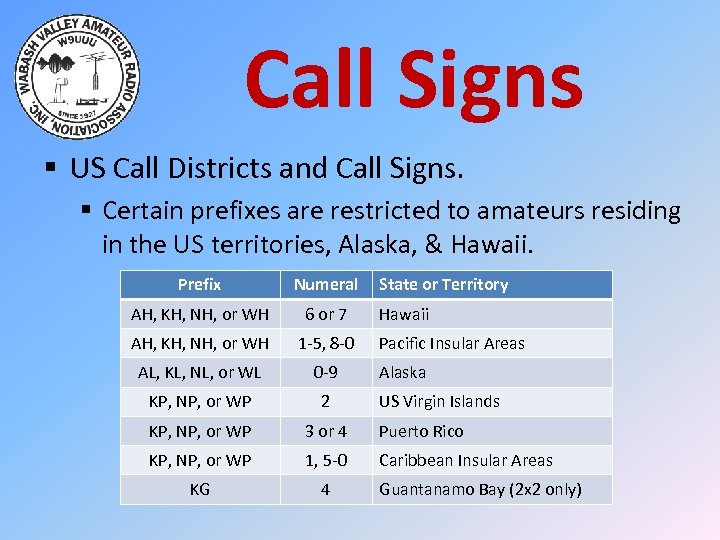 Call Signs § US Call Districts and Call Signs. § Certain prefixes are restricted to amateurs residing in the US territories, Alaska, & Hawaii. Prefix Numeral State or Territory AH, KH, NH, or WH 6 or 7 AH, KH, NH, or WH 1 -5, 8 -0 AL, KL, NL, or WL 0 -9 KP, NP, or WP 2 KP, NP, or WP 3 or 4 Puerto Rico KP, NP, or WP 1, 5 -0 Caribbean Insular Areas KG 4 Hawaii Pacific Insular Areas Alaska US Virgin Islands Guantanamo Bay (2 x 2 only)
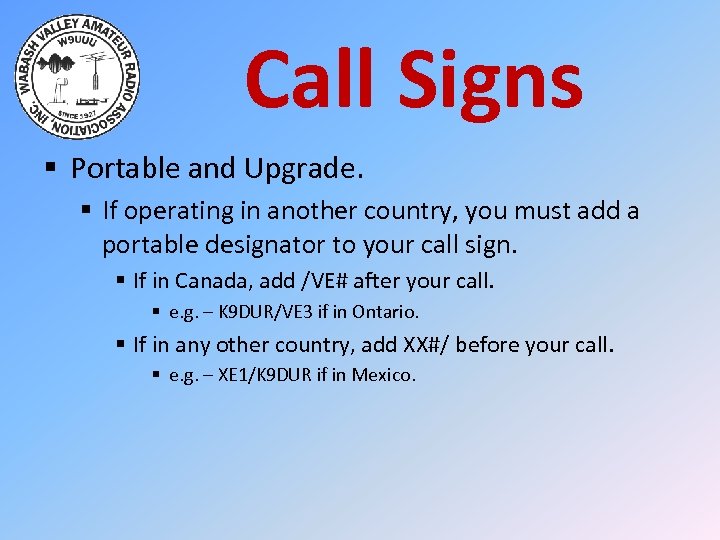 Call Signs § Portable and Upgrade. § If operating in another country, you must add a portable designator to your call sign. § If in Canada, add /VE# after your call. § e. g. – K 9 DUR/VE 3 if in Ontario. § If in any other country, add XX#/ before your call. § e. g. – XE 1/K 9 DUR if in Mexico.
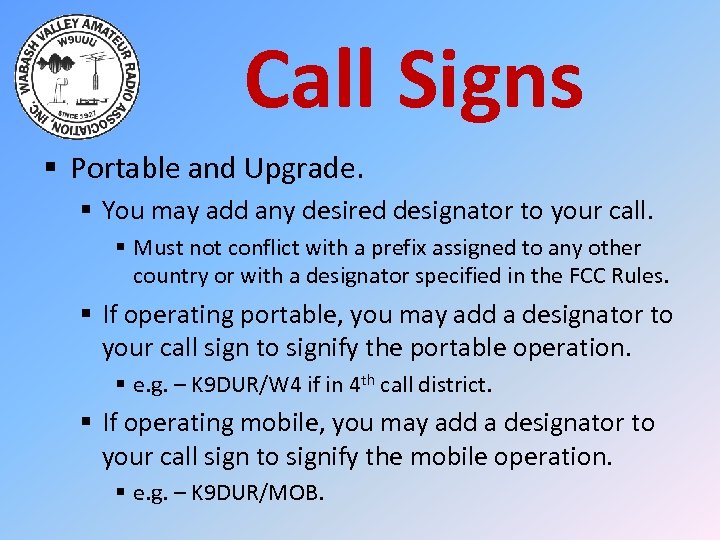 Call Signs § Portable and Upgrade. § You may add any desired designator to your call. § Must not conflict with a prefix assigned to any other country or with a designator specified in the FCC Rules. § If operating portable, you may add a designator to your call sign to signify the portable operation. § e. g. – K 9 DUR/W 4 if in 4 th call district. § If operating mobile, you may add a designator to your call sign to signify the mobile operation. § e. g. – K 9 DUR/MOB.
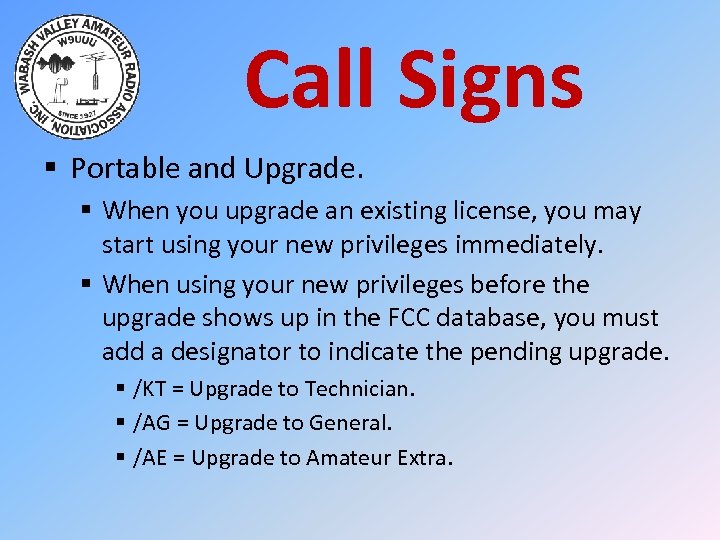 Call Signs § Portable and Upgrade. § When you upgrade an existing license, you may start using your new privileges immediately. § When using your new privileges before the upgrade shows up in the FCC database, you must add a designator to indicate the pending upgrade. § /KT = Upgrade to Technician. § /AG = Upgrade to General. § /AE = Upgrade to Amateur Extra.
 Call Signs § Choosing a Call Sign. § You may choose your own call sign under the vanity call system. § May choose any call available to the Amateur Radio Service, provided. § Call has never been issued. § Call has been expired at least 2 years. § Call is in a group available to your license class.
 Call Signs § Club and Special Event Call Signs. § Amateur radio clubs can obtain station licenses. § Club must have at least 4 members. § Club must have a document of organization. § Initially issued a call sign from Group D, but can change call using the vanity call system. § Club designates a trustee. § Club call privileges determined by license class of trustee. § Trustee is responsible for properation.
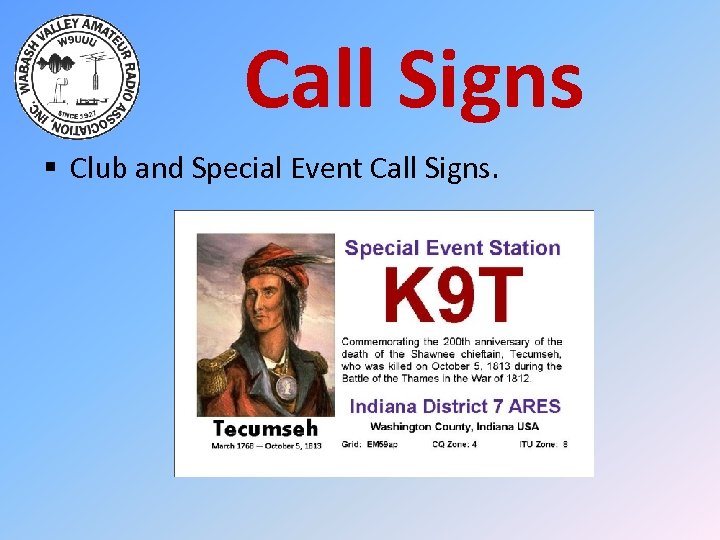
 Call Signs § Club and Special Event Call Signs. § Any amateur or club can obtain a temporary 1 x 1 call sign for a special event. § Period of operation cannot exceed 15 days. § Call sign of individual or club obtaining the special call must be used at least once an hour.
 Call Signs § Club and Special Event Call Signs.
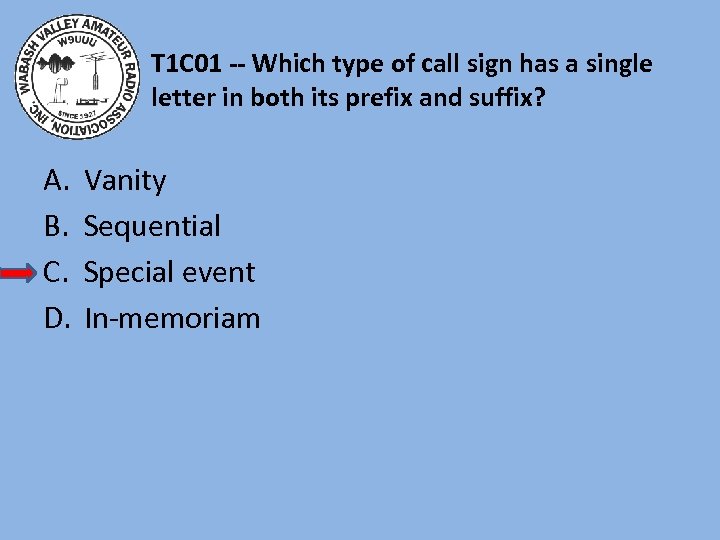 T 1 C 01 -- Which type of call sign has a single letter in both its prefix and suffix? A. B. C. D. Vanity Sequential Special event In-memoriam
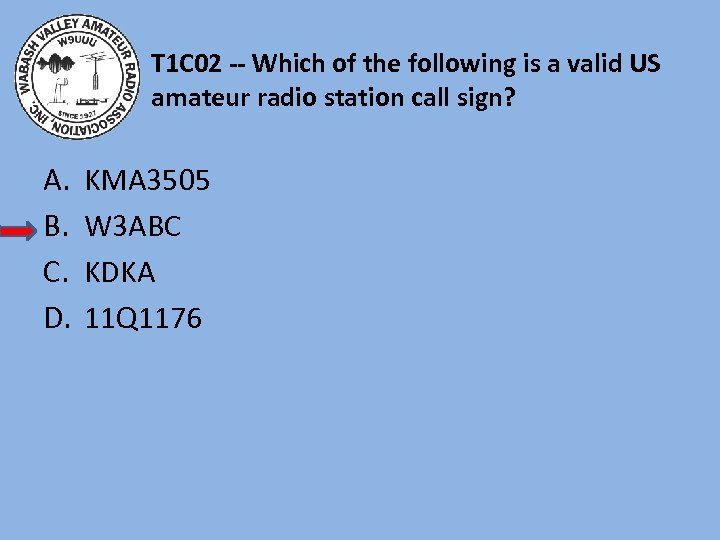 T 1 C 02 -- Which of the following is a valid US amateur radio station call sign? A. B. C. D. KMA 3505 W 3 ABC KDKA 11 Q 1176
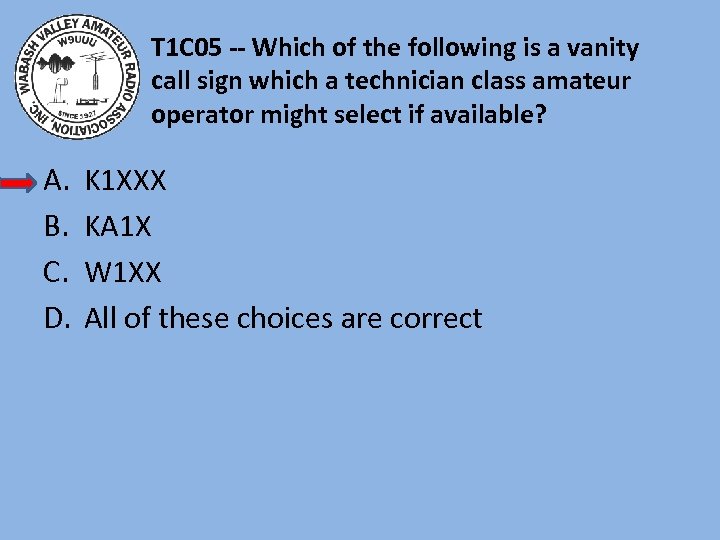 T 1 C 05 -- Which of the following is a vanity call sign which a technician class amateur operator might select if available? A. B. C. D. K 1 XXX KA 1 X W 1 XX All of these choices are correct
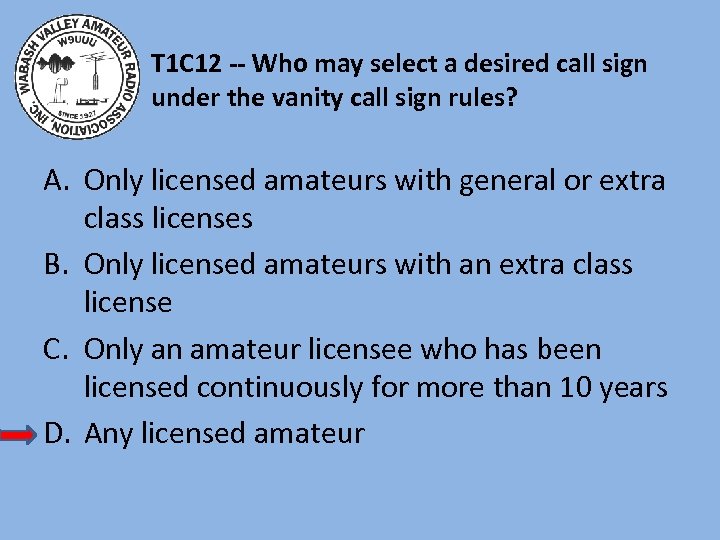 T 1 C 12 -- Who may select a desired call sign under the vanity call sign rules? A. Only licensed amateurs with general or extra class licenses B. Only licensed amateurs with an extra class license C. Only an amateur licensee who has been licensed continuously for more than 10 years D. Any licensed amateur
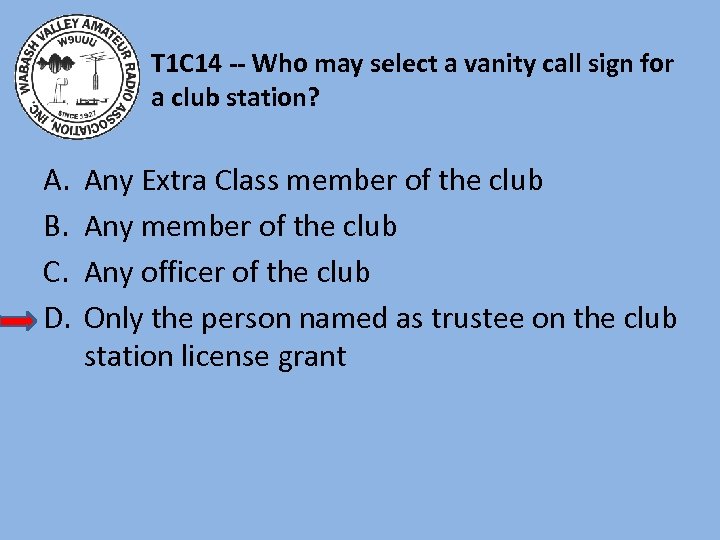 T 1 C 14 -- Who may select a vanity call sign for a club station? A. B. C. D. Any Extra Class member of the club Any officer of the club Only the person named as trustee on the club station license grant
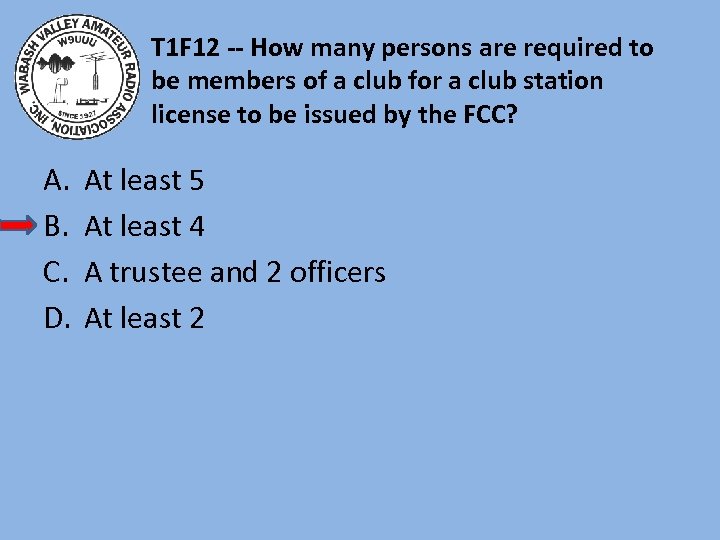 T 1 F 12 -- How many persons are required to be members of a club for a club station license to be issued by the FCC? A. B. C. D. At least 5 At least 4 A trustee and 2 officers At least 2
 Technician License Class Chapter 9 Safety
 Electrical Safety § Electrical Injuries. § An electrical current flowing through the human body can cause injuries in the following ways: § Heating of body tissue (burns). § Interference with electrical function of cells (shock). § Involuntary muscle contractions. § Heart fibrillation. § Loss of muscle control. § Can’t let go!
 Electrical Safety § Electrical Injuries. § Even small currents can cause problems. § Voltages over about 30 V are considered potentially dangerous.
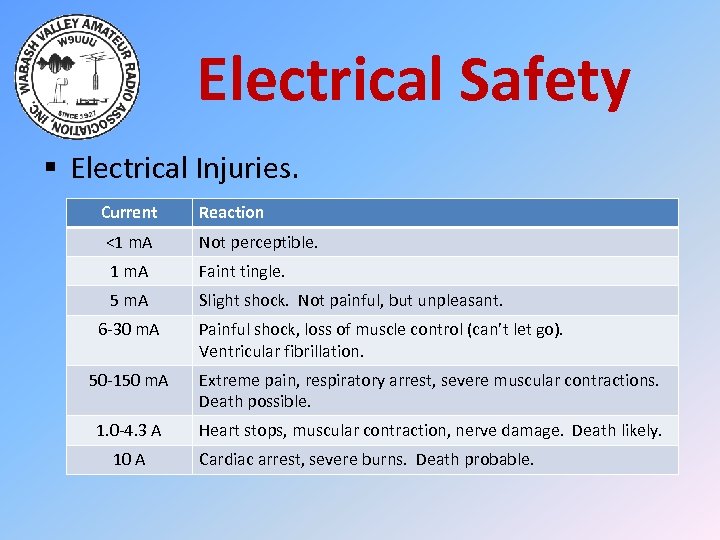 Electrical Safety § Electrical Injuries. Current Reaction <1 m. A Not perceptible. 1 m. A Faint tingle. 5 m. A Slight shock. Not painful, but unpleasant. 6 -30 m. A Painful shock, loss of muscle control (can’t let go). Ventricular fibrillation. 50 -150 m. A Extreme pain, respiratory arrest, severe muscular contractions. Death possible. 1. 0 -4. 3 A Heart stops, muscular contraction, nerve damage. Death likely. 10 A Cardiac arrest, severe burns. Death probable.
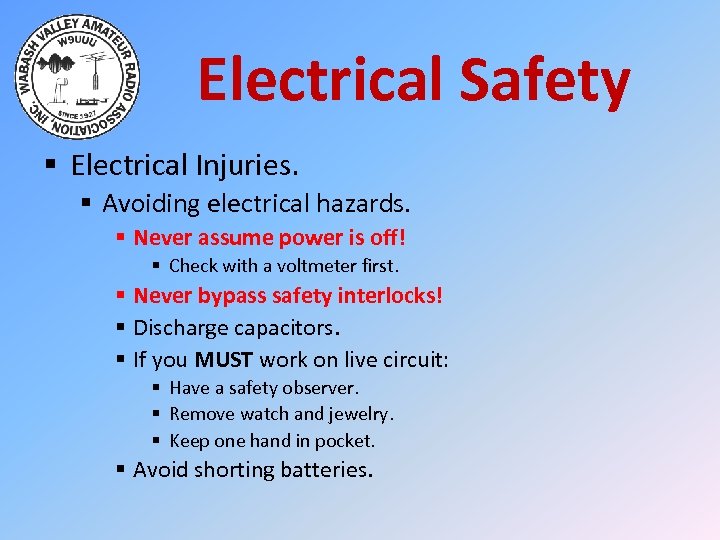 Electrical Safety § Electrical Injuries. § Avoiding electrical hazards. § Never assume power is off! § Check with a voltmeter first. § Never bypass safety interlocks! § Discharge capacitors. § If you MUST work on live circuit: § Have a safety observer. § Remove watch and jewelry. § Keep one hand in pocket. § Avoid shorting batteries.
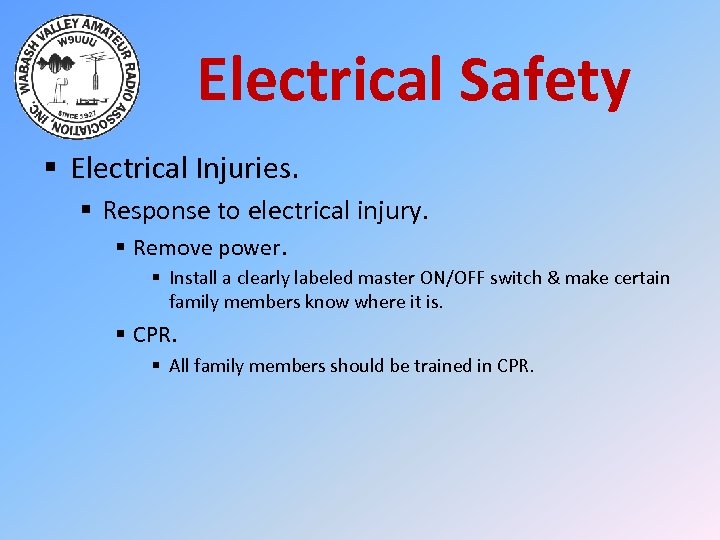 Electrical Safety § Electrical Injuries. § Response to electrical injury. § Remove power. § Install a clearly labeled master ON/OFF switch & make certain family members know where it is. § CPR. § All family members should be trained in CPR.
 Electrical Safety § AC Safety Grounding. § Normally, no special wiring is required. § Some amplifiers require 220 VAC. § Always use 3 -wire power cords. § Use ground fault current interrupter (GFCI) circuit breakers.
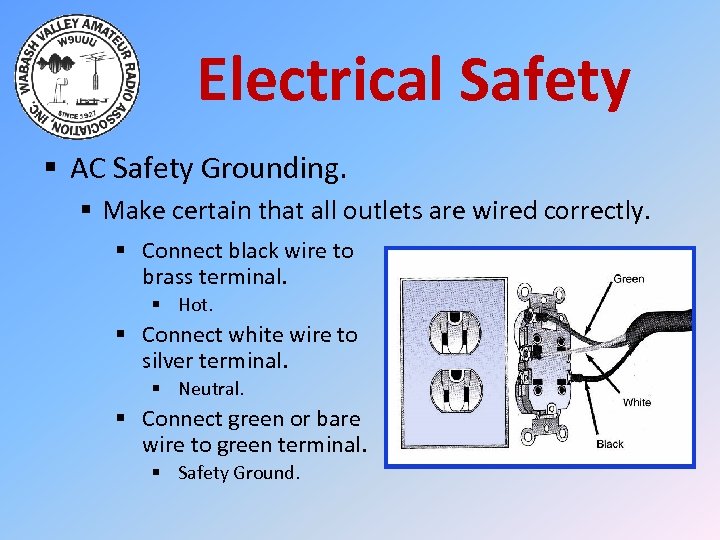 Electrical Safety § AC Safety Grounding. § Make certain that all outlets are wired correctly. § Connect black wire to brass terminal. § Hot. § Connect white wire to silver terminal. § Neutral. § Connect green or bare wire to green terminal. § Safety Ground.
 Electrical Safety § AC Safety Grounding. § RF burns. § House wiring ground system adequate for 60 Hz. § House wiring grounds NOT adequate for RF frequencies. § More likely to act as an antenna. § Bond all station equipment to a common RF ground point. § Separate wire from each piece fo equipment to ground. § DO NOT “daisy-chain” the equipment grounds. § Common RF ground point should be a short copper bar or pipe connected to an outside RF ground using wide copper strap or braid.
 Electrical Safety § Lightning. § Antennas are not struck any more frequently than trees or tall structures. § Ground all antennas & towers. § Short, direct connections. § No sharp turns. § Use lightning arrestors. § Disconnect antenna cables and power cords during storms. § Disconnect telephone lines from computer modems.
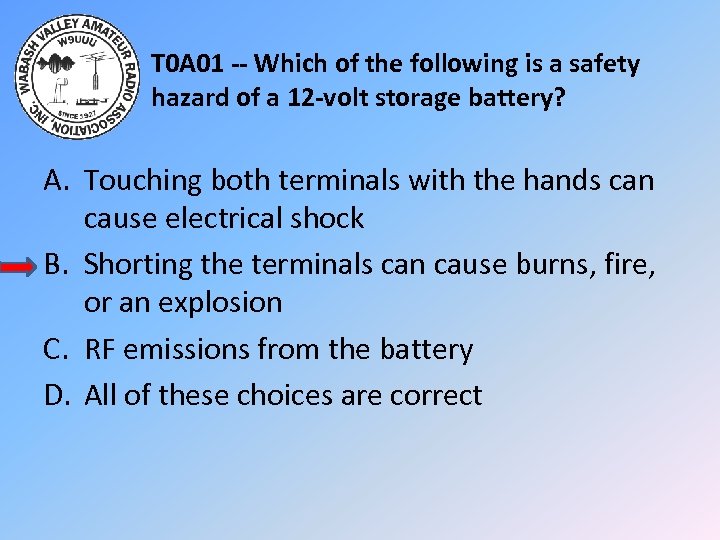 T 0 A 01 -- Which of the following is a safety hazard of a 12 -volt storage battery? A. Touching both terminals with the hands can cause electrical shock B. Shorting the terminals can cause burns, fire, or an explosion C. RF emissions from the battery D. All of these choices are correct
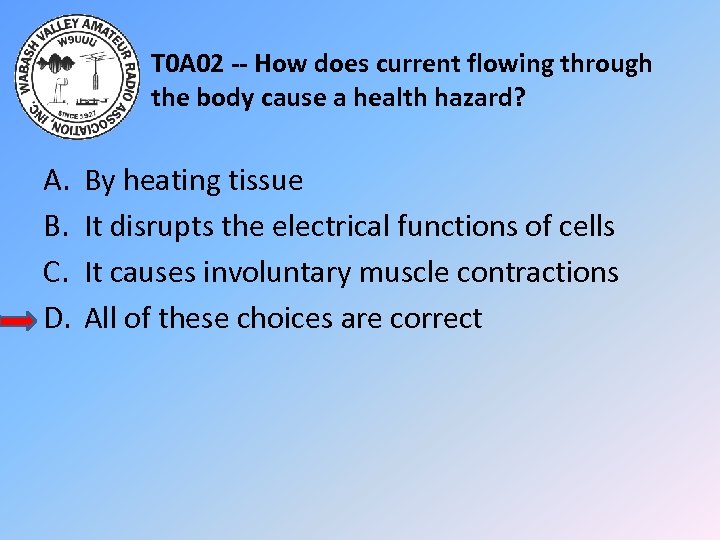 T 0 A 02 -- How does current flowing through the body cause a health hazard? A. B. C. D. By heating tissue It disrupts the electrical functions of cells It causes involuntary muscle contractions All of these choices are correct
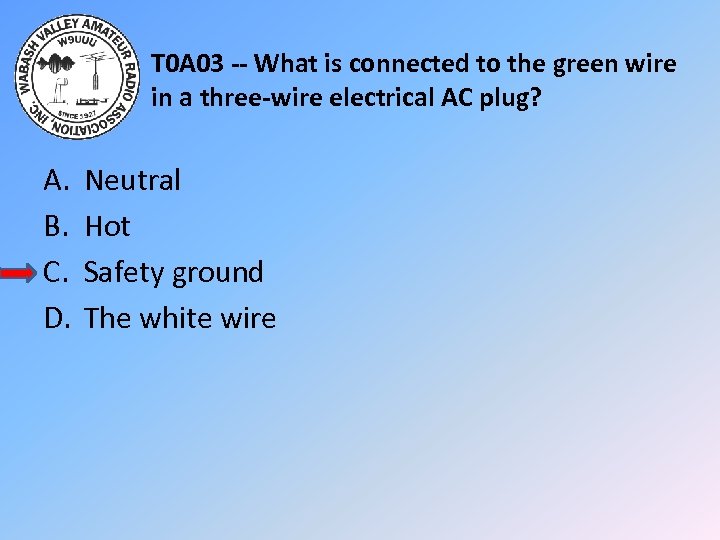 T 0 A 03 -- What is connected to the green wire in a three-wire electrical AC plug? A. B. C. D. Neutral Hot Safety ground The white wire
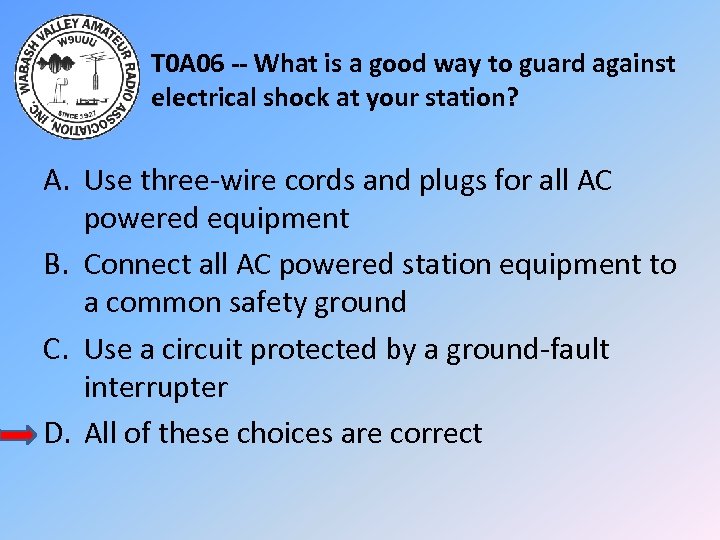 T 0 A 06 -- What is a good way to guard against electrical shock at your station? A. Use three-wire cords and plugs for all AC powered equipment B. Connect all AC powered station equipment to a common safety ground C. Use a circuit protected by a ground-fault interrupter D. All of these choices are correct
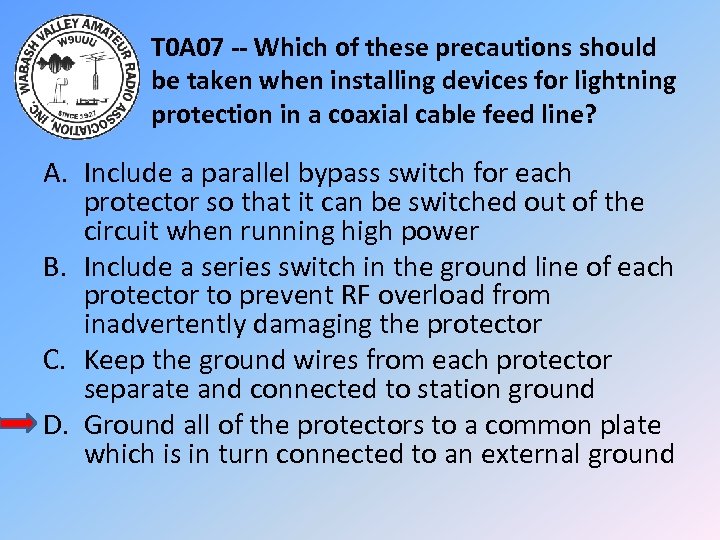 T 0 A 07 -- Which of these precautions should be taken when installing devices for lightning protection in a coaxial cable feed line? A. Include a parallel bypass switch for each protector so that it can be switched out of the circuit when running high power B. Include a series switch in the ground line of each protector to prevent RF overload from inadvertently damaging the protector C. Keep the ground wires from each protector separate and connected to station ground D. Ground all of the protectors to a common plate which is in turn connected to an external ground
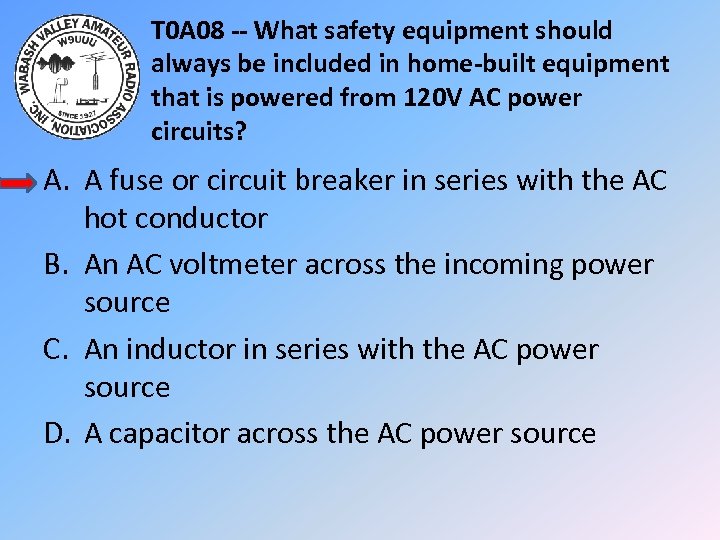 T 0 A 08 -- What safety equipment should always be included in home-built equipment that is powered from 120 V AC power circuits? A. A fuse or circuit breaker in series with the AC hot conductor B. An AC voltmeter across the incoming power source C. An inductor in series with the AC power source D. A capacitor across the AC power source
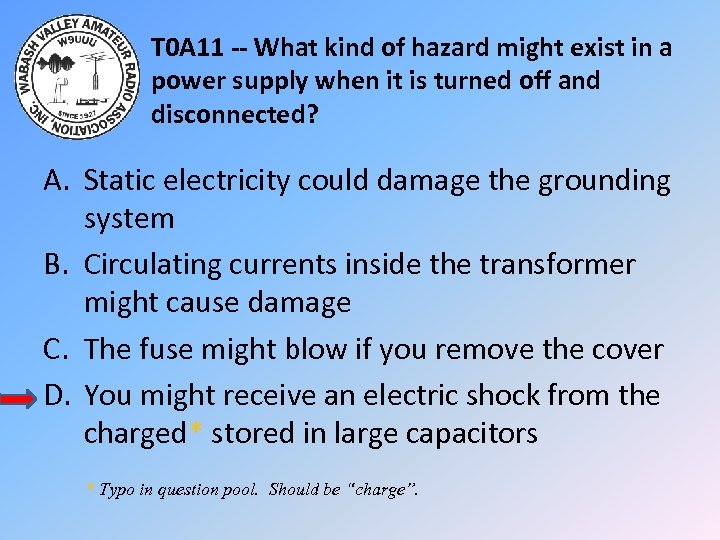 T 0 A 11 -- What kind of hazard might exist in a power supply when it is turned off and disconnected? A. Static electricity could damage the grounding system B. Circulating currents inside the transformer might cause damage C. The fuse might blow if you remove the cover D. You might receive an electric shock from the charged* stored in large capacitors * Typo in question pool. Should be “charge”.
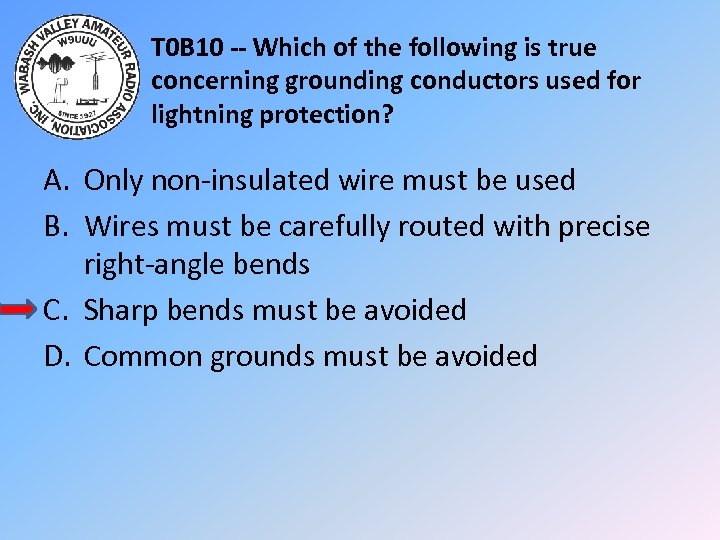 T 0 B 10 -- Which of the following is true concerning grounding conductors used for lightning protection? A. Only non-insulated wire must be used B. Wires must be carefully routed with precise right-angle bends C. Sharp bends must be avoided D. Common grounds must be avoided
 T 0 B 11 -- Which of the following establishes grounding requirements for an amateur radio tower or antenna? A. B. C. D. FCC Part 97 Rules Local electrical codes FAA tower lighting regulations Underwriters Laboratories' recommended practices
 T 0 B 12 -- Which of the following is good practice when installing ground wires on a tower for lightning protection? A. Put a loop in the ground connection to prevent water damage to the ground system B. Make sure that all bends in the ground wires are clean, right angle bends C. Ensure that connections are short and direct D. All of these choices are correct
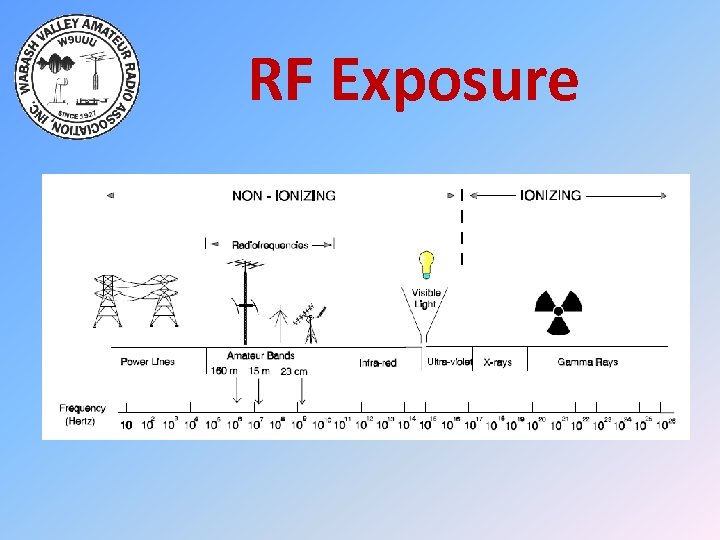
 RF Exposure § Electromagnetic energy can be absorbed by physical objects and cause changes. § Type of change depends on intensity and frequency of the energy. § At best, change in temperature. § At worst, change in molecular structure.
 RF Exposure § Non-ionizing radiation. § Only effect is heating. § Radio frequencies. § Ionizing radiation. § Strips electrons from atoms. § Ultra-violet light. § X-rays. § Gamma rays.
 RF Exposure
 RF Exposure § Maximum Permissible Exposure (MPE). § Maximum exposure limit set by FCC Rules. § Amateurs must evaluate their stations to ensure MPE’s are not exceeded. § To avoid exceeding MPE’s: § Prevent access to high RF-level areas. § Avoid directing high-level RF fields towards occupied areas.
 RF Exposure § Power Density. § Intensity of an RF field is described by its power density. § Measured in m. W/cm 2.
 RF Exposure § Power Density. § Transmitter power. § Higher power, higher risk. § Antenna gain and proximity. § Directional antennas focus available energy. § Being physically close to antenna or standing in the beam direction increases risk. § Controlling power & distance is the basis of maintaining RF safety.
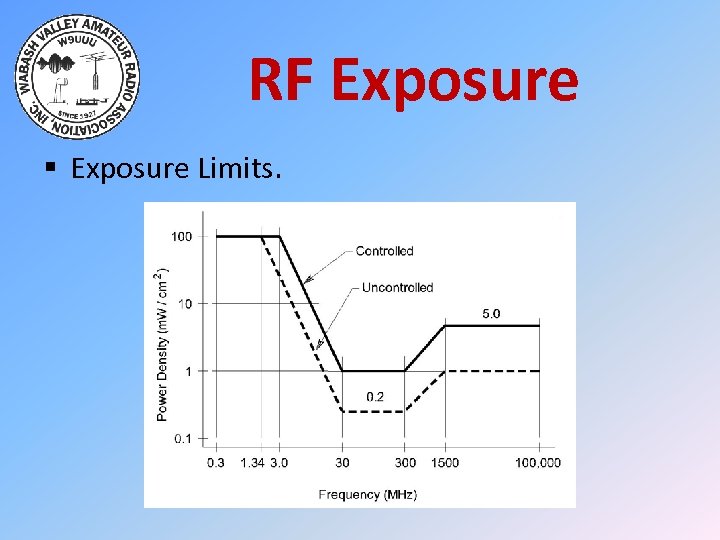
 RF Exposure § Exposure Limits. § MPE’s vary with frequency. § Body absorbs RF energy at different rates for different frequencies. § Different parts of body absorb RF energy at different rates based on size. § FCC Rules define two “environments” with different MPE’s for each. § Controlled environment. § Uncontrolled environment.
 RF Exposure § Exposure Limits. § Controlled environment. § You know where people are standing in relation to your antenna and you can do something about it. § People in the controlled environment are aware of the RF exposure and are knowledgeable about the risks involved. § More power is allowed because you can make adjustments if needed. § Exposure is averaged over a 6 -minute period.
 RF Exposure § Exposure Limits. § Uncontrolled environment. § You have no idea, or have no control of people near your antenna. § People in the uncontrolled environment are not aware of the RF exposure and do not know anything about the risks involved. § Less power is allowed because you have to assume the worst-case scenario. § Exposure is averaged over a 30 -minute period.
 RF Exposure § Exposure Limits.
 RF Exposure § Averaging and Duty Cycle. § For RF exposure purposes, the average transmitter power is reduced by a factor based on the mode. § Based on the percentage of time that the signal is at full power.
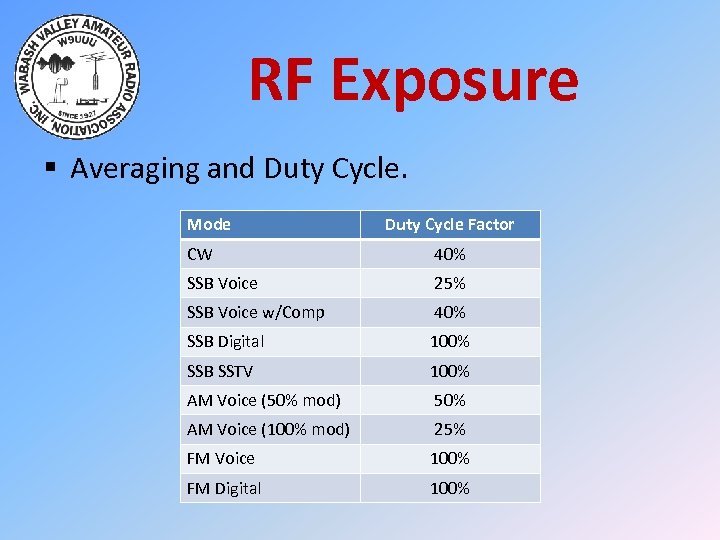 RF Exposure § Averaging and Duty Cycle. Mode Duty Cycle Factor CW 40% SSB Voice 25% SSB Voice w/Comp 40% SSB Digital 100% SSB SSTV 100% AM Voice (50% mod) 50% AM Voice (100% mod) 25% FM Voice 100% FM Digital 100%
 RF Exposure § Averaging and Duty Cycle. § For RF exposure purposes, the average transmitter power is further reduced by the ratio of transmit time to total time. § More listen & less talk reduced exposure.
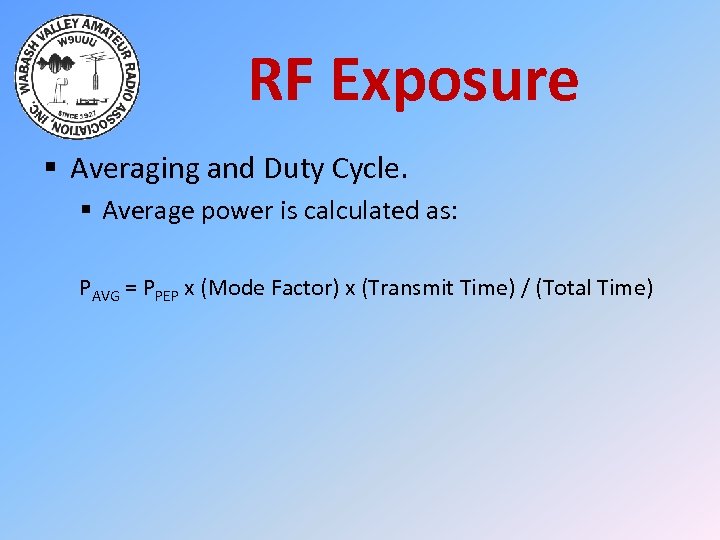 RF Exposure § Averaging and Duty Cycle. § Average power is calculated as: PAVG = PPEP x (Mode Factor) x (Transmit Time) / (Total Time)
 RF Exposure § Averaging and Duty Cycle. § Also must consider the antenna gain & feedline losses. § If antenna has 8 db gain & feedline has 2 d. B loss, then net gain is +6 d. B. § Need to multiply average power by 4.
 Break
Break
 RF Exposure § Evaluating Exposures. § All fixed stations must perform an exposure evaluation. § Mobile & handheld stations are exempt. § Below certain lower power levels, no evaluation is required. § Varies with frequency. § Example: below 50 W at VHF.
 RF Exposure § Evaluating Exposures. § Several methods are available to do the evaluation. § Use tables/formulas found in FCC OET Bulletin 65. § Use computer modeling software. § Based on formulas found in FCC OET Bulletin 65. § Use calibrated equipment to directly measure the field strength. § Equipment is extremely expensive.
 RF Exposure § Evaluating Exposures. § Calculate ERP in direction of maximum radiation. § Include mode factor, duty cycle, antenna gain, & feedline loss. § Use tables, formulas, or modeling software to determine minimum distance from antenna to stay below MPE. § Repeat for each transmitter & band.
 RF Exposure § Exposure Safety Measures. § Locate antennas away from areas people can access. § Locate antennas away from property line. § Mount antenna as high as possible. § Do not point directional antennas towards occupied areas. § Use lower gain antennas or lower avarage transmitter power.
 RF Exposure § Exposure Safety Measures. § Regardless of the exposure evaluation results, make sure that people cannot come into contact with your antennas. § RF burns are painful!
 T 0 C 01 -- What type of radiation are VHF and UHF radio signals? A. B. C. D. Gamma radiation Ionizing radiation Alpha radiation Non-ionizing radiation
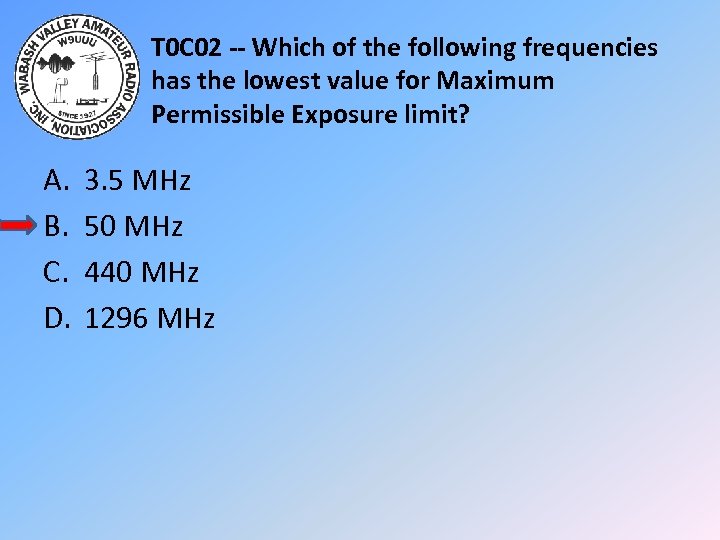 T 0 C 02 -- Which of the following frequencies has the lowest value for Maximum Permissible Exposure limit? A. B. C. D. 3. 5 MHz 50 MHz 440 MHz 1296 MHz
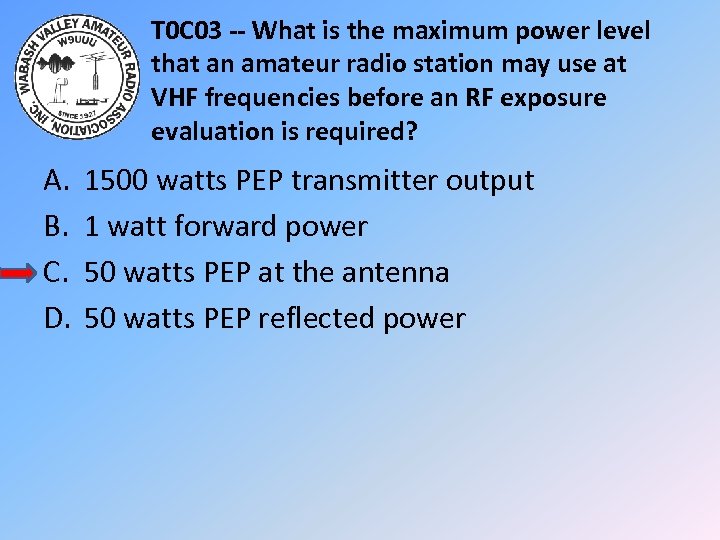 T 0 C 03 -- What is the maximum power level that an amateur radio station may use at VHF frequencies before an RF exposure evaluation is required? A. B. C. D. 1500 watts PEP transmitter output 1 watt forward power 50 watts PEP at the antenna 50 watts PEP reflected power
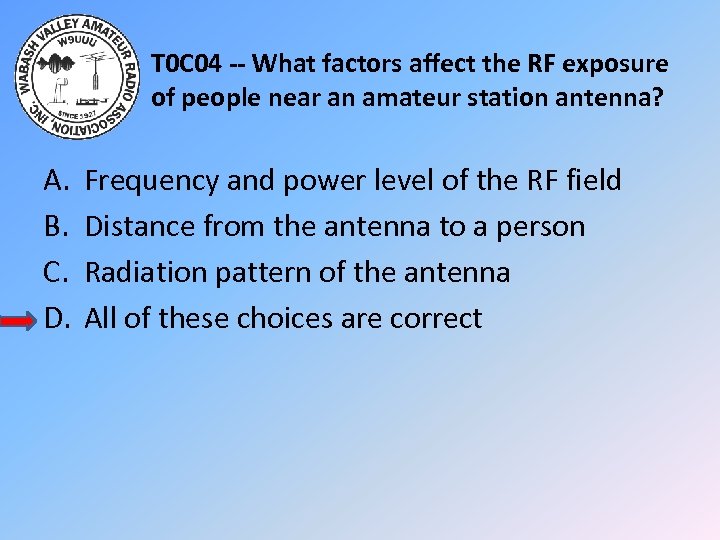 T 0 C 04 -- What factors affect the RF exposure of people near an amateur station antenna? A. B. C. D. Frequency and power level of the RF field Distance from the antenna to a person Radiation pattern of the antenna All of these choices are correct
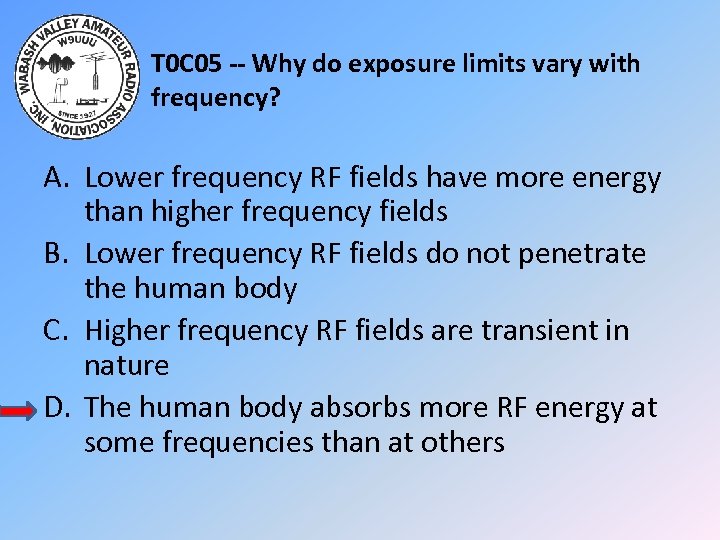 T 0 C 05 -- Why do exposure limits vary with frequency? A. Lower frequency RF fields have more energy than higher frequency fields B. Lower frequency RF fields do not penetrate the human body C. Higher frequency RF fields are transient in nature D. The human body absorbs more RF energy at some frequencies than at others
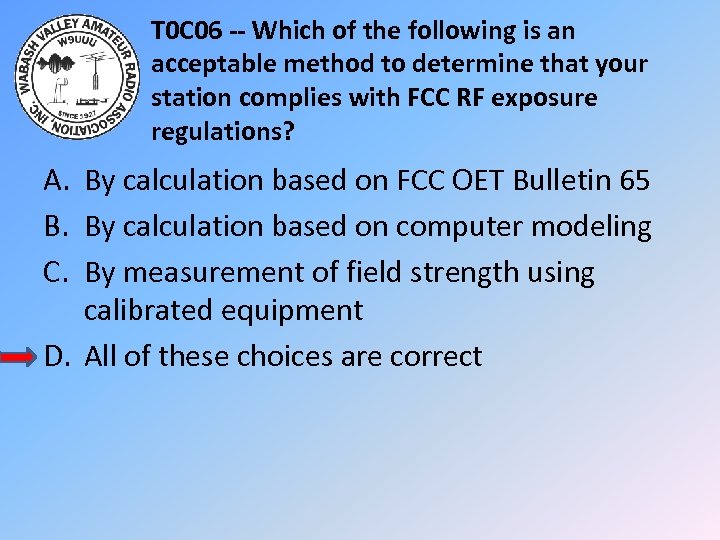 T 0 C 06 -- Which of the following is an acceptable method to determine that your station complies with FCC RF exposure regulations? A. By calculation based on FCC OET Bulletin 65 B. By calculation based on computer modeling C. By measurement of field strength using calibrated equipment D. All of these choices are correct
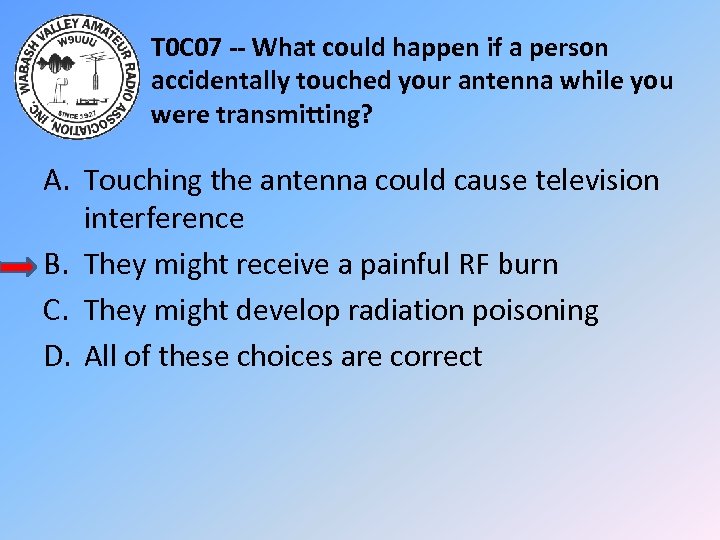 T 0 C 07 -- What could happen if a person accidentally touched your antenna while you were transmitting? A. Touching the antenna could cause television interference B. They might receive a painful RF burn C. They might develop radiation poisoning D. All of these choices are correct
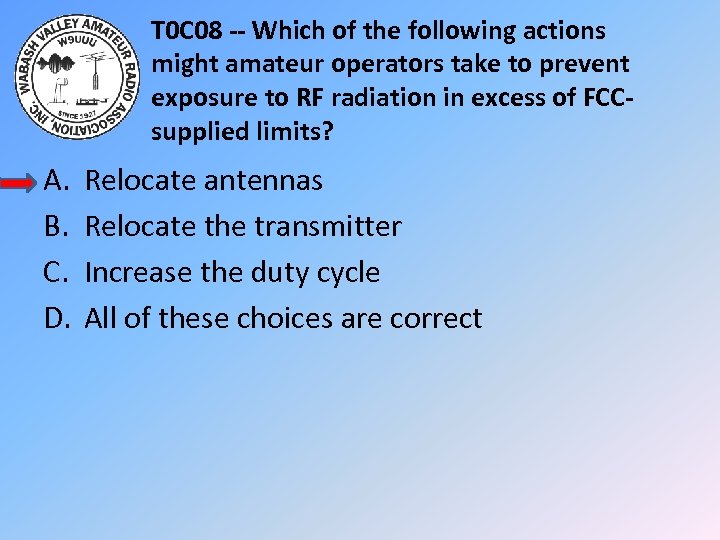 T 0 C 08 -- Which of the following actions might amateur operators take to prevent exposure to RF radiation in excess of FCCsupplied limits? A. B. C. D. Relocate antennas Relocate the transmitter Increase the duty cycle All of these choices are correct
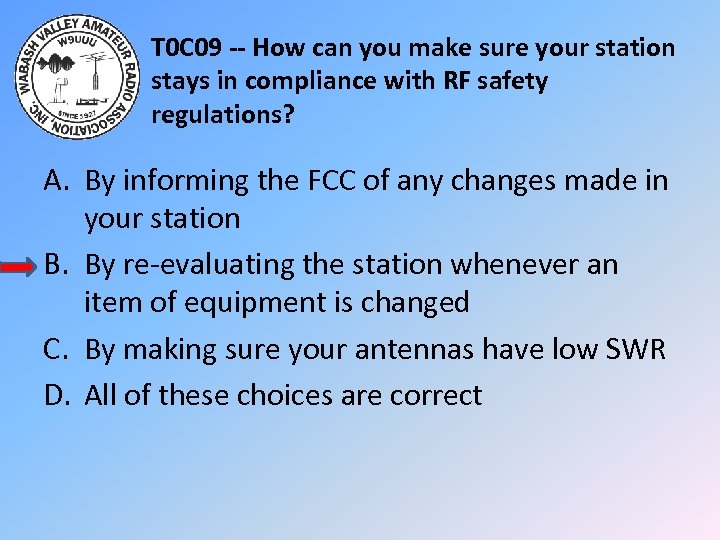 T 0 C 09 -- How can you make sure your station stays in compliance with RF safety regulations? A. By informing the FCC of any changes made in your station B. By re-evaluating the station whenever an item of equipment is changed C. By making sure your antennas have low SWR D. All of these choices are correct
 T 0 C 10 -- Why is duty cycle one of the factors used to determine safe RF radiation exposure levels? A. It affects the average exposure of people to radiation B. It affects the peak exposure of people to radiation C. It takes into account the antenna feed line loss D. It takes into account thermal effects of the final amplifier
 T 0 C 11 -- What is the definition of duty cycle during the averaging time for RF exposure? A. The difference between the lowest power output and the highest power output of a transmitter B. The difference between the PEP and average power output of a transmitter C. The percentage of time that a transmitter is transmitting D. The percentage of time that a transmitter is not transmitting
 T 0 C 12 -- How does RF radiation differ from ionizing radiation (radioactivity)? A. RF radiation does not have sufficient energy to cause genetic damage B. RF radiation can only be detected with an RF dosimeter C. RF radiation is limited in range to a few feet D. RF radiation is perfectly safe
 T 0 C 13 -- If the averaging time for exposure is 6 minutes, how much power density is permitted if the signal is present for 3 minutes and absent for 3 minutes rather than being present for the entire 6 minutes? A. B. C. D. 3 times as much 1/2 as much 2 times as much There is no adjustment allowed for shorter exposure times
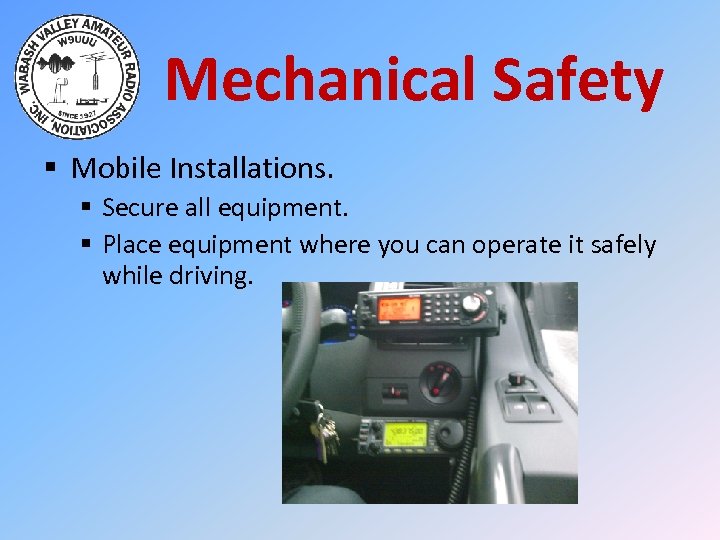 Mechanical Safety § Mobile Installations. § Secure all equipment. § Place equipment where you can operate it safely while driving.
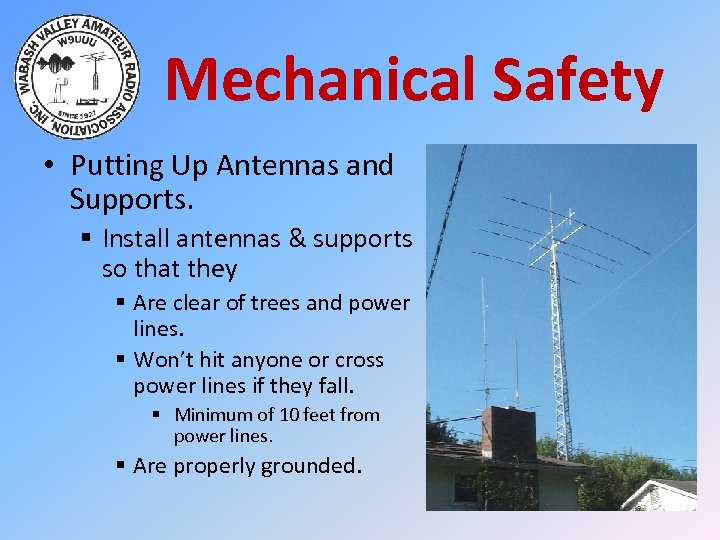 Mechanical Safety • Putting Up Antennas and Supports. § Install antennas & supports so that they § Are clear of trees and power lines. § Won’t hit anyone or cross power lines if they fall. § Minimum of 10 feet from power lines. § Are properly grounded.
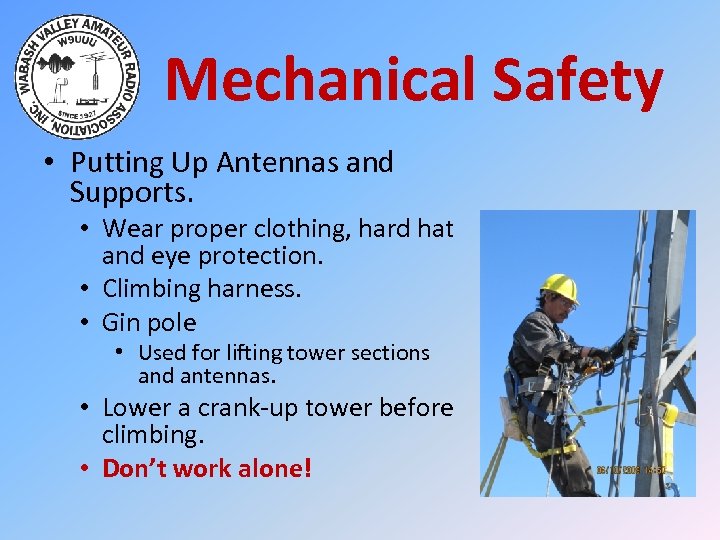 Mechanical Safety • Putting Up Antennas and Supports. • Wear proper clothing, hard hat and eye protection. • Climbing harness. • Gin pole • Used for lifting tower sections and antennas. • Lower a crank-up tower before climbing. • Don’t work alone!
 T 0 B 01 -- When should members of a tower work team wear a hard hat and safety glasses? A. At all times except when climbing the tower B. At all times except when belted firmly to the tower C. At all times when any work is being done on the tower D. Only when the tower exceeds 30 feet in height
 T 0 B 02 -- What is a good precaution to observe before climbing an antenna tower? A. Make sure that you wear a grounded wrist strap B. Remove all tower grounding connections C. Put on a climbing harness and safety glasses D. All of these choices are correct
 T 0 B 03 -- Under what circumstances is it safe to climb a tower without a helper or observer? A. When no electrical work is being performed B. When no mechanical work is being performed C. When the work being done is not more than 20 feet above the ground D. Never
 T 0 B 04 -- Which of the following is an important safety precaution to observe when putting up an antenna tower? A. Wear a ground strap connected to your wrist at all times B. Insulate the base of the tower to avoid lightning strikes C. Look for and stay clear of any overhead electrical wires D. All of these choices are correct
 T 0 B 05 -- What is the purpose of a gin pole? A. B. C. D. To temporarily replace guy wires To be used in place of a safety harness To lift tower sections or antennas To provide a temporary ground
 T 0 B 06 -- What is the minimum safe distance from a power line to allow when installing an antenna? A. B. C. D. Half the width of your property The height of the power line above ground 1/2 wavelength at the operating frequency So that if the antenna falls unexpectedly, no part of it can come closer than 10 feet to the power wires
 T 0 B 07 -- Which of the following is an important safety rule to remember when using a crank-up tower? A. This type of tower must never be painted B. This type of tower must never be grounded C. This type of tower must never be climbed unless it is in the fully retracted position D. All of these choices are correct
 T 0 B 08 -- What is considered to be a proper grounding method for a tower? A. A single four-foot ground rod, driven into the ground no more than 12 inches from the base B. A ferrite-core RF choke connected between the tower and ground C. Separate eight-foot long ground rods for each tower leg, bonded to the tower and each other D. A connection between the tower base and a cold water pipe
 T 0 B 09 -- Why should you avoid attaching an antenna to a utility pole? A. The antenna will not work properly because of induced voltages B. The utility company will charge you an extra monthly fee C. The antenna could contact high-voltage power wires D. All of these choices are correct
 Questions?
 Next Week Chapter 8 Operating Regulations