


 Скачать презентацию Technician License Class Chapter 3 Electricity Components and
224d4606de6318f949f6b2c5bd1f5e1f.ppt
- Количество слайдов: 169
 Technician License Class Chapter 3 Electricity, Components and Circuits
 Electricity § Voltage and Current § Current is the flow of electrons through a material. § The magnitude of a current is the number of electrons flowing past a given point in one second § Measured in amperes § 1 Ampere = 1 coulomb/second § 1 coulomb ≈ 6. 24 billion (6. 24 x 1018) electrons § Abbreviated to ”Amp” or “A” § Use symbol “I” in formulas § Current is measured using an ammeter.
 Electricity § Voltage and Current § Voltage is the electrical force that causes electrons to flow. § a. k. a. – Electromotive force (EMF), potential. § Measured in volts. § Abbreviated to “V” § Use symbol “E” in formulas § Voltage is measured using a voltmeter.
 Electricity § Voltage and Current § Voltage has polarity. § Positive voltage attracts electrons. § Negative voltage repels electrons. § Voltage is always referenced between 2 points. § Surface of the earth is often used as a universal reference point. § Called earth ground, ground potential, or ground.
 T 5 A 01 -- Electrical current is measured in which of the following units? A. Volts B. Watts C. Ohms D. Amperes
 T 5 A 03 -- What is the name for the flow of electrons in an electric circuit? A. Voltage B. Resistance C. Capacitance D. Current
 T 5 A 05 -- What is the electrical term for the electromotive force (EMF) that causes electron flow? A. Voltage B. Ampere-hours C. Capacitance D. Inductance
 T 5 A 11 -- What is the basic unit of electromotive force? A. The volt B. The watt C. The ampere D. The ohm
 Electricity § Resistance § All materials resist the flow of electrons. § Materials with very little resistance are called conductors. § Materials with a lot of resistance are called insulators. § Resistance is measured in ohms. § Symbol is Greek letter Omega (Ω). § Use “R” in formulas. § Measured with an ohmmeter.
 T 5 A 07 -- Which of the following is a good electrical conductor? A. Glass B. Wood C. Copper D. Rubber
 T 5 A 08 -- Which of the following is a good electrical insulator? A. Copper B. Glass C. Aluminum D. Mercury
 T 7 D 05 -- What instrument is used to measure resistance? A. An oscilloscope B. A spectrum analyzer C. A noise bridge D. An ohmmeter
 Electricity § Ohm’s Law § First published in 1827 by Georg Ohm in his book “Die galvanische Kette, mathematisch bearbeitet ” § Mathematically describes the relationship between voltage, current, and resistance. § Most basic formula in electricity and electronics.
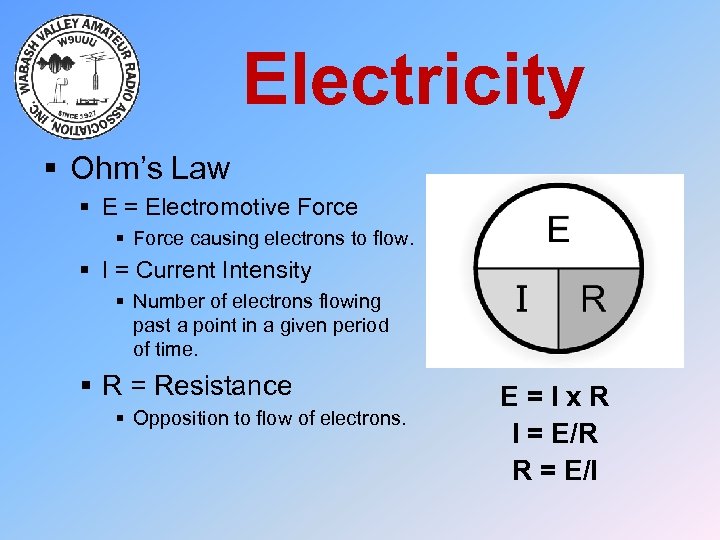 Electricity § Ohm’s Law § E = Electromotive Force § Force causing electrons to flow. § I = Current Intensity § Number of electrons flowing past a point in a given period of time. § R = Resistance § Opposition to flow of electrons. E=Ix. R I = E/R R = E/I
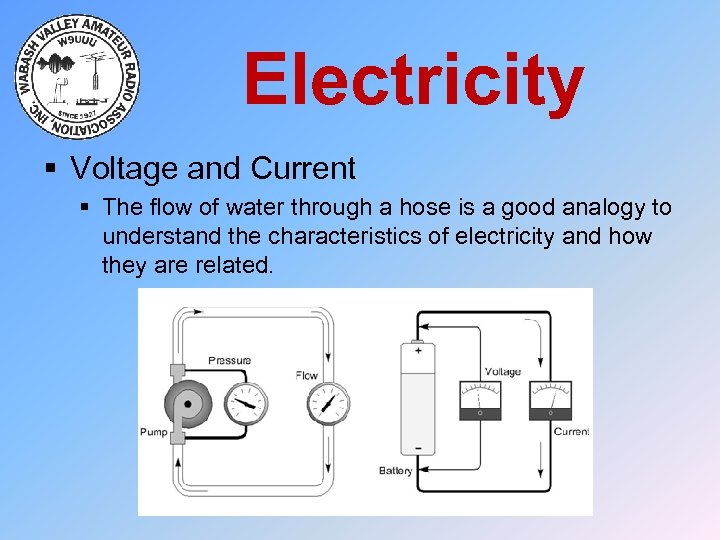 Electricity § Voltage and Current § The flow of water through a hose is a good analogy to understand the characteristics of electricity and how they are related.
 T 5 D 01 -- What formula is used to calculate current in a circuit? A. Current (I) equals voltage (E) multiplied by resistance (R) B. Current (I) equals voltage (E) divided by resistance (R) C. Current (I) equals voltage (E) added to resistance (R) D. Current (I) equals voltage (E) minus resistance (R)
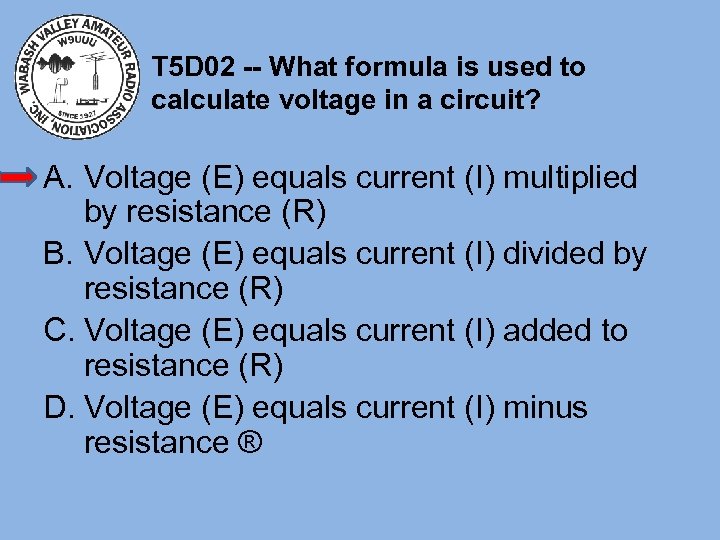 T 5 D 02 -- What formula is used to calculate voltage in a circuit? A. Voltage (E) equals current (I) multiplied by resistance (R) B. Voltage (E) equals current (I) divided by resistance (R) C. Voltage (E) equals current (I) added to resistance (R) D. Voltage (E) equals current (I) minus resistance ®
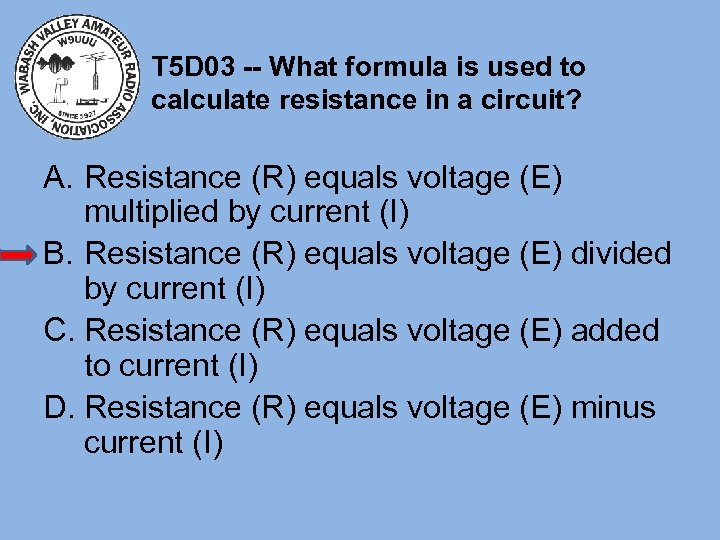 T 5 D 03 -- What formula is used to calculate resistance in a circuit? A. Resistance (R) equals voltage (E) multiplied by current (I) B. Resistance (R) equals voltage (E) divided by current (I) C. Resistance (R) equals voltage (E) added to current (I) D. Resistance (R) equals voltage (E) minus current (I)
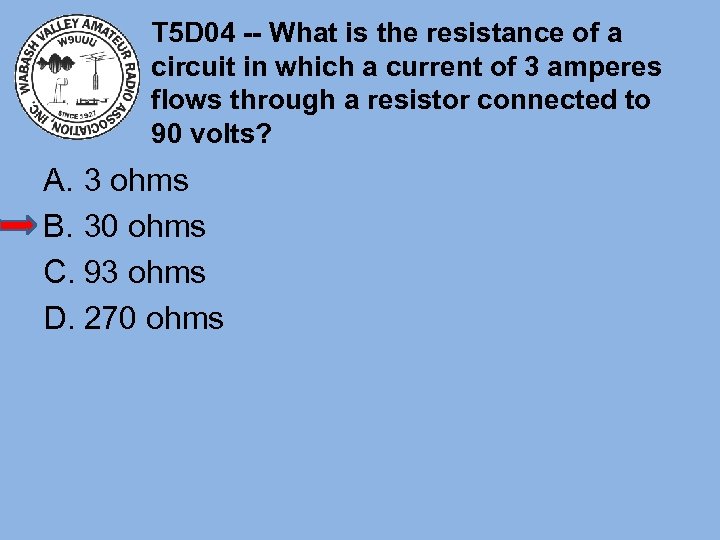 T 5 D 04 -- What is the resistance of a circuit in which a current of 3 amperes flows through a resistor connected to 90 volts? A. 3 ohms B. 30 ohms C. 93 ohms D. 270 ohms
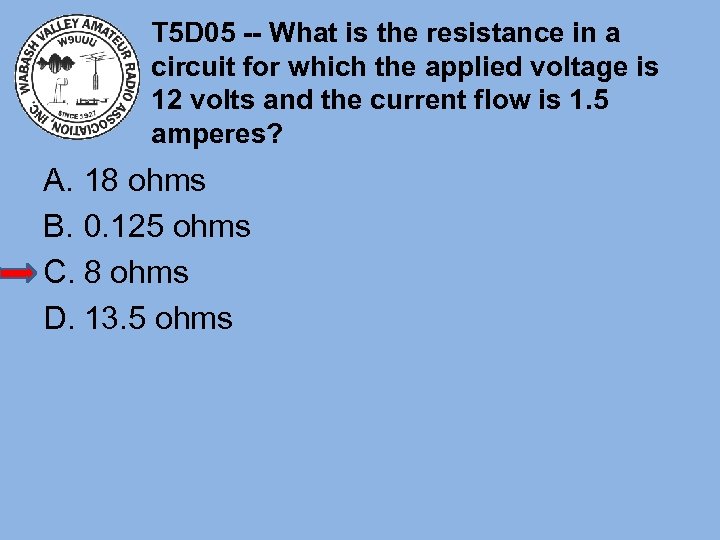 T 5 D 05 -- What is the resistance in a circuit for which the applied voltage is 12 volts and the current flow is 1. 5 amperes? A. 18 ohms B. 0. 125 ohms C. 8 ohms D. 13. 5 ohms
 T 5 D 06 -- What is the resistance of a circuit that draws 4 amperes from a 12 volt source? A. 3 ohms B. 16 ohms C. 48 ohms D. 8 Ohms
 T 5 D 07 -- What is the current flow in a circuit with an applied voltage of 120 volts and a resistance of 80 ohms? A. 9600 amperes B. 200 amperes C. 0. 667 amperes D. 1. 5 amperes
 T 5 D 08 -- What is the current flowing through a 100 -ohm resistor connected across 200 volts? A. 20, 000 amperes B. 0. 5 amperes C. 2 amperes D. 100 amperes
 T 5 D 09 -- What is the current flowing through a 24 -ohm resistor connected across 240 volts? A. 24, 000 amperes B. 0. 1 amperes C. 10 amperes D. 216 amperes
 T 5 D 10 -- What is the voltage across a 2 ohm resistor if a current of 0. 5 amperes flows through it? A. 1 volt B. 0. 25 volts C. 2. 5 volts D. 1. 5 volts
 T 5 D 11 -- What is the voltage across a 10 -ohm resistor if a current of 1 ampere flows through it? A. 1 volt B. 10 volts C. 11 volts D. 9 volts
 T 5 D 12 -- What is the voltage across a 10 -ohm resistor if a current of 2 amperes flows through it? A. 8 volts B. 0. 2 volts C. 12 volts D. 20 volts
 Electricity § Circuits § A circuit is any path where current can flow. § For current to flow, the circuit must be closed. § Current eventually ends up back where it started. § If only one path, it is a series circuit. § If multiple paths, it is a parallel circuit.
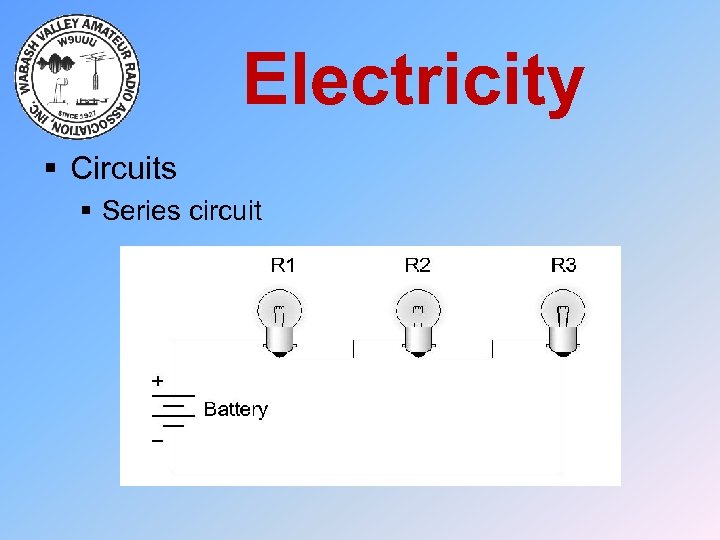 Electricity § Circuits § Series circuit
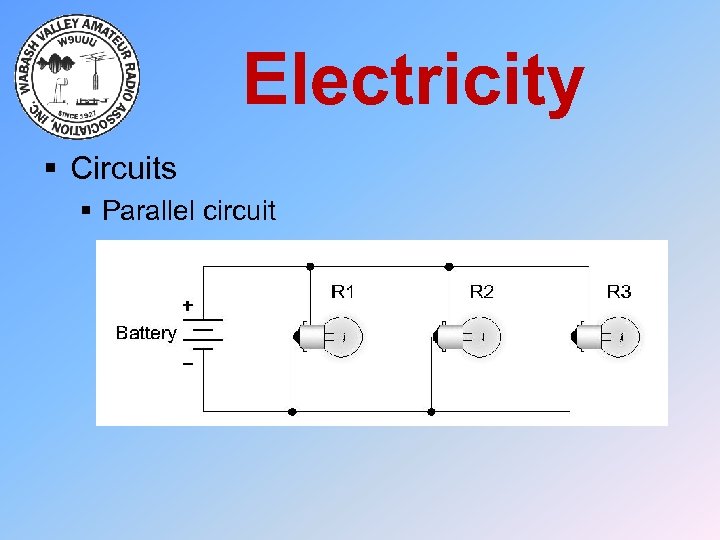 Electricity § Circuits § Parallel circuit
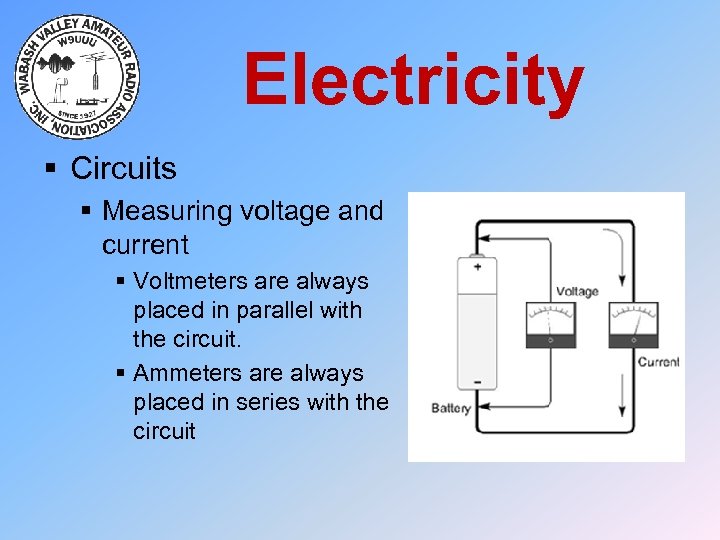 Electricity § Circuits § Measuring voltage and current § Voltmeters are always placed in parallel with the circuit. § Ammeters are always placed in series with the circuit
 T 7 D 01 -- Which instrument would you use to measure electric potential or electromotive force? A. An ammeter B. A voltmeter C. A wavemeter D. An ohmmeter
 T 7 D 02 -- What is the correct way to connect a voltmeter to a circuit? A. In series with the circuit B. In parallel with the circuit C. In quadrature with the circuit D. In phase with the circuit
 T 7 D 03 -- How is an ammeter usually connected to a circuit? A. In series with the circuit B. In parallel with the circuit C. In quadrature with the circuit D. In phase with the circuit
 T 7 D 04 -- Which instrument is used to measure electric current? A. An ohmmeter B. A wavemeter C. A voltmeter D. An ammeter
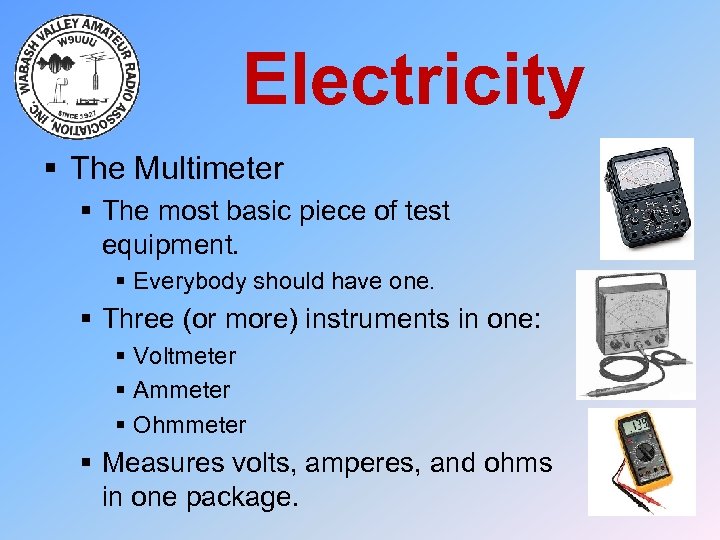 Electricity § The Multimeter § The most basic piece of test equipment. § Everybody should have one. § Three (or more) instruments in one: § Voltmeter § Ammeter § Ohmmeter § Measures volts, amperes, and ohms in one package.
 Electricity § The Multimeter § Digital multimeter (DVM) § Very inexpensive. § Often has extra features in addition to measuring volts, amps, & ohms.
 Electricity § The Multimeter § Meters can only measure current. § A voltmeter measures voltage by: 1. Placing a known resistance in parallel with the voltage being measured. 2. Measuring the current through the known resistance. 3. Calculating the voltage using Ohm’s law. § An ohmmeter measures resistance by: 1. Applying a known voltage to the circuit being measured. 2. Measuring the resulting current. 3. Calculating the resistance using Ohm’s law.
 Electricity § The Multimeter § Measuring resistance. § NEVER attempt to measure resistance with power applied to the circuit. § You WILL damage your multimeter. § NEVER attempt to measure voltage with the resistance setting. § You WILL damage your multimeter.
 Electricity § The Multimeter § If a resistance reading is initially very low but slowly increases to a higher value, it indicates the presence of a large capacitance in the circuit.
 T 7 D 06 -- Which of the following might damage a multimeter? A. Measuring a voltage too small for the chosen scale B. Leaving the meter in the milliamps position overnight C. Attempting to measure voltage when using the resistance setting D. Not allowing it to warm up properly
 T 7 D 07 -- Which of the following measurements are commonly made using a multimeter? A. SWR and RF power B. Signal strength and noise C. Impedance and reactance D. Voltage and resistance
 T 7 D 10 -- What is probably happening when an ohmmeter, connected across an unpowered circuit, initially indicates a low resistance and then shows increasing resistance with time? A. The ohmmeter is defective B. The circuit contains a large capacitor C. The circuit contains a large inductor D. The circuit is a relaxation oscillator
 T 7 D 11 -- Which of the following precautions should be taken when measuring circuit resistance with an ohmmeter? A. Ensure that the applied voltages are correct B. Ensure that the circuit is not powered C. Ensure that the circuit is grounded D. Ensure that the circuit is operating at the correct frequency
 T 7 D 12 -- Which of the following precautions should be taken when measuring high voltages with a voltmeter? A. Ensure that the voltmeter has very low impedance B. Ensure that the voltmeter and leads are rated for use at the voltages to be measured C. Ensure that the circuit is grounded through the voltmeter D. Ensure that the voltmeter is set to the correct frequency
 Electricity § Power § The rate at which energy is consumed. § Measured in watts § Abbreviated “W” § Use symbol “P” in formulas § 1 hp ≈ 745 watts § Power is measured using a wattmeter.
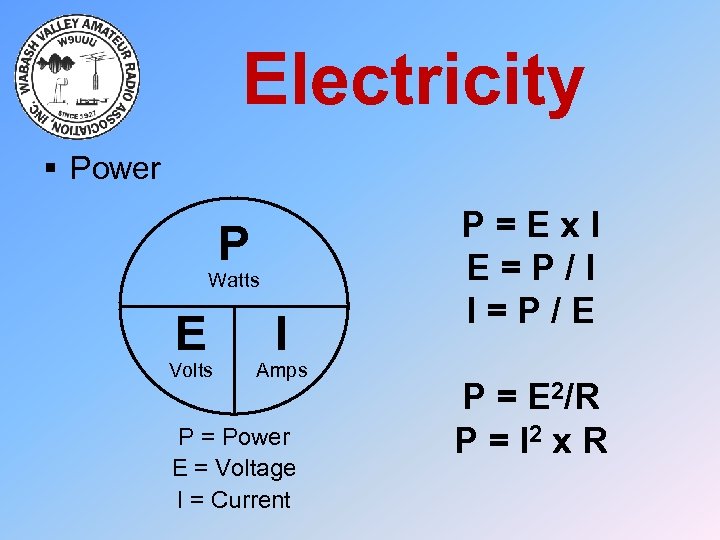 Electricity § Power P Watts E Volts I Amps P = Power E = Voltage I = Current P=Ex. I E=P/I I=P/E P = E 2/R P = I 2 x R
 Electricity § AC and DC § When current flows in only one direction, it is called direct current (DC). § Batteries are a common source of DC. § Most electronic devices are powered by DC. § When current flows alternatively in one direction then in the opposite direction, it is called alternating current (AC). § Rate at which direction changes is called the frequency. § Your household current is AC.
 T 5 A 02 -- Electrical power is measured in which of the following units? A. Volts B. Watts C. Ohms D. Amperes
 T 5 A 04 -- What is the name for a current that flows only in one direction? A. Alternating current B. Direct current C. Normal current D. Smooth current
 T 5 A 09 -- What is the name for a current that reverses direction on a regular basis? A. Alternating current B. Direct current C. Circular current D. Vertical current
 T 5 A 10 -- Which term describes the rate at which electrical energy is used? A. Resistance B. Current C. Power D. Voltage
 T 5 C 08 -- What is the formula used to calculate electrical power in a DC circuit? A. Power (P) equals voltage (E) multiplied by current (I) B. Power (P) equals voltage (E) divided by current (I) C. Power (P) equals voltage (E) minus current (I) D. Power (P) equals voltage (E) plus current (I)
 T 5 C 09 -- How much power is being used in a circuit when the applied voltage is 13. 8 volts DC and the current is 10 amperes? A. 138 watts B. 0. 7 watts C. 23. 8 watts D. 3. 8 watts
 T 5 C 10 -- How much power is being used in a circuit when the applied voltage is 12 volts DC and the current is 2. 5 amperes? A. 4. 8 watts B. 30 watts C. 14. 5 watts D. 0. 208 watts
 T 5 C 11 -- How many amperes are flowing in a circuit when the applied voltage is 12 volts DC and the load is 120 watts? A. 0. 1 amperes B. 10 amperes C. 12 amperes D. 132 amperes
 Components § Basic Components § There are 3 basic types of components: § Resistor § Unit of measurement of resistance is the ohm (Ω). § Capacitor § Unit of measurement of capacitance is the farad (F). § Inductor § Unit of measurement of inductance is the henry (H).
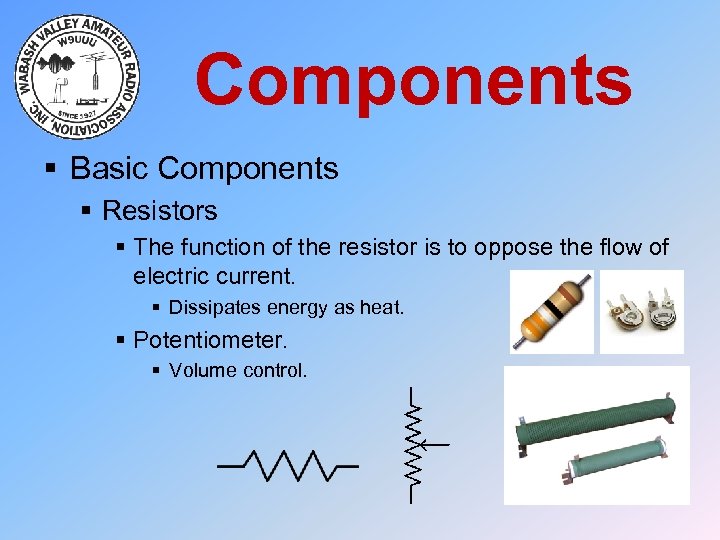 Components § Basic Components § Resistors § The function of the resistor is to oppose the flow of electric current. § Dissipates energy as heat. § Potentiometer. § Volume control.
 Components § Basic Components § Resistors. § A fixed amount of a partially conductive material. § Ratings. § Resistance. § Ohms (Ω), kilohms (kΩ), megohms (MΩ) § Values from <1 Ω to >10 MΩ. § Maximum power in watts (W). § Values from a fraction of a watt to >100 W.
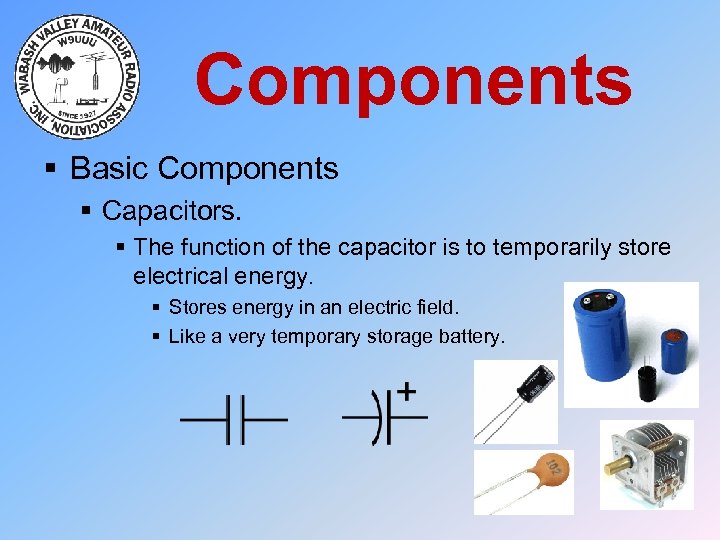 Components § Basic Components § Capacitors. § The function of the capacitor is to temporarily store electrical energy. § Stores energy in an electric field. § Like a very temporary storage battery.
 Components § Basic Components § Capacitors. § Two conductive surfaces separated by an insulator. § Ratings. § Capacitance in picofarads (p. F), microfarads (μF), or farads (F). § Values from 1 p. F to 1 F. § Maximum voltage in volts (V), or kilovolts (k. V). § Values from a few volts to several kilovolts.
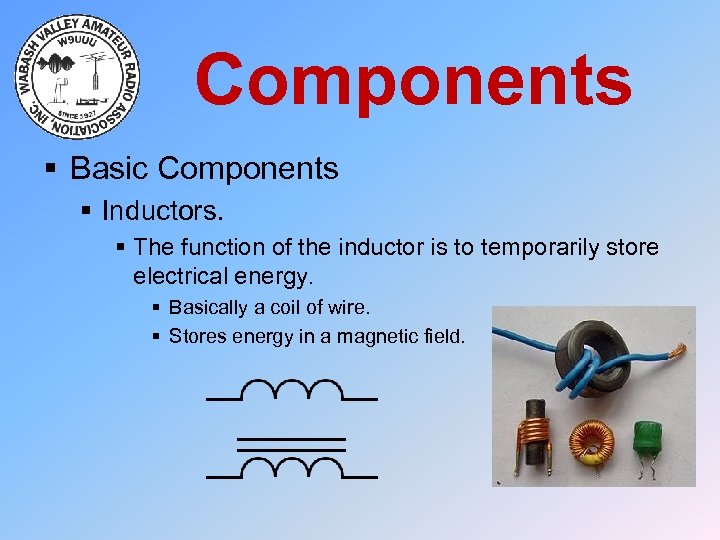 Components § Basic Components § Inductors. § The function of the inductor is to temporarily store electrical energy. § Basically a coil of wire. § Stores energy in a magnetic field.
 Components § Basic Components § Inductors. § A coil of wire wound around a non-magnetic form or a magnetic core. § Ratings. § Inductance in microhenries (μH), millihenries (m. H), or henries (H). § 1 μH to several henries. § Maximum current in milliamperes (m. A) or amperes (A). § A few milliamperes to several amperes.
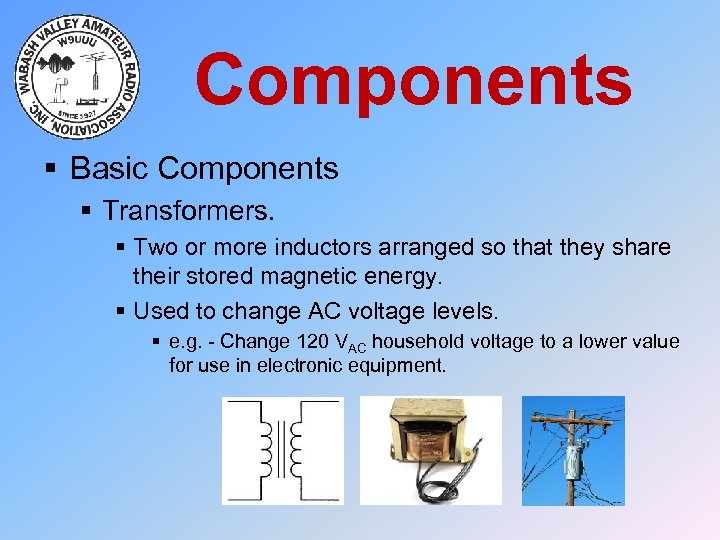 Components § Basic Components § Transformers. § Two or more inductors arranged so that they share their stored magnetic energy. § Used to change AC voltage levels. § e. g. - Change 120 VAC household voltage to a lower value for use in electronic equipment.
 Components § Color Code. § Component values often marked on component by colored stripes or dots. § Very common with resistors. § Less common with capacitors and inductors. § Axial-lead cases.
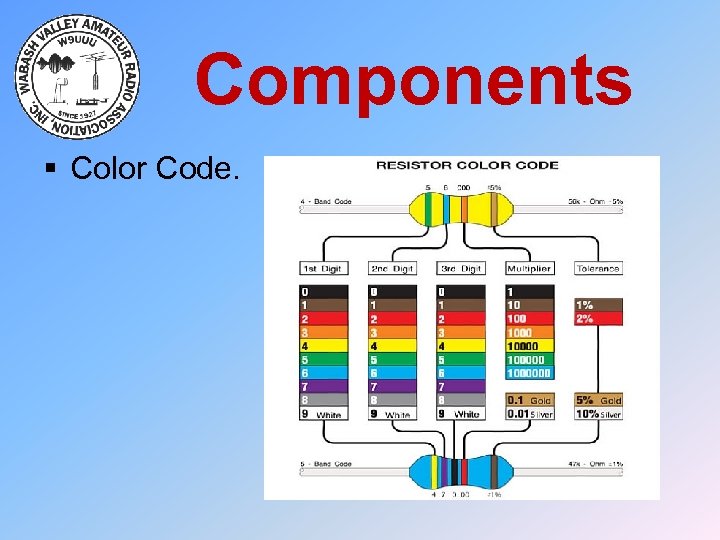 Components § Color Code.
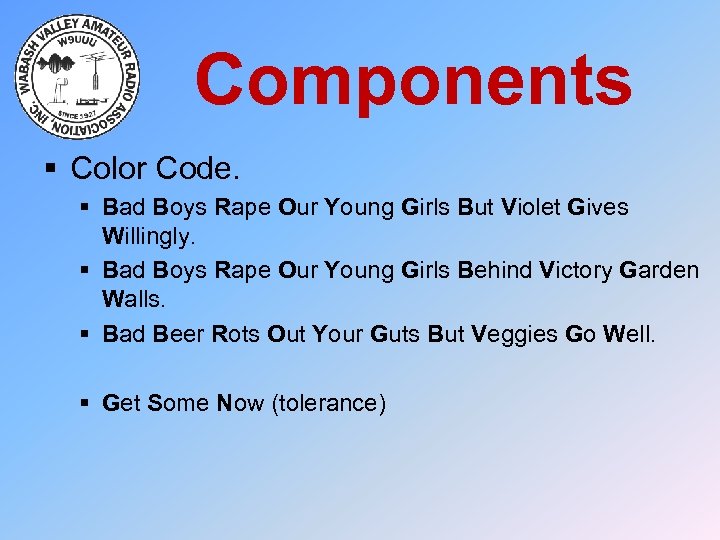 Components § Color Code. § Bad Boys Rape Our Young Girls But Violet Gives Willingly. § Bad Boys Rape Our Young Girls Behind Victory Garden Walls. § Bad Beer Rots Out Your Guts But Veggies Go Well. § Get Some Now (tolerance)
 T 5 C 01 -- What is the ability to store energy in an electric field called? A. Inductance B. Resistance C. Tolerance D. Capacitance
 T 5 C 02 -- What is the basic unit of capacitance? A. The farad B. The ohm C. The volt D. The henry
 T 5 C 03 -- What is the ability to store energy in a magnetic field called? A. Admittance B. Capacitance C. Resistance D. Inductance
 T 5 C 04 -- What is the basic unit of inductance? A. The coulomb B. The farad C. The henry D. The ohm
 T 6 A 01 -- What electrical component is used to oppose the flow of current in a DC circuit? A. Inductor B. Resistor C. Voltmeter D. Transformer
 T 6 A 02 -- What type of component is often used as an adjustable volume control? A. Fixed resistor B. Power resistor C. Potentiometer D. Transformer
 T 6 A 03 -- What electrical parameter is controlled by a potentiometer? A. Inductance B. Resistance C. Capacitance D. Field strength
 T 6 A 04 -- What electrical component stores energy in an electric field? A. Resistor B. Capacitor C. Inductor D. Diode
 T 6 A 05 -- What type of electrical component consists of two or more conductive surfaces separated by an insulator? A. Resistor B. Potentiometer C. Oscillator D. Capacitor
 T 6 A 06 -- What type of electrical component stores energy in a magnetic field? A. Resistor B. Capacitor C. Inductor D. Diode
 T 6 A 07 -- What electrical component is usually composed of a coil of wire? A. Switch B. Capacitor C. Diode D. Inductor
 T 6 D 06 -- What component is commonly used to change 120 V AC house current to a lower AC voltage for other uses? A. Variable capacitor B. Transformer C. Transistor D. Diode
 Components § Reactance and Impedance. § In circuits containing only resistors, voltage & current are always “in phase”. § Current flow changes at the same time and in the same direction as the voltage change.
 Components § Reactance and Impedance. § In circuits containing capacitors or inductors, voltage & current are “out of phase”. § Current flow changes before the voltage changes in a capacitor. § Current “leads” voltage. § Current flow changes after the voltage changes in an inductor. § Current “lags” voltage.
 Components ELI the ICE man
 Components § Reactance and Impedance. § Opposition to AC current flow in capacitors or inductors is called reactance (X). § Reactance (X) is measured in Ohms (Ω). § Capacitive reactance (XC) is measured in Ohms (Ω). § Inductive reactance (XL) is measured in Ohms (Ω). § Combination of resistance and reactance is called impedance (Z). § Impedance (Z) is measured in Ohms (Ω).
 Components § Resonance. • Because current leads voltage in a capacitor & lags voltage in an inductor, a combination of capacitance & inductance exists where the lead time & lag time cancel, resulting in the current & voltage being in phase.
 Components § Resonance. • This condition is called resonance. • Resonant circuit. • a. k. a. - Tuned circuit. • Acts as filter. • Used to adjust frequency of receiver or transmitter. • The capacitive reactance (XC) and inductive reactance (XL) in a resonant circuit are equal. • Impedance (Z) of a resonant circuit is purely resistive. • Reactance = 0Ω.
 T 5 C 12 -- What is meant by the term impedance? A. It is a measure of the opposition to AC current flow in a circuit B. It is the inverse of resistance C. It is a measure of the Q or Quality Factor of a component D. It is a measure of the power handling capability of a component
 T 5 C 13 -- What are the units of impedance? A. Volts B. Amperes C. Coulombs D. Ohms
 T 6 D 08 -- Which of the following is used together with an inductor to make a tuned circuit? A. Resistor B. Zener diode C. Potentiometer D. Capacitor
 T 6 D 11 -- What is a simple resonant or tuned circuit? A. An inductor and a capacitor connected in series or parallel to form a filter B. A type of voltage regulator C. A resistor circuit used for reducing standing wave ratio D. A circuit designed to provide high fidelity audio
 Break
Break
 Components § Diodes, Transistors, and Integrated Circuits. § Resistors, capacitors, and inductors are linear devices. § Response is ALWAYS directly proportional to the stimulus. § Diodes and transistors are non-linear devices. § Response is not always directly proportional to the stimulus.
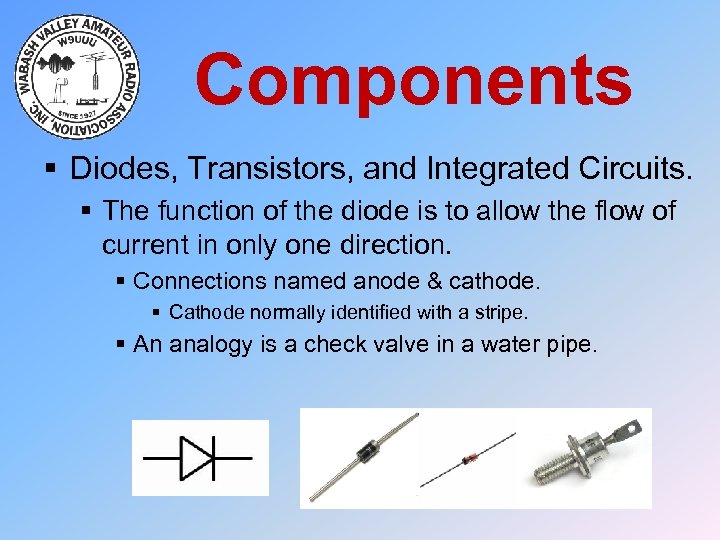 Components § Diodes, Transistors, and Integrated Circuits. § The function of the diode is to allow the flow of current in only one direction. § Connections named anode & cathode. § Cathode normally identified with a stripe. § An analogy is a check valve in a water pipe.
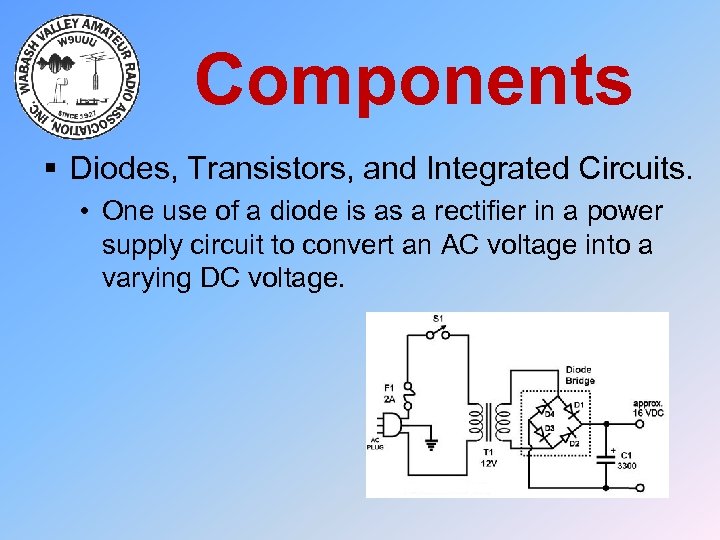 Components § Diodes, Transistors, and Integrated Circuits. • One use of a diode is as a rectifier in a power supply circuit to convert an AC voltage into a varying DC voltage.
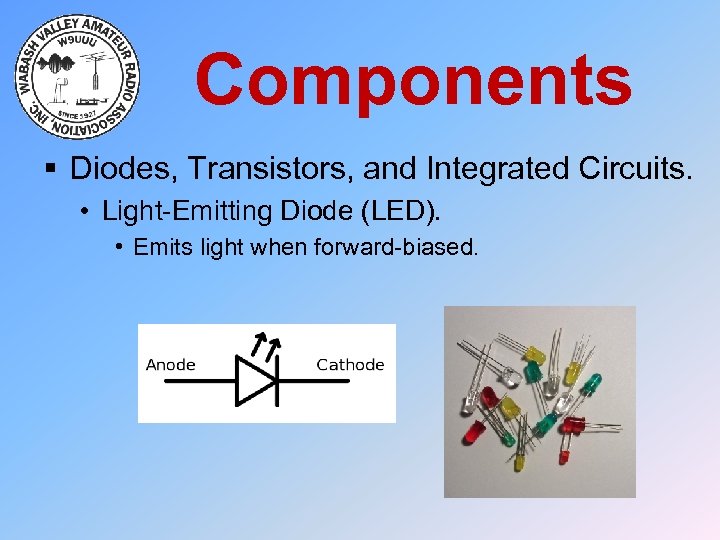 Components § Diodes, Transistors, and Integrated Circuits. • Light-Emitting Diode (LED). • Emits light when forward-biased.
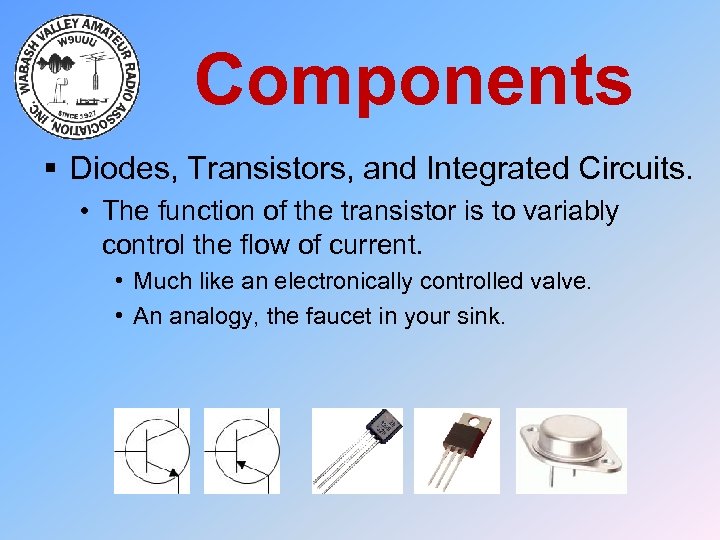 Components § Diodes, Transistors, and Integrated Circuits. • The function of the transistor is to variably control the flow of current. • Much like an electronically controlled valve. • An analogy, the faucet in your sink.
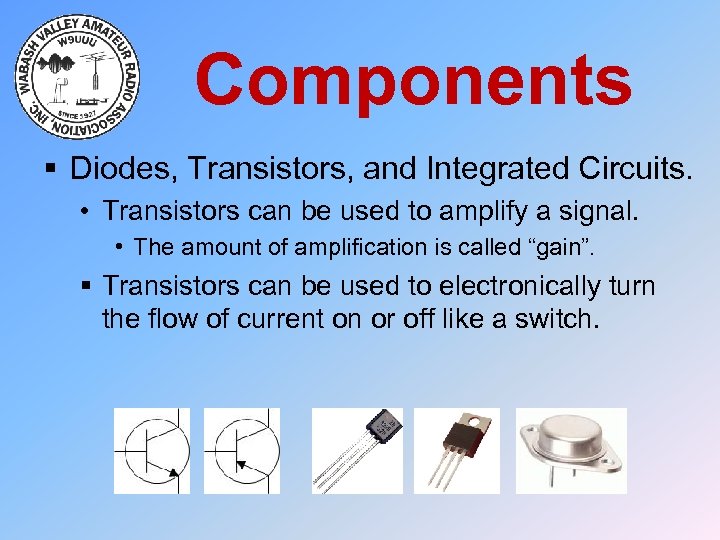 Components § Diodes, Transistors, and Integrated Circuits. • Transistors can be used to amplify a signal. • The amount of amplification is called “gain”. § Transistors can be used to electronically turn the flow of current on or off like a switch.
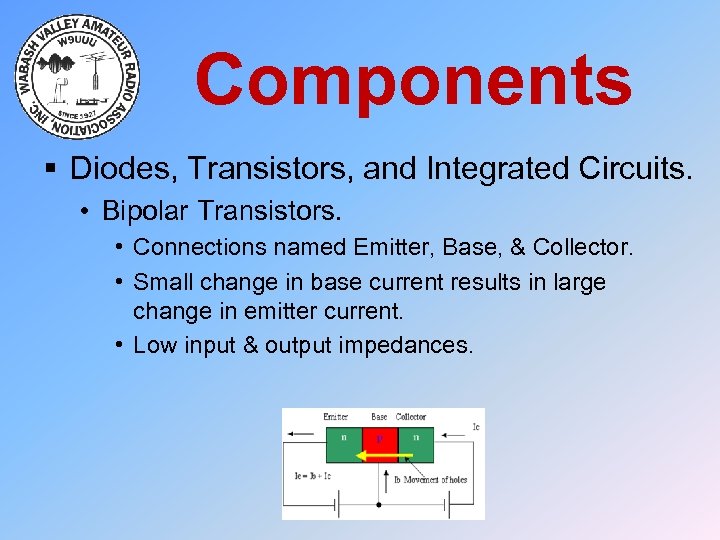 Components § Diodes, Transistors, and Integrated Circuits. • Bipolar Transistors. • Connections named Emitter, Base, & Collector. • Small change in base current results in large change in emitter current. • Low input & output impedances.
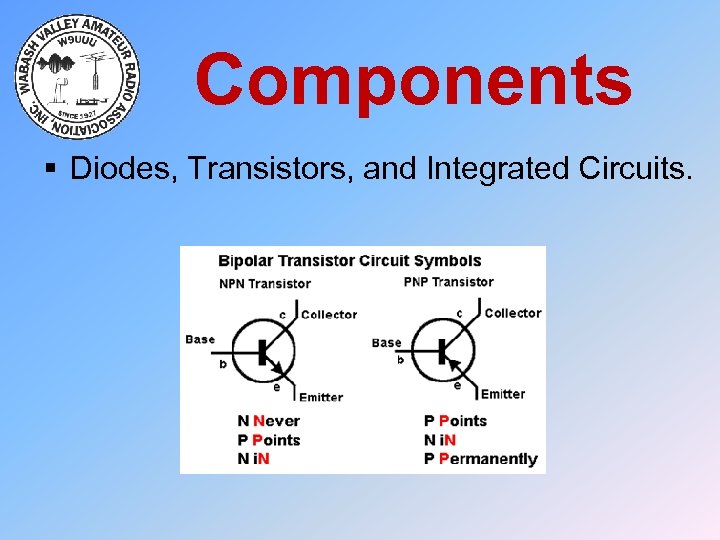 Components § Diodes, Transistors, and Integrated Circuits.
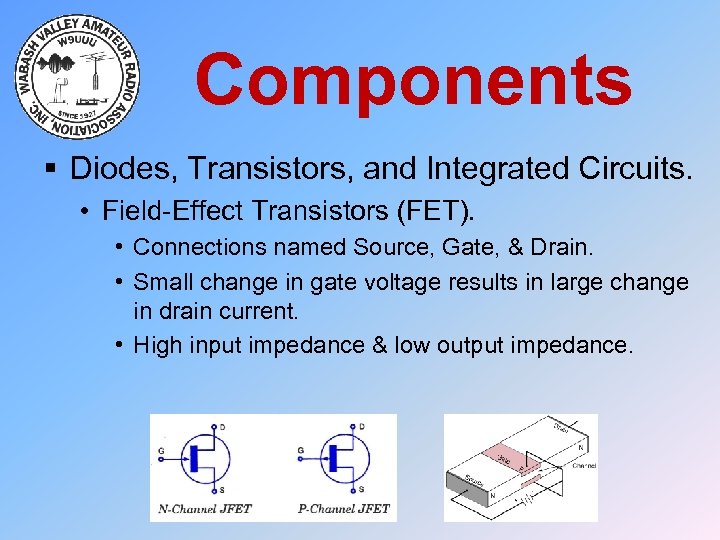 Components § Diodes, Transistors, and Integrated Circuits. • Field-Effect Transistors (FET). • Connections named Source, Gate, & Drain. • Small change in gate voltage results in large change in drain current. • High input impedance & low output impedance.
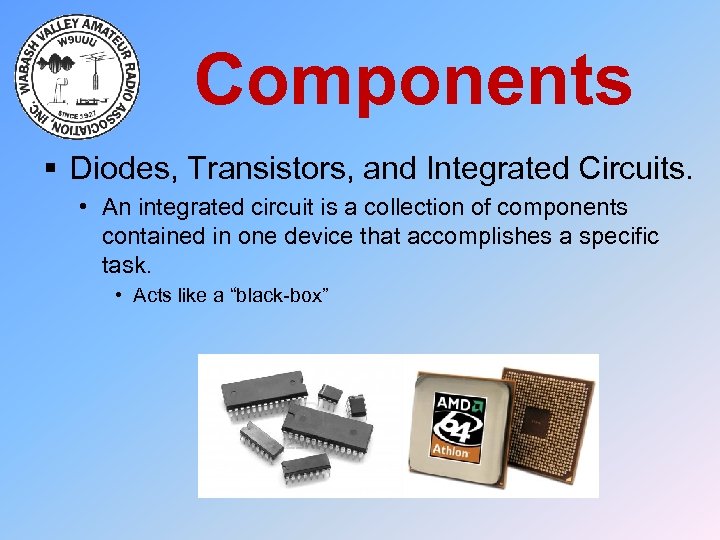 Components § Diodes, Transistors, and Integrated Circuits. • An integrated circuit is a collection of components contained in one device that accomplishes a specific task. • Acts like a “black-box”
 T 6 B 01 -- What class of electronic components is capable of using a voltage or current signal to control current flow? A. Capacitors B. Inductors C. Resistors D. Transistors
 T 6 B 02 -- What electronic component allows current to flow in only one direction? A. Resistor B. Fuse C. Diode D. Driven Element
 T 6 B 03 -- Which of these components can be used as an electronic switch or amplifier? A. Oscillator B. Potentiometer C. Transistor D. Voltmeter
 T 6 B 04 -- Which of the following components can be made of three layers of semiconductor material? A. Alternator B. Transistor C. Triode D. Pentagrid converter
 T 6 B 05 -- Which of the following electronic components can amplify signals? A. Transistor B. Variable resistor C. Electrolytic capacitor D. Multi-cell battery
 T 6 B 06 -- How is the cathode lead of a semiconductor diode usually identified? A. With the word cathode B. With a stripe C. With the letter C D. All of these choices are correct
 T 6 B 07 -- What does the abbreviation LED stand for? A. Low Emission Diode B. Light Emitting Diode C. Liquid Emission Detector D. Long Echo Delay
 T 6 B 08 -- What does the abbreviation FET stand for? A. Field Effect Transistor B. Fast Electron Transistor C. Free Electron Transition D. Field Emission Thickness
 T 6 B 09 -- What are the names of the two electrodes of a diode? A. Plus and minus B. Source and drain C. Anode and cathode D. Gate and base
 T 6 B 10 -- What are three electrodes of a PNP or NPN transistor? A. Emitter, base, and collector B. Source, gate, and drain C. Cathode, grid, and plate D. Cathode, drift cavity, and collector
 T 6 B 11 -- What at are three electrodes of a field effect transistor? A. Emitter, base, and collector B. Source, gate, and drain C. Cathode, grid, and plate D. Cathode, gate, and anode
 T 6 B 12 -- What is the term that describes a transistor's ability to amplify a signal? A. Gain B. Forward resistance C. Forward voltage drop D. On resistance
 T 6 D 01 -- Which of the following devices or circuits changes an alternating current into a varying direct current signal? A. Transformer B. Rectifier C. Amplifier D. Reflector
 T 6 D 07 -- Which of the following is commonly used as a visual indicator? A. LED B. FET C. Zener diode D. Bipolar transistor
 T 6 D 09 -- What is the name of a device that combines several semiconductors and other components into one package? A. Transducer B. Multi-pole relay C. Integrated circuit D. Transformer
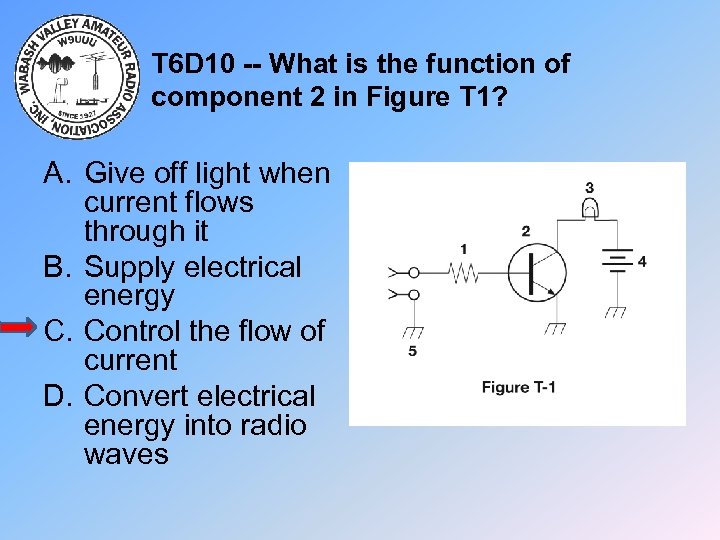 T 6 D 10 -- What is the function of component 2 in Figure T 1? A. Give off light when current flows through it B. Supply electrical energy C. Control the flow of current D. Convert electrical energy into radio waves
 Components § Protective Components. • Fuses and circuit breakers are designed to interrupt the flow of current if the current becomes too large.
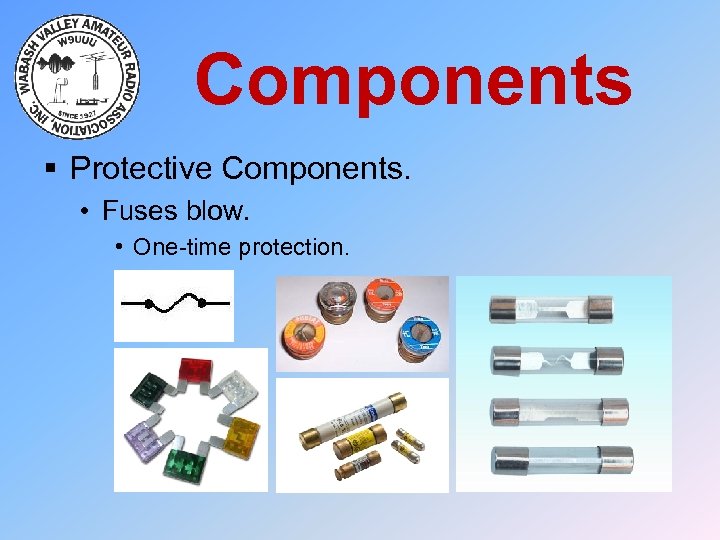 Components § Protective Components. • Fuses blow. • One-time protection.
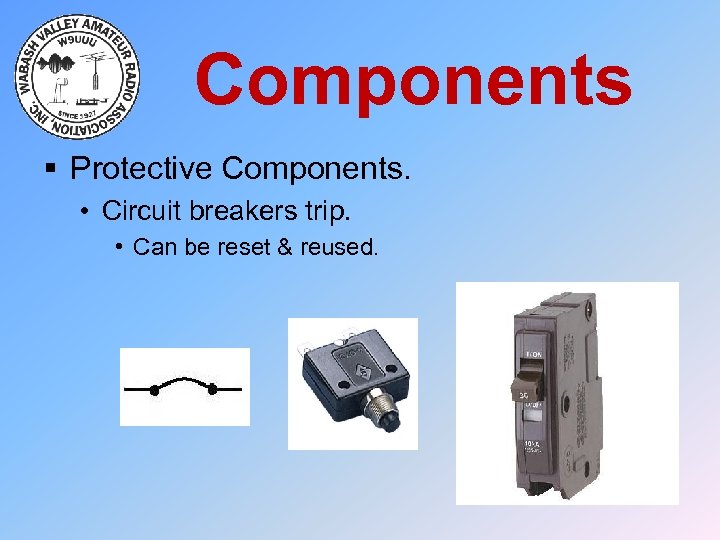 Components § Protective Components. • Circuit breakers trip. • Can be reset & reused.
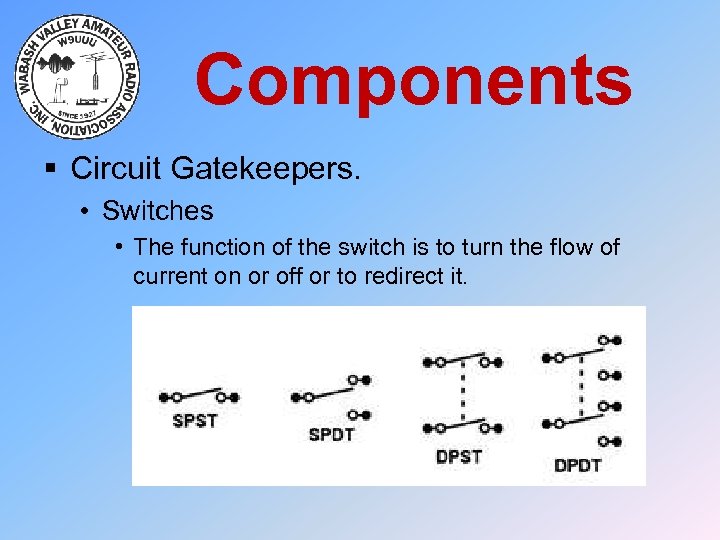 Components § Circuit Gatekeepers. • Switches • The function of the switch is to turn the flow of current on or off or to redirect it.
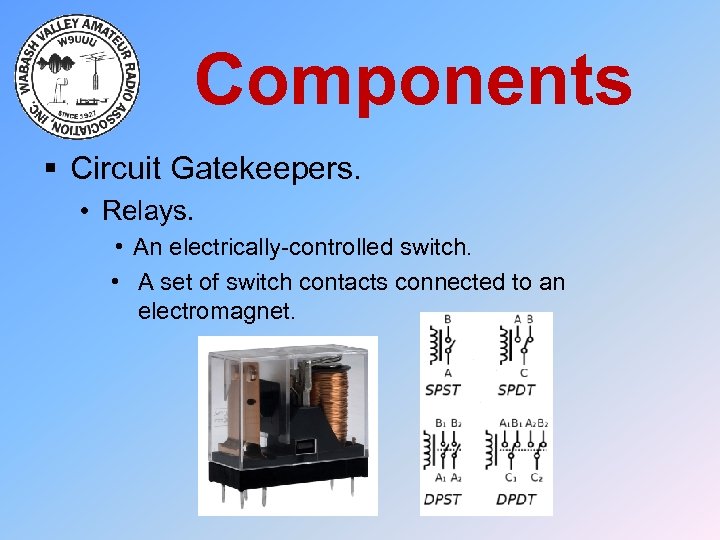 Components § Circuit Gatekeepers. • Relays. • An electrically-controlled switch. • A set of switch contacts connected to an electromagnet.
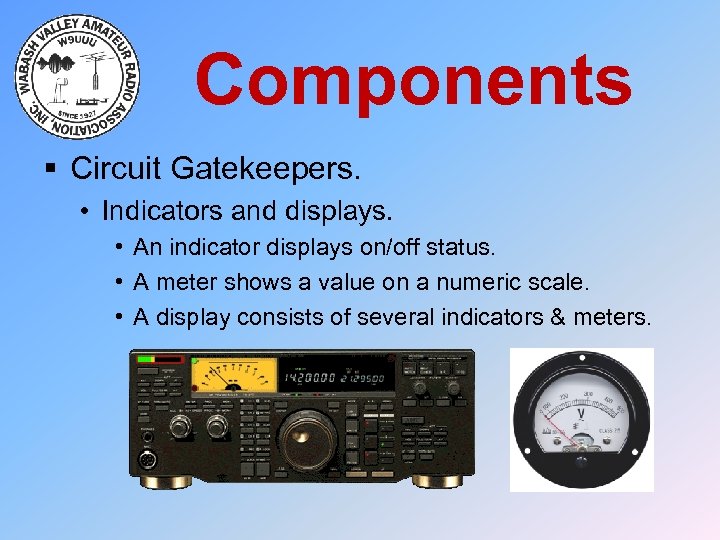 Components § Circuit Gatekeepers. • Indicators and displays. • An indicator displays on/off status. • A meter shows a value on a numeric scale. • A display consists of several indicators & meters.
 T 6 A 08 -- What electrical component is used to connect or disconnect electrical circuits? A. Magnetron B. Switch C. Thermistor D. All of these choices are correct
 T 6 A 09 -- What electrical component is used to protect other circuit components from current overloads? A. Fuse B. Capacitor C. Inductor D. All of these choices are correct
 T 6 D 02 -- What best describes a relay? A. A switch controlled by an electromagnet B. A current controlled amplifier C. An optical sensor D. A pass transistor
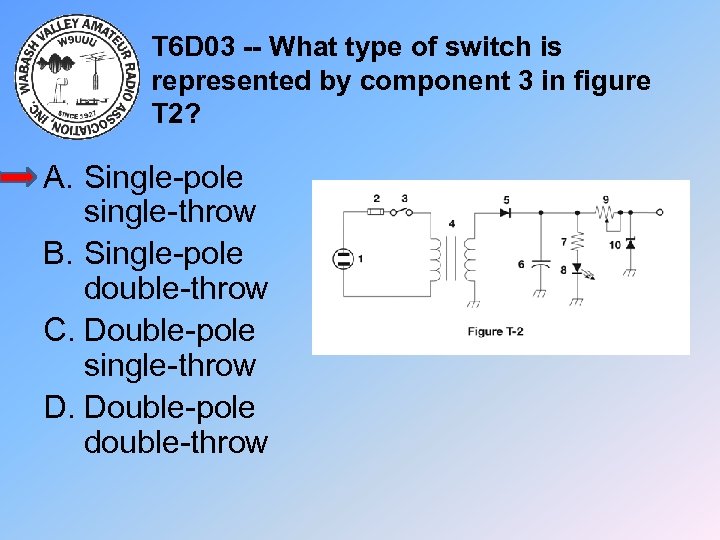 T 6 D 03 -- What type of switch is represented by component 3 in figure T 2? A. Single-pole single-throw B. Single-pole double-throw C. Double-pole single-throw D. Double-pole double-throw
 T 6 D 04 -- Which of the following can be used to display signal strength on a numeric scale? A. Potentiometer B. Transistor C. Meter D. Relay
 T 0 A 04 -- What is the purpose of a fuse in an electrical circuit? A. To prevent power supply ripple from damaging a circuit B. To interrupt power in case of overload C. To limit current to prevent shocks D. All of these choices are correct
 T 0 A 05 -- Why is it unwise to install a 20 -ampere fuse in the place of a 5 -ampere fuse? A. The larger fuse would be likely to blow because it is rated for higher current B. The power supply ripple would greatly increase C. Excessive current could cause a fire D. All of these choices are correct
 Components § Schematics and Component Symbols § Schematic diagrams § DO use a set of standard symbols for each component in a circuit. § DO represent the way components are interconnected. § DO NOT represent the physical layout of the components. § DO NOT represent the length of the conductors used for the interconnections.
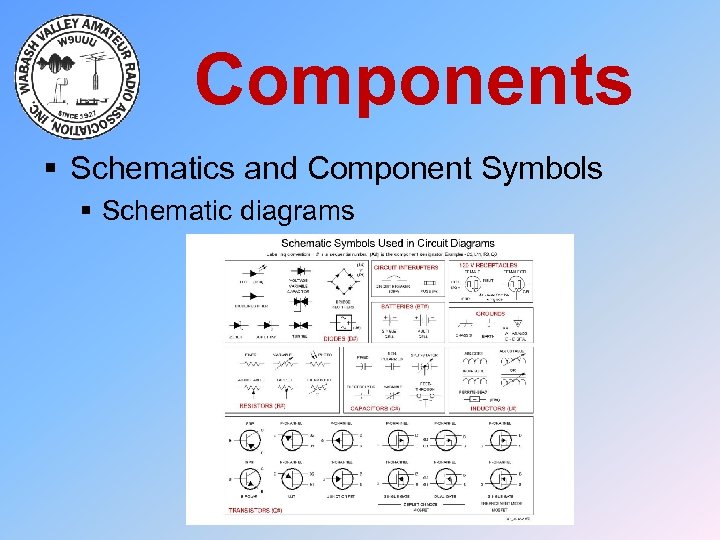 Components § Schematics and Component Symbols § Schematic diagrams
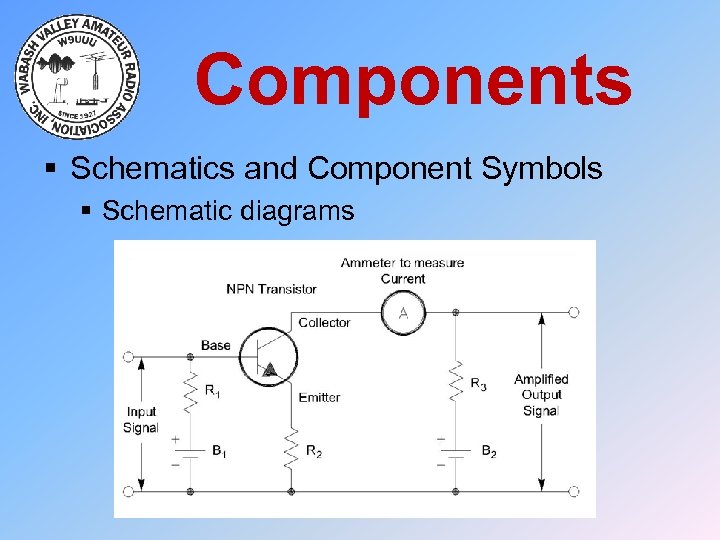 Components § Schematics and Component Symbols § Schematic diagrams
 T 6 C 01 -- What is the name for standardized representations of components in an electrical wiring diagram? A. Electrical depictions B. Grey sketch C. Schematic symbols D. Component callouts
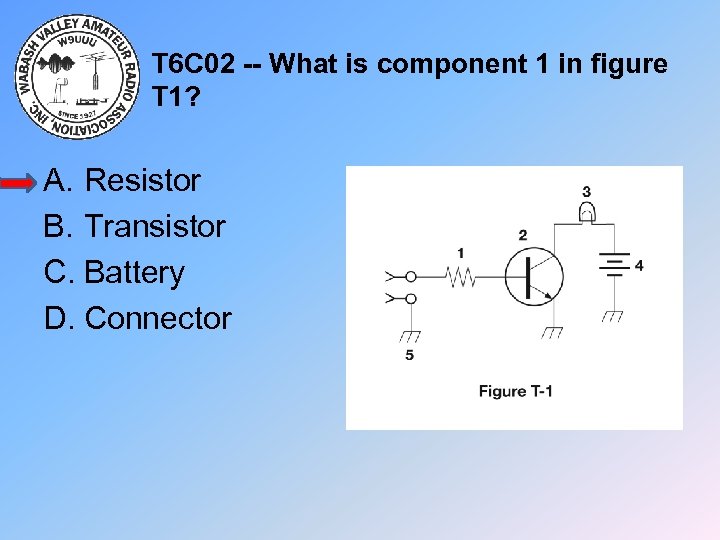 T 6 C 02 -- What is component 1 in figure T 1? A. Resistor B. Transistor C. Battery D. Connector
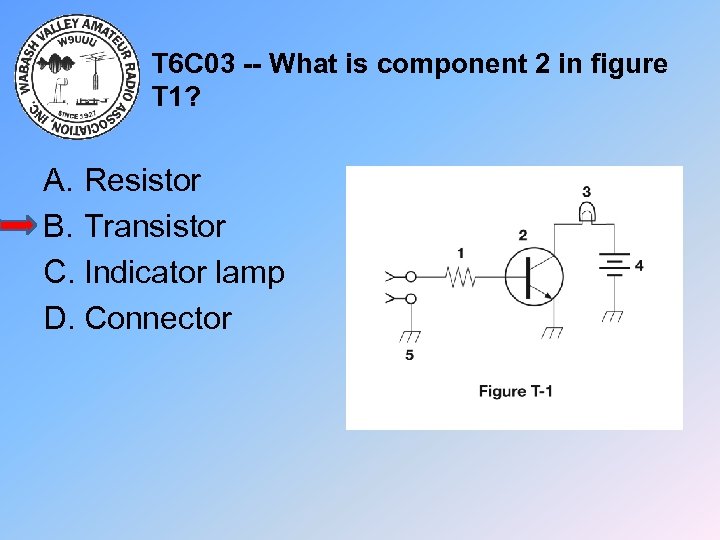 T 6 C 03 -- What is component 2 in figure T 1? A. Resistor B. Transistor C. Indicator lamp D. Connector
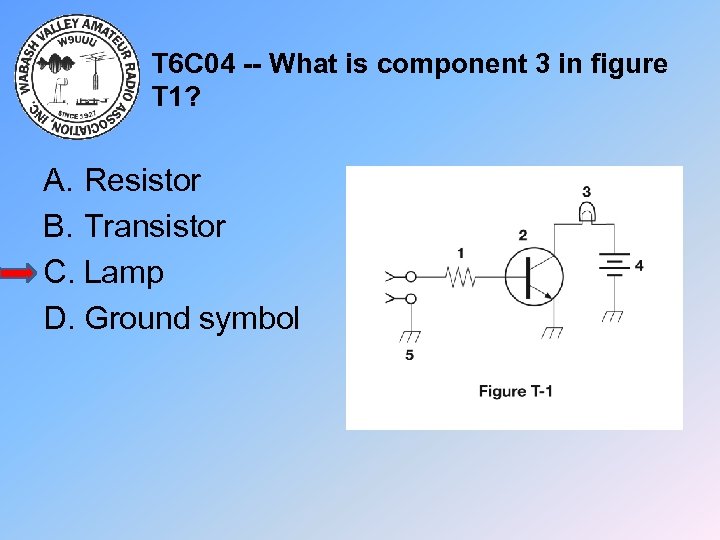 T 6 C 04 -- What is component 3 in figure T 1? A. Resistor B. Transistor C. Lamp D. Ground symbol
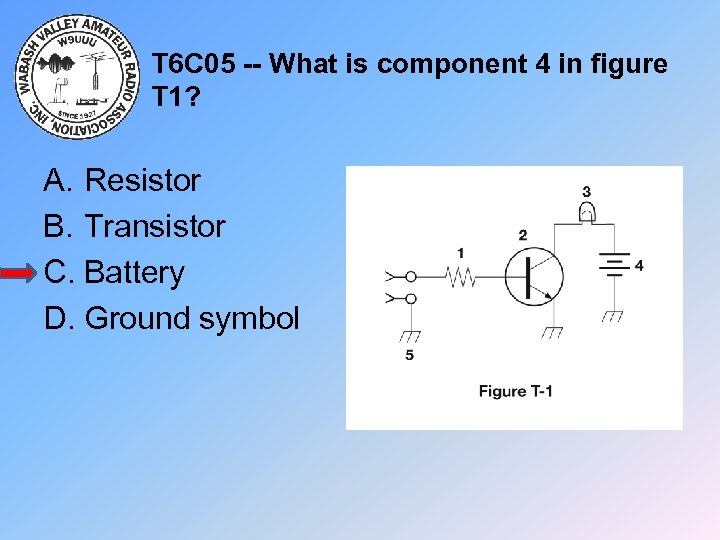 T 6 C 05 -- What is component 4 in figure T 1? A. Resistor B. Transistor C. Battery D. Ground symbol
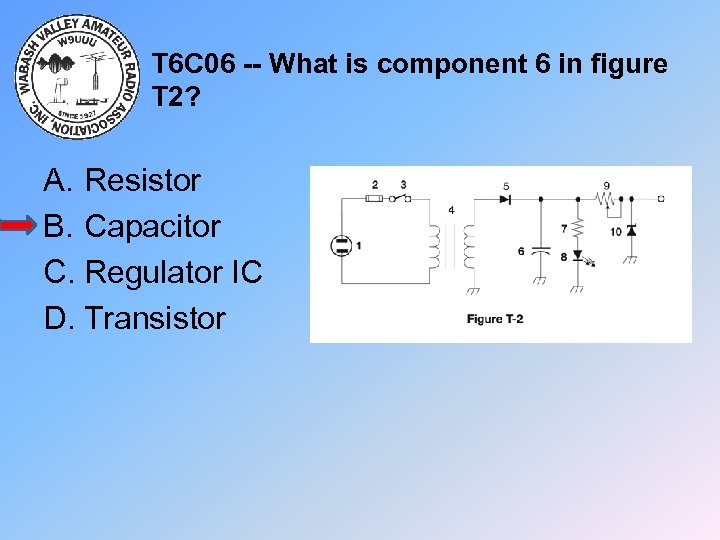 T 6 C 06 -- What is component 6 in figure T 2? A. Resistor B. Capacitor C. Regulator IC D. Transistor
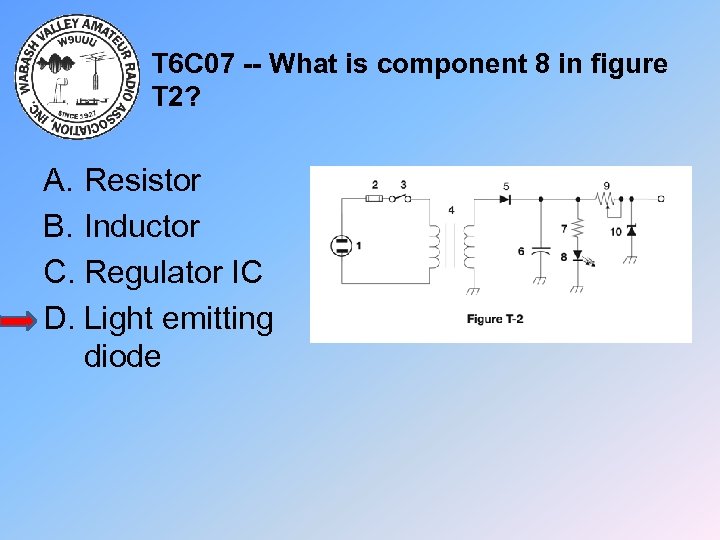 T 6 C 07 -- What is component 8 in figure T 2? A. Resistor B. Inductor C. Regulator IC D. Light emitting diode
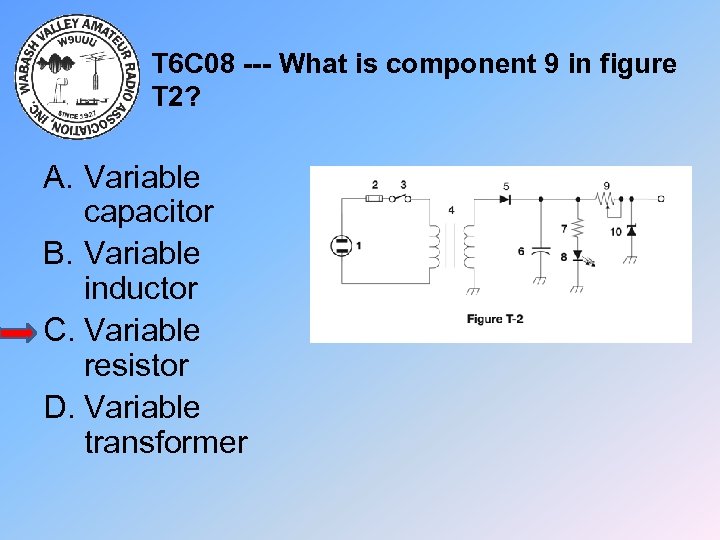 T 6 C 08 --- What is component 9 in figure T 2? A. Variable capacitor B. Variable inductor C. Variable resistor D. Variable transformer
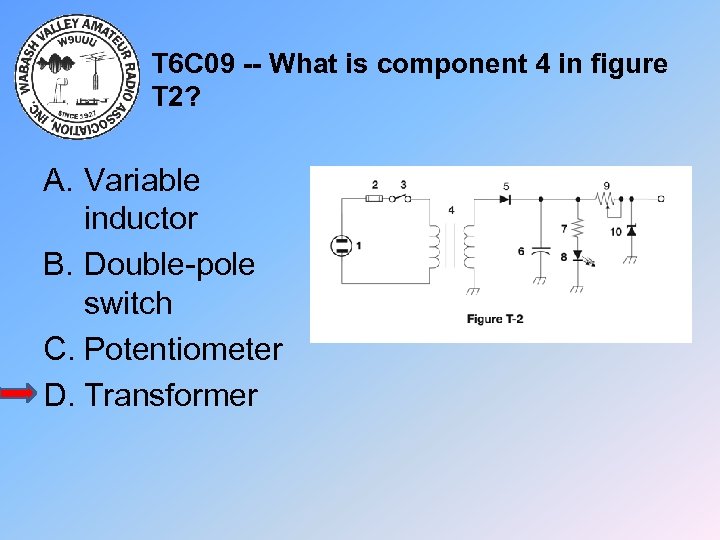 T 6 C 09 -- What is component 4 in figure T 2? A. Variable inductor B. Double-pole switch C. Potentiometer D. Transformer
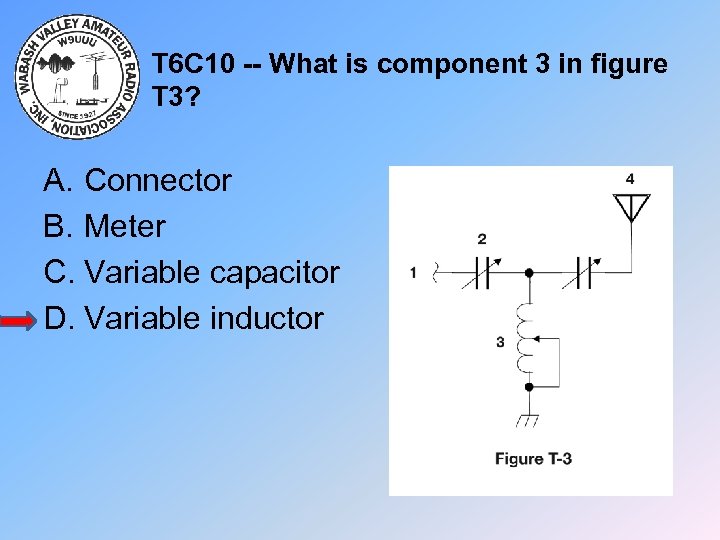 T 6 C 10 -- What is component 3 in figure T 3? A. Connector B. Meter C. Variable capacitor D. Variable inductor
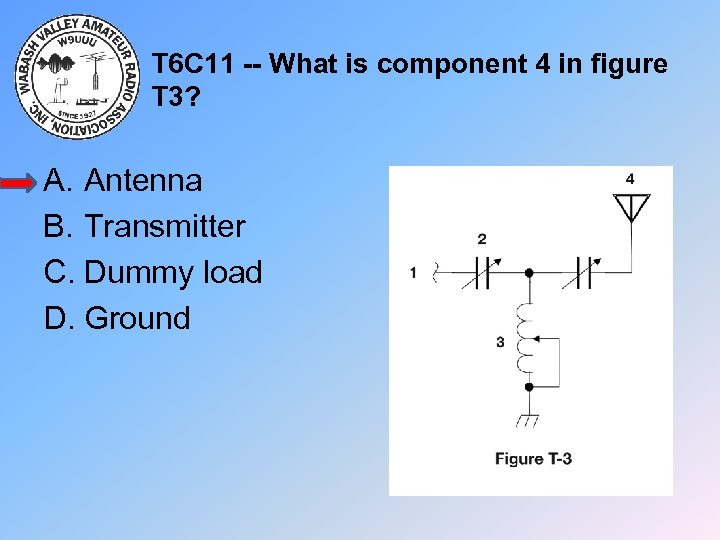 T 6 C 11 -- What is component 4 in figure T 3? A. Antenna B. Transmitter C. Dummy load D. Ground
 T 6 C 12 -- What do the symbols on an electrical circuit schematic diagram represent? A. Electrical components B. Logic states C. Digital codes D. Traffic nodes
 T 6 C 13 -- Which of the following is accurately represented in electrical circuit schematic diagrams? A. Wire lengths B. Physical appearance of components C. The way components are interconnected D. All of these choices are correct
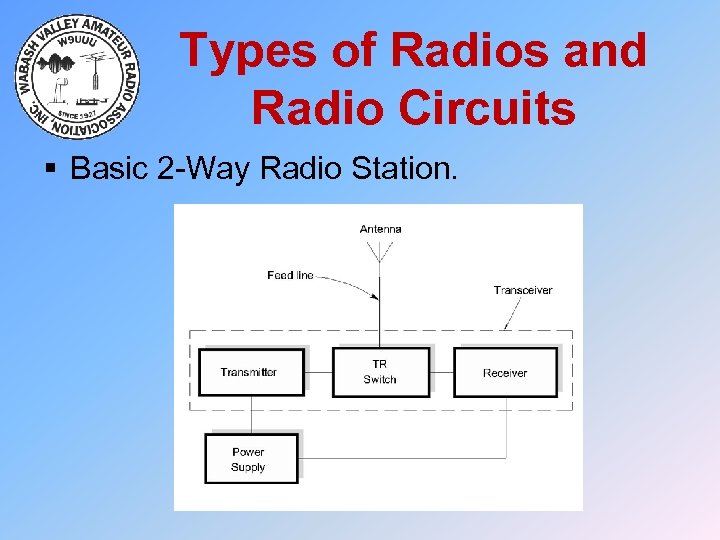 Types of Radios and Radio Circuits § Basic 2 -Way Radio Station.
 Types of Radios and Radio Circuits § Transmit-Receive Switches. § Switches antenna between transmitter and receiver. § Transceivers include the T/R switch as an internal circuit. § External T/R switch required if separate transmitter & receiver are used.
 Types of Radios and Radio Circuits § Oscillators and Amplifiers. • Oscillators produce a steady AC voltage on a single frequency. • Used in both receivers & transmitters to determine operating frequency. • Crystal-controlled oscillator. • Variable-frequency oscillator (VFO).
 Types of Radios and Radio Circuits § Oscillators and Amplifiers. • Amplifiers increase the strength of a signal. • Increase voltage, current, or power. • Amount of increase is called “gain”. • Numeric value – For example, a gain of 10 means the output signal is 10 times bigger than input signal. • d. B – For example, a power gain of 3 d. B means the output signal has twice the power than the input signal.
 Types of Radios and Radio Circuits § Filters. § Allow wanted signals to pass through. § Prevent unwanted signals from passing through. § Filters constructed using all passive components (resistors, capacitors, & inductors) are called “passive” filters. § Fitters that include an amplifier are called “active” filters.
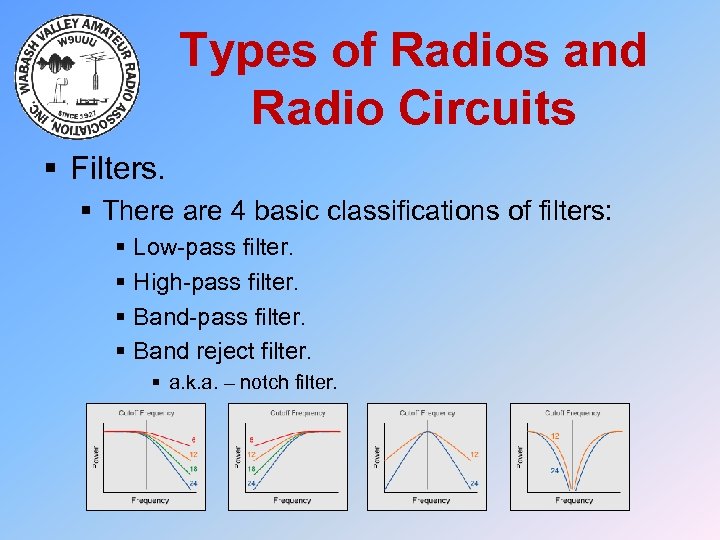 Types of Radios and Radio Circuits § Filters. § There are 4 basic classifications of filters: § Low-pass filter. § High-pass filter. § Band reject filter. § a. k. a. – notch filter.
 Types of Radios and Radio Circuits § Modulators. § The process of combining information (voice, data, etc. ) signals with an RF signal (carrier) is called “modulation”. • Can be as simple as an on-off switch. • Telegraph key. • Can be very complex. • A “demodulator” extracts the original information signal from the carrier.
 Types of Radios and Radio Circuits § Mixers. • Mixers combine 2 different frequency signals together to produce 4 output frequencies. • f 1 x f 2 f 1, f 2, f 1 -f 2, & f 1+f 2. • Usually one output frequency wanted, so filters remove other 3 frequencies. • Used in both transmitters & receivers. • Used to shift a signal or group of signals to another frequency.
 T 7 A 03 -- Which of the following is used to convert a radio signal from one frequency to another? A. Phase splitter B. Mixer C. Inverter D. Amplifier
 T 7 A 05 -- What is the name of a circuit that generates a signal of a desired frequency? A. Reactance modulator B. Product detector C. Low-pass filter D. Oscillator
 T 7 A 08 -- Which of the following describes combining speech with an RF carrier signal? A. Impedance matching B. Oscillation C. Modulation D. Low-pass filtering
 Types of Radios and Radio Circuits § Receivers. § A receiver gets the desired RF signal from the antenna and presents the original information to the user. § Many different types of receivers. § Direct-conversion. § If you count cell phones, most common type. § Superheterodyne. § Most common type used by amateur radio operators.
 Types of Radios and Radio Circuits § Receivers. § Direct-conversion receiver. • Local oscillator at (or near) frequency of signal to be received. • Advantage: Very easy to filter at audio frequency. • Advantage: No image responses. • Disadvantage: High stability local oscillator required. • Most software-defined radios (including cell phones) use direct-conversion receivers.
 Types of Radios and Radio Circuits § Receivers. § Heterodyne receiver. • RF & local oscillator fed into mixer to move signal to a lower intermediate frequency (IF) for filtering & demodulation. • Advantage: Easier to filter at lower frequency. • Disadvantage: Image responses. • Superheterodyne. • f. LO > f. RF.
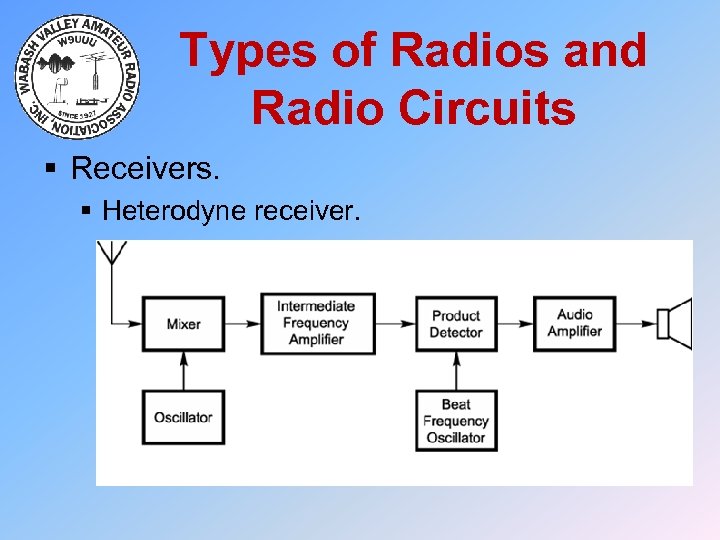 Types of Radios and Radio Circuits § Receivers. § Heterodyne receiver.
 Types of Radios and Radio Circuits § Receivers. § Sensitivity is a measure of how weak a signal can be received. § Sometimes a pre-amplifier (pre-amp) is installed between the antenna and the mixer to improve sensitivity.
 Types of Radios and Radio Circuits § Receivers. § Selectivity is a measure of how well a receiver can differentiate between signals. § Filters are used to provide selectivity.
 Types of Radios and Radio Circuits § Transverters. § The heterodyne method of shifting a frequency or range of frequencies can be used to shift a transceiver to a whole different band. § Allows HF transceiver to be used on VHF, UHF, & microwave frequencies. § Many amateur radio satellites are transverters.
 T 7 A 01 -- Which term describes the ability of a receiver to detect the presence of a signal? A. Linearity B. Sensitivity C. Selectivity D. Total Harmonic Distortion
 T 7 A 04 -- Which term describes the ability of a receiver to discriminate between multiple signals? A. Discrimination ratio B. Sensitivity C. Selectivity D. Harmonic Distortion
 T 7 A 06 -- What device takes the output of a low-powered 28 MHz SSB exciter and produces a 222 MHz output signal? A. High-pass filter B. Low-pass filter C. Transverter D. Phase converter
 T 7 A 11 -- Where is an RF preamplifier installed? A. Between the antenna and receiver B. At the output of the transmitter's power amplifier C. Between a transmitter and antenna tuner D. At the receiver's audio output
 Questions?
 Next Week Chapter 4 Propagation, Antennas, and Feed Lines