


 Скачать презентацию Technical Vocational Education Training upskilling China s workforce
c17258e2e9a8867d61785484bfacc16f.ppt
- Количество слайдов: 25
 Technical Vocational Education & Training upskilling China’s workforce Beijing, China 2 st November, 2005 Ron Perkinson Principal Education Specialist International Finance Corporation (World Bank Group) www. ifc. org Carl Dahlman Professor of International Relations and Information Technology Georgetown University, Washington DC, ` USA
 Implications for Role of Government and Structure of Education and Training Systems • Implies rethinking the role of government – What does the government need to provide? What can be provided by the private and non-government sector? – Who can best set the standards and do the accreditation? What should be compulsory and what voluntary? – What should be the financing role of government versus that of parents or corporations? – What role does government have in ensuring equity as there is a growing private system? – How can government promote development of an education loan market? • Implies rethinking and improving structure and content of education and training systems – Major challenges in what content and skills should be given at different levels of formal education – How to do this in the most cost effective way? – We are moving to system of just in time learning for whatever is the relevant need
 Global Trends in Education and Training • Increasing educational attainment • Continued high returns to higher levels of education until very recently • Increasing contribution of education to GDP growth • Increasing globalization of education • Increasing tendency for adults to go back to school or to get new skills • Growing amount of training provided on the job or by going back to formal education • Increasing private provision of education • Increased need to approach education and training as life long process from cradle to grave
 Stock Challenge in China • Rapid creation and diffusion of knowledge means adults constantly have to learn. China has to upgrade the skills of 700 million workers – – Improve training to millions of rural migrants Retrain millions of laid off workers Upgrade skills of hundreds of millions of employed persons Provide education and training to hundreds of millions of adults outside the labor force • China needs – Multiple mechanisms for continuous training beyond formal education system – Effective system for skills assessment and certification – To exploit potential of information and communications technologies to expand training opportunities
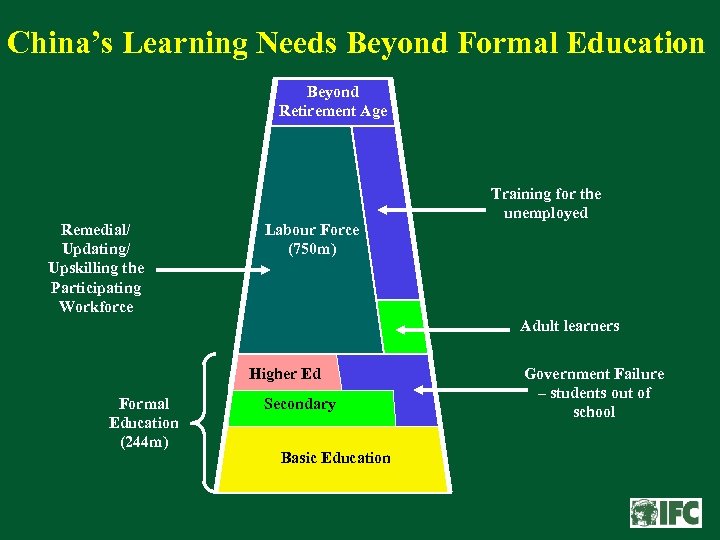 China’s Learning Needs Beyond Formal Education Beyond Retirement Age Remedial/ Updating/ Upskilling the Participating Workforce Labour Force (750 m) Training for the unemployed Adult learners Higher Ed Formal Education (244 m) Secondary Basic Education Government Failure – students out of school
 Key Issues in LLL for China • Need to Realize Potential of ICT Technologies to Expand Access and Quality of education and training – Need to develop more providers – Need to help create more content • Need for Accreditation, Vocational Qualification and Certification – Need better accreditation of education and training providers – Need effective system for assessing and certifying vocational qualifications (and not necessarily just by government)
 Need for Greater Partnership between Governments & Private Sector in Education • Government has key role as architect and coordinator of life long learning system – – Legislation / Regulations and standards / Quality assurance Equity Finance Information on needs of dynamic and rapidly growing system quality of different education and training providers, and qualifications and competencies of people – Encouragement for development of specialized intermediary institutions to fill gaps • Key private sector role – Increasing tuition payments by students in public system – Increasing provision of education at all levels, but especially higher education and training – Helping develop the education market: finance, information, content, standards, qualifications, accreditation
 China • Record 20 million students enrolled in Chinese colleges in 2004 – the largest college-student population in the world • 4. 2 million freshmen accepted for 2004/05 - double of 1998 • College acceptance rate this year was about 60% • Growing two-way relationships with foreign partners • Employers wanting skills relevant for economy – want to shift from producers of ‘volume’ to producers of ‘value’ – new focus on up skilling the workforce • China is adjusting to market demand – need for a framework for lifelong learning – private sector role critical – includes scoping new strategies for TVET Sources: Business China 14 March 2005; IFC 2005
 Economic Development. . . important impact comes from skills literacy • Not just about putting more highly qualified people in to higher paying jobs • The need to produce highly qualified people is important. . . but – • Proven impact on economic development comes from increasing skills literacy – mid & higher level skills are not just about degrees – indications show quite the opposite (University of British Colombia ‘Literacy Survey’) • China needs skills and workforce that provides backbone to private sector productivity and competitiveness Source: University of British Columbia – ‘Literacy Survey – Ana Ferrer, David A. Green, and W. Craig Riddell - The International Adult Literacy Survey’ (IALS) was a 22 -country initiative conducted between 1994 and 1998. http: //www. statcan. ca/english/research/89 -552 -MIE 2004012. pdf
 A Vibrant Private Sector Serves Needs Of Middle Class • OECD estimates in 2003 private companies accounted for 63% of China’s business-sector output – compares to 54% in 1998 – introduces new innovations – serves increased consumption by emerging middle class • More education & training capacity needed • What about ‘certified’ training – where the market will demand training linked to career pathways and life long learning? Source: The Economist September 17, 2005 - The OECD in China’s Economy
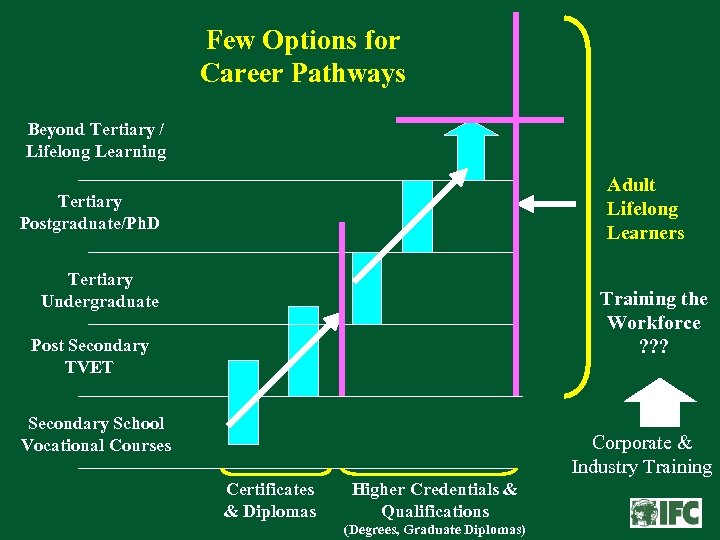 Few Options for Career Pathways Beyond Tertiary / Lifelong Learning Adult Lifelong Learners Tertiary Postgraduate/Ph. D Tertiary Undergraduate Training the Workforce ? ? ? Post Secondary TVET Secondary School Vocational Courses Corporate & Industry Training Certificates & Diplomas Higher Credentials & Qualifications (Degrees, Graduate Diplomas)
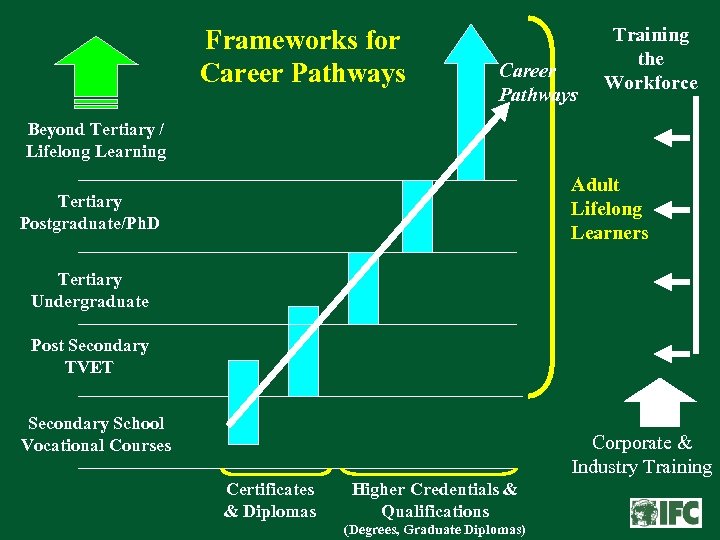 Frameworks for Career Pathways Training the Workforce Beyond Tertiary / Lifelong Learning Adult Lifelong Learners Tertiary Postgraduate/Ph. D Tertiary Undergraduate Post Secondary TVET Secondary School Vocational Courses Corporate & Industry Training Certificates & Diplomas Higher Credentials & Qualifications (Degrees, Graduate Diplomas)
 Higher Secondary & Tertiary Attainment: OECD By 2003 > 40% of adults between 25 to 64 yrs had tertiary qualifications
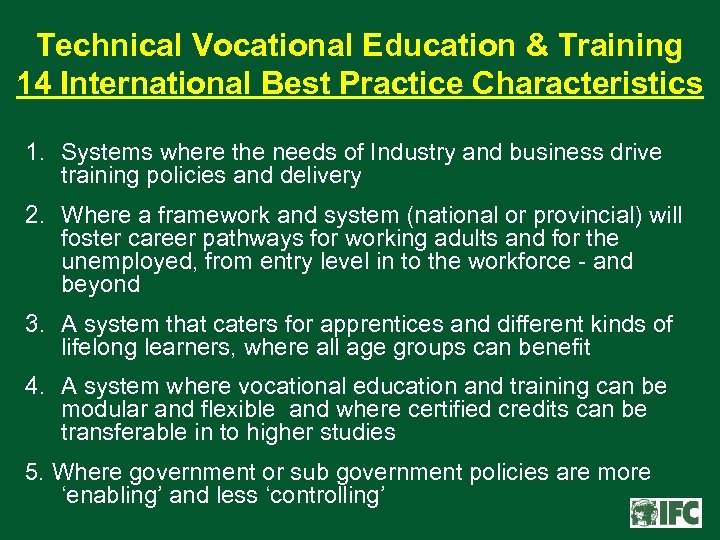 Technical Vocational Education & Training 14 International Best Practice Characteristics 1. Systems where the needs of Industry and business drive training policies and delivery 2. Where a framework and system (national or provincial) will foster career pathways for working adults and for the unemployed, from entry level in to the workforce - and beyond 3. A system that caters for apprentices and different kinds of lifelong learners, where all age groups can benefit 4. A system where vocational education and training can be modular and flexible and where certified credits can be transferable in to higher studies 5. Where government or sub government policies are more ‘enabling’ and less ‘controlling’
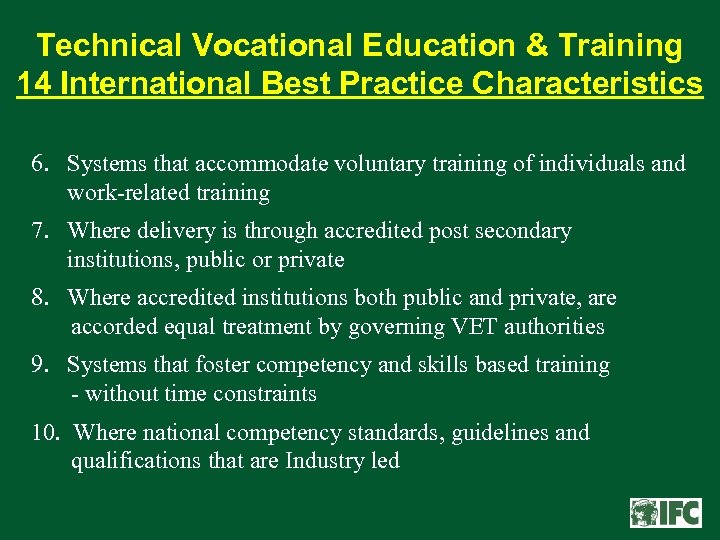 Technical Vocational Education & Training 14 International Best Practice Characteristics 6. Systems that accommodate voluntary training of individuals and work-related training 7. Where delivery is through accredited post secondary institutions, public or private 8. Where accredited institutions both public and private, are accorded equal treatment by governing VET authorities 9. Systems that foster competency and skills based training - without time constraints 10. Where national competency standards, guidelines and qualifications that are Industry led
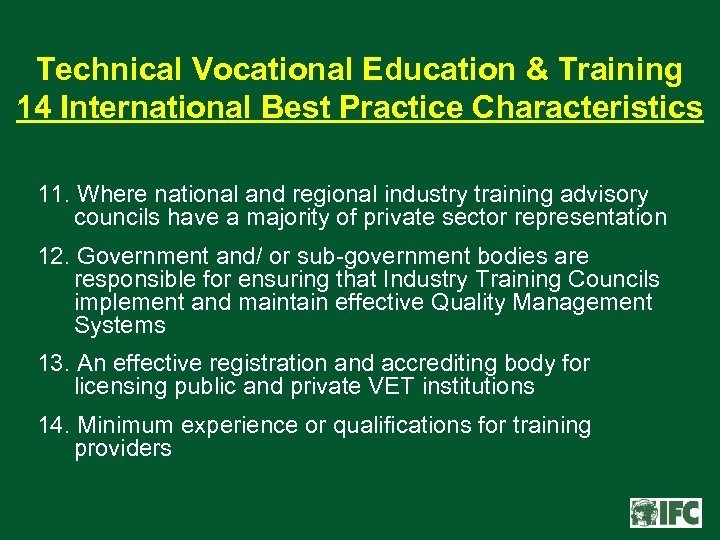 Technical Vocational Education & Training 14 International Best Practice Characteristics 11. Where national and regional industry training advisory councils have a majority of private sector representation 12. Government and/ or sub-government bodies are responsible for ensuring that Industry Training Councils implement and maintain effective Quality Management Systems 13. An effective registration and accrediting body for licensing public and private VET institutions 14. Minimum experience or qualifications for training providers
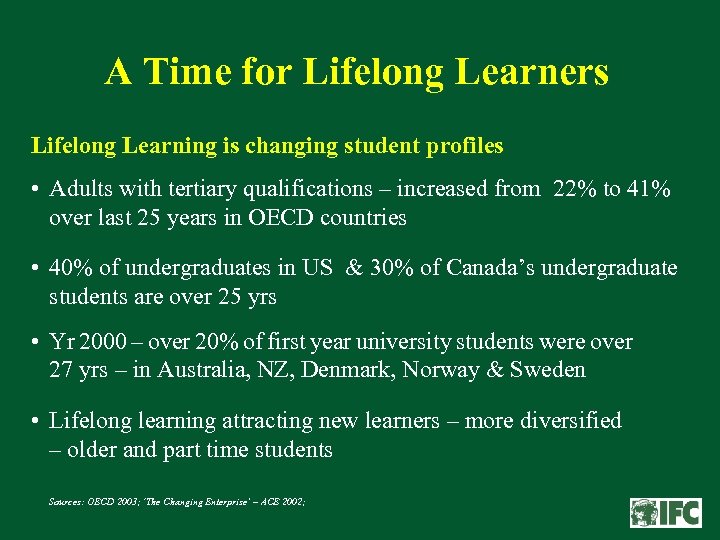 A Time for Lifelong Learners Lifelong Learning is changing student profiles • Adults with tertiary qualifications – increased from 22% to 41% over last 25 years in OECD countries • 40% of undergraduates in US & 30% of Canada’s undergraduate students are over 25 yrs • Yr 2000 – over 20% of first year university students were over 27 yrs – in Australia, NZ, Denmark, Norway & Sweden • Lifelong learning attracting new learners – more diversified – older and part time students Sources: OECD 2003; ‘The Changing Enterprise’ – ACE 2002;
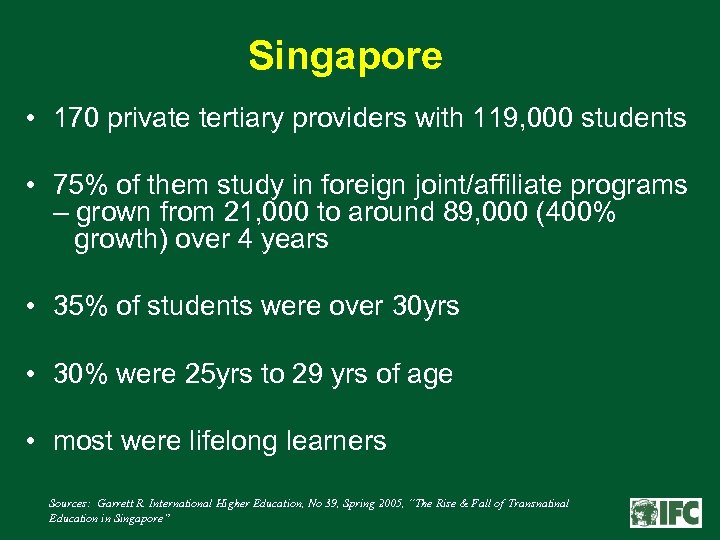 Singapore • 170 private tertiary providers with 119, 000 students • 75% of them study in foreign joint/affiliate programs – grown from 21, 000 to around 89, 000 (400% growth) over 4 years • 35% of students were over 30 yrs • 30% were 25 yrs to 29 yrs of age • most were lifelong learners Sources: Garrett R. International Higher Education, No 39, Spring 2005, “The Rise & Fall of Transnatinal Education in Singapore”
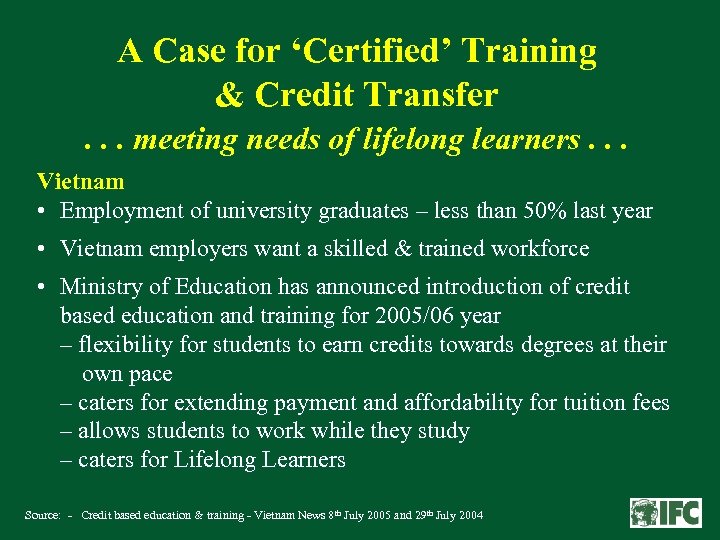 A Case for ‘Certified’ Training & Credit Transfer. . . meeting needs of lifelong learners. . . Vietnam • Employment of university graduates – less than 50% last year • Vietnam employers want a skilled & trained workforce • Ministry of Education has announced introduction of credit based education and training for 2005/06 year – flexibility for students to earn credits towards degrees at their own pace – caters for extending payment and affordability for tuition fees – allows students to work while they study – caters for Lifelong Learners Source: - Credit based education & training - Vietnam News 8 th July 2005 and 29 th July 2004
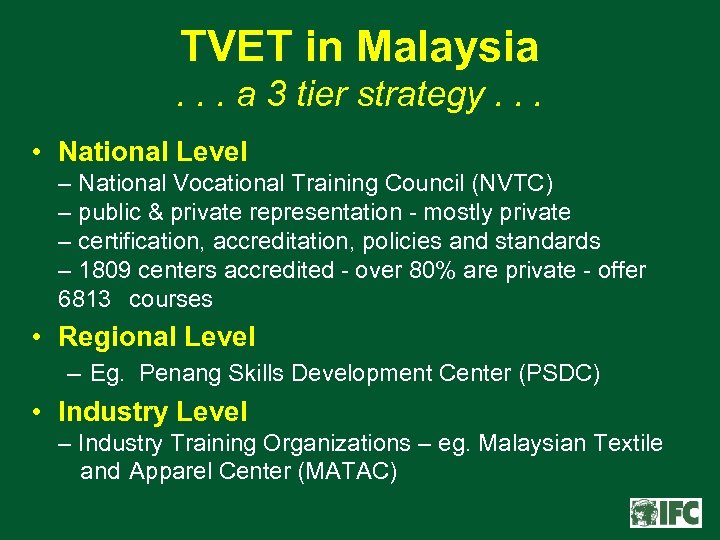 TVET in Malaysia. . . a 3 tier strategy. . . • National Level – National Vocational Training Council (NVTC) – public & private representation - mostly private – certification, accreditation, policies and standards – 1809 centers accredited - over 80% are private - offer 6813 courses • Regional Level – Eg. Penang Skills Development Center (PSDC) • Industry Level – Industry Training Organizations – eg. Malaysian Textile and Apparel Center (MATAC)
 India Formal and Informal TVET Sector • 28 million in the formal or organized TVET sector • 369 million (or 92%) in the informal sector – (contributes to 60% of the national domestic product) • System of training, re-skilling or upgrading not available • Current Knowledge Economy & Economic Strategies – requiring change • Planning Commission – VET important component of upskilling the workforce – Skills and training of economic relevance, for improving competitiveness and productivity
 Resurgence of the Demand in Global IT Sector • World wide jobs in the IT Industry around 6. 7 million today – predicted to be around 10. 6 million by 2008 • Employers in Europe & US reporting shortages in some IT jobs – eg. Systems Architecture, Biotechnology, Bioinformatics, Nanotechnologies • Private players in higher education offering education and training in more advanced technologies. • Global I. T. companies / I. T. training providers (NIIT; Aptech; New Horizons) – some seeking certified higher education credentials and accreditation – others increasing affiliations • In Yr 2000, global I. T. companies certified 1. 6 million students worldwide with 2. 4 million certificates in Information Technologies • Cisco provides certificates for >400, 000 students in 150 countries Source: Economist January 2005 – The World In 2005 – Mc. Kinseys; ‘The Changing Enterprise’ – ACE 2002; Cisco 2004
 International Students – Australia. . . changes ahead. . . • Total International Students at all levels today - 322, 000 – the only OECD country to increase in 2005 • Higher education enrollments 210, 000 (2003/04) – but expect 20% drop in university enrollments (2005) – while VET increases >13% • 18, 300 VET distance students (2003) studying from 24 countries Sources: Rhonda Piggott, DFAT, Australia; VTA Conference, Melbourne, Australia, 21 April, 2005; Australian Education International, August 2005; Institute for International Education, Nov. 15, 2004; Report commissioned by IDP Education Australia; , June 2005; AIEA Fact Sheet & NCVER Australia 2005; Austrade 2005
 Technical Vocational Education & Training. . . todays presentations • National and International examples of best practice • Career pathways • Credit transfer • Private sector / Industry led – quality & standards • Public sector enable credentials and qualifications for ‘certified’ training
 Thank You