



 Technical Track Session
 2
2
 Technical Track Session What is Service-Oriented Architecture?
 SOA • Uses open standards to integrate software assets as services • Standardizes interactions of services • Services become building blocks that form business flows • Services can be reused by other applications 4
 What is a Service? • A service is a reusable component that can be used as a building block to form larger, more complex businessapplication functionality. • A service may be as simple as “get me some person data, ” or as complex as “process a disbursement. ” 5
 What is a Service? • A service provides a discrete business function that operates on data. Its job is to ensure that the business functionality is applied consistently, returns predictable results, and operates within the quality of service required. 6
 What is a Service? • How the service is implemented, and how a user of the service accesses it, are limited only by the SOA infrastructure choices of the enterprise. • From a theory point of view, it really doesn’t matter how a service is implemented. 7
 Characteristics of a Service • Supports open standards for integration: Although proprietary integration mechanisms may be offered by the SOA infrastructure, SOA’s should be based on open standards. Open standards ensure the broadest integration compatibility opportunities. 8
 Characteristics of a Service • Loose coupling: The consumer of the service is required to provide only the stated data on the interface definition, and to expect only the specified results on the interface definition. The service is capable of handling all processing (including exception processing). 9
 Characteristics of a Service • Stateless: The service does not maintain state between invocations. It takes the parameters provided, performs the defined function, and returns the expected result. If a transaction is involved, the transaction is committed and the data is saved to the database. 10
 Characteristics of a Service • Location agnostic: Users of the service do not need to worry about the implementation details for accessing the service. The SOA infrastructure will provide standardized access mechanisms with service-level agreements. 11
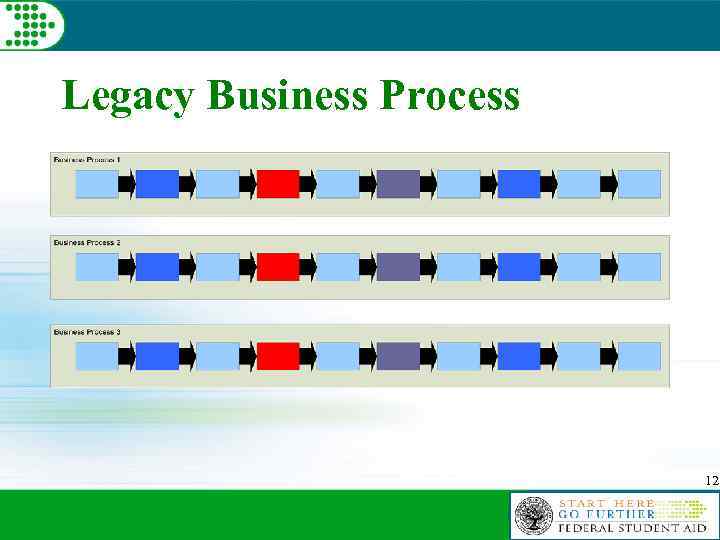 Legacy Business Process 12
 Architectural Choke Point • • • Monolithic Extremely complex Very tightly coupled Difficult to find clean integration points Lack of standards makes it difficult to integrate • Rigid architecture makes even small changes complex and costly 13
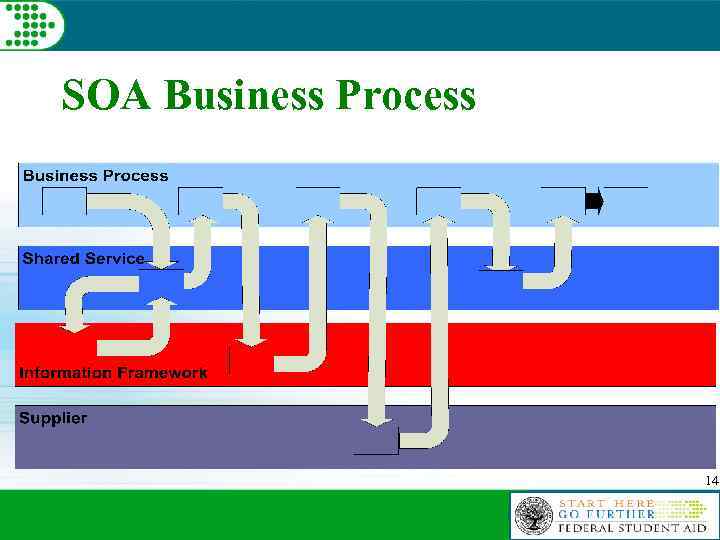 SOA Business Process 14
 Contact Information We appreciate your feedback and comments. We can be reached at: Phone: 202 377 3023 Email: Terry. Woods@ed. gov 15