


 Скачать презентацию TECHNICAL SUMMARY FOR APRM-SA COUNTRY SELF-ASSESSMENT SEMINAR Economic
148391ea3a7c7824d14309f2abf8e57e.ppt
- Количество слайдов: 50
 TECHNICAL SUMMARY FOR APRM-SA COUNTRY SELF-ASSESSMENT SEMINAR Economic Governance & Management 7 April 2006, Indaba Hotel, Johannesburg © The South African Institute of International Affairs 1
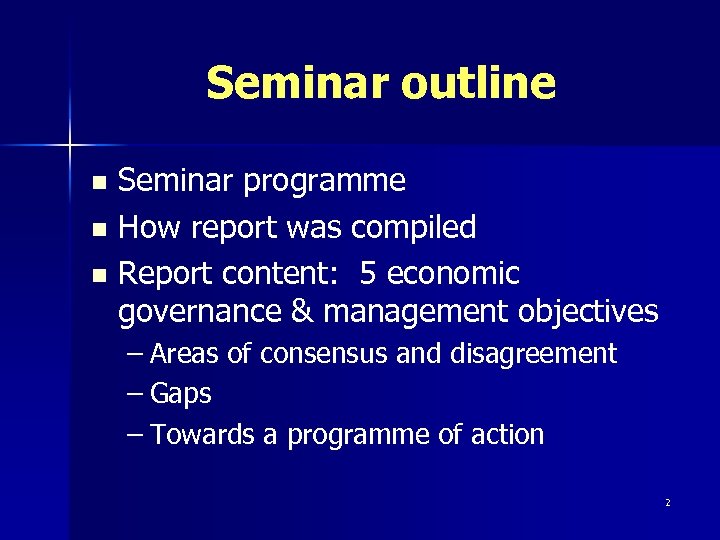 Seminar outline Seminar programme n How report was compiled n Report content: 5 economic governance & management objectives n – Areas of consensus and disagreement – Gaps – Towards a programme of action 2
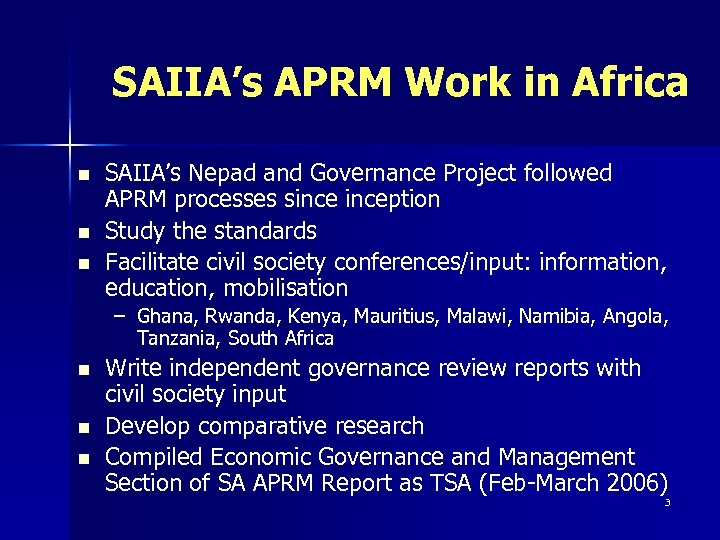 SAIIA’s APRM Work in Africa n n n SAIIA’s Nepad and Governance Project followed APRM processes sinception Study the standards Facilitate civil society conferences/input: information, education, mobilisation – Ghana, Rwanda, Kenya, Mauritius, Malawi, Namibia, Angola, Tanzania, South Africa n n n Write independent governance review reports with civil society input Develop comparative research Compiled Economic Governance and Management Section of SA APRM Report as TSA (Feb-March 2006) 3
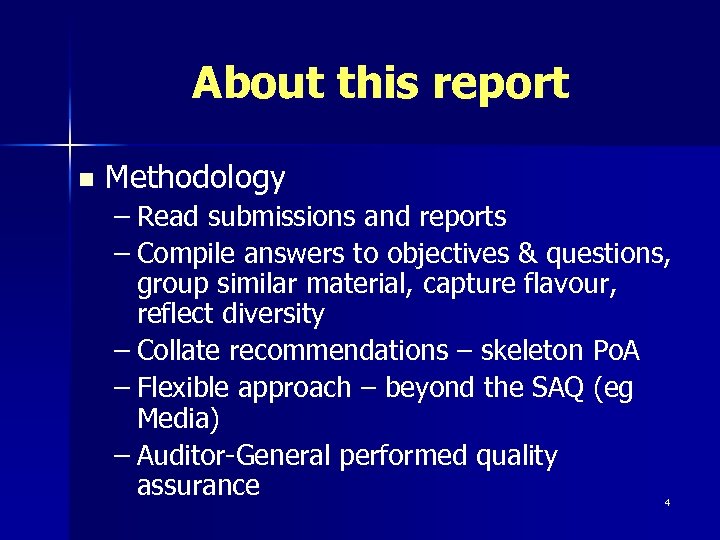 About this report n Methodology – Read submissions and reports – Compile answers to objectives & questions, group similar material, capture flavour, reflect diversity – Collate recommendations – skeleton Po. A – Flexible approach – beyond the SAQ (eg Media) – Auditor-General performed quality assurance 4
 About this report II n n Not a scorecard, a dialogue opportunity Constitution, Institution, Execution Focus on systems, not personalities 5 Objectives – – – Obj 3: Public finance management Obj 4: Fighting corruption and money-laundering Obj 1: Macroeconomic policies Obj 2: Sound, transparent economic policies Obj 5: Trade, investment and regional integration 5
 Limitations n n n n Timing – 31 Dec ’ 05 “deadline” deterred contributors; shifting deadlines Submissions trickled in Confusion over parliament & NGC process Slow, incomplete, transfer of submissions to TSAs Submissions different format, style, length Offered contentions without evidence “Voice of the people” - CDW process not fully included & provincial reports uneven; some still outstanding Late submissions after 17 March will be incorporated into next draft 6
 Submissions Included Alternative Info & Development Centre Black Sash Bureau for Economic Research Business Unity South Africa Chambers of Commerce & Industry of SA Congress of South African Trade Unions Dept of Foreign Affairs Dept of Justice & Const’l Development Dept of Public Service and Administration Dept of Trade and Industry Disabled People of South Africa Financial and Fiscal Commission Government submission ( 27 February) Human Sciences Research Council Industrial Development Corporation Institute for Democracy in South Africa Joint Working Group Media Institute of Southern Africa Metropolitan Asset Management National Treasury Open Democracy Advice Centre Pan-African Advisory Services Parliament Presidency Provinces (EC, FS, GP, NC, NW, WC) Public Service Accountability Monitor Public Service Commission SAIIA-ISS-AICC South African National Civic Organisation South African National Editors’ Forum SANGOCO South African Police Service Treatment Action Campaign UWC Department of Development Studies Youth Sector 7
 Submissions to be included n n n Women Sector (received 20 March) Culture Sector (received 20 March) Cosatu submission on Gender (received 22 March) Religious Sector (received 22 March) Idasa submission on public sector ethics regulations and post-employment restrictions (correct version received 22 March) Final Gauteng Provincial Report and supplementary documentation (received 23 March) 8
 Submissions on other topics n n n n n Auditor-General submission on corporate governance Chris Landsberg’s paper on democracy and political governance Department of Correctional Services Department of Environmental Affairs and Tourism Department of Home Affairs Institute for Economic Research on Innovation (IERI) (concentrates on socio-economic development) Nomini Rapoo’s paper on corporate governance Pansy Tlakula’s paper on corporate governance South African Institute of Chartered Accountants (SAICA) on corporate governance 9
 OBJECTIVE 3: Promote sound public finance management Notes: Question 2 asks steps the country has taken to promote sound financial management and question 3 asks about fiscal decentralisation. Local government not expressly discussed in questionnaire but clearly is most significant public finance issue. Thus treatment of question 2 is more cursory and much greater detail of similar issues comes under question 3. 10
 O 3 Q 1: Steps to promote sound public finance management Broad agreement Significant improvement since 1994; sophisticated laws anchored on PFMA & MFMA, MTEF. (95 -99) Sound laws but serious implementation problems n Financial misconduct rife in civil service (101) n Misconduct rules poorly enforced (101) n Misconduct unreported and poorly managed (101102) n Tensions between centralisation & decentralisation policies (102) 11
 O 3 Q 2: Measures to develop an effective system of fiscal decentralisation (94) Broad agreement n Fiscal, capacity and managerial performance issues intertwined. n Local and provincial governments are biggest fiscal management problem: have problems of mismanagement, poor oversight and corruption. Increasing public anger over service delivery. n Sound laws and systems; challenges with management and implementation, affected by capacity and political systems. n Weak performance: poor governance and management, failure to control assets, weak financial accounting, and exorbitant pay packages for some administrators. 12
 O 3 Q 2: Measures to develop an effective system of fiscal decentralisation (94) n n National Issues Capacity/Skill Issues Annual Reports & Financial Statements Local & Provincial Issues 13
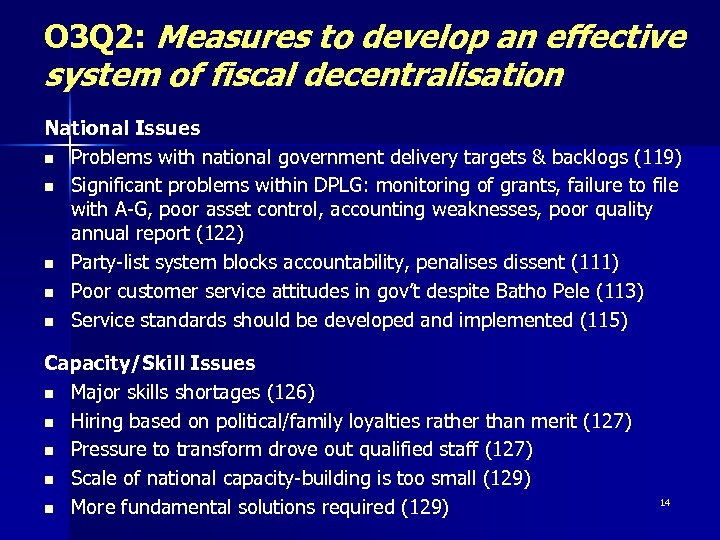 O 3 Q 2: Measures to develop an effective system of fiscal decentralisation National Issues n Problems with national government delivery targets & backlogs (119) n Significant problems within DPLG: monitoring of grants, failure to file with A-G, poor asset control, accounting weaknesses, poor quality annual report (122) n Party-list system blocks accountability, penalises dissent (111) n Poor customer service attitudes in gov’t despite Batho Pele (113) n Service standards should be developed and implemented (115) Capacity/Skill Issues n Major skills shortages (126) n Hiring based on political/family loyalties rather than merit (127) n Pressure to transform drove out qualified staff (127) n Scale of national capacity-building is too small (129) n More fundamental solutions required (129) 14
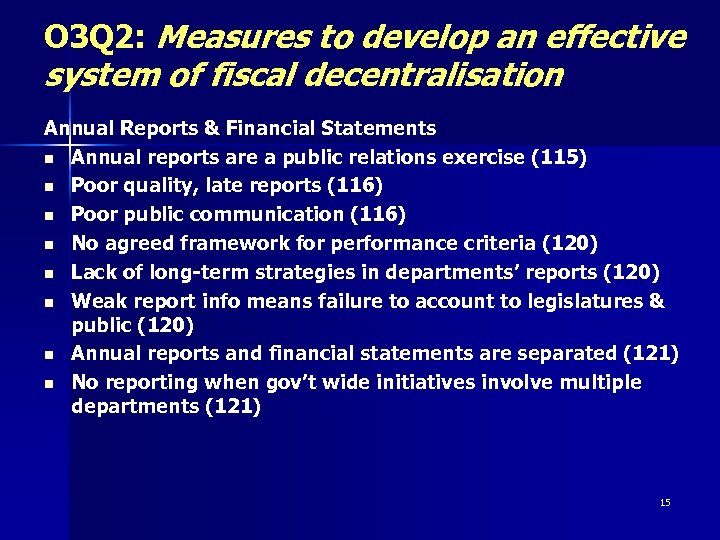 O 3 Q 2: Measures to develop an effective system of fiscal decentralisation Annual Reports & Financial Statements n Annual reports are a public relations exercise (115) n Poor quality, late reports (116) n Poor public communication (116) n No agreed framework for performance criteria (120) n Lack of long-term strategies in departments’ reports (120) n Weak report info means failure to account to legislatures & public (120) n Annual reports and financial statements are separated (121) n No reporting when gov’t wide initiatives involve multiple departments (121) 15
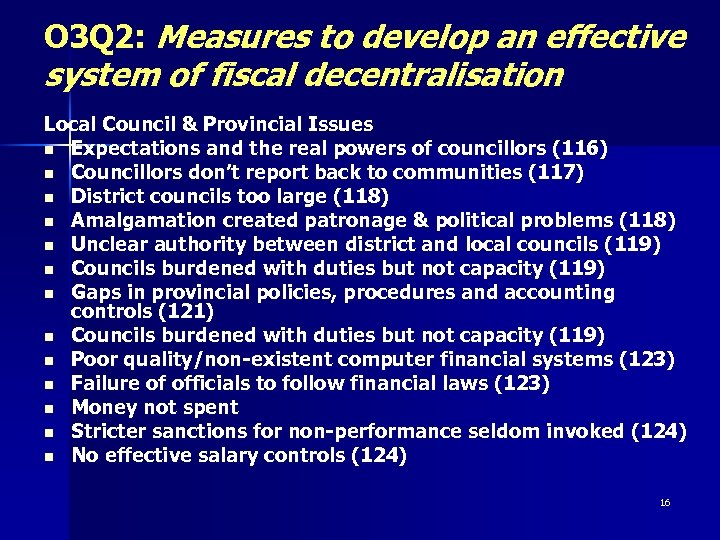 O 3 Q 2: Measures to develop an effective system of fiscal decentralisation Local Council & Provincial Issues n Expectations and the real powers of councillors (116) n Councillors don’t report back to communities (117) n District councils too large (118) n Amalgamation created patronage & political problems (118) n Unclear authority between district and local councils (119) n Councils burdened with duties but not capacity (119) n Gaps in provincial policies, procedures and accounting controls (121) n Councils burdened with duties but not capacity (119) n Poor quality/non-existent computer financial systems (123) n Failure of officials to follow financial laws (123) n Money not spent n Stricter sanctions for non-performance seldom invoked (124) n No effective salary controls (124) 16
 Obj 3: Gaps in Indicators Actual expenditure and revenue to targets. n Time allowed for parliamentary appraisal and approval of budgetary proposals. n 17
 OBJECTIVE 4: Fight corruption and moneylaundering 18
 O 4 Q 1 a: Prevalence of corruption in public administration (140 -143) Broad Agreement n SA ranks better than majority of Africa n Major concern in South Africa, along with organised crime, affects the country’s development efforts. Billions lost annually to graft in the public and private sectors, negative effects on employment, investment. Disagreement n Measures of corruption prevalence difficult and different. Perceptions vs reality. Gov depts generally more optimistic than other stakeholders on levels of graft. 19
 O 4 Q 1 b: Measures to fight corruption (144 -147) Broad Agreement n Strong anti-corruption systems in public and private sectors, major improvements to post-1994 legal framework: Prevention and Combating of Corrupt Activities Act (2004), PAIA (2000), PAJA (2000), PDA (2000), PFMA (1999), MFMA (2003), FICA (2001). n Insufficient public education and prevention of corruption efforts. n No regulation of private funding to political parties – opens the political system to abuse. n PDA to shield whistleblowers. In practice, whistleblowers are vulnerable. Legislation and procedures need revision. n Proportional representation electoral system gives voters little say in choosing candidates and submissions raised, this, contributes to poor accountability of elected persons. n Declarations/conflicts of interest are not optimally managed. Robust codes of ethics for public servants, ministers and MPs, frequently ignored and oversight bodies lack staff (parliamentary committees) and the will to enforce sanctions. 20
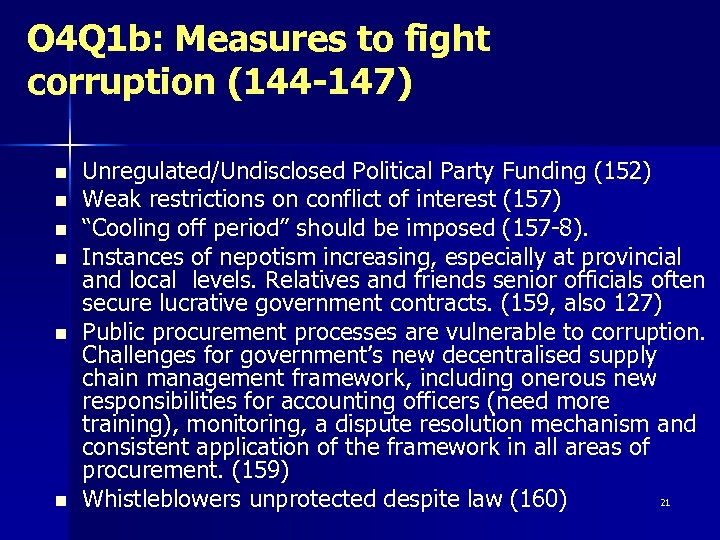 O 4 Q 1 b: Measures to fight corruption (144 -147) n n n Unregulated/Undisclosed Political Party Funding (152) Weak restrictions on conflict of interest (157) “Cooling off period” should be imposed (157 -8). Instances of nepotism increasing, especially at provincial and local levels. Relatives and friends senior officials often secure lucrative government contracts. (159, also 127) Public procurement processes are vulnerable to corruption. Challenges for government’s new decentralised supply chain management framework, including onerous new responsibilities for accounting officers (need more training), monitoring, a dispute resolution mechanism and consistent application of the framework in all areas of procurement. (159) 21 Whistleblowers unprotected despite law (160)
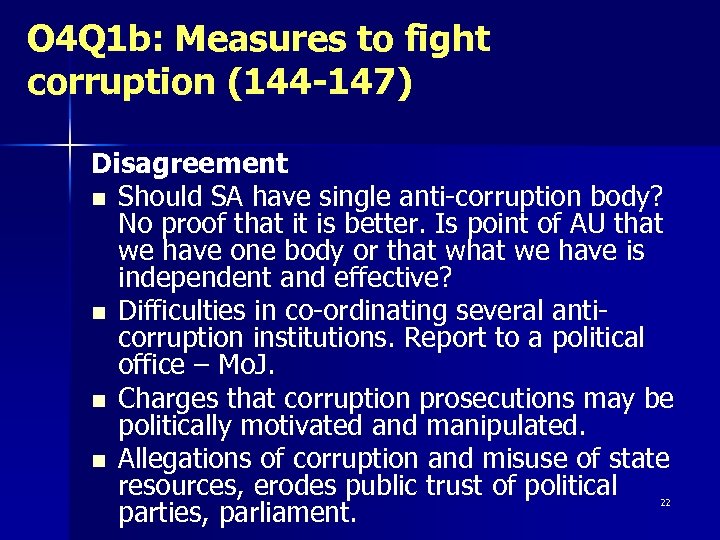 O 4 Q 1 b: Measures to fight corruption (144 -147) Disagreement n Should SA have single anti-corruption body? No proof that it is better. Is point of AU that we have one body or that we have is independent and effective? n Difficulties in co-ordinating several anticorruption institutions. Report to a political office – Mo. J. n Charges that corruption prosecutions may be politically motivated and manipulated. n Allegations of corruption and misuse of state resources, erodes public trust of political parties, parliament. 22
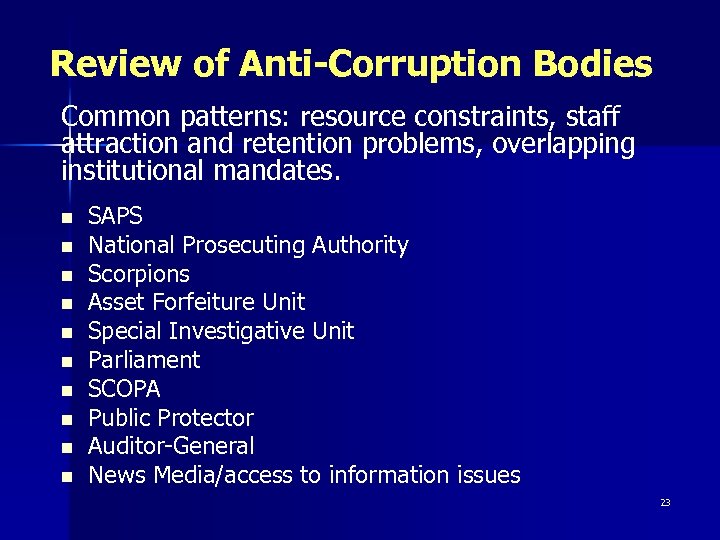 Review of Anti-Corruption Bodies Common patterns: resource constraints, staff attraction and retention problems, overlapping institutional mandates. n n n n n SAPS National Prosecuting Authority Scorpions Asset Forfeiture Unit Special Investigative Unit Parliament SCOPA Public Protector Auditor-General News Media/access to information issues 23
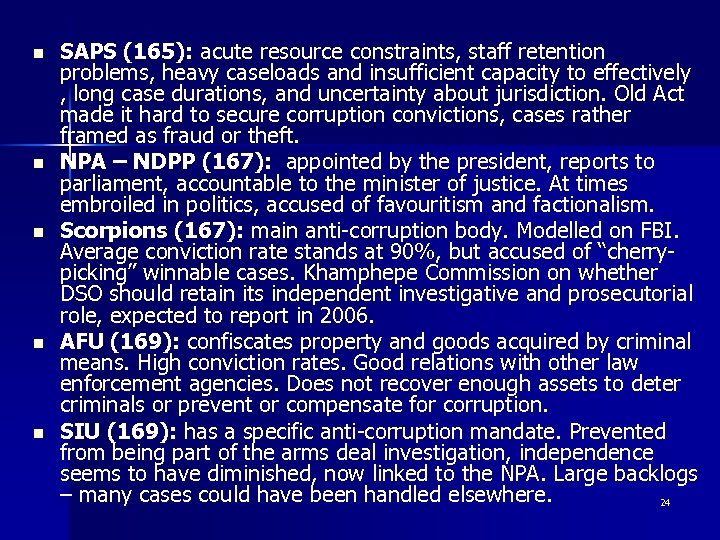 n n n SAPS (165): acute resource constraints, staff retention problems, heavy caseloads and insufficient capacity to effectively , long case durations, and uncertainty about jurisdiction. Old Act made it hard to secure corruption convictions, cases rather framed as fraud or theft. NPA – NDPP (167): appointed by the president, reports to parliament, accountable to the minister of justice. At times embroiled in politics, accused of favouritism and factionalism. Scorpions (167): main anti-corruption body. Modelled on FBI. Average conviction rate stands at 90%, but accused of “cherrypicking” winnable cases. Khamphepe Commission on whether DSO should retain its independent investigative and prosecutorial role, expected to report in 2006. AFU (169): confiscates property and goods acquired by criminal means. High conviction rates. Good relations with other law enforcement agencies. Does not recover enough assets to deter criminals or prevent or compensate for corruption. SIU (169): has a specific anti-corruption mandate. Prevented from being part of the arms deal investigation, independence seems to have diminished, now linked to the NPA. Large backlogs – many cases could have been handled elsewhere. 24
 n n n Parliamentary oversight (170 -2): Weaknesses in parliament oversight of the budget: lack of meaningful participation by the provinces; insufficient detail to monitor and evaluate budgeting practices; lack of incentives to ensure efficient and accountable resource allocations. Scopa (173 -81): receives all AG reports for scrutiny. Damaged credibility after arms deal investigation, performed better on Oilgate investigation. The Public Protector (182 -4): The ombudsman is mandated to investigate conduct by the government or public administration alleged to be improper or resulting in impropriety or prejudice. Increasing cases. Capacity constraints due to large case volumes, impartiality questioned. The Auditor-General (184 -90): supreme audit institution. Reports less informative than other African countries, reports not broadly distributed, arms deal damaged integrity, follow-up and consequences, struggles to collect audit fees, quality of subcontractors. News Media (190 -5): key role in disclosing corruption and nonperformance. threats to media freedom; access to information and administrative justice legally guaranteed – compliance lags. 25
 O 4 Q 2: Prevalence of moneylaundering SA should do everything in its power to deal with money-laundering. FICA collects information and passes it to relevant authorities. n Challenges: large informal sector and a predominantly cash economy. Skills and experience to investigate and deal with money-laundering. Disagreement n Act places burdens on business - time taken to complete the various processes, such as winding up estates, adds costs to business. n 26
 Obj 4: Gaps n n Submissions deficient on addressing money laundering regulation and enforcement. South African Reserve Bank’s effectiveness as a regulator of banks and banking No discussion of crimes such as internet banking fraud in relation to moneylaundering. Thousands of suspicious transactions have been reported, but what action has been taken? 27
 O 4 Q 2: Prevalence of moneylaundering SA should do everything in its power to deal with money-laundering. FICA collects information and passes it to relevant authorities. n Challenges: large informal sector and a predominantly cash economy. Skills and experience to investigate and deal with money-laundering. Disagreement n Act places burdens on business - time taken to complete the various processes, such as winding up estates, adds costs to business. n 28
 Obj 4: Gaps n n n South African Reserve Bank’s effectiveness as a regulator of banks and banking. No discussion of crimes such as internet banking fraud in relation to money-laundering. Money laundering – its causes and consequences. The efficacy of Fica – thousands of suspicious transactions have been reported, but what action has been taken? Scale and scope of the problem in SA, and solutions to combat it. Follow-up action including prosecutions of cases of moneylaundering. 29
 OBJECTIVE 1: Promote macroeconomic policies supporting sustainable development 30
 O 1 Q 1: Macroeconomic policy framework sound & supportive of sustainable development Broad agreement n Economy well-managed at national level, from stagnation and sanctions to sustained growth (26 -29) n Growth too low, unemployment too high, benefits uneven (29 -30) n Inflation targeting is working (30 -31) n Two economies, need Asgisa (33 -36) n SARS collections exceed predictions (57 -59) n SA promotes sustainable development 31
 O 1 Q 1: Is macroeconomic policy framework sound & supportive of sustainable development? II Disagreement n n n Logic, range and focus of inflation targeting (31) Challenges for Asgisa: (34 -36) – – – mismatched skills and skills shortages infrastructure backlogs poor competition (telecoms, steel and chemicals) weak public administration strong rand CSOs want more consultation on Asgisa (34 -36) Want more harmonisation in social grant institutions and policies (36) Optimal size of deficit and financing development (4041) 32 32
 O 1 Q 2: Basis for government formulating macroeconomic projections Broad agreement n n Govt follows rational, sensible, fairly transparent procedures. Hears experts, accurate projections (45 -46) Statistics good but could be improved (growth, inflation, crime, corruption, 2 nd economy) (4648) Disagreement n n Government tendency to dismiss unfavourable stats (47) Degree of independence of Stats. SA (47) 33
 O 1 Q 3: Sectoral and microeconomic policies to promote economic growth and sustainable development Broad agreement n National sectoral and microeconomic policies well articulated and publicised by government. MTEF, budget documentation allocates resources accordingly. (50) n Increased infrastructure investment, reduce cost of doing business in SA, boosting education and skills, land reform, broad-based BEE and improving public service delivery levels. (50) n Growth has NOT been for all. n Regulatory cost burden on companies is too high, especially SMMEs. Recommended regulatory impact assessments (business: retroactive application). (59 -61) 34
 O 1 Q 3: Sectoral and microeconomic policies to promote economic growth and sustainable development II Disagreement n Level and efficacy of social grant delivery programmes debated – poor still experience harsh social conditions despite grants. (50 -52) n Unemployment – Treasury said it is declining, Presidency on EPWP, CSOs disagreed. Criticise decision to dump “expanded” definition of unemployment in national figures. (52 -56) n Business: labour market “over-regulated”, inflexible, stifles growth. (53 -54) n Polarised views on tax: business – taxes too high, labour says too low given service delivery backlogs and social needs. (57 -58) 35
 O 1 Q 4: Increase domestic resource mobilisation including savings and capital formation, reduce capital flight Broad agreement n n Retirement funding reforms; changes in banking legislation; Msanzi accounts banked 2 million; financial sector charter; increased government cap-ex; rising business confidence and hence higher investment levels. (63 -64) Support for gradual exchange control relaxation, differ on pace & rate of changes. (65 -66) Remaining challenges: boost domestic savings (easier if economy strong), increase gross fixed capital formation: GDP, continued expansion of access to financial services. (65) Problems (NW): blacklisting; unemployment; insufficient information on training provision at local level; inefficient credit bureau policies; Khula and Seda not user-friendly; corruption effects welfare and savings; high indebtedness; high micro-lender rates; low interest rates discourage savings, harm pensioners; and poor general access to finance. (66) 36
 O 1 Q 5: Vulnerability to internal & external shocks Broad Agreement n Not contentious – definition of “shocks. ” (67) n NW – internal: crime and corruption, HIV/Aids, unemployment and poverty, the trade balance, disease and labour strikes; (66) external: oil prices, cheap and illegal imports, unfair global terms of trade, exchange rate fluctuations and regional instability. (66 -67) n The Rand – stable now but volatility is big risk. SARB – neutral, does not intervene, buys forex when rand is strong. (68) 37
 Obj 1: Gaps n n n n Credit extension (43) BEE, Women’s Empowerment, Opportunities for People with Disabilities Competition policy Variance in projections; degree of achievement; current real GDP growth projections. (AG) Socio-economic development indicators (AG) Share of population with access to finance, including micro-finance and saving facilities (AG) Steps to reduce vulnerability to shocks (AG) 38
 OBJECTIVE 2: Implement sound, transparent & predictable govt economic policies 39
 O 2 Q 1: Make public administration, legislative system & fiscal authorities work effectively and transparently Broad agreement n Treasury praised for needed reforms post 1994, including new intergovernmental fiscal relations system, multi-year budgeting through MTEF, budgeting formats focusing on spending analysis and service delivery information, PFMA & MFMA (75 -77; 84 -85) n Several submissions urged parliament to enact laws to allow it to change money bills. (77 -78) 40
 O 2 Q 1: Make public administration, legislative system & fiscal authorities work effectively and transparently II Disagreement n CSOs and some provinces criticised quality and frequency of engagement with government on policymaking. Often given a fait accompli with little room for substantive input. Gov departments and parliament felt they were extremely consultative. (8284) n Declining trends in oversight and accountability by parliament – political intervention compromised Scopa’s role in arms deal investigation, damaging parliament’s credibility. (78 -82) n Cursory oversight on budget votes, poor quality of debate, raised questions over parliament’s general efficiency and effectiveness. (81 -82) 41
 O 2 Q 2: Making economic policies predictable Broad agreement n Treasury outlined detailed process of publicising economic information, extensive and thorough budget documentation made publicly available, strong media coverage (86 -87) n Not disputed 42
 O 2 Q 3: Challenges to government departments co-ordinating economic policies Broad agreement n Consolidated gov submission made no comment Disagreement n n CSOs, several provincial submissions criticised relationship between national government and provinces. Said government has trouble implementing its good policies, has poor intergovernmental communication, offers uncoordinated and duplicated assistance efforts to communities, suffers from capacity & skills deficits. (88 -90) Provinces lack adequate voice or equal treatment, and the National Council of Provinces – fails to 43 represent provincial interests. (90)
 OBJECTIVE 5: Accelerate regional integration by participating in the harmonisation of monetary, trade and investment policies 44
 O 5 Q 1: Membership of regional economic arrangement(s), benefits & challenges Broad Agreement n SA prioritises foreign relations, vigorous proponent of multilateralism. (214) n SADC: links southern African countries and strives to promote sustainable development. Trade protocol signed and ratified. SADC aims to become a free trade area by 2008, customs union by 2010, and common market by 2012. (215 -216) n Sacu is a customs union between Botswana, Lesotho, Namibia, South Africa and Swaziland. Traditionally concentrated on sharing customs and excise duty revenues, recently more on policy harminsation. (216 -217) n IOR-ARC - The Indian Ocean Rim Association for Regional Cooperation - states that border the Indian Ocean. Aims for sustainable growth and balanced development; economic cooperation; and trade liberalisation among its members. (219) 45
 O 5 Q 1: Membership of regional economic arrangement(s), benefits & challenges II Disagreement n Sacu or SADC? Sacu may have to conclude agreements with other states on issues it has not yet resolved internally. (217; 223) n Limitations and difficulties: some states belong to multiple organisations (membership of more than one customs union is problematic); slow implementation of protocols; differing approaches to African problems by states, depts (eg DFA and the dti). (217 -219) 46
 O 5 Q 2: Ensure national policies are consistent with and supportive of regional economic integration objectives Broad agreement n n SA companies are major investors in Africa, grants preferential access to products from the region. Signs that the unequal trade balance may be rectifying itself. (221) Policy on intra-African investment premised on deepening regional integration and promoting large capital projects. (221) South Africa’s parastatals large investments in Africa. (222 -223) SA firms expanded into African markets since the mid-1990 s. Received a mixed reception: tough competition to local businesses, and claims they flout local labour standards. (222) Disagreement n Challenges: economic relations remain disappointing; South Africa needs to liberalise more unilaterally; South African companies need to promote “African Economic Empowerment” strategies; and dispute as to whether Sacu or SADC should be focus of South Africa’s efforts. (222 -225) 47
 O 5 Q 3: Ensure effective implementation of decisions and agreements made within regional economic integration arrangements Broad agreement n Agreements concluded within Sacu and SADC to establish necessary structures. (226) n Parliament plays a role to promote cooperation across Africa. Suggested that the SADC Parliamentary Forum should be transformed into a SADC parliament with full legislative powers. (226 -227) 48
 O 5 Q 4: Measures to promote regional monetary harmonisation, co-operation and co-ordination n One paragraph from dti on this issue. 49
 Contact SAIIA Steven Gruzd Research Manager: Nepad & Governance Programme South African Institute of International Affairs East Campus, University of Witwatersrand Tel 011 339 -2011 fax 011 339 -2154 gruzds@saiia. wits. ac. za www. saiia. org. za Click on “APRM Resource & Training Centre” icon 50