


 Скачать презентацию Technical proposals A written offer to undertake
11e98f6c353824c9347d3c466b9531a5.ppt
- Количество слайдов: 55
 Technical proposals • A written offer to undertake a project for designing, creating something new or for changing or modifying an existing procedure, method , system or structure within a specified period of time. • Types • Structure 1
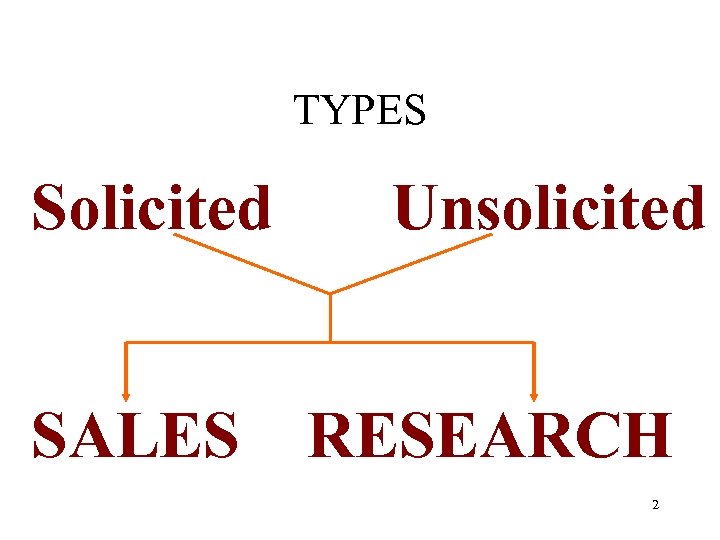 TYPES Solicited SALES Unsolicited RESEARCH 2
 Sales proposal • Sent outside the company to potential clients or customers • Also known as business proposals 3
 Research Proposal • Academic in nature, mostly solicited • May appear in a foreign language also • Basic format remains the same 4
 Characteristics • Demonstrate to appropriate decision makers that their needs would be met with • Keep in view the customer’s convenience, financial gain and prestige • Anticipate any possible reasons for rejection and provide suggestions to overcome them. • Use plain direct and unambiguous expressions 5
 Purposes • To construct parking slots, buildings, bridges, highways • To survey area for possible water sources • To modernize the office procedures of a company • To train international managers for work in foreign countries, etc. 6
 Structure Prefatory Main body Supplementary parts 7
 Prefatory Title page Draft contract Executive summary Table of contents List of illustrations 8
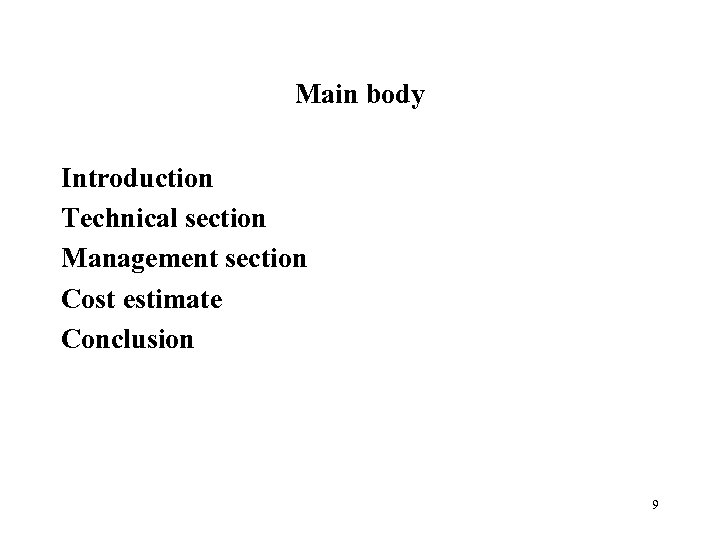 Main body Introduction Technical section Management section Cost estimate Conclusion 9
 Supplementary Appendix Sources and References 10
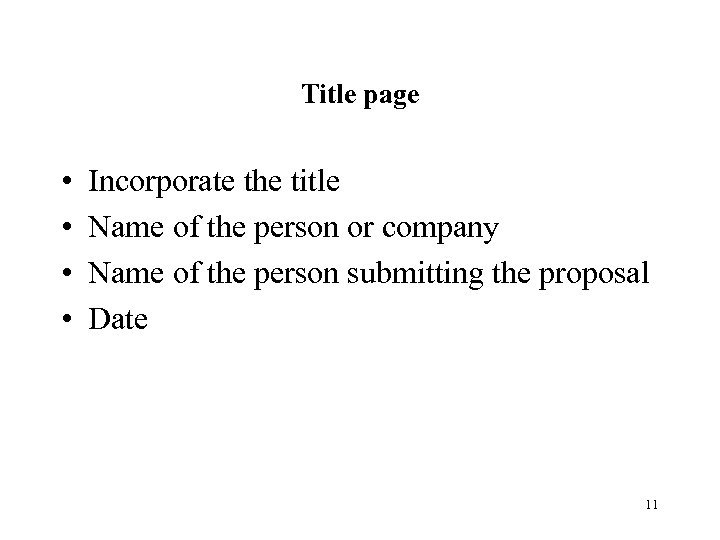 Title page • • Incorporate the title Name of the person or company Name of the person submitting the proposal Date 11
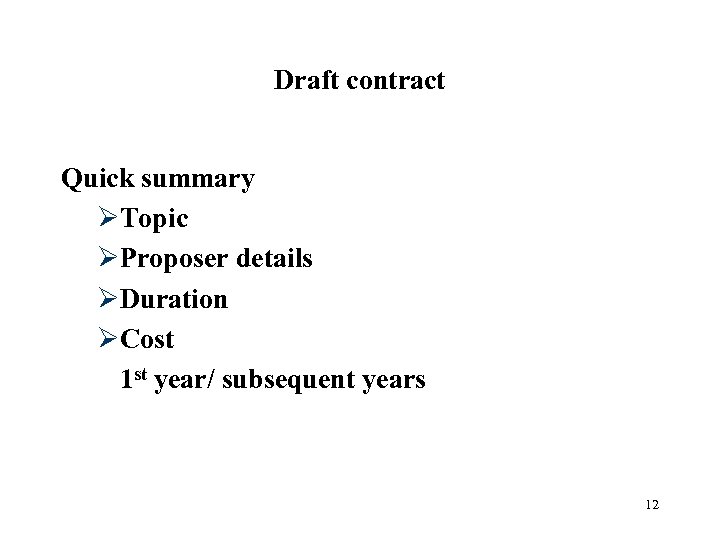 Draft contract Quick summary ØTopic ØProposer details ØDuration ØCost 1 st year/ subsequent years 12
 Continued • Rough draft of the contract proposed • Finalized after the acceptance of the proposal 13
 Executive summary v Back ground v Purpose v Scope v Infrastructure facilities v Technical details v Significance v Re-emphasis 14
 Continued • A Concise version of the detailed proposal • Gives a brief background need for taking up this project) • Summarize the objectives , how they will be met, procedures adopted • Ends with a reemphasis of proposals strengths • Length varies 100 -300 based on the complexity 15
 Introduction Problem statement (clearly specifies the need for investigation) Purpose, scope Technical overview Methodology (procedures adopted to carry out the project) Significance Structure 16
 Technical section • System overview (Technical description) • Analysis of existing situation • Possible design solutions • Proposed solution • Sources of information • Methodology 17
 Management section Ø Chains of command (org. charts) Ø Corporate / employee credentials Ø Schedules (work, implementation, reporting, maintenance, delivery, completion, payment, forecast) Ø Gantt chart, Milestone chart Ø Team organization Ø Company profile 18
 Cost Estimate Ø Important Ø Funding (if internal) Ø Break up (equipment details, man power expenses miscellaneous / consumables) Ø Match with draft contract 19
 Conclusion Re-emphasize strengths Assure the reader 20
 Appendix • Credentials details • Supporting technical documents • Illustrations 21
 DOCUMENTATION STYLES • MLA (Modern Language Association) • APA (American Psychological Association) • Chicago style • IEEE style 22
 Details for Documentation • • Author/s ( whether editor/s) Year Title of the book/article , Edition if any Name of Journal/Newspaper/Magazine, Volume No. Page no. • Place of Publication • Name of Publishers 23
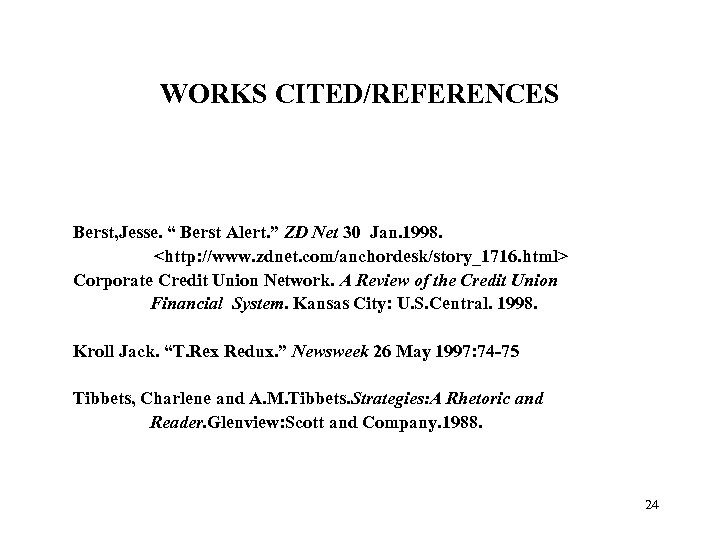 WORKS CITED/REFERENCES Berst, Jesse. “ Berst Alert. ” ZD Net 30 Jan. 1998.
 Oral presentation • Mend your speech a little Lest it may mar your fortune. William Shakespeare 25
 TYPES OF ORAL PRESENTATION • • Reading from the text Memorizing Impromptu Extemporaneous 26
 Requirements of Oral Presentation • • Knowing your purpose Audience awareness Use of visual aids Presentation plan 27
 Audience awareness • Size up your audience • Speak directly • Converse with them with conviction & sincerity • Dramatize certain aspects • Give a personal touch • Use humor if possible 28
 Use of Audio visuals • • • Integrate the aid with your op Use it when your reach the relevant point Make your aids accessible Interpret the aids Stand on one side and use the pointer Aids should be specific 29
 Contd. • Avoid crowding your aid • Keep speaking • Keep writing in case you are using black board 30
 Presentation plan • • • Plan and prepare beforehand Bring animation and spontaneity Lift your head and look at the audience Consult your notes when needed Cite references, quotations etc. Use note cards 31
 Contd. • • • Have sympathy for the crowd Avoid reading your presentation Avoid memorizing Avoid giving a long introduction Signal the end of your presentation 32
 Contd. • Avoid verbal fireworks • Avoid frowning • Ignore the smiles /whispers of listeners 33
 Dividing your presentation • Introduction Capture listeners’ attention and get them involved Identify yourself and establish your credibility Preview your main points 34
 BODY • LIMITED NUMBER OF POINTS • EXPLAIN AND GIVE DETAILS • KEEP YOUR PRESENTATION SIMPLE AND LOGICAL 35
 CONCLUSION • DON’T END LIMPLY • REVIEW ALL THAT YOU SAID • ENCOURAGE QUESTIONS 36
 Use of connectives • Transitions: end of one thought and indication of the beginning of another, such as, after having said that……it is time now; in addition to • Internal previews: indicating what the speaker takes up next, such as, we shall discuss its impact • Internal summary: recalling what has been said so far. e. g. in short • Signposts: indicating where the presenter is in his presentation, e. g. the first feature, the second, 37
 REMEBERTHE FOLLOWING • • • Prepare thoroughly Rehearse repeatedly Time yourself Request a lectern Check the room and gadgets Practice stress reduction 38
 Tips to remember during presentation • • Begin with a pause Present your first sentence from memory Maintain eye contact, correct posture, use gestures Pay attention to facial expressions and Time Control voice and vocabulary Put the brakes on Move naturally Use visual aids 39
 Contd. • Avoid digressions • Summarize your main points 40
 After your presentation Distribute handouts Encourage questions Repeat questions Reinforce main points keep control Admit if you are unable to answer some question End with a summary and appreciation 41
 Business writing: purposes • • • Making /answering an enquiry Placing an order Demanding or refusing credit Selling goods and services Accepting/refusing a project Responding to complaints 42
 Contd. • A business letter is a form of communication written by an authorized person of an organization. 43
 Letter • A Business letter must appeal to the reader’s interest and induce in him the proper mood. • “If he is rude be specially courteous. If he is muddle-headed be specially lucid. If he is pigheaded be patient. If he is helpful be appreciative. If he convicts you of a mistake acknowledge it freely and even with gratitude”. • Sir Ernest Gower 44
 Points to remember • Before expressing a thought, roll it in your mind to avoid ambiguity. • Choose short, common and concrete words. • Avoid jargon and slang. • Arrange your words according to the rules of grammar. • Write short and simple sentences. • Divide your ideas into small and distinct paragraphs. 45
 Structure and Layout of Letters • Elements • Heading • Date • Difference • Inside address • Attention line • Salutation • Subject 46
 • • • Contd. Body Complimentary Close Signature Identification marks Enclosure 47
 Principles of Letter Writing • • • Courtesy and Consideration Directness and Conciseness Avoid Verbosity Avoid Participial endings Positive and Direct Statements Clarity and Precision 48
 Styles of Business Letters • • • Indented Style Block Style Complete Block Style Semi Block Style Hanging Indented Style 49
 Indented style • • • Oldest form Each element indented to four spaces Closed punctuation Salutation on the left Date line & Complimentary close to the right 50
 BLOCK STYLE • Date line, complimentary close and signature aligned with the right margin • All other parts to the left • Double spacing • Mixed punctuation 51
 Complete block style • All parts of the letter aligned with the left margin • Indentation not required • Open punctuation • Appears imbalanced and heavy on the left 52
 Semi block style • • • Like the block style Date line on the right Paragraphs are indented Easier to read Mixed punctuation 53
 To sum up • Draft your business letters the way your organization wants it • Know the popular practice • Full block format is much in use. 54
 Hanging indented style • Like block style • First line of each paragraph aligns with the left margin • All other lines indented four to five spaces • Not so popular • Mixed punctuation 55