


 Скачать презентацию Technical Price Analysis H The analysis of historical
c237c0fab6ca44e730ff395c854ed36d.ppt
- Количество слайдов: 38
 Technical Price Analysis H The analysis of historical prices patterns using charts, diagrams, mathematical equations, etc. H This approach emphasizes how prices got to where they are. H We’ll only cover few methods.
 Technical Price Analysis Two views: H Prices reflect all available, relevant fundamental information. Random prices tomorrow. H Price movements are not random. Recognizable price patterns or formations are often repeated.
 Benefits of Charting H Provide a price history. H Help identify important fundamental factors; early warning of changes in process. H Help identify repetitive price patterns. Will they repeat in future?
 Benefits of Charting H Can improve the timing of purchases or sales. H Can help one to be more mechanical and objective (less emotional) H But, many methods! Which work?
 Tools of Technical Analysis H Charts H Trading Information Volume and Open Interest H Mathematical or Statistical Formulas or Calculations Moving Averages and Oscillators
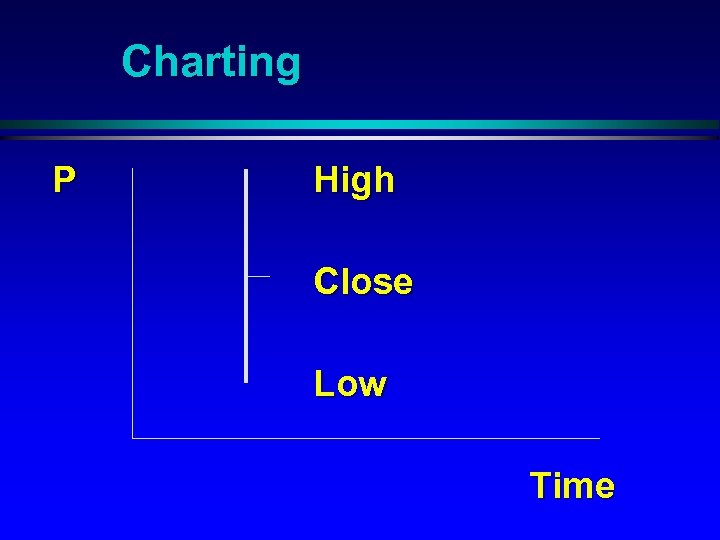 Charting P High Close Low Time
 Forecasting Price Changes H Trend = general direction H Types Rising = “Bullish” Falling = “Bearish” Change = “Reversal”
 Forecasting Price Changes H Trend Lengths Minor = 1 month or less Intermediate = 1 - 6 months Major = 6 months or more H Magnitude = extent of move
 Trend Lines H UP Shows trend of increasing prices Drawn by connecting ascending extreme lows H DOWN Shows trend of decreasing prices Drawn by connecting descending extreme highs
 Channel Lines (Up &Down) H Top line is parallel to bottom line H Drawn by connecting ascending or descending extreme highs and lows H Useful in showing likely trading ranges and possible deviations from up or down trends
 Support Line H An apparent lower bound on prices which market prices seem to not be able to fall below (due to increased interest in buying at that price level. ) H Is a flat line drawn by connecting “equal” extreme lows.
 Support Line H The greater the number of extreme equal lows, the greater the belief that it is a genuine area of support. H A close (or two) below the support line indicates that there is no longer any support at that price level.
 Resistance Line H An apparent upper bound on prices which market prices seem to not be able to rise above (due to increased interest in selling at that price level) H Is a flat line drawn by connecting “equal” extreme highs
 Resistance Line H The greater the number of extreme equal highs, the greater the belief that it is a genuine area of resistance. H A close (or two) above the resistance line indicates that there is no longer any resistance at that price level.
 Resistance Line H An excellent spot for a short position.
 Reversals H Signal change in direction or trend H Observable with a single day of trading (if there was a previous trend) H Bullish (bearish) reversals indicated that prices are likely to stop decreasing (increasing) & start increasing (decreasing)
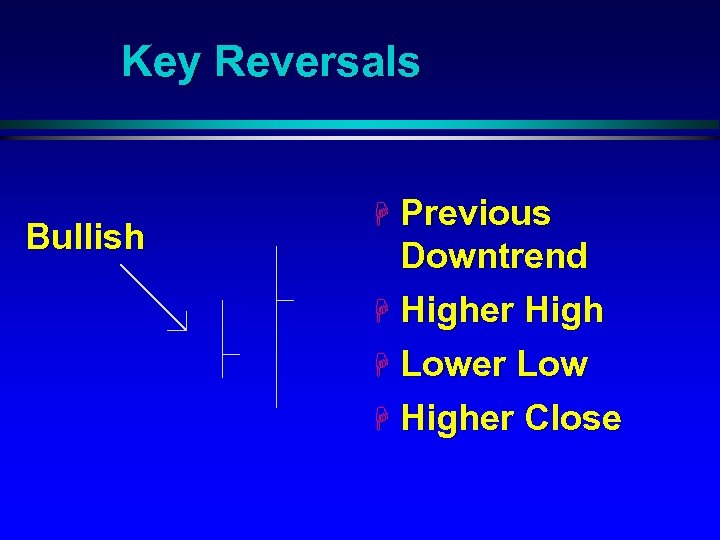 Key Reversals Bullish H Previous Downtrend H Higher High H Lower Low H Higher Close
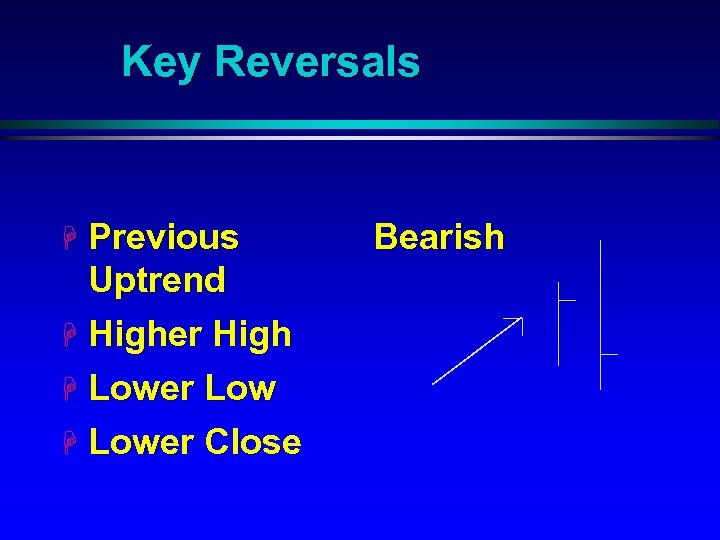 Key Reversals H Previous Uptrend H Higher High H Lower Low H Lower Close Bearish
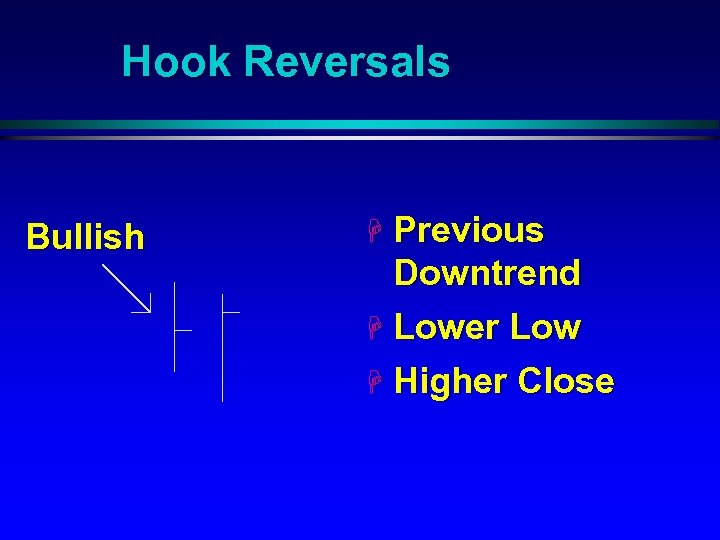 Hook Reversals Bullish H Previous Downtrend H Lower Low H Higher Close
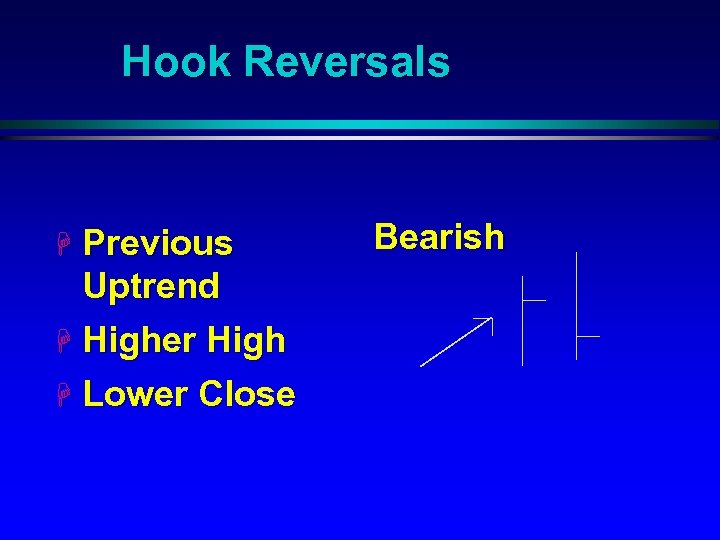 Hook Reversals H Previous Uptrend H Higher High H Lower Close Bearish
 Head and Shoulders H A reversal formation in a previous uptrending market that signals a top has been reached H Left Shoulder = 1 st set of peak prices H Head = Higher set of peak prices H Right Shoulder = 3 rd set of peak prices
 Head and Shoulders H Neckline =Line thru lows between head and l&r shoulders. Good necklines are fairly flat. H A close below neckline confirms the formation. H Belief that prices will decrease below neckline by an amt. = distance from top of head to the neckline.
 Double Top H Like Head and Shoulders w/o head H Low between two peaks = valley or fulcrum H Close below fulcrum confirms formation and indicates prices will continue to decline by an amt. at least equal to the distance from top of peaks to fulcrum H Also holds for multiple tops
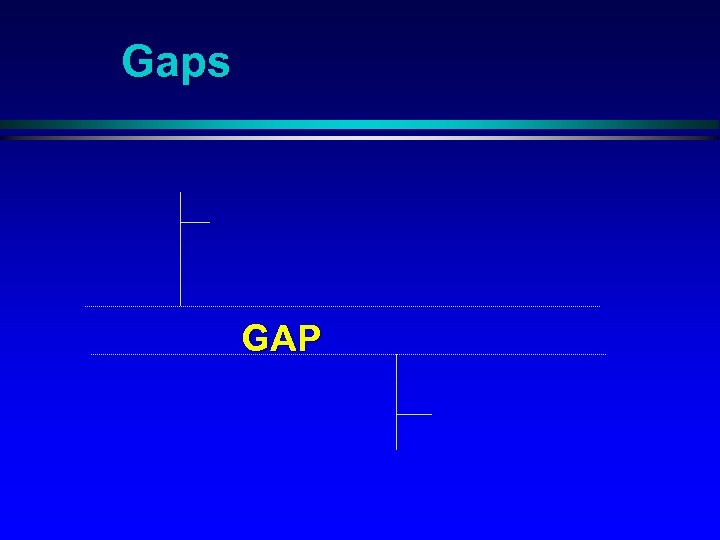
 Gaps H A hole or discontinuous part on a bar chart in looking at the trading range for two consecutive days (i. e. contracts traded at price ranges that do not overlap). H Today’s high is below yesterday’s low or today’s low is above yesterday’s high.
 Gaps GAP
 Moving Averages H Calculate the average price in the last several days (e. g. 3, 5, 7) and plot it. H Calculate the average price for a longer price series and plot it.
 Moving Averages H Where the short series average crosses the longer average, that is a buy signal if prices have been moving up recently, sell signal if they have been moving down.
 Moving Averages H The shorter the short series, the more frequent buy or sell signals. H What is the right length of series to use? Differs by commodity? Seems to keep changing!
 Relative Strength Index H An overbought or oversold indicator H Calculate the sum of the positive price changes and the sum of the negative price changes for the number of days you select
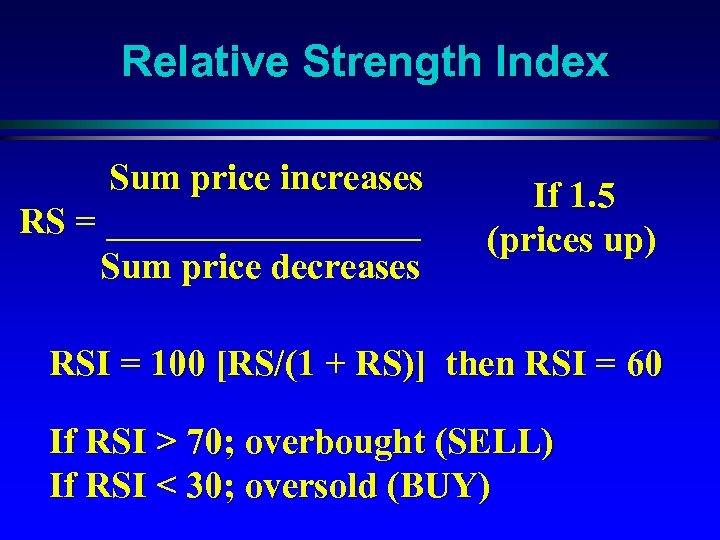 Relative Strength Index Sum price increases RS = _________ Sum price decreases If 1. 5 (prices up) RSI = 100 [RS/(1 + RS)] then RSI = 60 If RSI > 70; overbought (SELL) If RSI < 30; oversold (BUY)
 Technical analysis H If technical signal is linked with high trading volume, signal is often considered stronger H Advanced traders test historical fits, and use the one or combinations that work best recently in each market
 Reasons for Nonrandom Futures Price Behavior H Risk premium (return for taking risk) is required by speculators to encourage them to take positions. H If hedges are primarily short, then current futures should be below later expiration price.
 Overreaction Hypothesis H Traders overreact to new market information; if so, trend following techniques will work for a while. If enough traders are trend followers, may be self fulfilling forecast
 Overreaction Hypothesis H Traders may not be able to accurately evaluate impacts of new information, and perceive substantial risk in taking a position contrary to present trends, so price moves (overreactions) will persist longer.
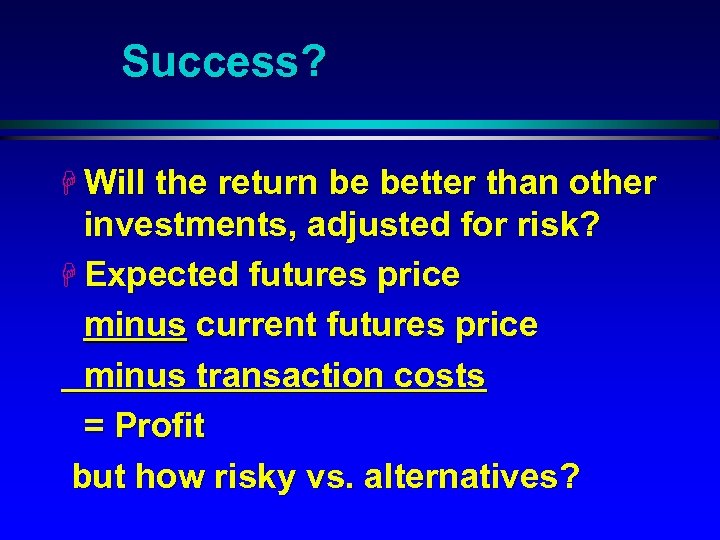 Success? H Will the return be better than other investments, adjusted for risk? H Expected futures price minus current futures price minus transaction costs = Profit but how risky vs. alternatives?
 Success? H Prevailing wisdom suggests: H 80+ percent of small speculators lose money H But new sheep come to be shorn! H 10% (professionals) make money H Commodity trading funds--highly variable results
 Assignment 8 H Where are futures charts found on the web? List several? ? H Report on best technical analysis site. H Precise address H How it’s useful
 Assignment 9 H Find one or more commodity forecast newsletter (or similar source). H Report briefly: H Where to get forecast(s)? H Key factors they consider in their price forecast process? H Does it look useful? At what cost?