


 Скачать презентацию Teatro Colon History of the Teatro Colon
Достопримечательности.pptx
- Количество слайдов: 7
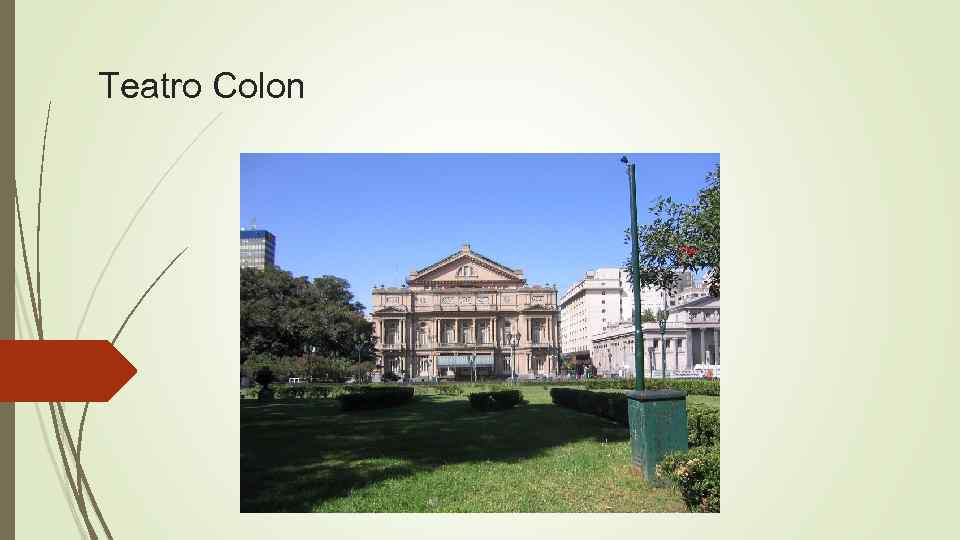 Teatro Colon
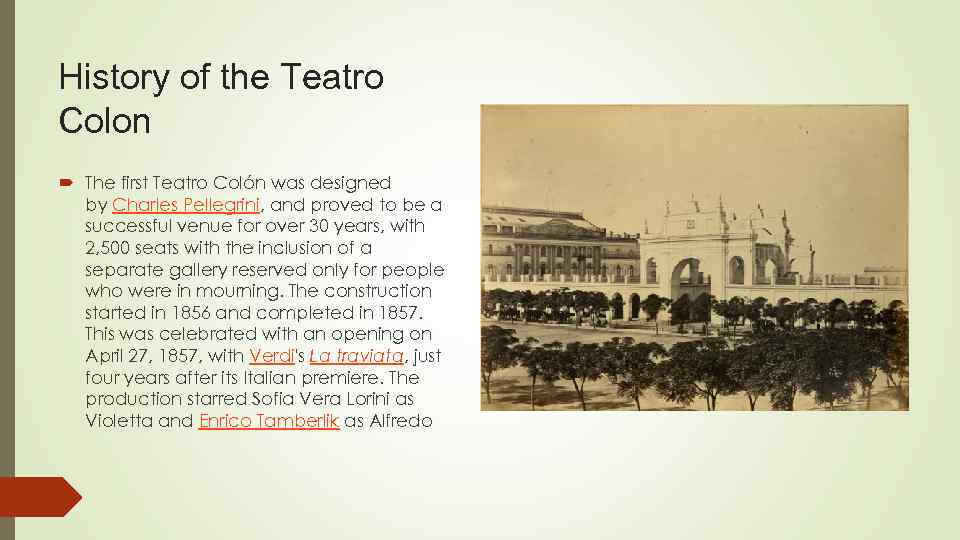 History of the Teatro Colon The first Teatro Colón was designed by Charles Pellegrini, and proved to be a successful venue for over 30 years, with 2, 500 seats with the inclusion of a separate gallery reserved only for people who were in mourning. The construction started in 1856 and completed in 1857. This was celebrated with an opening on April 27, 1857, with Verdi's La traviata, just four years after its Italian premiere. The production starred Sofia Vera Lorini as Violetta and Enrico Tamberlik as Alfredo
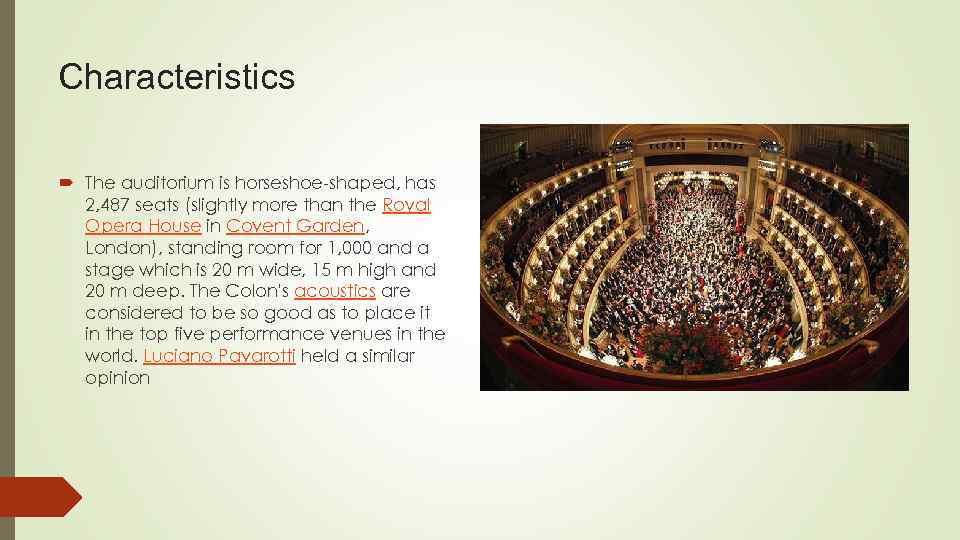 Characteristics The auditorium is horseshoe-shaped, has 2, 487 seats (slightly more than the Royal Opera House in Covent Garden, London), standing room for 1, 000 and a stage which is 20 m wide, 15 m high and 20 m deep. The Colon's acoustics are considered to be so good as to place it in the top five performance venues in the world. Luciano Pavarotti held a similar opinion
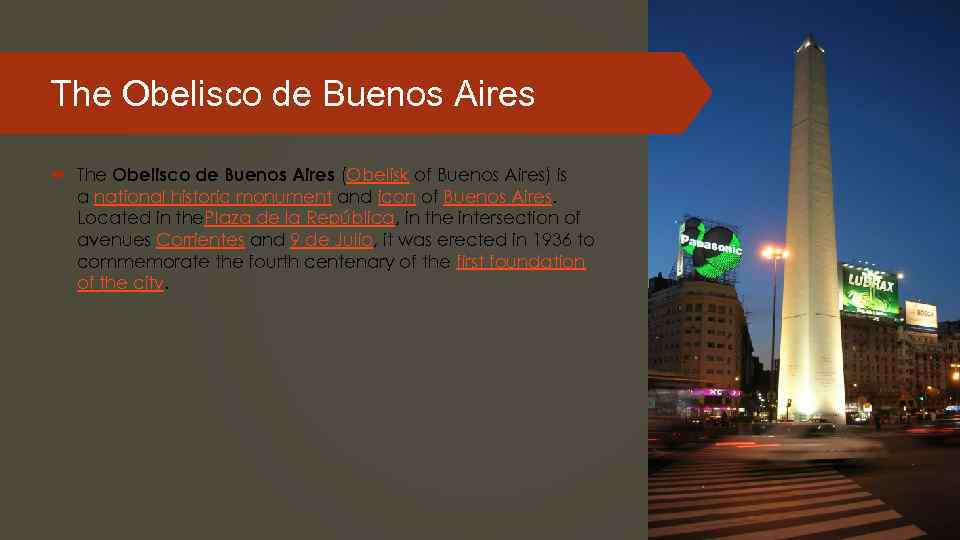 The Obelisco de Buenos Aires (Obelisk of Buenos Aires) is a national historic monument and icon of Buenos Aires. Located in the. Plaza de la República, in the intersection of avenues Corrientes and 9 de Julio, it was erected in 1936 to commemorate the fourth centenary of the first foundation of the city.
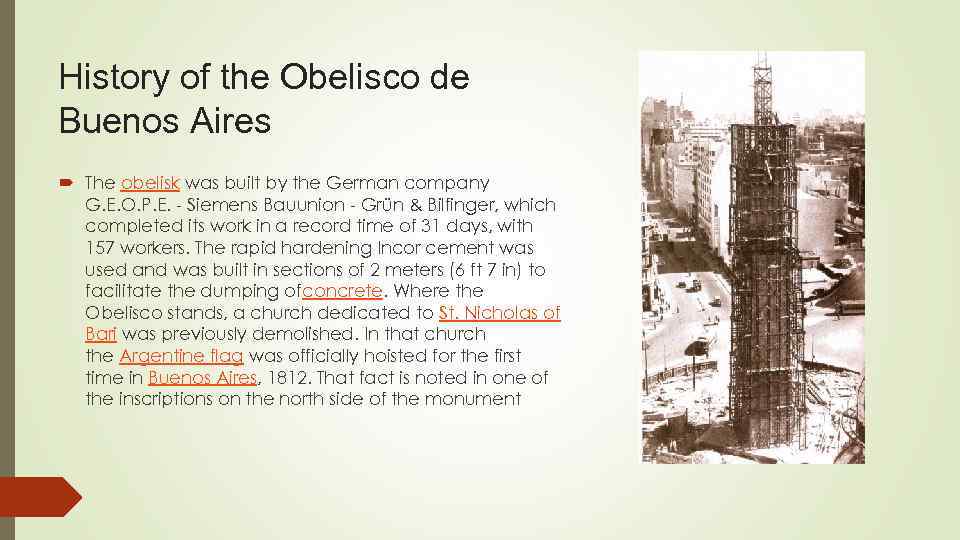 History of the Obelisco de Buenos Aires The obelisk was built by the German company G. E. O. P. E. - Siemens Bauunion - Grün & Bilfinger, which completed its work in a record time of 31 days, with 157 workers. The rapid hardening Incor cement was used and was built in sections of 2 meters (6 ft 7 in) to facilitate the dumping ofconcrete. Where the Obelisco stands, a church dedicated to St. Nicholas of Bari was previously demolished. In that church the Argentine flag was officially hoisted for the first time in Buenos Aires, 1812. That fact is noted in one of the inscriptions on the north side of the monument
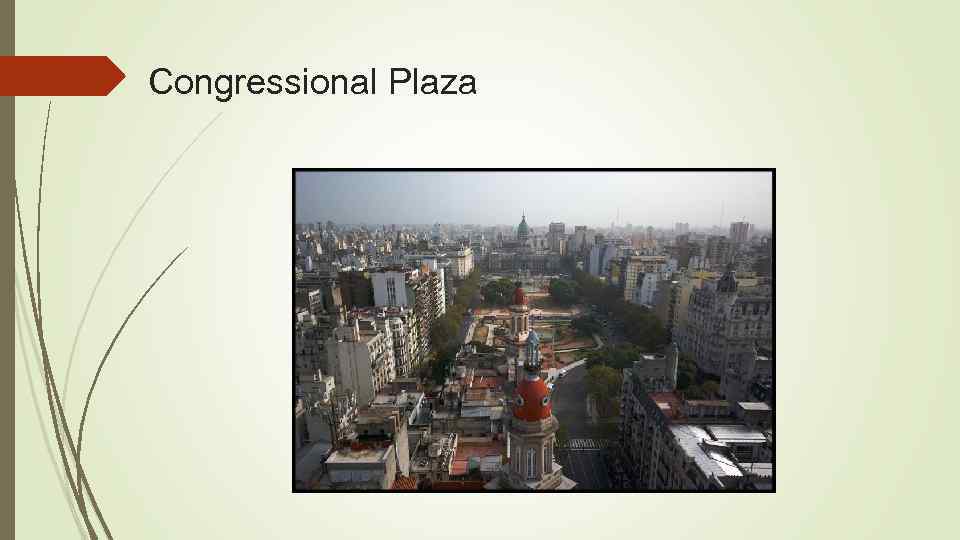 Congressional Plaza
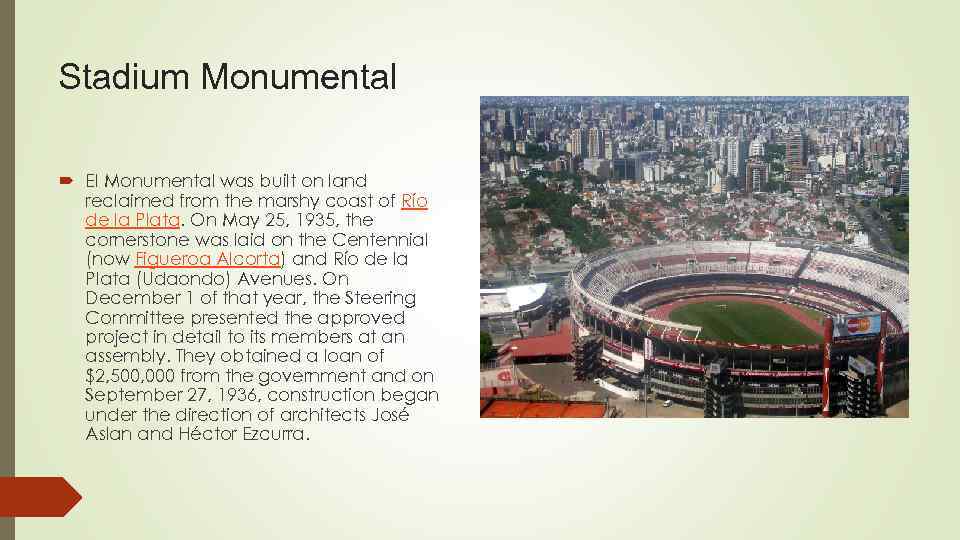 Stadium Monumental El Monumental was built on land reclaimed from the marshy coast of Río de la Plata. On May 25, 1935, the cornerstone was laid on the Centennial (now Figueroa Alcorta) and Río de la Plata (Udaondo) Avenues. On December 1 of that year, the Steering Committee presented the approved project in detail to its members at an assembly. They obtained a loan of $2, 500, 000 from the government and on September 27, 1936, construction began under the direction of architects José Aslan and Héctor Ezcurra.