Скачать презентацию Tears in the Iron Curtain Afghanistan Poland Hungary
87bd139c446e08e2811fd929970b7230.ppt
- Количество слайдов: 49
 Tears in the Iron Curtain Afghanistan, Poland Hungary
 AFGHANISTAN
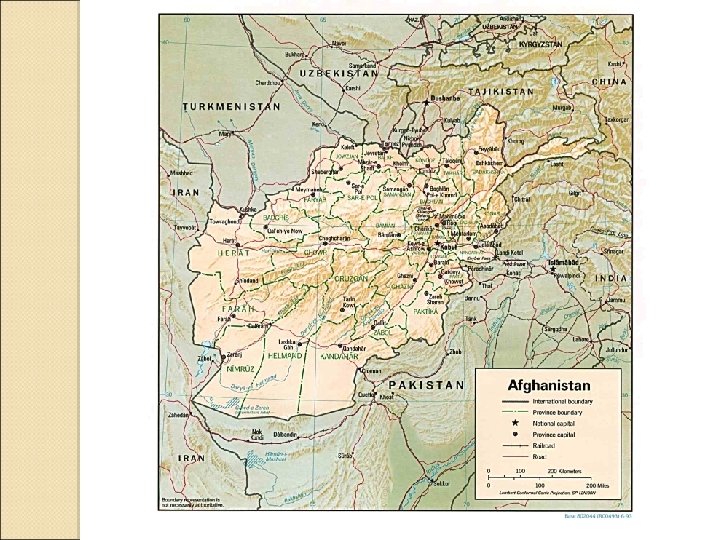
 The Soviets in Afghanistan The Soviets were interested in Afghanistan because gaining influence or even control in he region was a natural extension of decades of Russian foreign policy, namely southern expansion. Mohammed Daoud Khan had gained power in 1973 and after a short period began to suppress opposition parties.
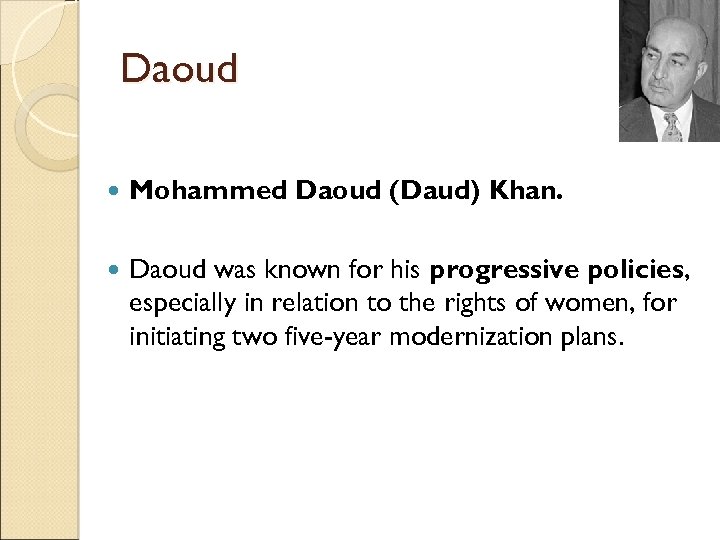 Daoud Mohammed Daoud (Daud) Khan. Daoud was known for his progressive policies, especially in relation to the rights of women, for initiating two five-year modernization plans.
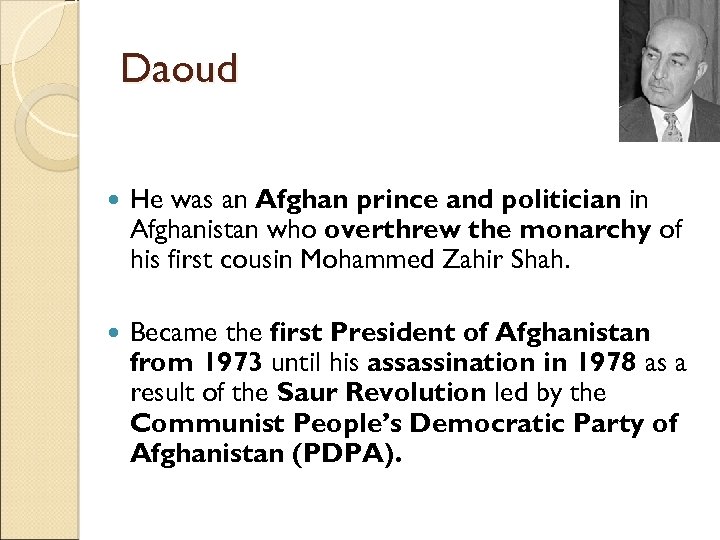 Daoud He was an Afghan prince and politician in Afghanistan who overthrew the monarchy of his first cousin Mohammed Zahir Shah. Became the first President of Afghanistan from 1973 until his assassination in 1978 as a result of the Saur Revolution led by the Communist People’s Democratic Party of Afghanistan (PDPA).
 Removed Daoud attacked Islamic fundamentalists with particular vigour. He was deposed (removed from office) because of an assassination claim (April 19, 1978) against him of a prominent leftist, Mir Akbar Khyber.
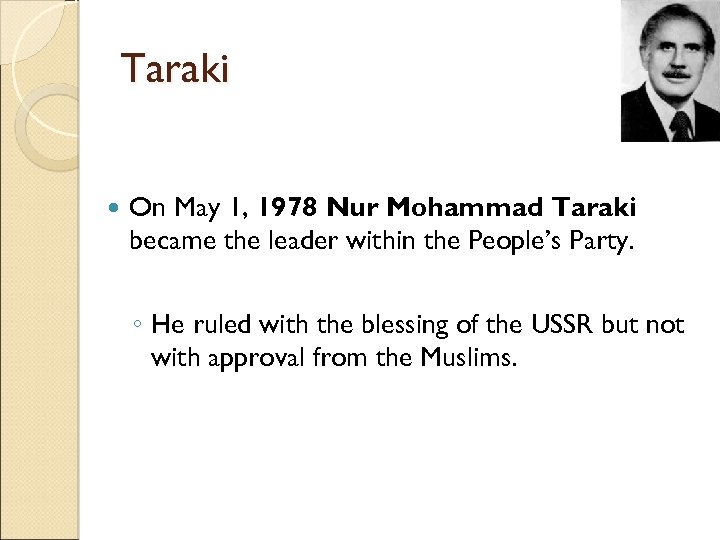 Taraki On May 1, 1978 Nur Mohammad Taraki became the leader within the People’s Party. ◦ He ruled with the blessing of the USSR but not with approval from the Muslims.
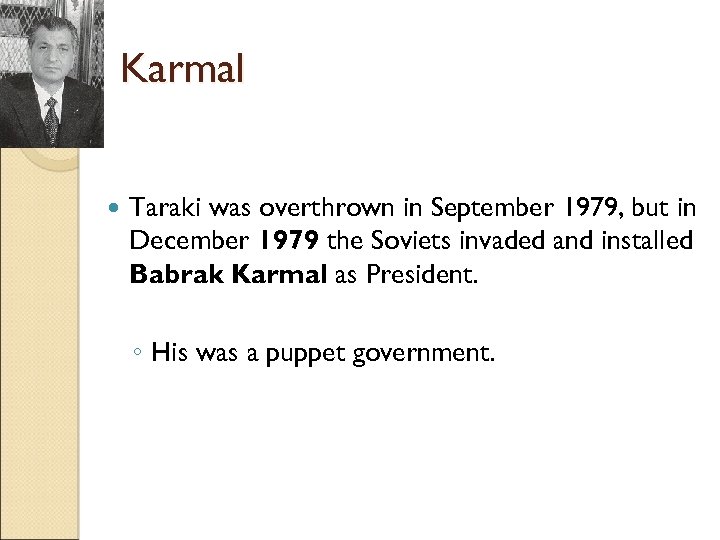 Karmal Taraki was overthrown in September 1979, but in December 1979 the Soviets invaded and installed Babrak Karmal as President. ◦ His was a puppet government.
 Soviet Invasion +1980 Olympics The West, China and India were alarmed. The Soviets appeared to be taking control of the Persian Gulf. ◦ The USA and others boycotted the Moscow Olympics in 1980 as a result.
 The End of Detente The Soviet Invasion of Afghanistan is generally considered the end of detente between the East and West.
 The Beginning of Afghanistan Early in the 1980 the USSR escalated the war. ◦ They soon had more than 80, 000 troops, 2, 000 tanks and squadrons of aircraft supporting their war effort.
 The Beginning of Afghanistan In spite of this effort, the rebels, the Mujahedin, still controlled most of the country. ◦ This was another guerrilla war.
 War in Afghanistan From 1980 -1988 a vicious war followed in Afghanistan, creating much East-West tension as well as an enormous refugee problem for neighbouring states like Pakistan.
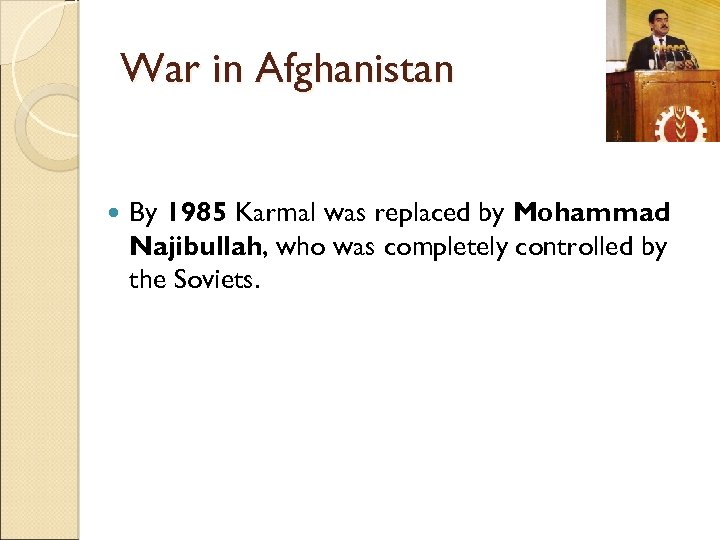 War in Afghanistan By 1985 Karmal was replaced by Mohammad Najibullah, who was completely controlled by the Soviets.
 War in Afghanistan In 1988 an Accord was signed that approved a withdrawal plan for the USSR. ◦ Given their problems at home, they were all too happy to withdraw in 1988/89. ◦ The USSR lost the war.
 Parallels The Afghanistan venture on the part of the Soviets had many parallels to the US experience in Vietnam. While the Soviet citizens were not entirely informed about activities in Afghanistan, growing resentment within the Soviet forces in Afghanistan was evidence that all was not well.
 Parallels The Soviets have been accused of practicing methods of warfare in Afghanistan that were brutal and against the Geneva Convention (i. e. chemical warfare). Western reporters in Afghanistan repeatedly reported examples of the brutal nature of this war.
 Afghanistan and Vietnam More comparisons of the Soviet experience in Afghanistan en the US experience in Vietnam: ◦ Native population was largely against the foreign forces. ◦ Guerrilla forces dedicated to a cause.
 Afghanistan and Vietnam ◦ World public opinion turned rapidly against both foreign invaders. ◦ Withdrew in less than glorious circumstances and their armies were discredited.
 POLAND
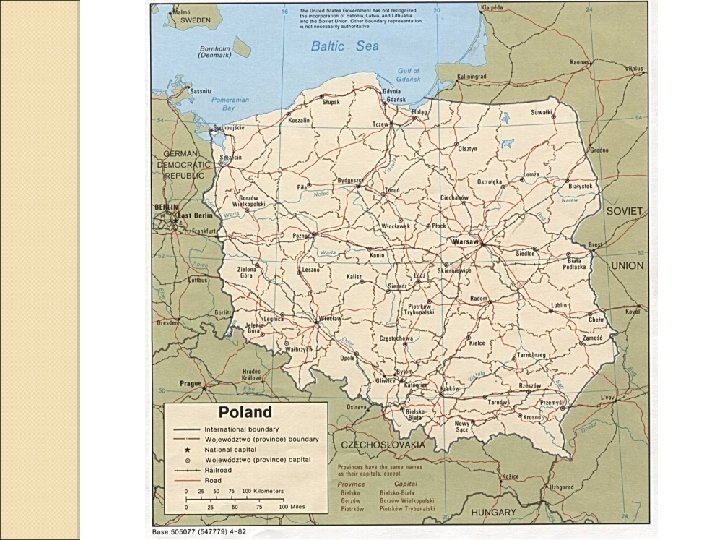
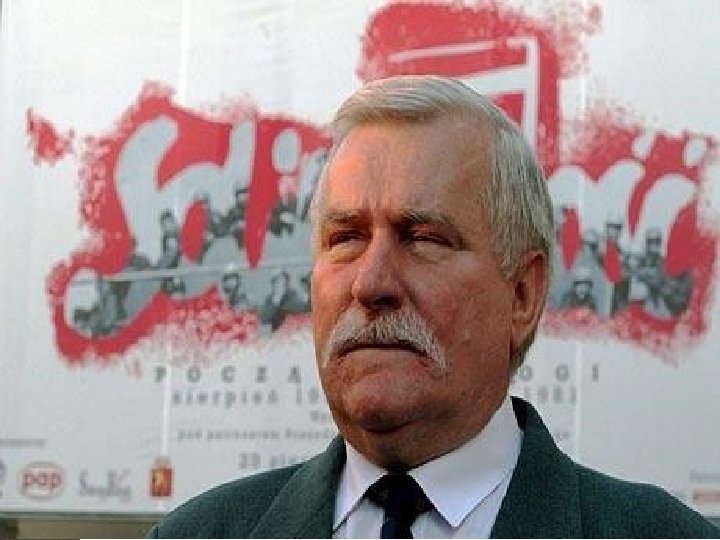
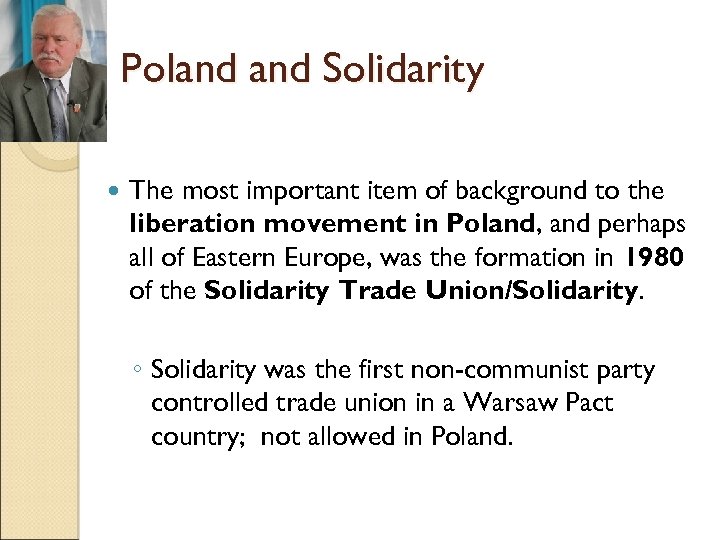 Poland Solidarity The most important item of background to the liberation movement in Poland, and perhaps all of Eastern Europe, was the formation in 1980 of the Solidarity Trade Union/Solidarity. ◦ Solidarity was the first non-communist party controlled trade union in a Warsaw Pact country; not allowed in Poland.
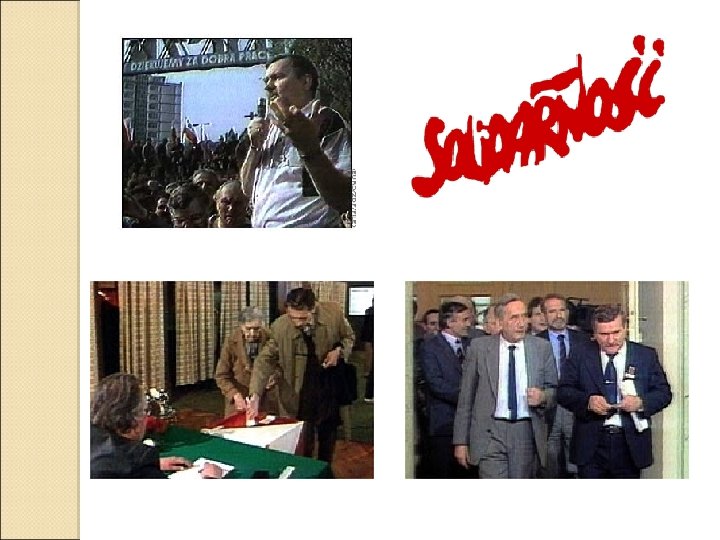
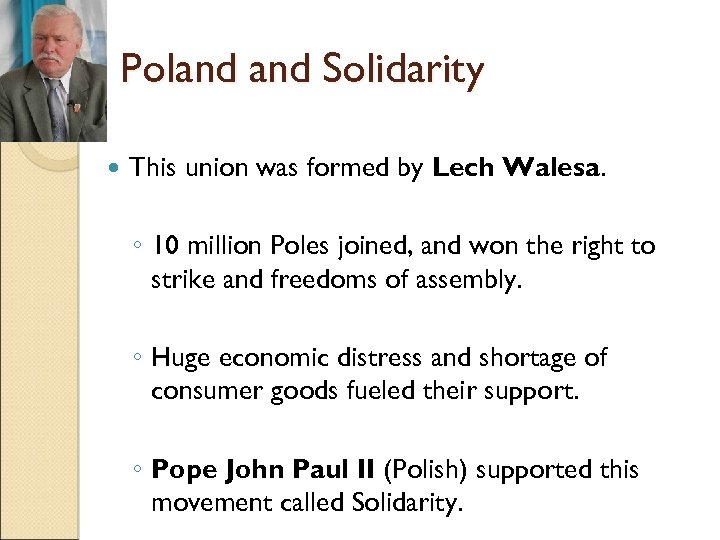 Poland Solidarity This union was formed by Lech Walesa. ◦ 10 million Poles joined, and won the right to strike and freedoms of assembly. ◦ Huge economic distress and shortage of consumer goods fueled their support. ◦ Pope John Paul II (Polish) supported this movement called Solidarity.
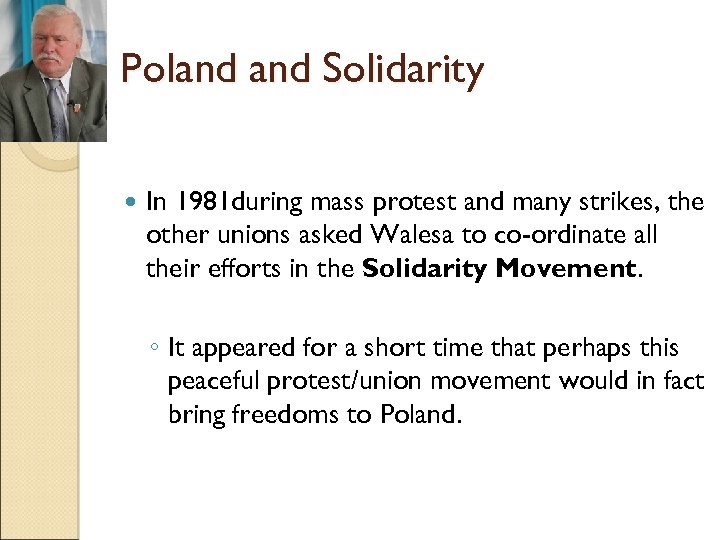 Poland Solidarity In 1981 during mass protest and many strikes, the other unions asked Walesa to co-ordinate all their efforts in the Solidarity Movement. ◦ It appeared for a short time that perhaps this peaceful protest/union movement would in fact bring freedoms to Poland.
 Solidarity In 1981 the government cracked down with martial law and made Solidarity illegal. ◦ Walesa, as well as many other Solidarity leaders, was imprisoned. ◦ Strikes were banned, and Soviet troops occupied the country.
 Solidarity In 1983 martial law was lifted and slowly Solidarity leaders were released. It would be 1989 before Solidarity would be made legal again. ◦ Their illegal status, however, did not mean that they had ceased to be effective.
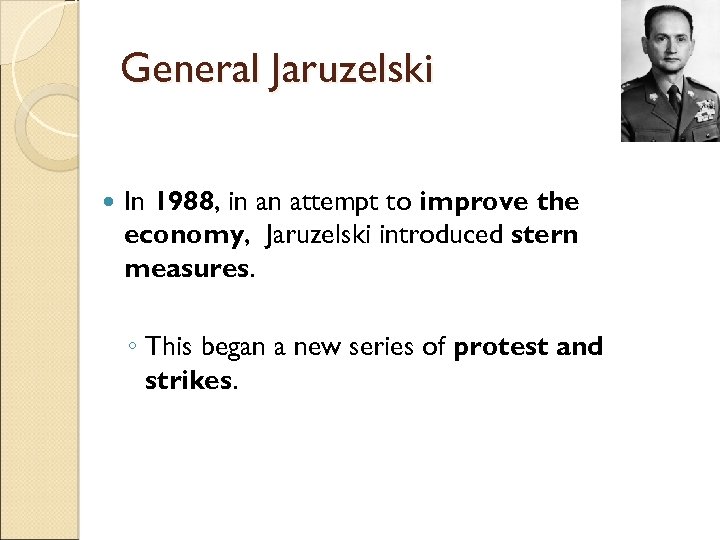
 General Jaruzelski General Wojciech Jaruzelski, a traditional Communist hardliner, came to power Poland in 1981. All the political action described in the previous slides did nothing to improve the already faltering economy.
 General Jaruzelski In 1988, in an attempt to improve the economy, Jaruzelski introduced stern measures. ◦ This began a new series of protest and strikes.
 The World’s Reactions The world got involved. ◦ Reagan (USA) put pressure on Poland: Halted USSR flights to the USA. Enacted trade restrictions.
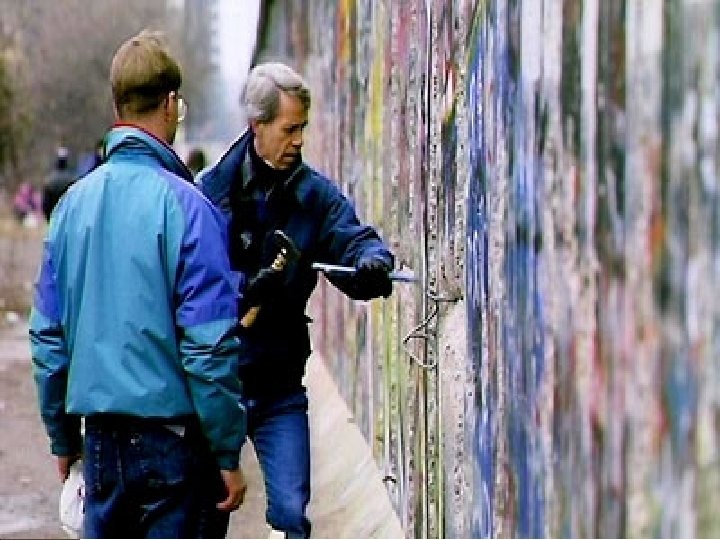
 The World’s Reactions 1988 -89 Gorbachev (USSR) did not have the capacity or the will to send in the Red Army like before. 1989, free elections were held for the first time since WW II. ◦ The Iron Curtain would soon fall apart.
 1989 From February to April, Jaruzelski engaged various opposition groups in discussion about the economy. ◦ He knew he would need their support to introduce his style of reforms.
 1989 Included in these opposition groups were government Communists, Solidarity members, representative from the Roman Catholic Church, as well as other smaller opposition groups.
 A New Constitution The results of these talks produced a new constitution for Poland which represented a revolution in itself. ◦ Free elections were introduced, yet the Communist Party held special privileges.
 A New Constitution After the first election Solidarity won 92% of the seats in the Senate and 160/161 seats in the lower house. ◦ It looked liked the Communists had been obliterated.
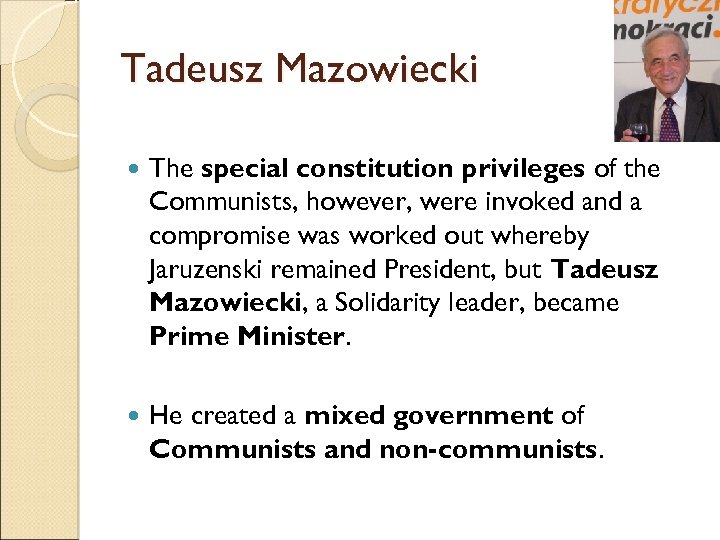 Tadeusz Mazowiecki The special constitution privileges of the Communists, however, were invoked and a compromise was worked out whereby Jaruzenski remained President, but Tadeusz Mazowiecki, a Solidarity leader, became Prime Minister. He created a mixed government of Communists and non-communists.
 Democratization The events in the rest of Europe were soon to overshadow what was yet to happen in Poland. The key for the move towards liberation in the rest of Europe was that the Soviets had not used force to intervene in the democratization of Poland. In December of 1990, Lech Walesa became President of Poland.
 HUNGARY
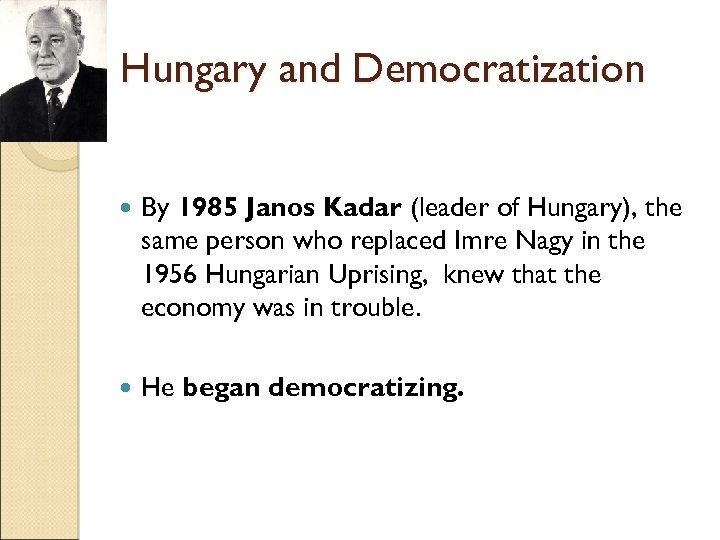 Hungary and Democratization By 1985 Janos Kadar (leader of Hungary), the same person who replaced Imre Nagy in the 1956 Hungarian Uprising, knew that the economy was in trouble. He began democratizing.
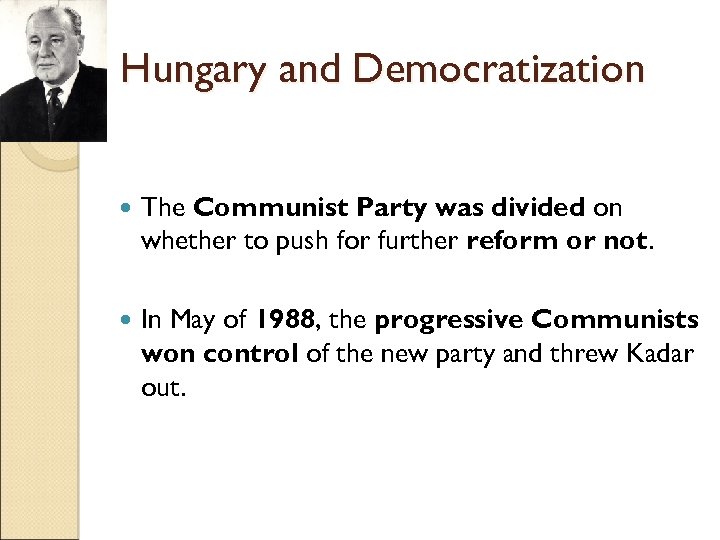 Hungary and Democratization The Communist Party was divided on whether to push for further reform or not. In May of 1988, the progressive Communists won control of the new party and threw Kadar out.
 Opposition Groups Two opposition groups continued their protest even against this more progressive Communist leadership. They were: ◦ The Alliance of Free Democrats ◦ The Democratic Forum (peasants and farmers)
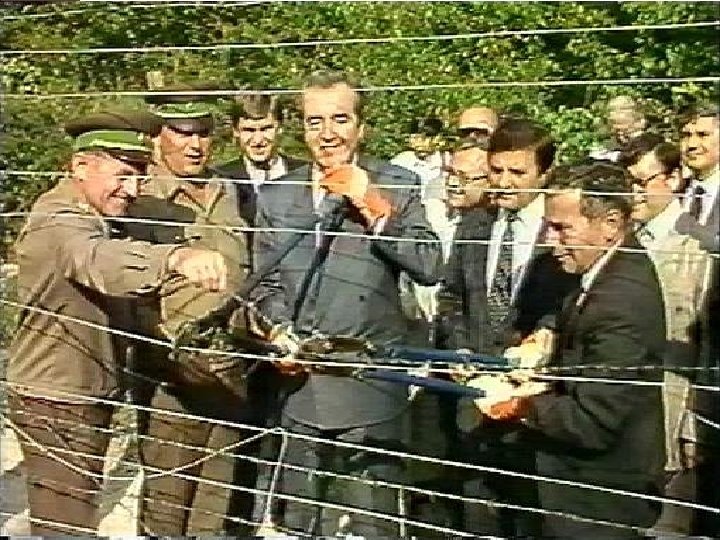
 Communism Collapses After observing the events in Poland the ease with which the hardliners had succumbed, this new progressive Communist group decided to go peacefully. In March, 1990 they allowed free elections.
 Communism Collapses The Democratic Forum won and Jozsef Natal became the Prime Minister.
 Communism Collapses What the freedom fighters of 1956 had failed to do by sacrificing 10, 000 lives, the modern reformers had accomplished without firing a shot.