 Скачать презентацию Teamwork Training in Critical Care Fabrice Brunet MD
69a0d096a3bcf66cf3489064b3e94798.ppt
- Количество слайдов: 23



Teamwork Training in Critical Care Fabrice Brunet, MD M. I. C. U-E. D Cochin, Paris C. C. D. St Michael’s, Toronto
Training in Critical Care • Education system in nursing and medicine give clinical skills to individuals • Superb individual skills do not guarantee effective team performance in care delivery • Effective teamwork does not arise spontaneously and needs behavior changes • Teaching of teamwork as integral in critical care is uncommon
Teamwork Training is: • • • A novel education model derived from aviation organisations Designed to train professionals Behavior-based teamwork course Using Problem-based learning Multidisciplinary groups Formal training program
Teamwork training is not • • An individual education system Focused on clinical skills Designed to teach students A transdisciplinary training
Teamwork training: Rationale • • • C. C. Ds are at risk environments Patients conditions are complex Technologies are always evolving Care needs multidisciplinary interactions Consequences of errors are severe Burn-out Syndrome is common
Teamwork training: Goals • • • Enhance department performance Improve Quality of Patient Care Reduce errors and litigation risks Improve patients/relatives comfort Develop multidisciplinary approach Increase staff satisfaction and as a result retention and recruitment of staff
Teamwork system: a standardized program • • • Teaching teamwork behavior and skills Designed for a « core team » Group animation concept Multidisciplinary teaching approach Interactive teaching method Topics selected on team needs
Organisation of seminars • • • Same team during the whole duration A coordinator following the team Multidisciplinary teachers Location: outside/inside the I. C. U Three kind of topics: medical, ethics, organisation Methods of training: lectures, simulation, clinical situation
Methods of training • Expert lecture: state-of-the art adapted for a multidisciplinary audience: Evidence-based • Simulation: Workshop allowing to adjust recommendations to real practice and to define local protocols: Experience-based • Clinical situation: confrontation with current practice: Real life
Factors of success • • Involvement of the Head of the C. C. D Steering committee Motivation of the team Training of the teachers Choice of appropriate topics Financial support by the institution Frequent reports of results
Evaluation • Evaluation of training itself – Questionnaire of satisfaction – Assessment of team performance • Evaluation of its results on practice – Implementation of new advances – Quality indicators – Analysis of adverse events
Performance assessment • • • Team and not individual performance Measurement of performance indicators during repeated simulations S. O. C. E. Assessment of team performance in clinical situations and novel techniques Decrease of adverse events Quality indicators: Audits and M. I. T
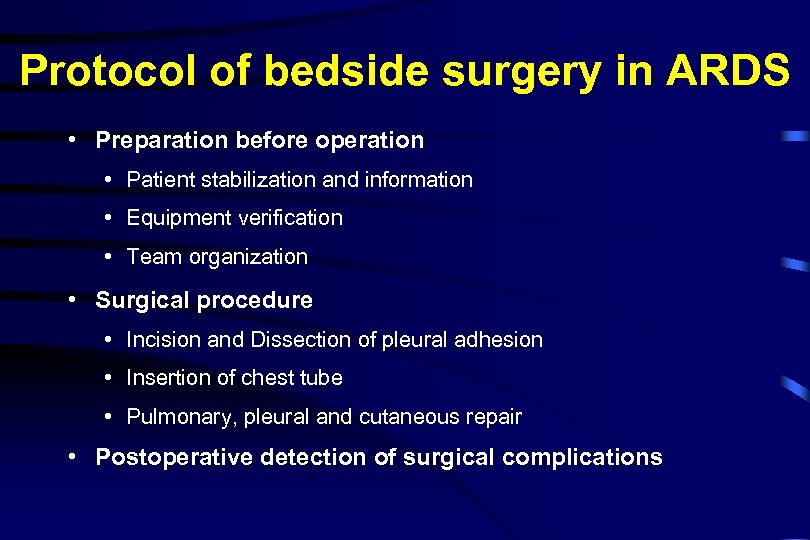
Protocol of bedside surgery in ARDS • Preparation before operation • Patient stabilization and information • Equipment verification • Team organization • Surgical procedure • Incision and Dissection of pleural adhesion • Insertion of chest tube • Pulmonary, pleural and cutaneous repair • Postoperative detection of surgical complications
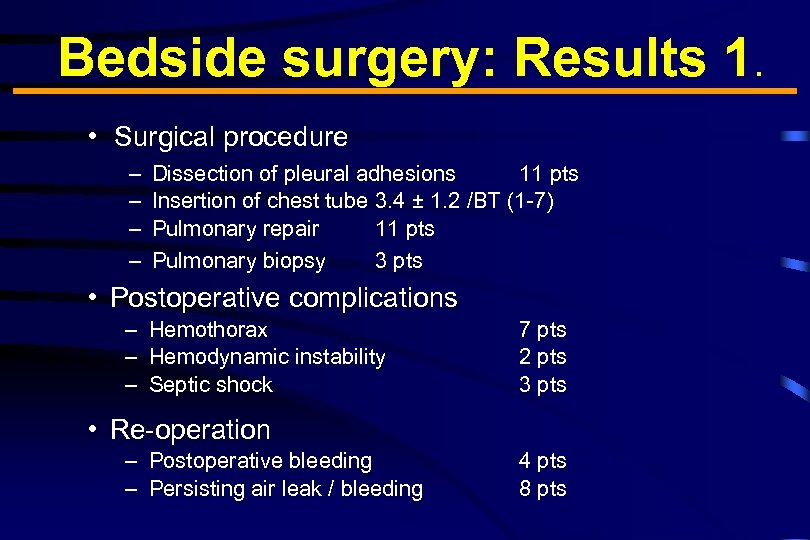
Bedside surgery: Results 1. • Surgical procedure – – Dissection of pleural adhesions 11 pts Insertion of chest tube 3. 4 ± 1. 2 /BT (1 -7) Pulmonary repair 11 pts Pulmonary biopsy 3 pts • Postoperative complications – – – Hemothorax Hemodynamic instability Septic shock 7 pts 2 pts 3 pts • Re-operation – Postoperative bleeding – Persisting air leak / bleeding 4 pts 8 pts
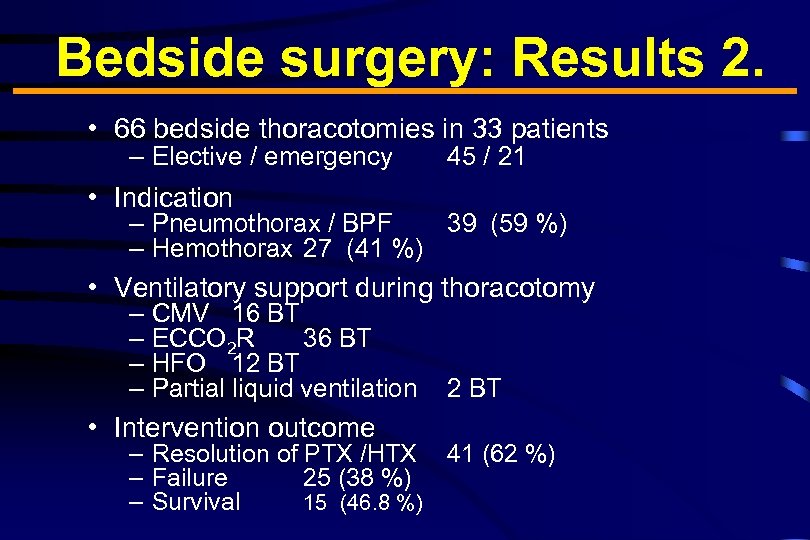
Bedside surgery: Results 2. • 66 bedside thoracotomies in 33 patients – Elective / emergency 45 / 21 • Indication – Pneumothorax / BPF 39 (59 %) – Hemothorax 27 (41 %) • Ventilatory support during thoracotomy – CMV 16 BT – ECCO 2 R 36 BT – HFO 12 BT – Partial liquid ventilation • Intervention outcome 2 BT – Resolution of PTX /HTX 41 (62 %) – Failure 25 (38 %) – Survival 15 (46. 8 %)
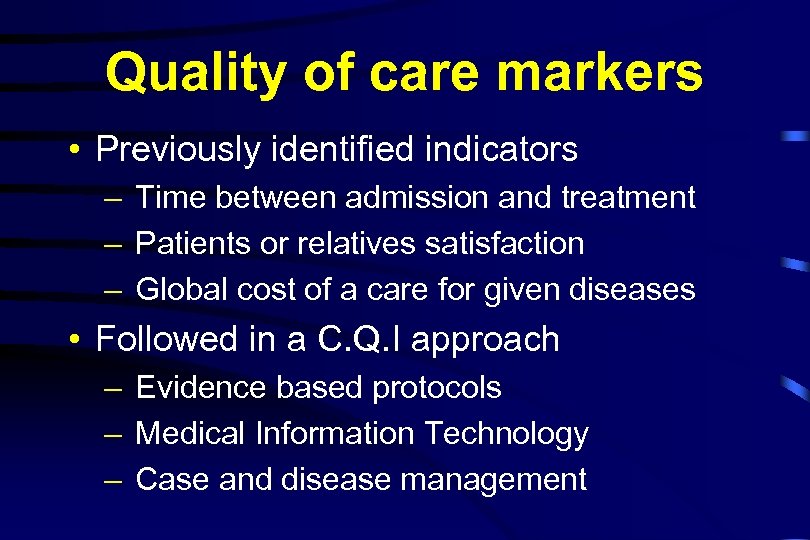
Quality of care markers • Previously identified indicators – Time between admission and treatment – Patients or relatives satisfaction – Global cost of a care for given diseases • Followed in a C. Q. I approach – Evidence based protocols – Medical Information Technology – Case and disease management
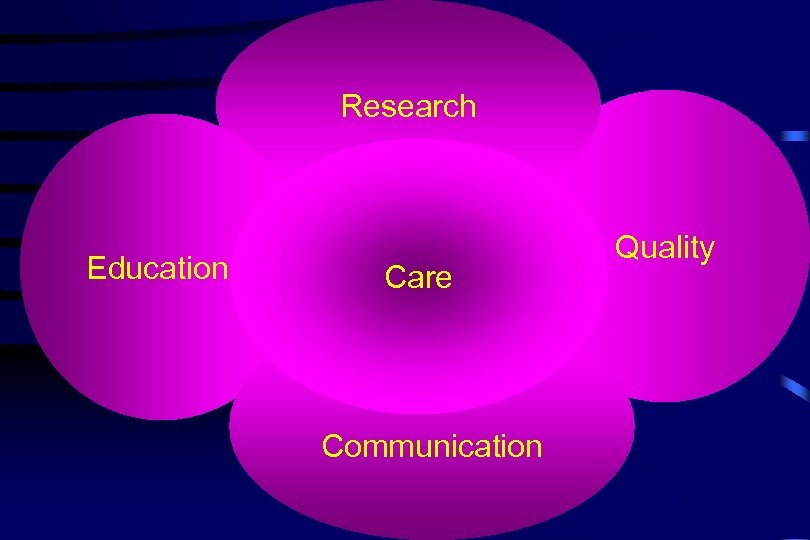
Research Education Care Communication Quality
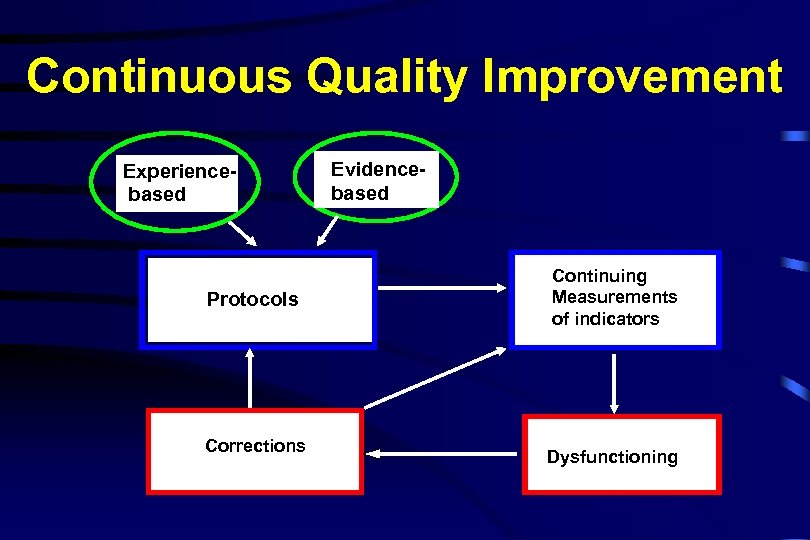
Continuous Quality Improvement Experiencebased Protocols Corrections Evidencebased Continuing Measurements of indicators Dysfunctioning
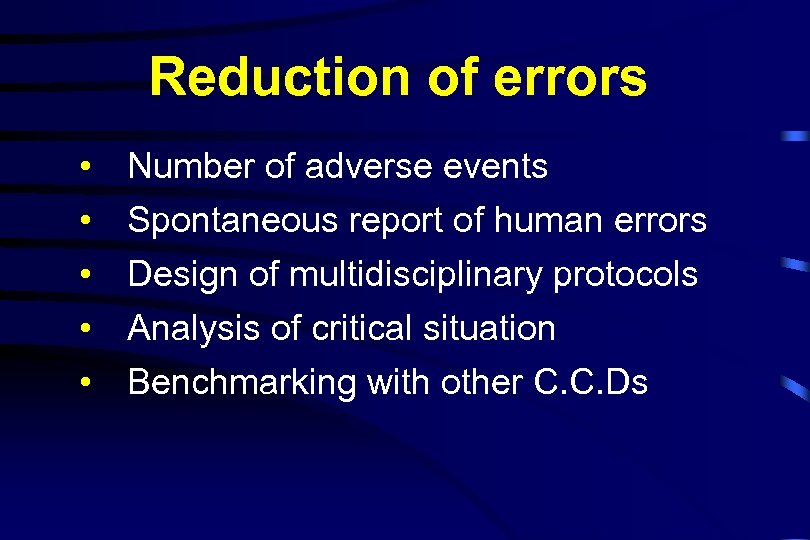
Reduction of errors • • • Number of adverse events Spontaneous report of human errors Design of multidisciplinary protocols Analysis of critical situation Benchmarking with other C. C. Ds
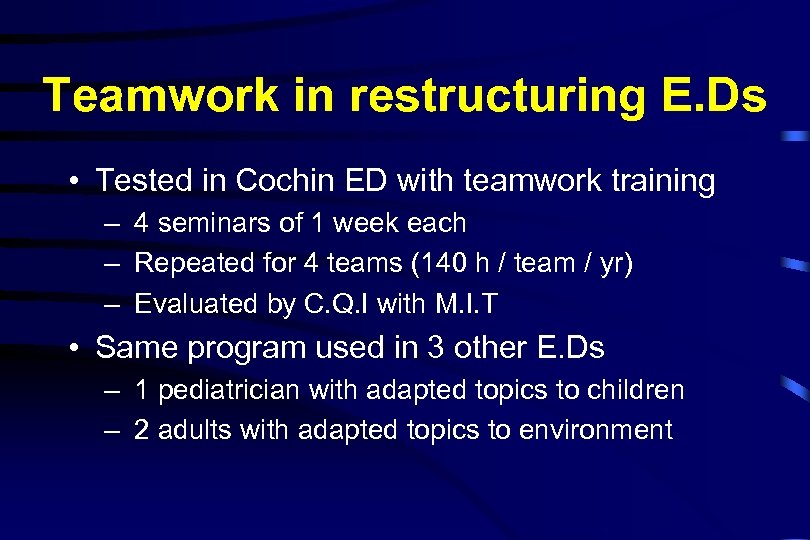
Teamwork in restructuring E. Ds • Tested in Cochin ED with teamwork training – 4 seminars of 1 week each – Repeated for 4 teams (140 h / team / yr) – Evaluated by C. Q. I with M. I. T • Same program used in 3 other E. Ds – 1 pediatrician with adapted topics to children – 2 adults with adapted topics to environment
Teamwork in E. Ds: results • Successful introduction of a new organisation – Triage, Observation units – Electronic patient chart • Increased department and team performance – Reducing waiting time for each step of the circuit – Designing Fast tracks for severely patients • Improving patient and team satisfaction – Decrease in patient complaints – Increased attractiveness of the E. Ds
Perspectives • Develop multicenter international studies on teamwork training sytems in C. C. Ds • Implement teamwork training early in the course of medical and nursing education • Design new systems of training to improve transdisciplinary teams performance
A few references • Brennan TA et al: The nature of adverse events in hospitalized patients. N Engl J Med 1991; 324: 370 -376. • Brennan TA et al: Hospital characteristics associated with adverse events and substandard care. JAMA 1991; 264: 3265 -3269. • Classen DC et al: Computerized surveillance of adverse drug events in hospital patients. JAMA 1991; 266: 2847 -2851. • Helmreich R: Managing human error in aviation. Sci Am 1997; 5: 62 -67. • Leape L. Error in medicine. JAMA 1994; 272: 1851 -1857. • Phillips K: The Power of Health Care Teams: Strategies for Success. Oakbrook, IL: Joint Commission on Accreditation of Health Care Organizations, 1997. • Risser DTet al: The potential for improved teamwork to reduce errors in the emergency department. Ann Emerg Med 1999; 34: 373 -383.
Скачать презентацию Teamwork Training in Critical Care Fabrice Brunet MD
69a0d096a3bcf66cf3489064b3e94798.ppt