 Скачать презентацию TEAM 11 ULTRASONIC MIXER n Team Members u
a3c14a7d6b8e552a9945362d9b85477e.ppt
- Количество слайдов: 37




TEAM 11 ULTRASONIC MIXER n Team Members: u Katie Kaser - Introduction & Concept Generation u Moshe Solomon - Concept Selection u Joanna Pirnot - Concept Development u Lihong Xu - Budget Sponsor: Fraunhofer USA Advisor: Dr. Michael Keefe Jump to first page

Jump to first page
Mechanical Mixers • Size • Cost • Wear • Contamination • Maintenance Jump to first page
Mission Design a non-mechanical mixer for homogenizing powder injection molding feedstock by April 1999 n Approach: u Identify wants and constraints u Benchmark previous technology u Generate set of concepts u Select best concept u Execute design via best engineering methodology Jump to first page
Customers n n Sponsor - Fraunhofer Mixer suppliers u Misonix n Inc. Ultrasonic consulting companies u Advanced n Sonic Processing Systems Anyone involved in powder injection molding Jump to first page
Wants & Constraints n Top 5 Wants Temperature Control u Low Contamination Level u Ease of cleaning u Cost u Produce measurable quantity u n Constraints Completion by April 1999 u Produce homogenous mixture u Safety u Jump to first page
System Benchmarking n n Mechanical Mixers High Shear Mixers u Static mixer u Pump/internal obstacle mixer (Sonolater) n Ultrasonic Mixers u Probe-type u External sound source Jump to first page
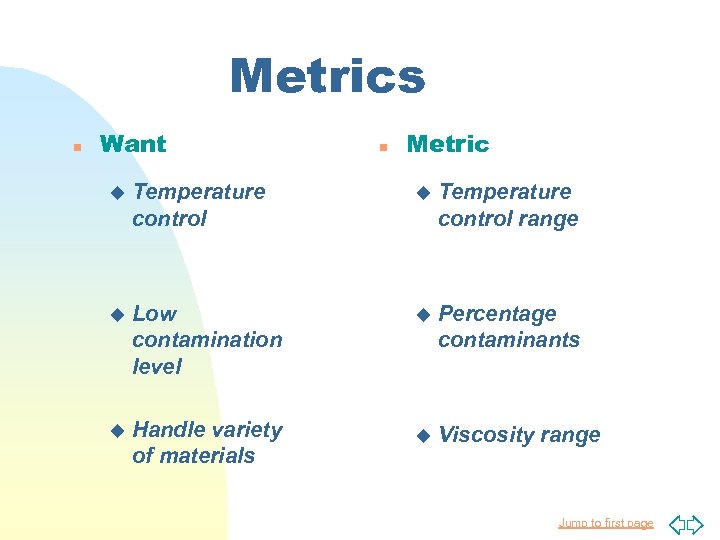
Metrics n Want n Metric u Temperature control range u Low contamination level u Percentage contaminants u Handle variety of materials u Viscosity range Jump to first page
Functional & Ultrasonic Benchmarking n Functions u Feeding u Heating u Mixing u Cooling n Ultrasonics u Ultrasonic Generators u Transducers Jump to first page
What did we learn? n Ultrasonics is a significant source of heat n Heating and mixing should be as concurrent as possible n n n A system incorporating a probe is subject to contamination and wear on the probe More energy reaches the material to be mixed using a probe than transmitting through walls of a vessel Ultrasonics are capable of mixing solid powders in a polymer resin. u On the macroscopic level a homogenous mixture was achieved Jump to first page
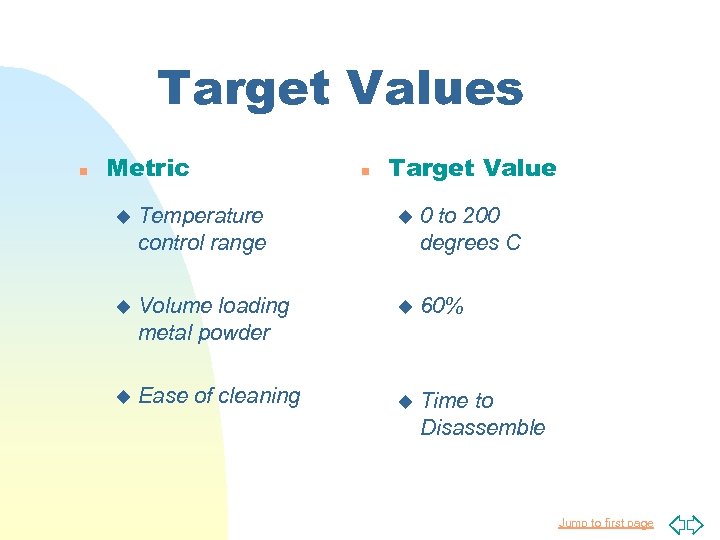
Target Values n Metric n Target Value u Temperature control range u 0 to 200 degrees C u Volume loading metal powder u 60% u Ease of cleaning u Time to Disassemble Jump to first page
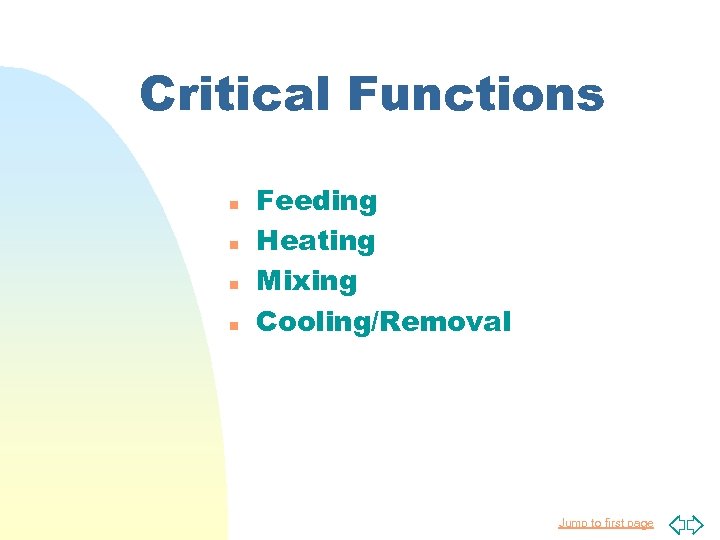
Critical Functions n n Feeding Heating Mixing Cooling/Removal Jump to first page
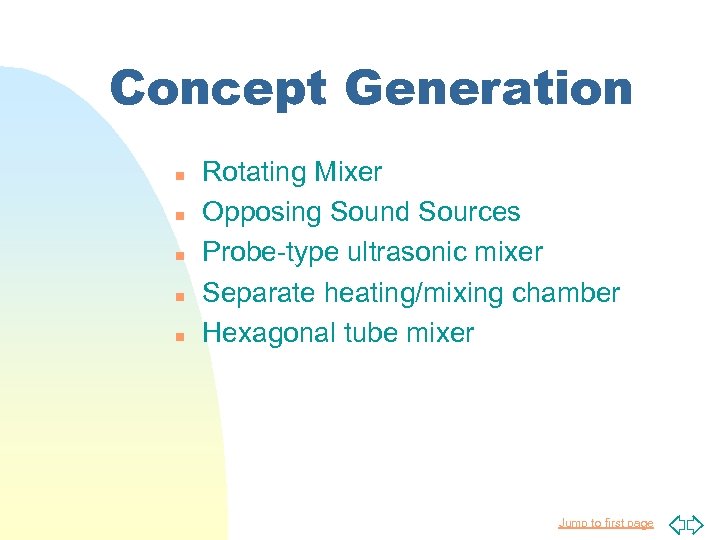
Concept Generation n n Rotating Mixer Opposing Sound Sources Probe-type ultrasonic mixer Separate heating/mixing chamber Hexagonal tube mixer Jump to first page
Concept 3: Rotating Mixer Jump to first page
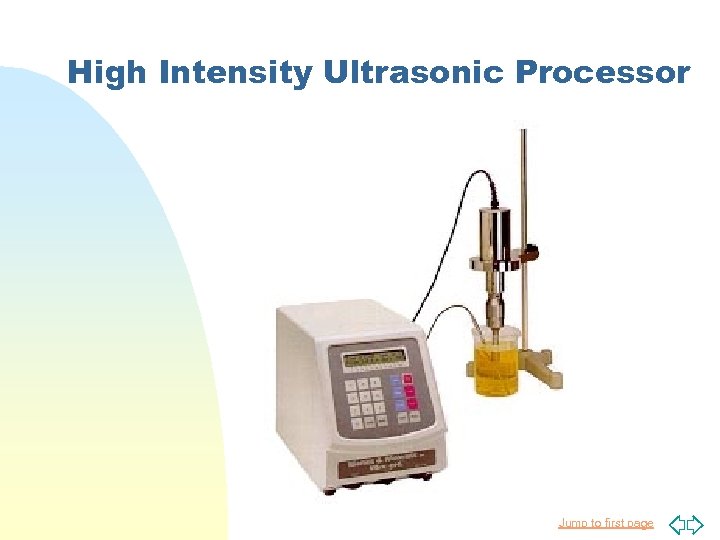
High Intensity Ultrasonic Processor Jump to first page
Jump to first page
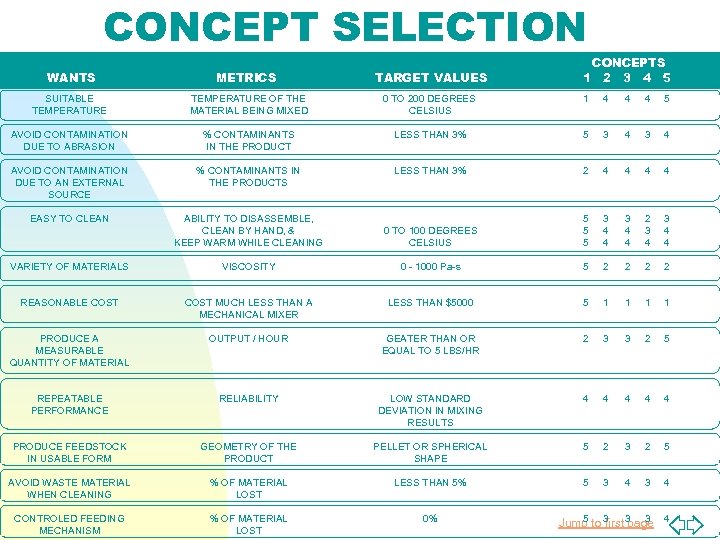
CONCEPT SELECTION SSD RESULTS TARGET VALUES CONCEPTS 1 2 3 4 5 WANTS METRICS SUITABLE TEMPERATURE OF THE MATERIAL BEING MIXED 0 TO 200 DEGREES CELSIUS 1 4 4 4 5 AVOID CONTAMINATION DUE TO ABRASION % CONTAMINANTS IN THE PRODUCT LESS THAN 3% 5 3 4 AVOID CONTAMINATION DUE TO AN EXTERNAL SOURCE % CONTAMINANTS IN THE PRODUCTS LESS THAN 3% 2 4 4 EASY TO CLEAN ABILITY TO DISASSEMBLE, CLEAN BY HAND, & KEEP WARM WHILE CLEANING 0 TO 100 DEGREES CELSIUS 5 5 5 3 4 4 2 3 4 4 VARIETY OF MATERIALS VISCOSITY 0 - 1000 Pa-s 5 2 2 REASONABLE COST MUCH LESS THAN A MECHANICAL MIXER LESS THAN $5000 5 1 1 PRODUCE A MEASURABLE QUANTITY OF MATERIAL OUTPUT / HOUR GEATER THAN OR EQUAL TO 5 LBS/HR 2 3 3 2 5 REPEATABLE PERFORMANCE RELIABILITY LOW STANDARD DEVIATION IN MIXING RESULTS 4 4 4 PRODUCE FEEDSTOCK IN USABLE FORM GEOMETRY OF THE PRODUCT PELLET OR SPHERICAL SHAPE 5 2 3 2 5 AVOID WASTE MATERIAL WHEN CLEANING % OF MATERIAL LOST LESS THAN 5% 5 3 4 CONTROLED FEEDING MECHANISM % OF MATERIAL LOST 0% 5 Jump to 3 3 3 4 first page
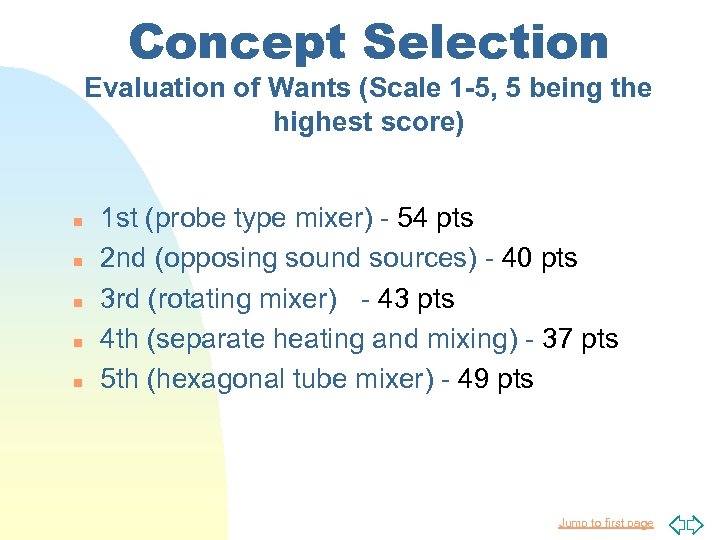
Concept Selection Evaluation of Wants (Scale 1 -5, 5 being the highest score) n n n 1 st (probe type mixer) - 54 pts 2 nd (opposing sound sources) - 40 pts 3 rd (rotating mixer) - 43 pts 4 th (separate heating and mixing) - 37 pts 5 th (hexagonal tube mixer) - 49 pts Jump to first page
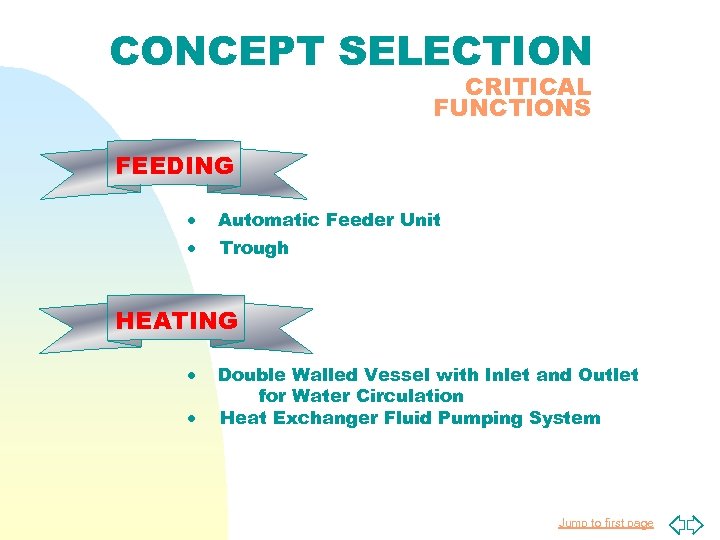
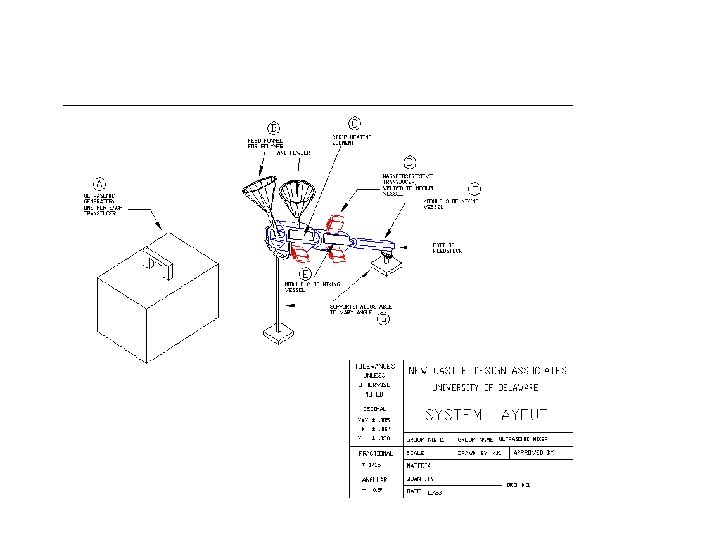
CONCEPT SELECTION CRITICAL FUNCTIONS FEEDING · Automatic Feeder Unit · Trough HEATING · · Double Walled Vessel with Inlet and Outlet for Water Circulation Heat Exchanger Fluid Pumping System Jump to first page
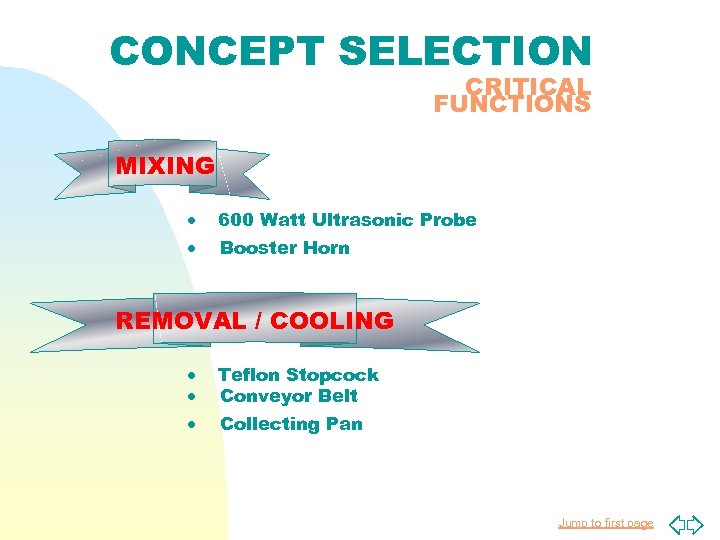
CONCEPT SELECTION CRITICAL FUNCTIONS MIXING · 600 Watt Ultrasonic Probe · Booster Horn REMOVAL / COOLING · · Teflon Stopcock Conveyor Belt · Collecting Pan Jump to first page
Concept Development n Demonstration (Video) n Test Results u Critical Functions u Prototype vs. Target Values n Modifications/Suggestions Jump to first page
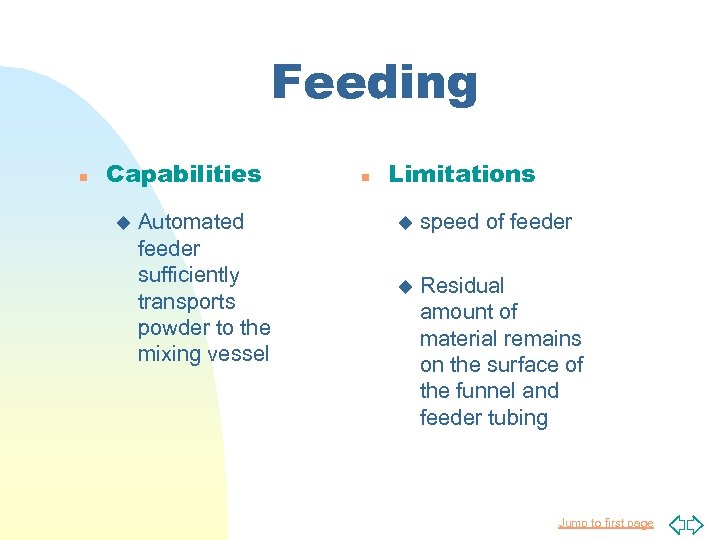
Feeding n Capabilities u Automated feeder sufficiently transports powder to the mixing vessel n Limitations u speed of feeder u Residual amount of material remains on the surface of the funnel and feeder tubing Jump to first page
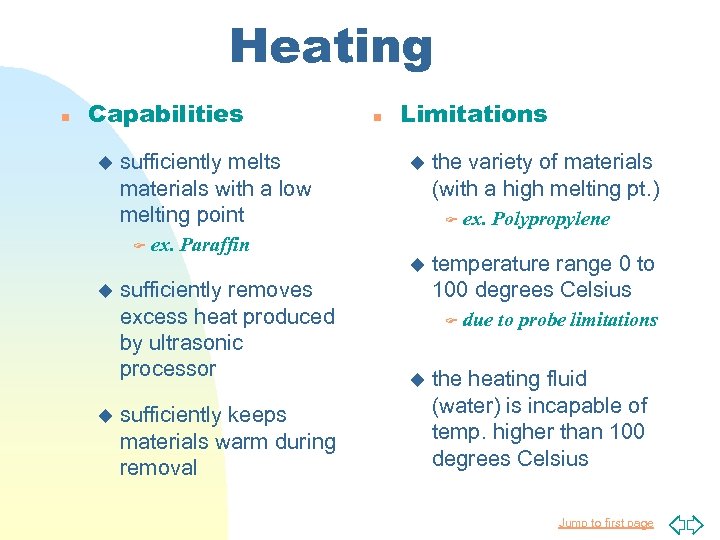
Heating n Capabilities u sufficiently melts materials with a low melting point F u u ex. Paraffin sufficiently removes excess heat produced by ultrasonic processor sufficiently keeps materials warm during removal n Limitations u the variety of materials (with a high melting pt. ) F u temperature range 0 to 100 degrees Celsius F u ex. Polypropylene due to probe limitations the heating fluid (water) is incapable of temp. higher than 100 degrees Celsius Jump to first page
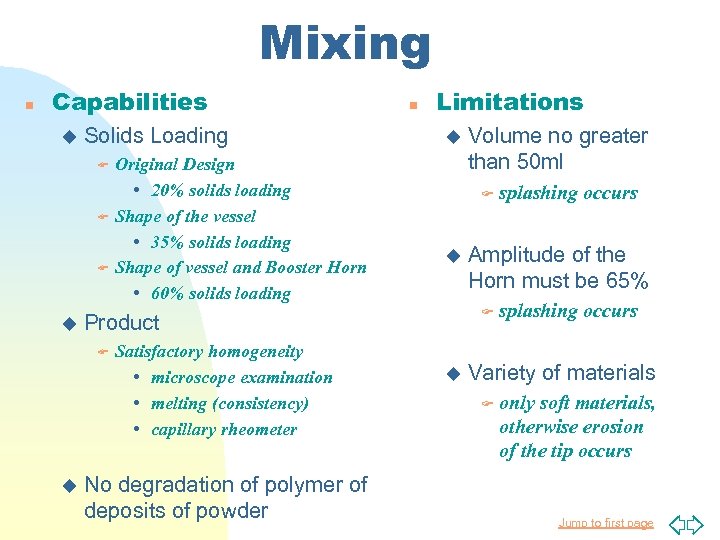
Mixing n Capabilities u Solids Loading F F F u Limitations u Satisfactory homogeneity • microscope examination • melting (consistency) • capillary rheometer No degradation of polymer of deposits of powder Volume no greater than 50 ml F u u splashing occurs Amplitude of the Horn must be 65% F Product F u Original Design • 20% solids loading Shape of the vessel • 35% solids loading Shape of vessel and Booster Horn • 60% solids loading n splashing occurs Variety of materials F only soft materials, otherwise erosion of the tip occurs Jump to first page
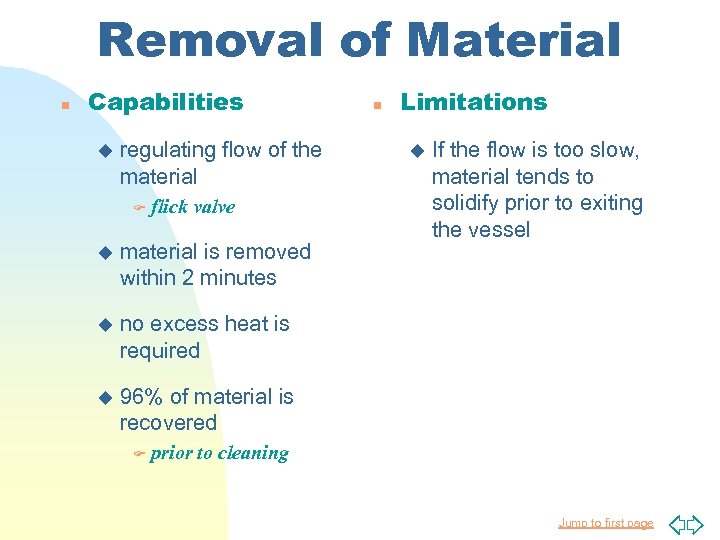
Removal of Material n Capabilities u regulating flow of the material F flick valve u material is removed within 2 minutes u Limitations u If the flow is too slow, material tends to solidify prior to exiting the vessel no excess heat is required u n 96% of material is recovered F prior to cleaning Jump to first page
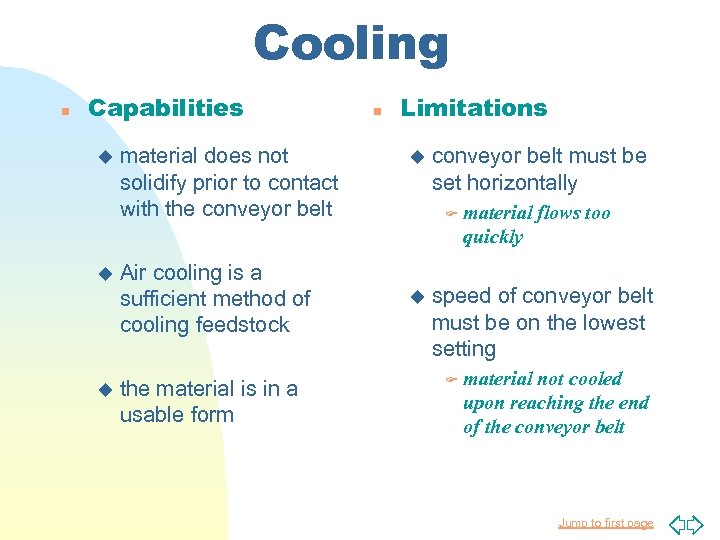
Cooling n Capabilities u u u material does not solidify prior to contact with the conveyor belt Air cooling is a sufficient method of cooling feedstock the material is in a usable form n Limitations u conveyor belt must be set horizontally F u material flows too quickly speed of conveyor belt must be on the lowest setting F material not cooled upon reaching the end of the conveyor belt Jump to first page

Jump to first page
Modifications/Suggestions (addressing our limitations) n Feeding u use n spherical shaped powders Heating u purchase F allows an air cooling converter probe to safely reach higher temperatures u use a fluid capable of reaching a higher temperature Jump to first page
Modifications/Suggestions n Mixing u purchase a larger vessel to increase the output/hour (no greater than 250 ml batches - probe tip (1/2 diameter) u purchase a larger probe tip - 1 in diameter (capable of mixing volumes up to 1000 ml) u coat the tip of the probe with tungsten carbide F this will reduce the erosion of the titanium tip Jump to first page
n Removal u Apply heat to the nozzle area to eliminate faster cooling of material; use heating gun n Cooling u Use longer conveyer belt; current length insufficient for air-cooling of larger pelleted feedstock Jump to first page

Jump to first page
Jump to first page
Budget All Budgeted Material and Equipment Expenditures Estimated Upgrade Cost Engineering Development Time Conclusion Jump to first page
All Budgeted Material Projected Production Cost: $15520. 99 Total cost for the project: $520. 99 Jump to first page
Estimated Upgrade Cost Total upgrade cost: $6670. 99 $50 K to $70 K $6700 Jump to first page
Engineering Development Time Fall 10 hr/person/week for 13 weeks Winter 4 hr/person/week for 4 weeks Spring 12 hr/person/week for 10 weeks (include testing time 4 hr/person/week for 6 weeks) Total time: 1064 hours Jump to first page
In Conclusion. . . A great team gained experience from the opportunity to use engineering theory in a practical way, developing an innovative technology solution meeting the specific real-world wants of our industrial customer. . . Jump to first page
Скачать презентацию TEAM 11 ULTRASONIC MIXER n Team Members u
a3c14a7d6b8e552a9945362d9b85477e.ppt