 Скачать презентацию Teaching Vocabulary Major Topics In this session
bf08af9fa09c04d49d300b56dcf4ba25.ppt
- Количество слайдов: 28




Teaching Vocabulary
Major Topics In this session, we are going to explore: 1. What is vocabulary? How is it learned? 2. What needs to be taught? 3. Methods for presenting new vocabulary items; 4. Ways to consolidate vocabulary; 5. Ways to help students develop vocabulary building strategies
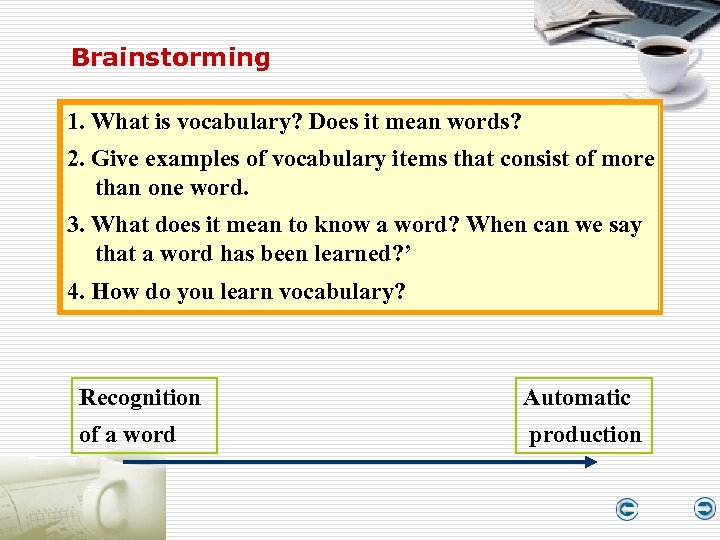
Brainstorming 1. What is vocabulary? Does it mean words? 2. Give examples of vocabulary items that consist of more than one word. 3. What does it mean to know a word? When can we say that a word has been learned? ’ 4. How do you learn vocabulary? Recognition Automatic of a word production
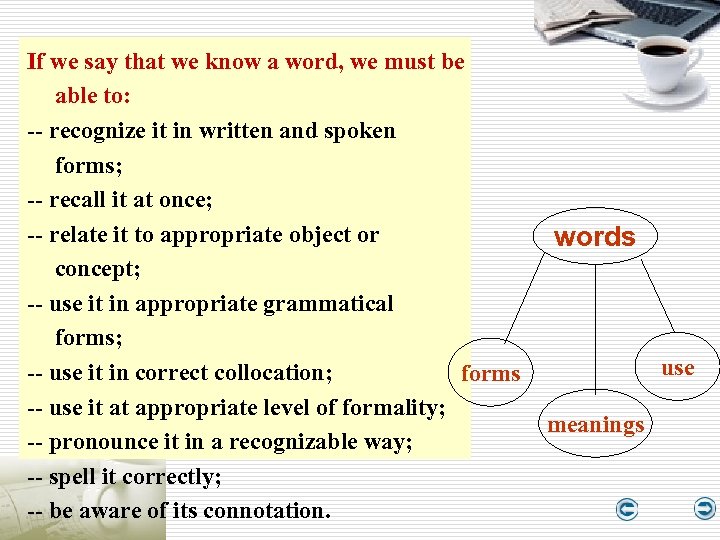
If we say that we know a word, we must be able to: -- recognize it in written and spoken forms; -- recall it at once; -- relate it to appropriate object or concept; -- use it in appropriate grammatical forms; -- use it in correct collocation; forms -- use it at appropriate level of formality; -- pronounce it in a recognizable way; -- spell it correctly; -- be aware of its connotation. words use meanings
Words and their forms o o Word grammar: the underlying form of a word and the derivatives that can be made from it -- regular and irregular forms -- the knowledge of word building Pronunciation -- the relationship of sound and spelling -- sound-spelling patterns -- stress patterns
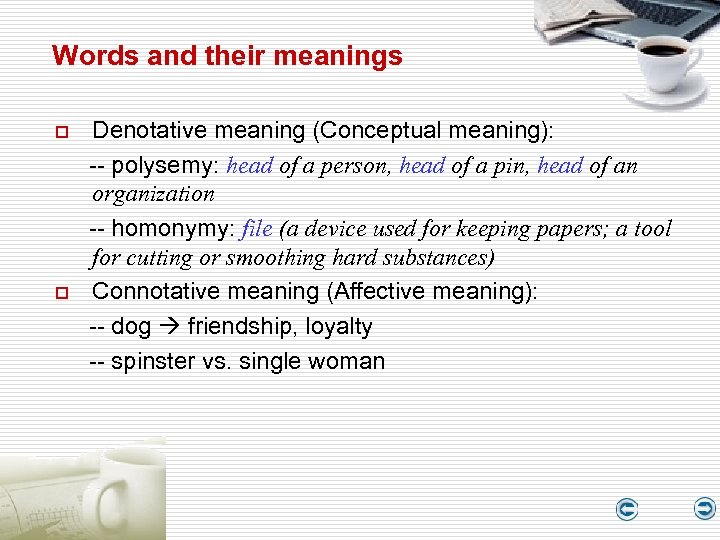
Words and their meanings o o Denotative meaning (Conceptual meaning): -- polysemy: head of a person, head of a pin, head of an organization -- homonymy: file (a device used for keeping papers; a tool for cutting or smoothing hard substances) Connotative meaning (Affective meaning): -- dog friendship, loyalty -- spinster vs. single woman
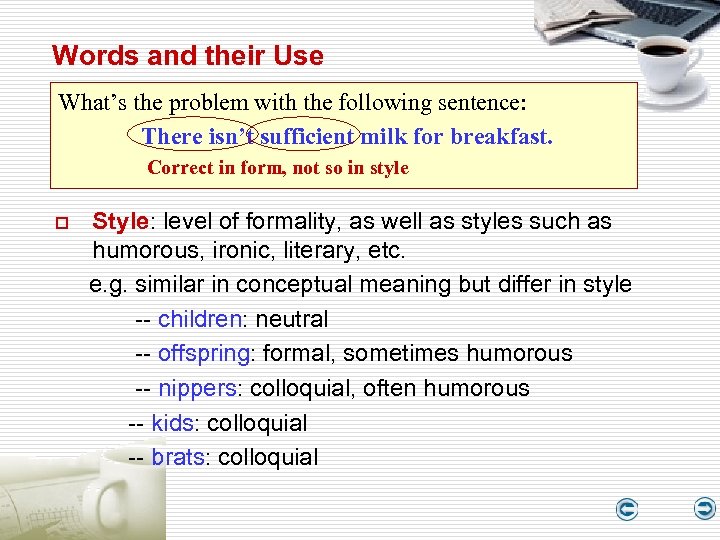
Words and their Use What’s the problem with the following sentence: There isn’t sufficient milk for breakfast. Correct in form, not so in style o Style: level of formality, as well as styles such as humorous, ironic, literary, etc. e. g. similar in conceptual meaning but differ in style -- children: neutral -- offspring: formal, sometimes humorous -- nippers: colloquial, often humorous -- kids: colloquial -- brats: colloquial
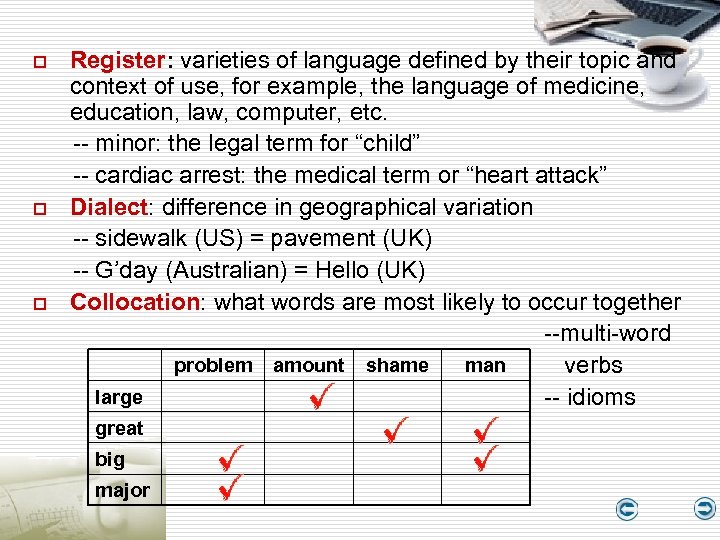
o o o Register: varieties of language defined by their topic and context of use, for example, the language of medicine, education, law, computer, etc. -- minor: the legal term for “child” -- cardiac arrest: the medical term or “heart attack” Dialect: difference in geographical variation -- sidewalk (US) = pavement (UK) -- G’day (Australian) = Hello (UK) Collocation: what words are most likely to occur together --multi-word problem amount shame man verbs large -- idioms great big major
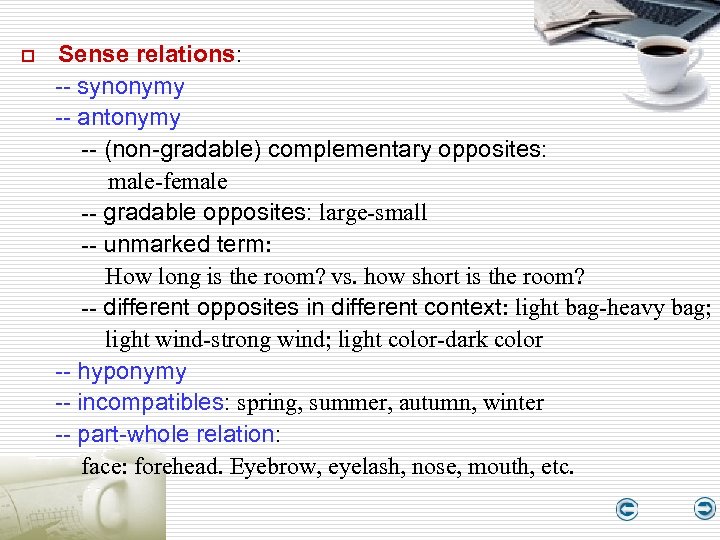
o Sense relations: -- synonymy -- antonymy -- (non-gradable) complementary opposites: male-female -- gradable opposites: large-small -- unmarked term: How long is the room? vs. how short is the room? -- different opposites in different context: light bag-heavy bag; light wind-strong wind; light color-dark color -- hyponymy -- incompatibles: spring, summer, autumn, winter -- part-whole relation: face: forehead. Eyebrow, eyelash, nose, mouth, etc.
What needs to be taught? Form: -- pronunciation and spelling -- grammar -- Word formation Meaning: -- denotation, connotation, -- meaning relationships Use: -- collocation -- appropriateness
How do your teachers usually teach vocabulary in the class? Teacher A: a) wrote “grumble” on the blackboard b) said “complain about someone or something in an annoyed way” c) translated the word into the students’ native language. d) gave more example sentences for the students to translate into their native language. Teacher B: said “ some people grumble about everything. For example, they grumble about the weather. If it is sunny, they say it is too hot. If it is cool, they say it is too cold. They are never happy with the weather”. Then the teacher set out to check the student’s understanding by asking “ so what does ‘grumble’ mean? ”
Presenting new words -- concise definition -- detailed description -- examples (hyponyms) -- illustration (picture, object) -- demonstration (acting, mime) -- context (story or sentence) -- synonyms -- antonyms -- translation -- associated ideas, collocations What kind of techniques does the teacher use in presenting new words?
Tips --use examples to show meaning; --ask the students to tell the meaning first; --draw pictures, diagrams and maps to show meanings or connection of meanings; --use real object to show meaning; --mime or act to show meaning; --use synonyms or antonyms to explain meanings; --use lexical sets, e. g. cook: fry, boil, bake, grill; --translate and exemplify technical and abstract words; --use word formation rules and common affixes;
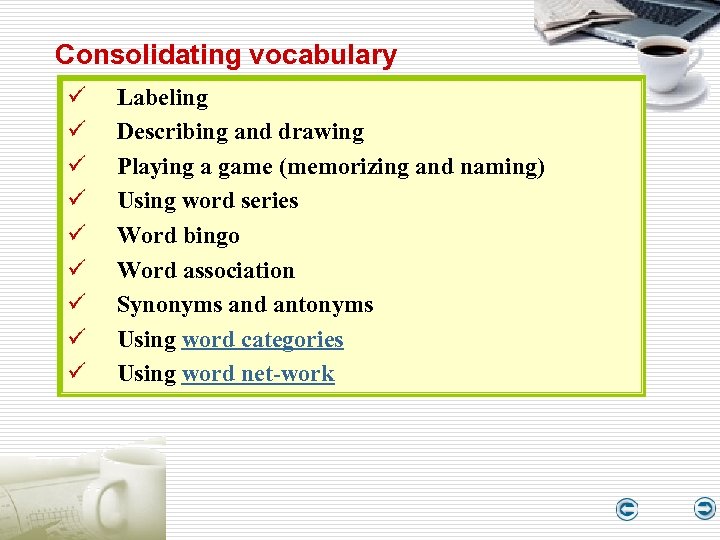
Consolidating vocabulary ü ü ü ü ü Labeling Describing and drawing Playing a game (memorizing and naming) Using word series Word bingo Word association Synonyms and antonyms Using word categories Using word net-work
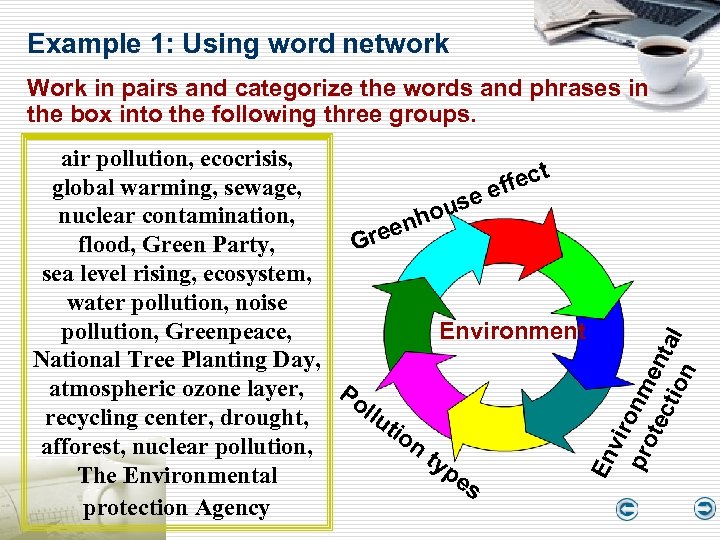
Example 1: Using word network En air pollution, ecocrisis, t fec global warming, sewage, e ef ous nuclear contamination, enh Gre flood, Green Party, sea level rising, ecosystem, water pollution, noise pollution, Greenpeace, Environment National Tree Planting Day, atmospheric ozone layer, Po llu recycling center, drought, tio n afforest, nuclear pollution, ty pe The Environmental s protection Agency vir pro onm tec ent tio al n Work in pairs and categorize the words and phrases in the box into the following three groups.
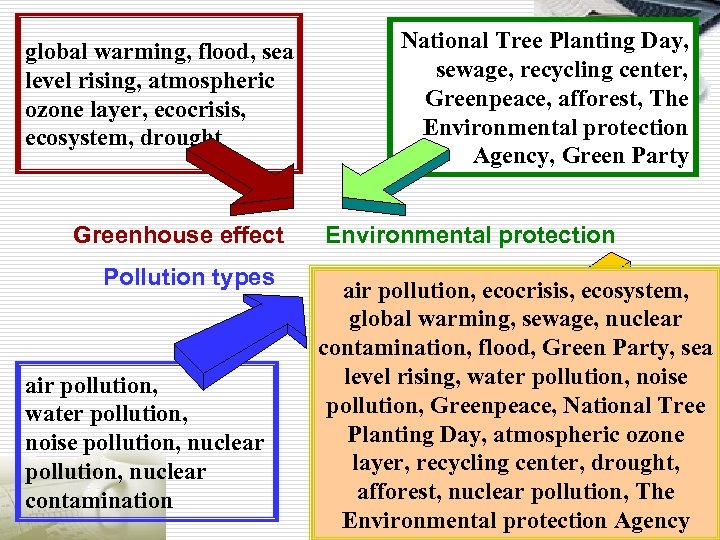
global warming, flood, sea level rising, atmospheric ozone layer, ecocrisis, ecosystem, drought Greenhouse effect Pollution types air pollution, water pollution, noise pollution, nuclear contamination National Tree Planting Day, sewage, recycling center, Greenpeace, afforest, The Environmental protection Agency, Green Party Environmental protection air pollution, ecocrisis, ecosystem, global warming, sewage, nuclear Environmental protection contamination, flood, Green Party, sea organizations level rising, water pollution, noise pollution, Greenpeace, National Tree Green Day, atmospheric ozone Planting Party, Greenpeace, The Environmental layer, recycling center, drought, protection Agency afforest, nuclear pollution, The Environmental protection Agency
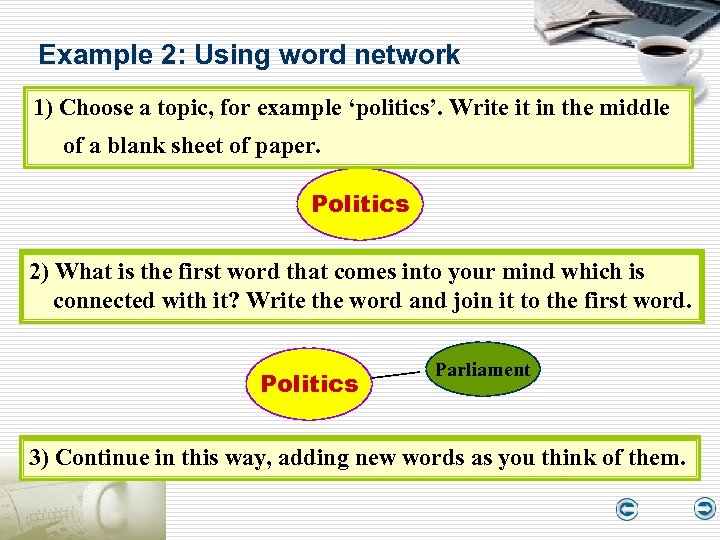
Example 2: Using word network 1) Choose a topic, for example ‘politics’. Write it in the middle of a blank sheet of paper. Politics 2) What is the first word that comes into your mind which is connected with it? Write the word and join it to the first word. Politics Parliament 3) Continue in this way, adding new words as you think of them.
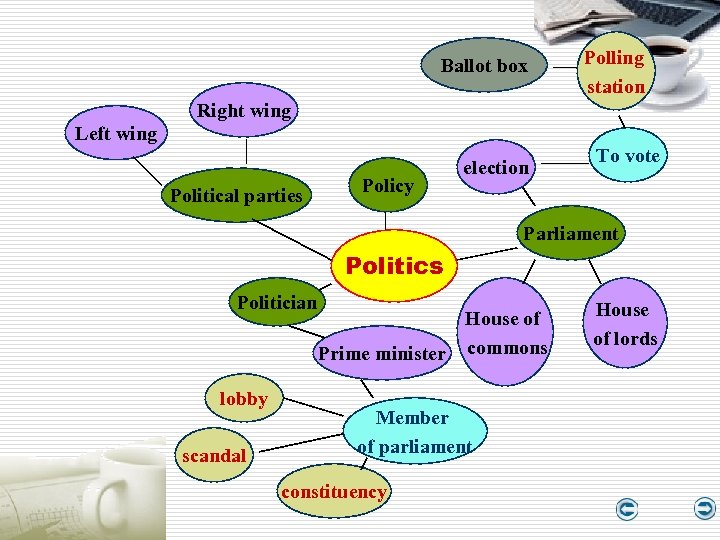
Ballot box Polling station Right wing Left wing Political parties Policy election To vote Parliament Politics Politician lobby scandal House of Prime minister commons Member of parliament constituency House of lords
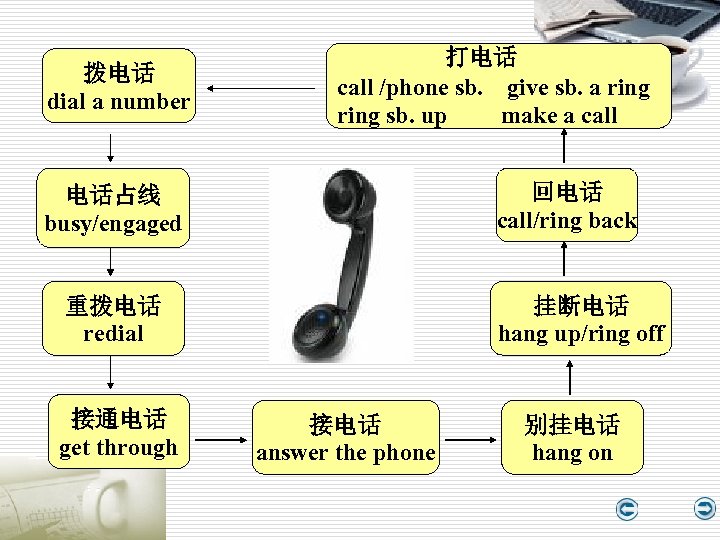
拨电话 dial a number 打电话 call /phone sb. give sb. a ring sb. up make a call 回电话 call/ring back 电话占线 busy/engaged 挂断电话 hang up/ring off 重拨电话 redial 接通电话 get through 接电话 answer the phone 别挂电话 hang on
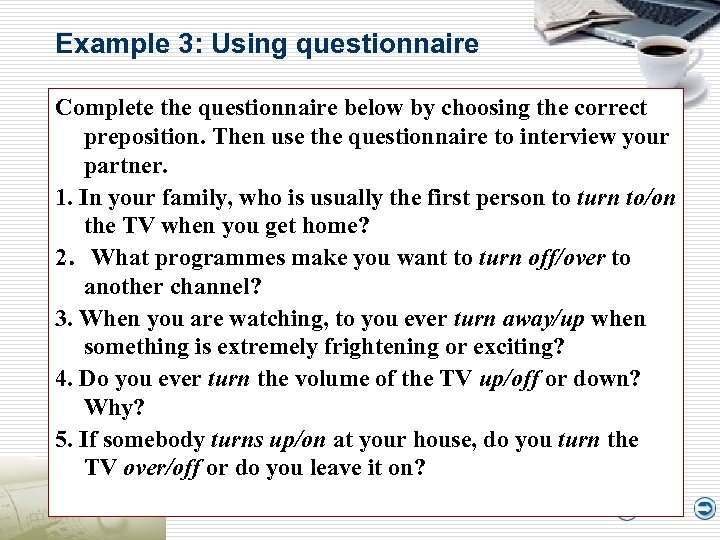
Example 3: Using questionnaire Complete the questionnaire below by choosing the correct preposition. Then use the questionnaire to interview your partner. 1. In your family, who is usually the first person to turn to/on the TV when you get home? 2.What programmes make you want to turn off/over to another channel? 3. When you are watching, to you ever turn away/up when something is extremely frightening or exciting? 4. Do you ever turn the volume of the TV up/off or down? Why? 5. If somebody turns up/on at your house, do you turn the TV over/off or do you leave it on?
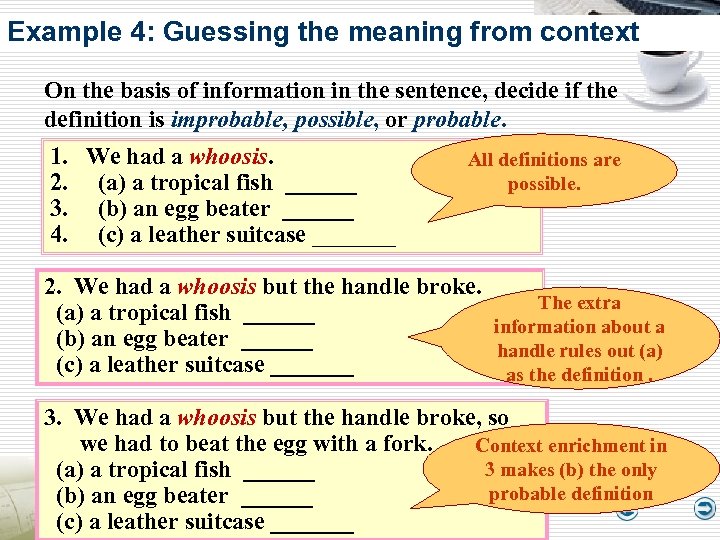
Example 4: Guessing the meaning from context On the basis of information in the sentence, decide if the definition is improbable, possible, or probable. 1. We had a whoosis. 2. (a) a tropical fish ______ 3. (b) an egg beater ______ 4. (c) a leather suitcase _______ All definitions are possible. 2. We had a whoosis but the handle broke. The extra (a) a tropical fish ______ information about a (b) an egg beater ______ handle rules out (a) (c) a leather suitcase _______ as the definition. 3. We had a whoosis but the handle broke, so we had to beat the egg with a fork. Context enrichment in 3 makes (b) the only (a) a tropical fish ______ probable definition (b) an egg beater ______ (c) a leather suitcase _______
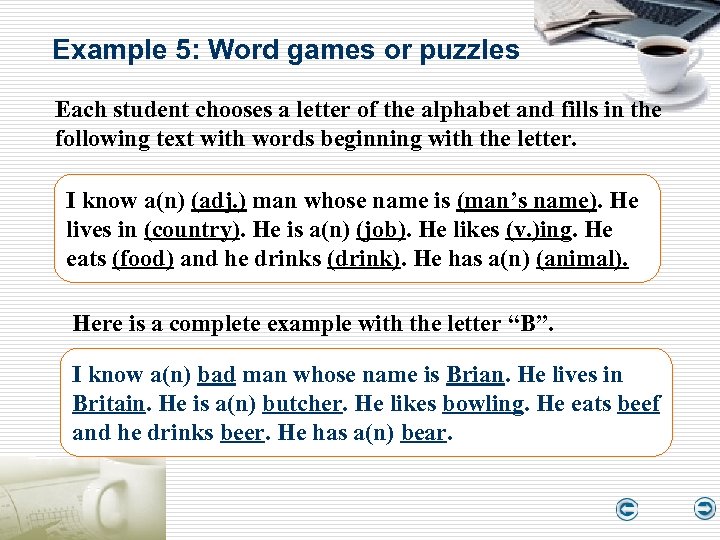
Example 5: Word games or puzzles Each student chooses a letter of the alphabet and fills in the following text with words beginning with the letter. I know a(n) (adj. ) man whose name is (man’s name). He lives in (country). He is a(n) (job). He likes (v. )ing. He eats (food) and he drinks (drink). He has a(n) (animal). Here is a complete example with the letter “B”. I know a(n) bad man whose name is Brian. He lives in Britain. He is a(n) butcher. He likes bowling. He eats beef and he drinks beer. He has a(n) bear.
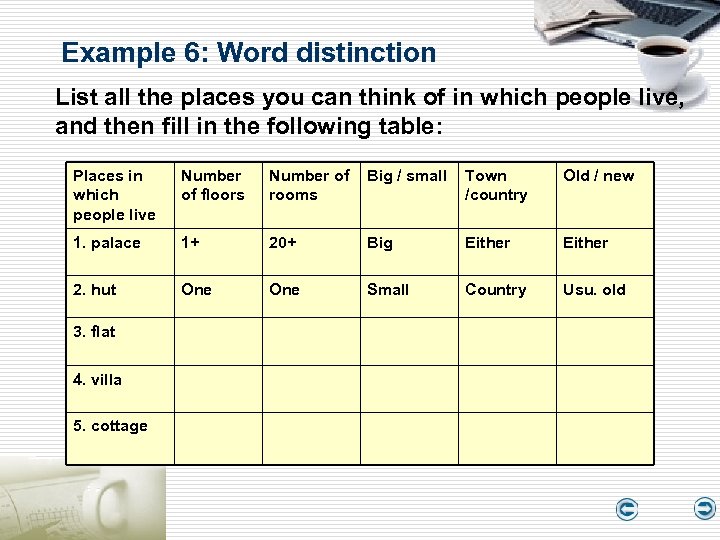
Example 6: Word distinction List all the places you can think of in which people live, and then fill in the following table: Places in which people live Number of floors Number of rooms Big / small Town /country Old / new 1. palace 1+ 20+ Big Either 2. hut One Small Country Usu. old 3. flat 4. villa 5. cottage
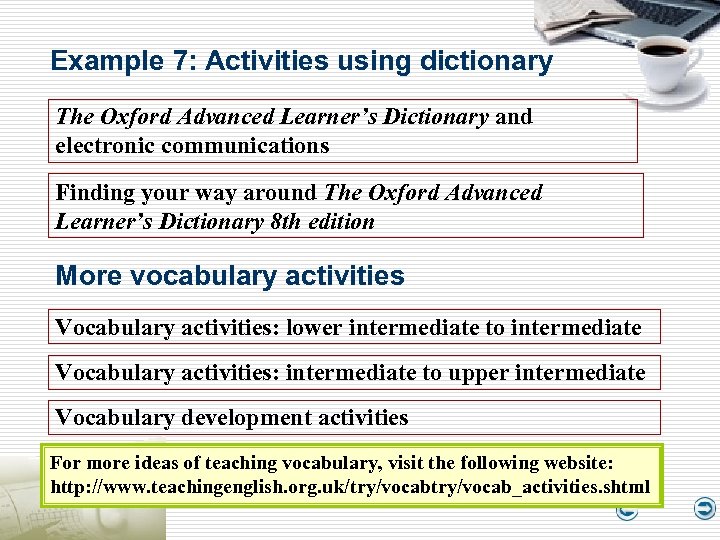
Example 7: Activities using dictionary The Oxford Advanced Learner’s Dictionary and electronic communications Finding your way around The Oxford Advanced Learner’s Dictionary 8 th edition More vocabulary activities Vocabulary activities: lower intermediate to intermediate Vocabulary activities: intermediate to upper intermediate Vocabulary development activities For more ideas of teaching vocabulary, visit the following website: http: //www. teachingenglish. org. uk/try/vocab_activities. shtml
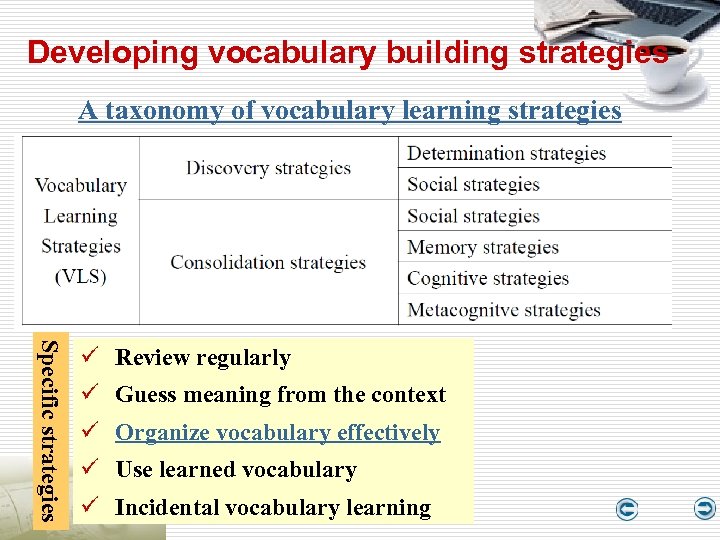
Developing vocabulary building strategies A taxonomy of vocabulary learning strategies Specific strategies ü Review regularly ü Guess meaning from the context ü Organize vocabulary effectively ü Use learned vocabulary ü Incidental vocabulary learning
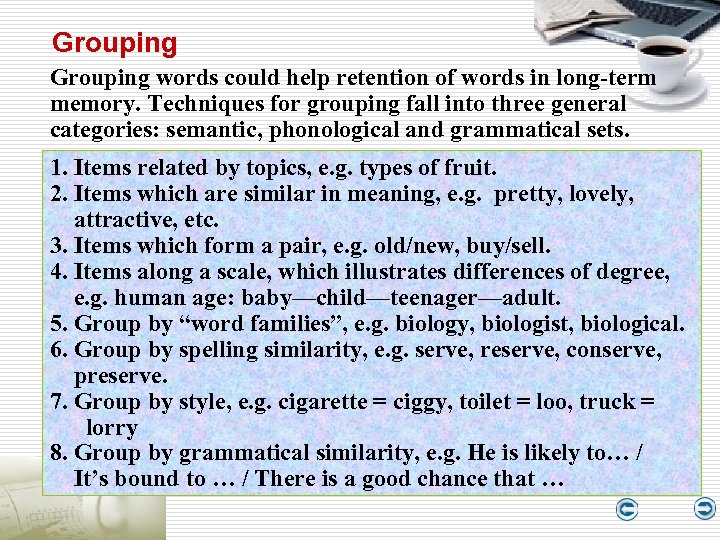
Grouping words could help retention of words in long-term memory. Techniques for grouping fall into three general categories: semantic, phonological and grammatical sets. 1. Items related by topics, e. g. types of fruit. 2. Items which are similar in meaning, e. g. pretty, lovely, attractive, etc. 3. Items which form a pair, e. g. old/new, buy/sell. 4. Items along a scale, which illustrates differences of degree, e. g. human age: baby—child—teenager—adult. 5. Group by “word families”, e. g. biology, biologist, biological. 6. Group by spelling similarity, e. g. serve, reserve, conserve, preserve. 7. Group by style, e. g. cigarette = ciggy, toilet = loo, truck = lorry 8. Group by grammatical similarity, e. g. He is likely to… / It’s bound to … / There is a good chance that …
Assignments Find 8 -10 words from NSEFC course book vocabulary list, design an activity to help students learn these words. 高中英语电子课本: http: //www. pep. com. cn/ge/jszx/jtj/dzkb/
Further reading: o Allen, V. F. (2002). Techniques in teaching vocabulary. Shanghai: Shanghai Foreign Language Education Press. o Leaney, C. (2009). Dictionary activities. Beijing: Foreign Language Teaching and Research Press. o Nation, I. S. P. (1998). Helping learners take control of their vocabulary learning. GRETA 6, 1: 9 -18. o Nation, I. S. P. (2003). Vocabulary. In D. Nunan. (ed. ) Practical English Language Teaching (pp. 129 -152). New York: Mc. Graw Hill. o Nation, I. S. P. (2004). Teaching and learning vocabulary. Beijing: Foreign Language Teaching and Research Press. o Sökmen, A. J. (1992). Students as vocabulary generators. TESOL Journal 1, 4: 16 -18.
Скачать презентацию Teaching Vocabulary Major Topics In this session
bf08af9fa09c04d49d300b56dcf4ba25.ppt