


 Скачать презентацию Teaching to Student Diversity n n Welcome Alex
32fe238d95906d32f4d74421168eb980.ppt
- Количество слайдов: 34
 Teaching to Student Diversity n n Welcome Alex Stanton Educational Support Office (ESO) – central office which coordinates the support for disabled students FW 151/ 01784 443966 1
 Session Outline n n n Legal framework and disability at RHUL The ESO Support Process DVD “A Veneer of Acceptance” Case studies and discussion Good practice advice 2
 Equality Duty 2010 n n Special Educational Needs and Disability Act 2001; Disability Discrimination Act, part IV (2005); Disability Equality Duty (2006) Equality Act 2010 which protects 9 characteristics: age, disability, gender reassignment, marriage and civil partnership, pregnancy and maternity, race, religion and belief, sex and sexual orientation. 3
 Defining the word disability… n n n How would you define the word disability? How do you think the Law defines disability? Give examples of disabilities 4
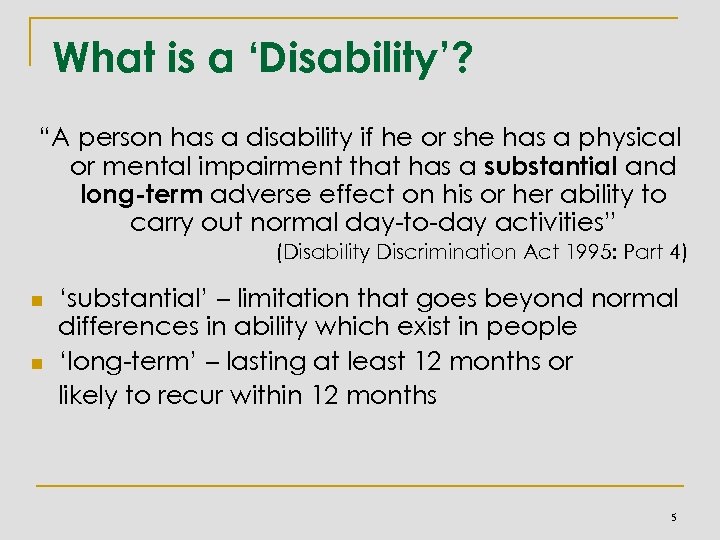 What is a ‘Disability’? “A person has a disability if he or she has a physical or mental impairment that has a substantial and long-term adverse effect on his or her ability to carry out normal day-to-day activities” (Disability Discrimination Act 1995: Part 4) n n ‘substantial’ – limitation that goes beyond normal differences in ability which exist in people ‘long-term’ – lasting at least 12 months or likely to recur within 12 months 5
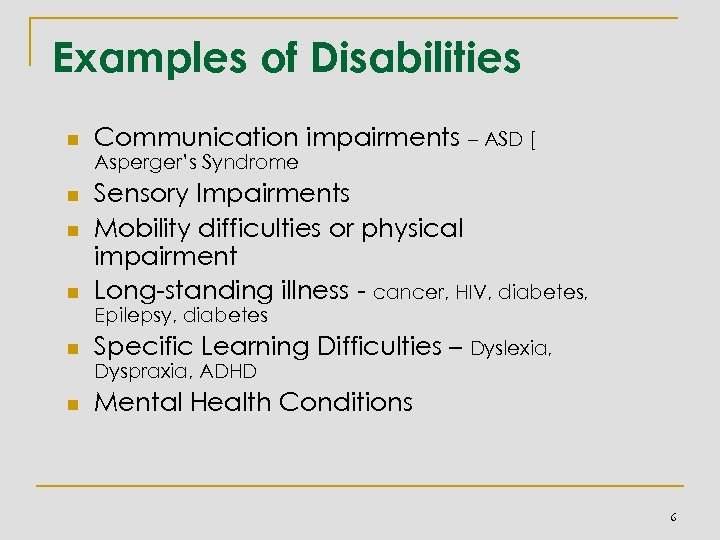 Examples of Disabilities n Communication impairments – ASD [ Asperger’s Syndrome n Sensory Impairments Mobility difficulties or physical impairment Long-standing illness - cancer, HIV, diabetes, n Specific Learning Difficulties – Dyslexia, n Mental Health Conditions n n Epilepsy, diabetes Dyspraxia, ADHD 6
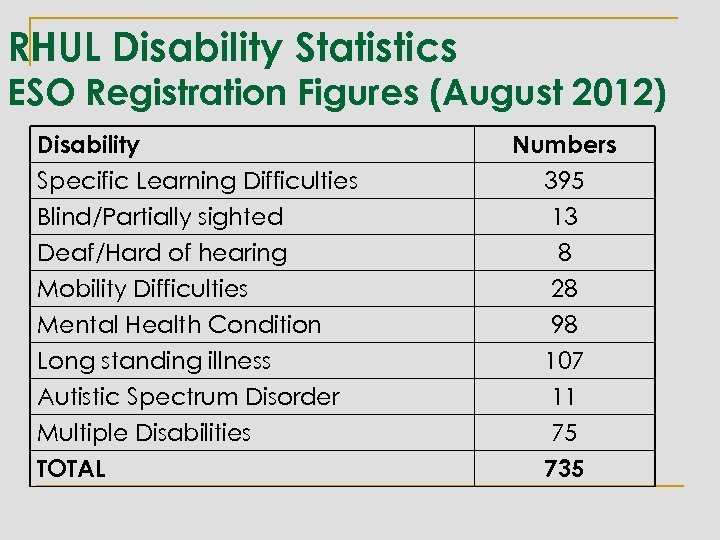 RHUL Disability Statistics ESO Registration Figures (August 2012) Disability Specific Learning Difficulties Blind/Partially sighted Deaf/Hard of hearing Numbers 395 13 8 Mobility Difficulties Mental Health Condition Long standing illness Autistic Spectrum Disorder Multiple Disabilities 28 98 107 11 75 TOTAL 735
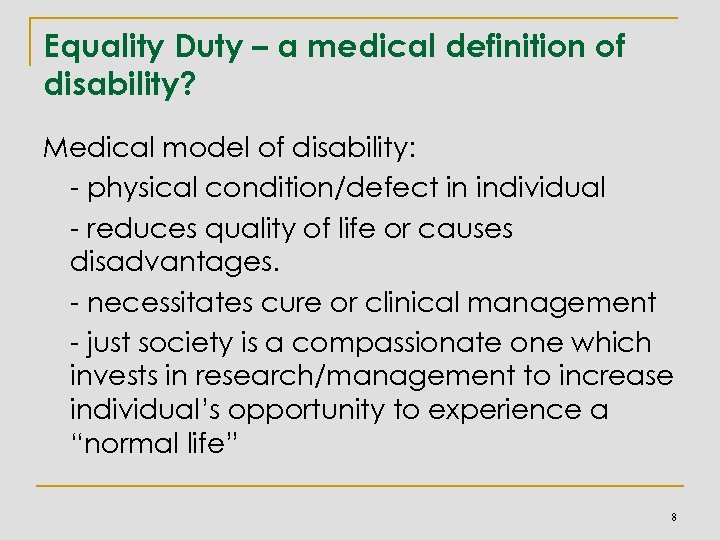 Equality Duty – a medical definition of disability? Medical model of disability: - physical condition/defect in individual - reduces quality of life or causes disadvantages. - necessitates cure or clinical management - just society is a compassionate one which invests in research/management to increase individual’s opportunity to experience a “normal life” 8
 Equality Duty and the social model of disability Whilst individuals have impairments that affect certain areas of their lives, it is social barriers which purposely or unintentionally contribute to making individuals disabled. 9
 Social model of disability - 2 Types of barriers: n environmental barriers(e. g. stairs instead of lifts), n attitudinal barriers(e. g. lack of understanding or discomfort with certain impairments) or n institutional (e. g. certain fixed assessment and examination procedures) 10
 Social Model of Disability - 3 These barriers can frequently be modified. If these barriers can be lessened by appropriate awareness and adjustments, then individuals with impairments can perform to their full potential 11
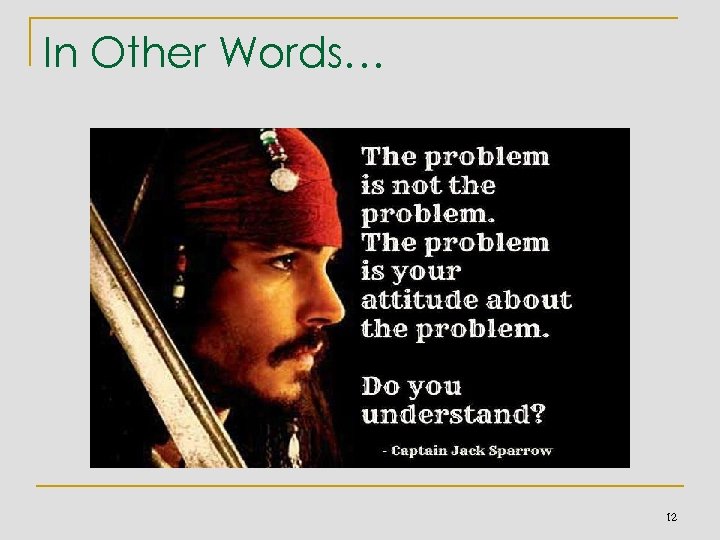 In Other Words… 12
 Main requirements of Disability Legislation 1. Reasonable adjustments 2. Anticipatory duties 3. Promoting disability equality All types of students and all College facilities and services 13
 1 – Reasonable adjustments n n n Not treating disabled students ‘less favourably’ Making ‘reasonable adjustments’ to ensure that disabled students are not at a ‘substantial disadvantage’ – in relation to time, inconvenience, effort and discomfort Treating disabled students more favourably (Equality Duty 2010) 14
 What Does This Include? n n n Changes to policies, practices and procedures Provision of services and auxiliary aids (interpreters or course materials/brochures in alternative formats) Physical features of buildings (from 2005) 15
 Reasonable vs. unreasonable adjustments? n Cost of making the adjustments – if alternative options or covered by other funding e. g. Disabled Students’ Allowance n Health and Safety implications n The interests of the other students n n “Competence Standard” (includes former “academic standards”): “an academic, medical or other standard applied by or on behalf of an [education provider] for the purpose of determining whether or not a person has a particular level of competency or ability” (DDA) Involves the question- what is ‘core’ to the learning outcomes or course? 16
 2. Anticipatory Duty n n Consideration and action in relation to barriers that disabled students prior to an individual disabled student seeking to access RHUL…therefore need for inclusive curriculum design (see next slide) Duty to create an environment where it is both easy and “comfortable” to disclose Students need to be given numerous and regular opportunities to disclose Support at earliest opportunity 17
 ESO Support Process n n n UCAS form/Post-grad application or student approaches the ESO Questionnaire – outlining students’ disability and support requested Students signs to give consent Memo to ESO Network Member(s) ESO Network Member cascades information to relevant staff ESO Network Member keeps ESO informed 18
 Other Support n n n Priority to College Accommodation Special Examination Arrangements Student Helpers (note-takers, mentors, specialist mentors, etc. ) Sp. LDs screenings and assessments Study Skills Tuition – for Sp. LDs (Pippa Moore) and for all other students (Helen Shore – Generic Study Skills Tutor) Financial Support (e. g. Disabled Students’ Allowance and ad-hoc financial help for International students) 19
 3. Promoting disability equality n n no direct/indirect discrimination, harrassment or victimisation Promoting equal opps Promoting disability equality: “it’s better to have no walls than have ladders to get over the walls” Inclusive curriculum design and delivery: pre-empting and reducing the need for reasonable adjustments for individual students. 20
 Example: 7 questions on inclusive curriculum design (Higher Education Authority, “Inclusive Curriculum Design in HE”) n n n Is there a variety of assessment opportunities used throughout programme/module? Can the need for compensatory or alternative assessment for specific students be reduced by alterations to the methods used to assess all students? Does the assessment give opportunities to develop graduate skills to aid employability? 21
 7 questions (continued) n n How are students prepared for assessments? Are there marking criteria which is clear (free from jargon)? How are the criteria shared with students? What feedback opportunities are there? Is this targeted at the individual or group? How timely is the feedback? How inclusive are the feedback methods used? 22
 General Awareness n n Multi-sensory teaching benefits all Sensitivity – handouts in pigeon holes or via e-mail (not in front of others) Don’t be afraid to ask questions Data Protection Act – anything written to or from the ESO is kept in the student files 23
 Good Practice – Preparation n Handouts/copies of OHPs in advance, on buff-coloured paper, in 16 pt+ print, in alternative formats – clear font (e. g. Century Gothic, Verdana) Not just handouts, all correspondence Ask the student what support they have had in the past 24
 Good Practice – Lectures n n n Allow lectures to be recorded/ note-taker in room TV/video subtitles and use large screen OHPs not too busy, use colours but have titles in same colour When skipping through OHPs or lecture notes, say the slide/page number aloud Use numbers for the lines – read numbers when referring to lines and use gestures to reinforce (e. g. use fingers to count) 25
 Good Practice - Lectures n n Repeat questions/answers from the students Extra room/corridor available for group/paired discussion (for hearing-impaired, social phobics) Encourage shared reading or study buddies/groups Be aware of darkening rooms when watching videos or showing slides – put a spotlight on the speaker 26
 Good Practice - Seminars n n n Horse-shoe shaped seating arrangement Sensitivity e. g. extra time for oral answers Record comments and ideas on flipchart/board Face the students then repeat what you have written on the flipchart/board Remember to use names during group discussions 27
 Good Practice – Fieldwork “Inclusive field trip design will envisage a variety of potential participants, and accommodate as many varied needs as possible without compromising the educational standards” (University of Strathclyde, 2000) n n n Core logging Video recordings/Virtual fieldwork Alternative areas of fieldwork site to investigate 28
 Good Practice – Laboratory Work n n n Health and Safety is paramount Adjustable height workbenches Be aware of allergies/asthma Be aware of extra noise/echo Alternative activities/Virtual lab Special equipment e. g. talking thermometers, beakers with raised markings, clamps to hold items, illuminated magnifiers 29
 Good Practice – Computer-based Teaching n n n Any screen work in large, clear font Good lighting and minimal glare Be aware of special software (e. g. screen-reading for blind students) Adjustable height work stations Special keyboards and mouse 30
 Good Practice - Assessment n n Extended deadlines - not good in the longrun (bunching up, need to encourage timekeeping/planning), but need to be flexible according to individual need Alternative assessment Read the students your essay feedback Exams - extra time/computer/separate room/amanuensis (scribe)/rest breaks 31
 Contact the ESO if… n n A disabled student needs to know where to go for support or advice You need advice on a particular student You need advice on a disability You need advice regarding inclusive teaching methods and practices 32
 ESO Team contact details n n n Senior Educational Support Officer: Alex Stanton (FW 153/ ext. 3393) Assistant Educational Support Officer: Debra Atkin (FW 151/ ext. 3966) Susan Jewitt – Student Support Workers Administrator (FW 151/ ext. 4634) Pippa Moore – Study Skills Tutor Sp. LDs (FW 147 / ext. 4289) Emily Titterell – Study Skills Administrator and Access Advisor (FW 151/ ext. 4634) Helen Shore – Study Skills Tutor (Generic Study Skills) (FW 145/ext. 4382) 33
 Questions and Answers 34