 Скачать презентацию Teaching Software Testing as a Problembased Learning Course
e3b5c64cb8ae1ad3ec974ccf4ffc5632.ppt
- Количество слайдов: 16



Teaching Software Testing as a Problembased Learning Course Stephanie Ludi Software Engineering Dept. Rochester Institute of Technology salvse@rit. edu © Lethbridge/Laganière 2001 Chapter 6: Using design patterns
Overview n n n n Introduction Motivation Problem-Based Learning Course Structure Course Project Administrative Issues Feedback Supporting Resources Rochester Institute of Technology
Introduction n n Verification & Validation course is a process elective Course is in the Software Engineering dept. Typical student enrolled: rd th n 3 or 4 year n Has some co-op experience Class size varies from 15 – 25 students Duration 4 hours/ week for 10 weeks Rochester Institute of Technology
Motivation n n Previous renditions of the course were lecturebased. Lecture is boring and passive. Potential for more active learning techniques. V&V is stereotyped and does not have immediate buy-in Lifelong learning is important – and so students need to take ownership of their learning Rochester Institute of Technology
Problem-Based Learning n n n Instructor is a facilitator and resource. Students work in small groups (3 -5) Stages of PBL n Defining the problem n Accessing, Evaluating, Utilizing Information n Synthesis and Performance As students work through problems, the instructor provides feedback. Student takes more ownership of their learning. Rochester Institute of Technology
Problem-Based Learning in V&V n n Instructor redesigns the course structure and assignments Lecture plays a minor role n When instructor deems it needed n When students request it n When assessment results call for it Teams play a larger role Individual assessment still needed Rochester Institute of Technology
Course Structure n n Core course objectives remained the same Classroom environment supported collaborative work Substantial work undertaken during the Summer Concepts grouped into 4 learning units n Role of V&V in the SE Process n Types of Testing n Planning & Measuring for Success n V&V Perspectives Rochester Institute of Technology
Course Structure n n n Each unit is organized in a consistent format n Objectives n Outline (Readings) n Guided Questions n Exercises All information is provided to the students Unit resources need to be carefully selected. Exercises are completed as a group Additional research is encouraged. Rochester Institute of Technology
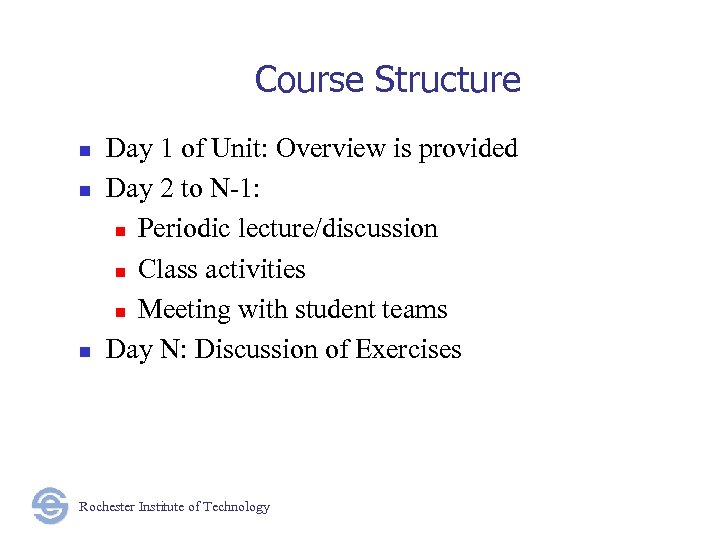
Course Structure n n n Day 1 of Unit: Overview is provided Day 2 to N-1: n Periodic lecture/discussion n Class activities n Meeting with student teams Day N: Discussion of Exercises Rochester Institute of Technology
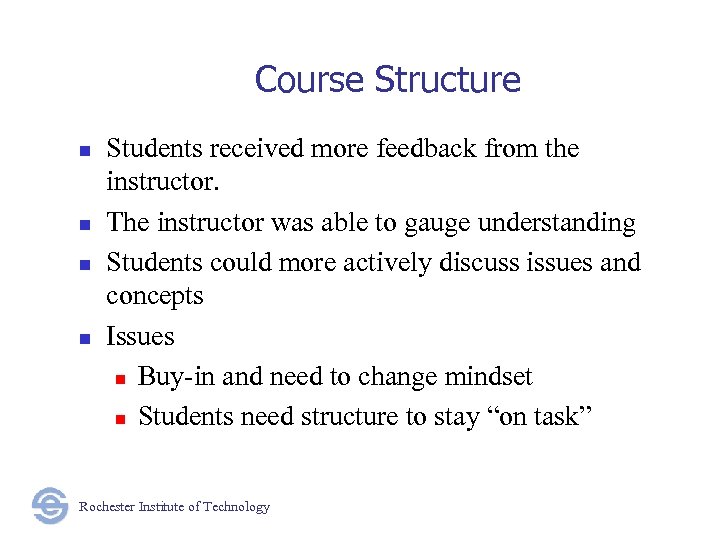
Course Structure n n Students received more feedback from the instructor. The instructor was able to gauge understanding Students could more actively discuss issues and concepts Issues n Buy-in and need to change mindset n Students need structure to stay “on task” Rochester Institute of Technology
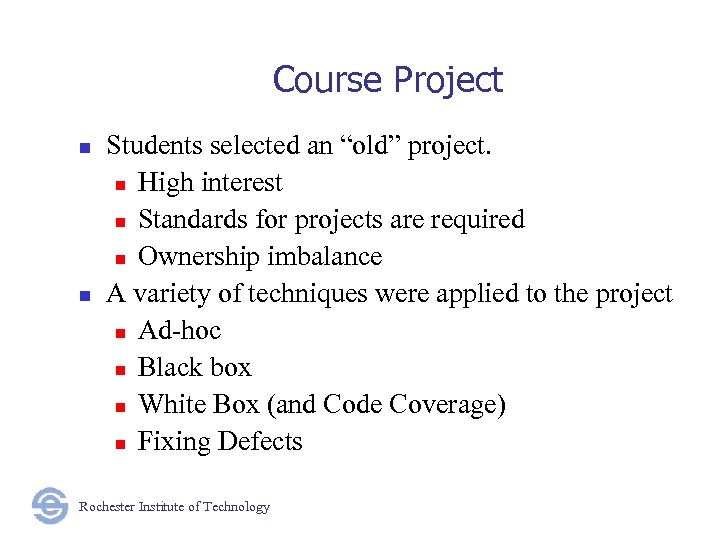
Course Project n n Students selected an “old” project. n High interest n Standards for projects are required n Ownership imbalance A variety of techniques were applied to the project n Ad-hoc n Black box n White Box (and Code Coverage) n Fixing Defects Rochester Institute of Technology
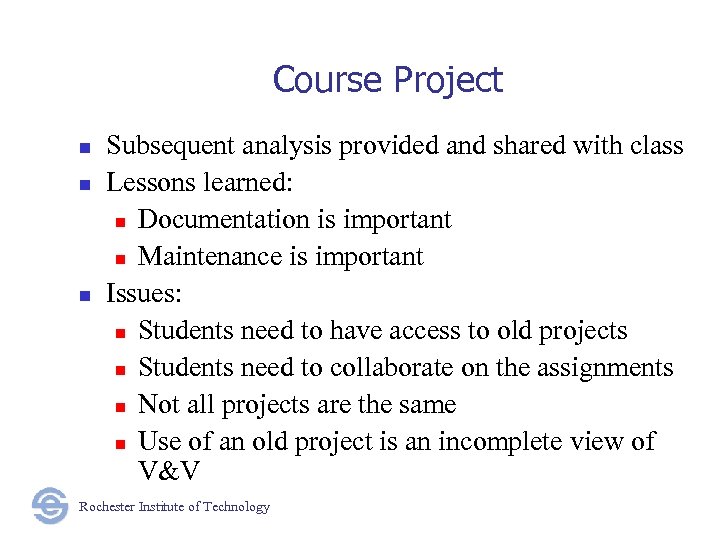
Course Project n n n Subsequent analysis provided and shared with class Lessons learned: n Documentation is important n Maintenance is important Issues: n Students need to have access to old projects n Students need to collaborate on the assignments n Not all projects are the same n Use of an old project is an incomplete view of V&V Rochester Institute of Technology
Administrative Issues n n Students need to be oriented to the new format. Student and Instructor expectations need to be clearly stated Time for grading materials is significant Team composition needs to remain consistent Rochester Institute of Technology
Administrative Issues n n Individual and Team Assessment needs to be balanced n Team: 45% n Individual: 55% Peer evaluations assess individual contribution within team activities Rochester Institute of Technology
Feedback n n n Quantitative Feedback was gathered, but limited Online survey used to gather feedback 70% of the students found the course components to be either Helpful or Extremely Helpful 75% of the students found the limited lecture format to be appropriate Many 62% felt that the course should continue to be delivered in the PBL format Feedback supported instructor observations about preparation and delegation of tasks Rochester Institute of Technology
Supporting Resources n n n Course materials for the learning units can be found at: http: //www. se. rit. edu/~sal/se 452/ Intro to PBL: http: //score. rims. k 12. ca. us/problearn. html J. Valino, "Design Patterns: Evolving from Passive to Active Learning, " ASEE/IEEE Frontiers In Education Conference, Boulder, pp. 19 -24, 2003. Rochester Institute of Technology
Скачать презентацию Teaching Software Testing as a Problembased Learning Course
e3b5c64cb8ae1ad3ec974ccf4ffc5632.ppt