


 Скачать презентацию Teaching Physicians to Provide Safe Patient Care Lucian
7ea120ad00bf4741202ed4ed18a798da.ppt
- Количество слайдов: 42
 Teaching Physicians to Provide Safe Patient Care Lucian L. Leape, MD Harvard School of Public Health UT Clinical Safety and Effectiveness Conference Austin, TX November 4, 2010
 02138 Perhaps the most opinionated zip code in America The New York Times
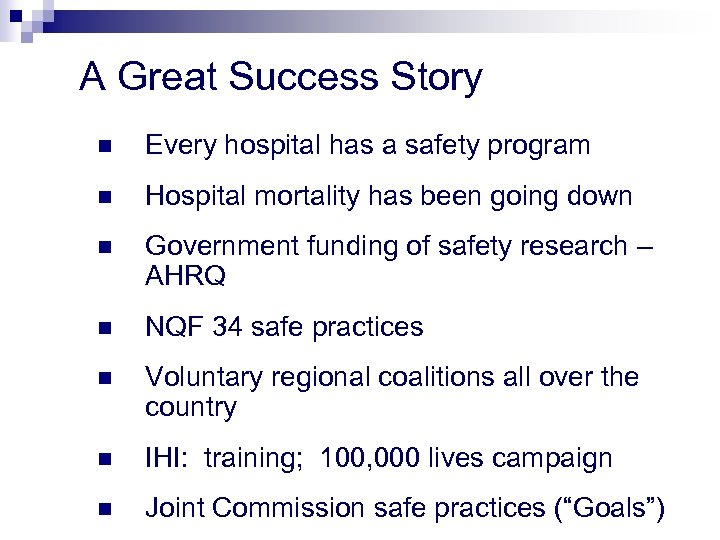 A Great Success Story n Every hospital has a safety program n Hospital mortality has been going down n Government funding of safety research – AHRQ n NQF 34 safe practices n Voluntary regional coalitions all over the country n IHI: training; 100, 000 lives campaign n Joint Commission safe practices (“Goals”)
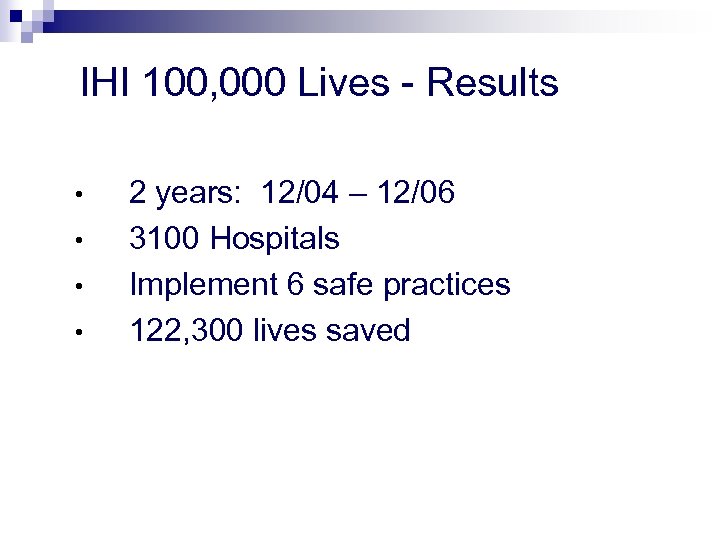 IHI 100, 000 Lives - Results • • 2 years: 12/04 – 12/06 3100 Hospitals Implement 6 safe practices 122, 300 lives saved
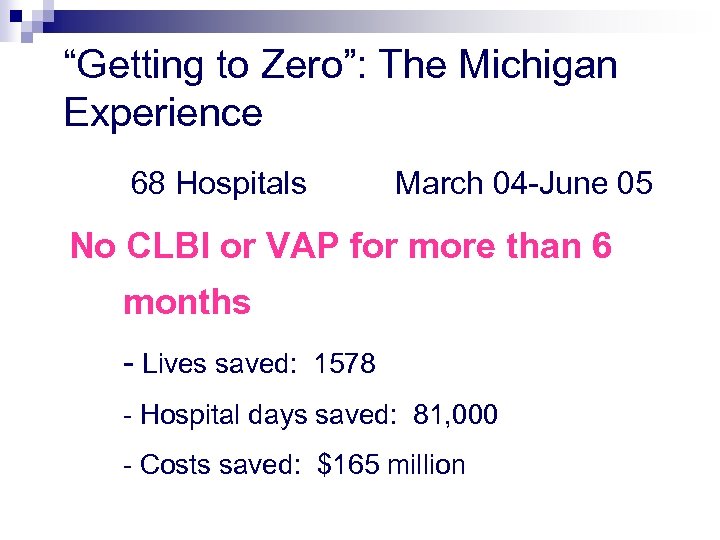 “Getting to Zero”: The Michigan Experience 68 Hospitals March 04 -June 05 No CLBI or VAP for more than 6 months - Lives saved: 1578 - Hospital days saved: 81, 000 - Costs saved: $165 million
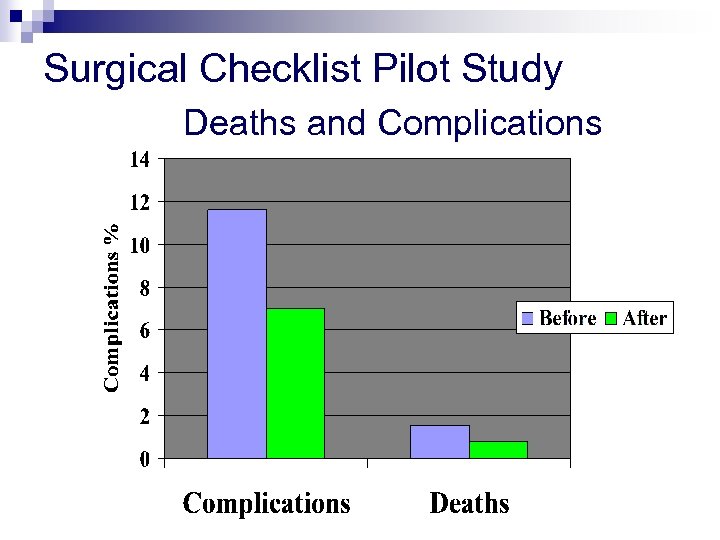 Surgical Checklist Pilot Study Deaths and Complications
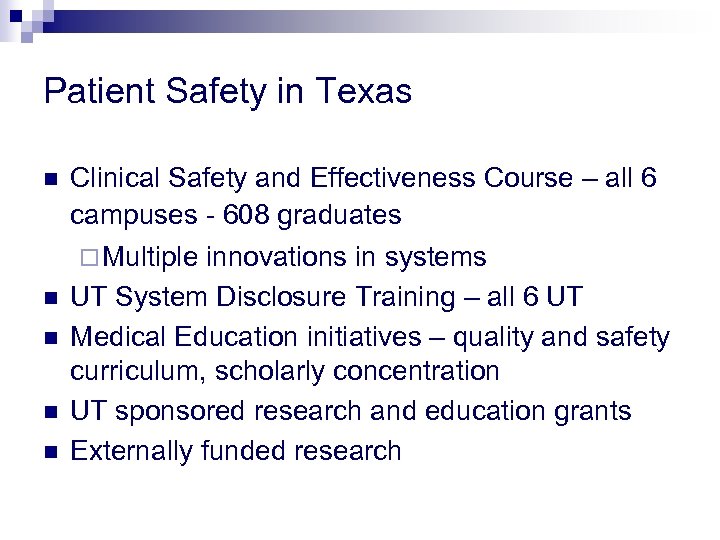 Patient Safety in Texas n n n Clinical Safety and Effectiveness Course – all 6 campuses - 608 graduates ¨ Multiple innovations in systems UT System Disclosure Training – all 6 UT Medical Education initiatives – quality and safety curriculum, scholarly concentration UT sponsored research and education grants Externally funded research
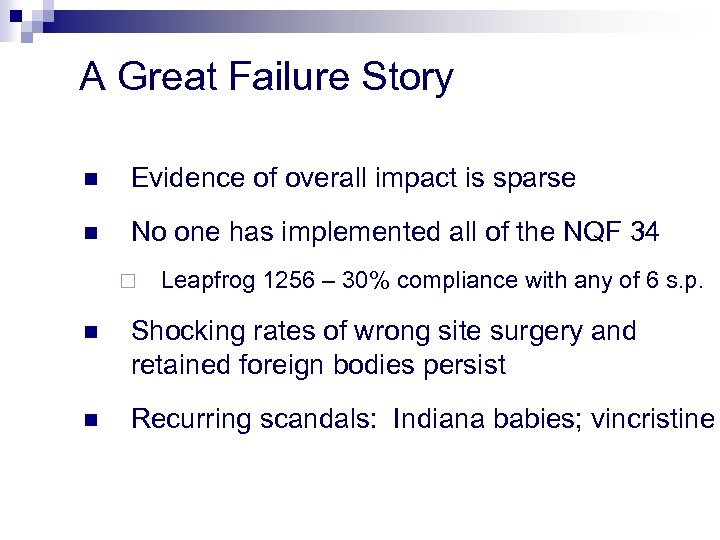 A Great Failure Story n Evidence of overall impact is sparse n No one has implemented all of the NQF 34 ¨ Leapfrog 1256 – 30% compliance with any of 6 s. p. n Shocking rates of wrong site surgery and retained foreign bodies persist n Recurring scandals: Indiana babies; vincristine
 Patient Safety as a Lens n Big new insight: It’s not primarily about systems, it’s about us
 Patient Safety as a Lens 1. 2. 3. 4. Systems / Organization Accountability Teamwork and Collaboration Patient Engagement
 Patient Safety as a Lens 1. Systems / Organization Complex – just “grew” ¨ Accept long waits, “silos”, variation, preferences ¨ Making changes is difficult ¨
 Patient Safety as a Lens 2. Accountability Institution To the public ¨ To other hospitals ¨ To our patients ¨ To our staff ¨
 Patient Safety as a Lens Institution - to our staff ¨ Provide a safe and supportive environment ¨ Implement known safe practices ¨ Monitor compliance with safe practices ¨ Provide resources to develop safe practices ¨ Ensure that all caregivers are qualified ¨ Monitor performance ¨ Take corrective action
 Patient Safety as a Lens Individual accountability To hospital: Follow safe practices ¨ To patients: “ “ “, be open and honest ¨ To colleagues: respectful, cooperative, support when things go wrong ¨ To self: Maintain competency, physical and mental health ¨
 Patient Safety as a Lens 3. Teamwork and Collaboration n IHI initial experience Pronovost Gawande
 Patient Safety as a Lens 1. 2. 3. 4. Systems / Organization Accountability Teamwork and Collaboration Patient Engagement
 Patient Safety as a Lens 4. Patient Engagement n Shared decision-making n Chronic disease n Hospital care n Transparency when things go wrong n Participation in the design of care “We are guests in their house”
 Some progress in all areas 1. Systems / Organization n ERs: some have reduced waiting substantitally n Virginia Mason Medical Center: no waiting rooms in its cancer center n Cleveland Clinic: multispecialty centers focused on disease groups, such as cardiac disease, neurological disease, etc. n Implementing and enforcing standard practices such as SBAR and handwashing n Surgical residents at Harvard now have laminated cards that spell out when to call the attending.
 Some progress in all areas 2. Accountability n n Some states now require hospitals to report SREs Hospital compare is just the beginning of public release of quality and safety data Most hospitals have or are moving to meaningful policies about full disclosure – and, as you are doing, training people to do it Many hospitals have implemented some safe practices, especially hand hygiene
 Some progress in all areas 3. Teams and Collaboration n n n Concord Cardiac Surgery reduced mortality and complications BIDMC Labor and Delivery complications halved 8 Harvard OB programs: 46% fewer claims Pronovost: Central Line infections eliminated Gawande: Surgical mortality and complications halved VA surgical mortality halved
 Patient Safety as a Lens What have we learned? It’s about relationships
 The Lucian Leape Institute of the NPSF • • • Donald Berwick Carolyn Clancy James Conway James Guest David Lawrence Julianne Morath Dennis O’Leary Paul O’Neill Diane Pinakiewicz Paul Gluck
 Five Transforming Concepts • Integrating Health Care • Transparency • Consumer Engagement • Finding Joy and Meaning in Work • Reforming Medical Education
 Paul O’Neill on Safety Every worker’s experience, every day: • I am treated with respect by everyone else, regardless of position, education or pay • I have the education and training, the tools, and the support to develop to my full potential • My work is noticed and appreciated
 Paul O’Neill on Safety Every worker’s experience, every day: • • • I am treated with respect by everyone else, regardless of position, education or pay I have the education and training, the tools, and the support to develop to my full potential My work is noticed and appreciated
 Paul O’Neill on Safety A hospital can not be safe for its patients if it is not safe for its staff
 Patient Safety as a Lens “Safe” = freedom from injury ¨ Physical safety ¨ Psychological ¨ Freedom safety from abuse – physical, psychological Common theme: Respect FAILURE TO PROVIDE A SAFE AND SUPPORTIVE ENVIRONMENT IS TREATING YOUR STAFF WITH DISRESPECT
 What do we mean by a culture of respect? n This is the culture problem: a culture of disrespect n It is inappropriate and incredibly damaging to the psychological well-being and mental health of everyone – staff and patients – to permit disrespectful behavior n And, it is unsafe for our patients
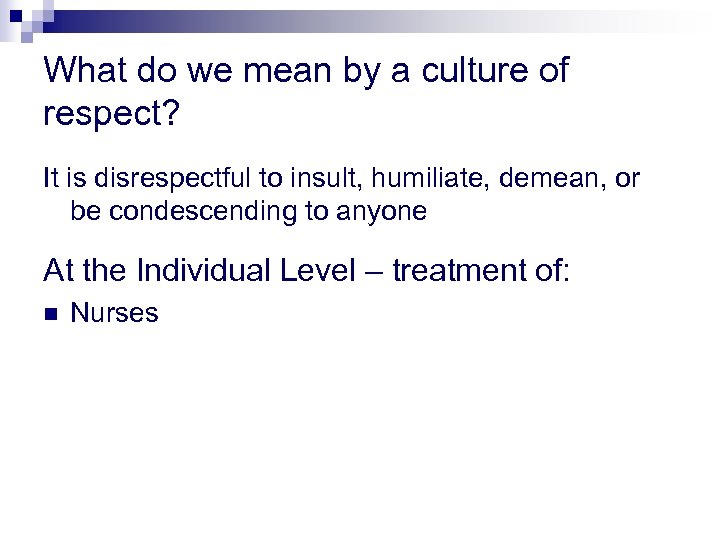 What do we mean by a culture of respect? It is disrespectful to insult, humiliate, demean, or be condescending to anyone At the Individual Level – treatment of: n Nurses
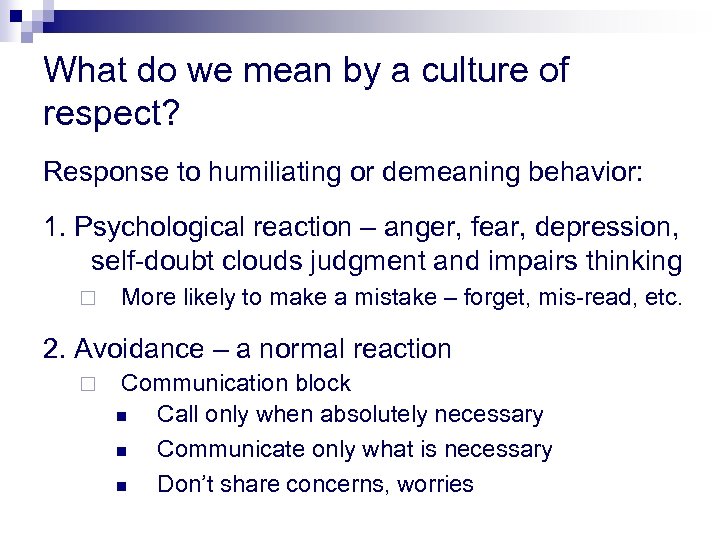 What do we mean by a culture of respect? Response to humiliating or demeaning behavior: 1. Psychological reaction – anger, fear, depression, self-doubt clouds judgment and impairs thinking ¨ More likely to make a mistake – forget, mis-read, etc. 2. Avoidance – a normal reaction ¨ Communication block n Call only when absolutely necessary n Communicate only what is necessary n Don’t share concerns, worries
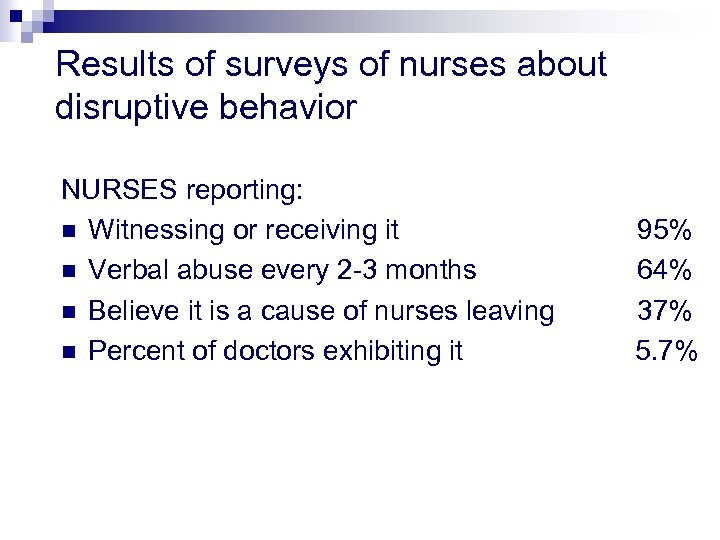 Results of surveys of nurses about disruptive behavior NURSES reporting: n Witnessing or receiving it n Verbal abuse every 2 -3 months n Believe it is a cause of nurses leaving n Percent of doctors exhibiting it 95% 64% 37% 5. 7%
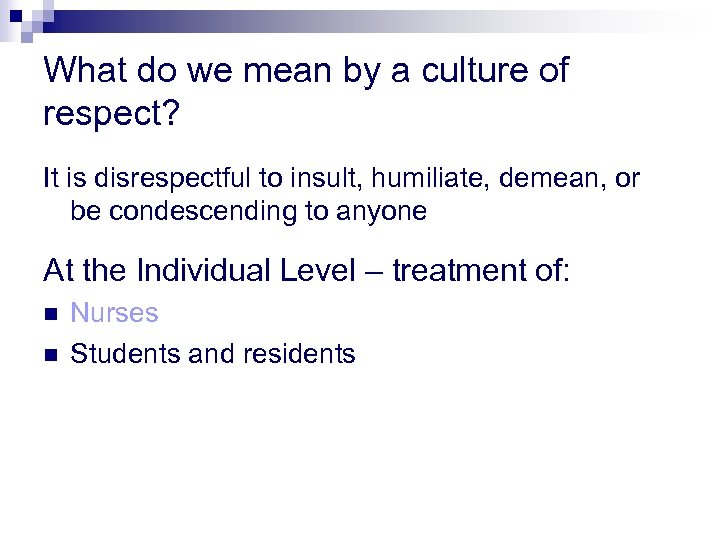 What do we mean by a culture of respect? It is disrespectful to insult, humiliate, demean, or be condescending to anyone At the Individual Level – treatment of: n n Nurses Students and residents
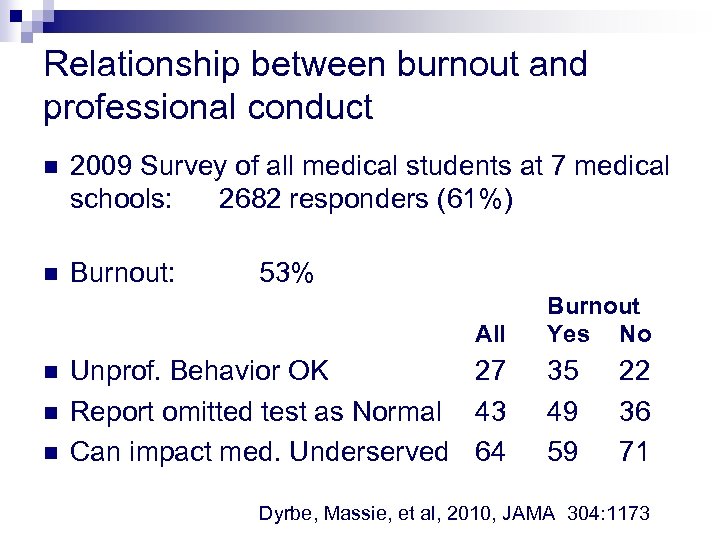 Relationship between burnout and professional conduct n 2009 Survey of all medical students at 7 medical schools: 2682 responders (61%) n Burnout: 53% All n n n Unprof. Behavior OK 27 Report omitted test as Normal 43 Can impact med. Underserved 64 Burnout Yes No 35 49 59 22 36 71 Dyrbe, Massie, et al, 2010, JAMA 304: 1173
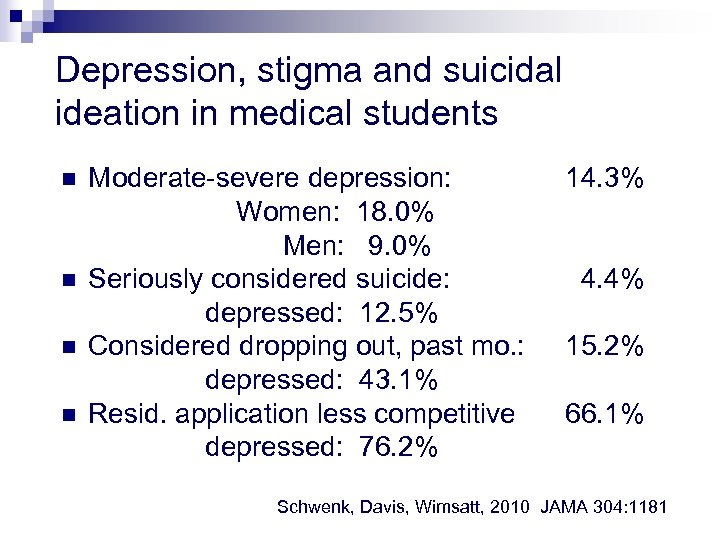 Depression, stigma and suicidal ideation in medical students n n Moderate-severe depression: Women: 18. 0% Men: 9. 0% Seriously considered suicide: depressed: 12. 5% Considered dropping out, past mo. : depressed: 43. 1% Resid. application less competitive depressed: 76. 2% 14. 3% 4. 4% 15. 2% 66. 1% Schwenk, Davis, Wimsatt, 2010 JAMA 304: 1181
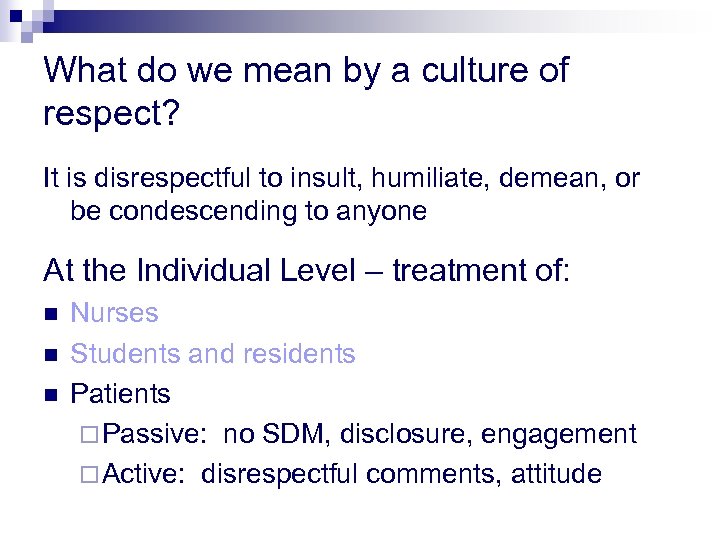 What do we mean by a culture of respect? It is disrespectful to insult, humiliate, demean, or be condescending to anyone At the Individual Level – treatment of: n n n Nurses Students and residents Patients ¨ Passive: no SDM, disclosure, engagement ¨ Active: disrespectful comments, attitude
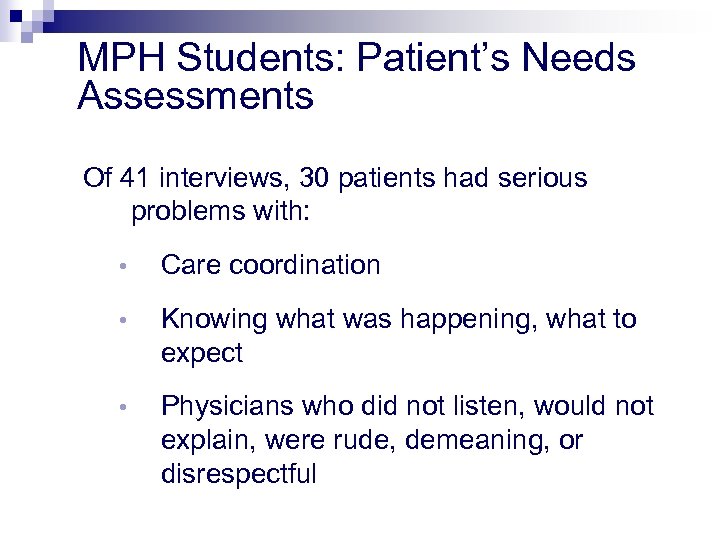 MPH Students: Patient’s Needs Assessments Of 41 interviews, 30 patients had serious problems with: • Care coordination • Knowing what was happening, what to expect • Physicians who did not listen, would not explain, were rude, demeaning, or disrespectful
 The Power of Words n Doctors and nurses greatly underestimate the power of their words and attitudes n By our manner, our comments, our concerns, we make patients’ fears and worries much better --or much worse
 What do we mean by a culture of respect? At the Institution level We have institutionalized disrespect ¨ Working conditions n Hazards n Hours n Work loads n Punishing for error ¨ Toleration of bad behavior
 We have institutionalized disrespect A sense of entitlement n Disrespect underlies: ¨Nurse resignations ¨Student / nurse abuse ¨The “hidden curriculum” ¨Physician resistance to safety changes
 Creating a culture of respect ¨ Correct ¨ Set working conditions and enforce behavioral standards n Policies: zero tolerance for disrespect n Leadership commitment n Enforcement
 What can you do? 1. Mobilize like-minded 2. Decide what kind of an institution you want to be 3. Agree on policies, set expectations 4. Monitor behavior 5. Follow through with deviant performers
 Paul O’Neill on Safety Every worker’s experience, every day: • • • I am treated with respect by everyone else, regardless of position, education or pay I have the education and training, the tools, and the support to develop to my full potential My work is noticed and appreciated