 Скачать презентацию Teaching phonics more effectively in shared book and
204d3d8419d313edc23dd59f30909cd7.ppt
- Количество слайдов: 25



Teaching phonics more effectively in shared book and guided reading lessons: What to do and how to do it Tom Nicholson and Laura Tse Massey University Auckland Email: t. nicholson@massey. ac. nz Tom Nicholson and Laura Tse 1

Presentation Overview 1. A research study: Which is better, shared book, phonics, or a combination? 2. How to become well informed about phonics. Learning some useful phonics rules. 3. The tricky bit: How to use phonics in shared book and guided reading 4. Deciding on phonics activities that are appropriate to the different levels of the Ready to Read colour wheel 5. Discussion activities Tom Nicholson and Laura Tse 2
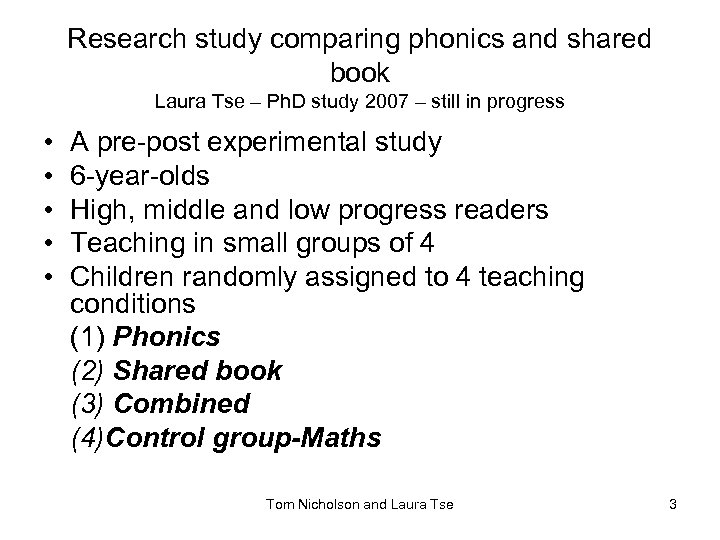
Research study comparing phonics and shared book Laura Tse – Ph. D study 2007 – still in progress • • • A pre-post experimental study 6 -year-olds High, middle and low progress readers Teaching in small groups of 4 Children randomly assigned to 4 teaching conditions (1) Phonics (2) Shared book (3) Combined (4)Control group-Maths Tom Nicholson and Laura Tse 3
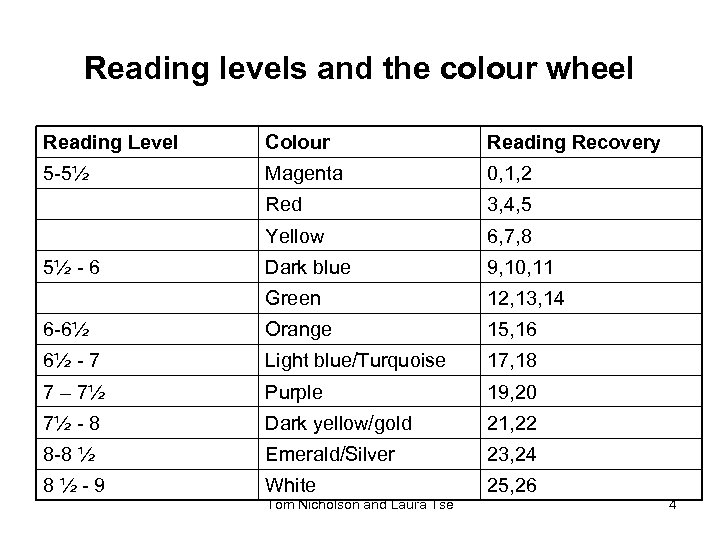
Reading levels and the colour wheel Reading Level Colour Reading Recovery 5 -5½ Magenta 0, 1, 2 Red 3, 4, 5 Yellow 6, 7, 8 Dark blue 9, 10, 11 Green 12, 13, 14 6 -6½ Orange 15, 16 6½ - 7 Light blue/Turquoise 17, 18 7 – 7½ Purple 19, 20 7½ - 8 Dark yellow/gold 21, 22 8 -8 ½ Emerald/Silver 23, 24 8½-9 White 25, 26 5½ - 6 Tom Nicholson and Laura Tse 4
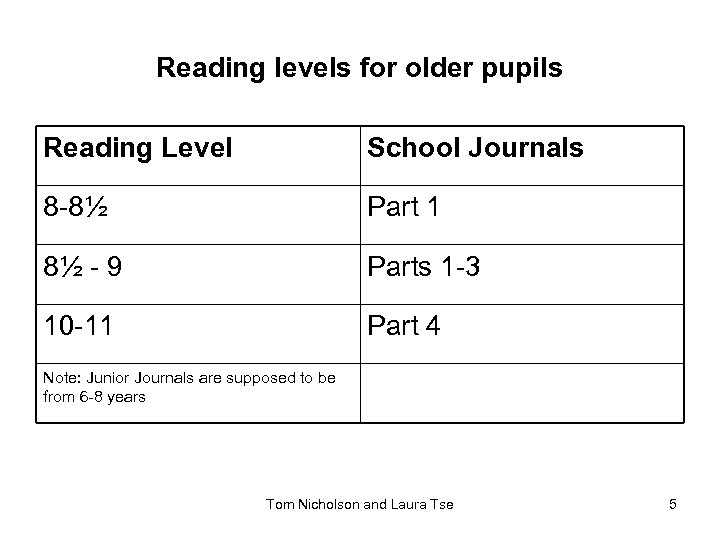
Reading levels for older pupils Reading Level School Journals 8 -8½ Part 1 8½ - 9 Parts 1 -3 10 -11 Part 4 Note: Junior Journals are supposed to be from 6 -8 years Tom Nicholson and Laura Tse 5
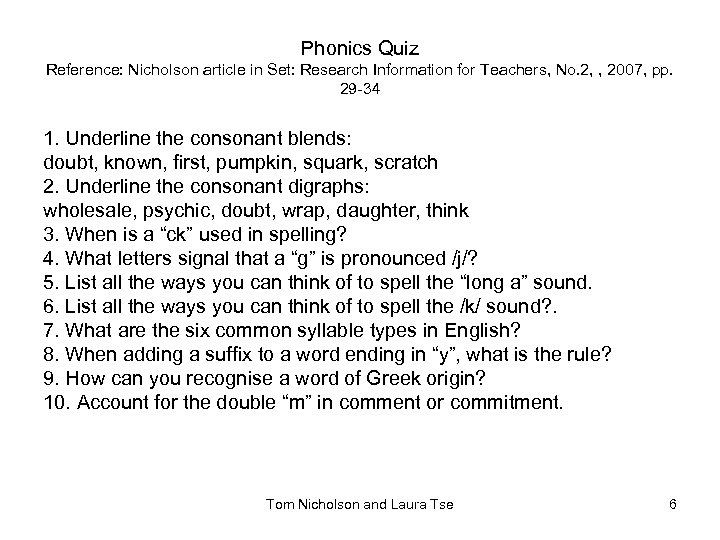
Phonics Quiz Reference: Nicholson article in Set: Research Information for Teachers, No. 2, , 2007, pp. 29 -34 1. Underline the consonant blends: doubt, known, first, pumpkin, squark, scratch 2. Underline the consonant digraphs: wholesale, psychic, doubt, wrap, daughter, think 3. When is a “ck” used in spelling? 4. What letters signal that a “g” is pronounced /j/? 5. List all the ways you can think of to spell the “long a” sound. 6. List all the ways you can think of to spell the /k/ sound? . 7. What are the six common syllable types in English? 8. When adding a suffix to a word ending in “y”, what is the rule? 9. How can you recognise a word of Greek origin? 10. Account for the double “m” in comment or commitment. Tom Nicholson and Laura Tse 6
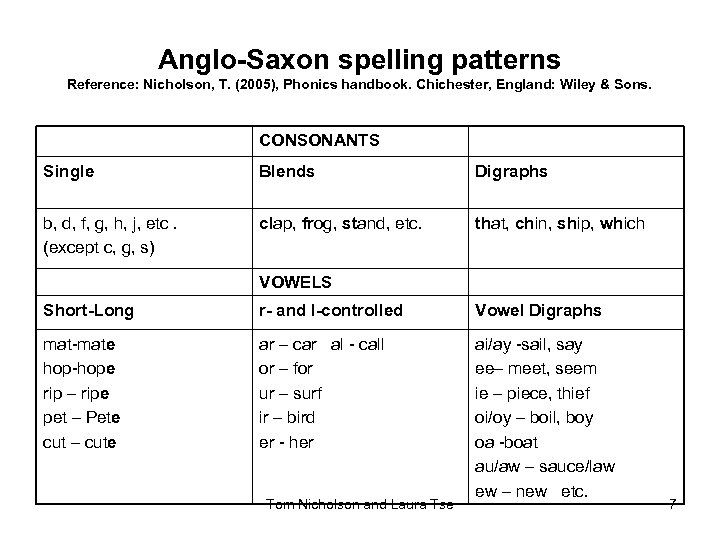
Anglo-Saxon spelling patterns Reference: Nicholson, T. (2005), Phonics handbook. Chichester, England: Wiley & Sons. CONSONANTS Single Blends Digraphs b, d, f, g, h, j, etc. (except c, g, s) clap, frog, stand, etc. that, chin, ship, which VOWELS Short-Long r- and l-controlled Vowel Digraphs mat-mate hop-hope rip – ripe pet – Pete cut – cute ar – car al - call or – for ur – surf ir – bird er - her ai/ay -sail, say ee– meet, seem ie – piece, thief oi/oy – boil, boy oa -boat au/aw – sauce/law ew – new etc. Tom Nicholson and Laura Tse 7
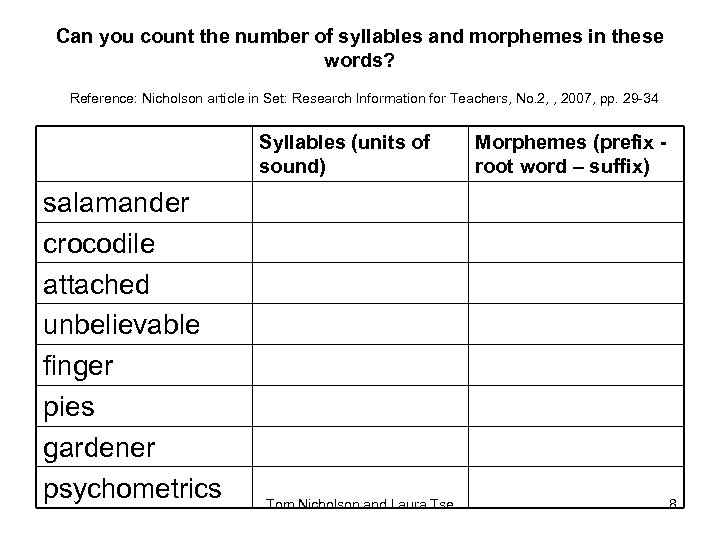
Can you count the number of syllables and morphemes in these words? Reference: Nicholson article in Set: Research Information for Teachers, No. 2, , 2007, pp. 29 -34 Syllables (units of sound) salamander crocodile attached unbelievable finger pies gardener psychometrics Tom Nicholson and Laura Tse Morphemes (prefix root word – suffix) 8
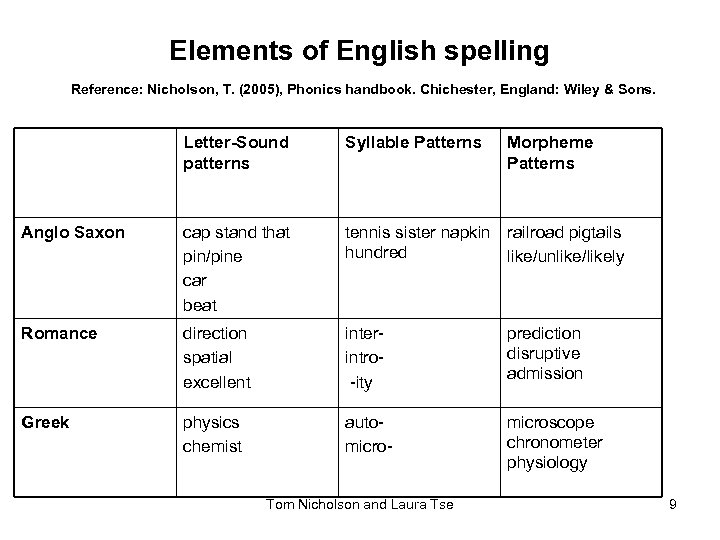
Elements of English spelling Reference: Nicholson, T. (2005), Phonics handbook. Chichester, England: Wiley & Sons. Letter-Sound patterns Syllable Patterns Anglo Saxon cap stand that pin/pine car beat tennis sister napkin railroad pigtails hundred like/unlike/likely Romance direction spatial excellent interintro-ity prediction disruptive admission Greek physics chemist automicro- microscope chronometer physiology Tom Nicholson and Laura Tse Morpheme Patterns 9
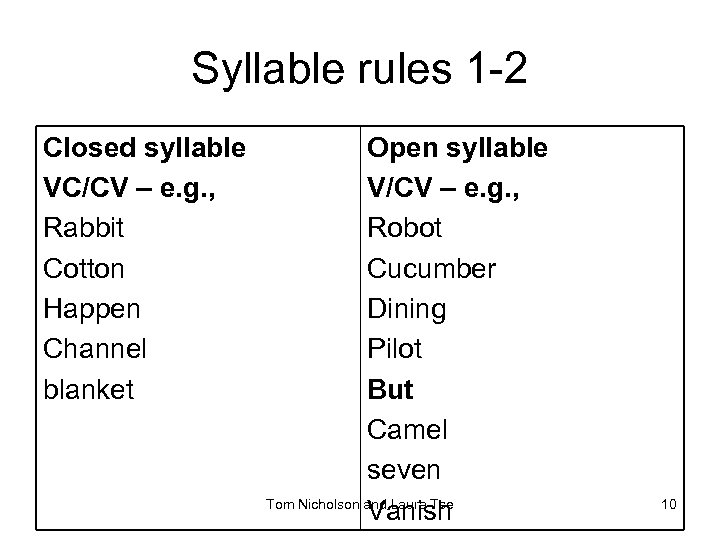
Syllable rules 1 -2 Closed syllable VC/CV – e. g. , Rabbit Cotton Happen Channel blanket Open syllable V/CV – e. g. , Robot Cucumber Dining Pilot But Camel seven Tom Nicholson and Laura Tse Vanish 10
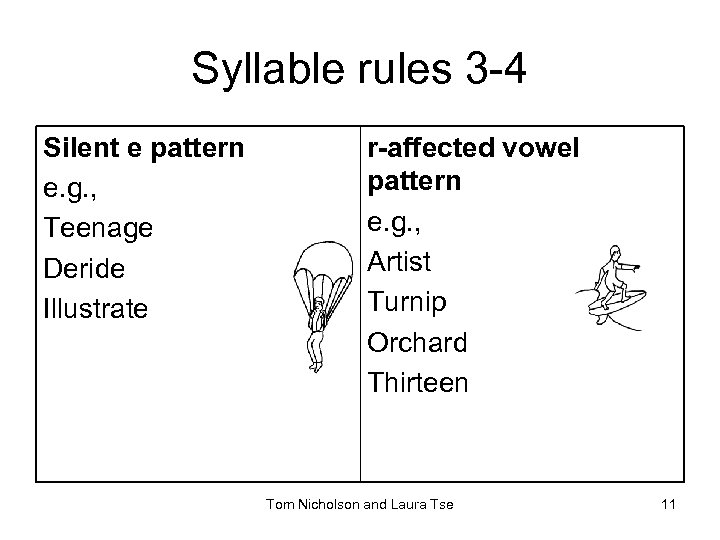
Syllable rules 3 -4 Silent e pattern e. g. , Teenage Deride Illustrate r-affected vowel pattern e. g. , Artist Turnip Orchard Thirteen Tom Nicholson and Laura Tse 11
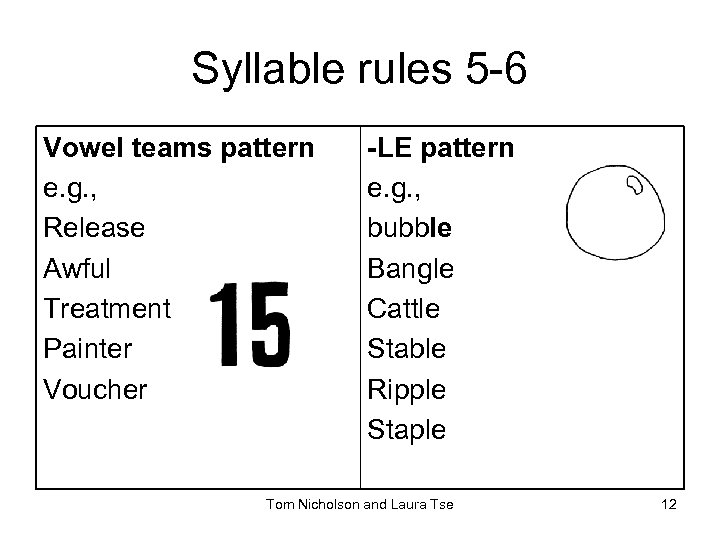
Syllable rules 5 -6 Vowel teams pattern e. g. , Release Awful Treatment Painter Voucher -LE pattern e. g. , bubble Bangle Cattle Stable Ripple Staple Tom Nicholson and Laura Tse 12
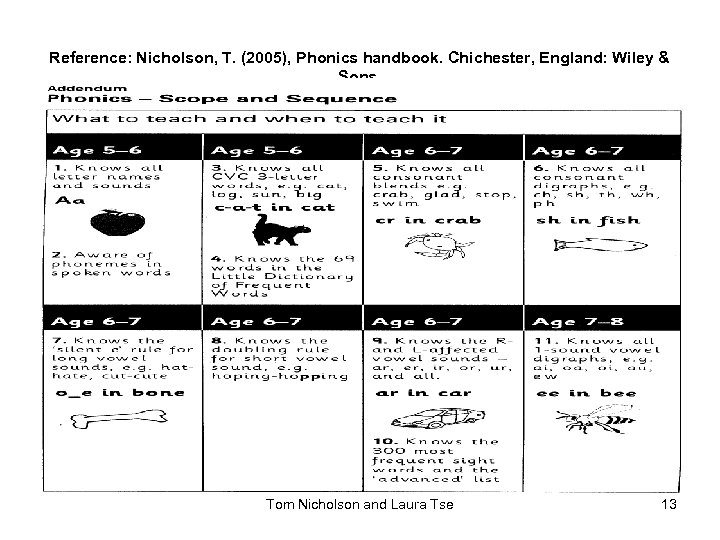
Reference: Nicholson, T. (2005), Phonics handbook. Chichester, England: Wiley & Sons. Tom Nicholson and Laura Tse 13
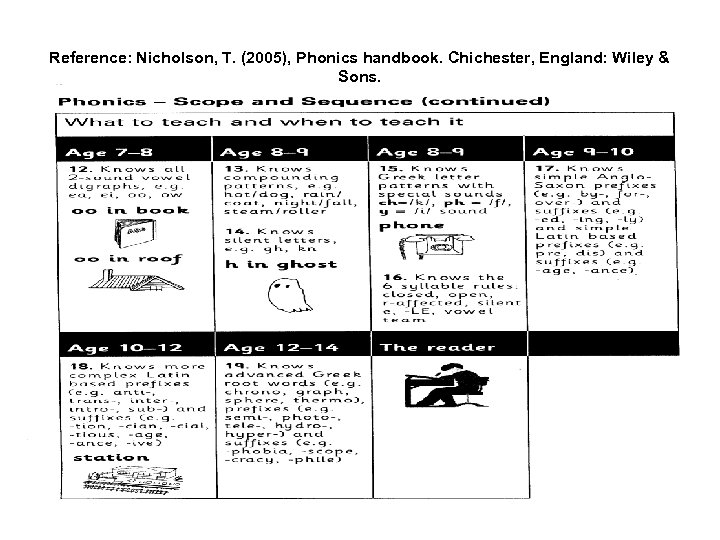
Reference: Nicholson, T. (2005), Phonics handbook. Chichester, England: Wiley & Sons. Tom Nicholson and Laura Tse 14
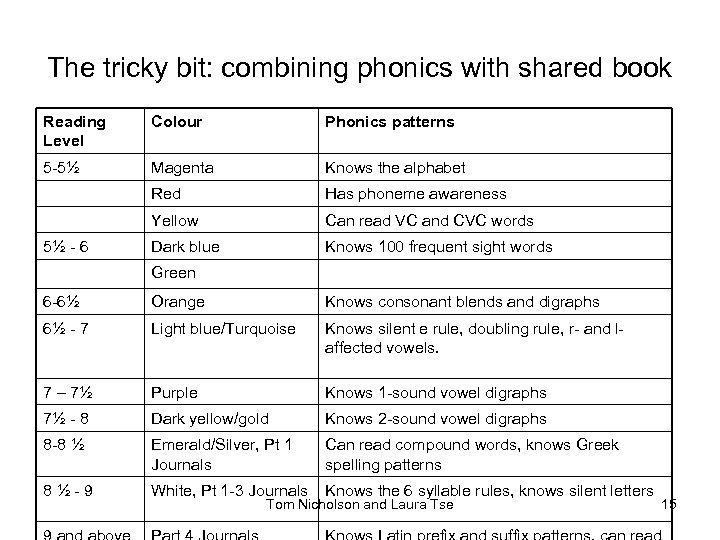
The tricky bit: combining phonics with shared book Reading Level Colour Phonics patterns 5 -5½ Magenta Knows the alphabet Red Has phoneme awareness Yellow Can read VC and CVC words Dark blue Knows 100 frequent sight words 5½ - 6 Green 6 -6½ Orange Knows consonant blends and digraphs 6½ - 7 Light blue/Turquoise Knows silent e rule, doubling rule, r- and laffected vowels. 7 – 7½ Purple Knows 1 -sound vowel digraphs 7½ - 8 Dark yellow/gold Knows 2 -sound vowel digraphs 8 -8 ½ Emerald/Silver, Pt 1 Journals Can read compound words, knows Greek spelling patterns 8½-9 White, Pt 1 -3 Journals Knows the 6 syllable rules, knows silent letters Tom Nicholson and Laura Tse 15
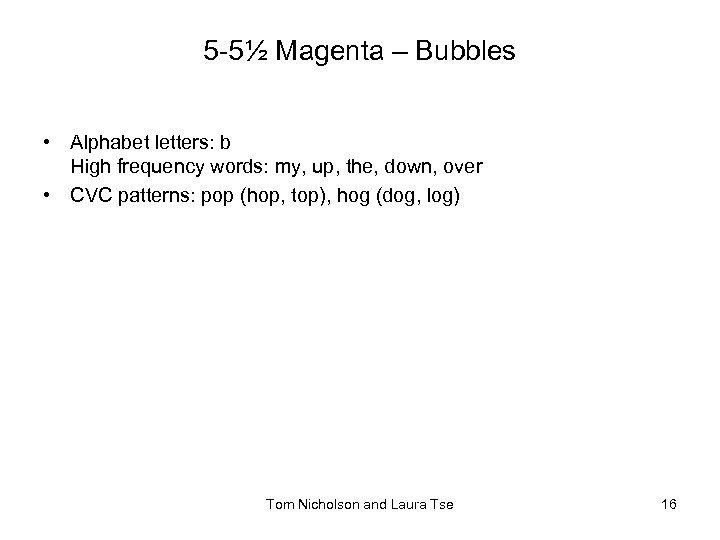
5 -5½ Magenta – Bubbles • Alphabet letters: b High frequency words: my, up, the, down, over • CVC patterns: pop (hop, top), hog (dog, log) Tom Nicholson and Laura Tse 16
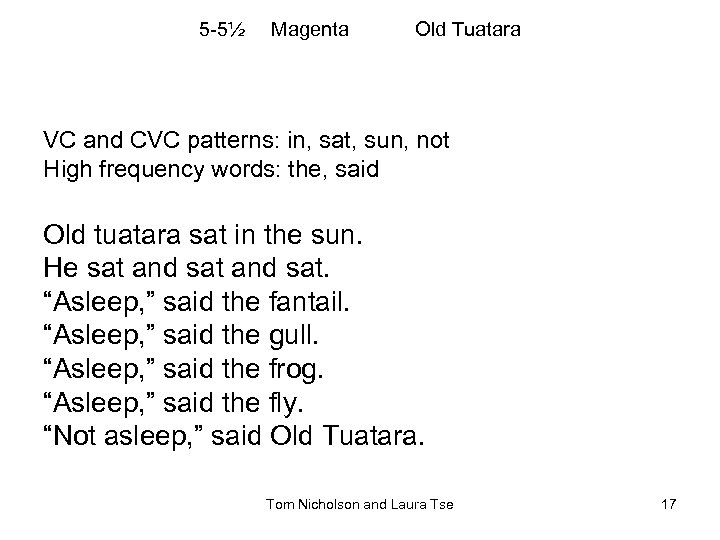
5 -5½ Magenta Old Tuatara VC and CVC patterns: in, sat, sun, not High frequency words: the, said Old tuatara sat in the sun. He sat and sat. “Asleep, ” said the fantail. “Asleep, ” said the gull. “Asleep, ” said the frog. “Asleep, ” said the fly. “Not asleep, ” said Old Tuatara. Tom Nicholson and Laura Tse 17
Title - No, Skipper! 5½ - 6 Green –What to do? The focus could be on a higher level of phonics: Teach the ai-ay pattern (e. g. , train) Teach silent e pattern (e. g. , side) Skipper was an outside dog. But sometimes Skipper wanted to be an inside dog. He wanted to eat the scraps That fell from Sophie’s high chair (NB: -air in “chair” is not ai pattern) “No!” said Mum. She pointed To the door. “Outside, Skipper!” He wanted to chase Greg’s toy train. … One day the rain came down. It rained and didn’t stop. . . And his kennel beside the deck was floating away. … In came Skipper, wagging his wet tail… Tom Nicholson and Laura Tse 18
Title: Greedy Cat’s Door • 5½-6 Blue – what to do? • Supposed to be just VC and CVC at this stage - in, it, cat, ran, leg, Dad, big, had, Mum, pop, • But could go to consonant blends - maybe look at gr-greedy, fr-front, cr-cried, st-stomped, gr-gravy Tom Nicholson and Laura Tse 19
Title: The hole in the king’s sock • Orange on the colour wheel • 6 -6½ year level • Suggest focus on consonant blends and digraphs • Could focus on –ck (“sock”, “sticky”, “prickly”, “click”) • And –tch (“stitch”) digraphs Tom Nicholson and Laura Tse 20
Is this an earthquake? • • • 6 -6½ year level Orange on the colour wheel Suggested focus: The doubling rule: two consonants after the vowel signals the short vowel sound; one consonant signals the long vowel sound • Extract from story: “Mum, I can feel our house shaking. Is that an earthquake? ” “No, that’s just a truck, a big logging truck, Rumbling and grumbling, Shaking our house. ” … Jumping and bumping Trundling and rumbling … “Is that an earthquake? ” “No, that’s the wind, Howling and growling, Squeaking and creaking, Blowing our house. ” Tom Nicholson and Laura Tse 21
The great grumbler and the wonder tree • 7½ - 8 years • Dark yellow/gold on the colour wheel • Suggested focus: 2 -sound vowel digraphs (oo, ou), doubling rule (dinner, etc) Extract from the story … One day Mr Finch looked at his dinner and sighed. “Oh dear! Mashed potato and gravy!” he said “I grew those potatoes in my own garden, ” said Mrs Finch. “Well I don’t like to grumble, ” said Mr Finch grumbling, “but I do wish you had grown pumpkins. I would have loved some pumpkin soup. ” Tom Nicholson and Laura Tse 22
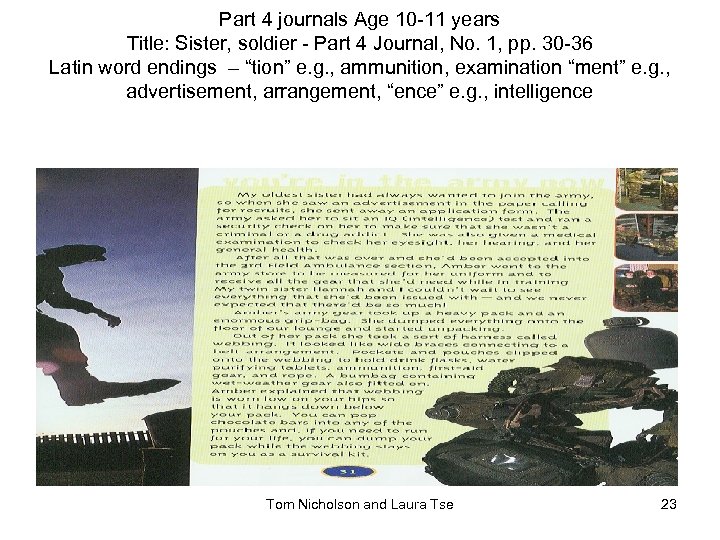
Part 4 journals Age 10 -11 years Title: Sister, soldier - Part 4 Journal, No. 1, pp. 30 -36 Latin word endings – “tion” e. g. , ammunition, examination “ment” e. g. , advertisement, arrangement, “ence” e. g. , intelligence Tom Nicholson and Laura Tse 23
Conclusion 1. 2. 3. 4. 5. Our research suggests that it is best to combine the teaching of phonics with shared book teaching You can teach phonics in a shared book lesson but to get the rules in sequence you need to teach them separately as a short lesson and then apply them to reading in shared book lessons: i. e. , teach phonics as a mini-lesson and then look for examples of the phonics rule in the shared book Shared book is a great way to revise phonics rules: you can highlight phonics rules as the text features of the shared book (see Ministry of Education folder of Ready to Read notes for some suggestions on teaching phonics) Keep a small list of useful phonics rules that you can highlight whenever you take a shared book lesson Try to highlight phonics rules that are appropriate for the reading level of the children you teach, not too hard or too easy Tom Nicholson and Laura Tse 24
References • Learning Media (2007). Ready to Read. Teacher support material. Wellington: Author. • Nicholson, T. (2007). “How many sounds in ox? ” Set: Research Information for Teachers, No. 2, pp. 29 -34 • Nicholson, T. (2006), Phonics handbook. Chichester, England: Wiley & Sons. • Nicholson, T. (2005). At the cutting edge. The importance of phonemic awareness in learning to read and spell. Wellington: New Zealand Council fro Educational Research. Tom Nicholson and Laura Tse 25
Скачать презентацию Teaching phonics more effectively in shared book and
204d3d8419d313edc23dd59f30909cd7.ppt