 Скачать презентацию Teaching Objectives Get a general idea about American
6a917af9178a4dae07ba9f4f89e9686d.ppt
- Количество слайдов: 80




Teaching Objectives |Get a general idea about American Dream, immigrants and the Great Depression |Understand the main idea and structure of Text A |Learn to describe a person by his/her characteristic features and supporting details |Grasp the key language points and grammatical structures in the text
Teaching Methods • Situational and discourse teaching • Task-based teaching • Group research and discussion
Teaching Procedures Before class, students are assigned to think about their own dreams. Ø Pre-reading activities: 1) warm-up questions: What’s your dream? 2) group discussion: How can we realize our dreams? 3) group discussion: What is the American Dream in your opinion? 3) presentation of background information Ø
Teaching Procedures (cont. ) Ø While-reading tasks: 1) global reading: time expressions and the function of time expressions; text organization 2) detailed reading: content questions; language study 3) text analysis: writing strategy--how to describe a person
Teaching Procedures (cont. ) Ø Post-reading tasks: 1) useful expressions 2) summary writing 3) essay writing: a personal description; I have a dream 4)after-text exercises and home reading 5) preparation for Unit 5

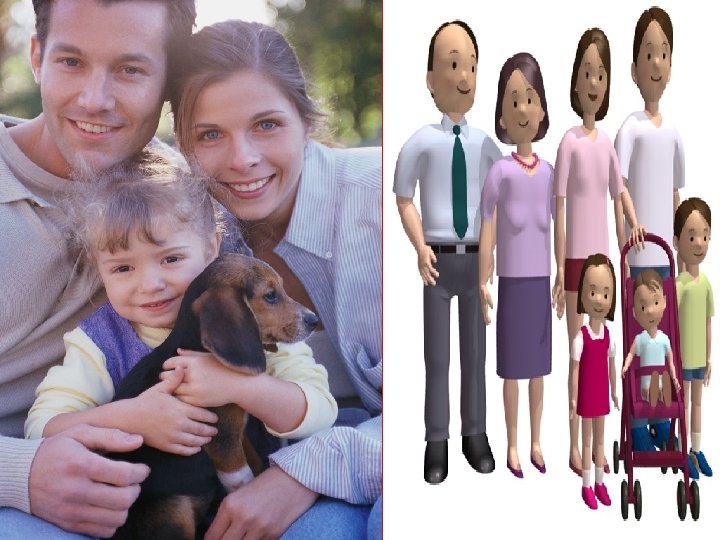
What’s your dream




How can we realize our dreams? • Genius is 1% inspiration and 99% perspiration. • hard work; vision; determination; self-control; self-respect; selfconfidence; honesty; talent; optimism; responsibility; opportunity; luck;


American Dream • for Americans --- the belief that their country offers opportunities for a good and successful life • for minorities and immigrants ---It also includes freedom and equal rights
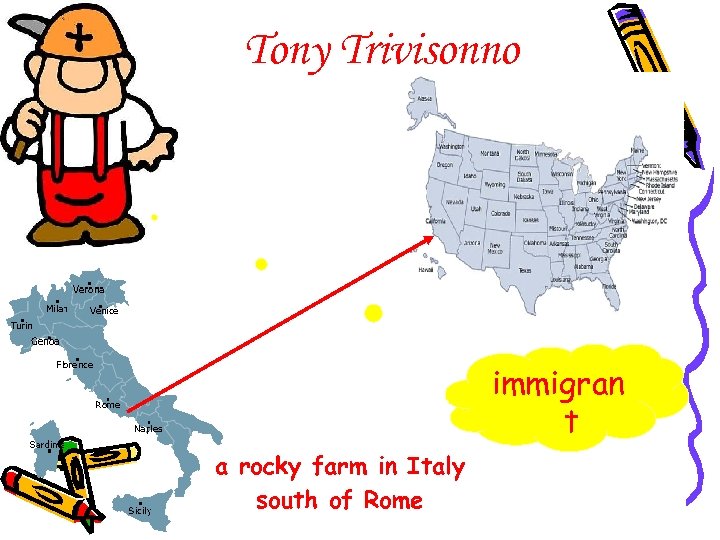
Tony Trivisonno immigran t a rocky farm in Italy south of Rome
Scanning • Scan the text to circle all the time words, phrases or sentences in this text.
Time Expressions |the first time interval è (Para. 1) one evening è (Para. 5) the next evening è (Para. 8) the next two days, on Friday |the second time interval è (Para. 11) summer passed into fall è (Para. 11) one evening è (Para. 13) the months passed
Time Expressions |the third time interval è (Para. 14) one day è (Para. 16) months later |the fourth time interval è (Para. 17) a year or two passed è (Para. 21) from then on
Time Expressions |the fifth time interval è (Para. 22) after about two years è (Para. 27) sometime later è (Para. 27) on a Sunday afternoon |the sixth time interval è (Para. 28) then, during the war è (Para. 30) after he passed away
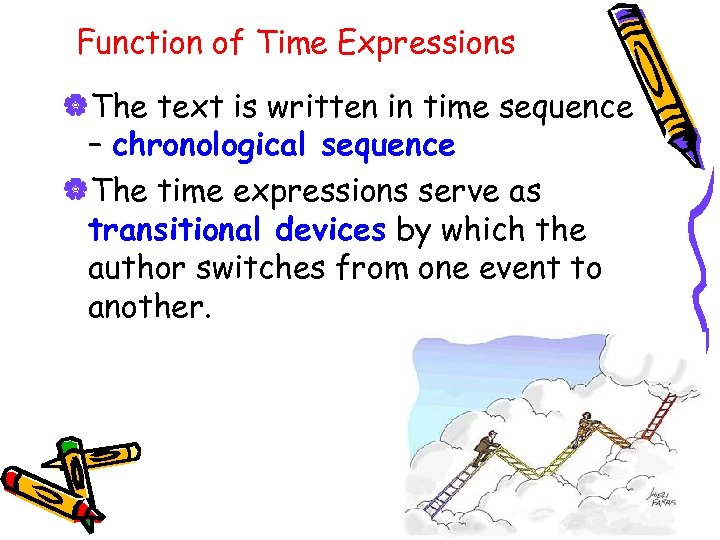
Function of Time Expressions |The text is written in time sequence – chronological sequence |The time expressions serve as transitional devices by which the author switches from one event to another.
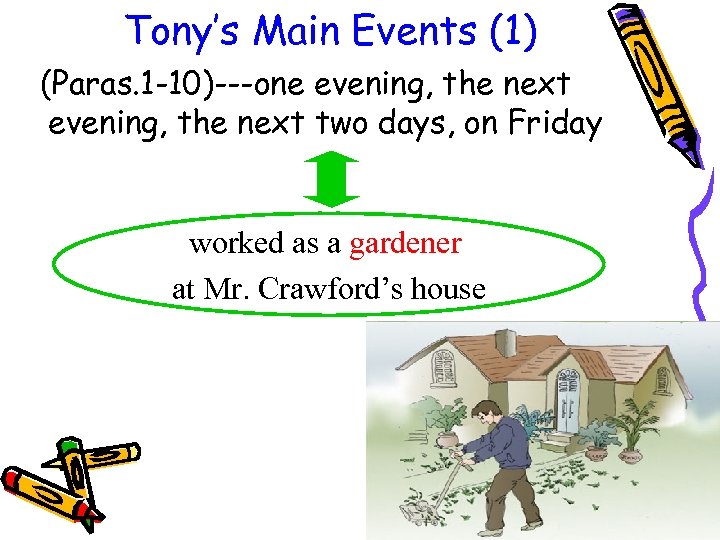
Tony’s Main Events (1) (Paras. 1 -10)---one evening, the next two days, on Friday worked as a gardener at Mr. Crawford’s house
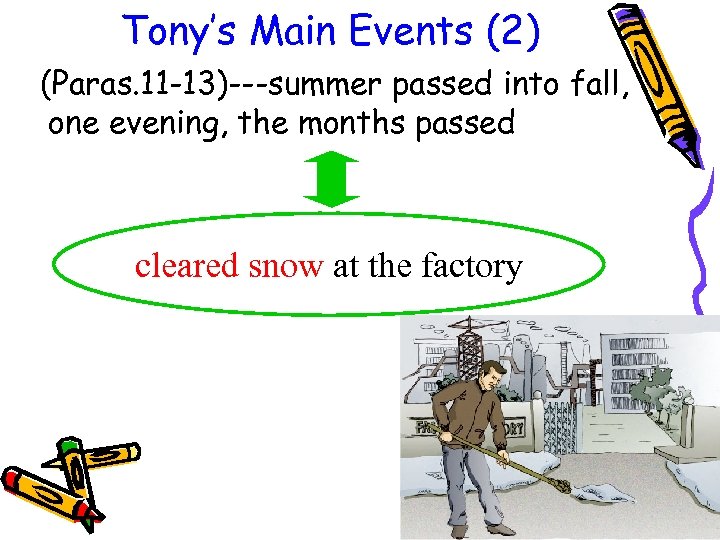
Tony’s Main Events (2) (Paras. 11 -13)---summer passed into fall, one evening, the months passed cleared snow at the factory
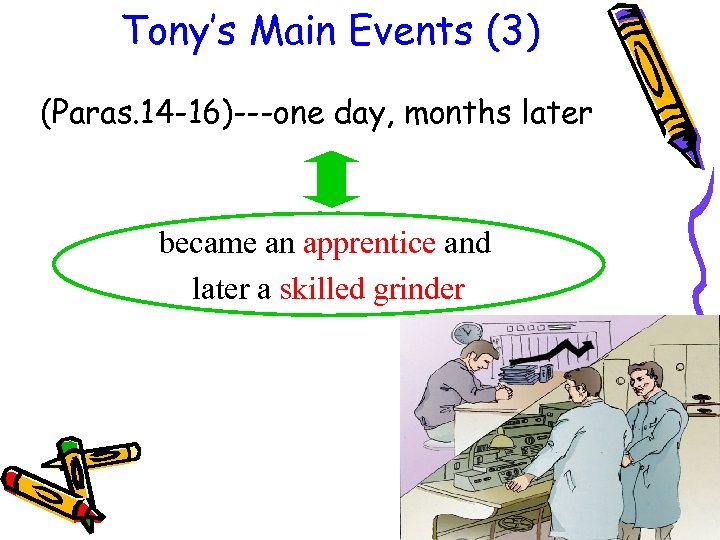
Tony’s Main Events (3) (Paras. 14 -16)---one day, months later became an apprentice and later a skilled grinder
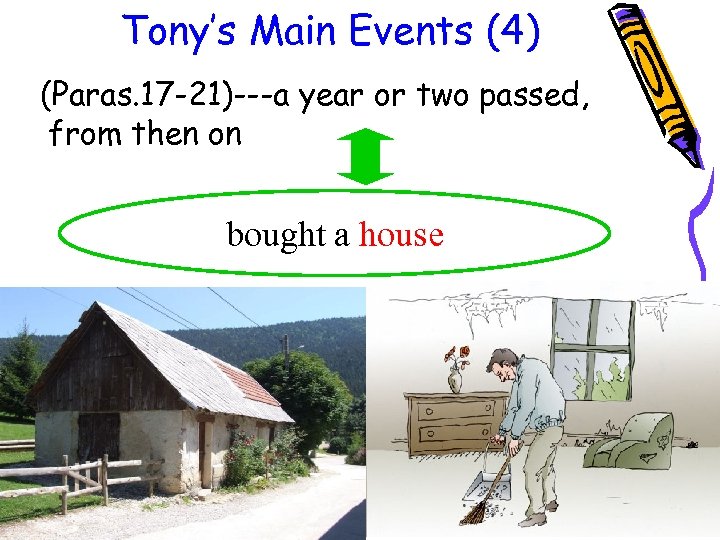
Tony’s Main Events (4) (Paras. 17 -21)---a year or two passed, from then on bought a house
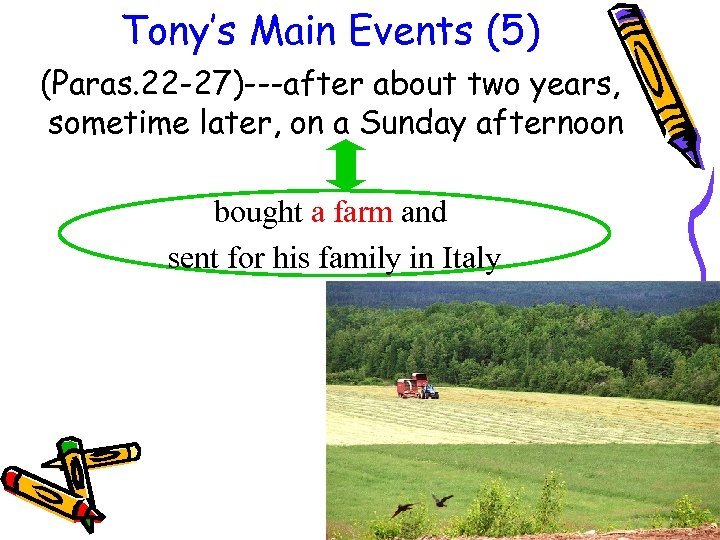
Tony’s Main Events (5) (Paras. 22 -27)---after about two years, sometime later, on a Sunday afternoon bought a farm and sent for his family in Italy
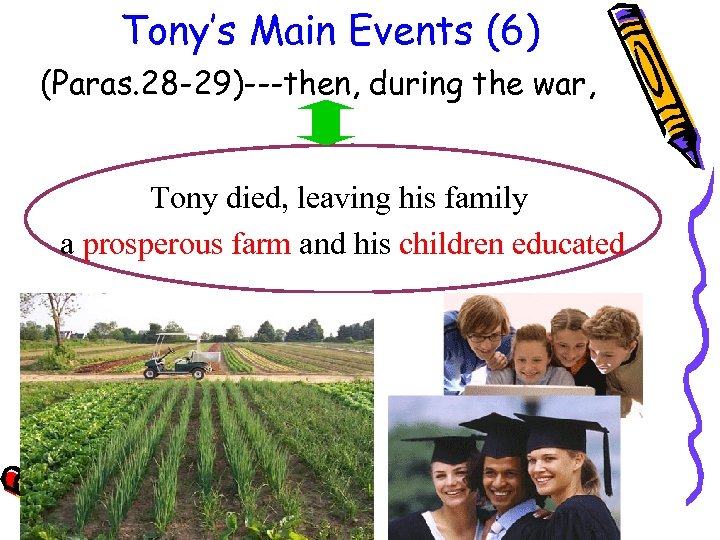
Tony’s Main Events (6) (Paras. 28 -29)---then, during the war, Tony died, leaving his family a prosperous farm and his children educated
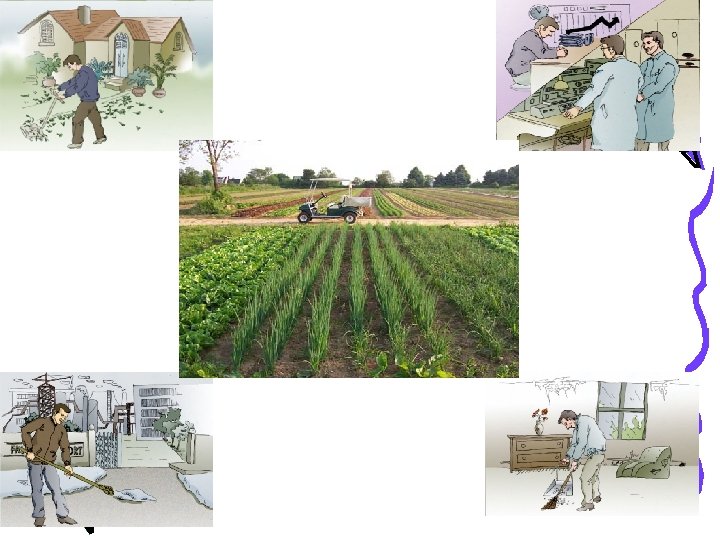

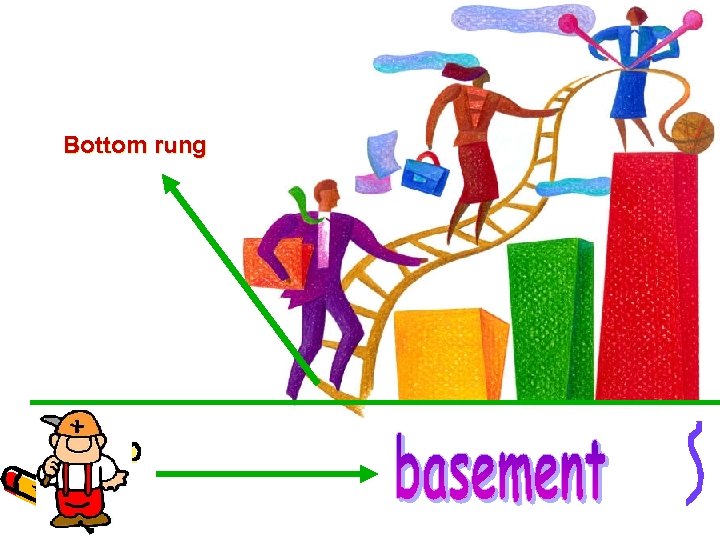
Tony fulfilled his American Dream step by step. Dreams are made of steps!
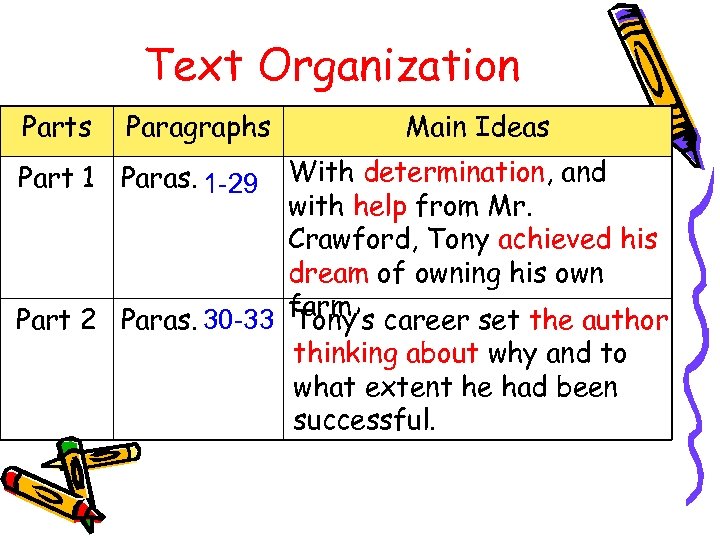
Text Organization Parts Paragraphs Main Ideas With determination, and with help from Mr. Crawford, Tony achieved his dream of owning his own farm. career set the author Part 2 Paras. 30 -33 Tony’s thinking about why and to what extent he had been successful. Part 1 Paras. 1 -29

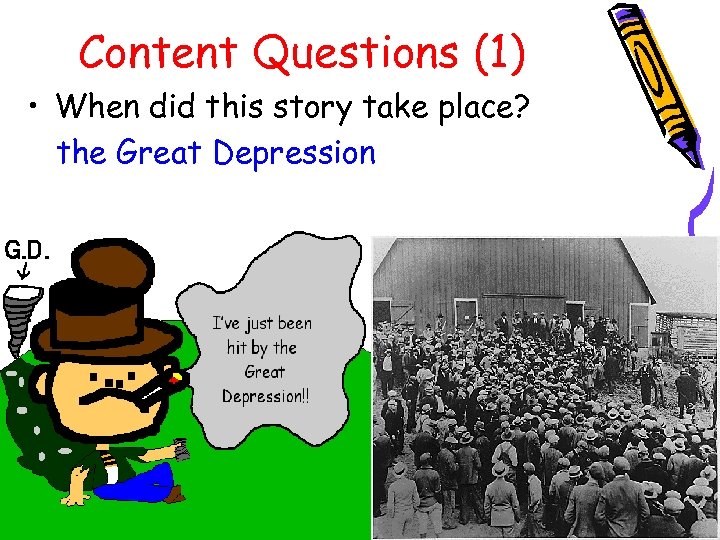
Content Questions (1) • When did this story take place? the Great Depression
Content Questions (2) • How did Mr. Crawford get to know Tony? found him standing in the driveway, behind my garage
Content Questions (3) • What was the purpose of Tony’s visit? @#$%? I can hardly understand! I mow your lawn. v. understand n. comprehension adj. comprehensive, It was hard to comprehend comprehensible _______his broken English.
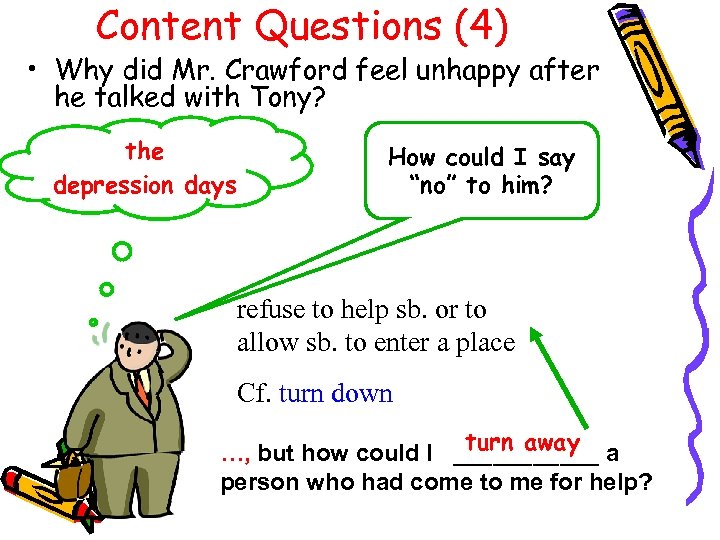
Content Questions (4) • Why did Mr. Crawford feel unhappy after he talked with Tony? the depression days How could I say “no” to him? refuse to help sb. or to allow sb. to enter a place Cf. turn down turn away …, but how could I ______ a person who had come to me for help?
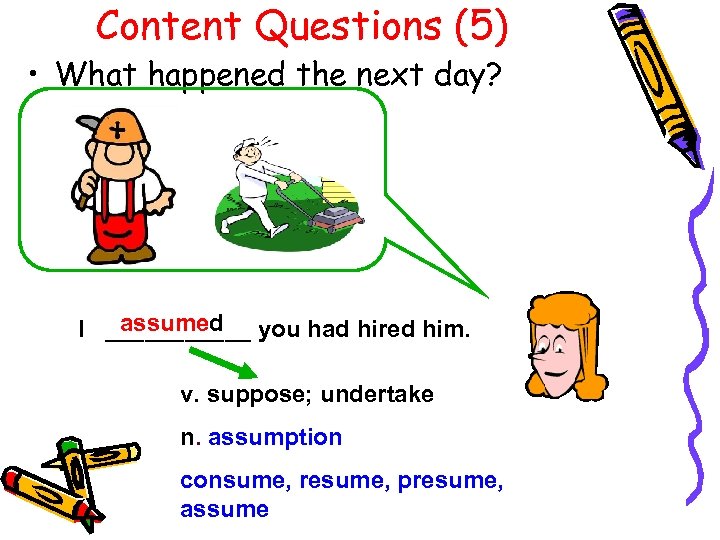
Content Questions (5) • What happened the next day? assumed I ______ you had hired him. v. suppose; undertake n. assumption consume, resume, presume, assume
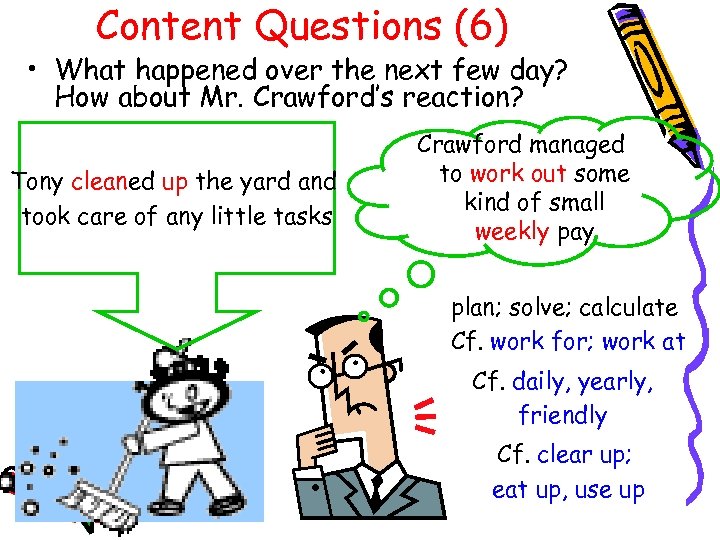
Content Questions (6) • What happened over the next few day? How about Mr. Crawford’s reaction? Tony cleaned up the yard and took care of any little tasks Crawford managed to work out some kind of small weekly pay plan; solve; calculate Cf. work for; work at Cf. daily, yearly, friendly Cf. clear up; eat up, use up
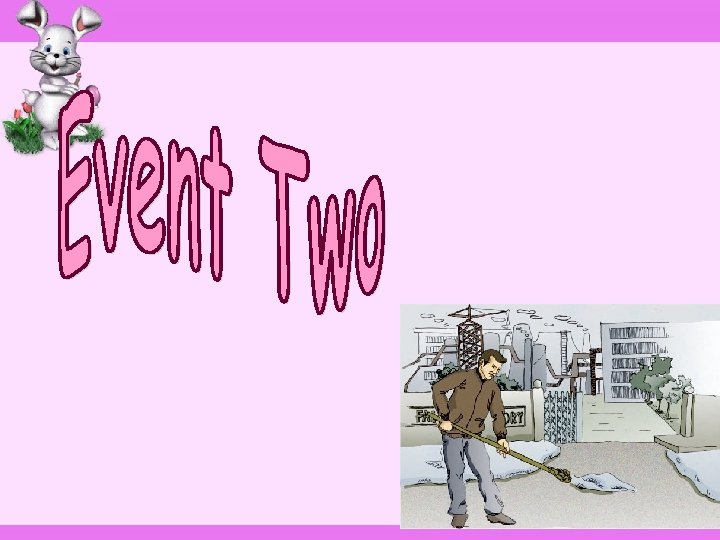
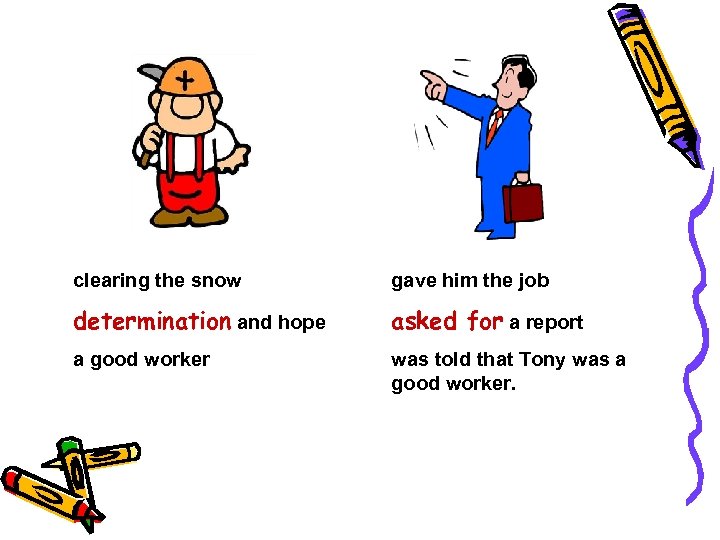
clearing the snow gave him the job determination and hope asked for a report a good worker was told that Tony was a good worker.

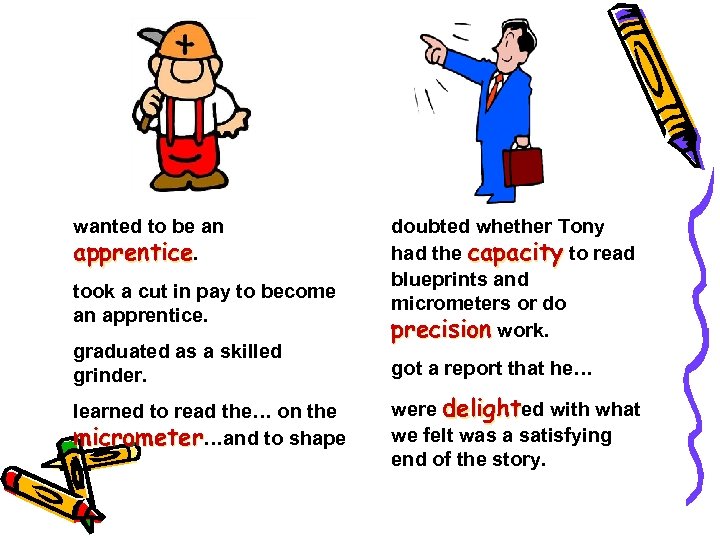
wanted to be an apprentice. took a cut in pay to become an apprentice. graduated as a skilled grinder. learned to read the… on the micrometer…and to shape … doubted whether Tony had the capacity to read blueprints and micrometers or do precision work. got a report that he… were delighted with what we felt was a satisfying end of the story.

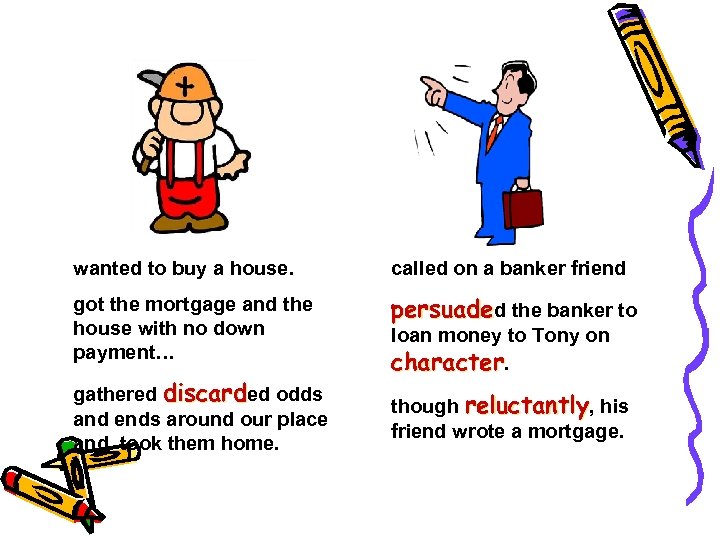
wanted to buy a house. called on a banker friend got the mortgage and the house with no down payment… persuaded the banker to gathered discarded odds and ends around our place and took them home. loan money to Tony on character. though reluctantly, his friend wrote a mortgage.

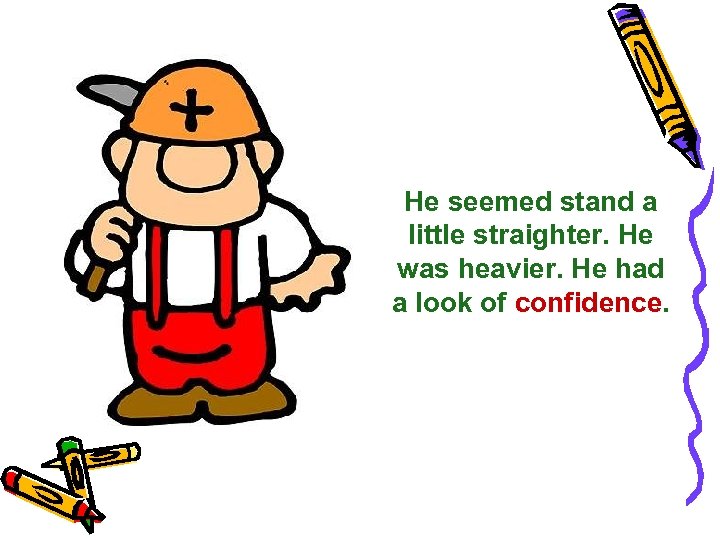
He seemed stand a little straighter. He was heavier. He had a look of confidence.
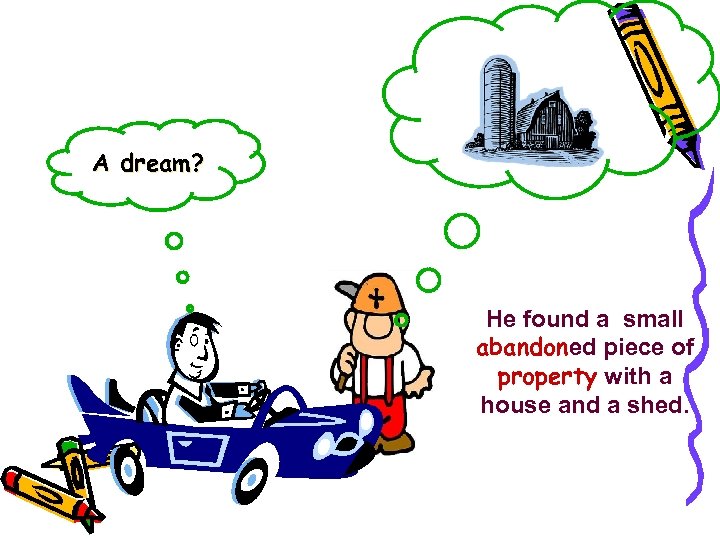
A dream? He found a small abandoned piece of property with a house and a shed.
? . . . ? !! ! sold the house and bought a farm. talked about his dream… he sent for his wife and his son and his daughter in Italy. amazed
neatly dressed had persuaded his childhood friend to move to America was sponsoring him. “When they approached the little farm he now operated, his friend stood in amazement and said, …
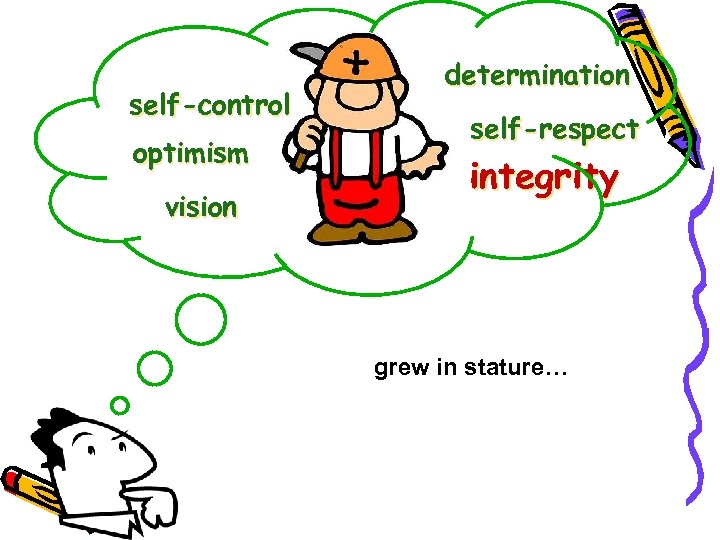
self-control optimism vision determination self-respect integrity grew in stature…
Bottom rung
The importance of details in describing a person Ø Changes of Tony’s appearance: Ô He was about five-foot-seven or eight, and thin—He seemed to stand a little straighter. He was heavier. He had a look of confidence—neatly dressed---He grew in stature in my mind. In the end, I think he stood as tall, and as proud as the greatest American industrialists. Ø Changes in Tony’s manner towards “me”: Ô Tony had remained standing when talking to “me” -we sat down and talked. Ø Functions of these details: they show that Tony’s social status has been improving and he has been moving nearer to his success.
- Does the author himself ever make a statement claiming Tony to be a good worker? No, he makes you infer from other people’s complements. e. g. , “my wife said he was very helpful. ”; the personnel department said “ Tony was a very good worker”; “I got a report that he had graduated as a skilled grinder. ” When Tony died, people found “the farm green with vegetables, the little house livable and homey. There were a tractor and a good card in the yard. The children were educated and working, and Tony didn't owe a cent.
Translation • 毕业在即. 许多大四学生正在忙于找 作. 要想得到一份技术员的 作, 求职者 首先必须要有技术. 而且, 正如许多人认 为那样, 他应该有能力处理出乎意料的事 情以及想出解决问题的方法. 当由人事 经理面试的时候, 他需要对自己有信心. 最重要的是, 他应该有很大的决心. 即使 他可能会被拒多次, 他也不能灰心放弃自 己.
• 毕业在即. 许多大四学生正在忙于 找 作. 要想得到一份技术员的 作, 求职者首先必须要有技术. • Graduation is approaching. Many seniors are busy hunting for a job. To get a job as a technician, first of all, a job-hunter must be skilled.
• 而且, 正如许多人认为那样, 他应该 有能力处理出乎意料的事情以及想 出解决问题的方法. • Furthermore, he should have the capacity to handle unexpected things and work out approaches to solving those problems, as is assumed by many people.
• 当由人事经理面试的时候, 他需要对自 己有信心. 最重要的是, 他应该有很大的 决心. 即使他可能会被拒多次, 他也不能 灰心放弃自己. • When he is interviewed by the personnel manager, he needs to have confidence in himself. Above all, he ought to have great determination. Even though he may be turned down many times, he cannot lose heart or abandon himself.
• Graduation is approaching. Many seniors are busy hunting for a job. To get a job as a technician, first of all, a job-hunter must be skilled. Furthermore, he should have the capacity to handle unexpected things and work out approaches to solving those problems, as is assumed by many people. When he is interviewed by the personnel manager, he needs to have confidence in himself. Above all, he ought to have great determination. Even though he may be turned down many times, he cannot lose heart or abandon himself.
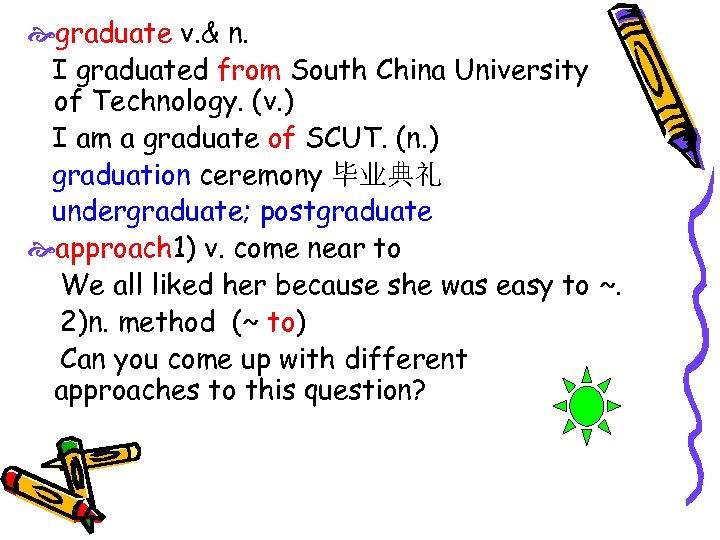
graduate v. & n. I graduated from South China University of Technology. (v. ) I am a graduate of SCUT. (n. ) graduation ceremony 毕业典礼 undergraduate; postgraduate approach 1) v. come near to We all liked her because she was easy to ~. 2)n. method (~ to) Can you come up with different approaches to this question?
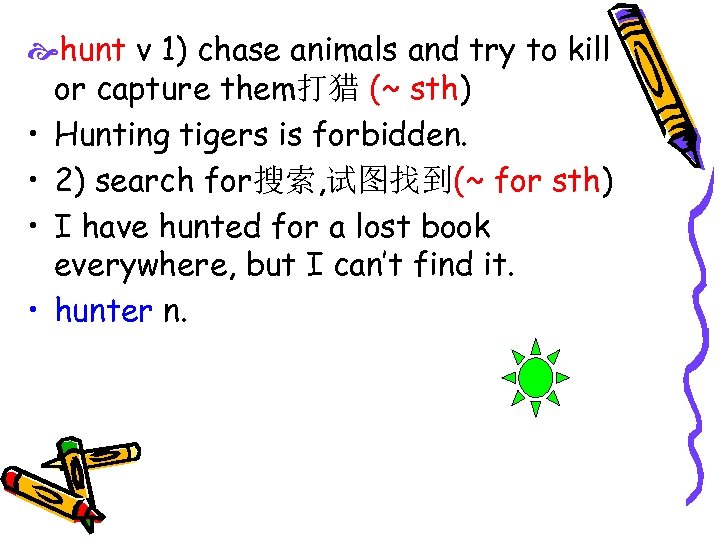
hunt v 1) chase animals and try to kill or capture them打猎 (~ sth) • Hunting tigers is forbidden. • 2) search for搜索, 试图找到(~ for sth) • I have hunted for a lost book everywhere, but I can’t find it. • hunter n.
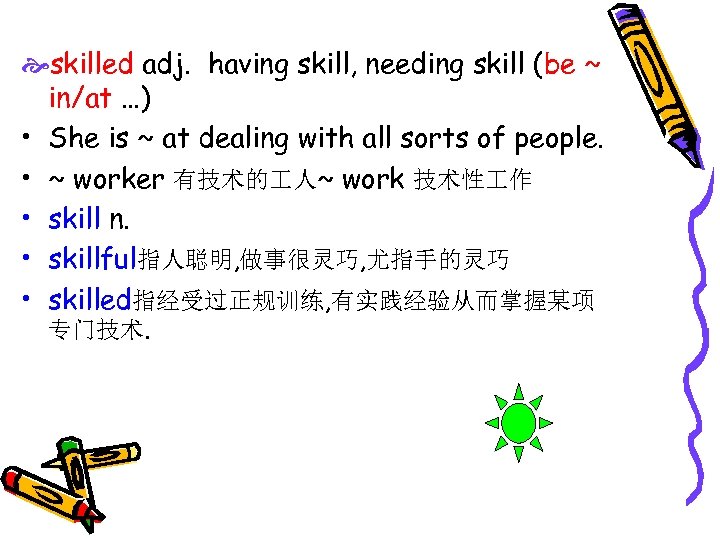
skilled adj. having skill, needing skill (be ~ in/at …) • She is ~ at dealing with all sorts of people. • ~ worker 有技术的 人~ work 技术性 作 • skill n. • skillful指人聪明, 做事很灵巧, 尤指手的灵巧 • skilled指经受过正规训练, 有实践经验从而掌握某项 专门技术.
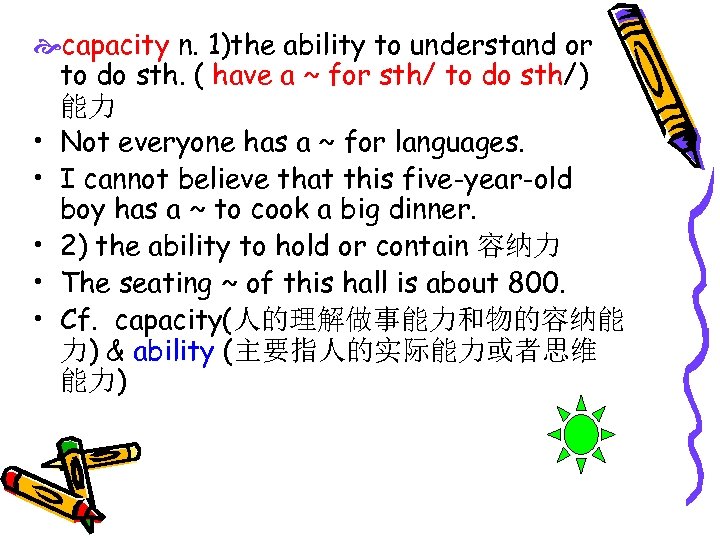
capacity n. 1)the ability to understand or to do sth. ( have a ~ for sth/ to do sth/) 能力 • Not everyone has a ~ for languages. • I cannot believe that this five-year-old boy has a ~ to cook a big dinner. • 2) the ability to hold or contain 容纳力 • The seating ~ of this hall is about 800. • Cf. capacity(人的理解做事能力和物的容纳能 力) & ability (主要指人的实际能力或者思维 能力)
handle v. 1) manage or control • We should learn how to ~ pressure. • 2) touch, lift • Please wash your hands before you ~ the white paper. • n. 把手, 拉手 • The ~ is not well fixed.
work out: plan, solve, calculate • I worked out my weekly expense at about 200 yuan. • Finally I worked out that my parcel had been sent to Guangxi by mistake. • work at 致力于 • work for 为… 作; 为…尽力

personnel n. 人事部门( 不可数名词, 谓语 动词可用单数或者复数形式); 职员(谓语 动词用复数形式) • Personnel has/have received your application form. • All personnel in this company are entitled to medical insurance. • staff, crew, faculty • Cf. personal adj. 亲自的, 个人的
confidence n. 信心 ( have/lose ~ in sth /sb; have ~ to do sth. ) • You will do a better job if you have ~ to do it/ if you do it with ~/ if you are confident in yourself/ if you are self-confident. Never lose ~.
above all: most important of all • Don’t go out to the bus station at night, because it is too far, too late, and above all, too dangerous. • after all 毕竟 first of all 首先 • at all 根本, 丝毫 in all一共, 总计
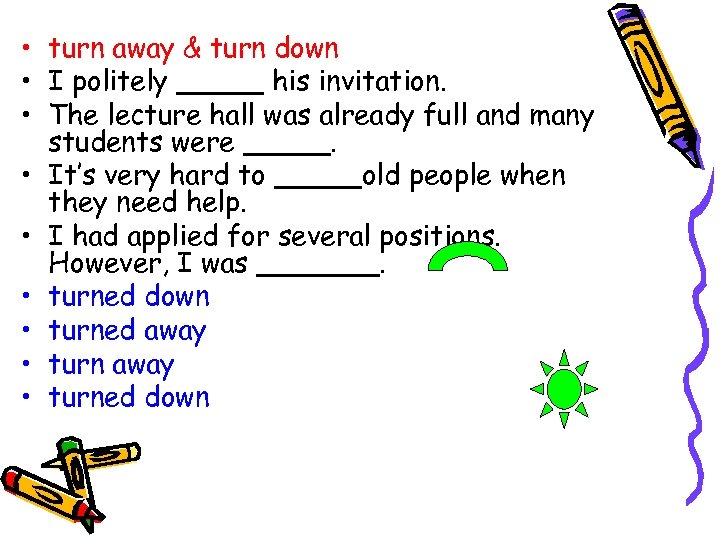
• turn away & turn down • I politely _____ his invitation. • The lecture hall was already full and many students were _____. • It’s very hard to _____old people when they need help. • I had applied for several positions. However, I was _______. • turned down • turned away • turned down
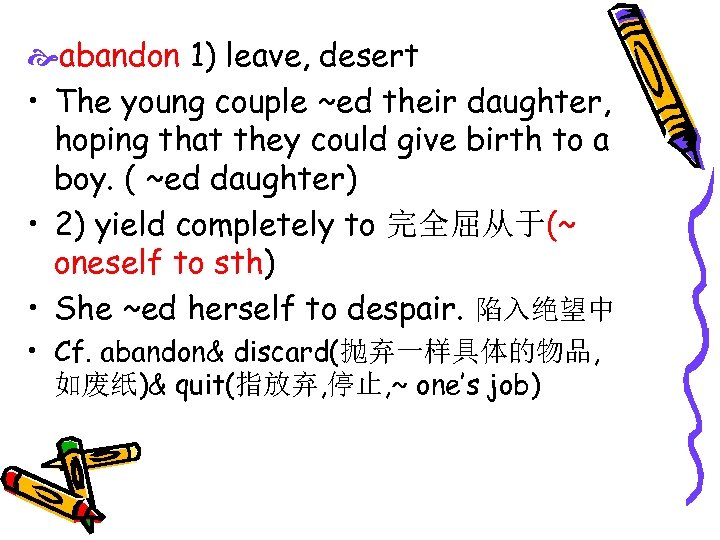
abandon 1) leave, desert • The young couple ~ed their daughter, hoping that they could give birth to a boy. ( ~ed daughter) • 2) yield completely to 完全屈从于(~ oneself to sth) • She ~ed herself to despair. 陷入绝望中 • Cf. abandon& discard(抛弃一样具体的物品, 如废纸)& quit(指放弃, 停止, ~ one’s job)
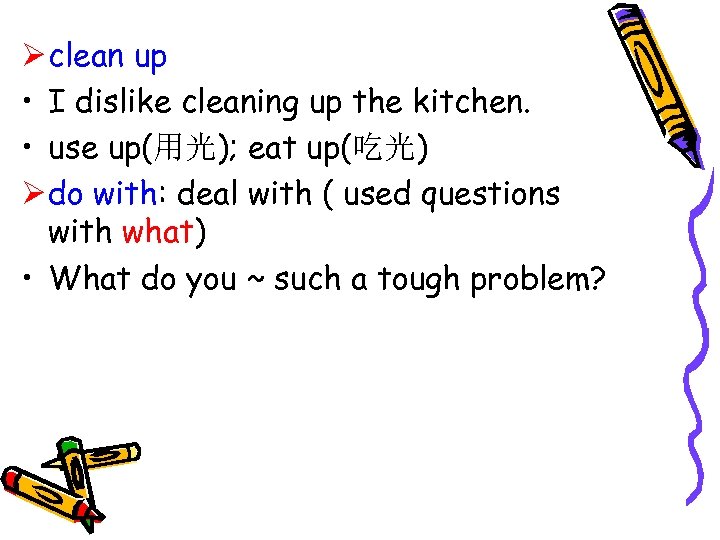
Ø clean up • I dislike cleaning up the kitchen. • use up(用光); eat up(吃光) Ø do with: deal with ( used questions with what) • What do you ~ such a tough problem?
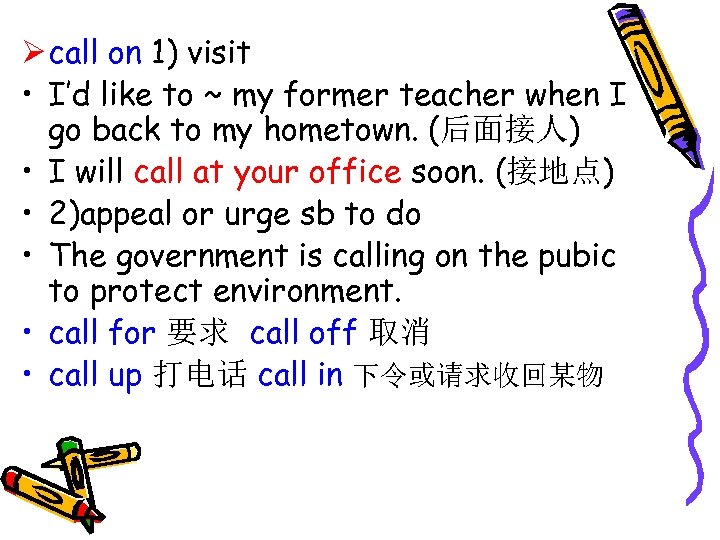
Ø call on 1) visit • I’d like to ~ my former teacher when I go back to my hometown. (后面接人) • I will call at your office soon. (接地点) • 2)appeal or urge sb to do • The government is calling on the pubic to protect environment. • call for 要求 call off 取消 • call up 打电话 call in 下令或请求收回某物
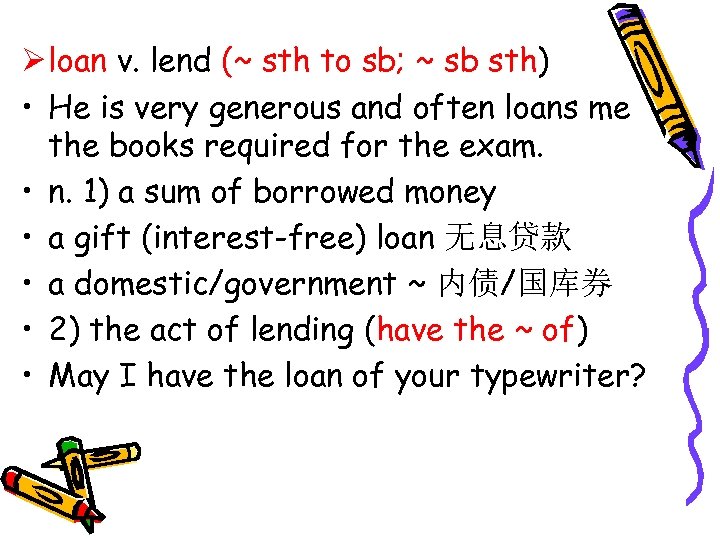
Ø loan v. lend (~ sth to sb; ~ sb sth) • He is very generous and often loans me the books required for the exam. • n. 1) a sum of borrowed money • a gift (interest-free) loan 无息贷款 • a domestic/government ~ 内债/国库券 • 2) the act of lending (have the ~ of) • May I have the loan of your typewriter?
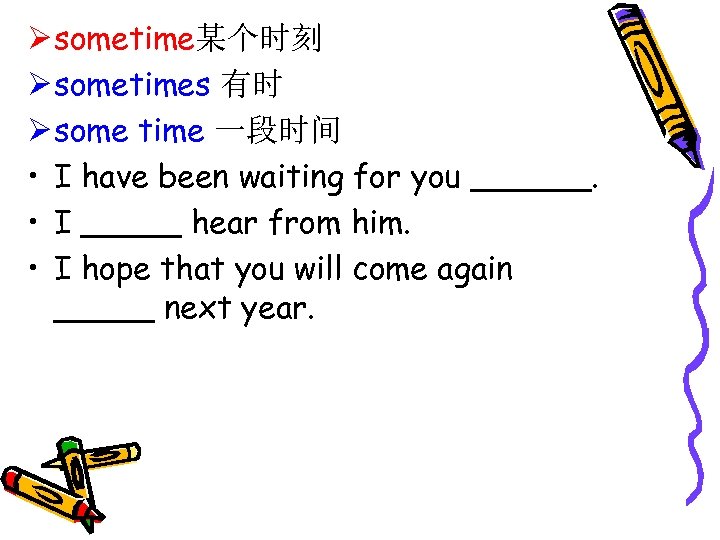
Ø sometime某个时刻 Ø sometimes 有时 Ø some time 一段时间 • I have been waiting for you ______. • I _____ hear from him. • I hope that you will come again _____ next year.
Ø Useful expressions Ø Summary writing
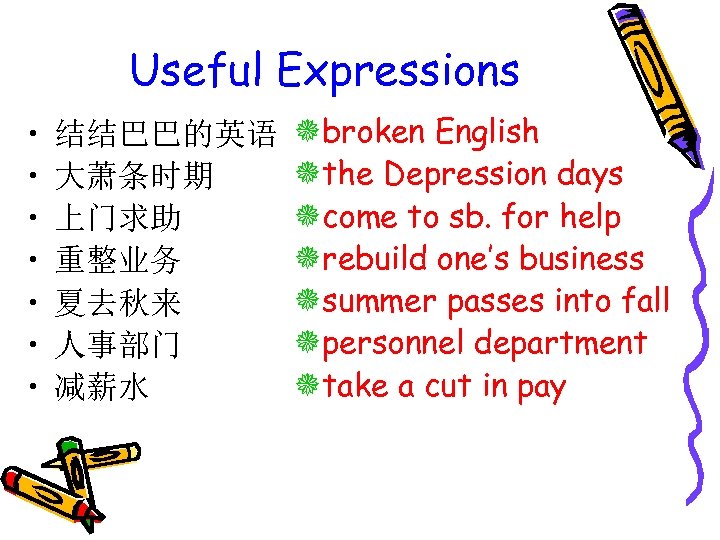
Useful Expressions • • 结结巴巴的英语 大萧条时期 上门求助 重整业务 夏去秋来 人事部门 减薪水 õbroken English õthe Depression days õcome to sb. for help õrebuild one’s business õsummer passes into fall õpersonnel department õtake a cut in pay
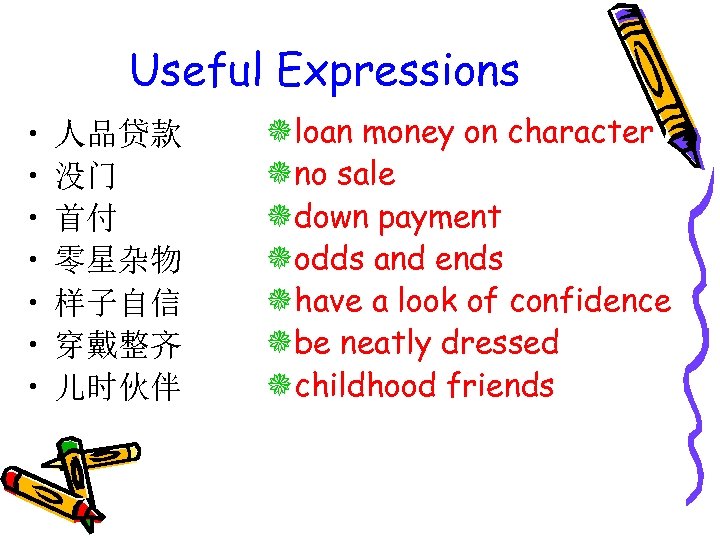
Useful Expressions • • 人品贷款 没门 首付 零星杂物 样子自信 穿戴整齐 儿时伙伴 õloan money on character õno sale õdown payment õodds and ends õhave a look of confidence õbe neatly dressed õchildhood friends
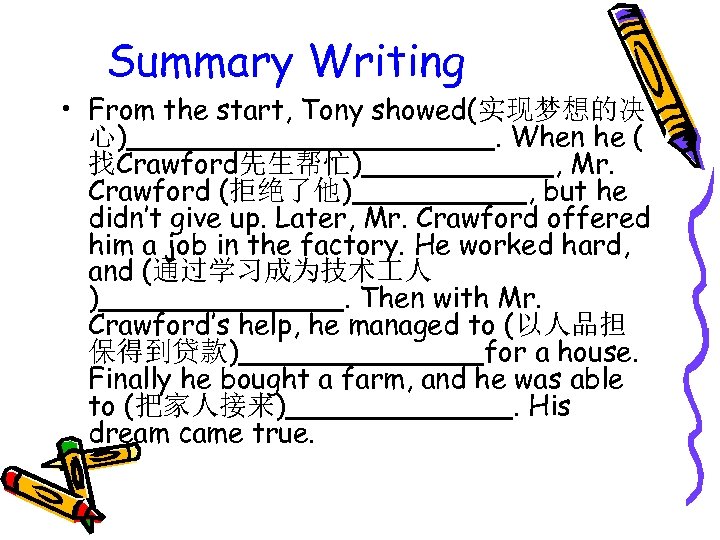
Summary Writing • From the start, Tony showed(实现梦想的决 心)___________. When he ( 找Crawford先生帮忙)______, Mr. Crawford (拒绝了他)_____, but he didn’t give up. Later, Mr. Crawford offered him a job in the factory. He worked hard, and (通过学习成为技术 人 )_______. Then with Mr. Crawford’s help, he managed to (以人品担 保得到贷款)_______for a house. Finally he bought a farm, and he was able to (把家人接来)_______. His dream came true.
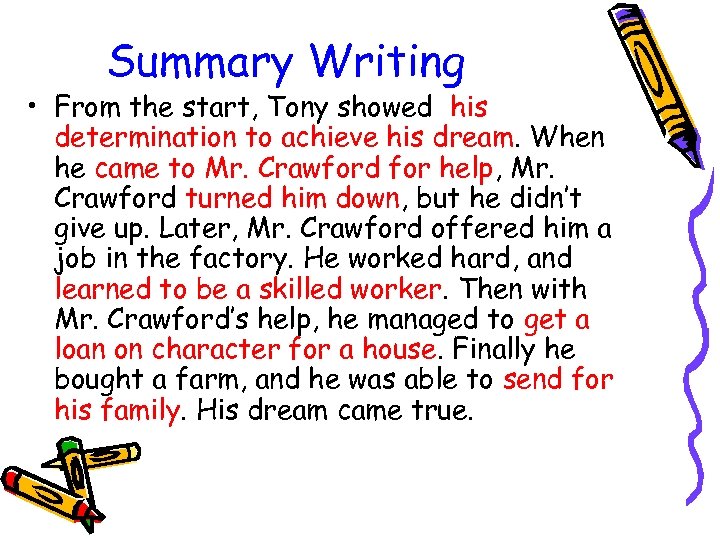
Summary Writing • From the start, Tony showed his determination to achieve his dream. When he came to Mr. Crawford for help, Mr. Crawford turned him down, but he didn’t give up. Later, Mr. Crawford offered him a job in the factory. He worked hard, and learned to be a skilled worker. Then with Mr. Crawford’s help, he managed to get a loan on character for a house. Finally he bought a farm, and he was able to send for his family. His dream came true.
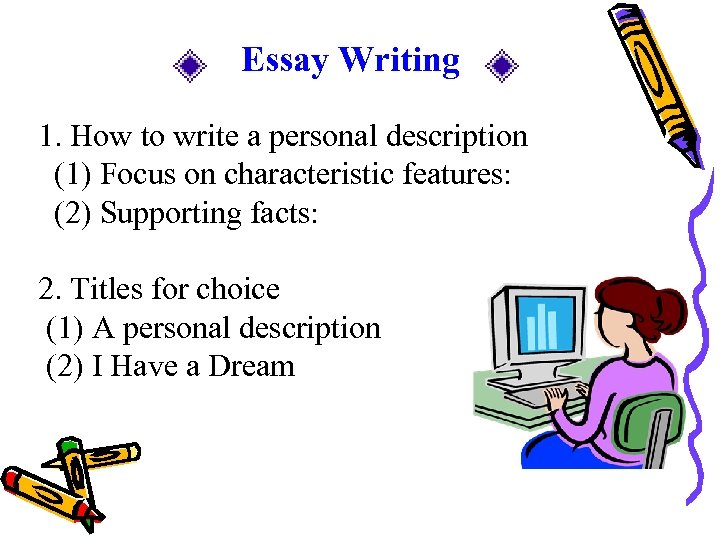
Essay Writing 1. How to write a personal description (1) Focus on characteristic features: (2) Supporting facts: 2. Titles for choice (1) A personal description (2) I Have a Dream
Assignments • Finish exercises of Text A and home reading of Text B • Write an essay about 100 words • Prepare for Unit Five Romance.
 Скачать презентацию Teaching Objectives Get a general idea about American
6a917af9178a4dae07ba9f4f89e9686d.ppt