 Скачать презентацию Teaching Culture by the Textbook and Beyond the
f57a086ddbd5cec1f1e209a8b9304904.ppt
- Количество слайдов: 15



Teaching Culture by the Textbook and Beyond the Textbook Northeast Conference on the Teaching of Foreign Languages Saturday, March 29 2008 Jutta Schmiers-Heller and Annie Falk js 2331@columbia. edu & aef 61@columbia. edu
Overview n Some Theoretical Aspects of Teaching Culture n By the Textbook and Beyond the Textbook: Samples n Questions and Discussion 03/29/08 Teaching Culture by the Textbook and Beyond the Textbook 2
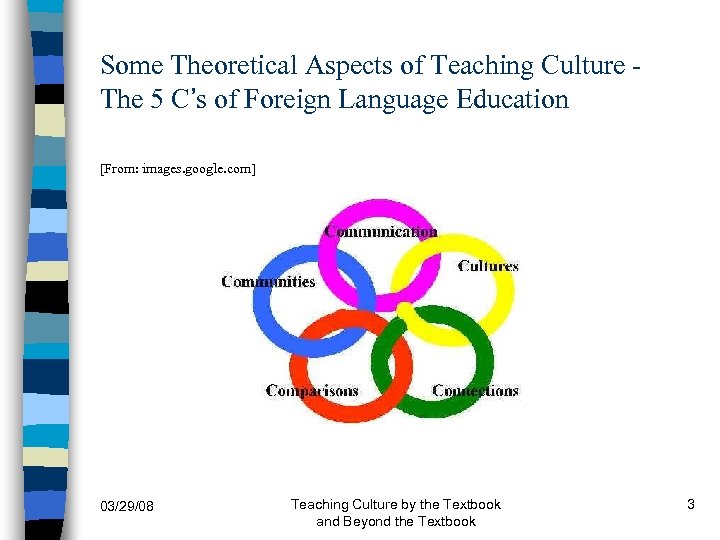
Some Theoretical Aspects of Teaching Culture The 5 C’s of Foreign Language Education [From: images. google. com] 03/29/08 Teaching Culture by the Textbook and Beyond the Textbook 3
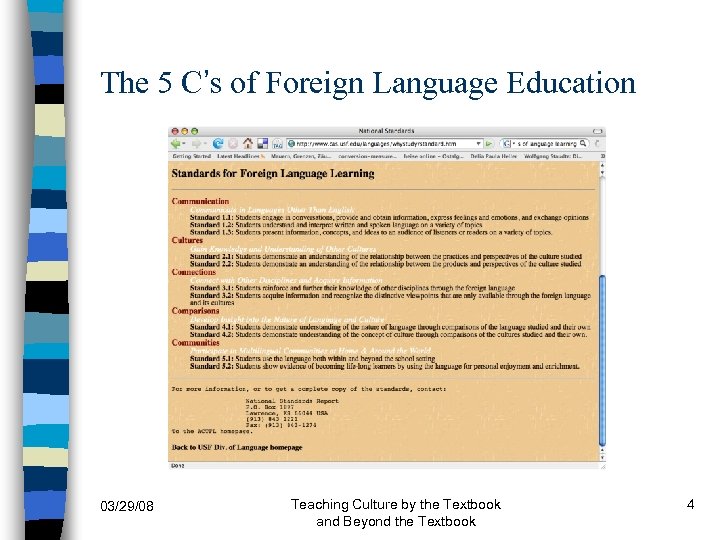
The 5 C’s of Foreign Language Education 03/29/08 Teaching Culture by the Textbook and Beyond the Textbook 4
Some Theoretical Aspects of Teaching Culture The 5 C’s of Foreign Language Education cont. ‘Cultures’ is one of the 5 C’s in the Standards for Foreign Language Learning (see: www. actfl. org) n “Cultures” is defined as follows in the National Standards: n n Gain Knowledge and Understanding of Other Cultures – Standard 2. 1: Students demonstrate an understanding of the relationship between the practices and perspectives of the culture studied – Standard 2. 2: Students demonstrate an understanding of the relationship between the products and perspectives of the culture studied (Shrum/Glisan, 2005) 03/29/08 Teaching Culture by the Textbook and Beyond the Textbook 5
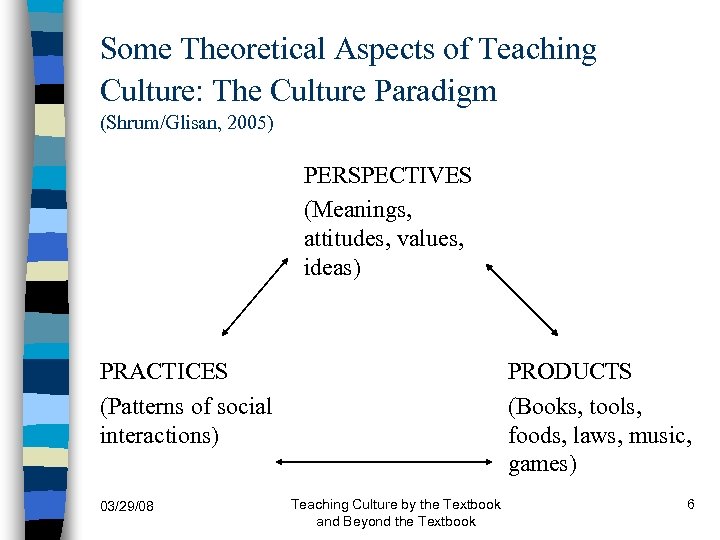
Some Theoretical Aspects of Teaching Culture: The Culture Paradigm (Shrum/Glisan, 2005) PERSPECTIVES (Meanings, attitudes, values, ideas) PRACTICES (Patterns of social interactions) 03/29/08 PRODUCTS (Books, tools, foods, laws, music, games) Teaching Culture by the Textbook and Beyond the Textbook 6
Some Theoretical Aspects of Teaching Culture The 5 C’s of Foreign Language Education cont. All C’s are interconnected and you can find the other 4 C’s in the Cultures C. n Examples: n » Connections: “Connections enable students to further their knowledge of other disciplines, acquire new information, and recognize the distinctive viewpoints that are available only through the foreign language and its cultures. ” (Shrum/Glisan 2005) » Comparisons: “Students demonstrate understanding of the concept of culture through comparisons of the cultures studied and their own. ” (Shrum/Glisan 2005) n Together these elements will lead to: “Knowing how, when and why to say what to whom. ” (http: //www. actfl. org/files/public/execsumm. pdf) 03/29/08 Teaching Culture by the Textbook and Beyond the Textbook 7
The Presentation of Culture n “Big C” vs. “little C” Culture • Big C: formal culture - arts, literature, music, history • Small c: daily life culture - anthropological and sociological aspects (e. g. : social behavior, beliefs, housing, food, and transportation) (Brooks, 1975) n Four Common Approaches to Teaching Culture: • The Frankenstein Approach: a taco from here, a flamenco dancer from there, a gaucho from here, etc. • The 4 -F Approach: folk dances, festivals, fairs, food • The Tour Guide Approach: identification of monuments, rivers, and cities • The “By-the-Way” Approach: sporadic lectures or bits of behavior selected indiscriminately to emphasize sharp differences (Galloway, 1985) 03/29/08 Teaching Culture by the Textbook and Beyond the Textbook 8
The Presentation of Culture - Issues Culture has been traditionally treated in the classroom by giving facts and information. Þ Information acquisition approach n Making culture an integral part of the classroom is a challenging task for teachers. n – We often feel that we don’t have time for culture. – Teachers do not always have sufficient cultural experiences themselves and find it difficult to integrate them into the linguistic part of the language class. n Learners do not always understand the relationship between language and culture. 03/29/08 Teaching Culture by the Textbook and Beyond the Textbook 9
The Process-Oriented vs. the Information -Acquisition Approach The latter: cultural information is presented by the teacher. n The former: n – based on the cultural paradigm which includes practices, products, and perspectives as outlined in the standards (slide 6) – allows students to learn about culture, by constructing their own views of culture through social interaction and interpersonal communication => constructivist approach (Shrum/Glisan, 2005) 03/29/08 Teaching Culture by the Textbook and Beyond the Textbook 10
Basic Structure of Any Activity n Basic Structure: – – n Warm-up/Introduction Modeling/Presentation of New Material Meaningful Activity/Activities Wrap-up Other Considerations: – – Contextualization Varying of Activities Transitions between Activities Keeping the Pace (5 -15 minutes) (Omaggio Hadley, 2001) 03/29/08 Teaching Culture by the Textbook and Beyond the Textbook 11
By the Book and Beyond – Where is the culture in my book? n Culture can be found in different ways: – as part of the presentation of material by the teacher – in various parts of the book (vocabulary, dialogs, reading passages, pictures, etc. ) – presented in special boxes labeled ‘Culture’ (can be used in a concrete way or as inspiration) 03/29/08 Teaching Culture by the Textbook and Beyond the Textbook 12
Some Sources for Taking You beyond the Textbook Your colleagues Websites [with a fairly simple surface structure – see WG/ Kafka/dating/ greeting cards/ restaurant menus/ hotels/ train, bus, movie schedules/ shopping websites (IKEA, clothing)/ university sites and course catalogs, etc. ] n Samples: n n – WG: www. wggesucht. de; – Kafka: http: //www. kafka. uni-bonn. de/cgibin/kafka? Rubrik=biographie&Punkt=genealogie or http: //www. franzkafka. de/franzkafka/home/ ; – Dating: www. yahoo. de (click on dating); – Reisen: http: //www. bahn. de, http: //www. hbf-berlin. de n Songs (itunes, youtube), video, podcasts (www. dwelle. de; http: //podster. de/; or google) 03/29/08 Teaching Culture by the Textbook and Beyond the Textbook 13
References n n n Brooks, N. (1785). The Analysis of language and familiar cultures. In R. C. Lafayette (Ed. ), The cultural revolution (pp. 19 -31). Reports on the Central States Conference on Foreign Language Education. Lincolnwood. IL: NTC/Contemporary Publishing Group. Galloway, V. B. (1985). A design for the improvement of the teaching of culture in foreign language classrooms. ACTFL project proposal. Yonkers, NY: American Concil on the Teaching of Foreign Languages. http: //images. google. com http: //www. actfl. org/files/public/execsumm. pdf Omaggio Hadley, A. (2001). Teaching Language in Context. Boston : Heinle & Heinle. Shrum, J. & Glisan, E. (2005). Teacher’s Handbook: Contextualized Language Instruction. Boston : Heinle & Heinle. 03/29/08 Teaching Culture by the Textbook and Beyond the Textbook 14
By the Book and Beyond Examples n n n Family The German ‘WG’ Transportation/Environment Fairy Tales: Biermann Health/Sickness – Worksheet – Text 03/29/08 Teaching Culture by the Textbook and Beyond the Textbook 15
Скачать презентацию Teaching Culture by the Textbook and Beyond the
f57a086ddbd5cec1f1e209a8b9304904.ppt