 Скачать презентацию Teaching Clinicians to Fish Library Skills for EBP
f2be172e209cae1a349aa6afb8a72dda.ppt
- Количество слайдов: 58



Teaching Clinicians to Fish Library Skills for EBP Margaret (Peg) Allen, MLS-AHIP pegallen@verizon. net
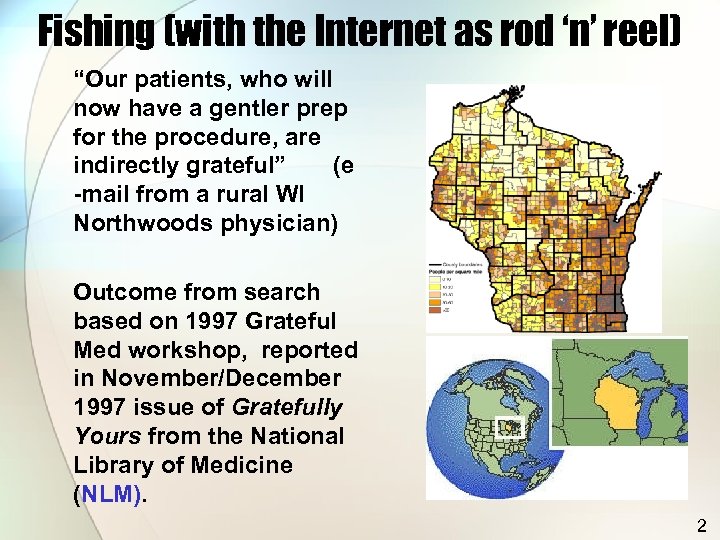
Fishing (with the Internet as rod ‘n’ reel) “Our patients, who will now have a gentler prep for the procedure, are indirectly grateful” (e -mail from a rural WI Northwoods physician) Outcome from search based on 1997 Grateful Med workshop, reported in November/December 1997 issue of Gratefully Yours from the National Library of Medicine (NLM). 2
Objectives • Access, appraise, and rate various forms of evidence for improving care • Identify and retrieve resources relevant to clinical practice decisions, including Discovery, Summary and Translation literature • Specify and acquire competencies needed in the healthcare workforce for expanded roles in evidence-based quality improvement. • Propose health information literacy competencies as basis for EBP practice and shared decision making • Use existing (national and local) partnerships and newly created resources to integrate evidence-based practice into health care, education, and research. • Develop partnerships with library systems, publishers, and health science librarians to improve access to EBP resources 3
Questions • Where is “the literature” today? 4
Questions • Where is “the literature” today? • Health information literacy – who needs it? 4
Questions • Where is “the literature” today? • Health information literacy – who needs it? • Can we teach clinicians to efficiently search the literature supporting EBP? 4
Questions • Where is “the literature” today? • Health information literacy – who needs it? • Can we teach clinicians to efficiently search the literature supporting EBP? • When (and where) should we teach? 4
Questions • Where is “the literature” today? • Health information literacy – who needs it? • Can we teach clinicians to efficiently search the literature supporting EBP? • When (and where) should we teach? • What should they learn – do they really need to be expert searchers? 4
Where is “the literature” today? Before going fishing, we need to know what kind of fish we’re looking for and the best fishing spots… Trends in scientific publication: • Internet publication • Online journals – not all free http: //www. nursingworld. org/ojin/admin/topics. htm • • Open access movement http: //www. nursingworld. org/ojin/ Peer Review? Medical news; direct to consumer ads Database coverage and indexing practices 5
What do nurses cite? Will this change? Mapping the literature of nursing: 1996– 2000. Margaret (Peg) Allen, Susan Kaplan Jacobs, and June R. Levy. J Med Libr Assoc. 2006 April; 94(2): 206– 220. Overview article and Online Symposium: http: //www. pubmedcentral. nih. gov/tocrender. fcgi? issn=1536 -5050 • Citation analysis • 18 studies: general & specialties • 53 source journals • Research sponsored by Nursing and Allied Health Resources Section of the Medical Library Association, NAHRS/MLA 6
Citation analysis Cited references from 3 years of the selected source journals were analyzed for each of the 18 areas. Study data was combined for comparison in the overview article. We looked at: • Publication years cited • Cited formats • Dispersion by zones of 3 equal numbers of citations 7
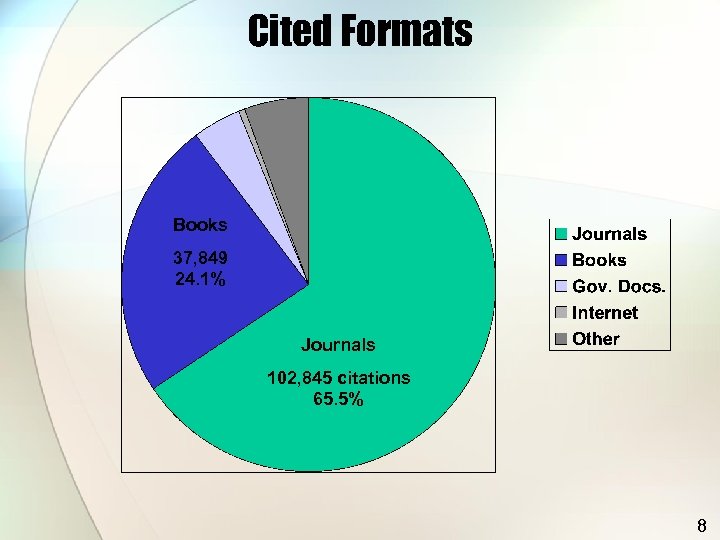
Cited Formats Books 37, 849 24. 1% Journals 102, 845 citations 65. 5% 8
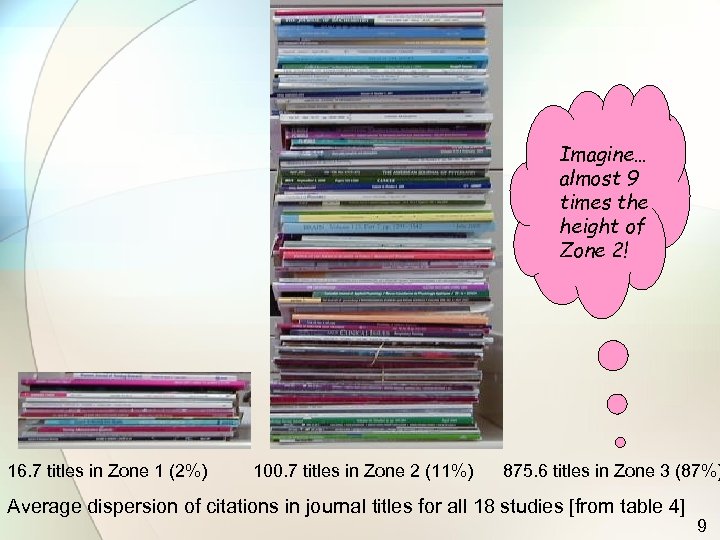
Imagine… almost 9 times the height of Zone 2! 16. 7 titles in Zone 1 (2%) 100. 7 titles in Zone 2 (11%) 875. 6 titles in Zone 3 (87%) Average dispersion of citations in journal titles for all 18 studies [from table 4] 9
We looked at database coverage of most frequently cited titles in zones 1 & 2 Overview article • Table 4 notes database coverage by area of study • Table 5 lists the top 115 most highly cited “nursing, ” “biomedical, ” and “social science” journals and the database coverage of each journal in the years 1998 and 2002 • CINAHL best coverage for nursing • Science Citation Index & Pub. Med/ MEDLINE best for biomedical journal titles 10
Mapping conclusions (limited) • Library collections should be based on needs of specialties served, including utilization as well as the relative “citedness” • CINAHL and MEDLINE should be searched for all nursing questions • Databases claiming coverage of nursing should increase coverage, particularly ISI Web of Science/Social Science Citation Index • Database choices beyond CINAHL and MEDLINE should be based on the question topic 11
Peer Review: What does it mean? Publisher-defined peer review practices in CINAHL® database: • BP= Blind peer-review • DP = Double-blind • EB = Editorial Board review • XP = Expert Peer review Allen, M. Key and electronic nursing journals, © 2006 Cinahl Information Systems Instructions to Authors in the Health Sciences http: //mulford. mco. edu/instr/ 12
Medical news Health news is everywhere! • Website news feeds: Medline Plus example http: //www. medlineplus. gov • Research behind the news: Health and Medicine in the News http: //www. biomed. lib. umn. edu/hmed/ • News evaluation: Health. News. Review. org (Foundation for Informed Medical Decision Making) http: //www. healthnewsreview. org/ 13
Direct-to-consumer drug advertising • Debated practice – drug company use suggests that it works! • Only legal only in U. S. and New Zealand • Pub. Med search results: www. pubmed. gov 14
Health Information Literacy • Health Literacy is …. . . the ability to read, understand, and act on health information. [Pfizer, 2002]. . . the degree to which individuals have the capacity to obtain, process, and understand basic health information and services needed to make appropriate health decisions. [Healthy People 2010, 2000] • Information Literacy is …. . . a set of abilities enabling individuals to "recognize when information is needed and have the ability to locate, evaluate, and use effectively the needed information. " [American Library Association, 1989] 15
Working Definition of Health Information Literacy is the set of abilities needed to: recognize a health information need; identify likely information sources and use them to retrieve relevant information; assess the quality of the information and its applicability to a specific situation; and analyze, understand, and use the information to make good health decisions. [Medical Library Association, July 23, 2003] http: //www. mlanet. org/resources/healthlit/define. html 16
Health Information Literacy Everyone is fishing! What fish do they catch? Medical Library Association vision: “quality information for improved health” • All people need to evaluate resources • Professionals need to understand health literacy challenges and share information Example: Foundation for Informed Medical Decision Making Shared Decision Making – EBP value http: //www. fimdm. org/shared_decision_making. php 17
Health Literacy Campaigns AMA Foundation Health Literacy http: //www. amaassn. org/ama/pub/category/8115. html Ask me I can help Partnership for Clear Health Communication http: //www. askme 3. org/PFCHC/ MLA Health Information Literacy http: //www. mlanet. org/resources/healthlit/ 18
What does this mean for clinicians? • Define core health information literacy competencies • • Critical thinking Informatics skills Knowledge of information environment Comprehend and value research • Address competencies in education and practice Example with bibliography: • Nursing & Allied Health Information Literacy, Northwestern State University, LA (Susan T. Pierce, Ed. D, MSN, RN and others) http: //www. nsula. edu/watson_library/shreve/nurse_info_lit. htm 19
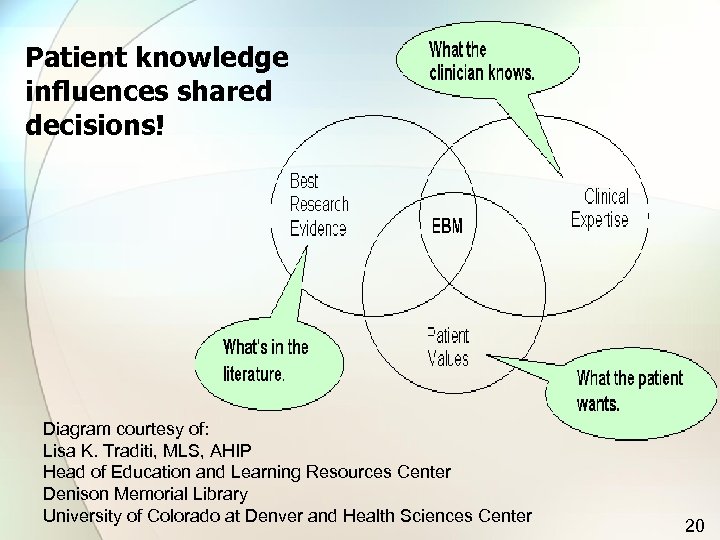
Patient knowledge influences shared decisions! Diagram courtesy of: Lisa K. Traditi, MLS, AHIP Head of Education and Learning Resources Center Denison Memorial Library University of Colorado at Denver and Health Sciences Center 20
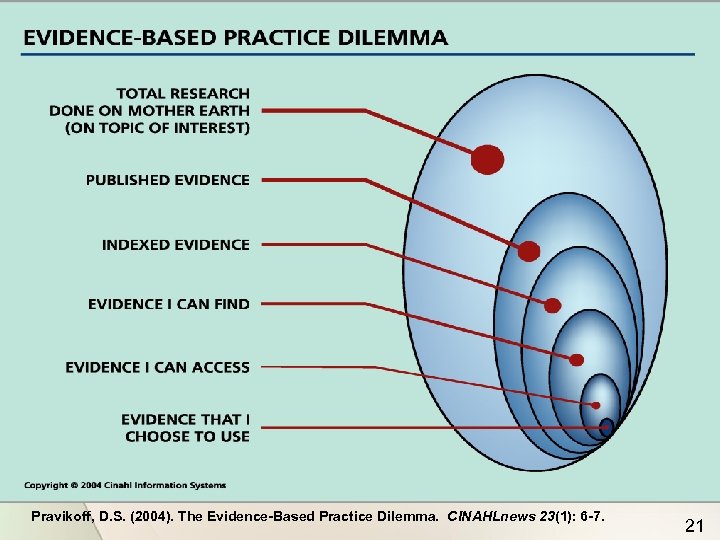
Pravikoff, D. S. (2004). The Evidence-Based Practice Dilemma. CINAHLnews 23(1): 6 -7. 21
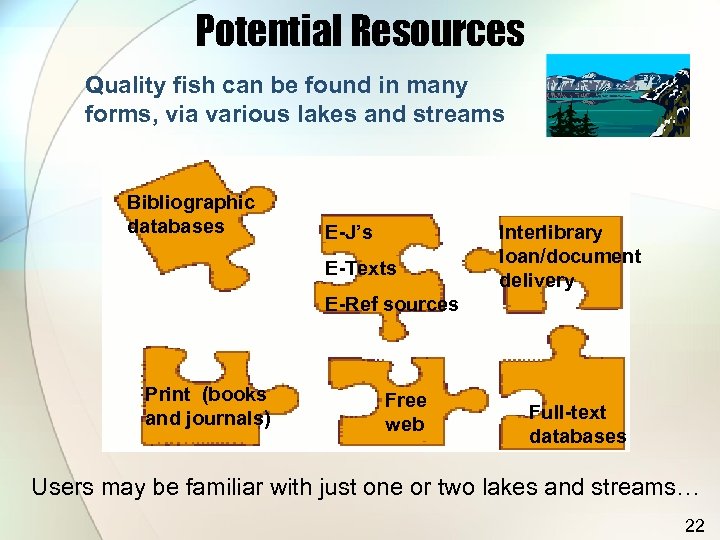
Potential Resources Quality fish can be found in many forms, via various lakes and streams Bibliographic databases E-J’s E-Texts Interlibrary loan/document delivery E-Ref sources Print (books and journals) Free web Full-text databases Users may be familiar with just one or two lakes and streams… 22
Can we teach clinicians to search efficiently? • Despite improved bibliographic database access, most physicians first ask a colleague, consult a clinical reference database or ask a librarian when they have a clinical question. (Coumou, H. C. , & Meijman, F. J. (2006). How do primary care physicians seek answers to clinical questions? A literature review. J Med Libr Assoc, 94(1), 55 -60. ) • Nurses in the U. S. search the Internet more than any other source. Those searching MEDLINE and CINAHL are not confident in their searching ability. (Pravikoff, D. S. , Tanner, A. B. , & Pierce, S. T. (2005). Readiness of U. S. Nurses for Evidence-Based Practice. American Journal of Nursing, 105(9), 40 -51. ) 23
When (and where) should we teach? • Search instruction needs to be related to meaningful student and work assignments. • Course-integrated instruction: make literature search relevant to patient care • Magnet hospital example: EBP certificate with searching module and project 24
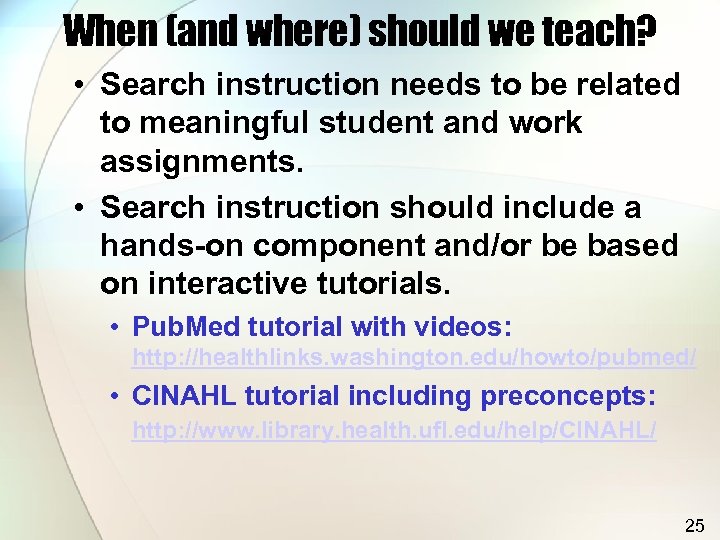
When (and where) should we teach? • Search instruction needs to be related to meaningful student and work assignments. • Search instruction should include a hands-on component and/or be based on interactive tutorials. • Pub. Med tutorial with videos: http: //healthlinks. washington. edu/howto/pubmed/ • CINAHL tutorial including preconcepts: http: //www. library. health. ufl. edu/help/CINAHL/ 25
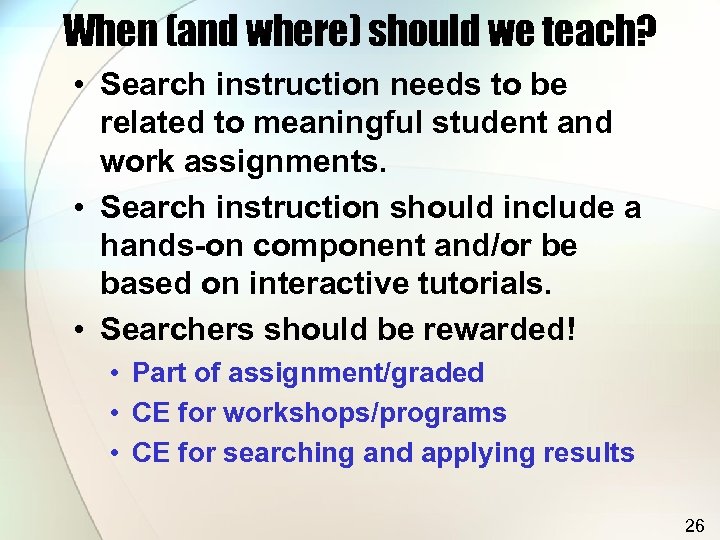
When (and where) should we teach? • Search instruction needs to be related to meaningful student and work assignments. • Search instruction should include a hands-on component and/or be based on interactive tutorials. • Searchers should be rewarded! • Part of assignment/graded • CE for workshops/programs • CE for searching and applying results 26
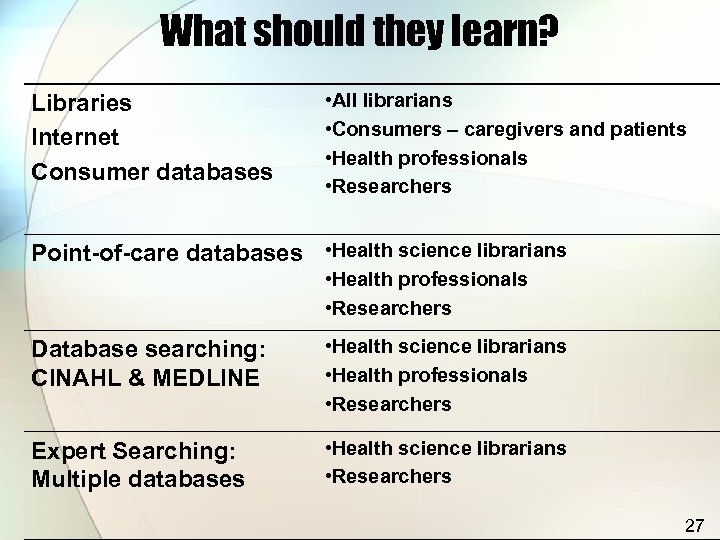
What should they learn? Libraries Internet Consumer databases • All librarians • Consumers – caregivers and patients • Health professionals • Researchers Point-of-care databases • Health science librarians • Health professionals • Researchers Database searching: CINAHL & MEDLINE • Health science librarians • Health professionals • Researchers Expert Searching: Multiple databases • Health science librarians • Researchers 27
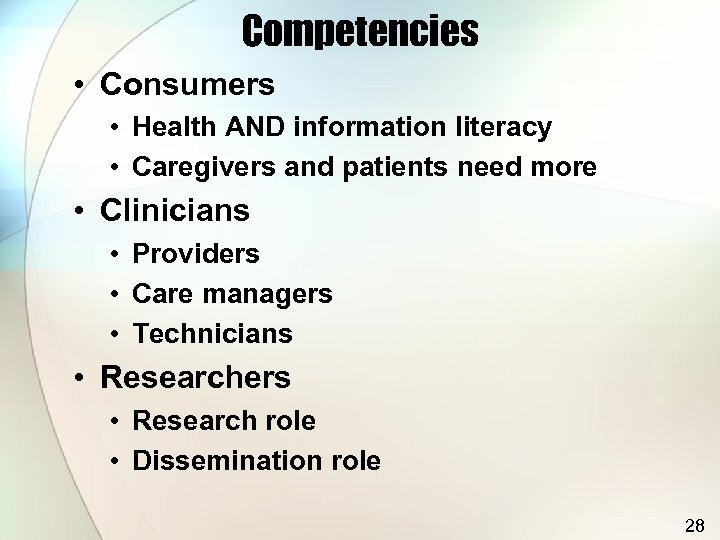
Competencies • Consumers • Health AND information literacy • Caregivers and patients need more • Clinicians • Providers • Care managers • Technicians • Researchers • Research role • Dissemination role 28
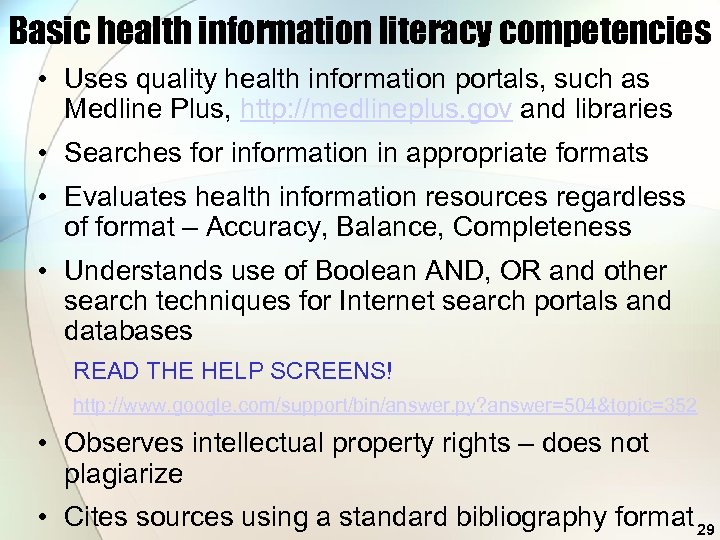
Basic health information literacy competencies • Uses quality health information portals, such as Medline Plus, http: //medlineplus. gov and libraries • Searches for information in appropriate formats • Evaluates health information resources regardless of format – Accuracy, Balance, Completeness • Understands use of Boolean AND, OR and other search techniques for Internet search portals and databases READ THE HELP SCREENS! http: //www. google. com/support/bin/answer. py? answer=504&topic=352 • Observes intellectual property rights – does not plagiarize • Cites sources using a standard bibliography format 29
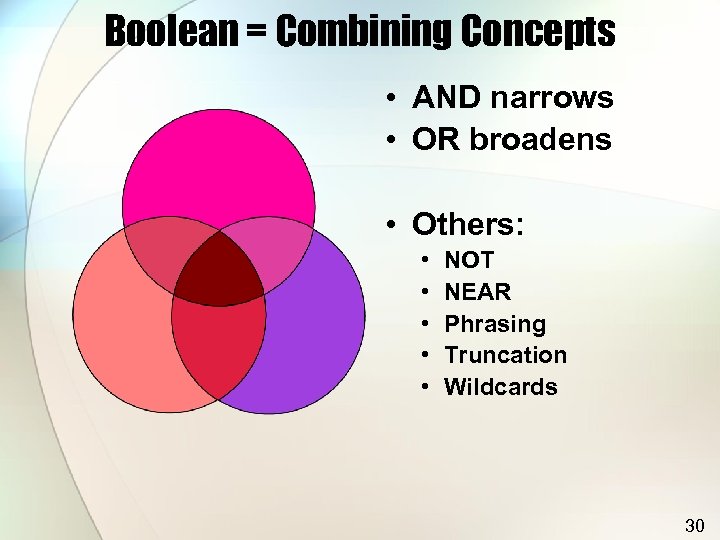
Boolean = Combining Concepts • AND narrows • OR broadens • Others: • • • NOT NEAR Phrasing Truncation Wildcards 30
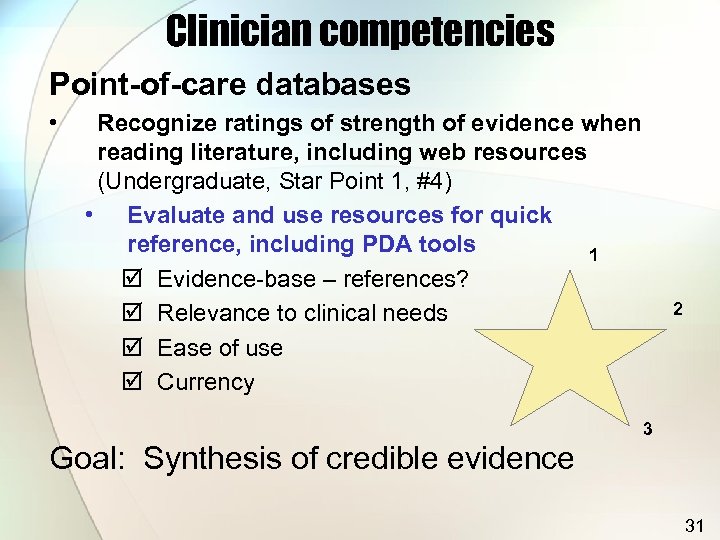
Clinician competencies Point-of-care databases • Recognize ratings of strength of evidence when reading literature, including web resources (Undergraduate, Star Point 1, #4) • Evaluate and use resources for quick reference, including PDA tools 1 þ Evidence-base – references? þ Relevance to clinical needs þ Ease of use þ Currency 2 3 Goal: Synthesis of credible evidence 31
Point-of-care examples • Dyna. Med http: //www. dynamicmedical. com/ • Alper, B. S. , White, D. S. , & Ge, B. (2005). Physicians answer more clinical questions and change clinical decisions more often with synthesized evidence: a randomized trial in primary care. Ann Fam Med, 3(6), 507 -513. • CINAHL Plus Evidence Based Care Sheets • Journal articles? Example: Evidence based clinical updates in anesthesia http: //www. cja-jca. org/misc/ifora/ebcu. shtml http: //www. cja-jca. org/cgi/content/full/52/6/650? view=long&pmid=15983155 32
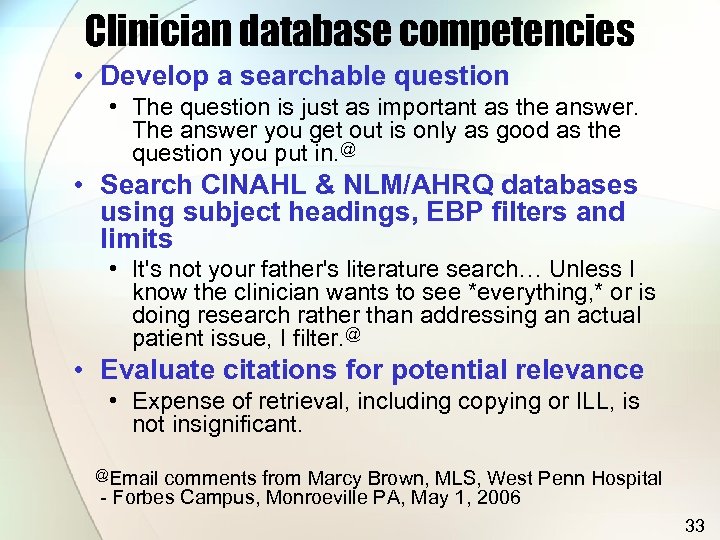
Clinician database competencies • Develop a searchable question • The question is just as important as the answer. The answer you get out is only as good as the question you put in. @ • Search CINAHL & NLM/AHRQ databases using subject headings, EBP filters and limits • It's not your father's literature search… Unless I know the clinician wants to see *everything, * or is doing research rather than addressing an actual patient issue, I filter. @ • Evaluate citations for potential relevance • Expense of retrieval, including copying or ILL, is not insignificant. @Email comments from Marcy Brown, MLS, West Penn Hospital - Forbes Campus, Monroeville PA, May 1, 2006 33
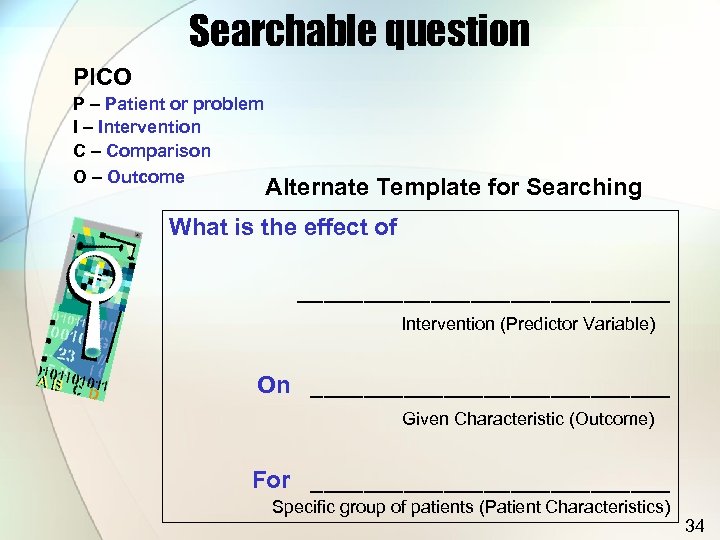
Searchable question PICO P – Patient or problem I – Intervention C – Comparison O – Outcome Alternate Template for Searching What is the effect of ______________ Intervention (Predictor Variable) On ______________ Given Characteristic (Outcome) For ______________ Specific group of patients (Patient Characteristics) 34
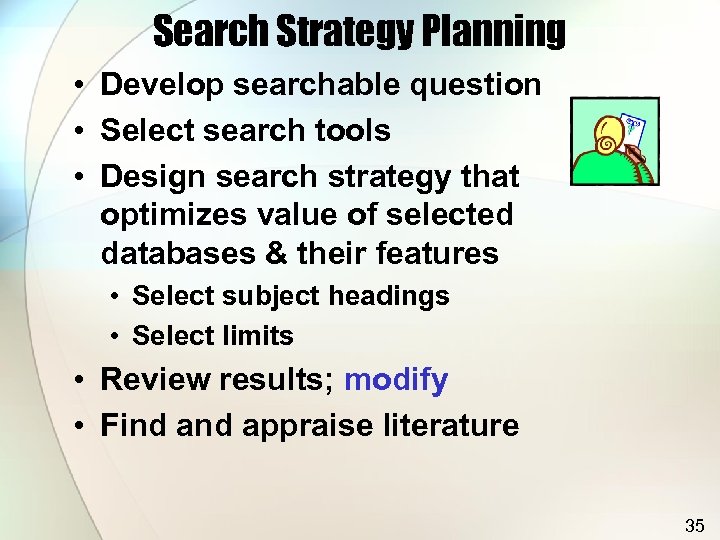
Search Strategy Planning • Develop searchable question • Select search tools • Design search strategy that optimizes value of selected databases & their features • Select subject headings • Select limits • Review results; modify • Find appraise literature 35
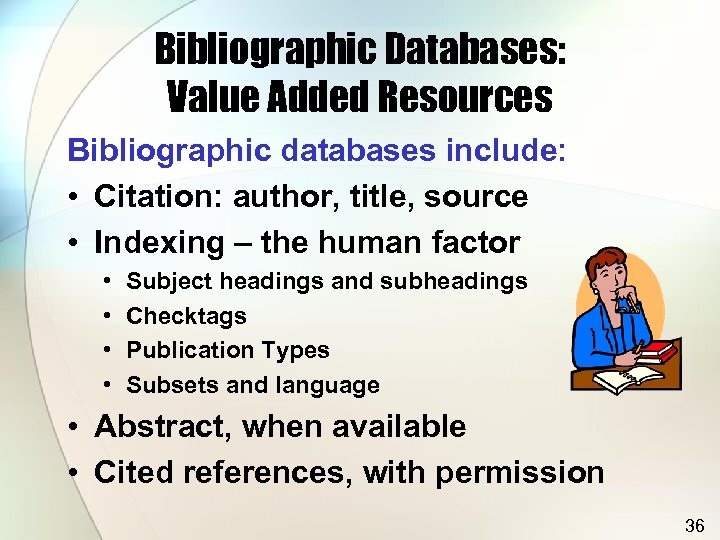
Bibliographic Databases: Value Added Resources Bibliographic databases include: • Citation: author, title, source • Indexing – the human factor • • Subject headings and subheadings Checktags Publication Types Subsets and language • Abstract, when available • Cited references, with permission 36
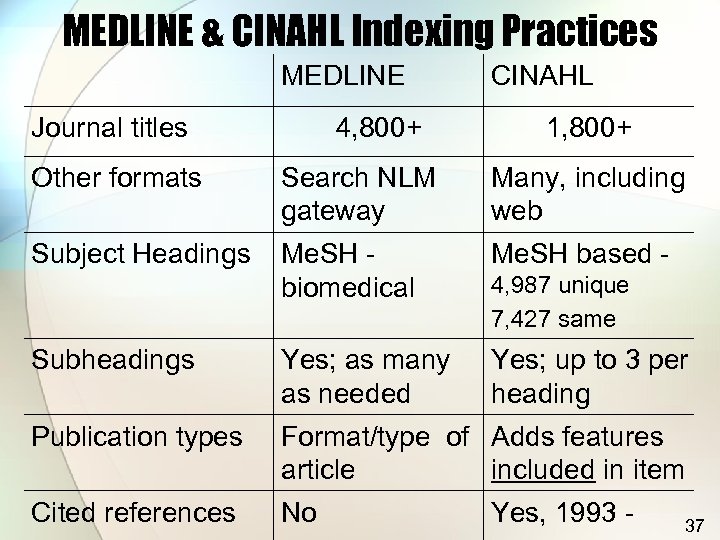
MEDLINE & CINAHL Indexing Practices MEDLINE Journal titles 4, 800+ CINAHL 1, 800+ Other formats Search NLM gateway Many, including web Subject Headings Me. SH - biomedical Me. SH based - Subheadings Yes; as many as needed Yes; up to 3 per heading Publication types Format/type of Adds features article included in item Cited references No 4, 987 unique 7, 427 same Yes, 1993 - 37
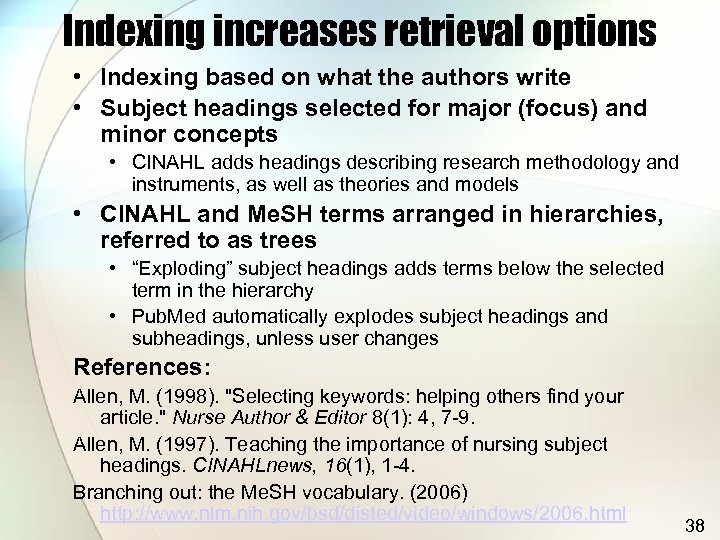
Indexing increases retrieval options • Indexing based on what the authors write • Subject headings selected for major (focus) and minor concepts • CINAHL adds headings describing research methodology and instruments, as well as theories and models • CINAHL and Me. SH terms arranged in hierarchies, referred to as trees • “Exploding” subject headings adds terms below the selected term in the hierarchy • Pub. Med automatically explodes subject headings and subheadings, unless user changes References: Allen, M. (1998). "Selecting keywords: helping others find your article. " Nurse Author & Editor 8(1): 4, 7 -9. Allen, M. (1997). Teaching the importance of nursing subject headings. CINAHLnews, 16(1), 1 -4. Branching out: the Me. SH vocabulary. (2006) http: //www. nlm. nih. gov/bsd/disted/video/windows/2006. html 38
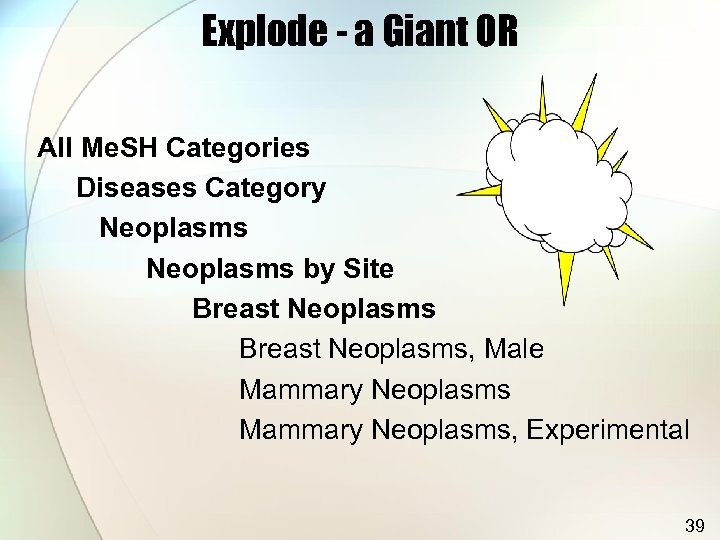
Explode - a Giant OR All Me. SH Categories Diseases Category Neoplasms by Site Breast Neoplasms, Male Mammary Neoplasms, Experimental 39
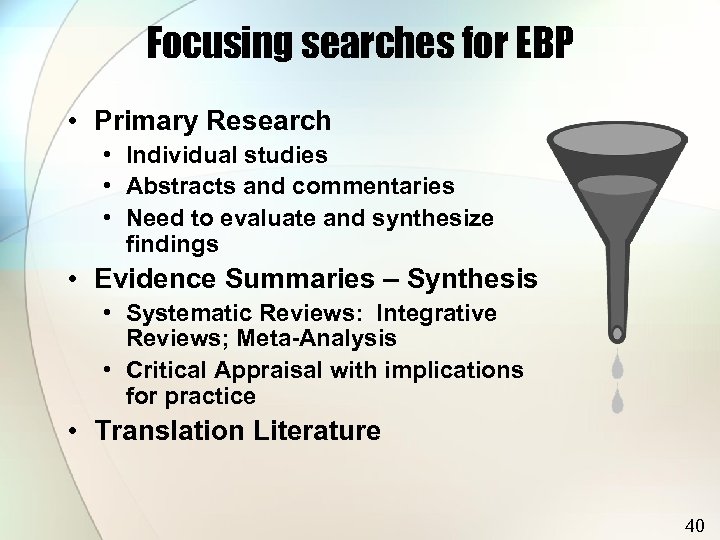
Focusing searches for EBP • Primary Research • Individual studies • Abstracts and commentaries • Need to evaluate and synthesize findings • Evidence Summaries – Synthesis • Systematic Reviews: Integrative Reviews; Meta-Analysis • Critical Appraisal with implications for practice • Translation Literature 40
Translation Literature = Best Practices • • Practice guidelines Care plans Critical paths Protocols Standards Clinical innovations Others in your organization? 41
Start with the quality-filtered resources! 1. Translation Literature – Practice guidelines • Are they evidence-based? 2. Look for: systematic reviews; meta-analysis; critical appraisal 3. What’s new? • • Primary Research Abstracts Research in progress Propose new research? 42
EBP search demonstration • Subject Headings • EBP Filters • Other limits? Question: What should we do to prevent pressure ulcers in our elderly patients? 43
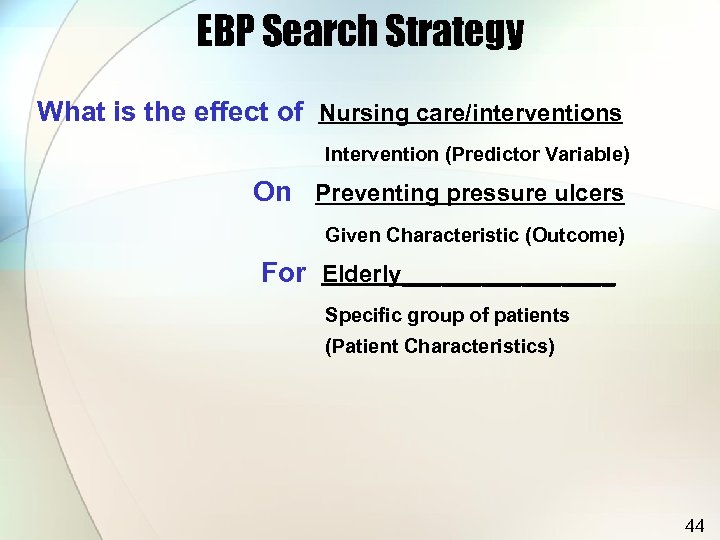
EBP Search Strategy What is the effect of Nursing care/interventions Intervention (Predictor Variable) On Preventing pressure ulcers Given Characteristic (Outcome) For Elderly________ Specific group of patients (Patient Characteristics) 44
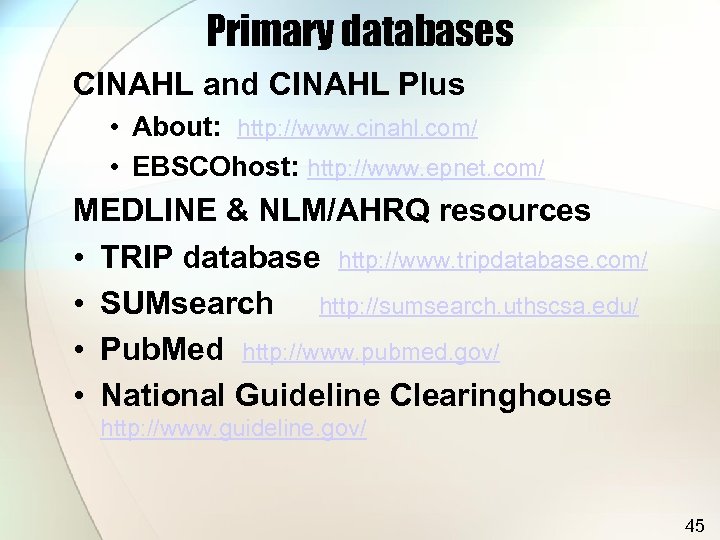
Primary databases CINAHL and CINAHL Plus • About: http: //www. cinahl. com/ • EBSCOhost: http: //www. epnet. com/ MEDLINE & NLM/AHRQ resources • TRIP database http: //www. tripdatabase. com/ • SUMsearch http: //sumsearch. uthscsa. edu/ • Pub. Med http: //www. pubmed. gov/ • National Guideline Clearinghouse http: //www. guideline. gov/ 45
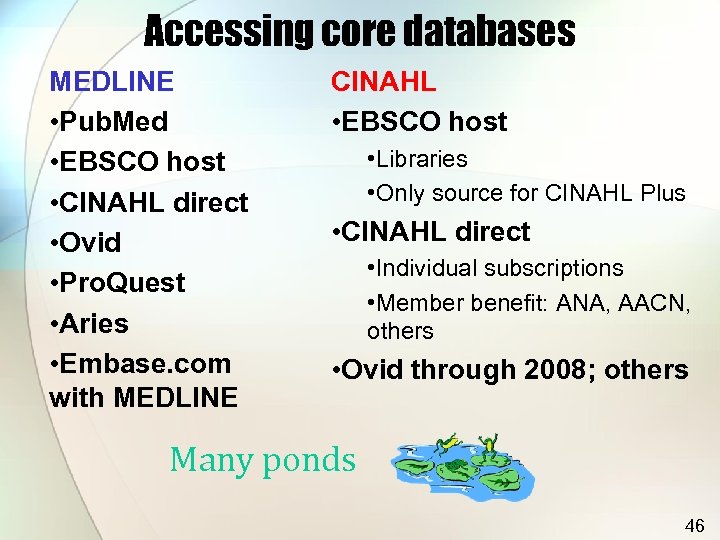
Accessing core databases MEDLINE • Pub. Med • EBSCO host • CINAHL direct • Ovid • Pro. Quest • Aries • Embase. com with MEDLINE CINAHL • EBSCO host • Libraries • Only source for CINAHL Plus • CINAHL direct • Individual subscriptions • Member benefit: ANA, AACN, others • Ovid through 2008; others Many ponds 46
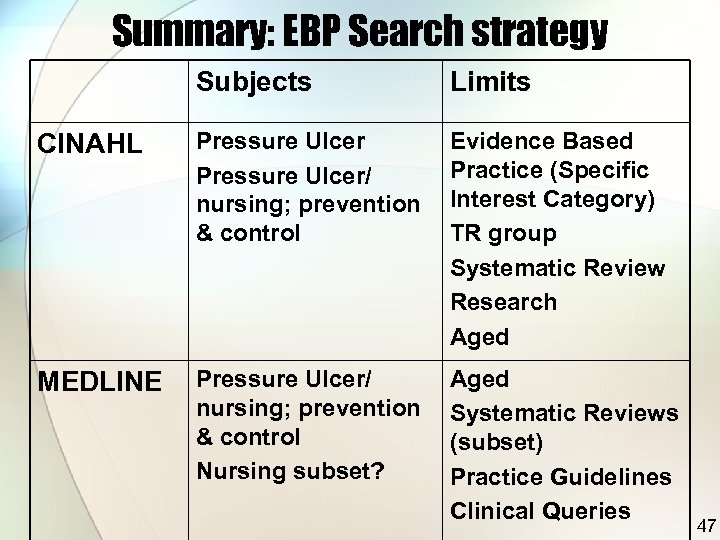
Summary: EBP Search strategy Subjects Limits CINAHL Pressure Ulcer/ nursing; prevention & control Evidence Based Practice (Specific Interest Category) TR group Systematic Review Research Aged MEDLINE Pressure Ulcer/ nursing; prevention & control Nursing subset? Aged Systematic Reviews (subset) Practice Guidelines Clinical Queries 47
![Useful Limits for Evidence-Based Searching CINAHL Pub. Med/MEDLINE Translation Literature Care Plan [PT] OR](https://present5.com/presentation/f2be172e209cae1a349aa6afb8a72dda/image-52.jpg "Useful Limits for Evidence-Based Searching CINAHL Pub. Med/MEDLINE Translation Literature Care Plan [PT] OR")
Useful Limits for Evidence-Based Searching CINAHL Pub. Med/MEDLINE Translation Literature Care Plan [PT] OR Clinical Innovations [PT] OR Critical Path [PT] OR Practice Guidelines [PT] OR Protocol [PT] OR Standards [PT] OR Algorithm [PT] OR Evidence Based Care Sheet [PT; C+ only] Optional: CEU [PT] Practice Guideline [PT] OR Guideline [PT] Clinical Protocols [MH] OR Critical Pathways [MH] OR Decision Trees [MH] OR Standards [subheading] Systematic [sb] NOT (Clinical Trial OR Review [PT] OR Meta-Analysis [PT]) Evidence Summaries Systematic Review [PT] Commentary [PT] with Research or Review Systematic [sb] AND (Review [PT]) OR Meta-Analysis [PT]) Primary Research [PT] Clinical Trials [PT] OR RCT [PT] Validation Studies [PT] Has abstract Pub. Med Clinical queries OR SUMsearch Clinical queries 48
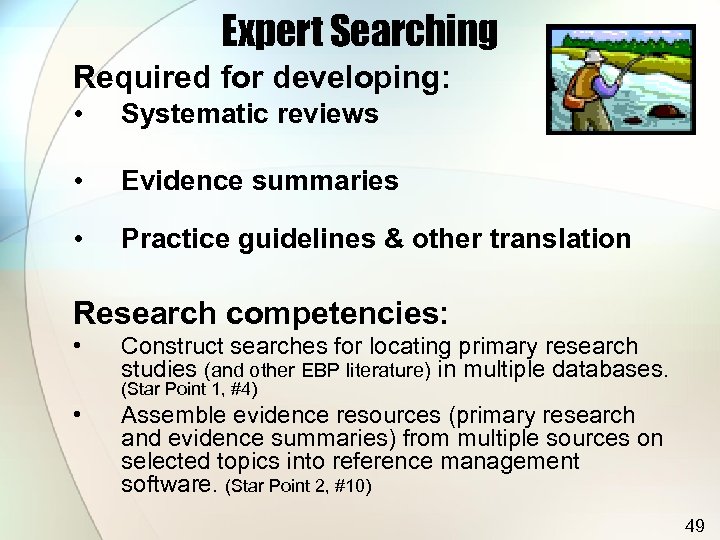
Expert Searching Required for developing: • Systematic reviews • Evidence summaries • Practice guidelines & other translation Research competencies: • Construct searches for locating primary research studies (and other EBP literature) in multiple databases. (Star Point 1, #4) • Assemble evidence resources (primary research and evidence summaries) from multiple sources on selected topics into reference management software. (Star Point 2, #10) 49
THINKING ABOUT A FISHING GUIDE? Consider collaborative searching • Working side-by-side with a librarian is best way to learn about comprehensive searching • Researchers need to know when librarian search is needed • Example of author guidelines suggesting working with librarian: Canadian Journal of Anesthesia Evidence-Based Clinical Updates (EBCU’s) in Anesthesia http: //www. cja-jca. org/misc/ifora/ebcu. shtml • Standards for systematic reviews should include expert searchers, preferably experienced librarians
Librarian roles Expert searching • Patient-focused clinical questions • Selecting point-of-care information resources • STAT searches • Guidelines development – “best practices” • Systematic review searches • Resources for client education • Research support • Collaborative searches • Research team member • Management and education issues • Comprehensive searches for practice improvement – multiple databases Teaching • Search skills for users • Partnership with faculty and staff educators Support for patients, families, and consumers 51
Recommendations • Provide library resources • Professional librarian: MLS • AHIP preferred (MLA Academy of Health Information Professionals) • Include in EBP initiatives • Collection developed with user input • Access from point-of-care • Work collaboratively with state and national organizations to improve access to health information and standards for health information literacy • MLA/NAHRS and ICIRN collaboration: Allen, M. P. , Jacobs, S. K. , Levy, J. , Pierce, S. , Pravikoff, D. S. , & Tanner, A. (2005). Continuing education as a catalyst for inter-professional collaboration. Medical Reference Services Quarterly, 24(3), 93 -102. 52
Comments from a colleague… • It's too difficult to keep up with the best research evidence all alone. Librarians can help by doing what we do best. If you don't have a librarian near you, ask for one to come provide searching training to your staff, department, team, etc. • Good literature searching takes practice, then more practice. Once you've learned to find the evidence, stay current with your searching skills in all the databases from which you've gotten the highest yield on your topic-- then rely on your librarian to search the rest of the resources. (Email comments from Lisa Traditi, MLS, AHIP, University of Colorado) 53
Questions? Read more about it: • Presentations page http: //www. pegallen. net • NAHRS website http: //nahrs. library. kent. edu/ 54
Скачать презентацию Teaching Clinicians to Fish Library Skills for EBP
f2be172e209cae1a349aa6afb8a72dda.ppt