


 Скачать презентацию Teaching and Evaluating the Use of Technology to
53e3eb4eb11a93cfeb9ee058ea0215c3.ppt
- Количество слайдов: 44
 Teaching and Evaluating the Use of Technology to Communicate with Patients Outside the Exam Room STFM Pre-Doc Conference February, 2006 SC
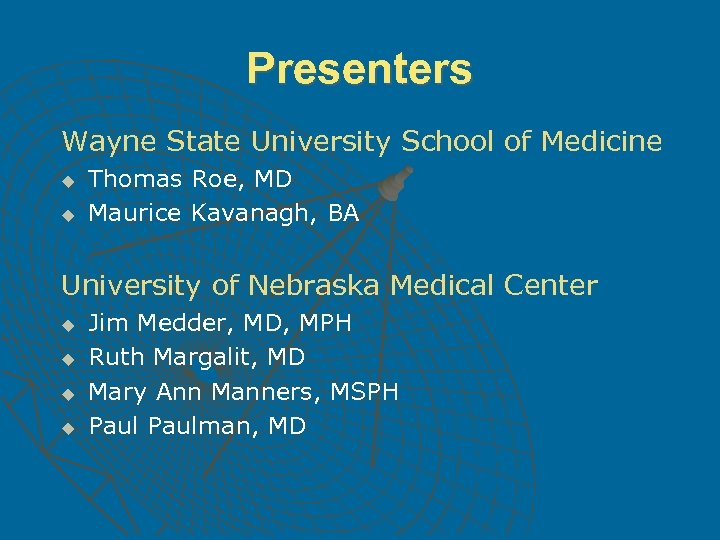 Presenters Wayne State University School of Medicine u u Thomas Roe, MD Maurice Kavanagh, BA University of Nebraska Medical Center u u Jim Medder, MD, MPH Ruth Margalit, MD Mary Ann Manners, MSPH Paulman, MD
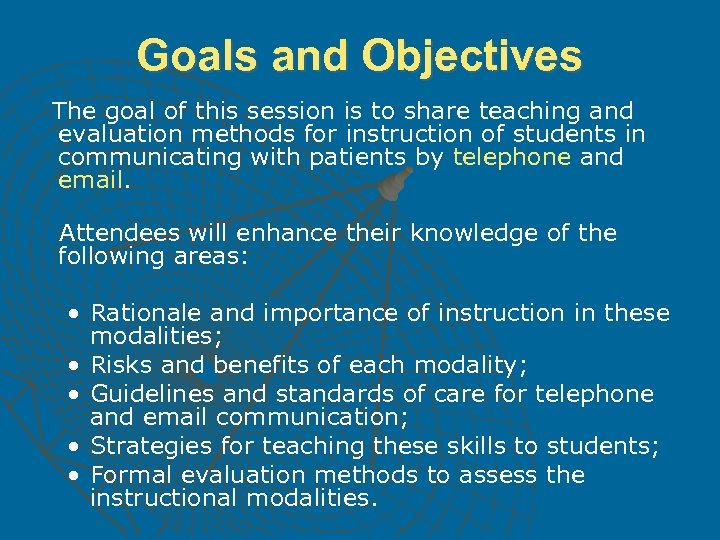 Goals and Objectives The goal of this session is to share teaching and evaluation methods for instruction of students in communicating with patients by telephone and email. Attendees will enhance their knowledge of the following areas: • Rationale and importance of instruction in these modalities; • Risks and benefits of each modality; • Guidelines and standards of care for telephone and email communication; • Strategies for teaching these skills to students; • Formal evaluation methods to assess the instructional modalities.
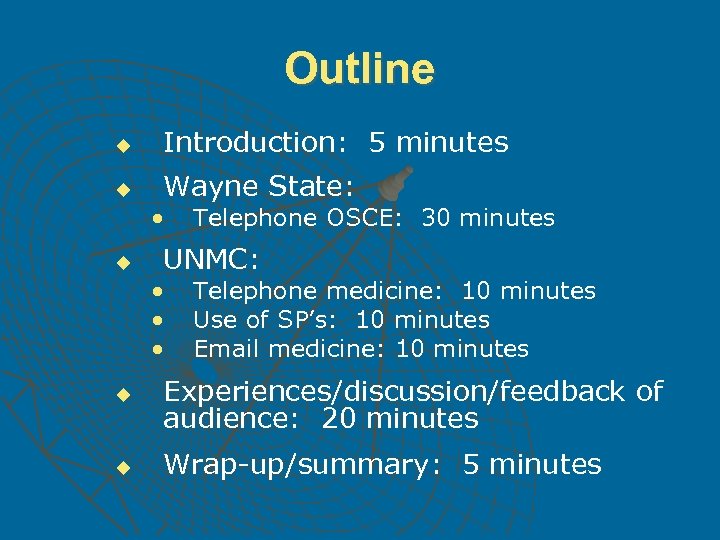 Outline u Introduction: 5 minutes u Wayne State: • u Telephone OSCE: 30 minutes UNMC: • • • Telephone medicine: 10 minutes Use of SP’s: 10 minutes Email medicine: 10 minutes u Experiences/discussion/feedback of audience: 20 minutes u Wrap-up/summary: 5 minutes
 Telephone/Email
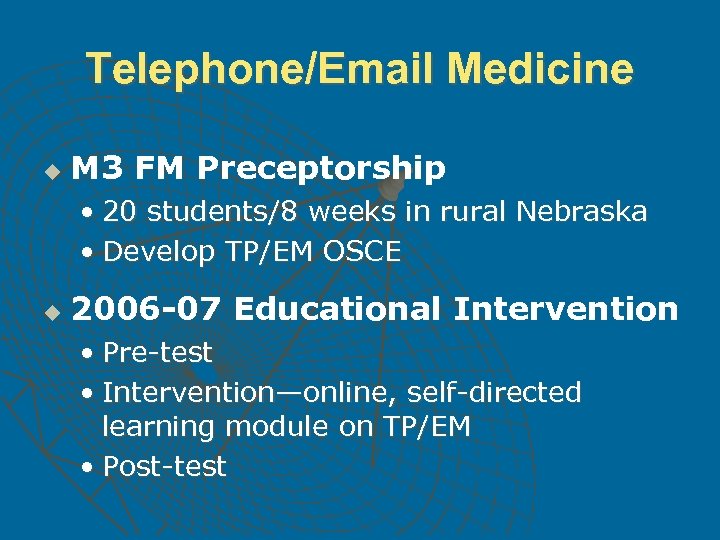 Telephone/Email Medicine u M 3 FM Preceptorship • 20 students/8 weeks in rural Nebraska • Develop TP/EM OSCE u 2006 -07 Educational Intervention • Pre-test • Intervention—online, self-directed learning module on TP/EM • Post-test
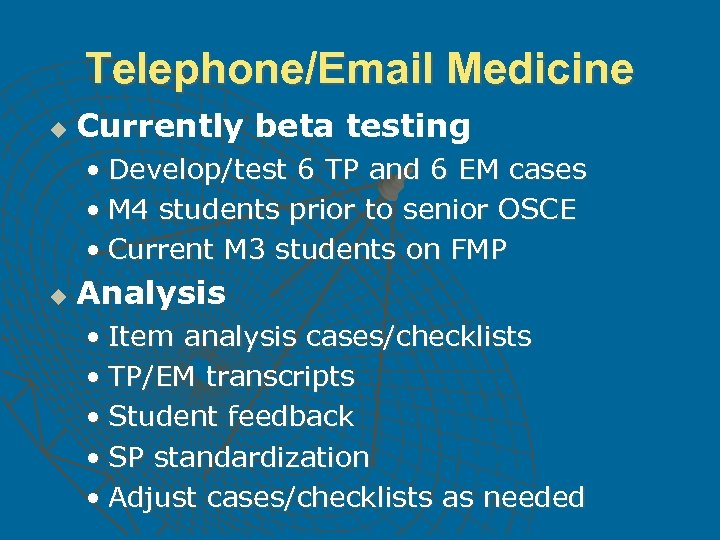 Telephone/Email Medicine u Currently beta testing • Develop/test 6 TP and 6 EM cases • M 4 students prior to senior OSCE • Current M 3 students on FMP u Analysis • Item analysis cases/checklists • TP/EM transcripts • Student feedback • SP standardization • Adjust cases/checklists as needed
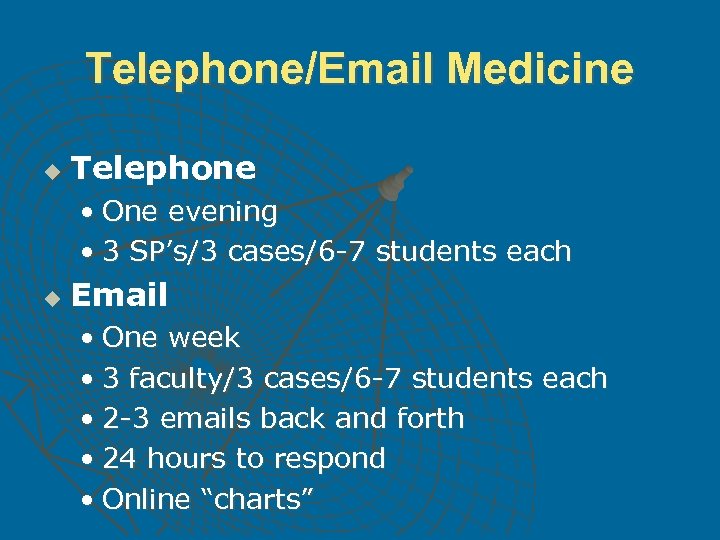 Telephone/Email Medicine u Telephone • One evening • 3 SP’s/3 cases/6 -7 students each u Email • One week • 3 faculty/3 cases/6 -7 students each • 2 -3 emails back and forth • 24 hours to respond • Online “charts”
 Telephone
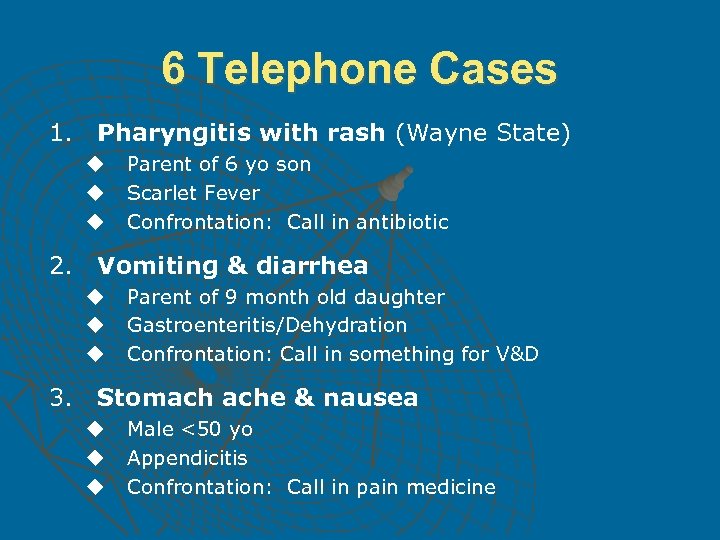 6 Telephone Cases 1. Pharyngitis with rash (Wayne State) u u u 2. Vomiting & diarrhea u u u 3. Parent of 6 yo son Scarlet Fever Confrontation: Call in antibiotic Parent of 9 month old daughter Gastroenteritis/Dehydration Confrontation: Call in something for V&D Stomach ache & nausea u u u Male <50 yo Appendicitis Confrontation: Call in pain medicine
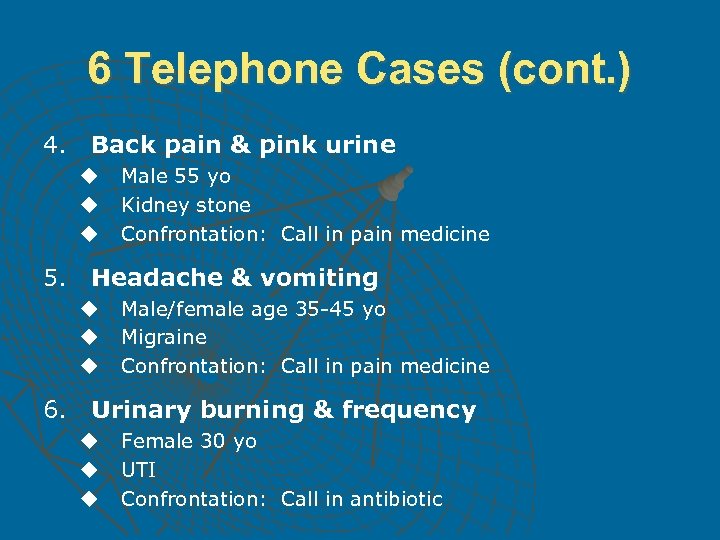 6 Telephone Cases (cont. ) 4. Back pain & pink urine u u u 5. Headache & vomiting u u u 6. Male 55 yo Kidney stone Confrontation: Call in pain medicine Male/female age 35 -45 yo Migraine Confrontation: Call in pain medicine Urinary burning & frequency u u u Female 30 yo UTI Confrontation: Call in antibiotic
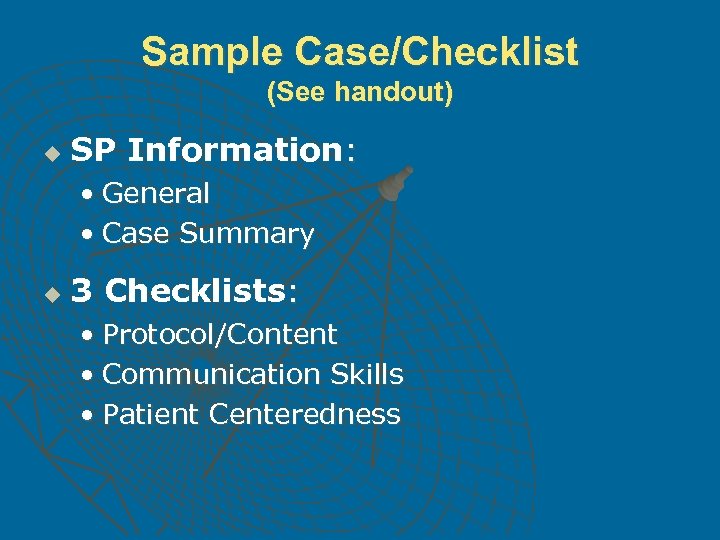 Sample Case/Checklist (See handout) u SP Information: • General • Case Summary u 3 Checklists: • Protocol/Content • Communication Skills • Patient Centeredness
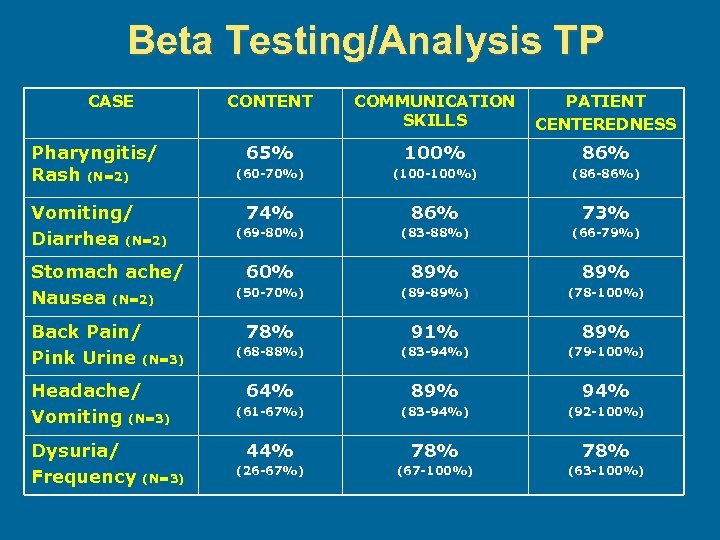 Beta Testing/Analysis TP CASE CONTENT Vomiting/ Diarrhea (N=2) Stomach ache/ Nausea (N=2) Back Pain/ Pink Urine (N=3) Headache/ Vomiting (N=3) Dysuria/ Frequency (N=3) PATIENT CENTEREDNESS 65% 100% 86% (60 -70%) (100 -100%) (86 -86%) 74% 86% 73% (69 -80%) (83 -88%) (66 -79%) 60% 89% (50 -70%) (89 -89%) (78 -100%) 78% 91% 89% (68 -88%) (83 -94%) (79 -100%) 64% 89% 94% (61 -67%) (83 -94%) (92 -100%) 44% Pharyngitis/ Rash (N=2) COMMUNICATION SKILLS 78% (26 -67%) (67 -100%) (63 -100%)
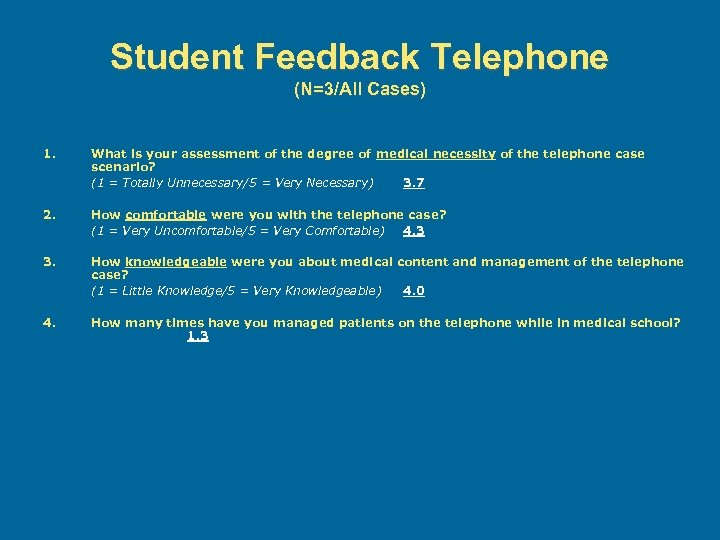 Student Feedback Telephone (N=3/All Cases) 1. What is your assessment of the degree of medical necessity of the telephone case scenario? (1 = Totally Unnecessary/5 = Very Necessary) 3. 7 2. How comfortable were you with the telephone case? (1 = Very Uncomfortable/5 = Very Comfortable) 4. 3 3. How knowledgeable were you about medical content and management of the telephone case? (1 = Little Knowledge/5 = Very Knowledgeable) 4. 0 4. How many times have you managed patients on the telephone while in medical school? 1. 3
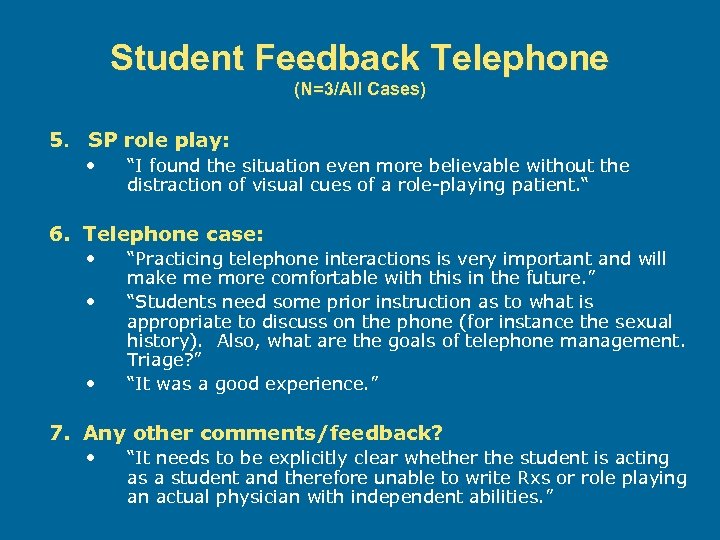 Student Feedback Telephone (N=3/All Cases) 5. SP role play: • “I found the situation even more believable without the distraction of visual cues of a role-playing patient. “ 6. Telephone case: • • • “Practicing telephone interactions is very important and will make me more comfortable with this in the future. ” “Students need some prior instruction as to what is appropriate to discuss on the phone (for instance the sexual history). Also, what are the goals of telephone management. Triage? ” “It was a good experience. ” 7. Any other comments/feedback? • “It needs to be explicitly clear whether the student is acting as a student and therefore unable to write Rxs or role playing an actual physician with independent abilities. ”
 Standardized Patients
 Selection Very experienced SPs, with “ad lib” skills u Able to “put on” the role, without every detail in script u Quick, think on their feet, react naturally u Personal experience with presenting problem u
 Location 3 staff offices, quiet, separate rooms with no background noise. u Evening hours, possible to reach our students, i. e. between 6: 00 -9: 00 pm. u Future consideration will be given to allow SPs to work from their home after training and at least one supervised session. u
 Training u u u Mail 3 separate cases 1 week prior to work date. 6 cases now —plan to develop more. Immediately before work session, review cases and check lists. Present possible questions students might ask, potential answers. “Mock” phone call with each SP on their case, completing check lists. Review and modify, answer questions.
 Taping Every phone call is audiotaped u Automatic start and stop recording device u Tapes are transcribed u Allows review/critique of student phrasing, question sequence, suggestions, explanations, etc. , and quality of SP responses. u
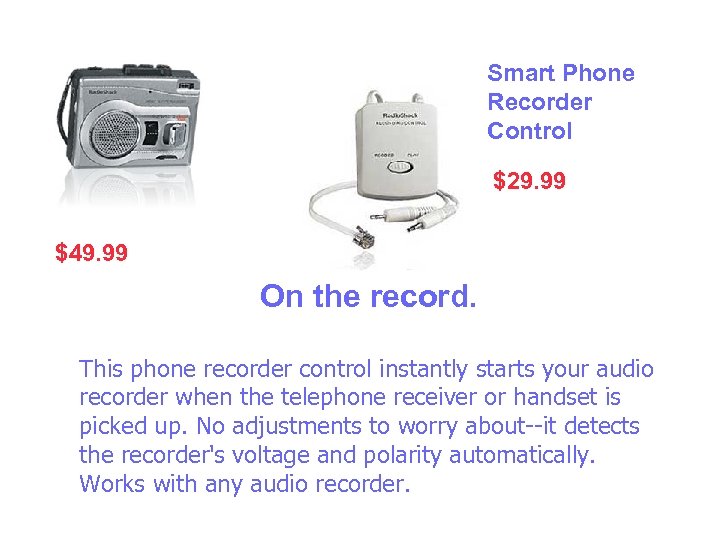 Smart Phone Recorder Control $29. 99 $49. 99 On the record. This phone recorder control instantly starts your audio recorder when the telephone receiver or handset is picked up. No adjustments to worry about--it detects the recorder's voltage and polarity automatically. Works with any audio recorder.
 Examples of Audiotape Segments Headache case Appendicitis case
 E-Mail
 Potential Email Uses u u u u Direct patients to quality health education materials Refer to web sites Provide medical advice for non-urgent medical questions Provide follow-up Clarify treatment plans Report of (selected) laboratory/test results Requests for prescription refills
 Email Uses (cont. ) u u u u Complete medical forms (school, camp, work) – can be done by office staff Give referrals Facilitate screening Obtain demographic data – address, phone, insurance data Release records Appointment scheduling or confirmation Contacting hard-to-reach patients including those studying abroad
 Potential Benefits (1) u Patient centered Increases patient’s involvement in own care (self management) u Cost savings u Time saving - efficient, effective u Flexible u Rapid u Available - 24 hour access
 Potential Benefits (2) u E-notes enrich the medical record u Easier to save than phone messages u Optimizes face-to-face office time u Ease in collecting quality improvement data u Better reporting of unpleasant events (? ) u Easier access to support/discussion groups u Enhances chronic disease management u Improves continuity of care
 Concerns/Risks (1) u u u Informed consent issues Medical advice based on partial information Impact on the doctor-patient relationship Patient satisfaction Time consuming - increased work load Billing issues
 Concerns/Risks (2) u u u Security/improper use Privacy/confidentiality Lack of universal access (with racial, socioeconomic, literacy, cultural differences) Potential slow response to messages that might require emergent response or actions. Website maintenance
 Email Guidelines (See handout) Example 1: Partners; Harvard May 9, 2001 Example 2: AMA guidelines
 Can Email: 1. Improve quality of care? (Satisfaction, adherence, outcomes) 2. Reduce medical errors? 3. Reduce health costs? 4. Assist in providing Patient Centered Care? 5. Be a barrier to effective patient-physician communication? 6. Further add to health disparities by the “digital divide”?
 6 Email Cases 1. Sinus problem u u u 2. STD results u u u 3. Female 40 yo Acute sinusitis Confrontation: Call in antibiotic Female 25 yo Chlaymdia Confrontation: Not tell partners New Rx side effects u u u Male 55 yo ED from HCTZ Confrontation: D/C HCTZ
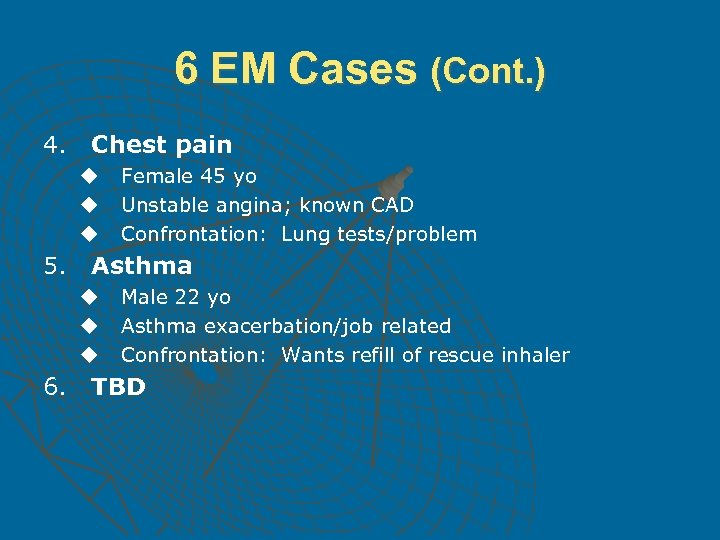 6 EM Cases (Cont. ) 4. Chest pain u u u 5. Asthma u u u 6. Female 45 yo Unstable angina; known CAD Confrontation: Lung tests/problem Male 22 yo Asthma exacerbation/job related Confrontation: Wants refill of rescue inhaler TBD
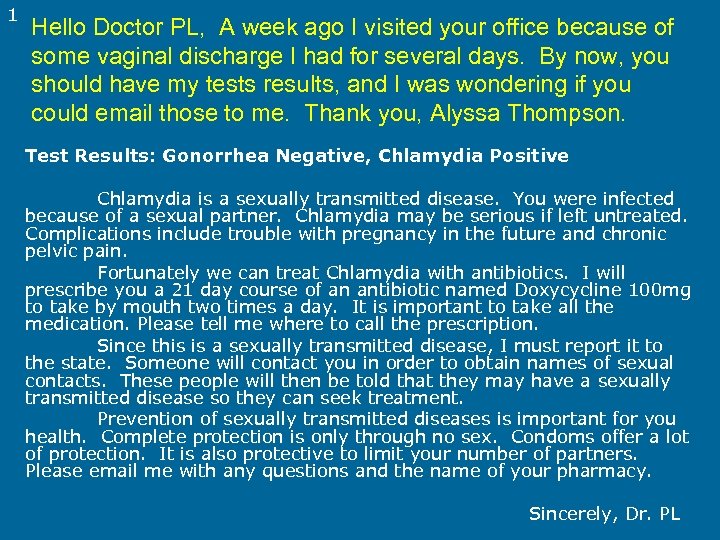 1 Hello Doctor PL, A week ago I visited your office because of some vaginal discharge I had for several days. By now, you should have my tests results, and I was wondering if you could email those to me. Thank you, Alyssa Thompson. Test Results: Gonorrhea Negative, Chlamydia Positive Chlamydia is a sexually transmitted disease. You were infected because of a sexual partner. Chlamydia may be serious if left untreated. Complications include trouble with pregnancy in the future and chronic pelvic pain. Fortunately we can treat Chlamydia with antibiotics. I will prescribe you a 21 day course of an antibiotic named Doxycycline 100 mg to take by mouth two times a day. It is important to take all the medication. Please tell me where to call the prescription. Since this is a sexually transmitted disease, I must report it to the state. Someone will contact you in order to obtain names of sexual contacts. These people will then be told that they may have a sexually transmitted disease so they can seek treatment. Prevention of sexually transmitted diseases is important for you health. Complete protection is only through no sex. Condoms offer a lot of protection. It is also protective to limit your number of partners. Please email me with any questions and the name of your pharmacy. Sincerely, Dr. PL
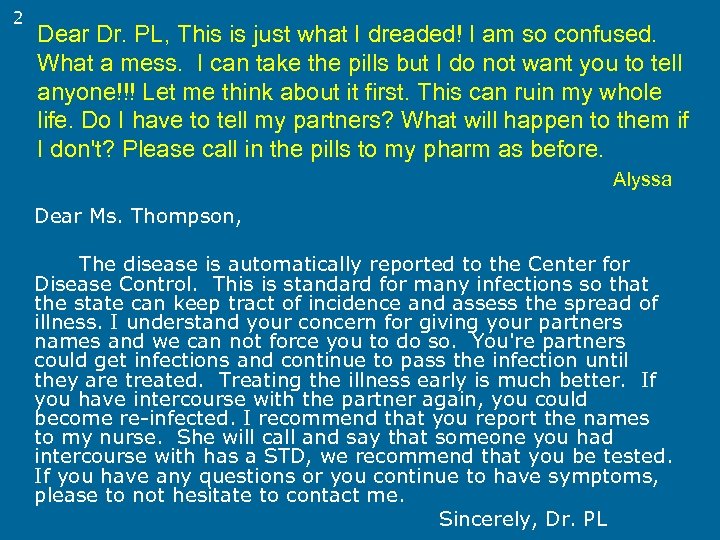 2 Dear Dr. PL, This is just what I dreaded! I am so confused. What a mess. I can take the pills but I do not want you to tell anyone!!! Let me think about it first. This can ruin my whole life. Do I have to tell my partners? What will happen to them if I don't? Please call in the pills to my pharm as before. Alyssa Dear Ms. Thompson, The disease is automatically reported to the Center for Disease Control. This is standard for many infections so that the state can keep tract of incidence and assess the spread of illness. I understand your concern for giving your partners names and we can not force you to do so. You're partners could get infections and continue to pass the infection until they are treated. Treating the illness early is much better. If you have intercourse with the partner again, you could become re-infected. I recommend that you report the names to my nurse. She will call and say that someone you had intercourse with has a STD, we recommend that you be tested. If you have any questions or you continue to have symptoms, please to not hesitate to contact me. Sincerely, Dr. PL
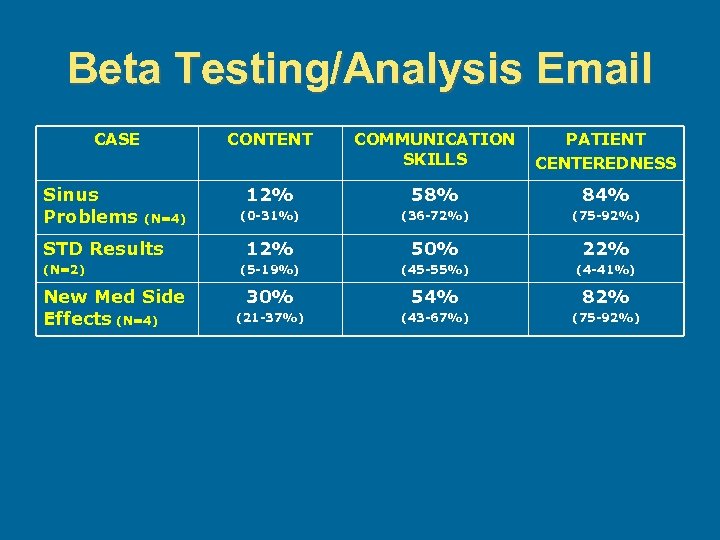 Beta Testing/Analysis Email CASE Sinus Problems CONTENT STD Results (N=2) New Med Side Effects (N=4) PATIENT CENTEREDNESS 12% (N=4) COMMUNICATION SKILLS 58% 84% (0 -31%) (36 -72%) (75 -92%) 12% 50% 22% (5 -19%) (45 -55%) (4 -41%) 30% 54% 82% (21 -37%) (43 -67%) (75 -92%)
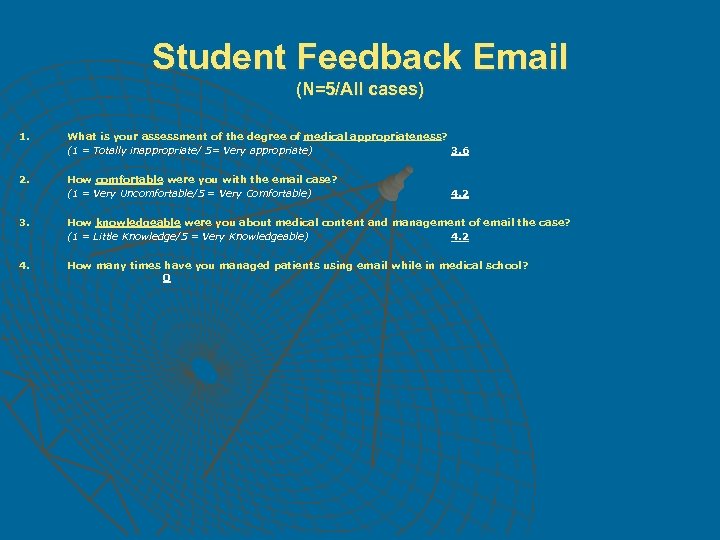 Student Feedback Email (N=5/All cases) 1. What is your assessment of the degree of medical appropriateness? (1 = Totally inappropriate/ 5= Very appropriate) 3. 6 2. How comfortable were you with the email case? (1 = Very Uncomfortable/5 = Very Comfortable) 4. 2 3. How knowledgeable were you about medical content and management of email the case? (1 = Little Knowledge/5 = Very Knowledgeable) 4. 2 4. How many times have you managed patients using email while in medical school? 0
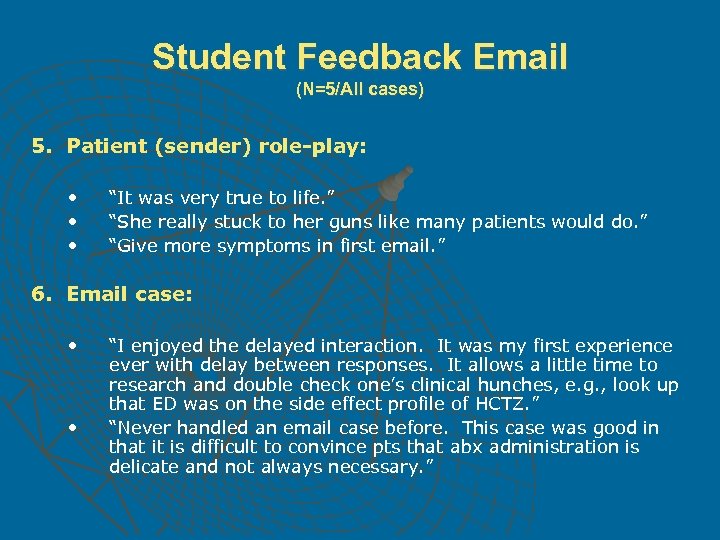 Student Feedback Email (N=5/All cases) 5. Patient (sender) role-play: • • • “It was very true to life. ” “She really stuck to her guns like many patients would do. ” “Give more symptoms in first email. ” 6. Email case: • • “I enjoyed the delayed interaction. It was my first experience ever with delay between responses. It allows a little time to research and double check one’s clinical hunches, e. g. , look up that ED was on the side effect profile of HCTZ. ” “Never handled an email case before. This case was good in that it is difficult to convince pts that abx administration is delicate and not always necessary. ”
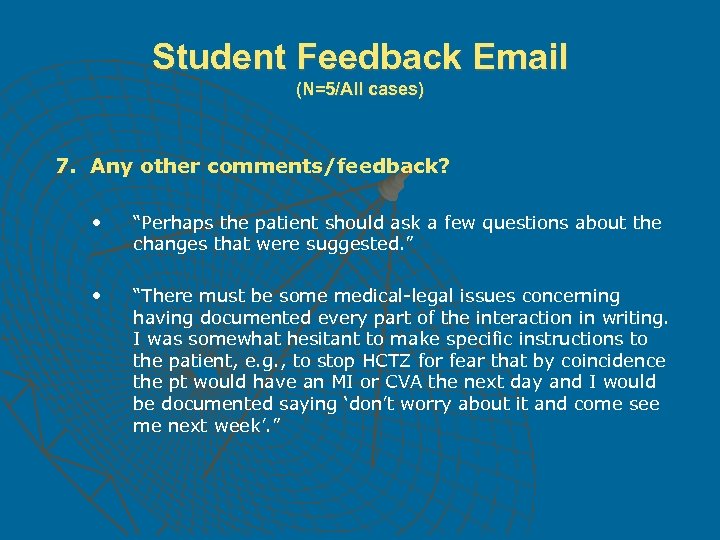 Student Feedback Email (N=5/All cases) 7. Any other comments/feedback? • “Perhaps the patient should ask a few questions about the changes that were suggested. ” • “There must be some medical-legal issues concerning having documented every part of the interaction in writing. I was somewhat hesitant to make specific instructions to the patient, e. g. , to stop HCTZ for fear that by coincidence the pt would have an MI or CVA the next day and I would be documented saying ‘don’t worry about it and come see me next week’. ”
 Challenges 1. 2. 3. 4. 5. 6. 7. Preliminary Coordination Standardization Faculty time Security (not in-house) Student participation Technical issues Facilitation of e-communication through a 3 rd party (Sarah)
 Discussion
 Contact Information Jim Medder, MD, MPH University of Nebraska Medical Center Department of Family Medicine 983075 Nebraska Medical Center Omaha, NE 68198 -3075 Phone: 402 -559 -6271 Fax: 402 -559 -8118 E-mail: jmedder@unmc. edu Mary Ann Manners, MSPH University of Nebraska Medical Center Department of Family Medicine 984175 Nebraska Medical Center Omaha, NE 68198 -4175 Phone: 402 -559 -6830 Fax: 402 -559 -9310 E-mail: mmanners@unmc. edu Ruth Margalit, MD University of Nebraska Medical Center Dept of Preventive and Societal Medicine 986075 Nebraska Medical Center Omaha, NE 68198 -6075 Phone: 402 -559 -7458 Fax: 402 -559 -3773 E-mail: rmargalit@unmc. edu Paulman, MD University of Nebraska Medical Center Department of Family Medicine 983075 Nebraska Medical Center Omaha, NE 68198 -3075 Phone: 402 -559 -6818 Fax: 402 -559 -8118 E-mail: ppaulman@unmc. edu
 Contact Information Thomas Roe, MD Wayne State University School of Medicine Department of Family Medicine 101 E. Alexandrine, 2 nd Floor Detroit, MI 48201 Phone: 313 -577 -8867 Fax: 313 -577 -3070 E-mail: troe@med. wayne. edu Maurice Kavanagh, BA Wayne State University School of Medicine Department of Family Medicine 101 E. Alexandrine, 2 nd Floor Detroit, MI 48201 Phone: 313 -577 -8867 Fax: 313 -577 -3070 E-mail: mkavanag@med. wayne. edu