


 Скачать презентацию Teachers and Advisors Conference University of Leicester —
14de47c5237524354b8213046d2d17e4.ppt
- Количество слайдов: 24
 Teachers’ and Advisors’ Conference University of Leicester - 27 June 2008 Recruitment and Admissions to Higher Education: Patterns and Issues Anthony Mc. Claran Chief Executive
 Overview § Setting the scene § § UCAS today Admissions trends § Changes and challenges § Questions and answers
 Setting the scene § Established central role in UK admissions providing wide-ranging, impartial service to schools, applicants and HEIs § UCAS is the central application agency for full-time § § § Undergraduate degree courses Foundation degree courses HND courses HNC courses Diploma of Higher Education courses Certificate of Higher Education courses
 Setting the scene § UCAS today “The UCAS system is sophisticated and allows for many different routes. Its advantages for both applicants and institutions are that it eliminates duplication of effort, and provides a fair and consistent framework within which both applicants and institutions can compete. ” Wikipedia
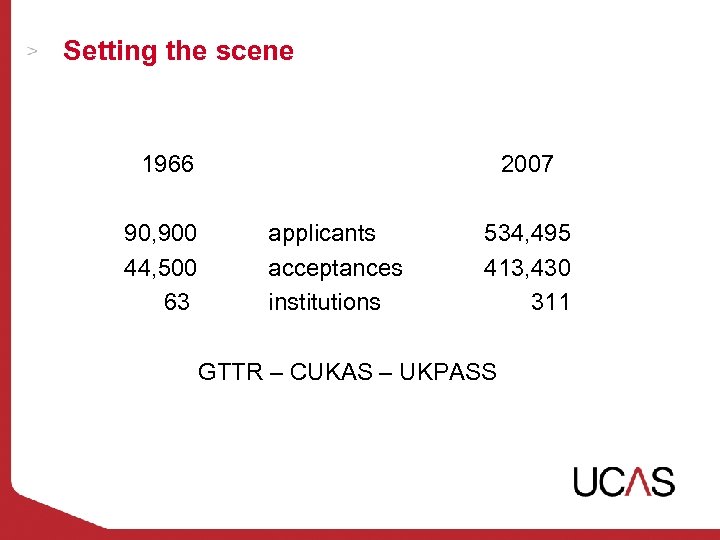 Setting the scene 1966 90, 900 44, 500 63 2007 applicants acceptances institutions 534, 495 413, 430 311 GTTR – CUKAS – UKPASS
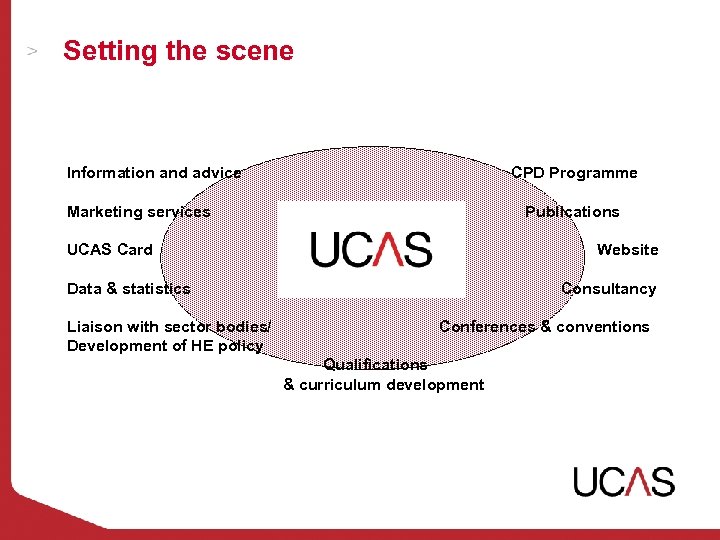 Setting the scene Information and advice CPD Programme Marketing services Publications UCAS Card Website Data & statistics Liaison with sector bodies/ Development of HE policy Consultancy Conferences & conventions Qualifications & curriculum development
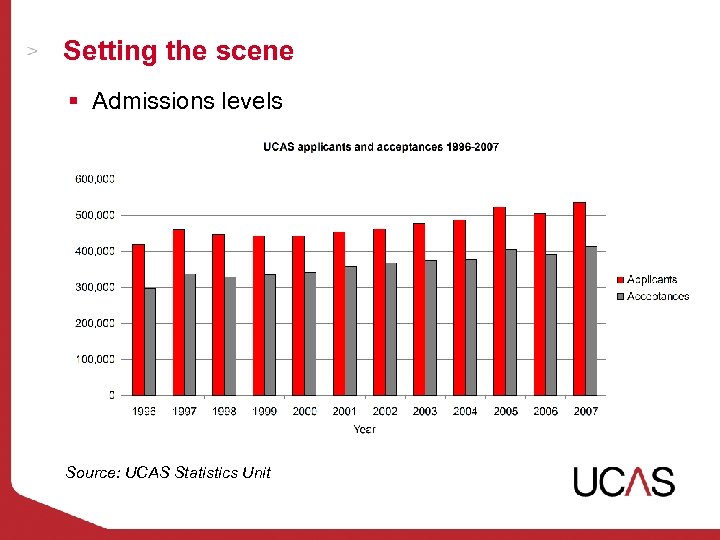 Setting the scene § Admissions levels Source: UCAS Statistics Unit
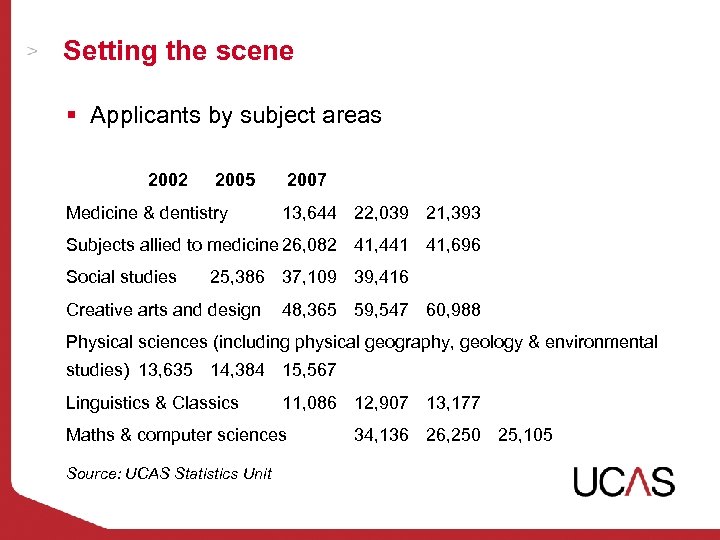 Setting the scene § Applicants by subject areas 2002 2005 Medicine & dentistry 2007 13, 644 22, 039 21, 393 Subjects allied to medicine 26, 082 41, 441 41, 696 Social studies 25, 386 37, 109 39, 416 Creative arts and design 48, 365 59, 547 60, 988 Physical sciences (including physical geography, geology & environmental studies) 13, 635 14, 384 15, 567 Linguistics & Classics 11, 086 12, 907 13, 177 Maths & computer sciences Source: UCAS Statistics Unit 34, 136 26, 250 25, 105
 Changes and challenges § Overview § Demographic change § The Leitch Report § 14 - 19 curriculum § Foundation degrees § Differentiation § International recruitment § Post Qualification Application (PQA)
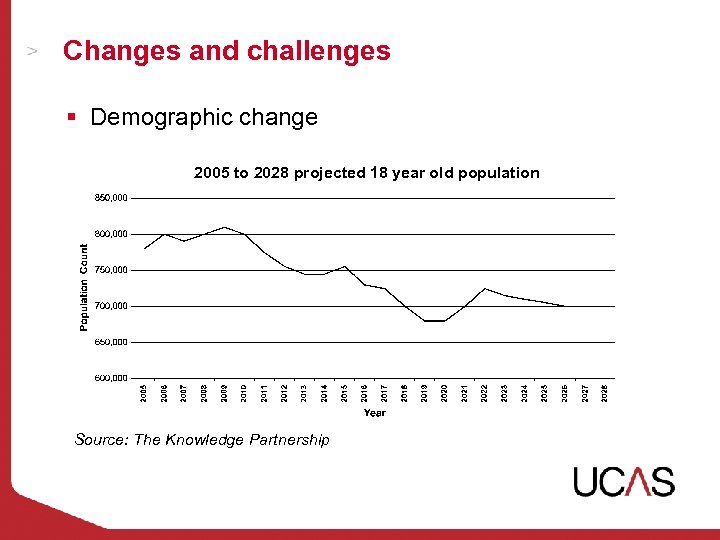 Changes and challenges § Demographic change 2005 to 2028 projected 18 year old population Source: The Knowledge Partnership
 Changes and challenges § The Leitch Report § “Prosperity for all in the global economy: world class skills” (December 2006) § 4 objectives for 2020 i. 95% of adults to achieve the basic skills of functional literacy and numeracy ii. More than 90% of adults qualified to at least Level 2 iii. Shifting the balance of intermediate skills from Level 2 to Level 3 iv. Exceeding and above 40% of adults qualified to Level 4
 Changes and challenges § Objective iv: Exceeding 40% of adults qualified to Level 4 and above § Up from 29% in 2005 with a commitment to continue progression § Unlikely to be achieved by further expansion of current model of HE § Rebalance the priorities of HEIs to make available relevant, flexible and responsive provision that meets the high skills needs of employers and their staff
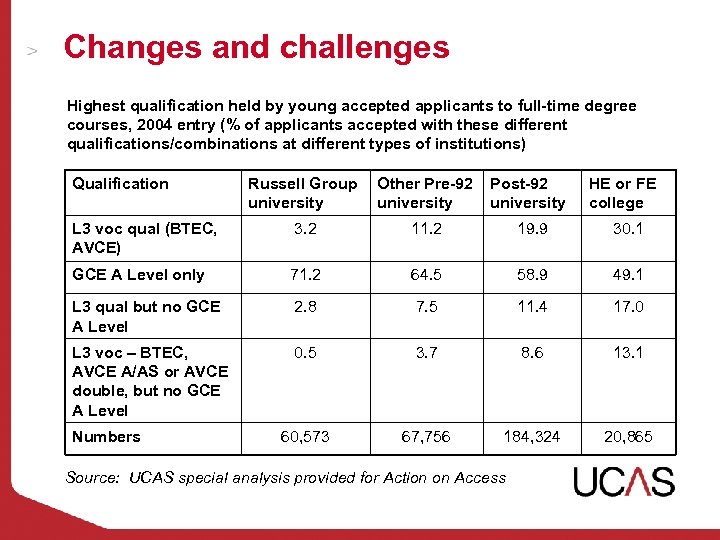 Changes and challenges Highest qualification held by young accepted applicants to full-time degree courses, 2004 entry (% of applicants accepted with these different qualifications/combinations at different types of institutions) Qualification Russell Group university Other Pre-92 university Post-92 university L 3 voc qual (BTEC, AVCE) 3. 2 11. 2 19. 9 30. 1 GCE A Level only 71. 2 64. 5 58. 9 49. 1 L 3 qual but no GCE A Level 2. 8 7. 5 11. 4 17. 0 L 3 voc – BTEC, AVCE A/AS or AVCE double, but no GCE A Level 0. 5 3. 7 8. 6 13. 1 60, 573 67, 756 184, 324 20, 865 Numbers Source: UCAS special analysis provided for Action on Access HE or FE college
 Changes and challenges § 14 -19 curriculum § A* A level grades § Diplomas § How will HE react to Diplomas? § 14 -19 HE Engagement Project Board
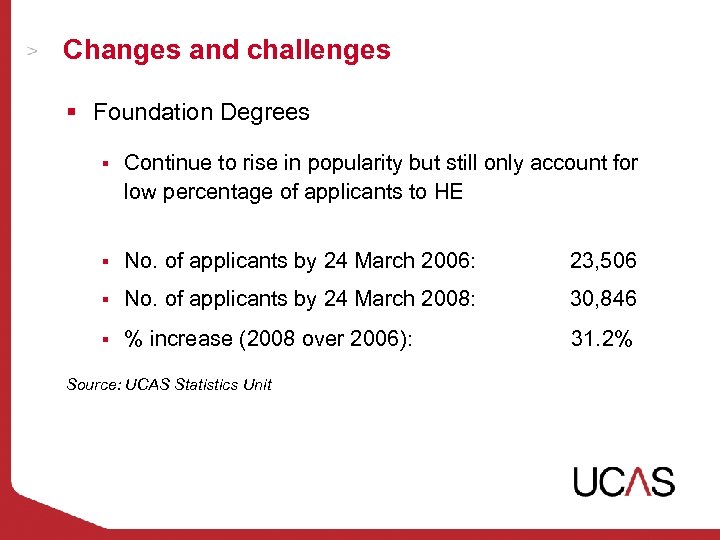 Changes and challenges § Foundation Degrees § Continue to rise in popularity but still only account for low percentage of applicants to HE § No. of applicants by 24 March 2006: 23, 506 § No. of applicants by 24 March 2008: 30, 846 § % increase (2008 over 2006): 31. 2% Source: UCAS Statistics Unit
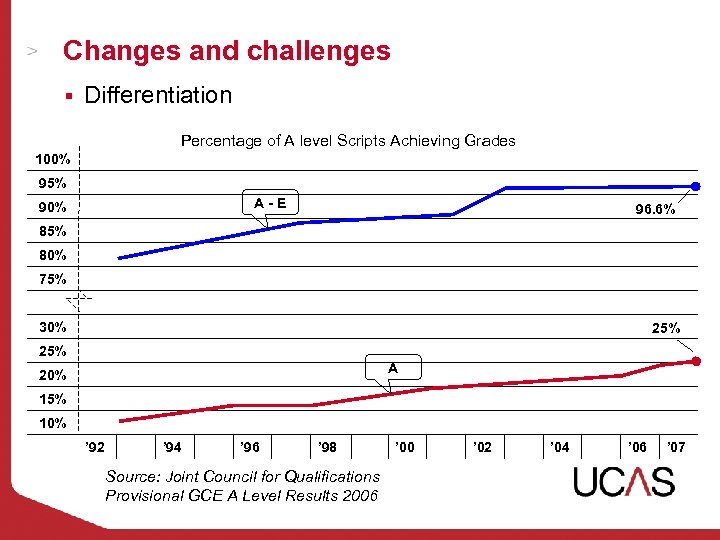 Changes and challenges § Differentiation Percentage of A level Scripts Achieving Grades 100% 95% A-E 90% 96. 6% 85% 80% 75% 30% 25% A 20% 15% 10% ’ 92 ’ 94 ’ 96 ’ 98 Source: Joint Council for Qualifications Provisional GCE A Level Results 2006 ’ 00 ’ 02 ’ 04 ’ 06 ’ 07
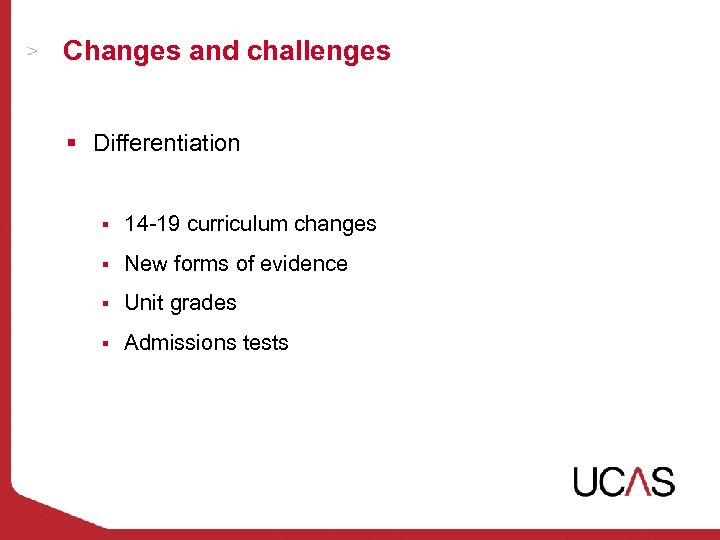 Changes and challenges § Differentiation § 14 -19 curriculum changes § New forms of evidence § Unit grades § Admissions tests
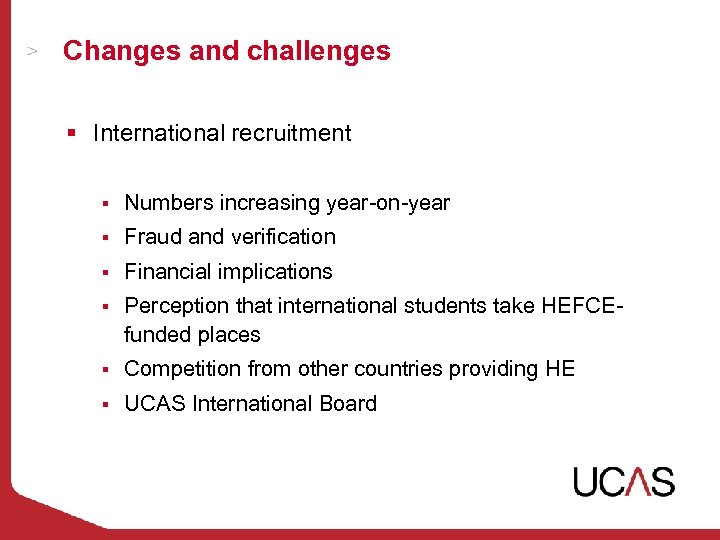 Changes and challenges § International recruitment § Numbers increasing year-on-year § Fraud and verification § Financial implications § Perception that international students take HEFCEfunded places § Competition from other countries providing HE § UCAS International Board
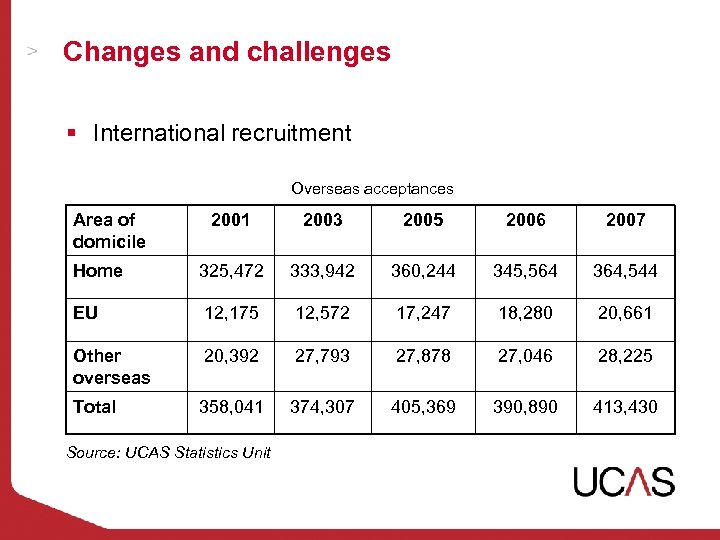 Changes and challenges § International recruitment Overseas acceptances Area of domicile 2001 2003 2005 2006 2007 Home 325, 472 333, 942 360, 244 345, 564 364, 544 EU 12, 175 12, 572 17, 247 18, 280 20, 661 Other overseas 20, 392 27, 793 27, 878 27, 046 28, 225 Total 358, 041 374, 307 405, 369 390, 890 413, 430 Source: UCAS Statistics Unit
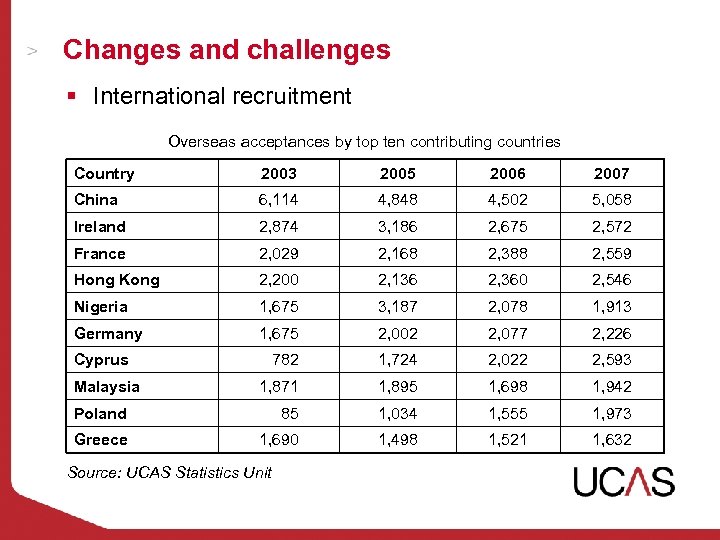 Changes and challenges § International recruitment Overseas acceptances by top ten contributing countries Country 2003 2005 2006 2007 China 6, 114 4, 848 4, 502 5, 058 Ireland 2, 874 3, 186 2, 675 2, 572 France 2, 029 2, 168 2, 388 2, 559 Hong Kong 2, 200 2, 136 2, 360 2, 546 Nigeria 1, 675 3, 187 2, 078 1, 913 Germany 1, 675 2, 002 2, 077 2, 226 782 1, 724 2, 022 2, 593 1, 871 1, 895 1, 698 1, 942 Poland 85 1, 034 1, 555 1, 973 Greece 1, 690 1, 498 1, 521 1, 632 Cyprus Malaysia Source: UCAS Statistics Unit
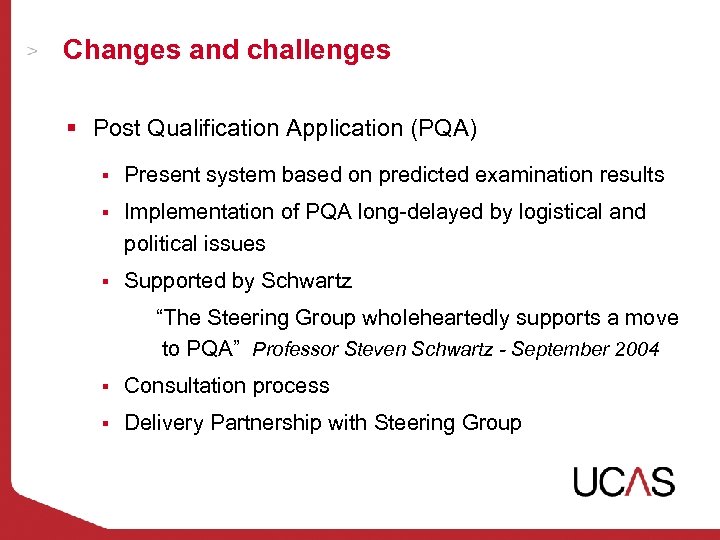 Changes and challenges § Post Qualification Application (PQA) § Present system based on predicted examination results § Implementation of PQA long-delayed by logistical and political issues § Supported by Schwartz “The Steering Group wholeheartedly supports a move to PQA” Professor Steven Schwartz - September 2004 § Consultation process § Delivery Partnership with Steering Group
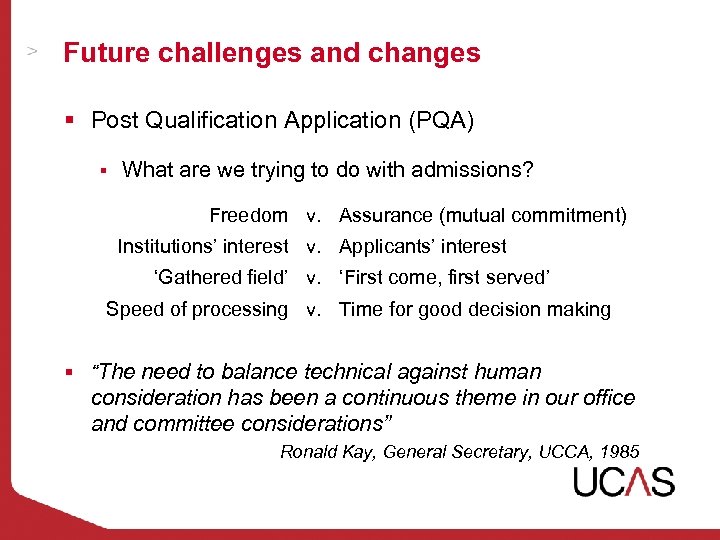 Future challenges and changes § Post Qualification Application (PQA) § What are we trying to do with admissions? Freedom v. Assurance (mutual commitment) Institutions’ interest v. Applicants’ interest ‘Gathered field’ v. ‘First come, first served’ Speed of processing v. Time for good decision making § “The need to balance technical against human consideration has been a continuous theme in our office and committee considerations” Ronald Kay, General Secretary, UCCA, 1985
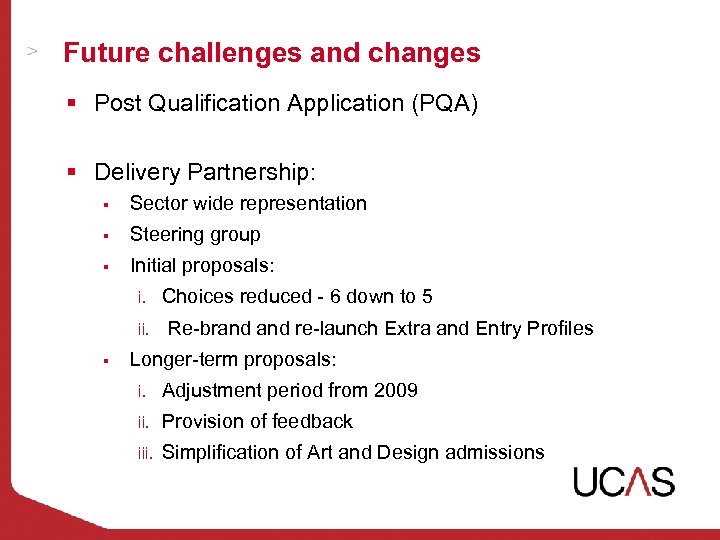 Future challenges and changes § Post Qualification Application (PQA) § Delivery Partnership: § Sector wide representation § Steering group § Initial proposals: i. ii. § Choices reduced - 6 down to 5 Re-brand re-launch Extra and Entry Profiles Longer-term proposals: i. Adjustment period from 2009 ii. Provision of feedback iii. Simplification of Art and Design admissions
 Teachers’ and Advisors’ Conference University of Leicester - 27 June 2008 Any Questions ? Anthony Mc. Claran, Chief Executive Rosehill, New Barn Lane Cheltenham GL 52 3 LZ t: +44 (0) 1242 544990 e: a. mcclaran@ucas. ac. uk