 Скачать презентацию Teacher Leadership Institute Why Project Based Learning Office
4cc7cc4eb3b3bf0cfddb68dd2a5cfbed.ppt
- Количество слайдов: 113



Teacher Leadership Institute Why Project Based Learning? Office of Instruction WVDE
The 21 st Century Context for Standards-Focused Project Based Learning
Education exists in the larger context o society. When society changes – so too must education if it is to remain viable.
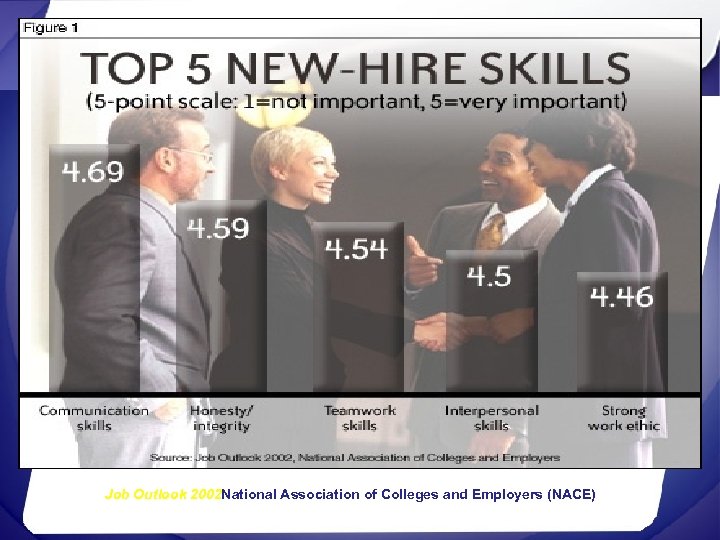
Job Outlook 2002 National Association of Colleges and Employers (NACE)
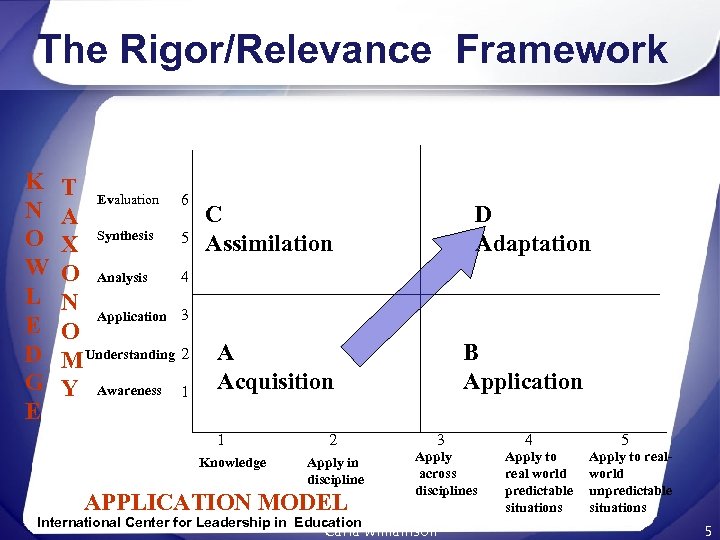
The Rigor/Relevance Framework K N O W L E D G E T Evaluation 6 C A Synthesis 5 Assimilation X O Analysis 4 N Application 3 O M Understanding 2 A Y Awareness 1 Acquisition 1 Knowledge 2 Apply in discipline APPLICATION MODEL D Adaptation B Application 3 Apply across disciplines International Center for Leadership in Education Carla Williamson 4 Apply to real world predictable situations 5 Apply to realworld unpredictable situations 5
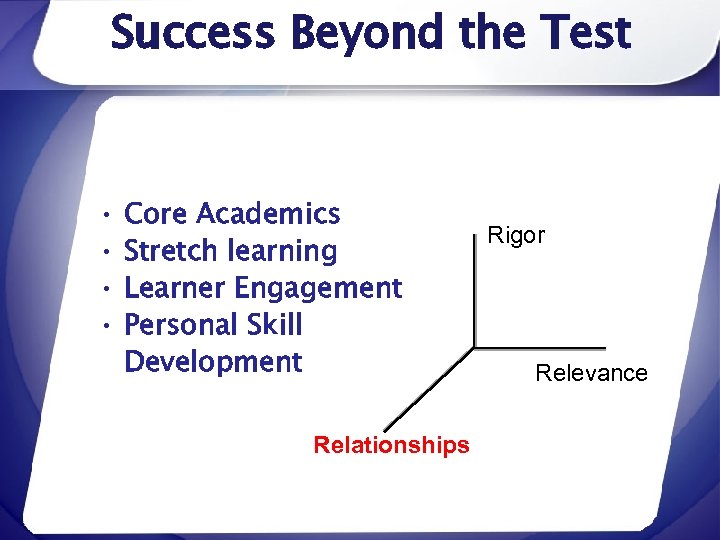
Success Beyond the Test • • Core Academics Stretch learning Learner Engagement Personal Skill Development Relationships Rigor Relevance
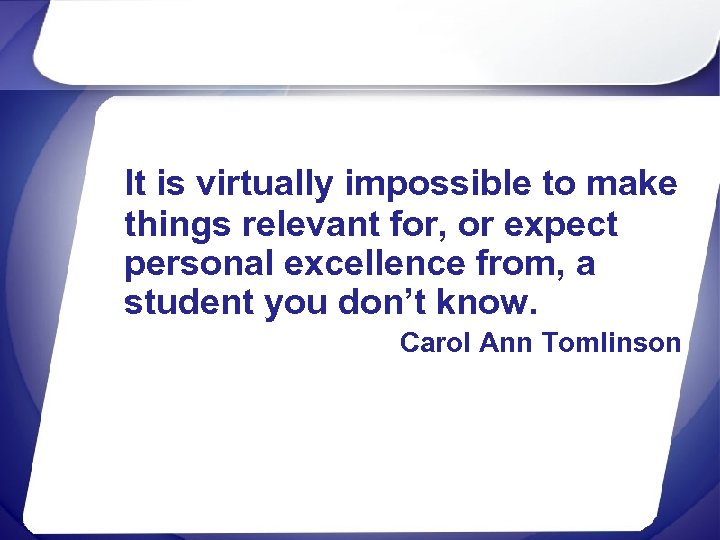
It is virtually impossible to make things relevant for, or expect personal excellence from, a student you don’t know. Carol Ann Tomlinson
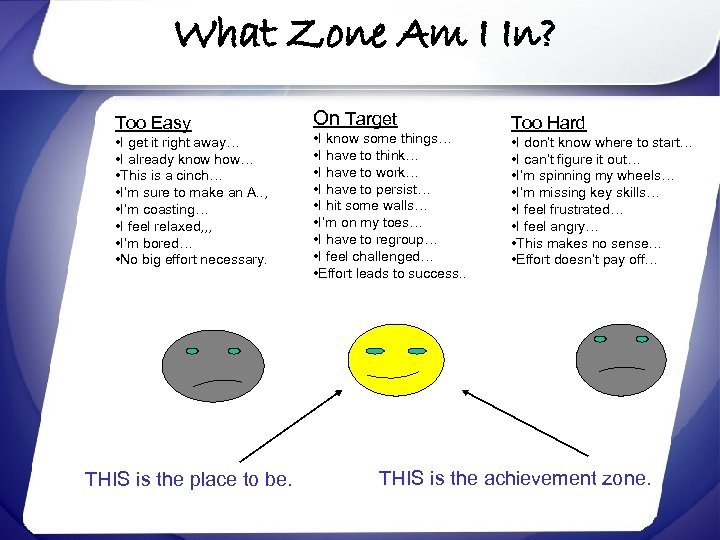
What Zone Am I In? Too Easy • I get it right away… • I already know how… • This is a cinch… • I’m sure to make an A. . , • I’m coasting… • I feel relaxed, , , • I’m bored… • No big effort necessary. THIS is the place to be. On Target • I know some things… • I have to think… • I have to work… • I have to persist… • I hit some walls… • I’m on my toes… • I have to regroup… • I feel challenged… • Effort leads to success. . Too Hard • I don’t know where to start… • I can’t figure it out… • I’m spinning my wheels… • I’m missing key skills… • I feel frustrated… • I feel angry… • This makes no sense… • Effort doesn’t pay off… THIS is the achievement zone.
Learning Criteria • Core Academics – Achievement in the core subjects of English language arts, math, science, social studies and others identified by the school or district • Stretch Learning – Demonstration of rigorous and relevant learning beyond the minimum requirements
Learning Criteria • Learner Engagement – The extent to which students are motivated and committed to learning; have a sense of belonging and accomplishment; and have relationships with adults, peers and parents that support learning • Personal Skill Development – Measures of personal, social, service, and leadership skills and demonstrations of positive behaviors and attitudes
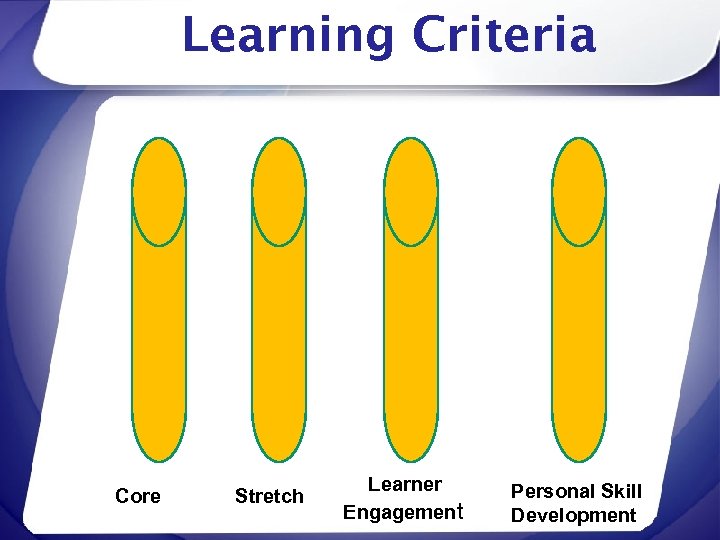
Learning Criteria Core Stretch Learner Engagement Personal Skill Development
Learning Criteria
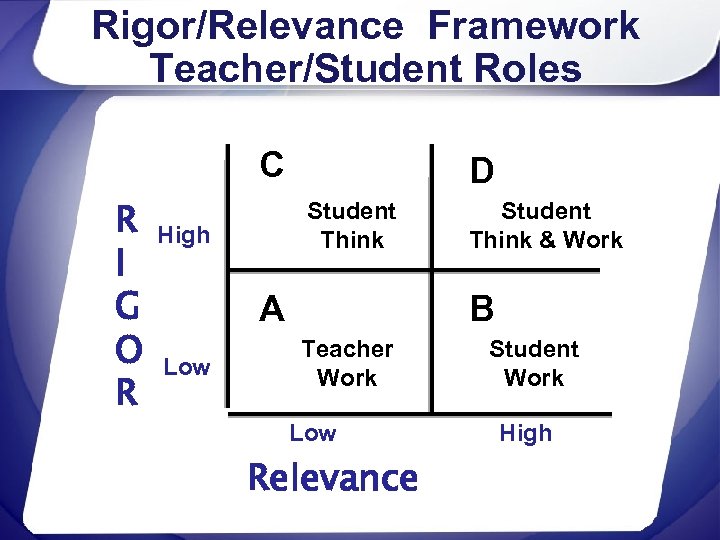
Rigor/Relevance Framework Teacher/Student Roles C R I G O R D Student Think High A Low Student Think & Work B Teacher Work Low Relevance Student Work High
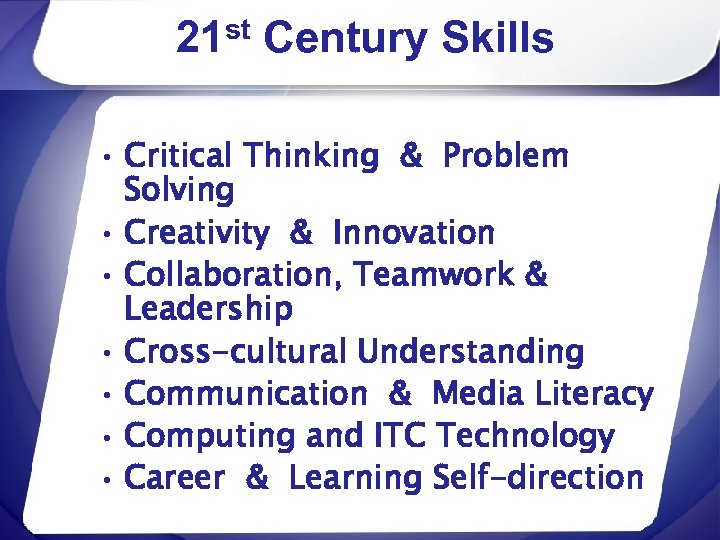
st 21 Century Skills • Critical Thinking & Problem Solving • Creativity & Innovation • Collaboration, Teamwork & Leadership • Cross-cultural Understanding • Communication & Media Literacy • Computing and ITC Technology • Career & Learning Self-direction
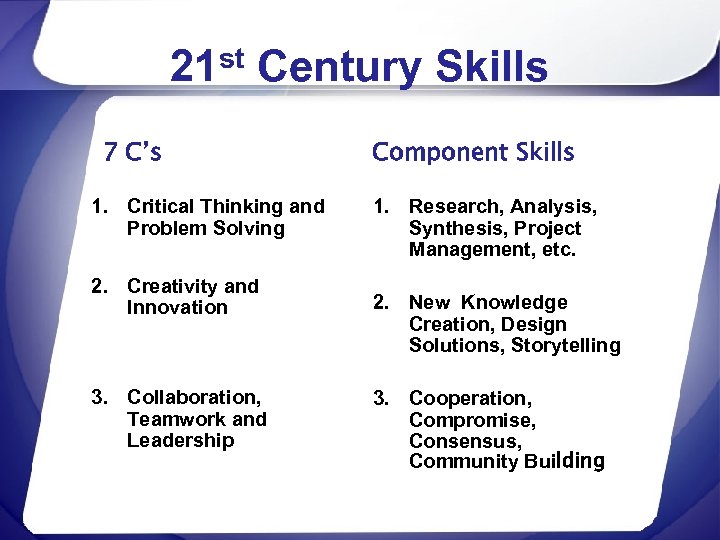
21 st Century Skills 7 C’s 1. Critical Thinking and Problem Solving 2. Creativity and Innovation 3. Collaboration, Teamwork and Leadership Component Skills 1. Research, Analysis, Synthesis, Project Management, etc. 2. New Knowledge Creation, Design Solutions, Storytelling 3. Cooperation, Compromise, Consensus, Community Building
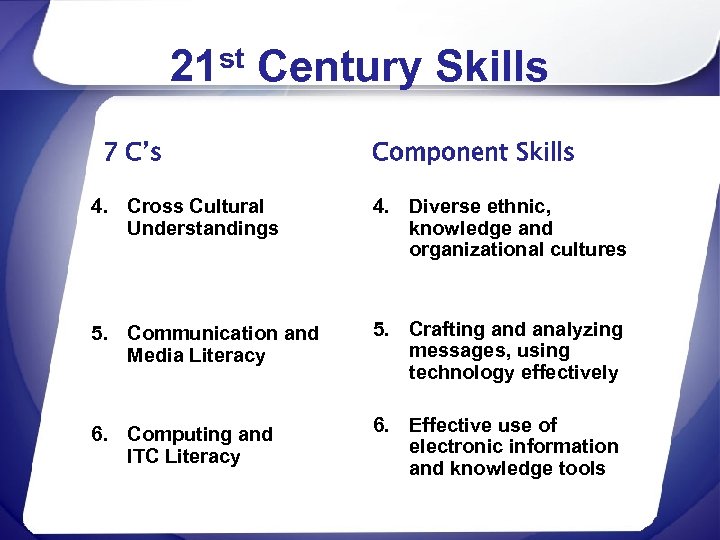
21 st Century Skills 7 C’s Component Skills 4. Cross Cultural Understandings 4. Diverse ethnic, knowledge and organizational cultures 5. Communication and Media Literacy 5. Crafting and analyzing messages, using technology effectively 6. Computing and ITC Literacy 6. Effective use of electronic information and knowledge tools
21 st Century Skills 7 C’s 7. Career and Learning Self Direction Component Skills 7. Managing change, lifelong learning, and career redefinition
Creating a Learning Environment for 21 st Century Skills Students working in teams to experience and explore relevant, real-world problems, questions, issues, and challenges; then creating presentations and products to share what they have learned.
Project Learning is Skill-Based To learn collaboration – work in teams To learn critical thinking – take on complex problems To learn oral communication – present To learn written communications – write
Project Learning is Skill-Based To learn technology – use technology To develop citizenship – take on civic and global issues To learn about careers – To learn content – do internships research and do all of the above
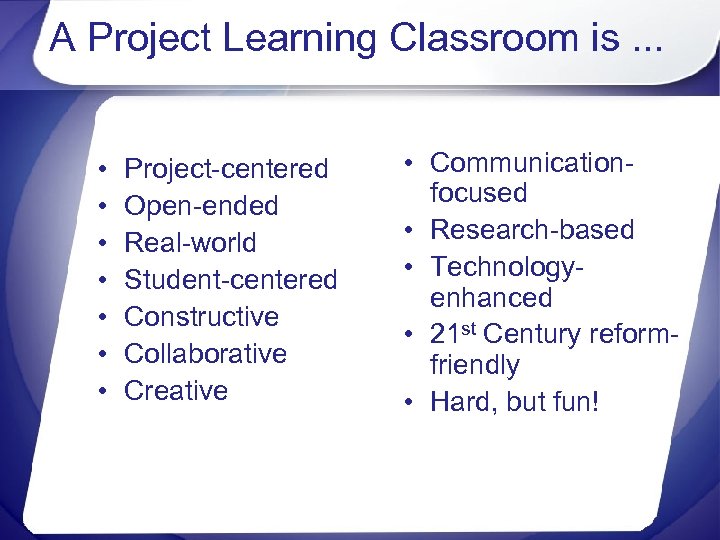
A Project Learning Classroom is. . . • • Project-centered Open-ended Real-world Student-centered Constructive Collaborative Creative • Communicationfocused • Research-based • Technologyenhanced • 21 st Century reformfriendly • Hard, but fun!
In a project learning classroom The teacher’s role is one of coach, facilitator, guide, advisor, mentor… not directing and managing all student work.
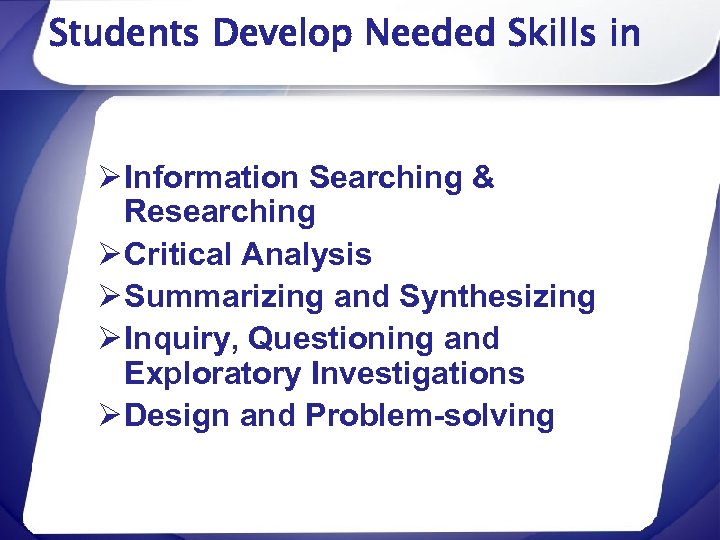
Students Develop Needed Skills in Ø Information Searching & Researching Ø Critical Analysis Ø Summarizing and Synthesizing Ø Inquiry, Questioning and Exploratory Investigations Ø Design and Problem-solving
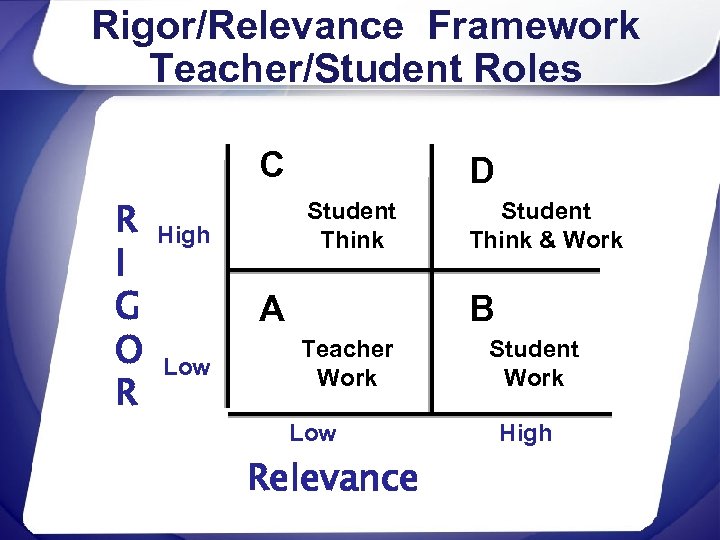
Rigor/Relevance Framework Teacher/Student Roles C R I G O R D Student Think High A Low Student Think & Work B Teacher Work Low Relevance Student Work High
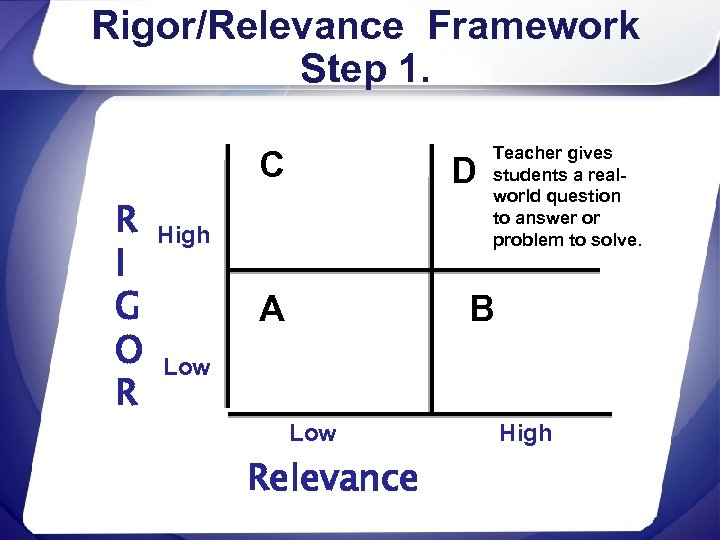
Rigor/Relevance Framework Step 1. C R I G O R D High A Teacher gives students a realworld question to answer or problem to solve. B Low Relevance High
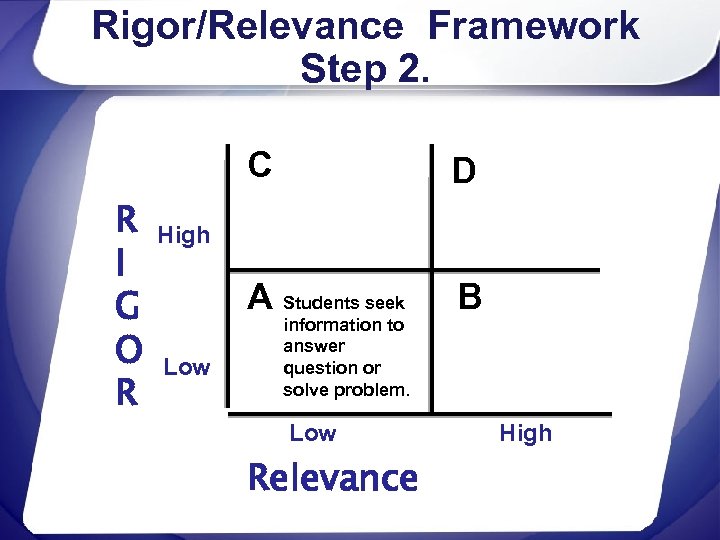
Rigor/Relevance Framework Step 2. C R I G O R D A Students seek B High Low information to answer question or solve problem. Low Relevance High
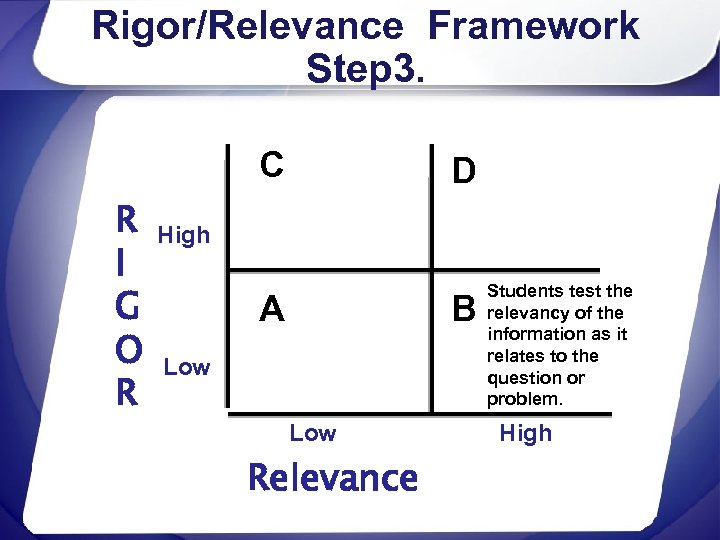
Rigor/Relevance Framework Step 3. C R I G O R D High A B Low Relevance Students test the relevancy of the information as it relates to the question or problem. High
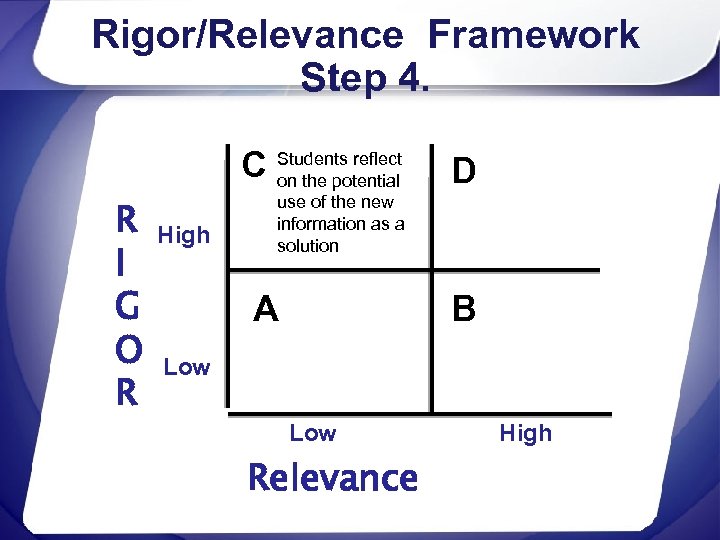
Rigor/Relevance Framework Step 4. C Students reflect on the potential R I G O R High D use of the new information as a solution A B Low Relevance High
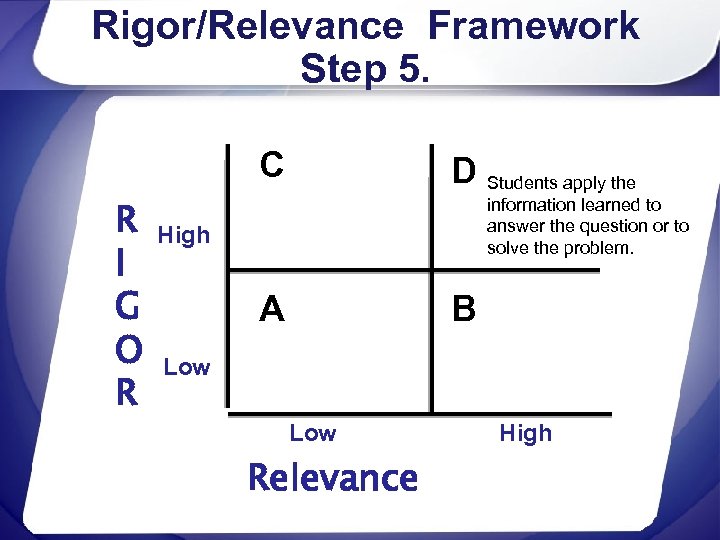
Rigor/Relevance Framework Step 5. C R I G O R D Students apply the information learned to answer the question or to solve the problem. High A B Low Relevance High
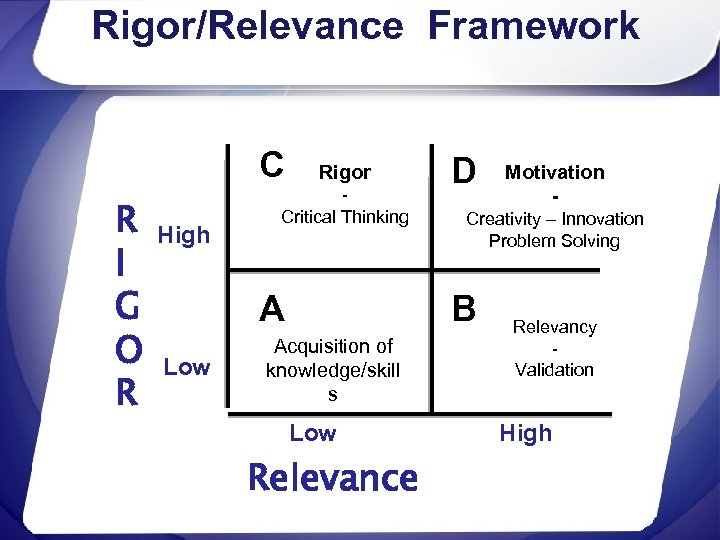
Rigor/Relevance Framework C R I G O R High Rigor Critical Thinking A Low D Creativity – Innovation Problem Solving B Acquisition of knowledge/skill s Low Relevance Motivation - Relevancy Validation High
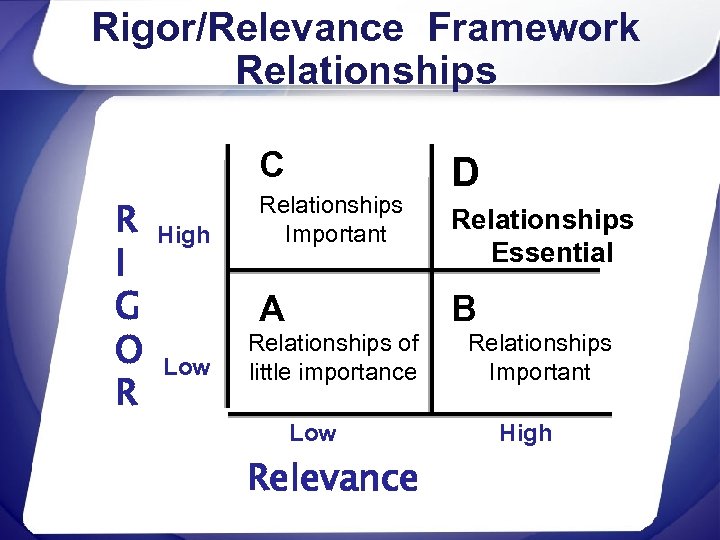
Rigor/Relevance Framework Relationships C R I G O R High Relationships Important A Low D Relationships Essential B Relationships of little importance Low Relevance Relationships Important High
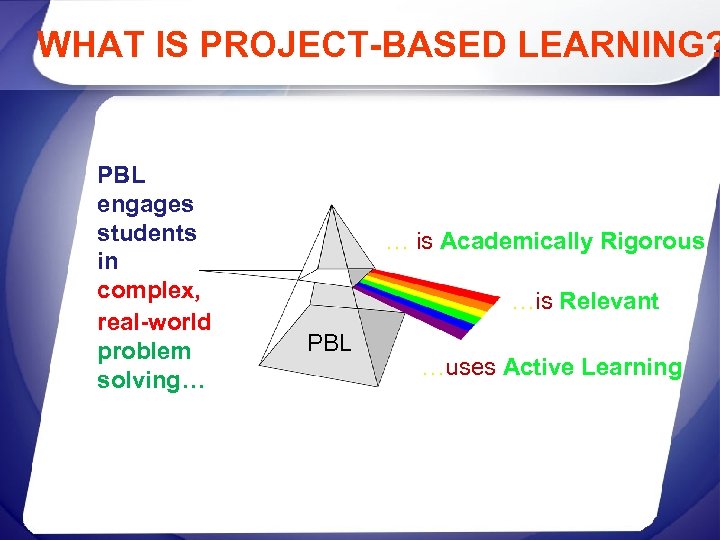
WHAT IS PROJECT-BASED LEARNING? PBL engages students in complex, real-world problem solving… … is Academically Rigorous …is Relevant PBL …uses Active Learning
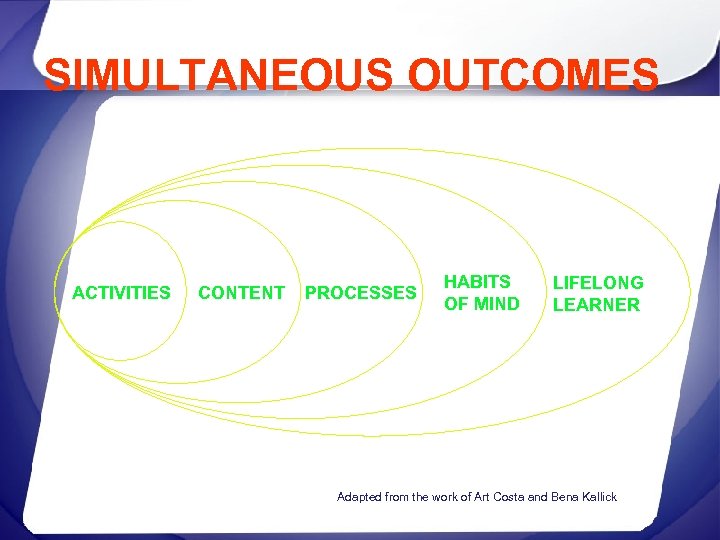
SIMULTANEOUS OUTCOMES ACTIVITIES CONTENT PROCESSES HABITS OF MIND LIFELONG LEARNER Adapted from the work of Art Costa and Bena Kallick
Begin with the end in mind. Stage 1
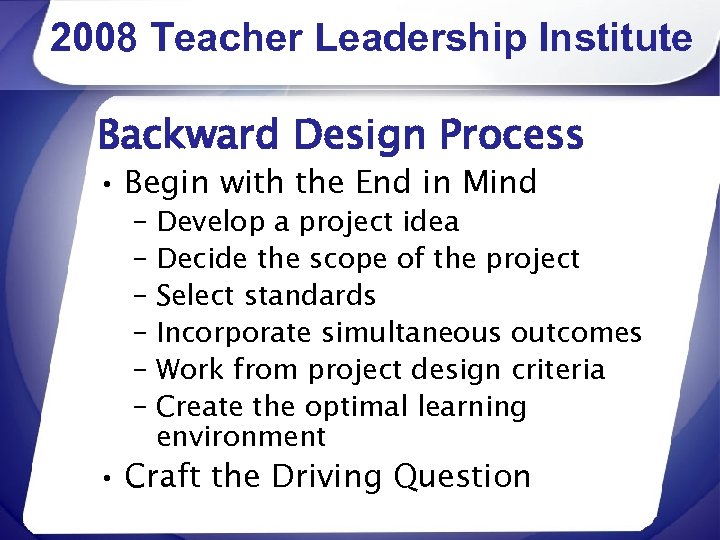
2008 Teacher Leadership Institute Backward Design Process • Begin with the End in Mind – Develop a project idea – Decide the scope of the project – Select standards – Incorporate simultaneous outcomes – Work from project design criteria – Create the optimal learning environment • Craft the Driving Question
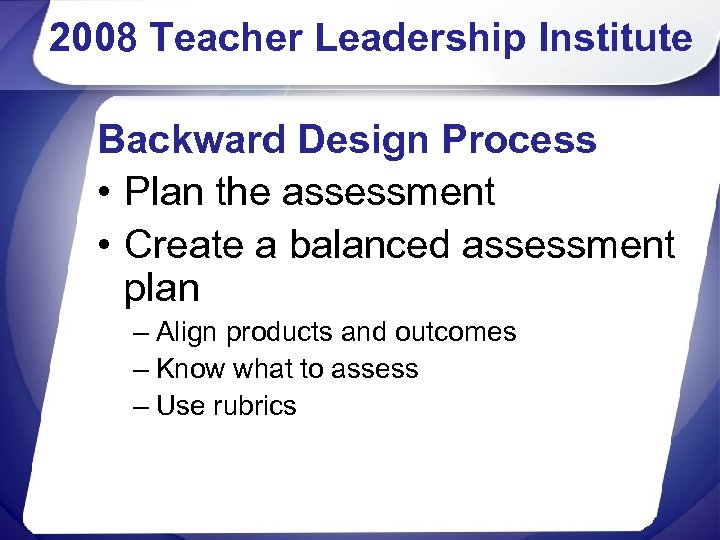
2008 Teacher Leadership Institute Backward Design Process • Plan the assessment • Create a balanced assessment plan – Align products and outcomes – Know what to assess – Use rubrics
2008 Teacher Leadership Institute Backward Design Process • Map the Project – Organize tasks and activities – Decide how to launch the project – Gather resources – Draw a “Storyboard” • Manage the Process – Share project goals with students – Use problem-solving tools – Use checkpoints and milestones – Plan for evaluation and reflection
Step 1. Develop a Project Idea 7 Suggestions: 1. Work backward from a topic. 2. Use your standards. 3. Find projects and ideas on the Web. www. bie. org 4. Map your community 5. Match what people do in their daily work. 6. Tie the project to local and national events. 7. Focus on community service.
Step 1. Develop a Project Idea 7 Suggestions: 1. Work backward from a topic. 2. Use your standards. 3. Find projects and ideas on the Web. www. bie. org 4. Map your community 5. Match what people do in their daily work. 6. Tie the project to local and national events. 7. Focus on community service.
Step 2. Define scope of project. • Duration • Breadth • Technology • Outreach • Partnership • Audience
Step 2. Student Autonomy • Who selects the topic? • Who defines the learning outcomes? • Does the teacher solicit student input? • Do the student and teacher negotiate learning outcomes? • Who defines the products and activities? • Who controls the timeline and pace of the project?
3. Select Standards What do you want your students to know and be able to do? Ø Identify the key standards that you believe might best be met through project based instruction. Ø No more than 3 standards per subject is best in shorter projects. Adjust accordingly for interdisciplinary or longer-term projects. Include at least one literacy outcome in your project. Ø Do not plan for outcomes you cannot assess. Be clear about the standards that will be assessed and how the products will allow each student to demonstrate their learning.
4. Simultaneous Outcomes • Teachers incorporate more than academic outcomes into classroom activities – Specific skills (being able to work in groups, manage projects, meet deadlines, present information, think critically, solve problems, use technology efficiently) – Habits of mind (curiosity, flexibility, perseverance)
5. Project Design Criteria The Six A’s • Authenticity • Academic Rigor • Applied Learning • Active Exploration • Adult Connections • Thoughtful Assessment Practices
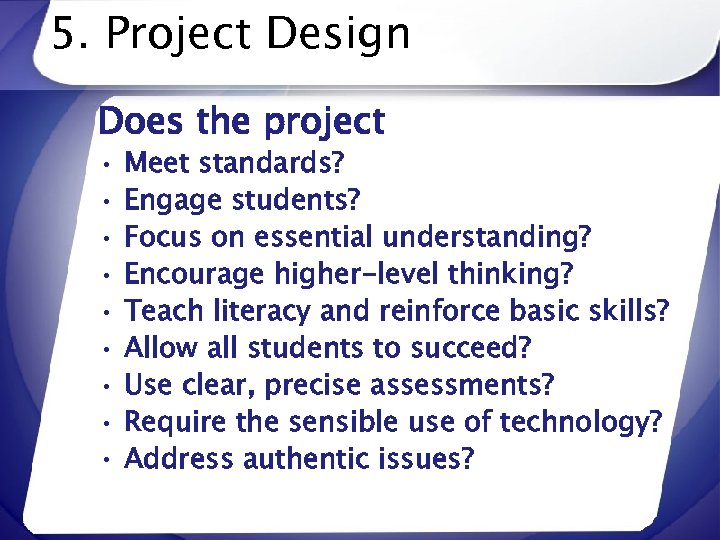
5. Project Design Does the project • • • Meet standards? Engage students? Focus on essential understanding? Encourage higher-level thinking? Teach literacy and reinforce basic skills? Allow all students to succeed? Use clear, precise assessments? Require the sensible use of technology? Address authentic issues?
Caution Well-designed projects that meet PBL criteria differ from activities, or even projects, that have been traditional in the classroom.
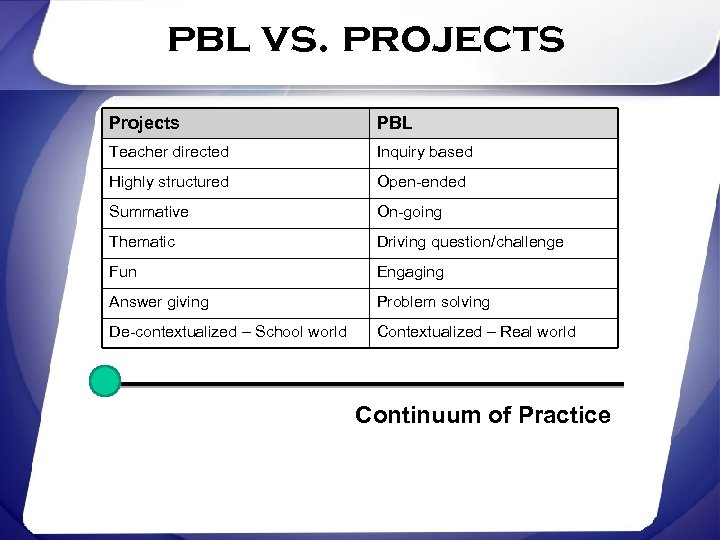
pbl vs. projects PBL Teacher directed Inquiry based Highly structured Open-ended Summative On-going Thematic Driving question/challenge Fun Engaging Answer giving Problem solving De-contextualized – School world Contextualized – Real world Continuum of Practice
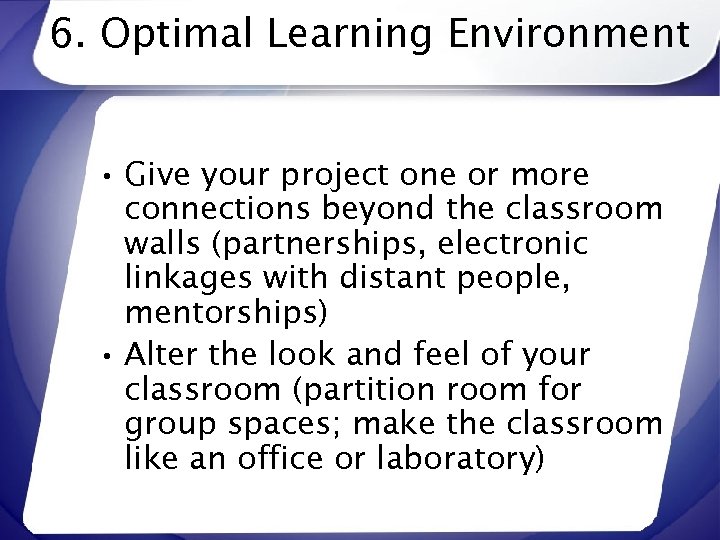
6. Optimal Learning Environment • Give your project one or more connections beyond the classroom walls (partnerships, electronic linkages with distant people, mentorships) • Alter the look and feel of your classroom (partition room for group spaces; make the classroom like an office or laboratory)
6. Optimal Learning Environment Three Ideas for improving learning: Ø See the whole before practicing the parts. Ø Study content and apply it to authentic problems. Ø Make schoolwork more like real work.
Buck Institute PBL Handbook Begin with the End in Mind Idea Bank Project Ideas Project Outcomes Project Design
Crafting the Driving Question When crafting the Driving Question, remember: Ø Driving Questions are provocative. Ø Driving Questions are open-ended. Ø Driving Questions go to the heart of a discipline or topic. Ø Driving Questions are challenging. Ø Driving Questions can arise from realworld dilemmas that students interesting. Ø Driving Questions are consistent with curricular standards and frameworks.
Example from PBL Handbook Should the Unites States have used the atomic bomb in World War II?
Resources Project Planning Forms Buck Institute PBL Handbook “Begin with the End in Mind” & “Draft the Driving Question”
Announcements • Use the PBL Template found on the TLI 08 Google Site, not the one imaged on your computer. • The K-2 group will get their elementary PBL books in content session today. We were able to secure additional copies from Scholastic for next week.
Create a Balanced Assessment Plan Stage 2
Balanced Assessment Plan • Formative assessments that allow you to give feedback as the project progresses – Classroom Assessments for Learning • Classroom Assessments of Learning that provide students with a culminating appraisal of their performance
Align Products with Outcomes. Planning effective assessments requires that you work backwards to align the product or performances for the project with the outcomes.
Align Products with Outcomes This requires: § Identifying culminating products for the project § Using multiple products and providing feedback to students § Using artifacts – evidence of the process of student thinking – to assess learning skills or habits of mind
Establish Performance Criteria • How well do the students know the content? • What is their skill level? • How well did they apply their knowledge and skills as they prepared their product?
How will products allow students to demonstrate their learning? If the project asks students to demonstrate proficiency in three areas, each outcome must be assessed and included in one or more of the components of the products for the project.
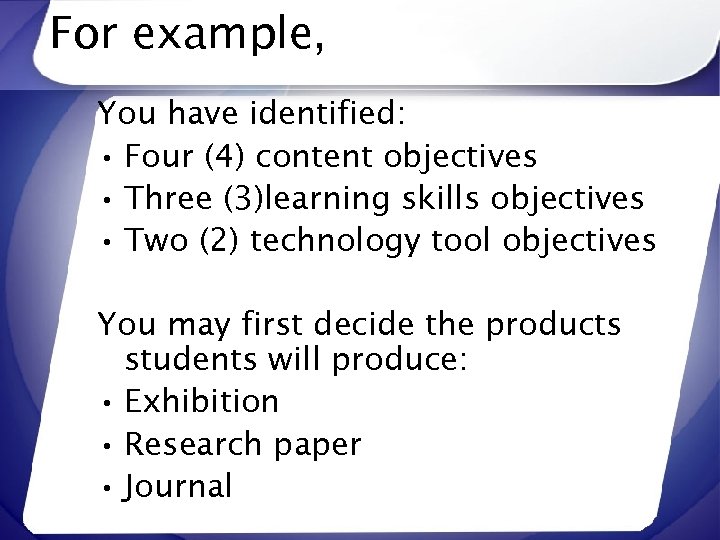
For example, You have identified: • Four (4) content objectives • Three (3)learning skills objectives • Two (2) technology tool objectives You may first decide the products students will produce: • Exhibition • Research paper • Journal
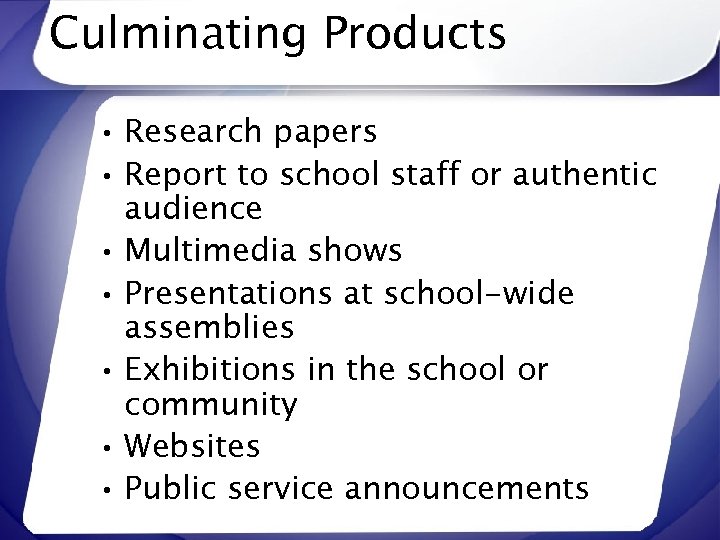
Culminating Products • Research papers • Report to school staff or authentic audience • Multimedia shows • Presentations at school-wide assemblies • Exhibitions in the school or community • Websites • Public service announcements
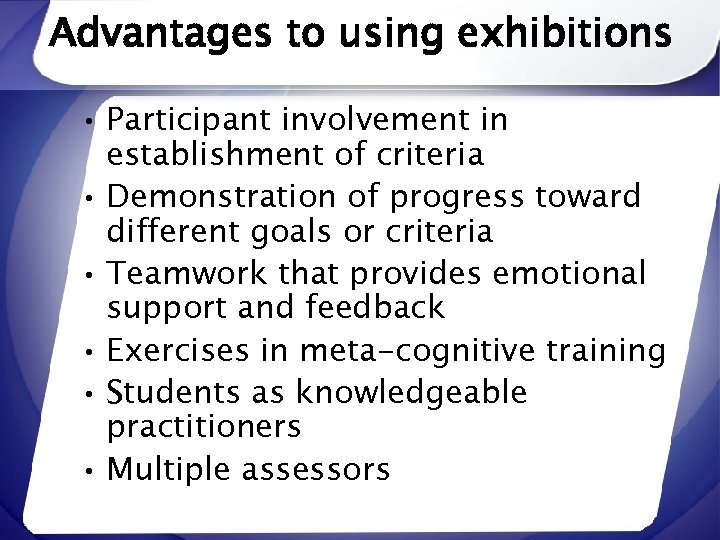
Advantages to using exhibitions • Participant involvement in establishment of criteria • Demonstration of progress toward different goals or criteria • Teamwork that provides emotional support and feedback • Exercises in meta-cognitive training • Students as knowledgeable practitioners • Multiple assessors
A systematic set of checkpoints for project products will not only help keep students on schedule, but it will also help them refine and improve their work.
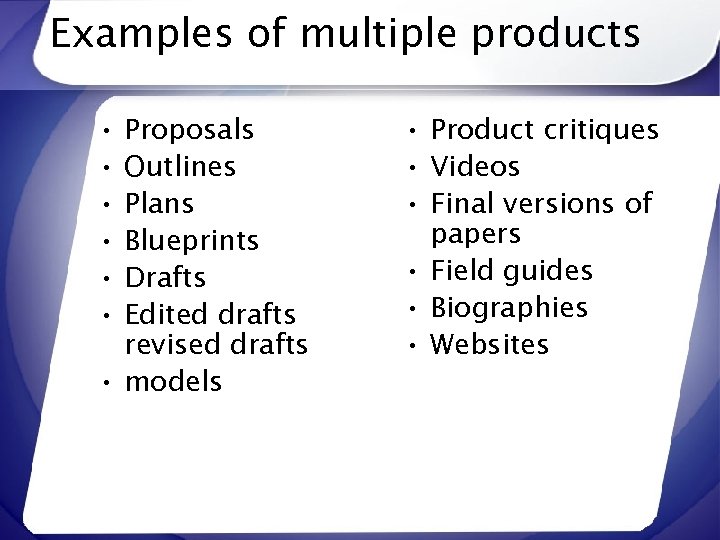
Examples of multiple products • • • Proposals Outlines Plans Blueprints Drafts Edited drafts revised drafts • models • Product critiques • Videos • Final versions of papers • Field guides • Biographies • Websites
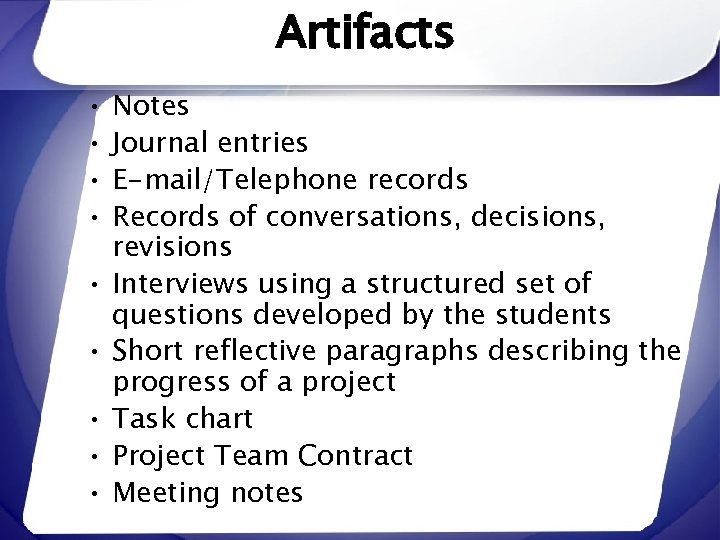
Artifacts • • • Notes Journal entries E-mail/Telephone records Records of conversations, decisions, revisions Interviews using a structured set of questions developed by the students Short reflective paragraphs describing the progress of a project Task chart Project Team Contract Meeting notes
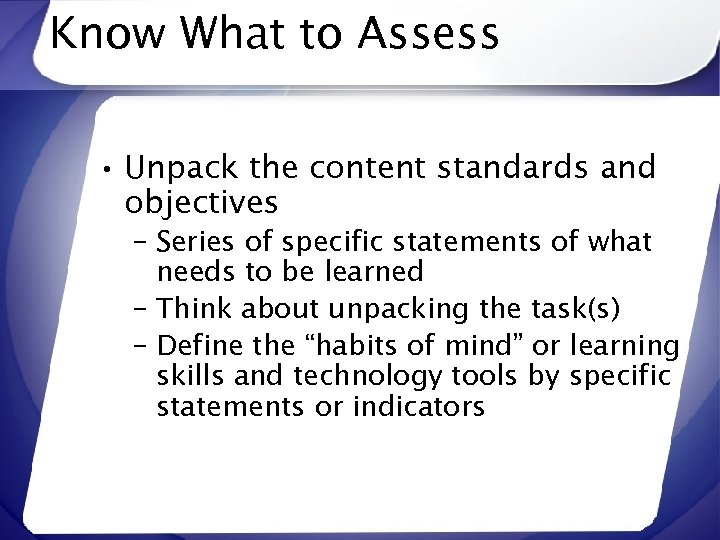
Know What to Assess • Unpack the content standards and objectives – Series of specific statements of what needs to be learned – Think about unpacking the task(s) – Define the “habits of mind” or learning skills and technology tools by specific statements or indicators
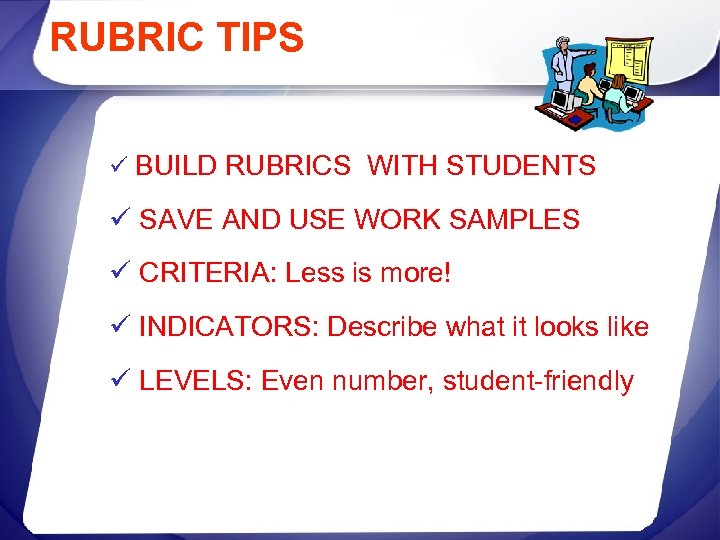
RUBRIC TIPS ü BUILD RUBRICS WITH STUDENTS ü SAVE AND USE WORK SAMPLES ü CRITERIA: Less is more! ü INDICATORS: Describe what it looks like ü LEVELS: Even number, student-friendly
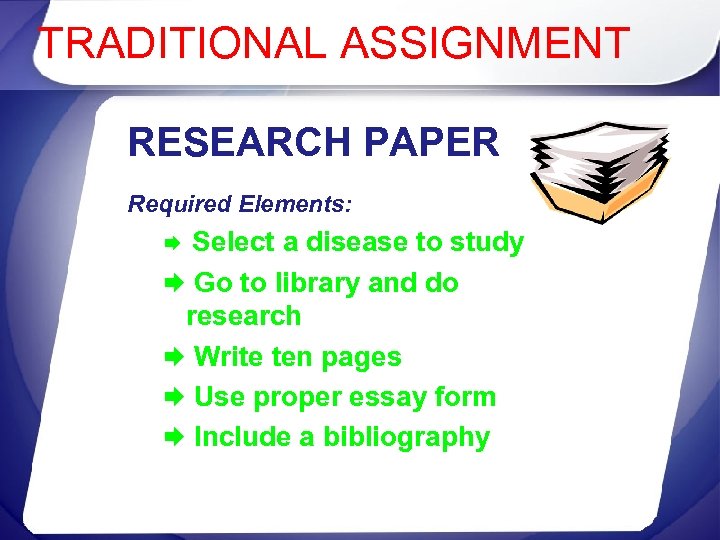
TRADITIONAL ASSIGNMENT RESEARCH PAPER Required Elements: Select a disease to study Æ Go to library and do research Æ Write ten pages Æ Use proper essay form Æ Include a bibliography Æ
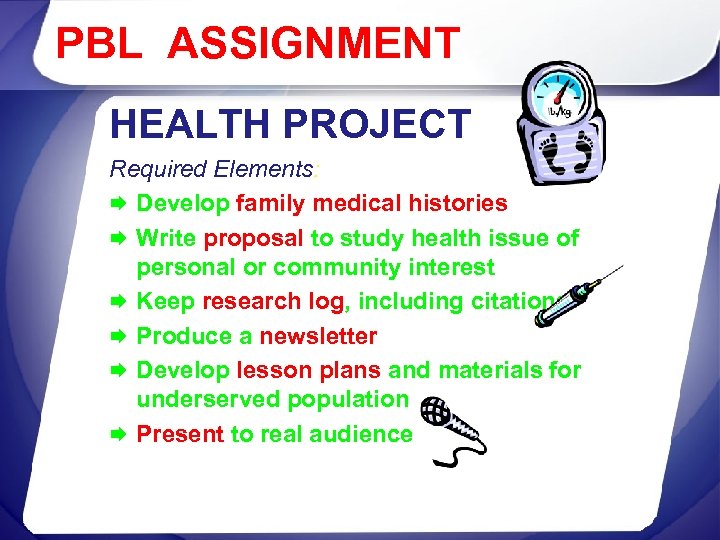
PBL ASSIGNMENT HEALTH PROJECT Required Elements: Æ Develop family medical histories Æ Write proposal to study health issue of personal or community interest Æ Keep research log, including citations Æ Produce a newsletter Æ Develop lesson plans and materials for underserved population Æ Present to real audience
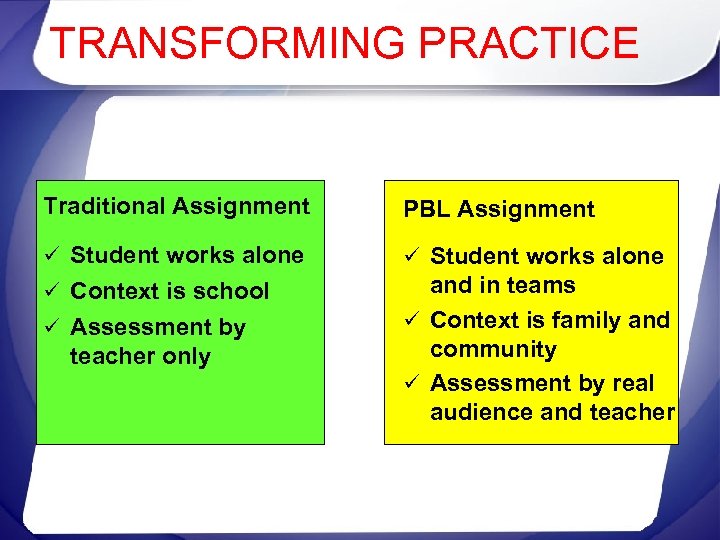
TRANSFORMING PRACTICE Traditional Assignment PBL Assignment ü Student works alone ü Context is school and in teams ü Context is family and community ü Assessment by real audience and teacher ü Assessment by teacher only
WHY ASSESS? What role does assessment play in project-based teaching and learning?
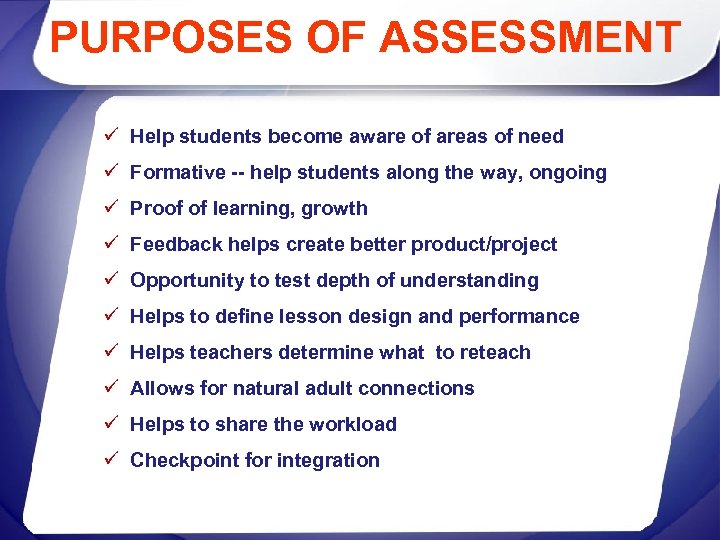
PURPOSES OF ASSESSMENT ü Help students become aware of areas of need ü Formative -- help students along the way, ongoing ü Proof of learning, growth ü Feedback helps create better product/project ü Opportunity to test depth of understanding ü Helps to define lesson design and performance ü Helps teachers determine what to reteach ü Allows for natural adult connections ü Helps to share the workload ü Checkpoint for integration
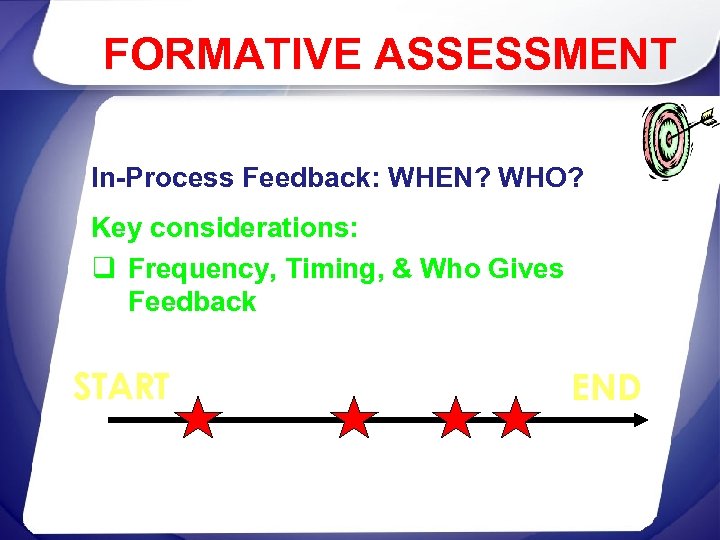
FORMATIVE ASSESSMENT In-Process Feedback: WHEN? WHO? Key considerations: q Frequency, Timing, & Who Gives Feedback START END
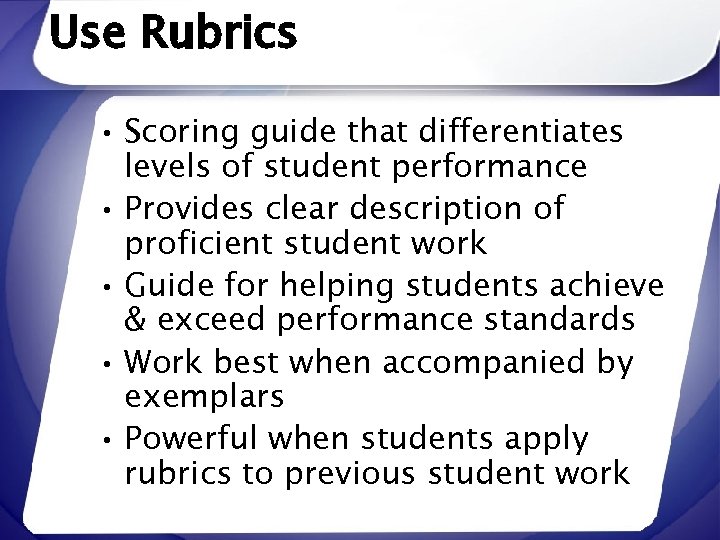
Use Rubrics • Scoring guide that differentiates levels of student performance • Provides clear description of proficient student work • Guide for helping students achieve & exceed performance standards • Work best when accompanied by exemplars • Powerful when students apply rubrics to previous student work
The process of writing a rubric requires teachers to think deeply about what they want their students to know and do. The clearer the outcomes, the clearer the assignments and the better the products.
Effective Rubrics • Are based on an analysis of student work. • Discriminate among the performances by targeting the central features of performance • Provide useful and appropriate discrimination to allow for sufficient judgments regarding performances. • Use rich descriptive language that allows for students to verify their score and accurately self-assess and self-correct • Allow us to remove much of the ambiguity as we recognize levels of performance
School-Wide Rubrics School-wide rubrics can be a powerful tool when developing a culture of high expectations in your school.
21 st Century Skills Rubrics http: //www. novelapproachpbl. com/Project Assessment. Tools. htm
Guidelines for Writing Rubrics To write clear descriptions of proficient student work requires: • thoughtful analysis; • drafting and re-drafting; and • piloting All rubrics have three common features: • elements • scales • criteria
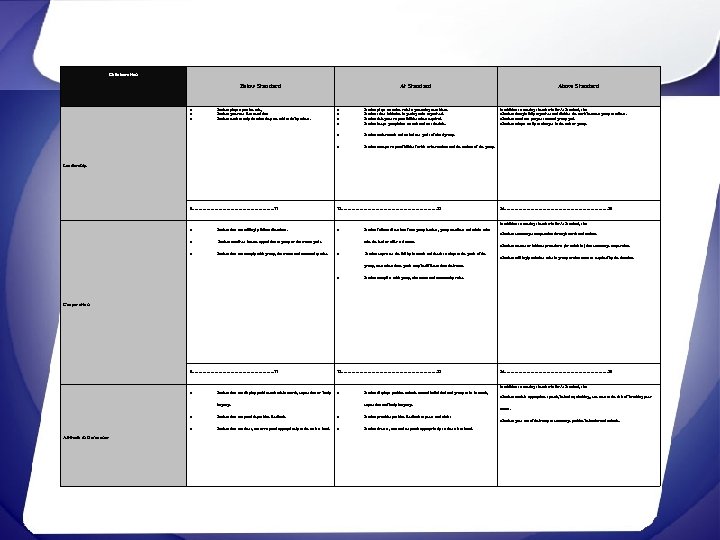
Collaboration Below Standard At Standard Student plays an active role in generating new ideas. Student takes initiative in getting tasks organized. Student delegates responsibilities when required. Student keeps group/class on task and on schedule. Student understands and articulates goals of class/group. Student plays a passive role, Student generates few new ideas Student tends to only do what they are told to do by others. Above Standard Student accepts responsibilities for his or her actions and the actions of the group. In addition to meeting the criteria for At Standard, the: Student thoughtfully organizes and divides the work between group members. Student monitors progress toward group goal. Student adapts easily to changes in the task or group. Leadership 0…………………………. . 17 18……………………………… 35 Student does not willingly follow directions. Student vocalizes intense opposition to group or classroom goals. Student does not comply with group, classroom and community rules. 36………………………………… 50 In addition to meeting the criteria for At Standard, the: Student follows directions from group leaders, group members and adults who take the lead or offer assistance. Student expresses the ability in words and deeds to adapt to the goals of the Student encourages cooperation through words and actions. Student creates or initiates procedures (or activities) that encourage cooperation. Student willingly switches roles in group or classroom as required by the situation. group, even when those goals may be different than their own. Student complies with group, classroom and community rules. Cooperation 0…………………………. . 17 18……………………………… 35 36………………………………… 50 In addition to meeting the criteria for At Standard, the: Student does not display positive attitude in words, expression or body language Student displays positive attitude toward individual and group tasks in words, Student models appropriate speech, behavior, clothing, , etc. even at the risk of breaking peer expression and body language norms. Student provides positive feedback to peers and adults Attitude & Demeanor Student does not provide positive feedback. Student does not dress, act or respond appropriately to the task at hand. Student dresses, acts and responds appropriately to the task at hand. Student goes out of their way to encourage positive behavior and attitude.
When building your rubric, • Language used to label the scale should reflect performance in relation to a standard (below standard, above standard, exceed standard, etc. ) • Be sure to use enough points to accurately represent the degrees of student performance.
When applying criteria to the elements and scales: • Describe which criteria apply to different aspects of performance • Write criteria that describe behaviors or results that be easily measured or observed. • Determine which criteria are critical for the assignment • Begin your rubric with a description of exemplary performance.
Other Tips Related to Rubrics • Use the Idea Bank in your Buck Institute PBL Handbook • Use Bloom’s Taxonomy for action verbs • Link your grade level CSOs with the scoring criteria. What do performance descriptors say? • Be thoughtful as you determine the essential elements you want to assess; do not have too many/too few rubrics for the project. • Use student-friendly language • Maintain high standards for exemplary work • Focus on tangible results – the product
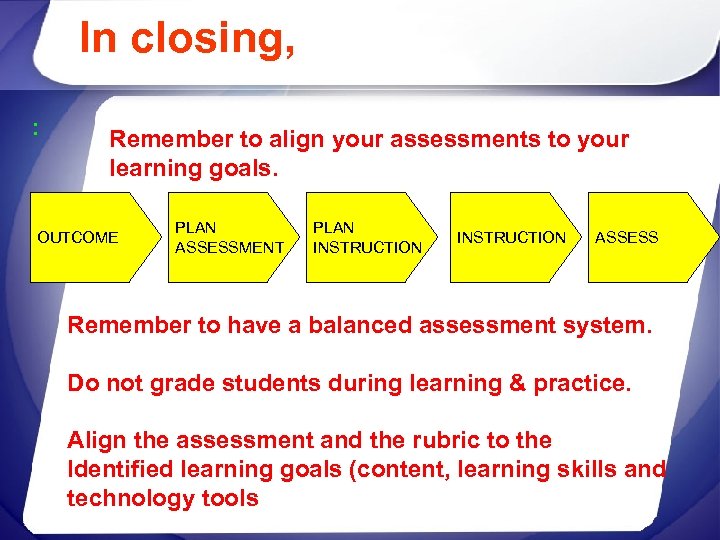
In closing, : Remember to align your assessments to your learning goals. OUTCOME PLAN ASSESSMENT PLAN INSTRUCTION ASSESS Remember to have a balanced assessment system. Do not grade students during learning & practice. Align the assessment and the rubric to the Identified learning goals (content, learning skills and technology tools
Announcements • Check out at Waterfront is at 12: 00 Noon. Be sure to honor this time. • All equipment checked out by participants is due in the TLI office by 12: 00 Noon. • Continue to monitor your access email address, because all TLI correspondence will be sent to that address. • You may keep the globe given to your county.
Stage 3 Map the Project
Mapping the Project Stage 3 • Analyzing instructional needs • Planning activities • Estimating time • Preparing resources
Launching the Project • Entry Events • Entry Documents
Gathering Resources • Information – Websites, books, articles, experts • Supplies • Technology tools • Adults to attend final exhibition
Caution! When there are central ideas that everyone should understand or critical skills that everyone should obtain, structure group work so that all students learn the common core concepts.
Caution! Begin with powerful, central ideas or complex concepts and then plan activities around this content. Design so that the challenge associated with the project is in discovering and using subject-matter principles.
Caution! Emphasizing technology in place of content can take up time, encourage “splash” at the expense of deep learning, and mask the fact that students have not done sufficient work to solve the problem or address the issues raised by the Driving Question. PBL Handbook
Drawing a Storyboard • Sketch the project in a flow chart or storyboard format • Create a timeline • Identify milestones and assignments • Include the following: – Project launch – Sequence of activities – Drafts, rehearsals, practices – Due dates – Exams – Homework assignments – Reflection and review
Managing the Process • Orient students to the goals of the project on a regular basis. • Group students appropriately • Organize the project on a daily basis • Clarify everything • Monitor and regulate student behavior • Manage the flow of work • Evaluate the success of the project
Key Steps • Share project goals with students • Use problem-solving tools – Know/Need to Know list – Learning Logs – Planning, investigation, product briefs • Use checkpoints and milestones • Plan for evaluation and reflection
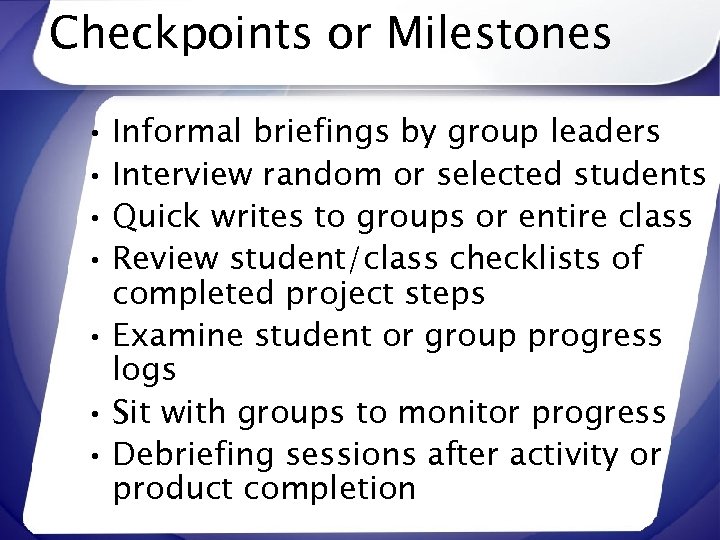
Checkpoints or Milestones • Informal briefings by group leaders • Interview random or selected students • Quick writes to groups or entire class • Review student/class checklists of completed project steps • Examine student or group progress logs • Sit with groups to monitor progress • Debriefing sessions after activity or product completion
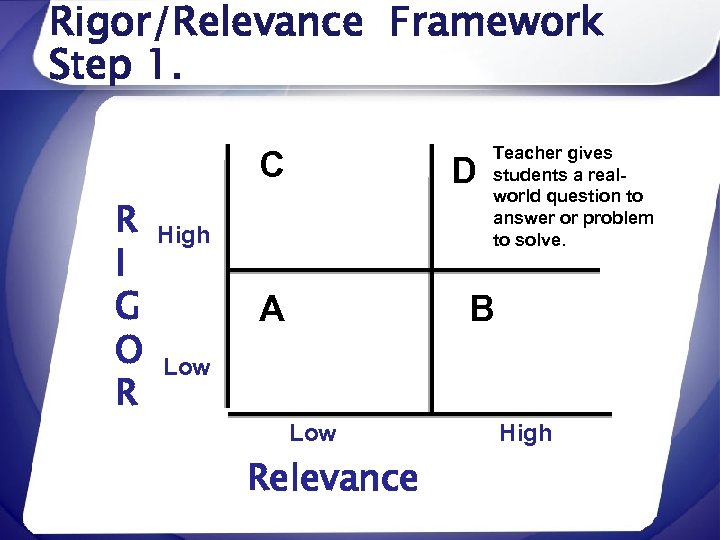
Rigor/Relevance Framework Step 1. C R I G O R D High A Teacher gives students a realworld question to answer or problem to solve. B Low Relevance High
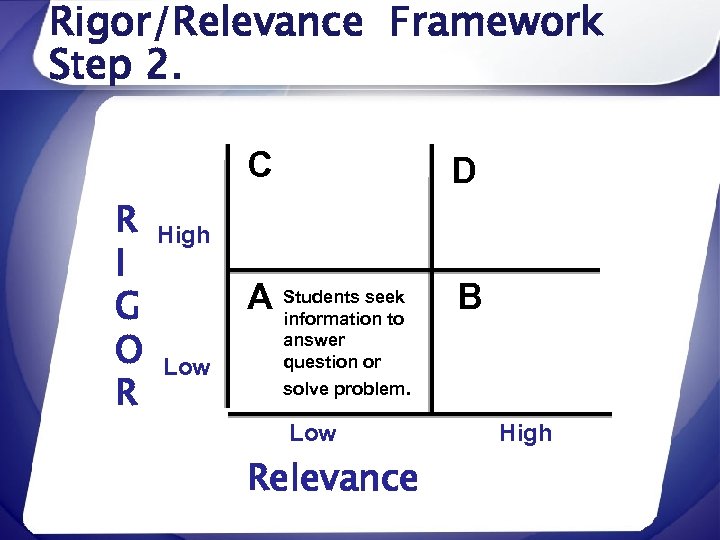
Rigor/Relevance Framework Step 2. C R I G O R D A Students seek information to B High Low answer question or solve problem. Low Relevance High
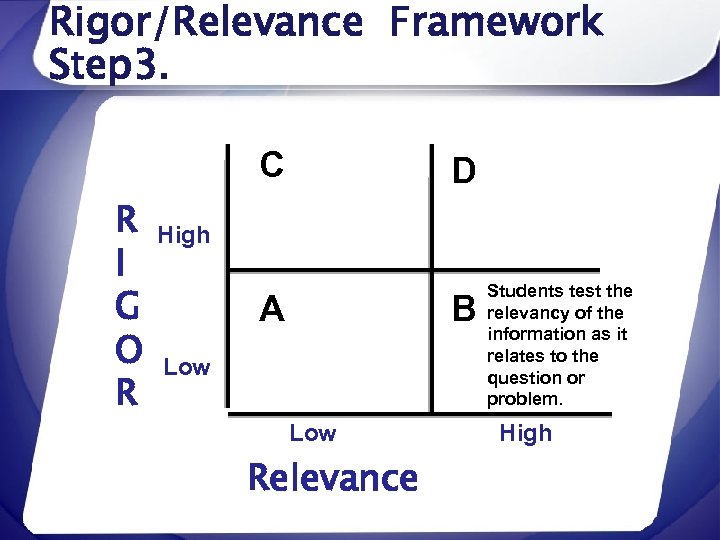
Rigor/Relevance Framework Step 3. C R I G O R D High A B Low Relevance Students test the relevancy of the information as it relates to the question or problem. High
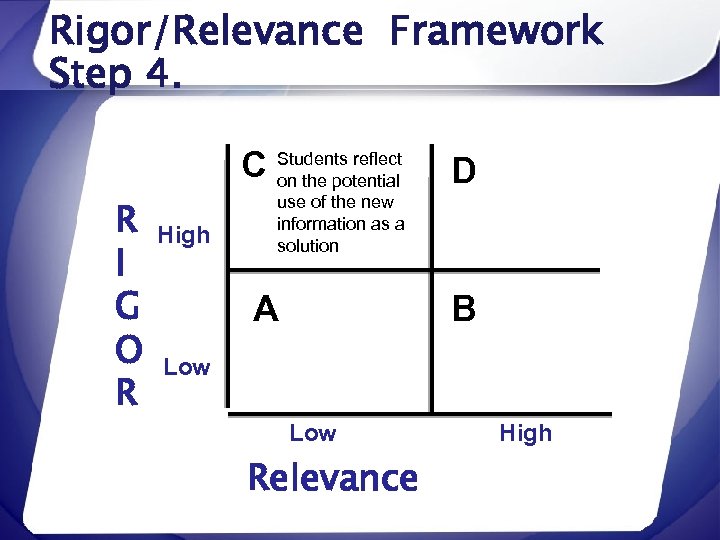
Rigor/Relevance Framework Step 4. C Students reflect on the potential R I G O R High D use of the new information as a solution A B Low Relevance High
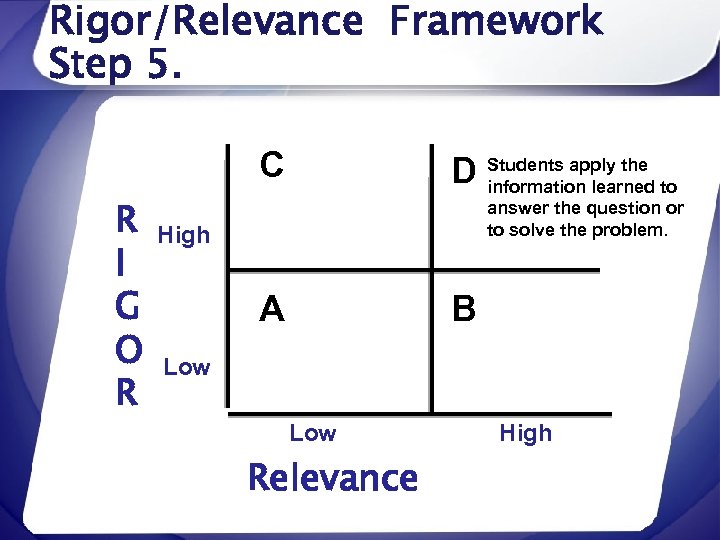
Rigor/Relevance Framework Step 5. C R I G O R D Students apply the to information learned answer the question or to solve the problem. High A B Low Relevance High
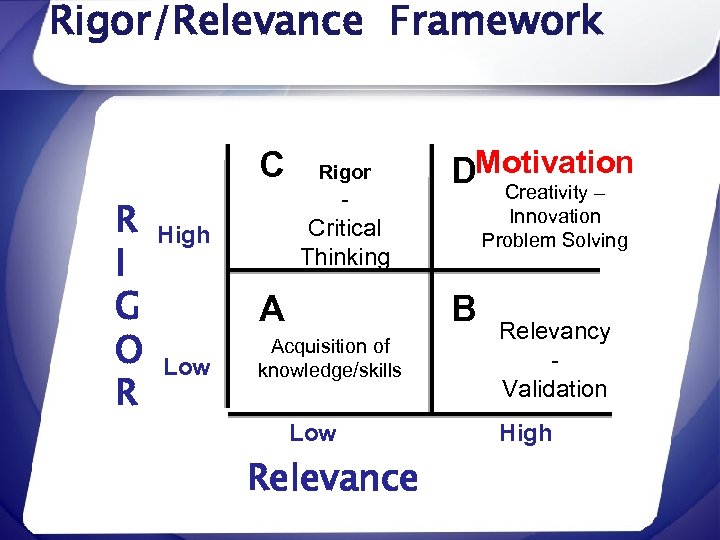
Rigor/Relevance Framework C R I G O R Rigor Critical Thinking High A Low DMotivation Creativity – Innovation Problem Solving B Acquisition of knowledge/skills Low Relevance Relevancy Validation High
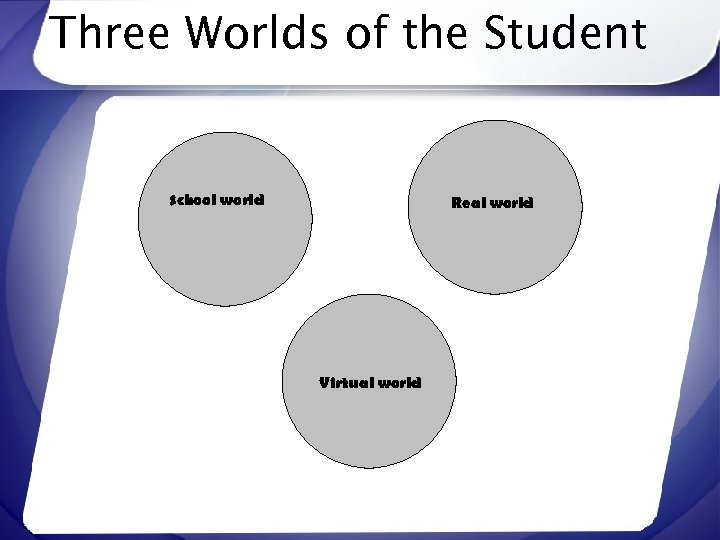
Three Worlds of the Student School world Real world Virtual world
Reflect on Process & Outcomes §Student performance tied to project goals/requirements §Student performance compared to prior work/external standard §Clarity of instructions §Clarity of process §Clarity of assessment
planning §Review Standards §Write/Refine the Driving Question Day 0 §Write/Refine/Find the Project §Describe Student Products (demonstration of understanding) §Create an Engaging Entry Event §Meet with your team; get some help §Project Duration: Contact hours vs. days/periods Tip: Create master project calendar for your school
planning Day 0. 5 §Create Assessments (Authentic) §Design Scaffolds §Collect Resources §Schedule Facilities/Equipment §Create Groups §Create Calendars §Create/Collect Exemplars §Create Presentation Schedule (arrange panel) §Participate in Critical Friends
Let It Roll! Day 1. 0 §Unleash Entry Event §Create Need-to-Know List §Announce Groups/Presentation Schedules Students begin to…. §Hold Initial Group Meetings §Write Group Contracts §Write Preliminary Task Lists §Complete Individual Activity Logs §Begin Research and Reading
Presentation Group report Peer Evaluation Individual Defense – take the time! Days 14. 0 to 15. 0 Followed by… Structured Reflection Self Evaluation Peer Collaboration Scoring Assignment of Bonuses/Rewards Project Debriefs
Evaluations and Reflections Students who have the opportunity to discuss, analyze, and reflect on their learning experiences are more likely to retain and use their knowledge and skills.
Culminating Evaluation • What did we learn? • Did we collaborative effectively? • What skills did we learn? • What skills do we need to practice? • What was the quality of our work? • Where can we improve?
Four Methods • Whole class de-briefing • Fishbowl • Survey • Self-evaluation
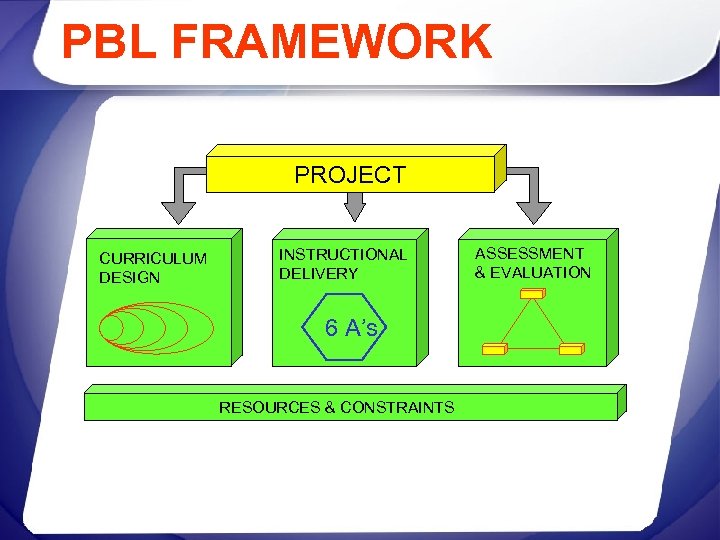
PBL FRAMEWORK PROJECT CURRICULUM DESIGN INSTRUCTIONAL DELIVERY 6 A’s RESOURCES & CONSTRAINTS ASSESSMENT & EVALUATION
Скачать презентацию Teacher Leadership Institute Why Project Based Learning Office
4cc7cc4eb3b3bf0cfddb68dd2a5cfbed.ppt