


 Скачать презентацию TEACHER IMMEDIACY THE RELATIONSHIP WITH PERCEIVED LEARNING AND
559d97871af4c88571484b24917572ca.ppt
- Количество слайдов: 29
 TEACHER IMMEDIACY: THE RELATIONSHIP WITH PERCEIVED LEARNING AND STUDENT OUTCOMES IN THE U. S. INTERNATIONAL CLASSROOM Jillian L. Wendt University of the District of Columbia Deanna Nisbet Regent University E-LEARN 2015 CONFERENCE OCTOBER 19 -22, 2015
 INTRODUCTION • Unique challenges encountered by international students enrolled in U. S. courses – Many are successful – Different set of challenges • How do we best meet international students’ needs?
 INTRODUCTION • Challenges include: – Language – Culture – Academic expectations – Social expectations
 INTRODUCTION • Documented difficulties: – Language – Adapting to academic culture – Misunderstandings – Complications in communication – Isolation – Alienation – Culture shock – Overall adjustment (Erichsen & Bollinger, 2011)
 INTRODUCTION • Importance of examining design and delivery of instruction – How can international students be best supported? – What are best practices? – What are evidence-based practices? – Do current models meet international student needs?
 INTRODUCTION • Positive relationship between teacher immediacy and positive student outcomes (Ni & Aust, 2008; King & Witt, 2009; Russo & Benson, 2005) • Positive relationship between perceived learning and positive student outcomes (King & Witt, 2009; Rovai et al. , 2009) • …with U. S. students. • Do similar relationships exist with international students?
 INTRODUCTION Does a relationship exist between international students’perceptions of teacher immediacy, perceived learning, and end of course grades when enrolled in U. S. graduate courses offered in a computer-mediated delivery format?
 THEORETICAL FRAMEWORK • Theory of immediacy (Mehrabian, 1971) – Indicator of attitudes in communication – Verbal and non-verbal immediacy – Explicit and implicit forms (Mehrabian, 1966)
 BACKGROUND • Relationship between increased teacher immediacy and positive student outcomes (Gorham, 1988) • Relationship between increased teacher immediacy and student satisfaction (Ni & Aust, 2008) • Relationship between increased teacher immediacy and student motivation (Wilson, 2006)
 BACKGROUND • CAP Perceived Learning Scale – Measures perceived learning • Domains: – Cognitive – Affective – Psychomotor (Rovai et al. , 2009)
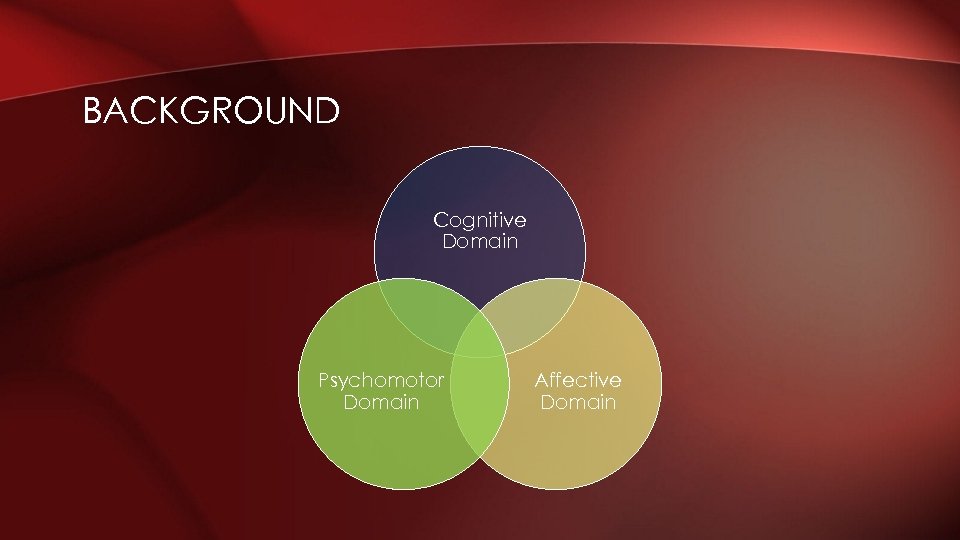 BACKGROUND Cognitive Domain Psychomotor Domain Affective Domain
 BACKGROUND • CAP – Relationship to learning effectiveness – Relationship to learning practices – Predictor of student course outcomes (Rovai et al. , 2009)
 BACKGROUND • Nature of teaching and learning environment – Discourse community – Varies from one culture to another 1986; Sadykova & Dautermann, 2009) • Expectations vary (De. Villar, Faltis, & Cummins, 1994; Hofsted,
 BACKGROUND • Challenges of computer-mediated environment – Delayed response time – Lower quality of communication – Heightened cultural challenges Reeves, 2007) (Liu et al. , 2010) (Erichsen & Bollinger, 2011; Liu et al. , 2010; Want &
 BACKGROUND • Increased examination • Increased intervention • Importance of studying impact of teacher immediacy on outcomes • Relationship to student success
 METHODOLOGY • Causal comparative research design • Spearman’s rank order correlation
 RESEARCH QUESTIONS • RQ 1: Is there a statistically significant relationship between international students’ perceptions of teacher immediacy when enrolled in a graduate course and students’ end of course grades?
 RESEARCH QUESTIONS • RQ 2: Is there a statistically significant relationship between international students’ perceived learning when enrolled in a graduate course and students’ end of course grades?
 RESEARCH QUESTIONS • RQ 3: Is there a statistically significant relationship between international students’ perceptions of teacher immediacy when enrolled in a graduate course and students’ perceived learning?
 PARTICIPANTS • 276 students • Enrolled in graduate courses • Northern Virginia, USA – 211 males – 65 females
 PARTICIPANTS • Synchronous delivery • Moodle ™ learning management system • 8 week courses • Survey given during week 5 – Demographics – Verbal Immediacy Scale (Gorham, 1988) – CAP Perceived Learning Scale – End of course grades (Rovai et al. , 2009)
 OVERVIEW OF RESULTS • RQ 1: Small, negative statistically significant relationship between students’ perceptions of teacher immediacy and end of course grades
 OVERVIEW OF RESULTS • RQ 2: No statistically significant relationship between students’ perceived learning and end of course grades
 OVERVIEW OF RESULTS • RQ 3: Small, positive statistically significant relationship between students’ perceptions of teacher immediacy and students’ perceived learning
 DISCUSSION • Current findings contradict previous studies which revealed the following: – Positive relationship between perceived teacher immediacy and student outcomes (Ni & Aust, 2008; Russo & Benson, 2005) – Positive relationship between perceived learning and course grades (Rovai et al. , 2009)
 IMPLICATIONS • What works for U. S. students may not work for international students. • Certain types of course design may present a barrier for international students.
 FUTURE STUDY More research is needed to examine: • Factors that impact international students’ success • Unique considerations for course design and delivery
 REFERENCES Bista, K. , & Foster, C. (2011). Issues of international student retention in American higher education. The International Journal of Research and Review, 7(2), 1 -10. Bloom, B. S. (1956). Taxonomy of educational objectives: Handbook 1: Cognitive domain. New York: David Mc. Kay. De. Villar, R. A. , Faltis, C. , & Cummins, J. (1994). Cultural diversity in schools: From rhetoric to practice. Albany, NY: State University of New York Press. Erichsen, E. , & Bolliger, D. (2011). Towards understanding international graduate student isolation in traditional and online environments. Educational Technology Research & Development, 59(3), 309 -326. Gorham, J. (1988). The relationship between verbal teacher immediacy behaviors and student learning. Communication Education, 37, 40 -53. Hofstede, G. (1986). Cultural differences in teaching and learning. International journal of International Relations, 10, 301 -320. Kearney, P. (1994). Affective learning scale. In R. B. Rubin, P. Palmgreen, & H. E. Sypher (Eds. ), Communication research measures: A sourcebook. New York: The Guilford Press (pp. 81 -85). King, P. , & Witt, P. (2009). Teacher immediacy, confidence testing, and the measurement of cognitive learning. Communication Education, 58(1), 110 -123. Lin, M. (2012). Students of different minds: Bridging the gaps of international students studying in the US. US-China Education Review, 3, 333 -344. Liu, X. , Liu, S. , Lee, S. , & Magjuka, R. J. (2010). Cultural difference in online learning: International student perceptions. Journal of Educational Technology & Society, 13(3), 177 -188.
 REFERENCES Mehrabian, A. (1966). Immediacy: An indicator of attitudes in linguistic communication. Journal of Personality, 34(1), 26 -34. Mehrabian, A. (1971). Silent messages. Belmont, CA: Wadsworth Publishing Company, Inc. Ni, S. , & Aust, R. (2008). Examining teacher verbal immediacy and sense of classroom community in online classes. International Journal on E-Learning, 7(3), 477 -498. Rovai, A. , Wighting, M. J. , Baker, J. D. , & Grooms, L. D. (2009). Development of an instrument to measure perceived cognitive, affective, and psychomotor learning in traditional and virtual classroom higher education settings. Internet and Higher Education, 12, 7 -13. Russo, T. , & Benson, S. (2005). Learning with invisible others: Perceptions of online presence and their relationship to cognitive and affective learning. Educational Technology & Society, 8(1), 54 -62. Sadykova, G. (2014). Mediating Knowledge through Peer-to-Peer Interaction in a Multicultural Online Learning Environment: A Case Study of International Students in the US. International Review of Research in Open And Distance Learning, 15(3), 24 -49. Sadykova, G. , & Dautermann, J. (2009). Crossing cultures and borders in international online distance higher education. Journal of Asynchronous Learning Networks, 13(2), 89 -114. Wang, C. , & Reeves, T. C. (2007). Synchronous online learning experiences: The perspectives of international students from Taiwan. Educational Media International, 44(4), 339 -356. Wilson, J. H. (2006). Predicting student attitudes and grades from perceptions of instructors’ attitudes. Teaching of Psychology, 33(2), 91 -95. Zhang, Z. , & Kenny, R. F. (2010). Learning in an online distance education course: Experiences of three international students. International Review of Research In Open And Distance Learning, 11(1), 17 -36.