


 Скачать презентацию Teacher Education Program University of Mount Olive
8240bea687a64e299a578ead2c1b5630.ppt
- Количество слайдов: 63
 Teacher Education Program University of Mount Olive
 “Failure is not a option, but opportunity for success and high expectations are options for students to succeed. ” -Ruby A. Bell
 Teacher Education at UMO • Envisioned around the North Carolina Professional Teaching Standards and the 21 st century knowledge, skills, and dispositions. • Integrated academic experience • quality educational programs • supportive learning environment • individual growth opportunities for total development of our students
 Our Program • Nurtures systemic thinking • Provides disciplinary knowledge based in theory and application • Encourages lifelong learning opportunities • Provides trans-cultural experiences, and global awareness
 We Believe • Professionals should possess the skills to advance student learning in the areas of literacy, leadership, and technology.
 Mission • Transform education (and thereby lives) by preparing and producing education professionals knowledgeable of the content they teach, skilled in pedagogy, and passionate about teaching all students.
 Conceptual Framework • The Teacher Education program design is based on the concept of a Professional Learning Community (PLC). • Guiding Principle that “Learning to teach involves learning about practice in practice. ” • focusing on practical and active experiences • defining a clear plan to achieve competency • developing community learning experiences, guided through focused reflection opportunities.
 Learning Communities • • • Consortium Community Cohort Community Specialty Area Community School and LEA, Community K-12 Teacher Education Community Advising Community
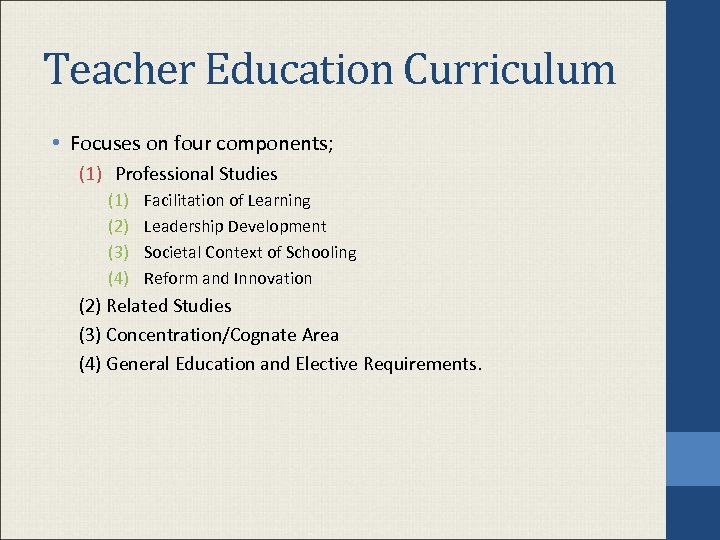 Teacher Education Curriculum • Focuses on four components; (1) Professional Studies (1) (2) (3) (4) Facilitation of Learning Leadership Development Societal Context of Schooling Reform and Innovation (2) Related Studies (3) Concentration/Cognate Area (4) General Education and Elective Requirements.
 Professional Studies Courses • Leadership Development • Based on the premise that teachers should be leaders. • Helps students develop leadership skills as they learn about leadership theory and practices that can • improve workplace satisfaction • student performance and behavior • promote collaboration in the classroom and beyond. • Students learn that effective leaders engage in reflective practice.
 Professional Studies Courses • Facilitation of Learning • Emphasizes the appropriate use of educational theory, practice, procedures, and resources to enable facilitators and learners to work collaboratively toward desired goals. • Focuses on individualizing instruction to help learners achieve growth through self-evaluation and cooperation with others.
 Professional Studies Courses • Societal Context of Schooling • Evaluates the current major themes in education and society to promote a global and comparative educational perspective. • Defines the topics that are at the forefront of educational discussion as they relate to school, social, economic, and political institutions. • Diversity, English Language Learners (ELL), Academically/Intellectually Gifted (AIG), and Exceptional Children’s issues are addressed through the use of the Universal Design for Learning (UDL).
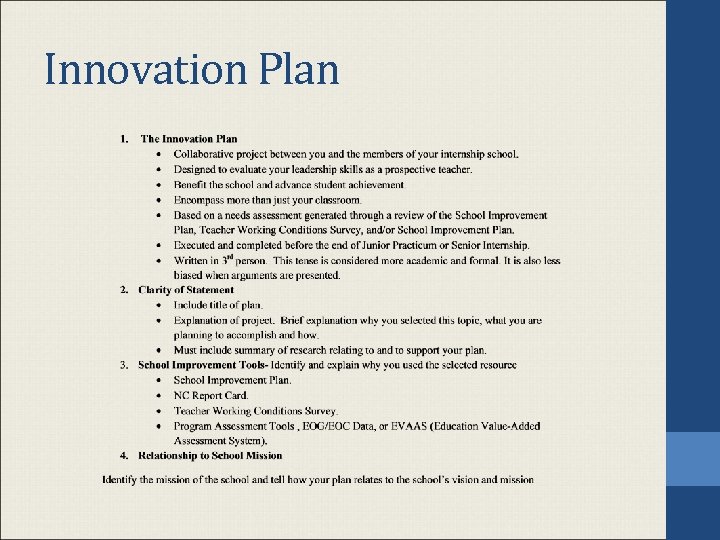
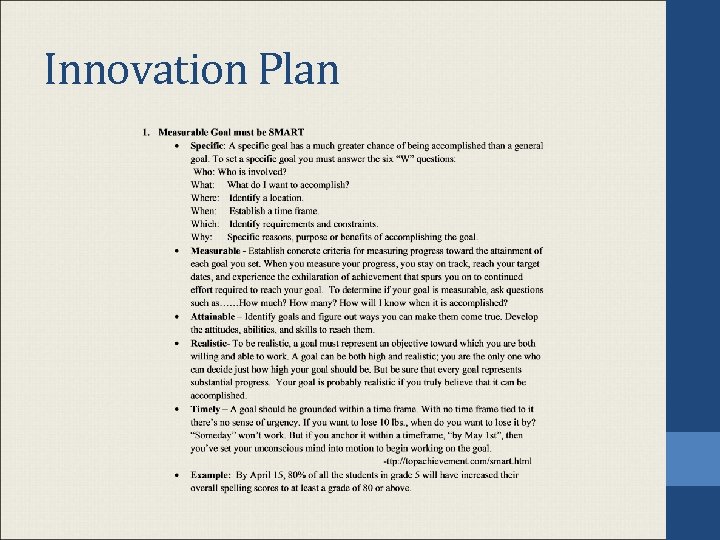
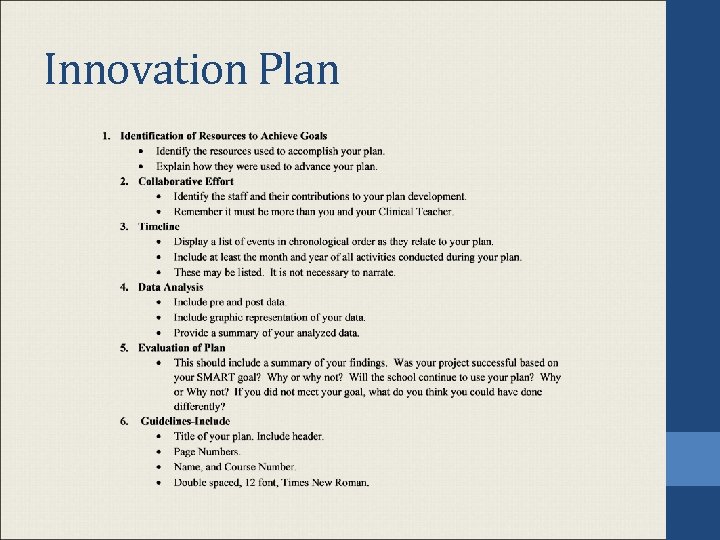
 Professional Studies Courses • Reform and Innovation • Explores the guiding forces which can revolutionize the way schools operate and the way students learn. • Reform and innovation discussions provide an opportunity to reflect on some of the major aspects of education reform leading to school improvement and increased student achievement. • The School Improvement Plan, Teacher Working Conditions Survey (TWCS), and the School Report Card are examples of items studied as students develop an innovation plan for improving teaching and learning and facilitating change in the least disruptive manner.
 Professional Studies • Classroom Management and Organization • This course instructs prospective/current teachers in using methods to establish a positive, nurturing classroom environment through the use of developmental appropriate practices and effective teaching strategies.
 Field Experience • Provides students with: • A structured learning experience. • Allows an opportunity for entrance to the school system under the supervision of an appropriately credentialed and experienced teacher in the K-12 classrooms. • Begins in the freshman year and continuing each term until the student teaching internship.
 Field Experiences • Field Experiences includes: • • • Observations in the classrooms One-on-one and small group tutoring Service as an instructional/teacher assistant Co-teaching opportunities. Students are continuously engaged in a progressive practicum developing knowledge, skills and dispositions vital to the profession.
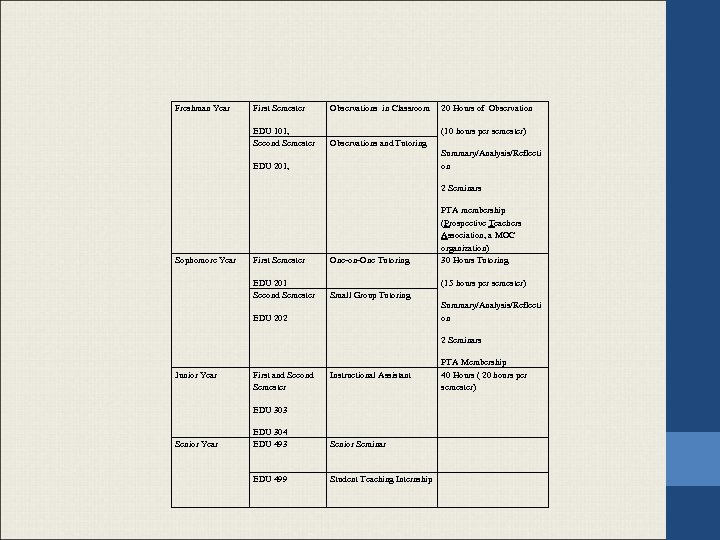 Freshman Year First Semester Observations in Classroom EDU 101, Second Semester 20 Hours of Observations and Tutoring (10 hours per semester) Summary/Analysis/Reflecti on EDU 201, 2 Seminars Sophomore Year First Semester One-on-One Tutoring EDU 201 Second Semester PTA membership (Prospective Teachers Association, a MOC organization) 30 Hours Tutoring Small Group Tutoring (15 hours per semester) Summary/Analysis/Reflecti on EDU 202 2 Seminars Junior Year Instructional Assistant PTA Membership 40 Hours ( 20 hours per semester) EDU 304 EDU 493 Senior Seminar EDU 499 Student Teaching Internship First and Second Semester EDU 303 Senior Year
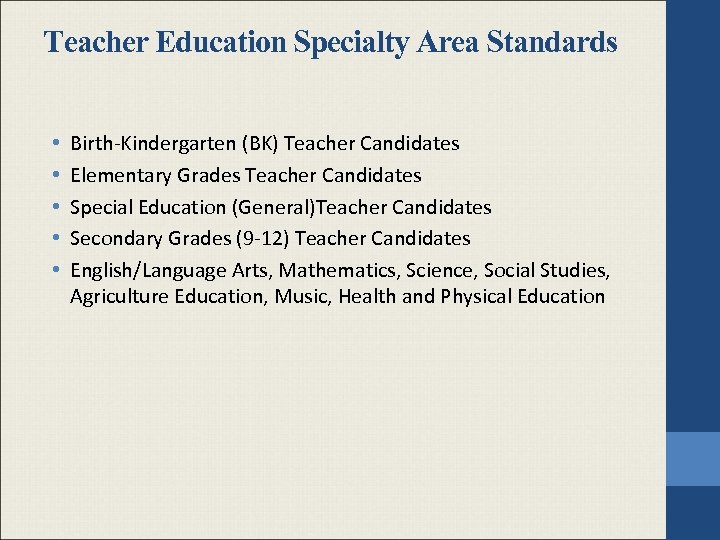 Teacher Education Specialty Area Standards • • • Birth-Kindergarten (BK) Teacher Candidates Elementary Grades Teacher Candidates Special Education (General)Teacher Candidates Secondary Grades (9 -12) Teacher Candidates English/Language Arts, Mathematics, Science, Social Studies, Agriculture Education, Music, Health and Physical Education
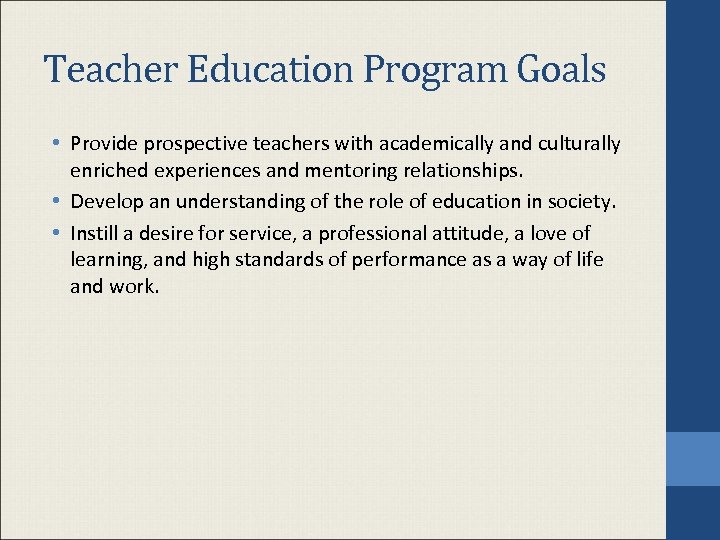 Teacher Education Program Goals • Provide prospective teachers with academically and culturally enriched experiences and mentoring relationships. • Develop an understanding of the role of education in society. • Instill a desire for service, a professional attitude, a love of learning, and high standards of performance as a way of life and work.
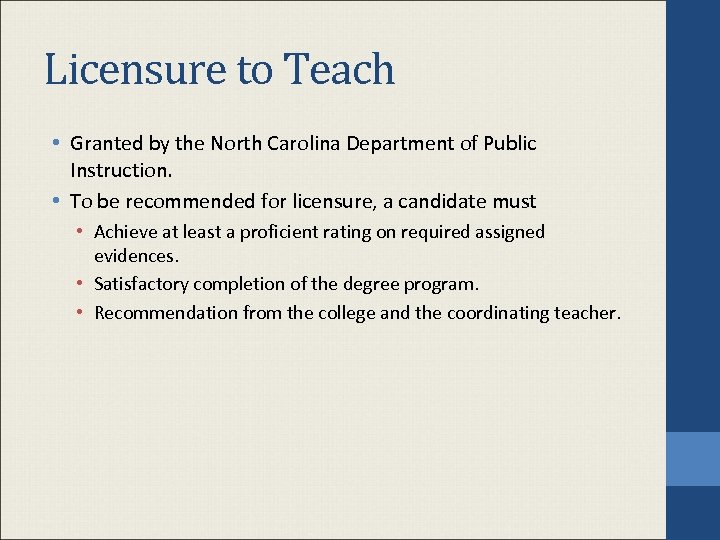 Licensure to Teach • Granted by the North Carolina Department of Public Instruction. • To be recommended for licensure, a candidate must • Achieve at least a proficient rating on required assigned evidences. • Satisfactory completion of the degree program. • Recommendation from the college and the coordinating teacher.
 Background Check • All Prospective Students will receive a background check conducted by UMO and the school system of which he/she has been assigned to complete the internship.
 Meeting State Requirements Six Electronic Evidences
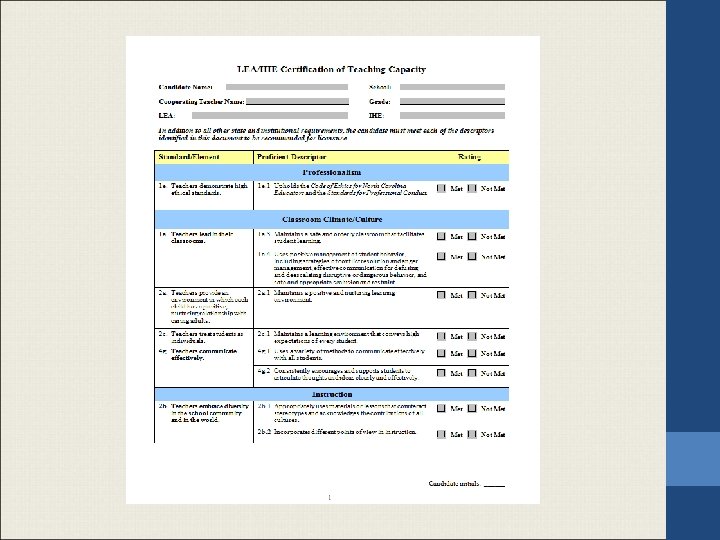
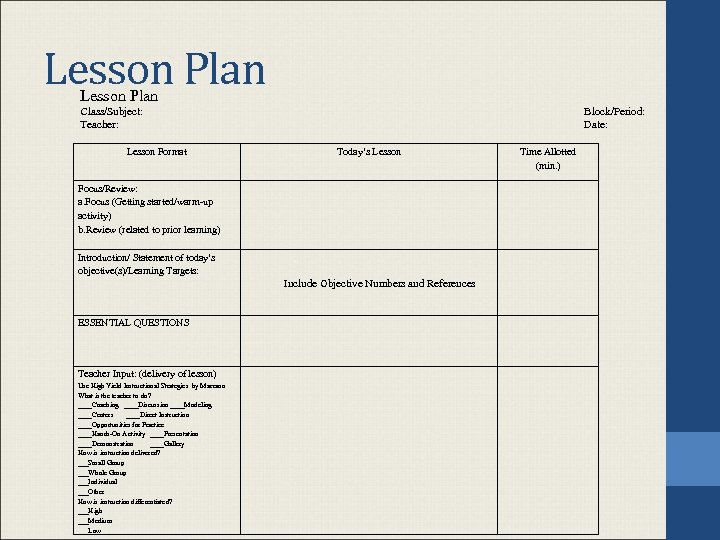
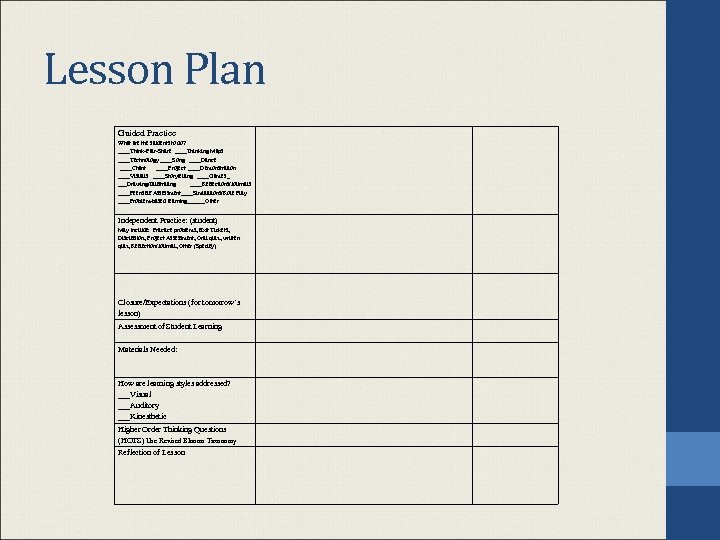
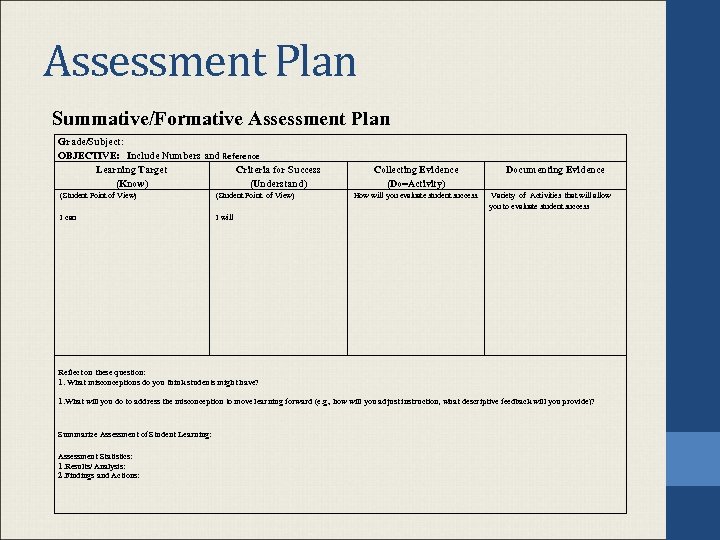
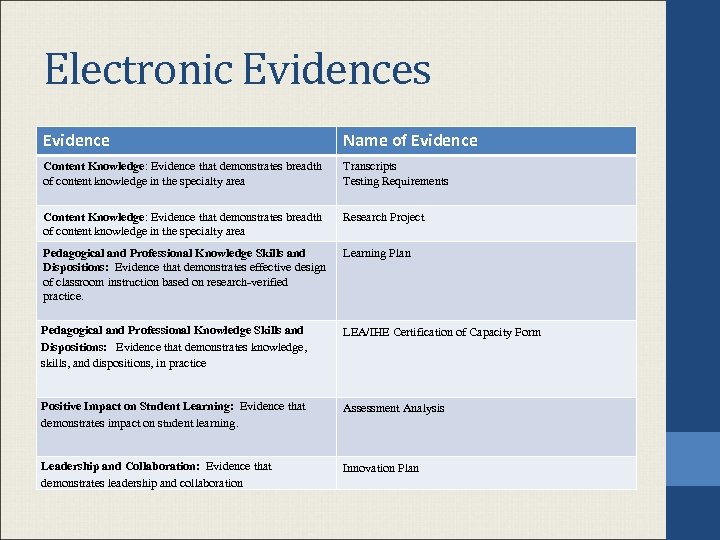 Electronic Evidences Evidence Name of Evidence Content Knowledge: Evidence that demonstrates breadth of content knowledge in the specialty area Transcripts Testing Requirements Content Knowledge: Evidence that demonstrates breadth of content knowledge in the specialty area Research Project Pedagogical and Professional Knowledge Skills and Dispositions: Evidence that demonstrates effective design of classroom instruction based on research-verified practice. Learning Plan Pedagogical and Professional Knowledge Skills and Dispositions: Evidence that demonstrates knowledge, skills, and dispositions, in practice LEA/IHE Certification of Capacity Form Positive Impact on Student Learning: Evidence that demonstrates impact on student learning. Assessment Analysis Leadership and Collaboration: Evidence that demonstrates leadership and collaboration Innovation Plan
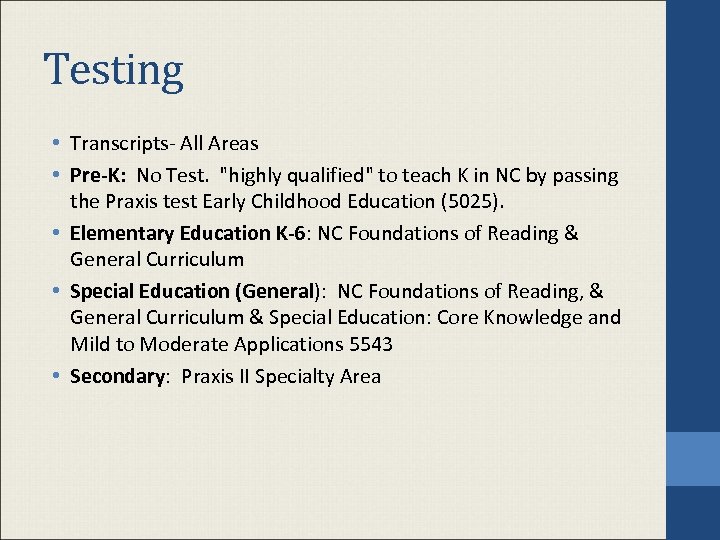 Testing • Transcripts- All Areas • Pre-K: No Test. "highly qualified" to teach K in NC by passing the Praxis test Early Childhood Education (5025). • Elementary Education K-6: NC Foundations of Reading & General Curriculum • Special Education (General): NC Foundations of Reading, & General Curriculum & Special Education: Core Knowledge and Mild to Moderate Applications 5543 • Secondary: Praxis II Specialty Area
 The Student Teaching Process
 Student Teaching Terms • • STI-Student Teaching Intern CT-Clinical Teacher SP-Supervising Professor LEA/IHE-Local Education Agency/Institute for Higher Education
 Mount Olive College Internship Agreement Clinical Teacher • The clinical teacher’s duties are focused on preparing the intern for instruction in the public schools. • Acting as a mentor, the clinical teacher assigns the intern progressively challenging activities that will assist in developing skills to transition into the profession.
 Clinical Teacher Agreement • 1. Instructional duties which provide the opportunity to plan and conduct classroom instruction. • 2. Assessing the student performance • 3. Following school procedures and policies • 4. Incorporating educational technologies into instruction • 5. Conducting parent conferences • 6. Participation in staff meetings • 7. Identifying different student learning styles • 8. Effective classroom management techniques • 9. Time and stress management techniques • Additionally, the clinical teacher will: • 1. Work closely with the college supervisor by conferring on difficulties encountered and recommend corrective measures • 2. Assure appropriate support and supervision of the intern • 3. Give the intern constructive feedback and provide suggestions for improvement and growth • 4. Assure the intern’s experience is comprehensive and educational.
 Mount Olive College Internship Agreement Supervising School District • The supervising school district’s focus is aimed at providing exceptional educators to mentor student teachers. • By submitting the name of a potential clinical teacher candidate, the supervising school district agrees the candidate is qualified to engage the student intern in all facets of the teaching practice.
 Supervising School District • 1. Instructional duties which provide the opportunity to plan and conduct classroom instruction. • 2. Assessing the student performance • 3. Following school procedures and policies • 4. Incorporating educational technologies into instruction • 5. Conducting parent conferences • 6. Participation in staff meetings • 7. Identifying different student learning styles • 8. Effective classroom management techniques • 9. Time and stress management techniques • Additionally, the recommended clinical teacher candidate will: • 1. Assure appropriate support and supervision of the intern • 2. Give constructive feedback and provide positive suggestions for improvement and growth • 3. Assure the intern’s experience is comprehensive and educational • 4. Work closely with the college supervisor by conferring on difficulties encountered by the intern and recommend corrective measures. • 5. Complete the Mount Olive College training session for clinical teachers
 Internship Agreements • Clinical Teacher • Signed by Week 3 • Supervising School District • Signed by Week 3
 Clinical Teachers • Must have at least 5 years of experience • Must be certified • • • Address, Email, Telephone Contact End of Student Teaching Evaluation/Survey -online Certificate provide for renewal credit-survey completed Stipend $200. Paid at end after survey completed Evaluate and give guidance for lesson plans (8) Evaluate and give guidance for assessment plans (8)
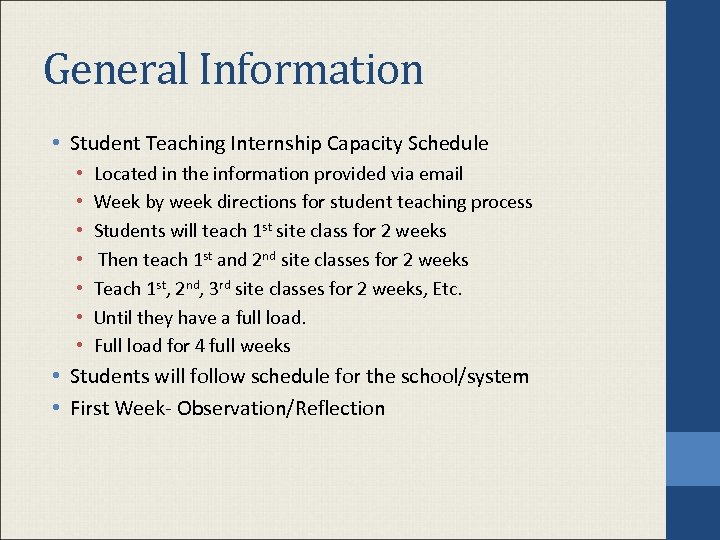 General Information • Student Teaching Internship Capacity Schedule • • Located in the information provided via email Week by week directions for student teaching process Students will teach 1 st site class for 2 weeks Then teach 1 st and 2 nd site classes for 2 weeks Teach 1 st, 2 nd, 3 rd site classes for 2 weeks, Etc. Until they have a full load. Full load for 4 full weeks • Students will follow schedule for the school/system • First Week- Observation/Reflection
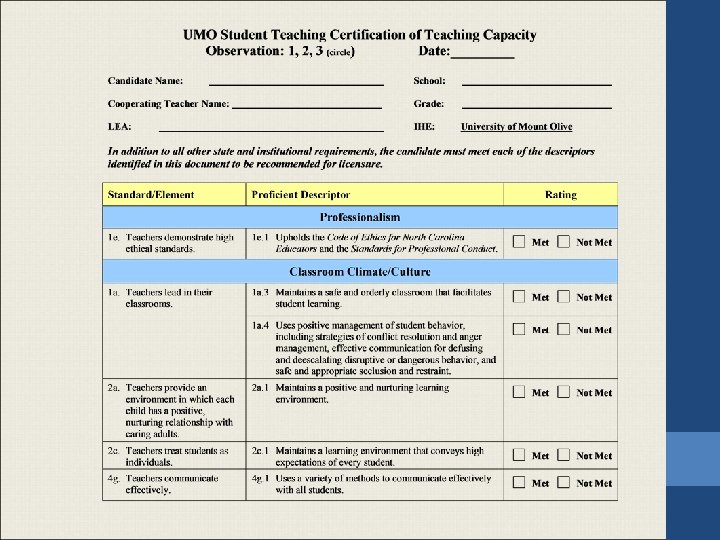
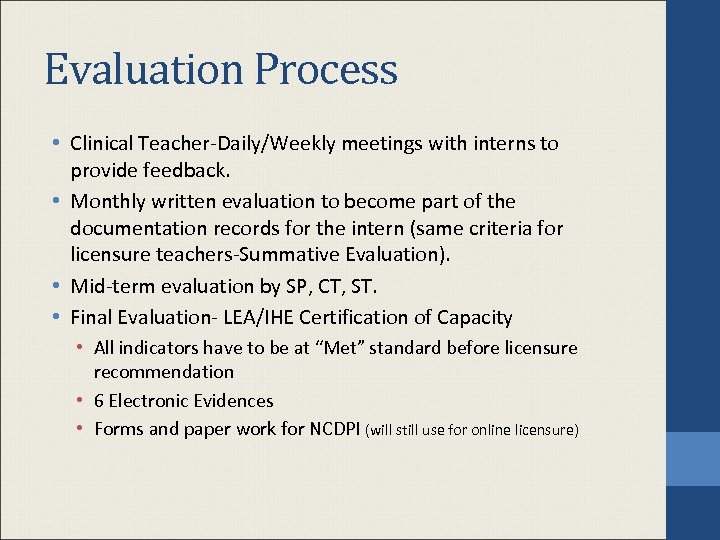 Evaluation Process • Clinical Teacher-Daily/Weekly meetings with interns to provide feedback. • Monthly written evaluation to become part of the documentation records for the intern (same criteria for licensure teachers-Summative Evaluation). • Mid-term evaluation by SP, CT, ST. • Final Evaluation- LEA/IHE Certification of Capacity • All indicators have to be at “Met” standard before licensure recommendation • 6 Electronic Evidences • Forms and paper work for NCDPI (will still use for online licensure)
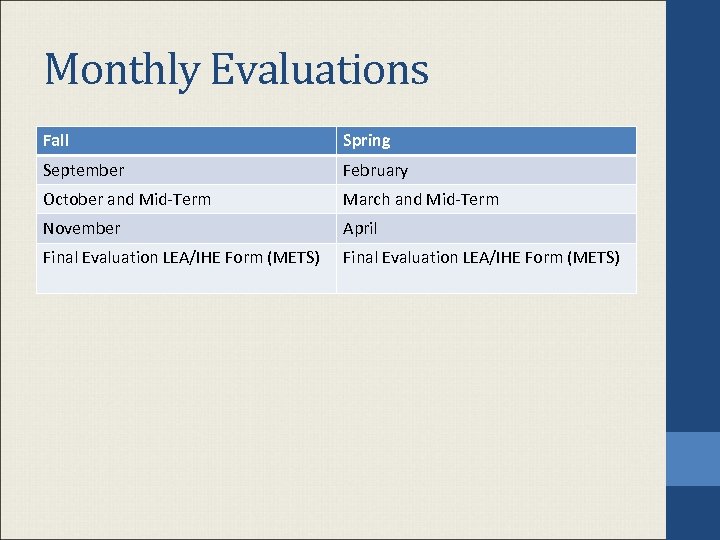 Monthly Evaluations Fall Spring September February October and Mid-Term March and Mid-Term November April Final Evaluation LEA/IHE Form (METS)
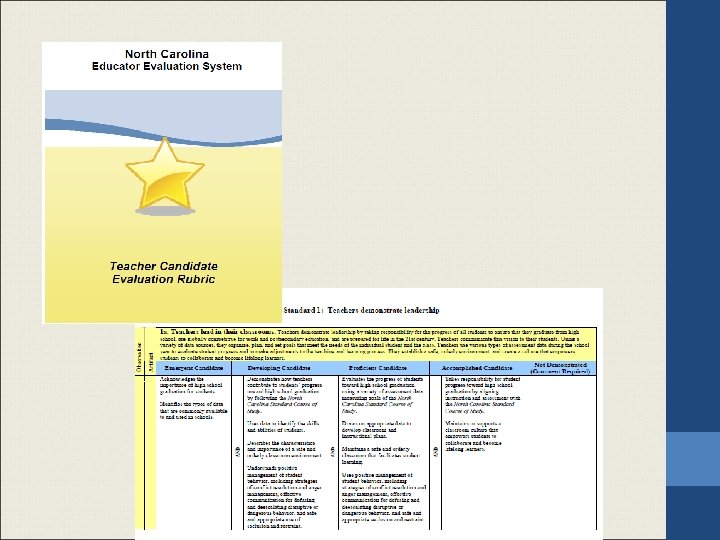
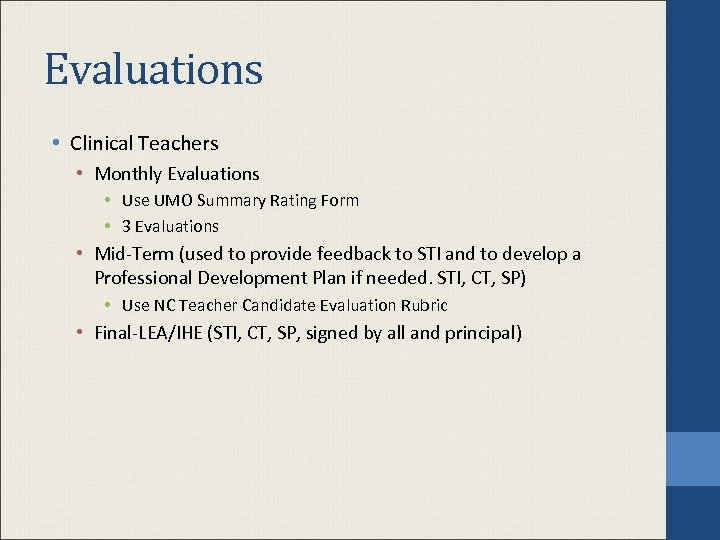 Evaluations • Clinical Teachers • Monthly Evaluations • Use UMO Summary Rating Form • 3 Evaluations • Mid-Term (used to provide feedback to STI and to develop a Professional Development Plan if needed. STI, CT, SP) • Use NC Teacher Candidate Evaluation Rubric • Final-LEA/IHE (STI, CT, SP, signed by all and principal)
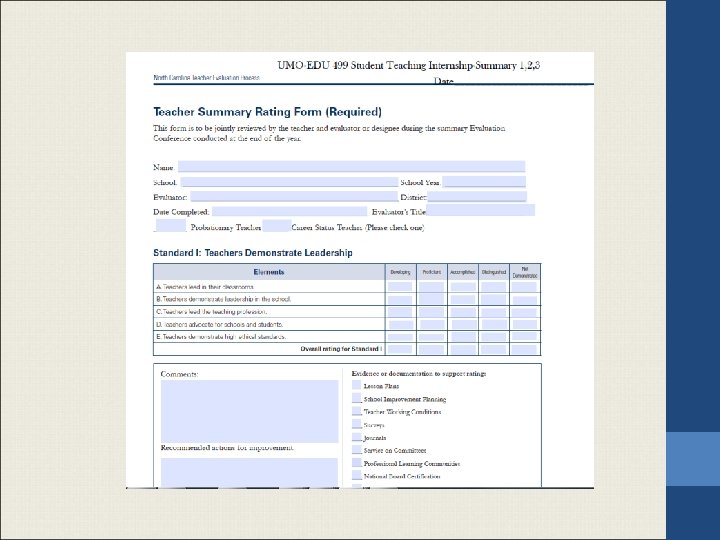
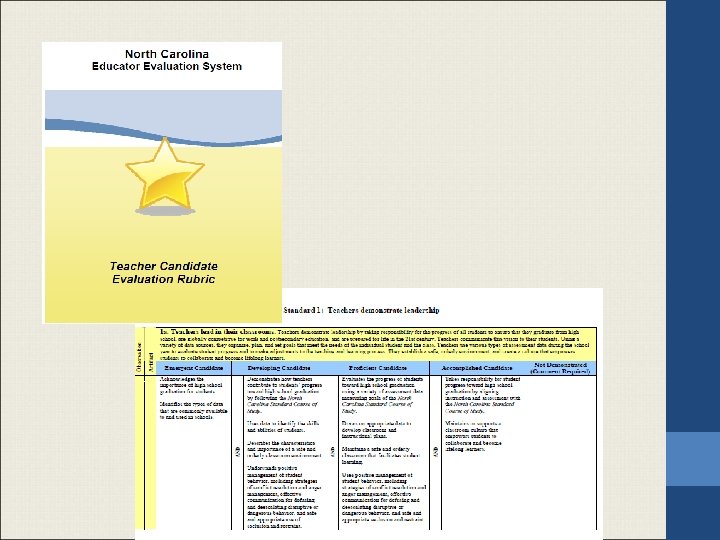
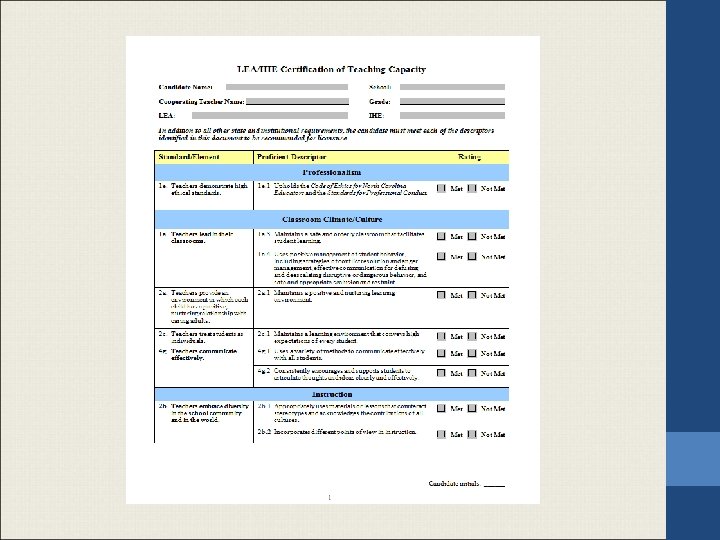
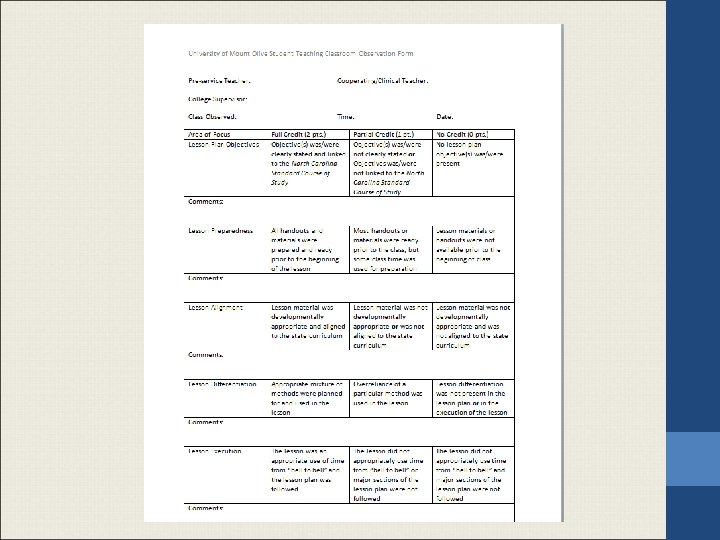
 Evaluations Supervising Professors • Monthly Evaluations • May use either Revised LEA/IHE or UMO Student Teaching Classroom Observation Form • 3 Evaluations • Mid-Term (used to provide feedback to STI and to develop a Professional Development Plan if needed. STI, CT, SP) • NC Teacher Candidate Evaluation Rubric • Final-LEA/IHE (STI, CT, SP, signed by all and principal)
 Electronic Evidences Documents Used for Student Teaching: Lesson Plans, Assessment Plans Other Documents: Innovation Plan, Research Paper
 Lesson Plan Class/Subject: Teacher: Block/Period: Date: Lesson Format Focus/Review: a. Focus (Getting started/warm-up activity) b. Review (related to prior learning) Today’s Lesson Time Allotted (min. ) Introduction/ Statement of today’s objective(s)/Learning Targets: Include Objective Numbers and References ESSENTIAL QUESTIONS Teacher Input: (delivery of lesson) Use High Yield Instructional Strategies by Marzano What is the teacher to do? ____Coaching ____Discussion ____Modeling ____Centers ____Direct Instruction ____Opportunities for Practice ____Hands-On Activity ____Presentation ____Demonstration ____Gallery How is instruction delivered? ___Small Group ___Whole Group ___Individual ___Other How is instruction differentiated? ___High ___Medium ___Low
 Lesson Plan Guided Practice What are the students to do? ____Think-Pair-Share ____Thinking Maps ____Technology ____Song ____Dance ____Chant ____Project ____Demonstration ____Visuals ____Storytelling ____Games _ ___Drawing/Illustrating ____Reflections/Journals ____Peer/self Assessment____Simulations/Role Play ____Problem-based learning______Other Independent Practice: (student) May include: Practice problems, Exit Tickets, Discussion, Project Assessment, Oral quiz, written quiz, Reflection/Journal, Other (Specify) Closure/Expectations (for tomorrow’s lesson) Assessment of Student Learning How are learning styles addressed? ___Visual ___Auditory ___Kinesthetic Higher Order Thinking Questions (HOTS) Use Revised Blooms Taxonomy Reflection of Lesson Materials Needed:
 Assessment Plan Summative/Formative Assessment Plan Grade/Subject: OBJECTIVE: Include Numbers and Reference Learning Target Criteria for Success (Know) (Understand) Collecting Evidence (Do=Activity) Documenting Evidence (Student Point of View) How will you evaluate student success. Variety of Activities that will allow you to evaluate student success I can I will Reflect on these question: 1. What misconceptions do you think students might have? 1. What will you do to address the misconception to move learning forward (e. g. , how will you adjust instruction, what descriptive feedback will you provide)? Summarize Assessment of Student Learning: Assessment Statistics: 1. Results/ Analysis: 2. Findings and Actions:
 Innovation Plan
 Innovation Plan
 Innovation Plan
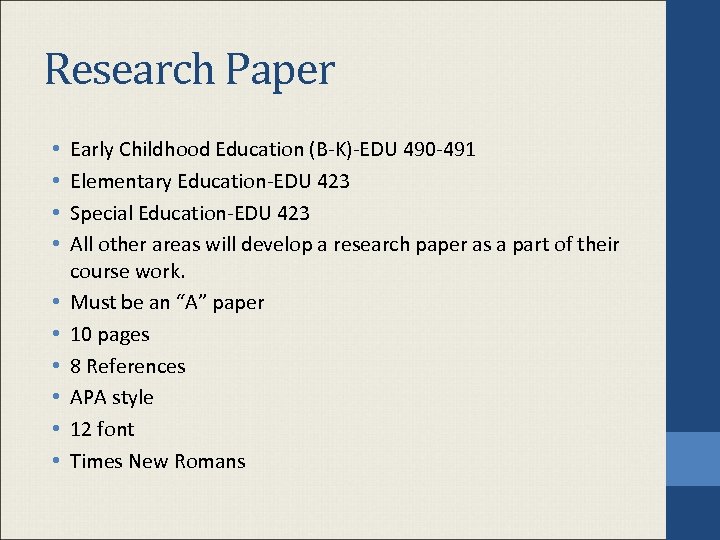 Research Paper • • • Early Childhood Education (B-K)-EDU 490 -491 Elementary Education-EDU 423 Special Education-EDU 423 All other areas will develop a research paper as a part of their course work. Must be an “A” paper 10 pages 8 References APA style 12 font Times New Romans
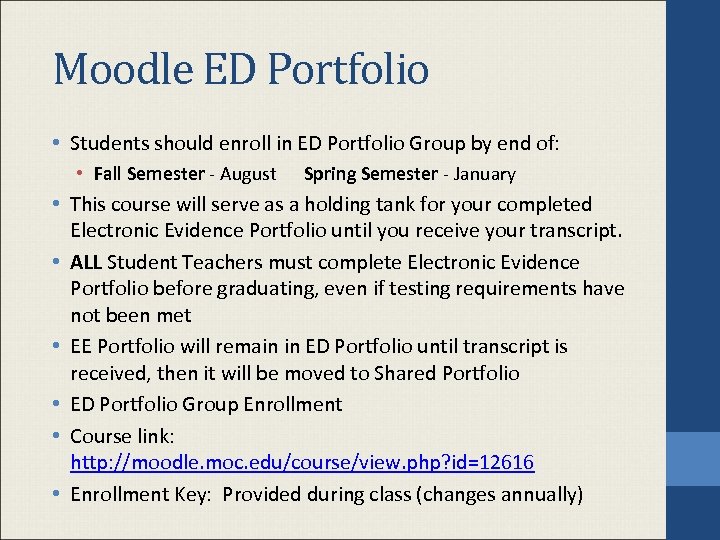 Moodle ED Portfolio • Students should enroll in ED Portfolio Group by end of: • Fall Semester - August Spring Semester - January • This course will serve as a holding tank for your completed Electronic Evidence Portfolio until you receive your transcript. • ALL Student Teachers must complete Electronic Evidence Portfolio before graduating, even if testing requirements have not been met • EE Portfolio will remain in ED Portfolio until transcript is received, then it will be moved to Shared Portfolio • ED Portfolio Group Enrollment • Course link: http: //moodle. moc. edu/course/view. php? id=12616 • Enrollment Key: Provided during class (changes annually)
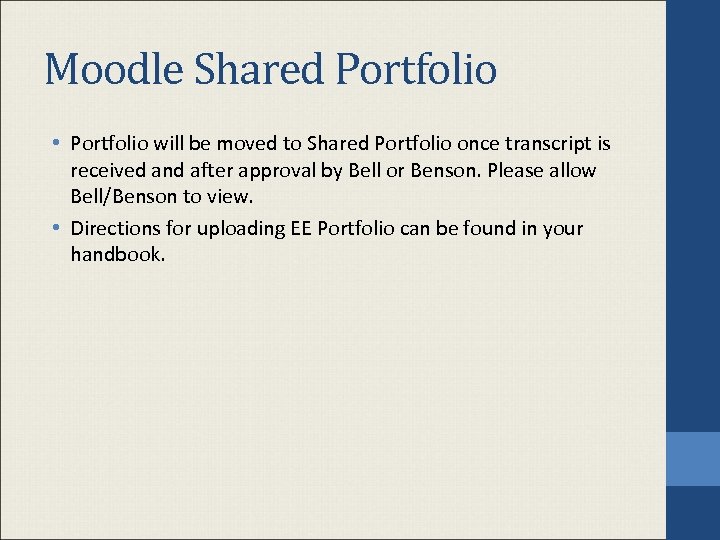 Moodle Shared Portfolio • Portfolio will be moved to Shared Portfolio once transcript is received and after approval by Bell or Benson. Please allow Bell/Benson to view. • Directions for uploading EE Portfolio can be found in your handbook.
 Testing
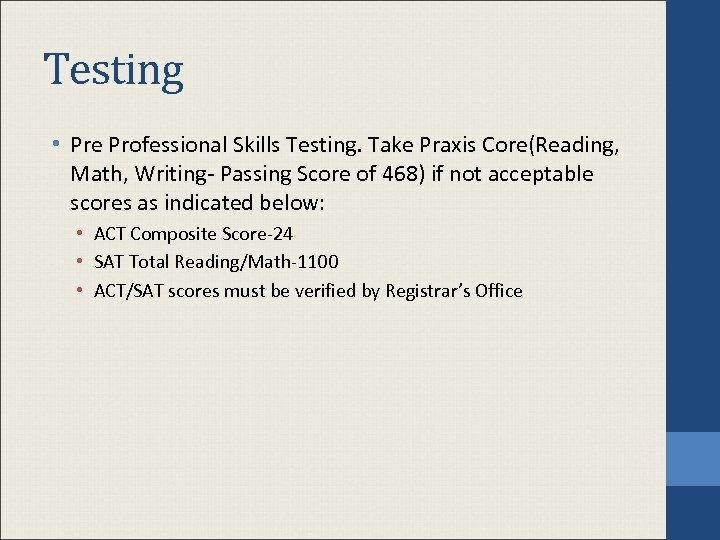 Testing • Pre Professional Skills Testing. Take Praxis Core(Reading, Math, Writing- Passing Score of 468) if not acceptable scores as indicated below: • ACT Composite Score-24 • SAT Total Reading/Math-1100 • ACT/SAT scores must be verified by Registrar’s Office
 Testing • Secondary Education: English, Social Studies, Math, Science, Music, Physical Edu. • Praxis II scores for Core Area • Must take Praxis II before graduating • If not passed can still submit to NCDPI • Elementary Education • Foundations of Reading test • General Curriculum test • Must pass test before NCDPI submission
 Testing • Special Education • Foundations of Reading Test • Pearson General Curriculum test • ETS Praxis II Special Education: Core Knowledge and Mild to Moderate Applications (5543) • Must pass test before NCDPI submission • Early Childhood (B-K) No test required. Although no test is required for the Birth–Kindergarten (B–K) license, B–K teachers may be designated "highly qualified" to teach kindergarten by passing the Praxis test Early Childhood Education (5025). • Agriculture Education-Does not have Praxis II Testing.
 NCDPI Online Licensure Process • Receive online information and directions via email (from Lsutton@umo. edu) once transcripts are received. • Transcripts will be released by registrar’s office two weeks after graduation. • Transcripts will be scanned and emailed to students by Ms. Sutton. • UMO email account is active for 180 days. Need to make sure we have personal email as well. • Upload personal information, transcripts, testing, LEA/IHE Certification of Capacity Form. (Lateral Entry Candidates. Summary Rating Form. • Complete Forms A & V and return at end of internship.
 Code of Ethics for North Carolina Educators • Adopted by the State Board of Education June 5, 1997 • The purpose of this Code of Ethics is to define standards of professional conduct.
 EDU 493 Seminar • EDU 493 Senior Seminar • • • Attendance is averaged in final grade Traditional Students-required Non-Tradition- may audit Video Conference to all site Go To Meeting (Local/seated on campus)
 Additional Information • Dr. Tommy Benson, Division Chair. tbenson@moc. edu • Dr. Ruby A. Bell, Chair of Education Department. rbell@moc. edu • Lynn Sutton, Administrative Assistant
 Q/A Session • Do you have any questions? • Thank you attending the session. We will get certification of attendance emailed and final certificates will be provided for credit upon completion of the process.