


 Скачать презентацию Teacher Compensation Research and Policy Overview SEDL Policy
d13a6134c80b6fc4032fdbd350c15368.ppt
- Количество слайдов: 23
 Teacher Compensation Research and Policy Overview SEDL Policy Forum 2005 Tony Milanowski Consortium for Policy Research in Education Wisconsin Center for Education Research University of Wisconsin-Madison
 CPRE Work on Teacher Compensation Innovations § 1991: Odden & Conley, “A New Teacher Compensation System to Promote Productivity” § 1995 -97: Exploratory design meetings with National Board for Professional Teaching Standards, leading edge states & districts, national teacher organizations § 1997: Odden & Kelley, Paying Teachers for What They Know and Can Do (2 nd ed. 2002, Corwin Press) § 1996 -2005: Research on school-based performance awards & knowledge & skill-based pay; National Conference. §www. wcer. wisc. edu/cpre
 Teacher Compensation Innovations §What are they? §Where are they being used? §What do we know about how they work?
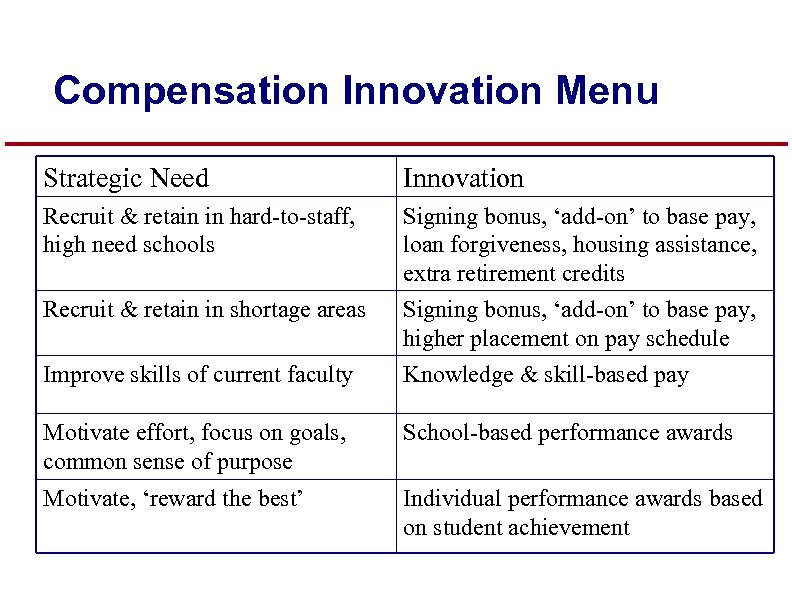 Compensation Innovation Menu Strategic Need Innovation Recruit & retain in hard-to-staff, high need schools Signing bonus, ‘add-on’ to base pay, loan forgiveness, housing assistance, extra retirement credits Recruit & retain in shortage areas Signing bonus, ‘add-on’ to base pay, higher placement on pay schedule Improve skills of current faculty Knowledge & skill-based pay Motivate effort, focus on goals, common sense of purpose School-based performance awards Motivate, ‘reward the best’ Individual performance awards based on student achievement
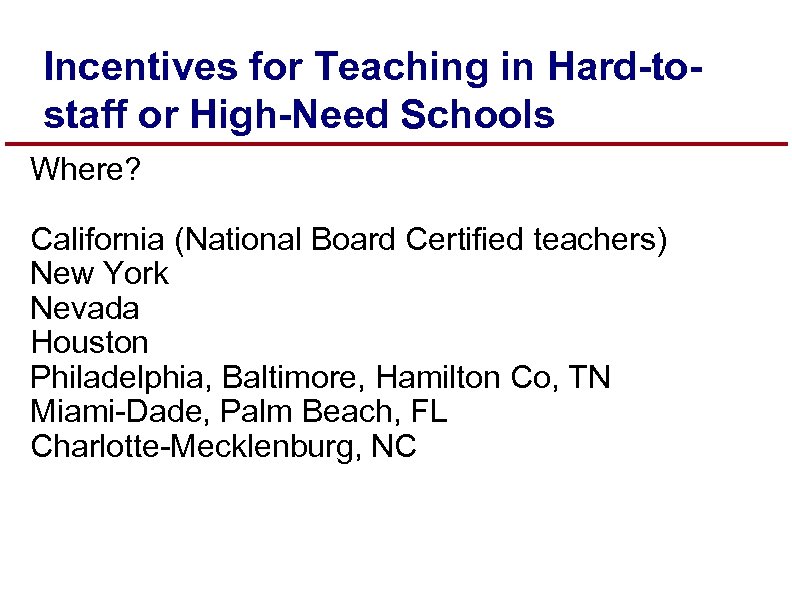 Incentives for Teaching in Hard-tostaff or High-Need Schools Where? California (National Board Certified teachers) New York Nevada Houston Philadelphia, Baltimore, Hamilton Co, TN Miami-Dade, Palm Beach, FL Charlotte-Mecklenburg, NC
 Incentives for Teaching in Hard-tostaff or High-Need Schools Relevant Research §Teachers tend to move out of poor, non-white, low achievement schools § Both pay and working conditions affect teacher job choice §Econometric studies suggest relatively large financial incentives would be needed to influence teacher choice §No large scale studies of targeted incentives; anecdotal evidence positive from some districts
 Charlotte-Mecklenburg’s Equity Plus Program § Signing Bonus ($2, 000) §Deferred Accountability Bonus ($500 -750) (to be replaced with performance pay 2006 -07) §Master Teacher Incentive ($1, 500 -2, 500) §Reduced class size and extra resources §Paid/subsidized Master’s degree tuition §Pay incentives to help retain quality school leaders
 Hiring/Retention Incentives for Teaching in Shortage Areas (Math, science, special education) Where? §North Carolina (program discontinued) §Charlotte-Mecklenburg §Baltimore §Blue Valley, KS §‘Covert’ programs (bring in at higher step)
 Incentives for Teaching in Shortage Areas Relevant Research §Some evidence that math/science teachers have better- paying alternatives outside education than other teachers §Significantly higher base pay (at least 25%) would be needed to attract a significant number of Wisc. math, science, and technology majors to teaching §Evaluation of NC program concluded that modest incentives can have a positive effect on recruitment of math & science teachers
 Knowledge & Skill-based Pay I Incentives for National Board Certification § Most states and many districts provide them § Range from assistance with application costs to bonuses, 10 -15% pay increases § Research suggests: – NB assessment does identify teachers with higher levels of student achievement – Incentives raise rate of NB participation – Mixed evidence on whether NB improves skill – NB teachers may not be teaching where most needed
 Knowledge & Skill-based Pay II Incentives for Professional Development Participation § Iowa, Minneapolis, Douglas County, CO, Plymouth & Menomonee Falls, WI, Delaware - Moderate participation, relatively low cost, and perceived effectiveness in Douglas County - Shaky start in Minneapolis due to district leadership changes, implementation problems, and new direction from state level
 Knowledge & Skill-Based Pay III Pay for Demonstrating Competencies in the Classroom n Based on a comprehensive model of what teachers should know and be able to do - Explicit standards, multiple practice levels, and behavioral rating scales - Multiple classroom observations & multiple lines of evidence - Danielson’s Framework for Teaching popular starting point § If periodic assessment shows practice is at a higher level, teacher receives a base pay increase or salary add -on, and in some cases the potential for more step increases (otherwise capped)
 Knowledge & Skill-Based Pay Demonstrating Competencies in Classroom Where? Vaughn Charter School, Kyrene, AZ Cincinnati, Philadelphia, La Crescent, MN, Steamboat Springs, CO CPRE Research Findings: § Trained evaluators can provide reliable ratings § Evaluation ratings from well-designed & run system are correlated with student achievement § Evaluation process affects teaching practice
 Knowledge and Skill-based Pay Demonstrating Competencies in Classroom CPRE Research Findings n Requires attention to teacher development n Can be costly and time-consuming to administer n - Feedback, coaching - Aligned professional development In typical district, many teachers are likely to be uncomfortable with uncertain pay and higher expectations for teaching practice
 School-based Performance Awards § § Bonuses provided to all teachers (and others) in a school when that school achieves pre-established performance goals Longest-running ‘new’ compensation innovation ü North Carolina, Charlotte-Mecklenburg, Dallas, Cincinnati, Vaughn Charter, several Arizona districts in response to Prop 301 S Kentucky, California
 CPRE Research Findings § Programs help focus attention & emphasize performance goals § Low to moderate motivational impact - Small bonus amounts Limited attention to ‘enablers’ Uncertainty about effort-goal link Uncertainty about funding § May increase turnover in schools identified as low- performing § Performance pay option least preferred by students preparing to be teachers in Wisc. § May be most effective as a symbol rather than a motivator
 Incentives for Individual Teacher Performance n “Merit Pay” – variable annual pay increases based on principal’s subjective evaluation of last year’s performance - Problems with evaluation, funding - Programs died out except in a few wealthy districts n Current approach: pay increase or bonus based on achievement of individual teacher’s students, often calculated using ‘value-added’ approach - Colonial, PA - Charlotte-Mecklenburg - Dallas? Houston?
 Research on Individual Incentives Based on Student Achievement § Very limited; mixed evidence from Mexico, Israel and US § Only very best and worst teachers can be reliably differentiated due to small samples § Not all teachers teach tested subjects § Students not assigned to teachers at random § Control for student characteristics or not?
 Our Take on Teacher Pay Innovations n n Incentives for teaching in high-need schools look promising, especially when coupled with working condition improvements Incentives for shortage areas: common sense to policy makers but a dilemma for teacher organizations Incentives for professional development can be useful as a ‘soft’ way to more strategic use of pay, but danger is loose administration KSBP based on demonstrating competencies in the classroom could work, but needs streamlining and careful implementation
 Our Take…. § Problem may be skill, not will § Pay change has often been seen as an end in itself, or as another simple solution § Need to use pay change to support other reform strategies that impact instruction; pay by itself is not a strong reform strategy
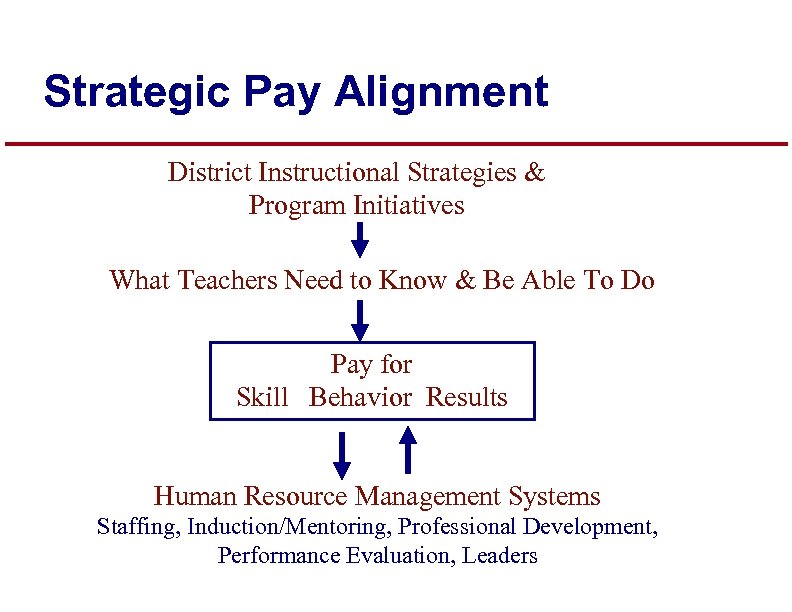 Strategic Pay Alignment District Instructional Strategies & Program Initiatives What Teachers Need to Know & Be Able To Do Pay for Skill Behavior Results Human Resource Management Systems Staffing, Induction/Mentoring, Professional Development, Performance Evaluation, Leaders
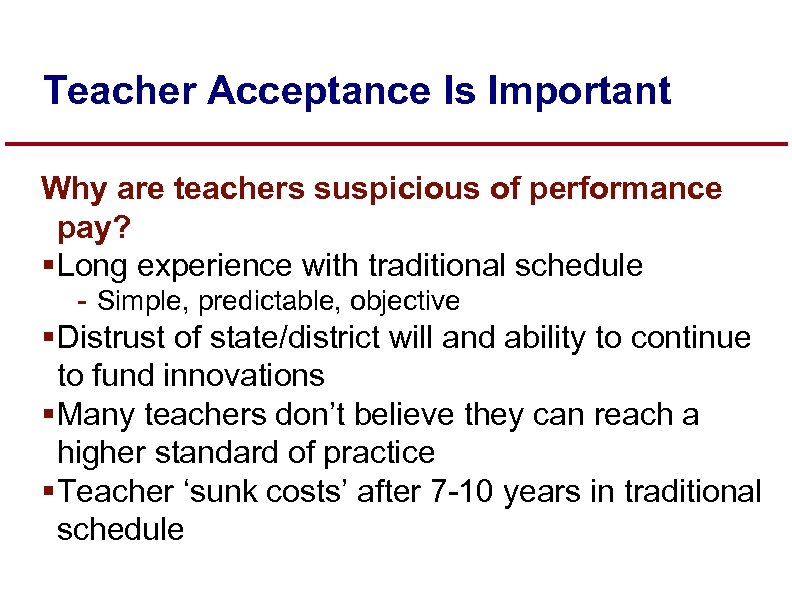 Teacher Acceptance Is Important Why are teachers suspicious of performance pay? § Long experience with traditional schedule - Simple, predictable, objective § Distrust of state/district will and ability to continue to fund innovations § Many teachers don’t believe they can reach a higher standard of practice § Teacher ‘sunk costs’ after 7 -10 years in traditional schedule
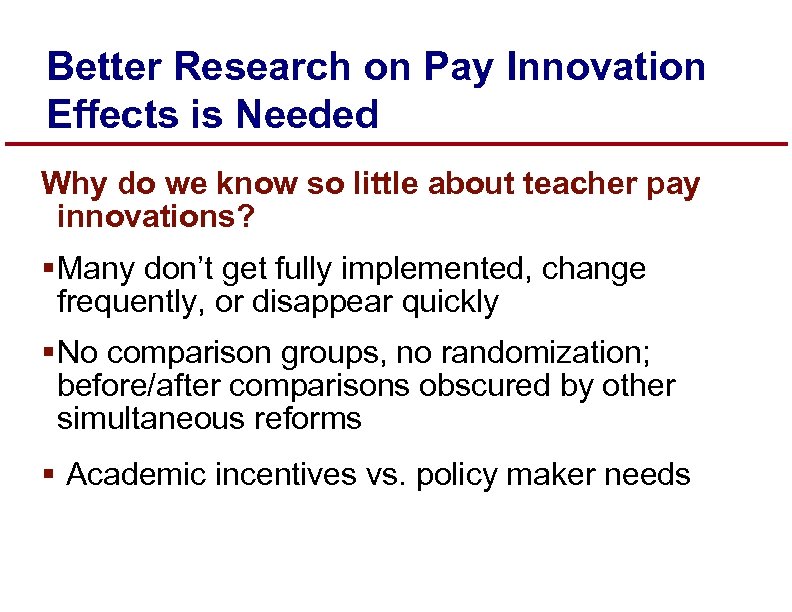 Better Research on Pay Innovation Effects is Needed Why do we know so little about teacher pay innovations? § Many don’t get fully implemented, change frequently, or disappear quickly § No comparison groups, no randomization; before/after comparisons obscured by other simultaneous reforms § Academic incentives vs. policy maker needs