 Скачать презентацию TCP Over Wireless Professor Alhussein Abouzeid Rensselaer Polytechnic
7da368fb05c988c846dd45a85c0b8042.ppt
- Количество слайдов: 51



TCP Over Wireless Professor Alhussein Abouzeid Rensselaer Polytechnic Institute 110 Eighth St, Troy NY 12180 Slides adapted from Nitin Vaidya’s Tutorial and others – see referene list
Transmission Control Protocol / Internet Protocol TCP/IP
Internet Protocol (IP) • Packets may be delivered out-of-order • Packets may be lost • Packets may be duplicated
Transmission Control Protocol (TCP) • Reliable ordered delivery to the higher layer • Implements congestion avoidance and control • Reliability achieved by means of retransmissions if necessary • End-to-end semantics – Acknowledgements sent to TCP sender confirm delivery of data received by TCP receiver – Ack for data sent only after data has reached receiver
TCP Basics • Cumulative acknowledgements • An acknowledgement ack’s all contiguously received data • TCP assigns byte sequence numbers • For simplicity, we will assign packet sequence numbers, and assume equal size packets • Also, we use slightly different syntax for acks than normal TCP syntax – In our notation, ack i acknowledges receipt of packets through packet i
TCP • Adaptive mechanism for congestion control • The concept (AIMD): – Speed-up (additive) – Slow-down (multiplicative) • The elements: packets, ACKs, window • The mechanism – Window increase modes: • Slow Start (exp. ), Congestion Avoidance (add. ) – Loss detection modes: • Triple Duplicates; ‘single’ loss; MD • Time-Out; ‘burst’ loss; reset
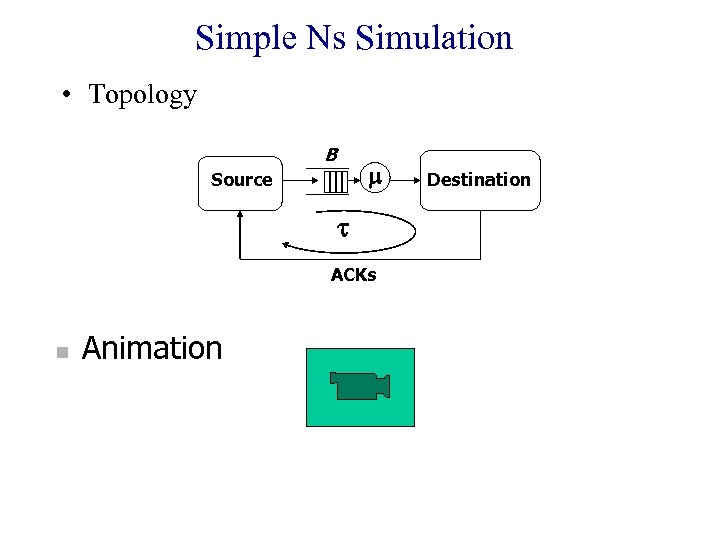
Simple Ns Simulation • Topology B m Source t ACKs n Animation Destination
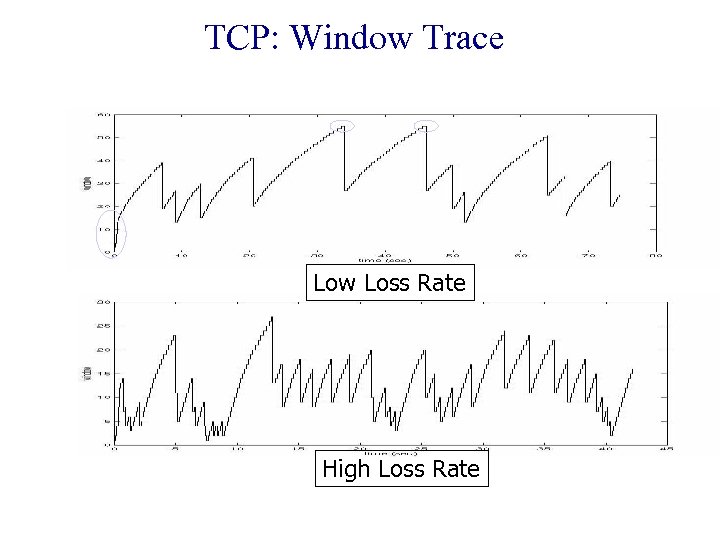
TCP: Window Trace Low Loss Rate High Loss Rate
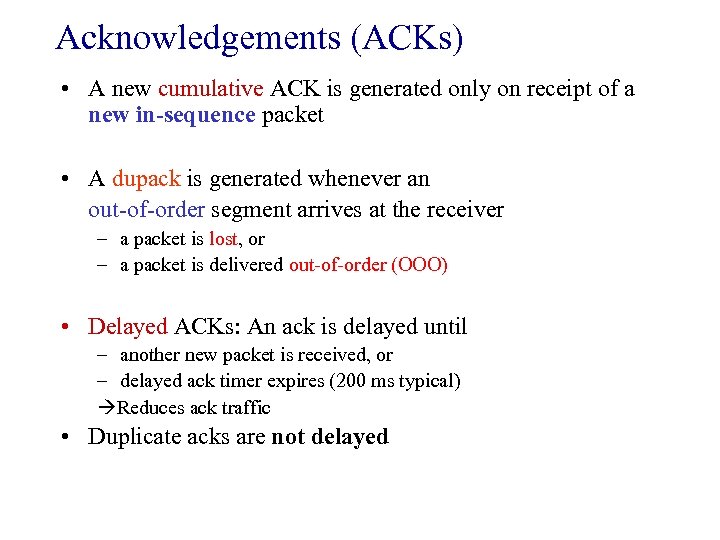
Acknowledgements (ACKs) • A new cumulative ACK is generated only on receipt of a new in-sequence packet • A dupack is generated whenever an out-of-order segment arrives at the receiver – a packet is lost, or – a packet is delivered out-of-order (OOO) • Delayed ACKs: An ack is delayed until – another new packet is received, or – delayed ack timer expires (200 ms typical) Reduces ack traffic • Duplicate acks are not delayed
Ack Clock • TCP window flow control is “self-clocking” • New data sent when old data is ack’d • Helps maintain “equilibrium”
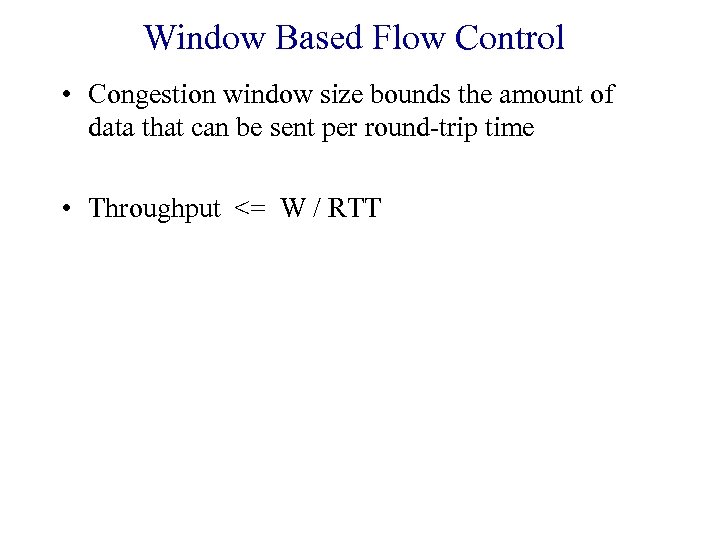
Window Based Flow Control • Congestion window size bounds the amount of data that can be sent per round-trip time • Throughput <= W / RTT
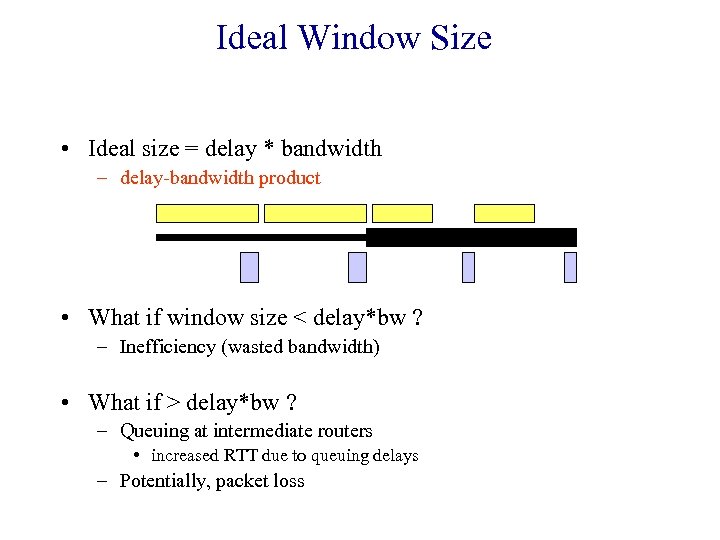
Ideal Window Size • Ideal size = delay * bandwidth – delay-bandwidth product • What if window size < delay*bw ? – Inefficiency (wasted bandwidth) • What if > delay*bw ? – Queuing at intermediate routers • increased RTT due to queuing delays – Potentially, packet loss
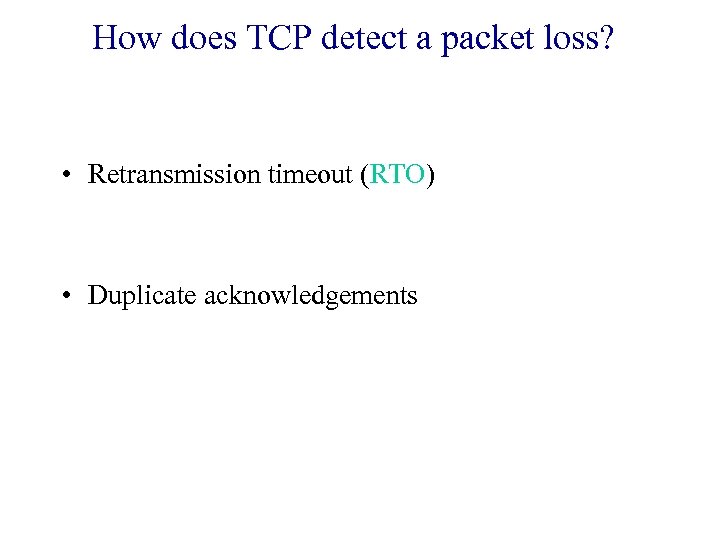
How does TCP detect a packet loss? • Retransmission timeout (RTO) • Duplicate acknowledgements
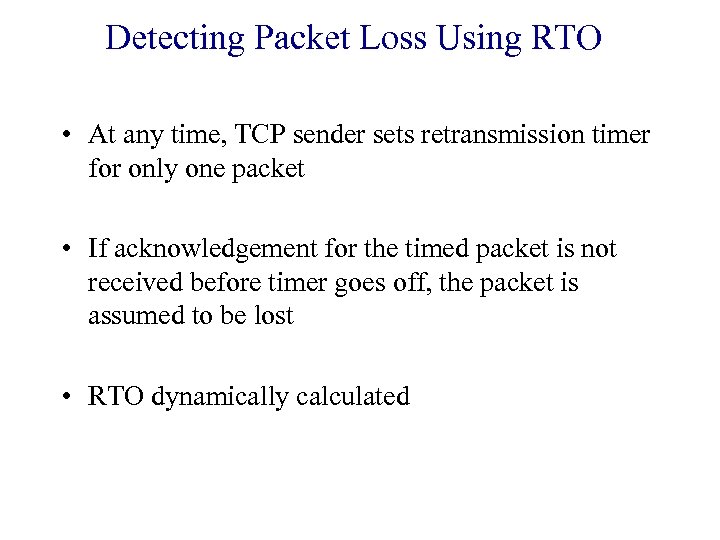
Detecting Packet Loss Using RTO • At any time, TCP sender sets retransmission timer for only one packet • If acknowledgement for the timed packet is not received before timer goes off, the packet is assumed to be lost • RTO dynamically calculated
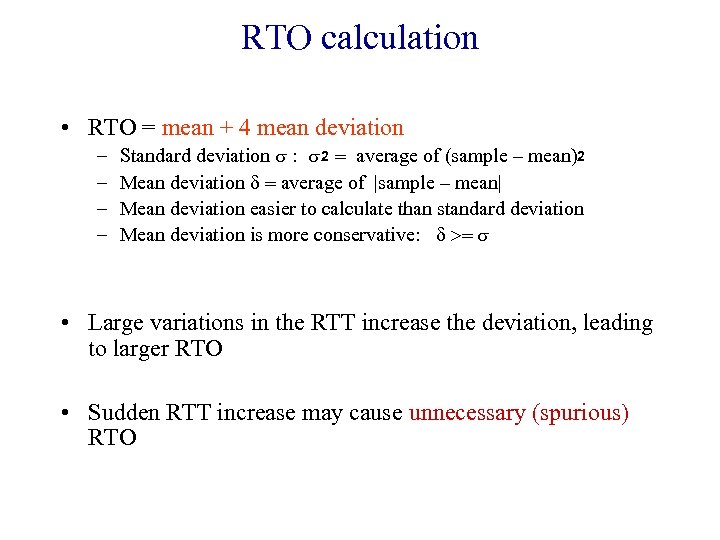
RTO calculation • RTO = mean + 4 mean deviation – – Standard deviation s : s 2 = average of (sample – mean)2 Mean deviation d = average of |sample – mean| Mean deviation easier to calculate than standard deviation Mean deviation is more conservative: d >= s • Large variations in the RTT increase the deviation, leading to larger RTO • Sudden RTT increase may cause unnecessary (spurious) RTO
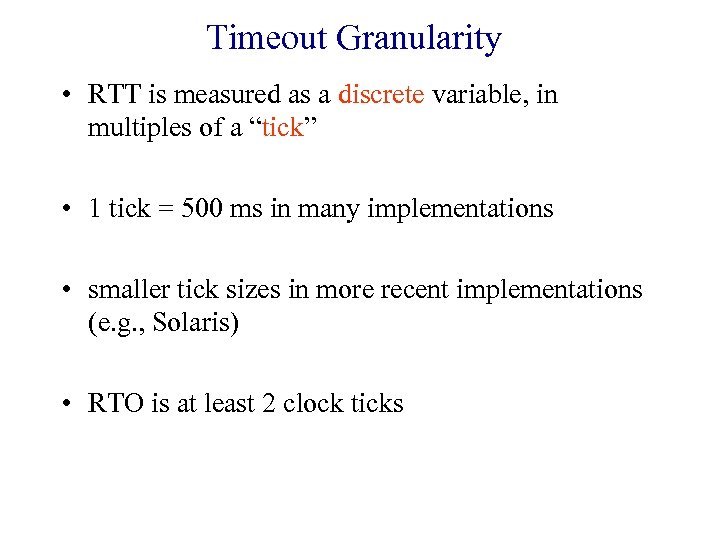
Timeout Granularity • RTT is measured as a discrete variable, in multiples of a “tick” • 1 tick = 500 ms in many implementations • smaller tick sizes in more recent implementations (e. g. , Solaris) • RTO is at least 2 clock ticks
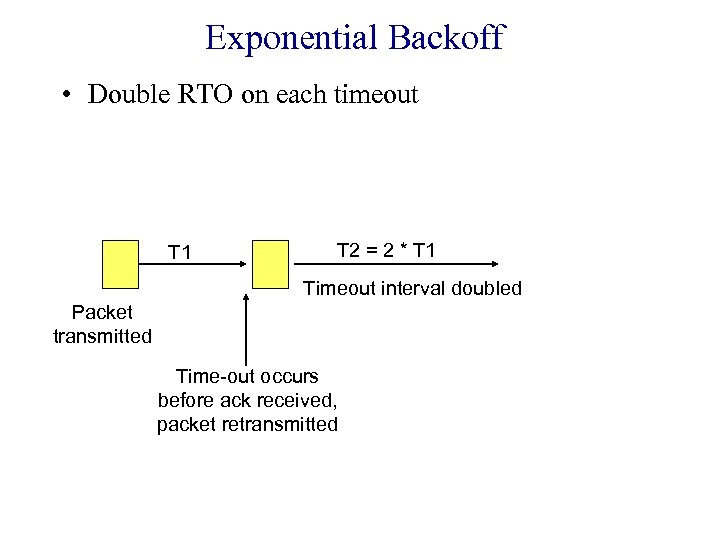
Exponential Backoff • Double RTO on each timeout T 1 T 2 = 2 * T 1 Timeout interval doubled Packet transmitted Time-out occurs before ack received, packet retransmitted
Congestion Avoidance and Control Slow Start • initially, congestion window size cwnd = 1 MSS (maximum segment size) • increment window size by 1 MSS on each new ack • slow start phase ends when window size reaches the slowstart threshold • cwnd grows exponentially with time during slow start – factor of 1. 5 per RTT if every other packet ack’d – factor of 2 per RTT if every packet ack’d – Could be less if sender does not always have data to send
Congestion Avoidance • On each window’s worth of new acks, increase cwnd by 1/cwnd packets • cwnd increases linearly with time during congestion avoidance (assuming cwnd is less than bandwidth-delay product) – 1/2 MSS per RTT if every other packet ack’d – 1 MSS per RTT if every packet ack’d
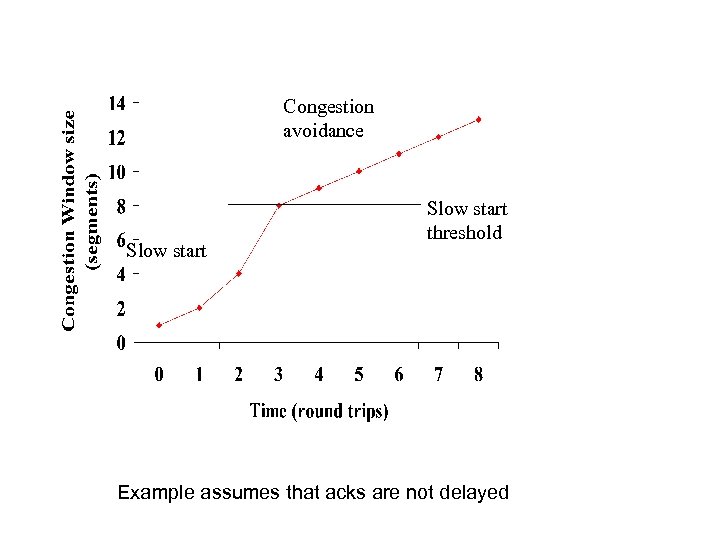
Congestion avoidance Slow start threshold Example assumes that acks are not delayed
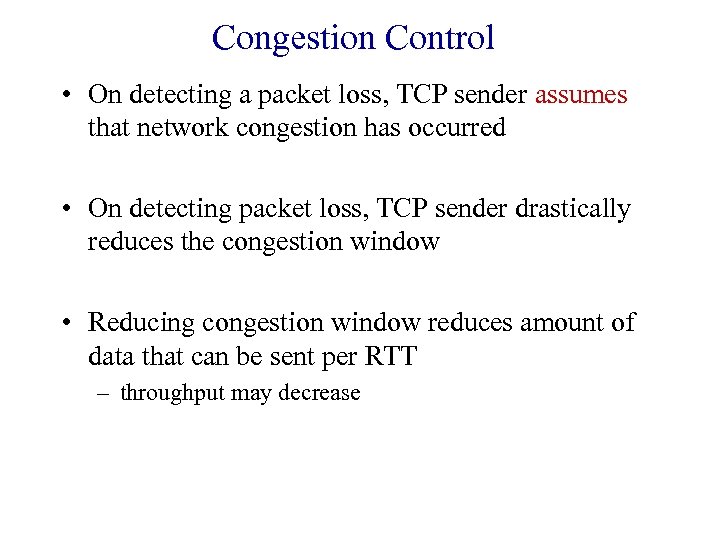
Congestion Control • On detecting a packet loss, TCP sender assumes that network congestion has occurred • On detecting packet loss, TCP sender drastically reduces the congestion window • Reducing congestion window reduces amount of data that can be sent per RTT – throughput may decrease
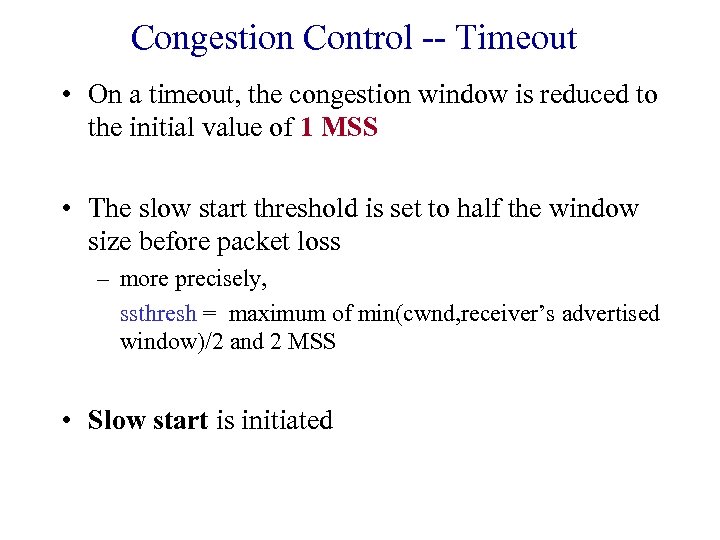
Congestion Control -- Timeout • On a timeout, the congestion window is reduced to the initial value of 1 MSS • The slow start threshold is set to half the window size before packet loss – more precisely, ssthresh = maximum of min(cwnd, receiver’s advertised window)/2 and 2 MSS • Slow start is initiated
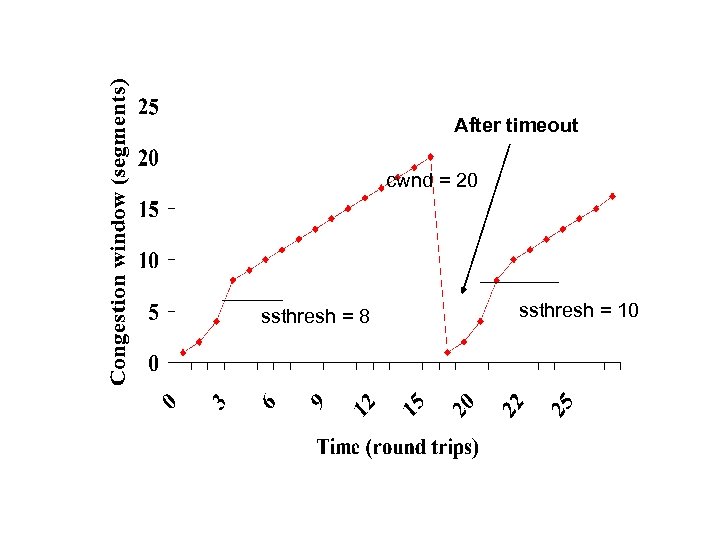
After timeout cwnd = 20 ssthresh = 8 ssthresh = 10
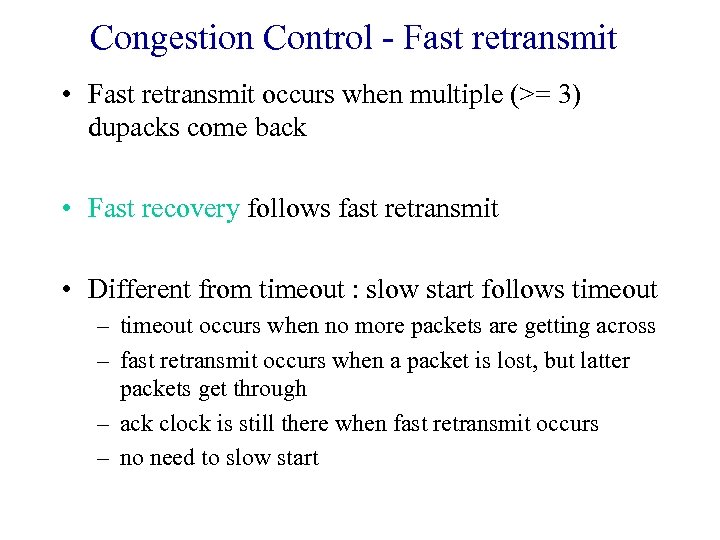
Congestion Control - Fast retransmit • Fast retransmit occurs when multiple (>= 3) dupacks come back • Fast recovery follows fast retransmit • Different from timeout : slow start follows timeout – timeout occurs when no more packets are getting across – fast retransmit occurs when a packet is lost, but latter packets get through – ack clock is still there when fast retransmit occurs – no need to slow start
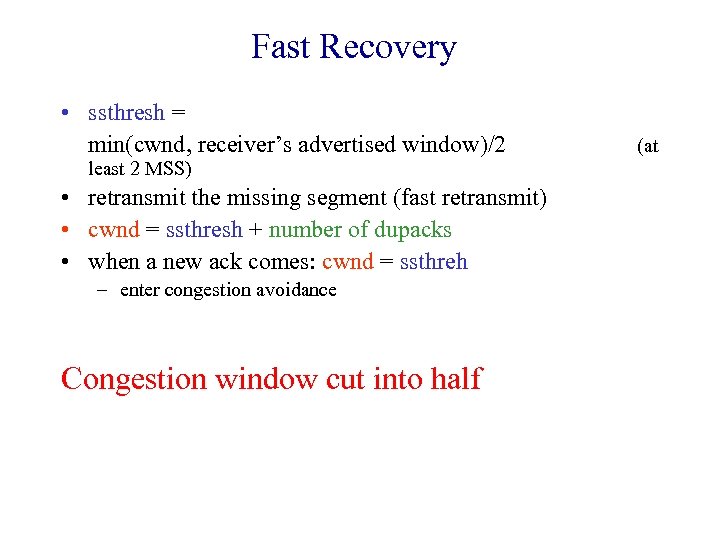
Fast Recovery • ssthresh = min(cwnd, receiver’s advertised window)/2 least 2 MSS) • retransmit the missing segment (fast retransmit) • cwnd = ssthresh + number of dupacks • when a new ack comes: cwnd = ssthreh – enter congestion avoidance Congestion window cut into half (at
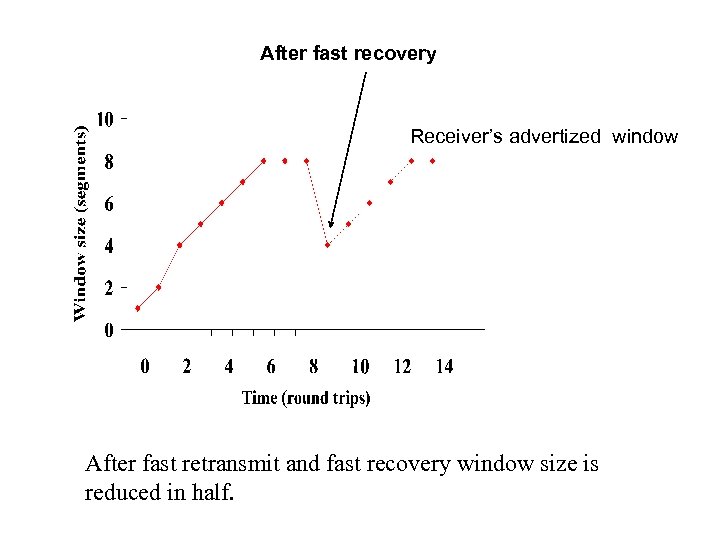
After fast recovery Receiver’s advertized window After fast retransmit and fast recovery window size is reduced in half.
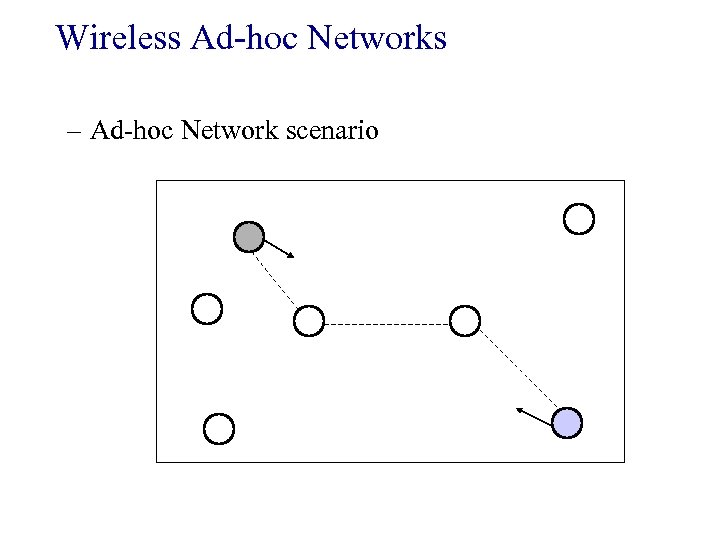
Wireless Ad-hoc Networks – Ad-hoc Network scenario
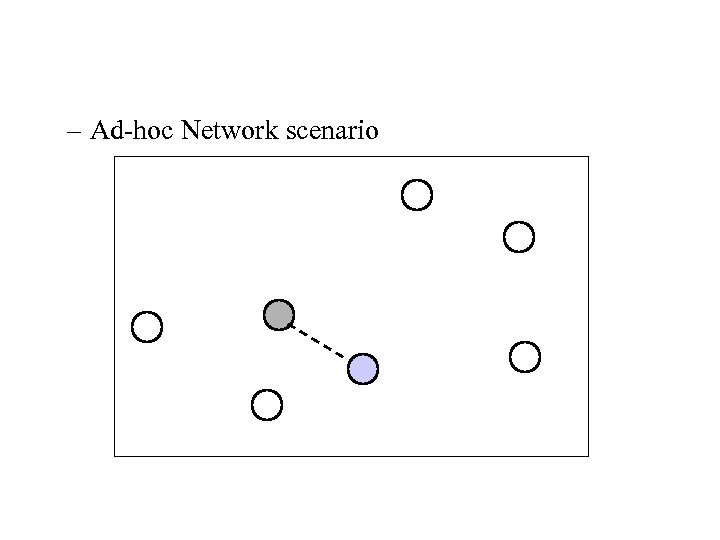
– Ad-hoc Network scenario
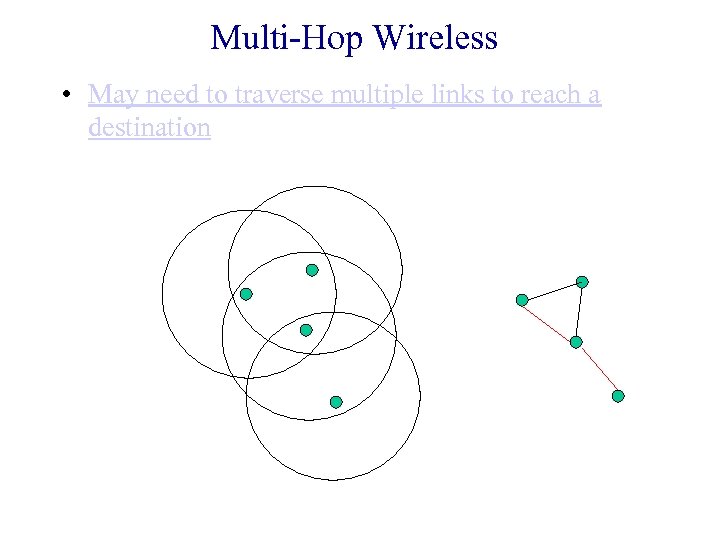
Multi-Hop Wireless • May need to traverse multiple links to reach a destination
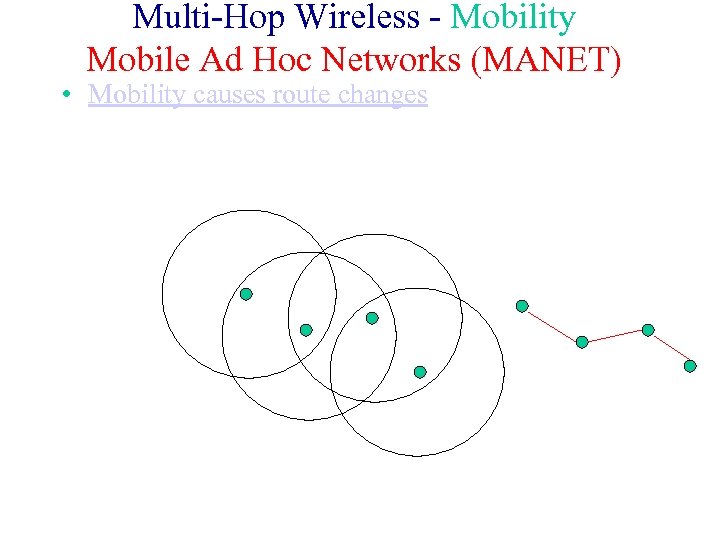
Multi-Hop Wireless - Mobility Mobile Ad Hoc Networks (MANET) • Mobility causes route changes
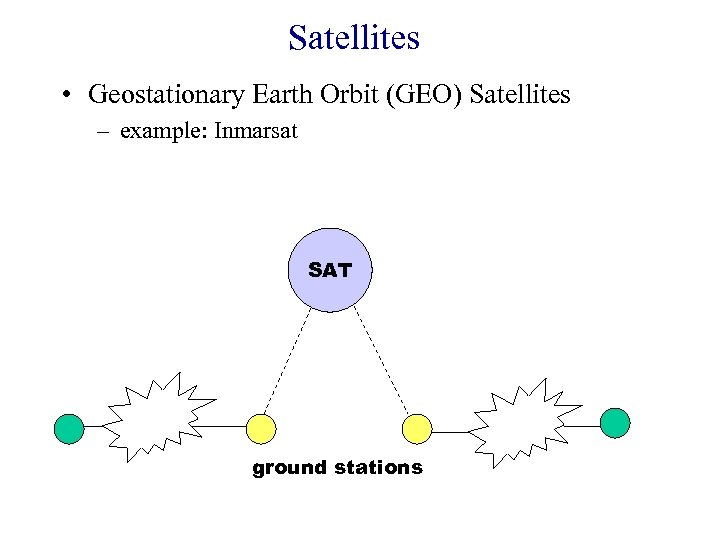
Satellites • Geostationary Earth Orbit (GEO) Satellites – example: Inmarsat SAT ground stations
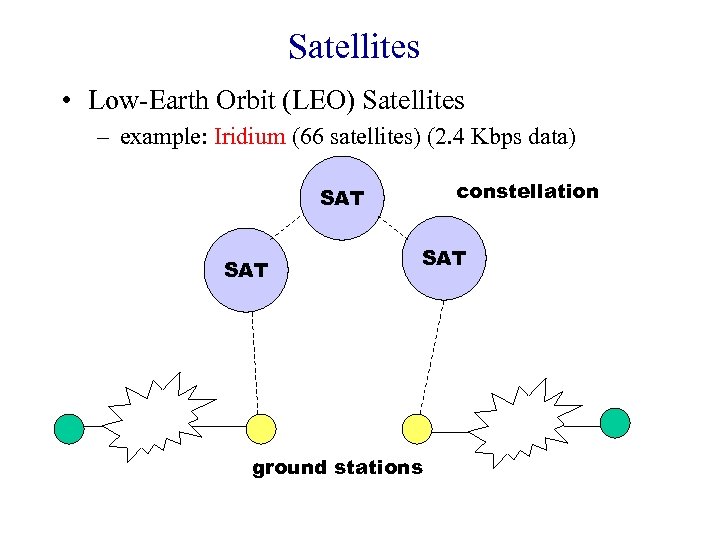
Satellites • Low-Earth Orbit (LEO) Satellites – example: Iridium (66 satellites) (2. 4 Kbps data) constellation SAT SAT ground stations
Satellites • GEO – long delay - 250 -300 ms propagation delay • LEO – relatively low delay - 40 - 200 ms – large variations in delay - multiple hops/route changes, relative motion of satellites, queueing
Wireless Connectivity - Characteristics • Transmission errors – – Wireless LANs - 802. 11, Hyperlan Cellular wireless Multi-hop wireless Satellites • Low bandwidth – Cellular wireless – Packet radio (e. g. , Metricom, Nokia) • Long or variable latency – GEO, LEO satellites – Packet radio - high variability • Asymmetry in bandwidth, error characteristics – Satellites (example: Direct. PC)
Impact of transmission errors on TCP performance
Random Errors • If number of errors is small, they may be corrected by an error correcting code • Excessive bit errors result in a packet being discarded, possibly before it reaches the transport layer
Random Errors May Cause Fast Retransmit • Fast retransmit results in – retransmission of lost packet – reduction in congestion window • Reducing congestion window in response to errors is unnecessary • Reduction in congestion window reduces the throughput
Sometimes Congestion Response May be Appropriate in Response to Errors • On a CDMA channel, errors occur due to interference from other user, and due to noise [Karn 99 pilc] – Interference due to other users is an indication of congestion. If such interference causes transmission errors, it is appropriate to reduce congestion window – If noise causes errors, it is not appropriate to reduce window • When a channel is in a bad state for a long duration, it might be better to let TCP backoff, so that it does not unnecessarily attempt retransmissions while the channel remains in the bad state [Padmanabhan 99 pilc]
Burst Errors May Cause Timeouts • If wireless link remains unavailable for extended duration, a window worth of data may be lost – driving through a tunnel – passing a truck – Slow fading • Timeout results in slow start • Slow start reduces congestion window to 1 MSS, reducing throughput • Reduction in window in response to errors unnecessary
Random Errors May Also Cause Timeout • Multiple packet losses in a window can result in timeout when using TCP-Reno (and to a lesser extent when using SACK)
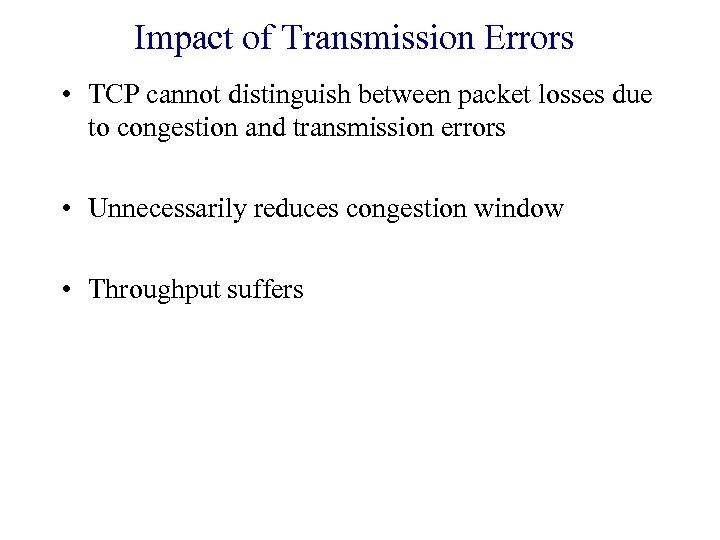
Impact of Transmission Errors • TCP cannot distinguish between packet losses due to congestion and transmission errors • Unnecessarily reduces congestion window • Throughput suffers
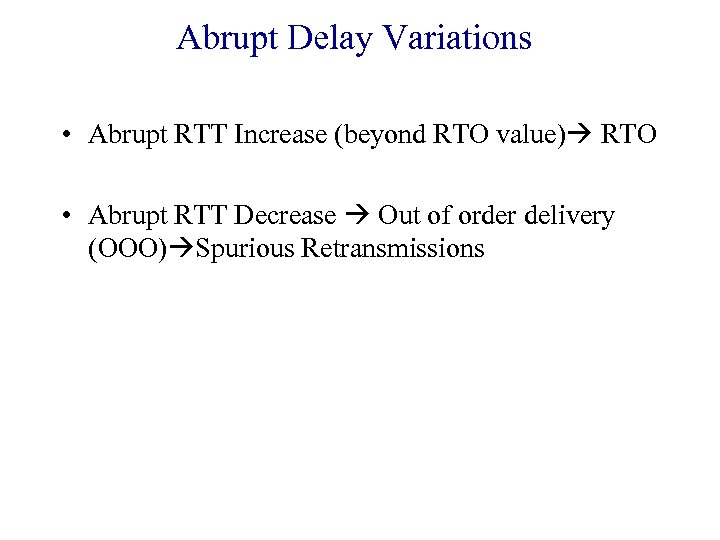
Abrupt Delay Variations • Abrupt RTT Increase (beyond RTO value) RTO • Abrupt RTT Decrease Out of order delivery (OOO) Spurious Retransmissions
This Lecture • We consider errors for which reducing congestion window is an inappropriate response
Lecture Outline • TCP basics • Wireless technologies • Impact of transmission errors on TCP performance • Approaches to improve TCP performance – Classification – Discussion of selected approaches
Schemes to Improve Performance of TCP in Presence of Transmission Errors
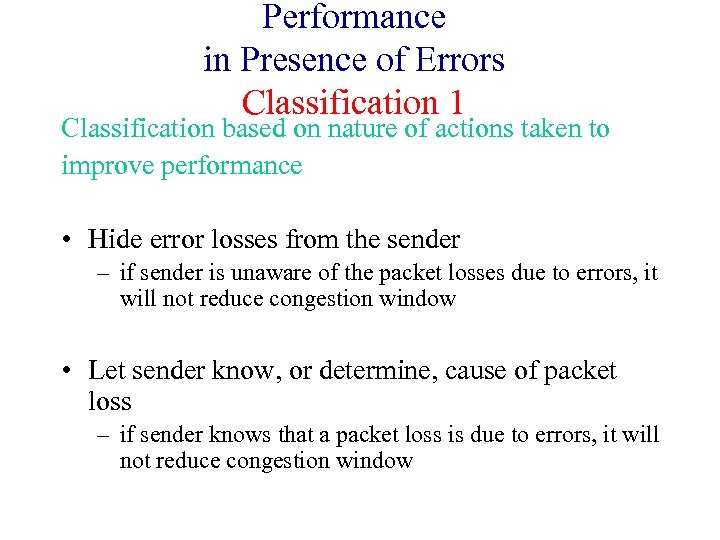
Performance in Presence of Errors Classification 1 Classification based on nature of actions taken to improve performance • Hide error losses from the sender – if sender is unaware of the packet losses due to errors, it will not reduce congestion window • Let sender know, or determine, cause of packet loss – if sender knows that a packet loss is due to errors, it will not reduce congestion window
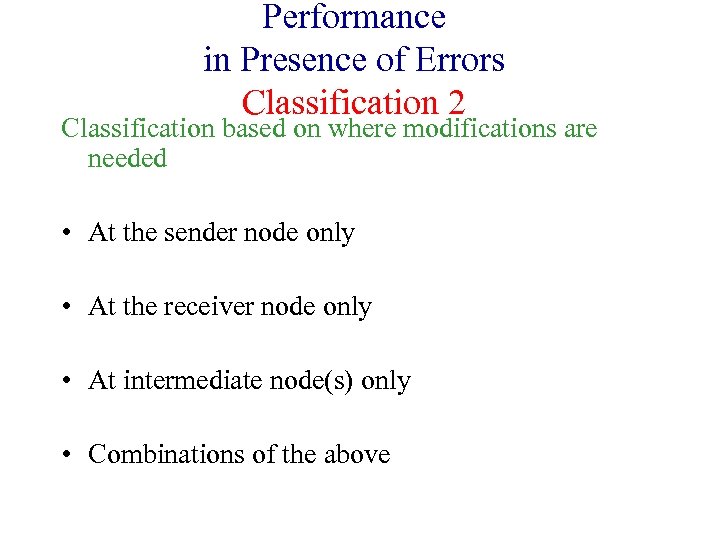
Performance in Presence of Errors Classification 2 Classification based on where modifications are needed • At the sender node only • At the receiver node only • At intermediate node(s) only • Combinations of the above
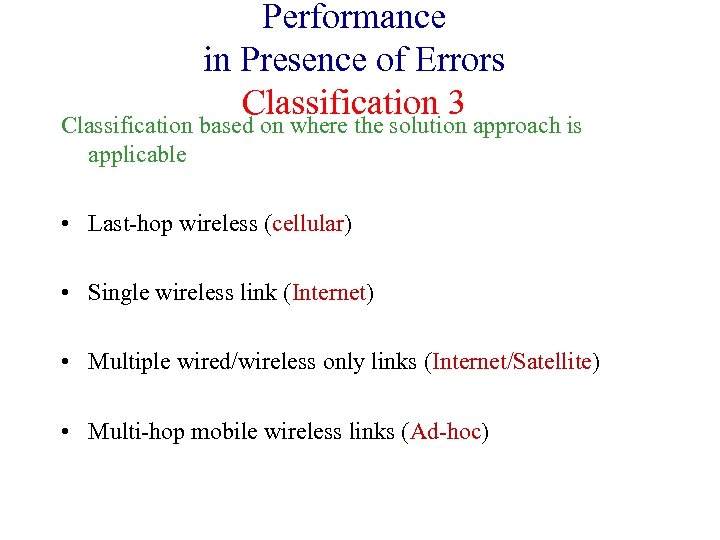
Performance in Presence of Errors Classification 3 Classification based on where the solution approach is applicable • Last-hop wireless (cellular) • Single wireless link (Internet) • Multiple wired/wireless only links (Internet/Satellite) • Multi-hop mobile wireless links (Ad-hoc)
Ideal Behavior • Ideal TCP behavior: Ideally, the TCP sender should simply retransmit a packet lost due to transmission errors, without taking any congestion control actions – Such a TCP referred to as Ideal TCP – Ideal TCP typically not realizable • Ideal network behavior: Transmission errors should be hidden from the sender -- the errors should be recovered transparently and efficiently • Proposed schemes attempt to approximate one of the above two ideals
References-1 • • • • • J. Hoe, "Improving the start-up behavior of a congestion control scheme for TCP, " in Proceedings of ACM SIGCOMM '96, August 1996. M. Mathis, J. Mahdavi, and S. Floyd, "TCP selective acknowledgement options, " October 1996. RFC 2018. P. Karn, "Re: Pilc: prioritization, " January 1999. E-mail posting on the IETF PILC working group mailing list. Archive available at http: //pilc. grc. nasa. gov. V. Padmanabhan, "Re: Pilc: prioritization, " January 1999. E-mail posting on the IETF PILC working group mailing list. Archive available at http: //pilc. grc. nasa. gov S. Dawkins, a. Montenegro, M. Kojo, V. Magret, and N. H. Vaidya, "Performance implications of link-layer characteristics: Links with errors, " tech. rep. , PILC, Internet Engineering Task Force (Internet Draft), June 1999. S. Lin and D. J. Costello Jr. , Error Control Coding: Fundamentals and Applications. Prentice- Hall, Englewood Cliffs, NJ, 1983. D. A. Eckhardt and P. Steenkiste, "Improving wireless LAN performance via adaptive local error control, " in Int. Conf. Network Protocols, pp. 327 -338, 1998. A. De. Simone, M. Chuah, and 0. Yue, "Throughput performance of transport-layer protocols over wireless LANs, " in Proc. Globecom '93, December 1993. S. Seshan, H. Balakrishnan, and R. Katz, "Handoffs in cellular wireless networks: The daedalus implementation and experience, " Kluwer International Jouranl on Wireless Communication Systems, 1996. R. Ludwig and B. Rathonyi, "Multi-layer tracing of TCP over a reliable wireless link, " in ACM SIGMETRICS, 1998. R. Ludwig, "A case for flow-adaptive wireless links, " Tech. Rep. UCBj. CSD-99 -1053, CS Dep. , University of California, Berkley, May 1999. http: //iceberg. cs. berkeley. edujpublications. html. D. A. Eckhardt and P. Steenkiste, "Improving wireless LAN performance via adaptive local error control, " in Int. Conf. Network Protocols, pp. 327 -338, 1998. G. Holland N. H. Vaidya, "Analysis of. TCP performance over mobile ad hoc networks, " in International Conference on Mobile Computing and Networking (MOBICOM), August 1999. A. Bakre and B. Badrinath, "I-Tap: Indirect Tap for mobile hosts, " in Proc. 15 th Interna- tional Conf. on Distributed Computing Systems (ICDCS), May 1995. R. Yavatkar and N. Bhagwat, "Improving end-to-end performance of TCP over mobile inter-networks, " in Workshop on Mobile Computing Systems and Applications, December 1994. Z. Haas and P. Agrawal, "Mobile-TCP: An asymmetric transport protocol design for mobile systems, " in ICC'97, Montreal, Canada, June 1997.
References-2 • • • K. Wang and S. K. Tripathi, "Mobile-end transport protocol: An alternative to TCP /IP over wireless links, " in IEEE Infocom, pp. 1046 -1053, March 1998. H. Balakrishnan and R. Katz, "Explicit loss notification and wireless web performance, " in IEEE Globecom Internet Mini- Conference, Sydney, October 1998. H. Balakrishnan, V. Padmanabhan, and R. Katz, "The effects of asymmetry on TCP performance, " in Third ACM/IEEE Mobicom conference, Budapest, Hungary, September 1997. H. Balakrishnan, V. Padmanabhan, S. Seshan, and R. Katz, " A comparison of mechanisms for improving Tap performance over wireless links, " in ACM SIGCOMM, Stanford, CA, August 1996. H. Balakrishnan, S. Seshan, and R. Katz, "Improving reliable transport and handoff perfor- mance in cellular wireless networks, " ACM Wireless Networks, vol. 1, December 1995.
Скачать презентацию TCP Over Wireless Professor Alhussein Abouzeid Rensselaer Polytechnic
7da368fb05c988c846dd45a85c0b8042.ppt