 Скачать презентацию TC 842 Budgeting Budgeting Producers do
ad633a577d40edcb5ec7b7687025e1eb.ppt
- Количество слайдов: 19




TC 842 Budgeting
Budgeting • Producers do it--but have little or no training in it. • predict the future • world of projections • in business, budgets are accepted way of life • things more predictable and standardized than in production
Media Budgeting • how do you value creativity • attempt to impose order on essentially disordered process • difficult to be precise • frequently done backwards--ought to cost $$$$, make it fit • necessary in all production
Bertold Brecht • Ah how sorely they're mistaken Who think that money doesn't count Fruitfulness turns to famine When the kindly stream runs out
Operating Budget • often flexible in businesses as long as stay within the total amount- but less so in nonprofit organizations • much estimation in budgeting – predicting prices (market forces), – salaries (union contracts), – success of a product (whimsy of consumer) • profits depend on keeping within it • Department heads must work within
Operating Budget • allocation to the entire department • total money for an entire fiscal yea – Equipment travel, phone, office supplies, subscriptions, special events, supplies – Salaries – overhead (lights, heat, corporate overhead charged) – maintenance and repair, rentals, licensing fees, instructional materials
Project Budget • partial charge back – contracting department pays for extras only – tape, outside sources (writers, graphics, shooters, music, etc) – the out of pocket costs. – This is most frequent arrangement--PTV
Project Budget • Total charge back – Contracting department pays for everything – hourly salaries, depreciation of eqt – plus out of pocket – outside clients
Project Budget Flat budget--all production is to be accomplished within a set budget for the year-ITV
Budget Questions What must be done and who will pay for it • 1. Can it be done in house, or will it require independent/external help ? • 2. Travel ? How much ? • 3. Length of program/piece ? • 4. Level of sophistication of project (tape format, graphics, drama, web site)
Budget Questions What must be done and who will pay for it • 5. Format (docum style more involved than studio int) • 6. Does distribution require funding ( duplication, uplink costs, server, postage etc) • 7. Performers/ talent • 8. Research costs • 9. Timeline
Budget Questions What must be done and who will pay for it • • 10. Shooting ratio 11. Sets/ graphics/materials 12. Size/sophistication of crew 13. Is there music 14 Remember set up/rehearsal 15. Royalties, fees 16. lighting, electrical
Budget Questions What must be done and who will pay for it • • 17. Media costs (tape, CD’s, DVD’s) 18. Food/lodging/catering 19. Insurance 20. Ancillary uses/technology – Web for tv or film
Budget Questions What must be done and who will pay for it • Challenge all assumptions – Realistic ? – Needed ? – Do internally ? – Internal good enough
During Project • Track all expenses – Weekly if possible • Track payments • Organizational tracking – Often well behind • Save all receipts • Cut costs where possible – Shoot less, reduce complexity • Prompt action if problem surfaces
Questions for Outside Vendors • • Normal business hours Overtime rates Require operator Personnel and mileage for location shoots Minimums Liability Discounts--large volume or not-for-profit
Questions for Outside Vendors • Down time policy--equipment malfunctions • Cancellation deadline • Equipment included in package ?
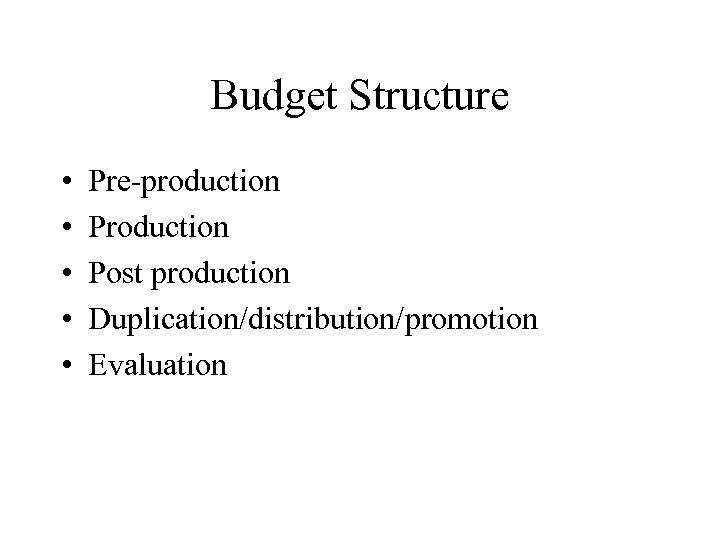
Budget Structure • • • Pre-production Post production Duplication/distribution/promotion Evaluation
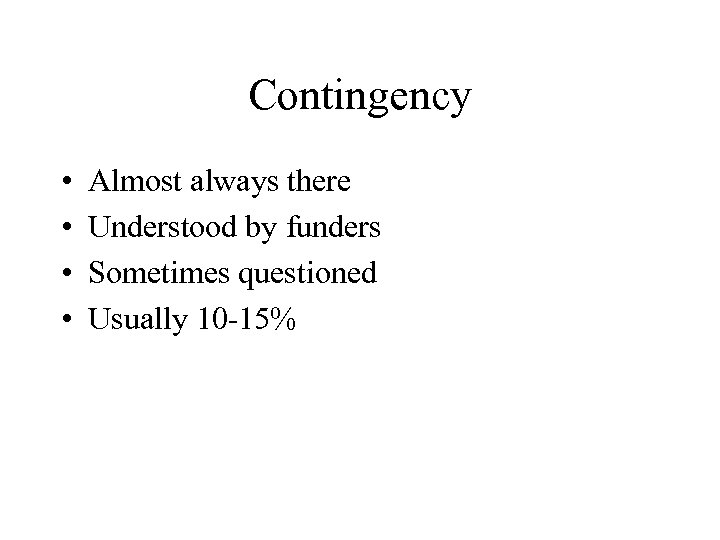
Contingency • • Almost always there Understood by funders Sometimes questioned Usually 10 -15%
Скачать презентацию TC 842 Budgeting Budgeting Producers do
ad633a577d40edcb5ec7b7687025e1eb.ppt