 Скачать презентацию TBL 1 Orthopedic Trauma Husna Izzati Ili Safia
541b8f59bfc309c27f894107fa4f23ae.ppt
- Количество слайдов: 97



TBL 1: Orthopedic Trauma Husna, Izzati, Ili Safia, Aqilah & Safiyyah
TBL Trigger A 24 year old man was involved in a road traffic accident. He was a pedestrian when a motorcycle knocked him down when he was crossing the road. Following that incident, he complained of pain of the left leg and was unable to bear weight on his left lower limb.
In A&E, physical examination was performed: ◦ Revealed swollen, tender and deformed proximal region of the left leg. ◦ No limb threatening injury noted. ◦ No wound overlying the deformed region. An X-ray of the left leg done reported transverse fracture proximal of the left fibula.
He was admitted to the ward: ◦ The left leg was elevated on the Bohler Braun frame awaiting for the swelling to subside and to observe for Compartment syndrome. ◦ He was told the fracture is best treated with internal fixation but he opted for conservative treatment. ◦ Full leg POP cast was applied after 3 days of admission.
Follow up visit (6 weeks post-trauma): ◦ X ray was done and it showed no healing signs. ◦ The earlier cast was removed and changed to patellar tendon bearing cast for another six weeks. Follow up visit (12 weeks post-trauma): ◦ Revealed mobility to the fracture site – painless. ◦ He was told to have problem with the fracture healing and needs surgical treatment.
Learning Issues Anatomy of the Leg. Fracture – Definition, Classification and Patterns. Principle of Fracture Management. Acute Complications of Fracture. Process of Fracture Healing. Late Complications of Fracture. Non Union Fracture – Definition, Classification and Management.
Anatomy of the Leg
The Leg Bones ii. Muscles ◦ Compartments iii. Blood Supply iv. Nerve Supply i.
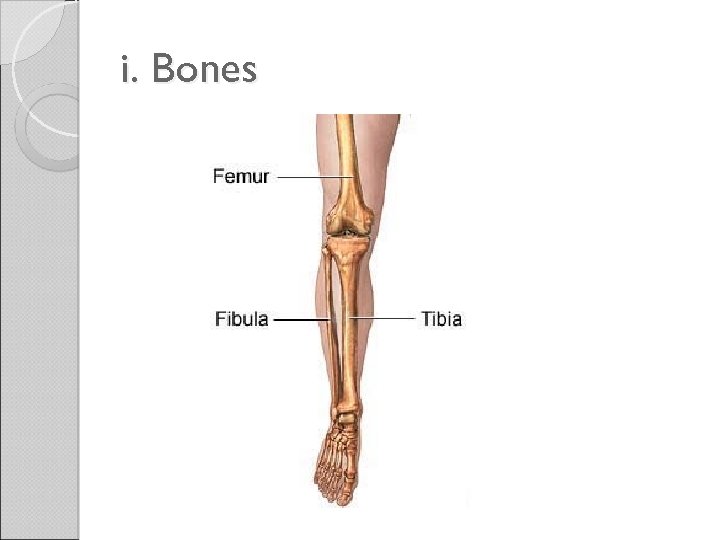
i. Bones
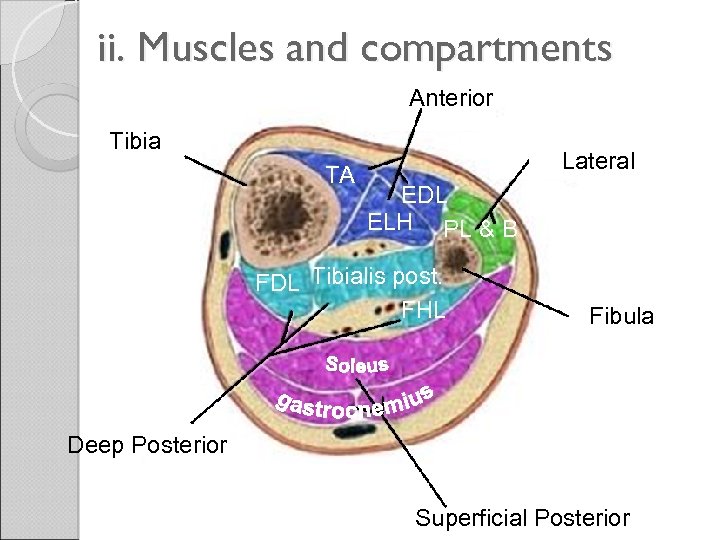
ii. Muscles and compartments Anterior Tibia TA Lateral EDL ELH PL & B FDL Tibialis post. FHL Fibula Deep Posterior Superficial Posterior
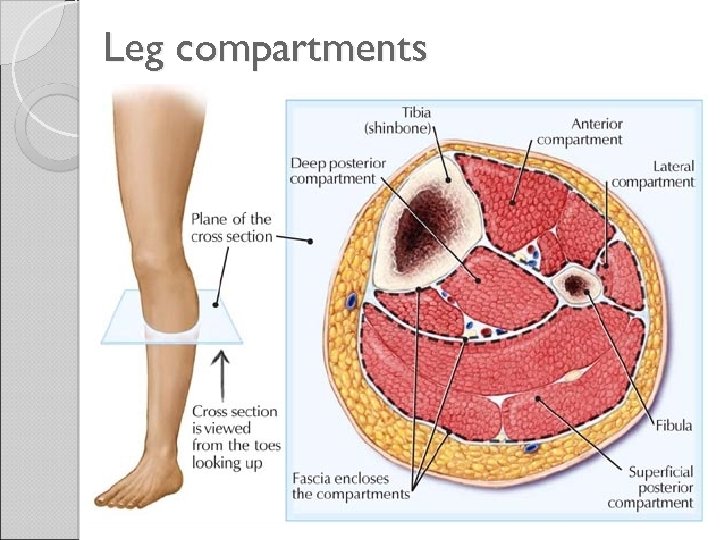
Leg compartments
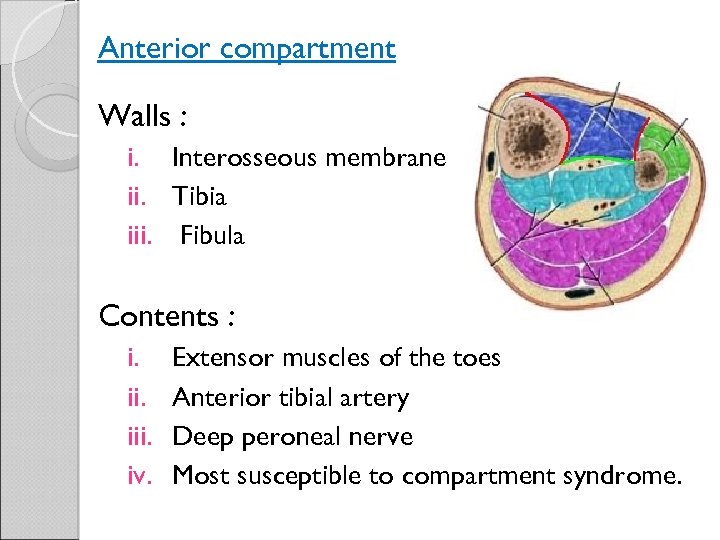
Anterior compartment Walls : i. Interosseous membrane ii. Tibia iii. Fibula Contents : i. iii. iv. Extensor muscles of the toes Anterior tibial artery Deep peroneal nerve Most susceptible to compartment syndrome.
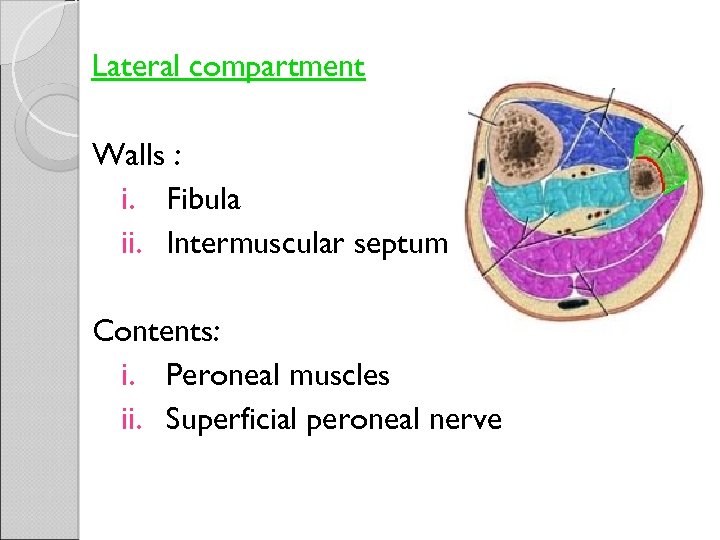
Lateral compartment Walls : i. Fibula ii. Intermuscular septums Contents: i. Peroneal muscles ii. Superficial peroneal nerve
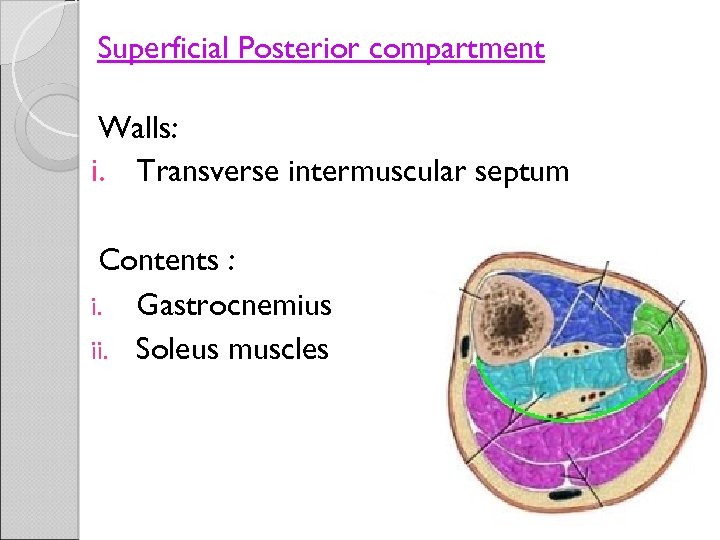
Superficial Posterior compartment Walls: i. Transverse intermuscular septum Contents : i. Gastrocnemius ii. Soleus muscles
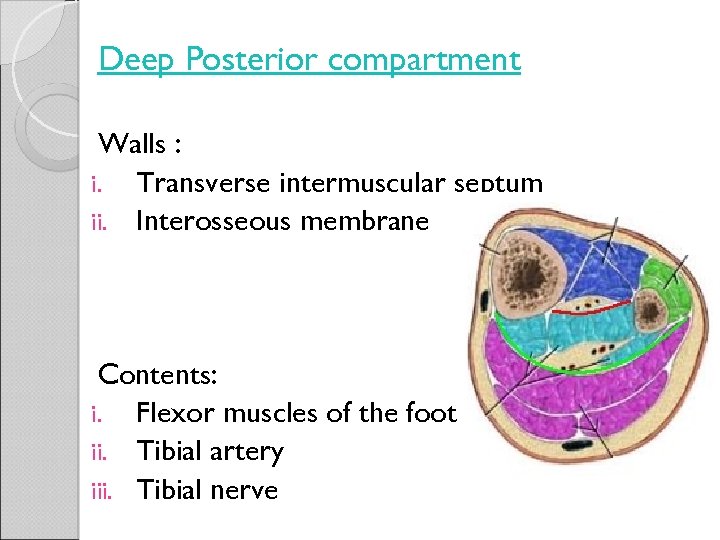
Deep Posterior compartment Walls : i. Transverse intermuscular septum ii. Interosseous membrane Contents: i. Flexor muscles of the foot ii. Tibial artery iii. Tibial nerve
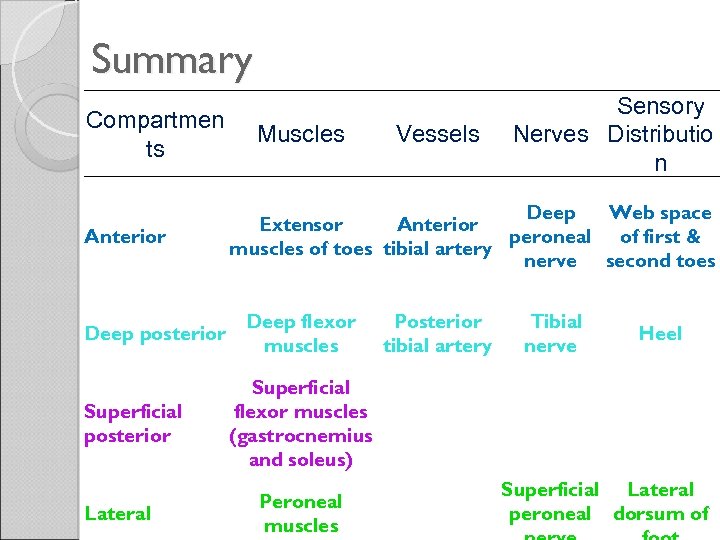
Summary Compartmen ts Anterior Deep posterior Superficial posterior Lateral Muscles Vessels Sensory Nerves Distributio n Deep Web space Extensor Anterior peroneal of first & muscles of toes tibial artery nerve second toes Deep flexor muscles Posterior tibial artery Tibial nerve Heel Superficial flexor muscles (gastrocnemius and soleus) Peroneal muscles Superficial Lateral peroneal dorsum of
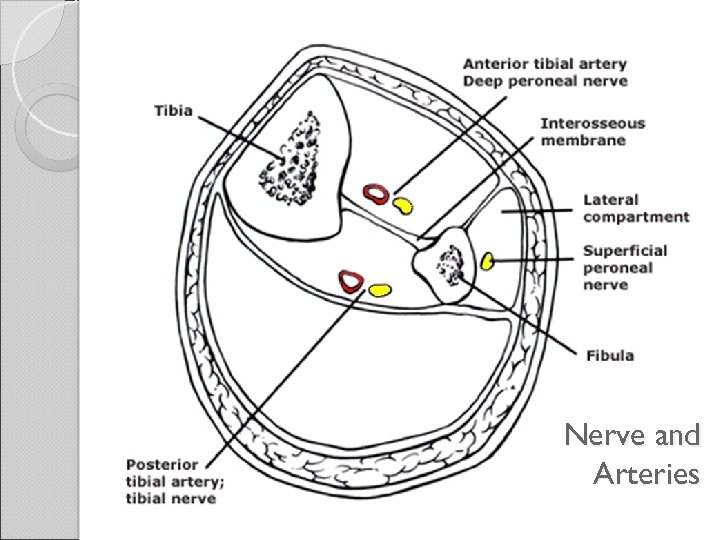
Nerve and Arteries
Fracture – Definition, Classification and Patterns
Definition of Fracture A break in the structural continuity of bone. - Apley’s System of Orthopedics & Fractures, 8 th Edition
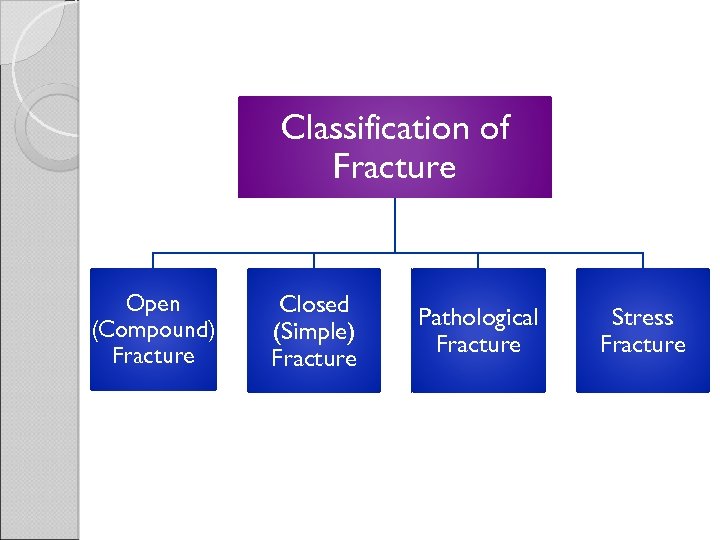
Classification of Fracture Open (Compound) Fracture Closed (Simple) Fracture Pathological Fracture Stress Fracture
i. Open (Compound) Fracture Breakage in the bone that breaches the skin or one of the body cavities. Usually due to high-energy injuries e. g. MVA, falls, sports injuries. Liable to contamination and infection hence require immediate treatment and surgery to clean the area.
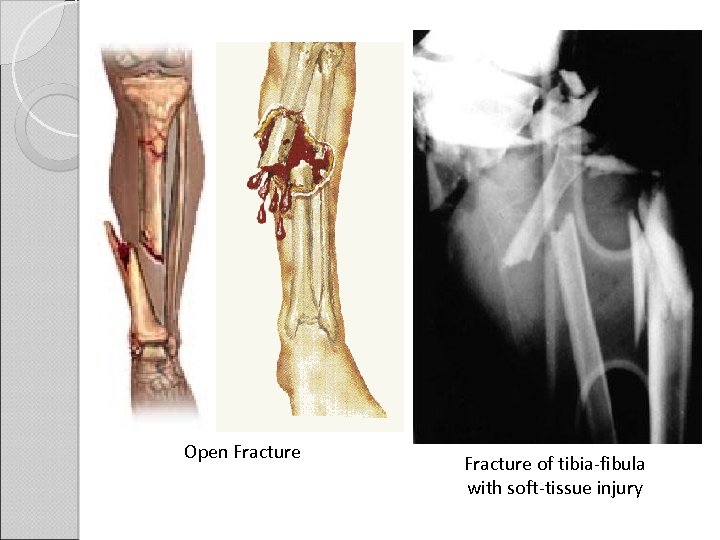
Open Fracture of tibia-fibula with soft-tissue injury
ii. Closed (Simple) Fracture Breakage in the bone with the overlying skin still intact. 3 types: ◦ Compression fracture Occurs when 2 or more bones are compressed against each other – commonly in the spine bone. Due to falling in a standing or sitting position, advanced osteoporosis.
◦ Avulsion fracture Occurs when a piece of bone is broken off by a sudden forceful contraction of a muscle. Common in young athletes. ◦ Impacted fracture Occurs when pressure is applied to both ends of one bone causing it to split into fragments that collide with each other. Similar to compression fracture, only it is within one bone. Common in falls and MVA. **View video http: //video. about. com/orthopedics/Fractures-2. htm for better understanding.
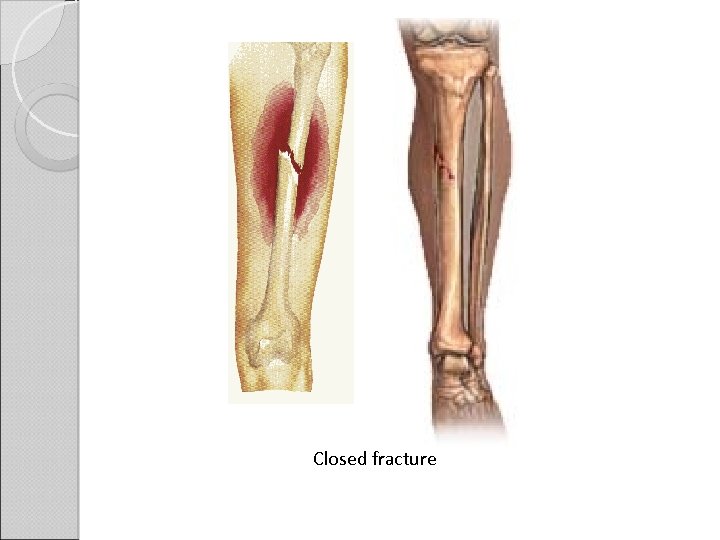
Closed fracture
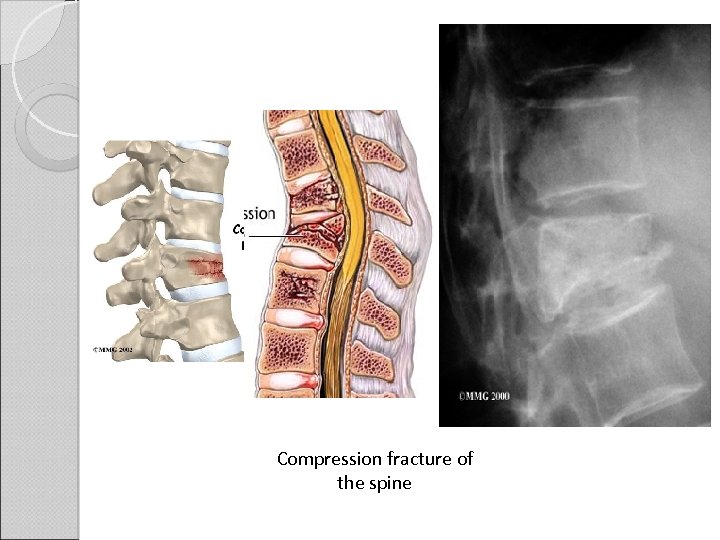
Compression fracture of the spine
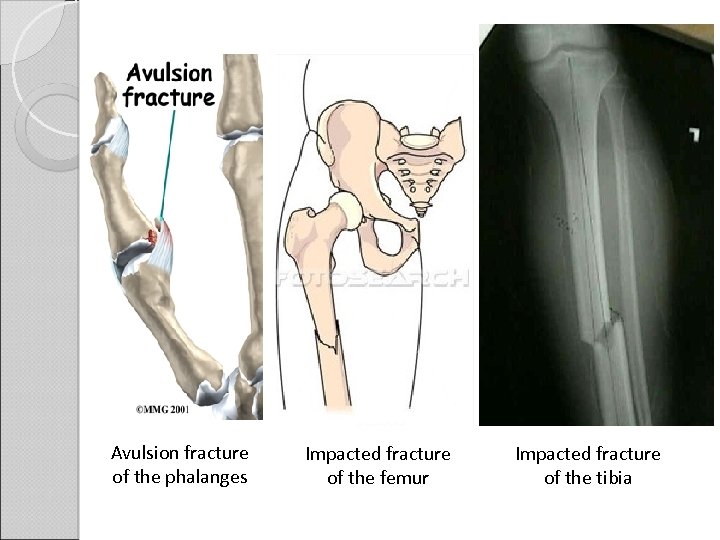
Avulsion fracture of the phalanges Impacted fracture of the femur Impacted fracture of the tibia
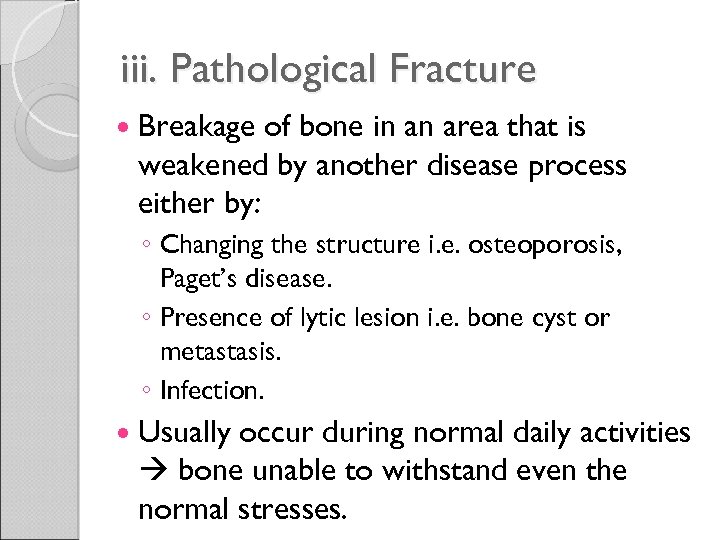
iii. Pathological Fracture Breakage of bone in an area that is weakened by another disease process either by: ◦ Changing the structure i. e. osteoporosis, Paget’s disease. ◦ Presence of lytic lesion i. e. bone cyst or metastasis. ◦ Infection. Usually occur during normal daily activities bone unable to withstand even the normal stresses.
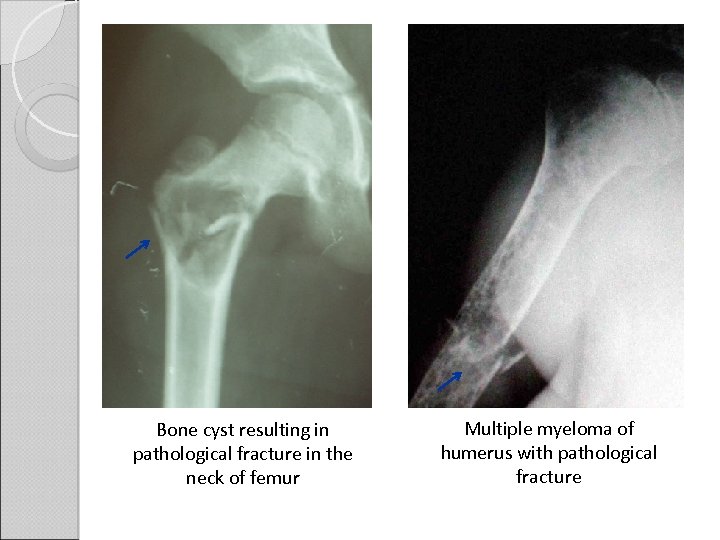
Bone cyst resulting in pathological fracture in the neck of femur Multiple myeloma of humerus with pathological fracture
iv. Stress Fracture Usually fractures are caused by acute, high force to the bone i. e. MVA, fall. In Stress facture, the force applied is much lower but it happens repetitively for a long period of time. Rarely occur in the upper extremity because weight bearing is by lower extremity – common site shin and foot.
Contributing factors: ◦ Athletes High demand of activity repetitively. ◦ Diet abnormalities Poor nutrition e. g. in aneroxia, bulimia. ◦ Menstrual irregularities Irregular cycles/amenorrhea signify lack of estrogen which results in lower bone density. Common in female athletes.
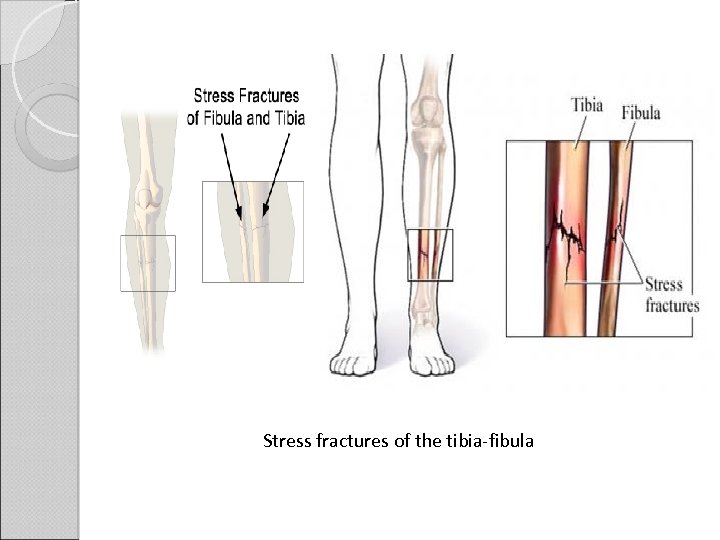
Stress fractures of the tibia-fibula
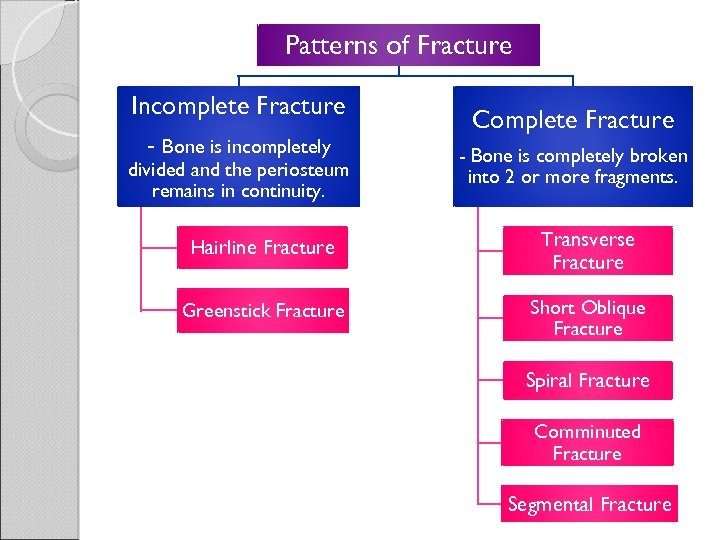
Patterns of Fracture Incomplete Fracture - Bone is incompletely divided and the periosteum remains in continuity. Complete Fracture - Bone is completely broken into 2 or more fragments. Hairline Fracture Transverse Fracture Greenstick Fracture Short Oblique Fracture Spiral Fracture Comminuted Fracture Segmental Fracture
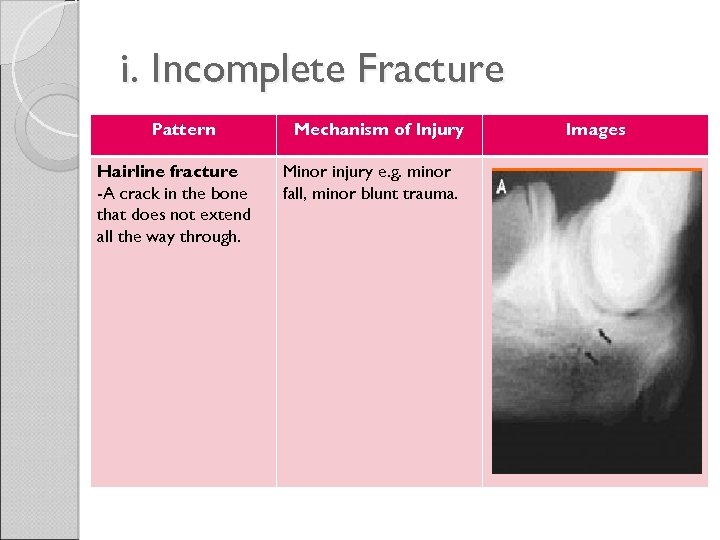
i. Incomplete Fracture Pattern Hairline fracture -A crack in the bone that does not extend all the way through. Mechanism of Injury Minor injury e. g. minor fall, minor blunt trauma. Images
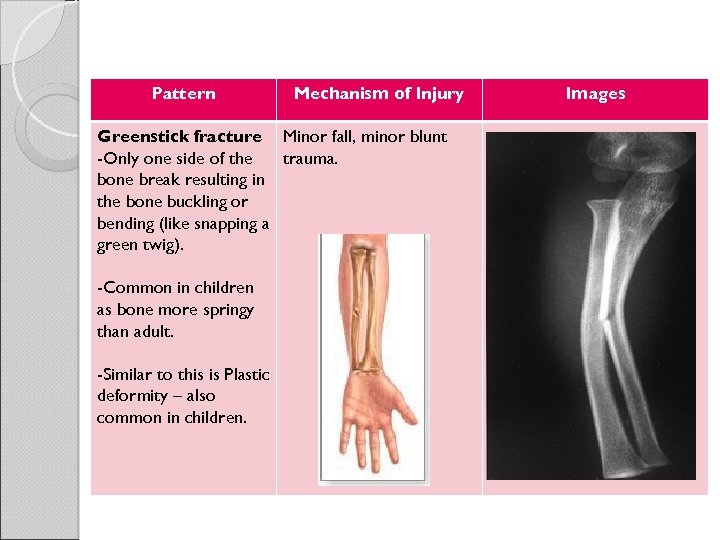
Pattern Mechanism of Injury Greenstick fracture Minor fall, minor blunt -Only one side of the trauma. bone break resulting in the bone buckling or bending (like snapping a green twig). -Common in children as bone more springy than adult. -Similar to this is Plastic deformity – also common in children. Images
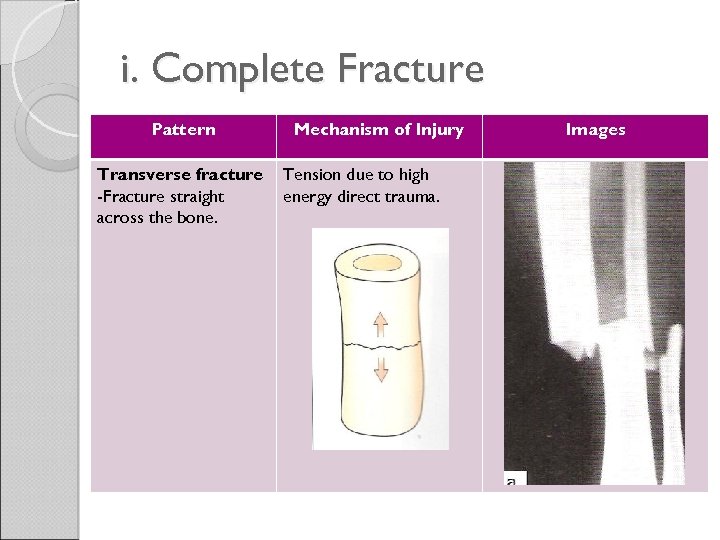
i. Complete Fracture Pattern Transverse fracture -Fracture straight across the bone. Mechanism of Injury Tension due to high energy direct trauma. Images
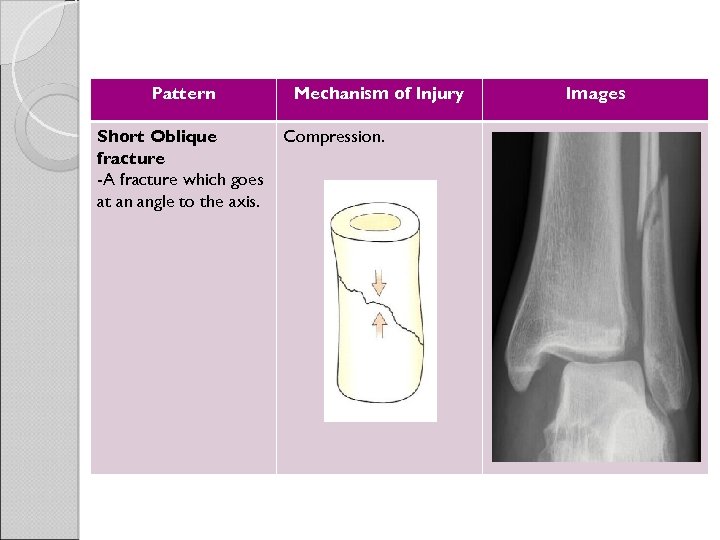
Pattern Short Oblique fracture -A fracture which goes at an angle to the axis. Mechanism of Injury Compression. Images
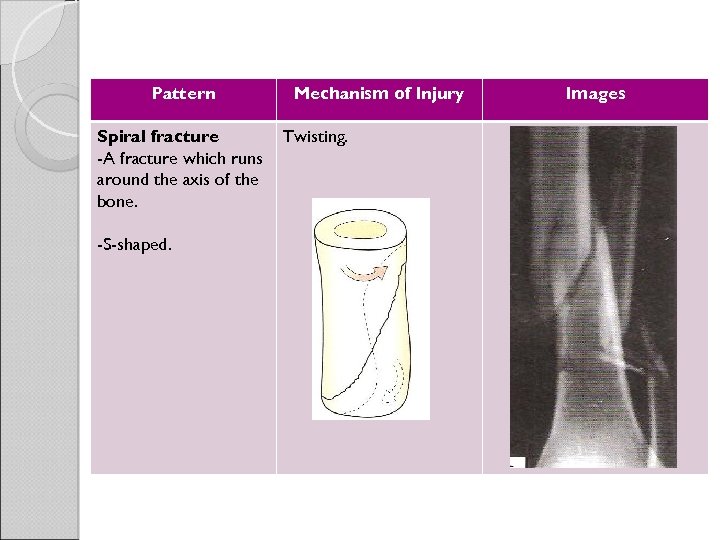
Pattern Spiral fracture -A fracture which runs around the axis of the bone. -S-shaped. Mechanism of Injury Twisting. Images
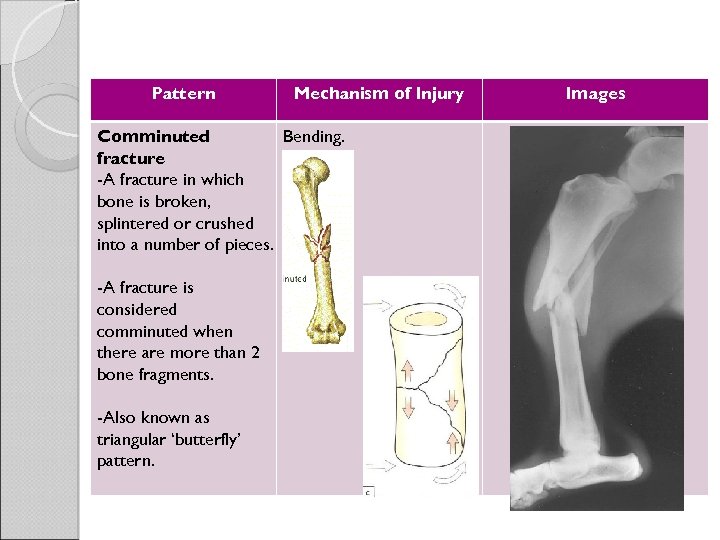
Pattern Mechanism of Injury Comminuted Bending. fracture -A fracture in which bone is broken, splintered or crushed into a number of pieces. -A fracture is considered comminuted when there are more than 2 bone fragments. -Also known as triangular ‘butterfly’ pattern. Images
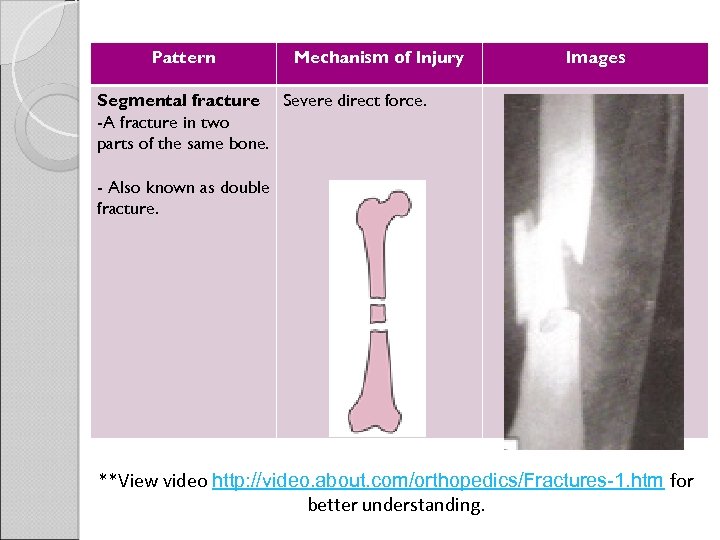
Pattern Mechanism of Injury Images Segmental fracture Severe direct force. -A fracture in two parts of the same bone. - Also known as double fracture. **View video http: //video. about. com/orthopedics/Fractures-1. htm for better understanding.
Principles of Fracture Management
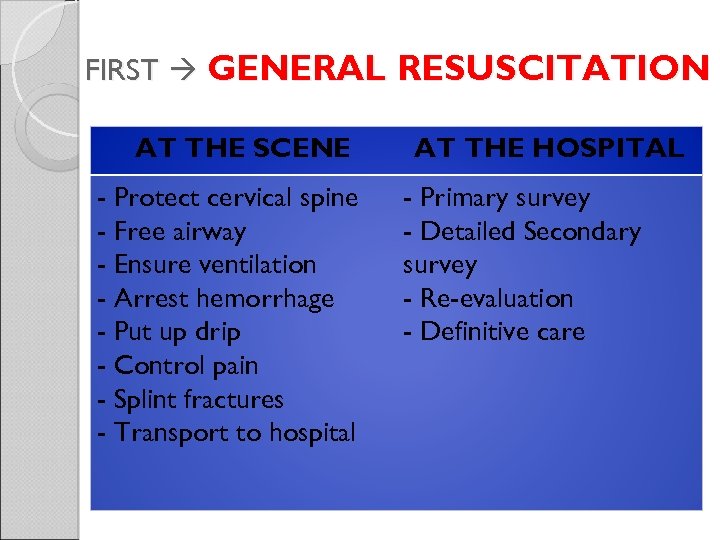
FIRST GENERAL RESUSCITATION AT THE SCENE - Protect cervical spine - Free airway - Ensure ventilation - Arrest hemorrhage - Put up drip - Control pain - Splint fractures - Transport to hospital AT THE HOSPITAL - Primary survey - Detailed Secondary survey - Re-evaluation - Definitive care
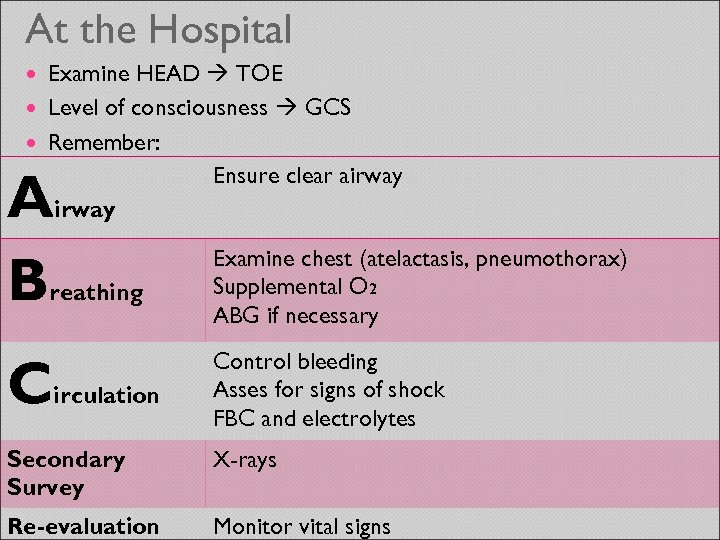
At the Hospital Examine HEAD TOE Level of consciousness GCS Remember: Ensure clear airway A B reathing C irculation Examine chest (atelactasis, pneumothorax) Supplemental O 2 ABG if necessary Control bleeding Asses for signs of shock FBC and electrolytes Secondary Survey X-rays Re-evaluation Monitor vital signs
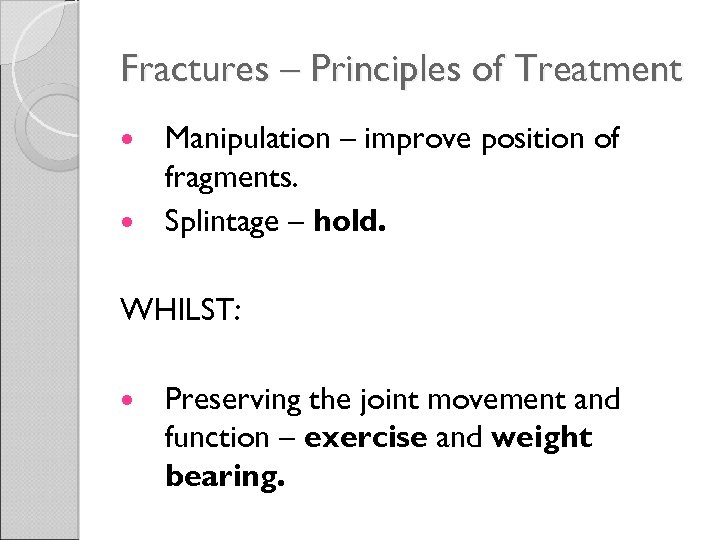
Fractures – Principles of Treatment Manipulation – improve position of fragments. Splintage – hold. WHILST: Preserving the joint movement and function – exercise and weight bearing.
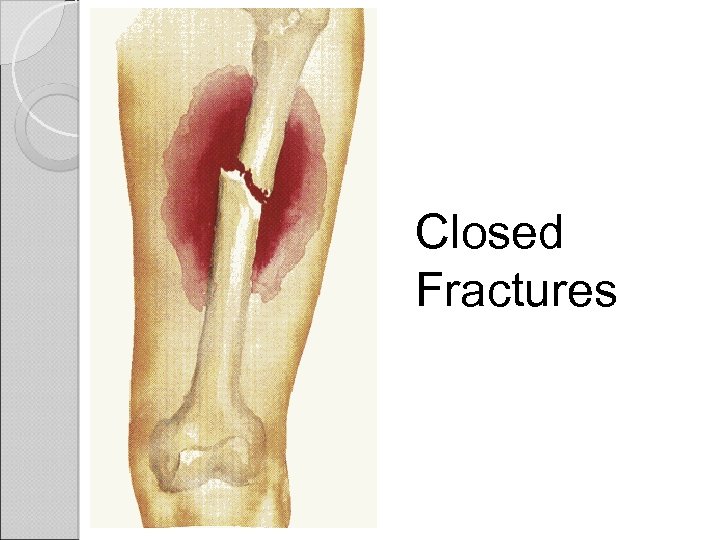
Closed Fractures
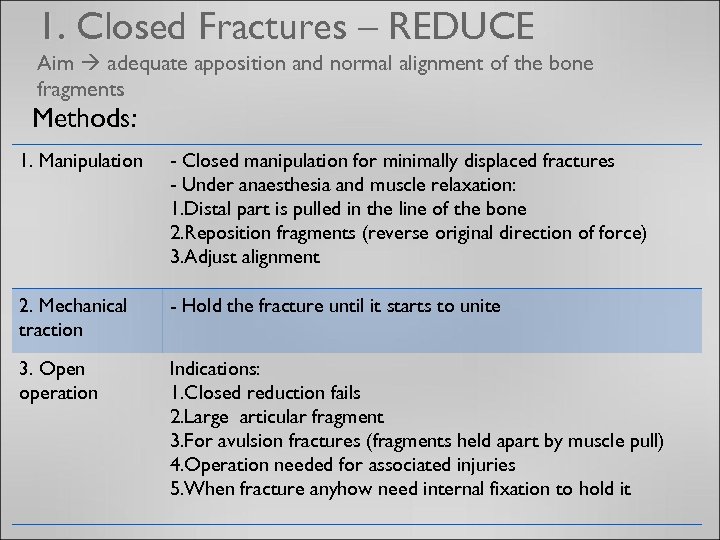
1. Closed Fractures – REDUCE Aim adequate apposition and normal alignment of the bone fragments Methods: 1. Manipulation - Closed manipulation for minimally displaced fractures - Under anaesthesia and muscle relaxation: 1. Distal part is pulled in the line of the bone 2. Reposition fragments (reverse original direction of force) 3. Adjust alignment 2. Mechanical traction - Hold the fracture until it starts to unite 3. Open operation Indications: 1. Closed reduction fails 2. Large articular fragment 3. For avulsion fractures (fragments held apart by muscle pull) 4. Operation needed for associated injuries 5. When fracture anyhow need internal fixation to hold it
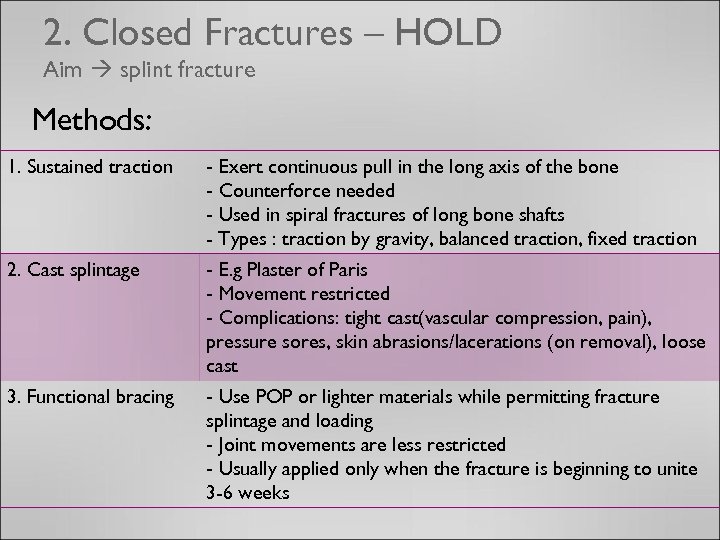
2. Closed Fractures – HOLD Aim splint fracture Methods: 1. Sustained traction - Exert continuous pull in the long axis of the bone - Counterforce needed - Used in spiral fractures of long bone shafts - Types : traction by gravity, balanced traction, fixed traction 2. Cast splintage - E. g Plaster of Paris - Movement restricted - Complications: tight cast(vascular compression, pain), pressure sores, skin abrasions/lacerations (on removal), loose cast 3. Functional bracing - Use POP or lighter materials while permitting fracture splintage and loading - Joint movements are less restricted - Usually applied only when the fracture is beginning to unite 3 -6 weeks
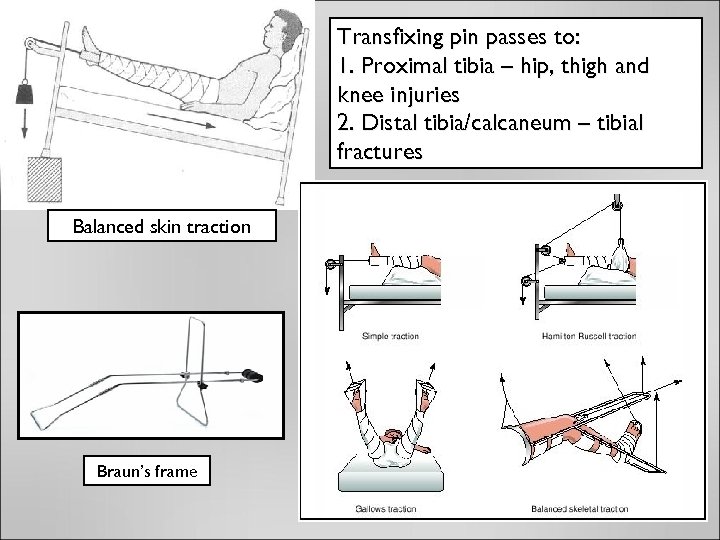
Transfixing pin passes to: 1. Proximal tibia – hip, thigh and knee injuries 2. Distal tibia/calcaneum – tibial fractures Balanced skin traction Braun’s frame
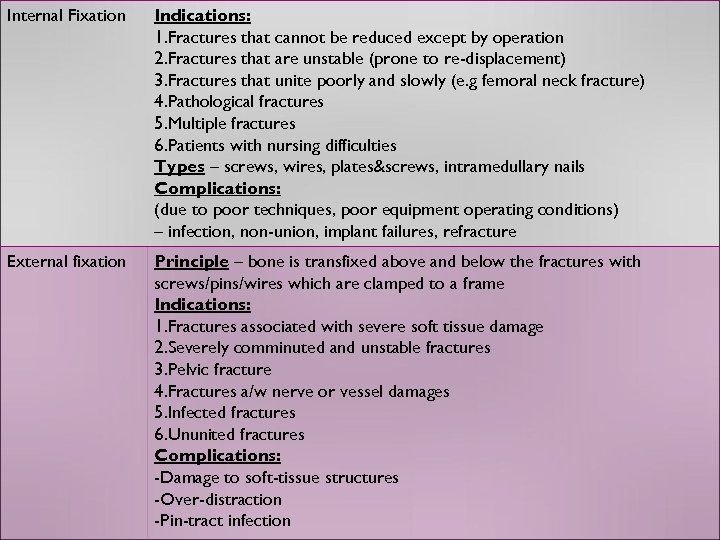
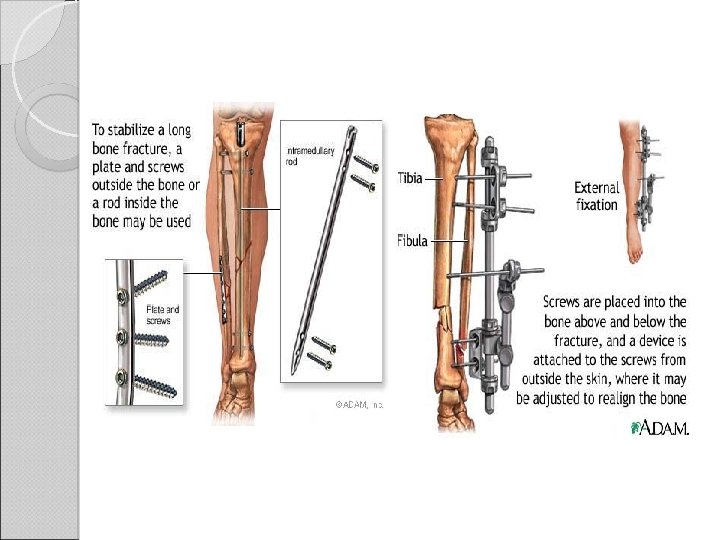
Internal Fixation Indications: 1. Fractures that cannot be reduced except by operation 2. Fractures that are unstable (prone to re-displacement) 3. Fractures that unite poorly and slowly (e. g femoral neck fracture) 4. Pathological fractures 5. Multiple fractures 6. Patients with nursing difficulties Types – screws, wires, plates&screws, intramedullary nails Complications: (due to poor techniques, poor equipment operating conditions) – infection, non-union, implant failures, refracture External fixation Principle – bone is transfixed above and below the fractures with screws/pins/wires which are clamped to a frame Indications: 1. Fractures associated with severe soft tissue damage 2. Severely comminuted and unstable fractures 3. Pelvic fracture 4. Fractures a/w nerve or vessel damages 5. Infected fractures 6. Ununited fractures Complications: -Damage to soft-tissue structures -Over-distraction -Pin-tract infection
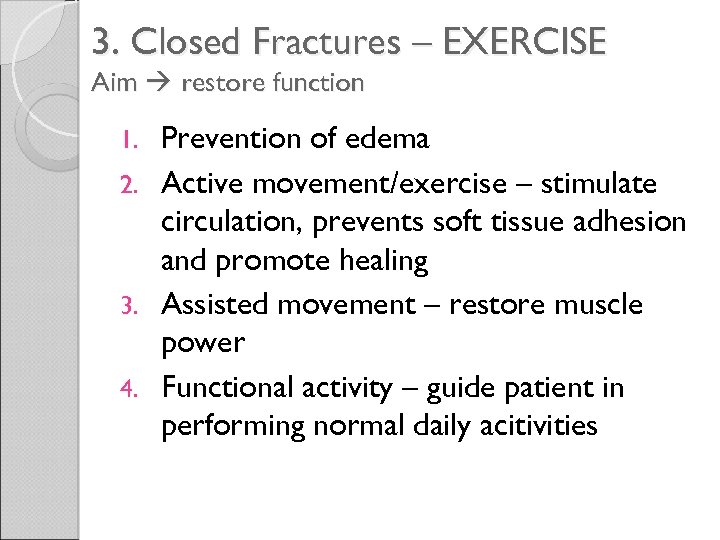
3. Closed Fractures – EXERCISE Aim restore function Prevention of edema 2. Active movement/exercise – stimulate circulation, prevents soft tissue adhesion and promote healing 3. Assisted movement – restore muscle power 4. Functional activity – guide patient in performing normal daily acitivities 1.
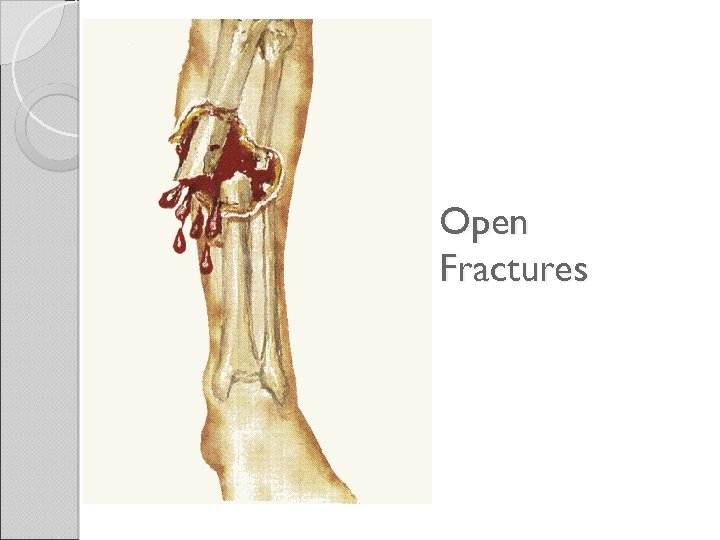
Open Fractures
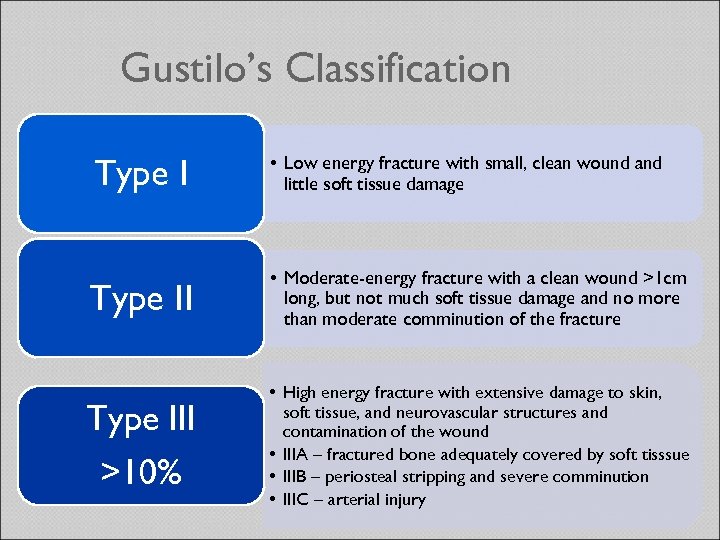
Gustilo’s Classification Type I • Low energy fracture with small, clean wound and little soft tissue damage Type II • Moderate-energy fracture with a clean wound >1 cm long, but not much soft tissue damage and no more than moderate comminution of the fracture Type III >10% • High energy fracture with extensive damage to skin, soft tissue, and neurovascular structures and contamination of the wound • IIIA – fractured bone adequately covered by soft tisssue • IIIB – periosteal stripping and severe comminution • IIIC – arterial injury
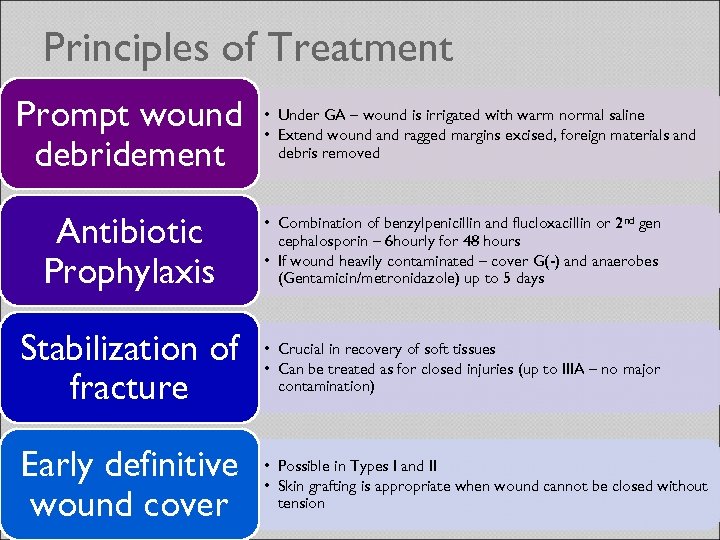
Principles of Treatment Prompt wound debridement • Under GA – wound is irrigated with warm normal saline • Extend wound and ragged margins excised, foreign materials and debris removed Antibiotic Prophylaxis • Combination of benzylpenicillin and flucloxacillin or 2 nd gen cephalosporin – 6 hourly for 48 hours • If wound heavily contaminated – cover G(-) and anaerobes (Gentamicin/metronidazole) up to 5 days Stabilization of fracture • Crucial in recovery of soft tissues • Can be treated as for closed injuries (up to IIIA – no major contamination) Early definitive wound cover • Possible in Types I and II • Skin grafting is appropriate when wound cannot be closed without tension
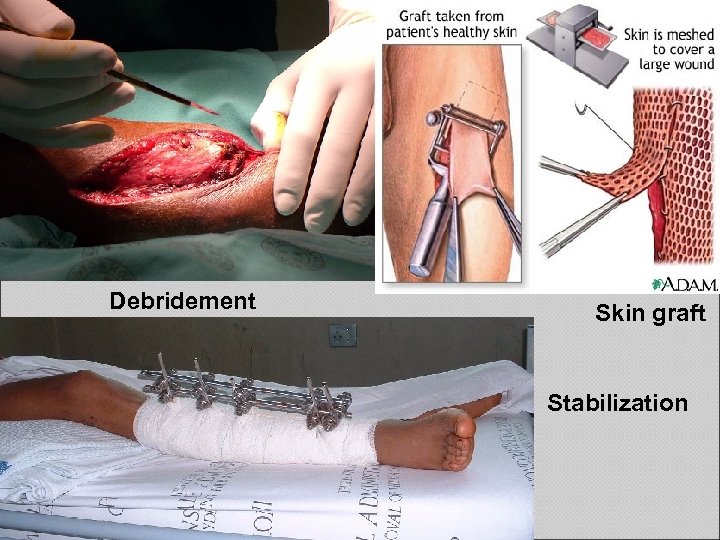
Debridement Skin graft Stabilization
Acute Complications of Fracture
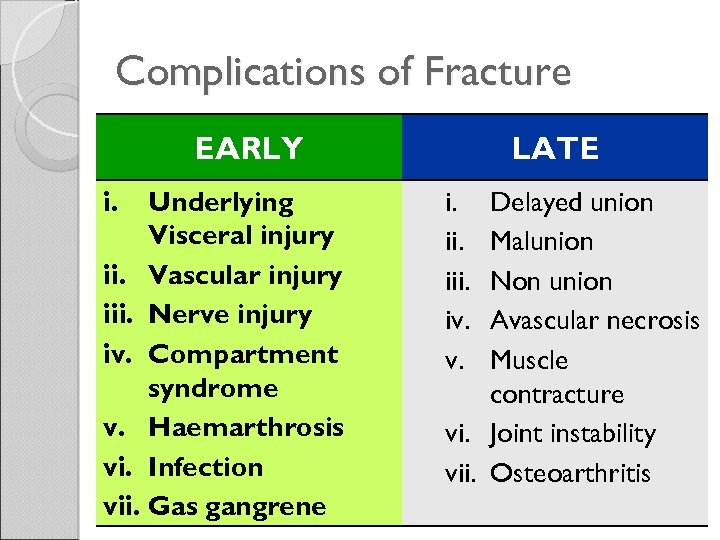
Complications of Fracture EARLY i. Underlying Visceral injury ii. Vascular injury iii. Nerve injury iv. Compartment syndrome v. Haemarthrosis vi. Infection vii. Gas gangrene LATE i. iii. iv. v. Delayed union Malunion Non union Avascular necrosis Muscle contracture vi. Joint instability vii. Osteoarthritis
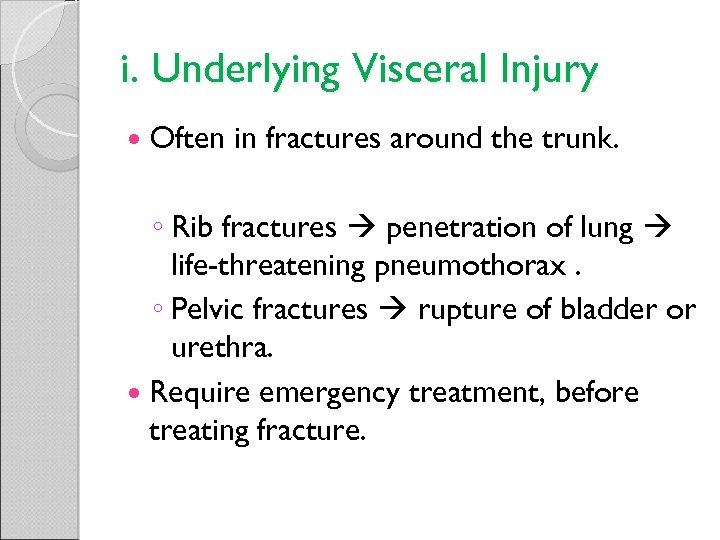
i. Underlying Visceral Injury Often in fractures around the trunk. ◦ Rib fractures penetration of lung life-threatening pneumothorax. ◦ Pelvic fractures rupture of bladder or urethra. Require emergency treatment, before treating fracture.
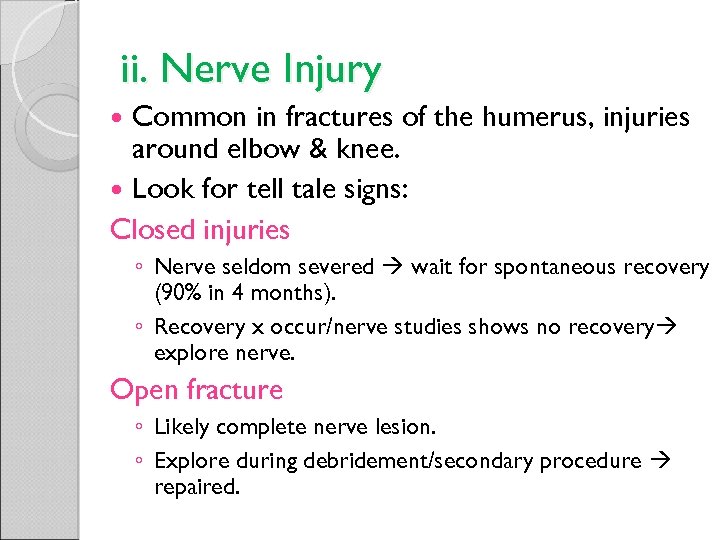
ii. Nerve Injury Common in fractures of the humerus, injuries around elbow & knee. Look for tell tale signs: Closed injuries ◦ Nerve seldom severed wait for spontaneous recovery (90% in 4 months). ◦ Recovery x occur/nerve studies shows no recovery explore nerve. Open fracture ◦ Likely complete nerve lesion. ◦ Explore during debridement/secondary procedure repaired.
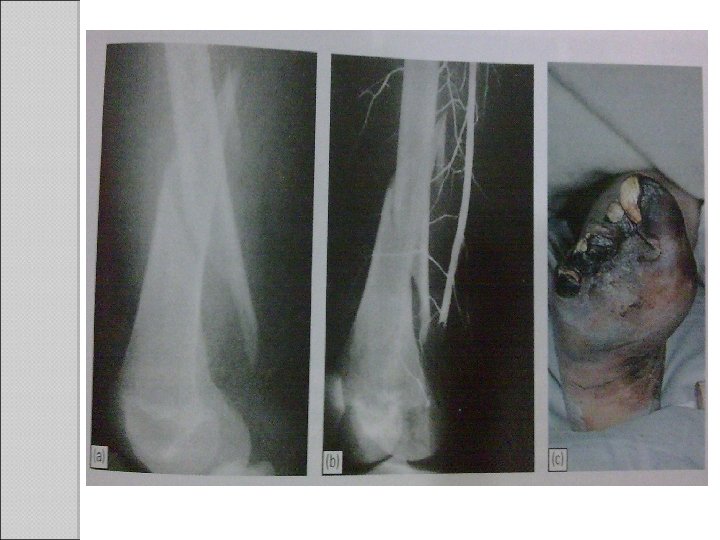
iii. Vascular Injury Fracture around knee and elbow, humeral and femoral shafts ↑ ass. w. damage to major artery. Cut, torn, compressed, contused by initial injury/jagged bone fragments. N outward appearance intima may be detached, vessel blocked by thrombus, spasm. Effects vary : transient diminutive of blood flow, profound inchaemia, tissue death, peripheral gangrene.
Clinical features Paraesthesia /numbness of toes/fingers Cold, pale, slightly cyanosed weak/absent pulse X ray shows high risk fractures Management Angiogram Remove bandages/splint X ray – kinking or compressed reduction Reassess circulation No improvement explore via operation ◦ Torn Suture/ replace by vein graft ◦ Thrombosed endarterectomy to restore blood flow
iv. Compartment Syndrome A group of conditions that result from ↑ pressure within a limited anatomic space (limb compartments), acutely compromising the microcirculation and leading to ischaemia of the muscle. Causes : high risk fractures, infection, operation.
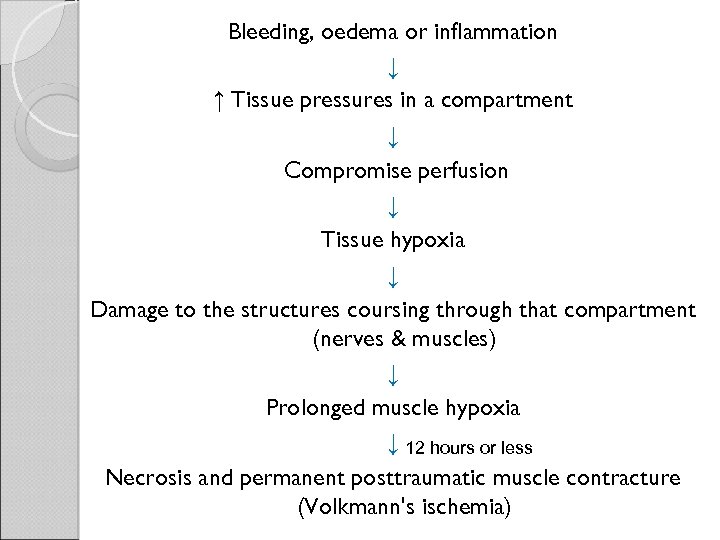
Bleeding, oedema or inflammation ↓ ↑ Tissue pressures in a compartment ↓ Compromise perfusion ↓ Tissue hypoxia ↓ Damage to the structures coursing through that compartment (nerves & muscles) ↓ Prolonged muscle hypoxia ↓ 12 hours or less Necrosis and permanent posttraumatic muscle contracture (Volkmann's ischemia)
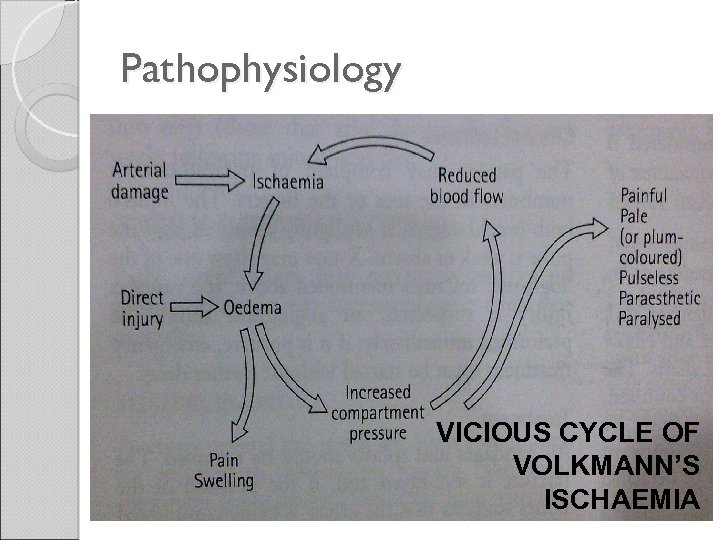
Pathophysiology VICIOUS CYCLE OF VOLKMANN’S ISCHAEMIA
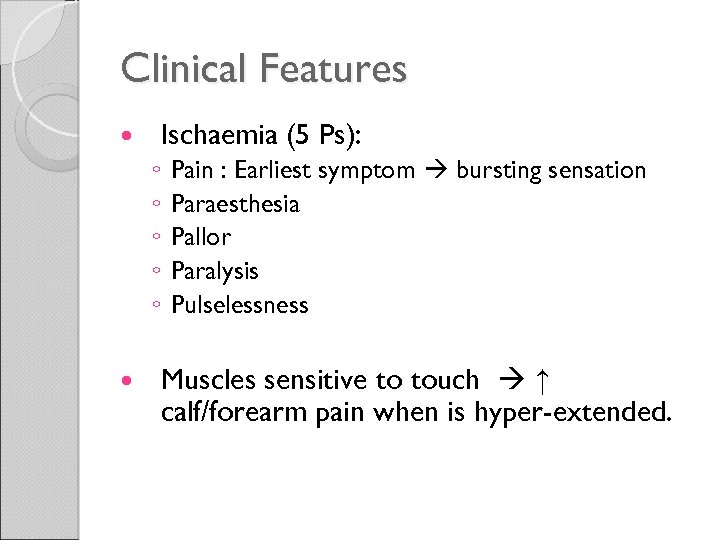
Clinical Features Ischaemia (5 Ps): ◦ ◦ ◦ Pain : Earliest symptom bursting sensation Paraesthesia Pallor Paralysis Pulselessness Muscles sensitive to touch ↑ calf/forearm pain when is hyper-extended.
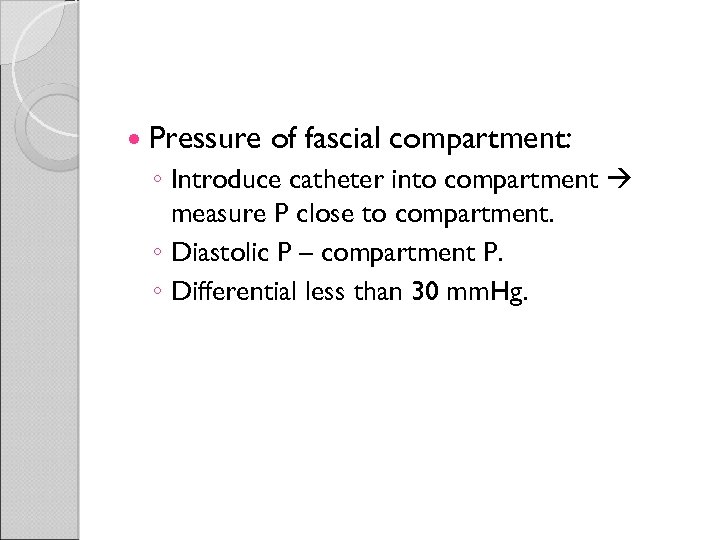
Pressure of fascial compartment: ◦ Introduce catheter into compartment measure P close to compartment. ◦ Diastolic P – compartment P. ◦ Differential less than 30 mm. Hg.
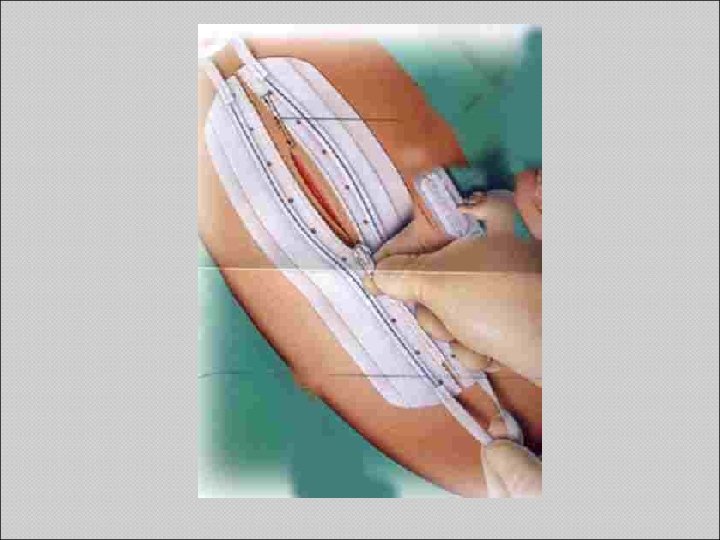
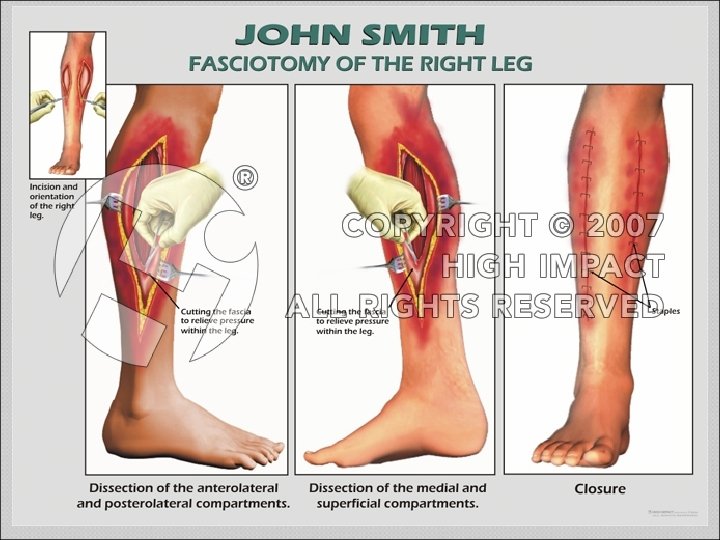
Treatment Decompression ◦ Remove bandage, casts, dressings. Fasciotomy
v. Haemarthrosis Joint is swollen, tense. Pt resists any attempt to move it. Aspirate blood first.
vi. Infection Common in open fractures, unless closed fracture is opened. Chronic osteomyelitis. Slow union, w ↑ chance of re-fracturing Imflamed wound, w seropurulent discharge. Send for C&S. Start antibiotic.
vii. Gas gangrene Produced by clostridial infection esp Clostridum welchii in dirty wounds Destroy cell walls necrosis spread of disease Appear within 24 hours on injury Intense pain, swelling, brownish discharge, ↑ HR, characteristic smell, gas formation Toxaemic coma death
Process of Fracture Healing
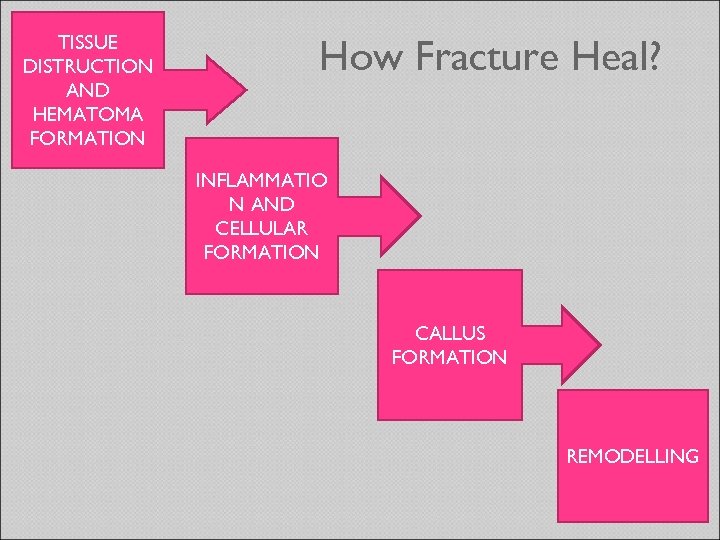
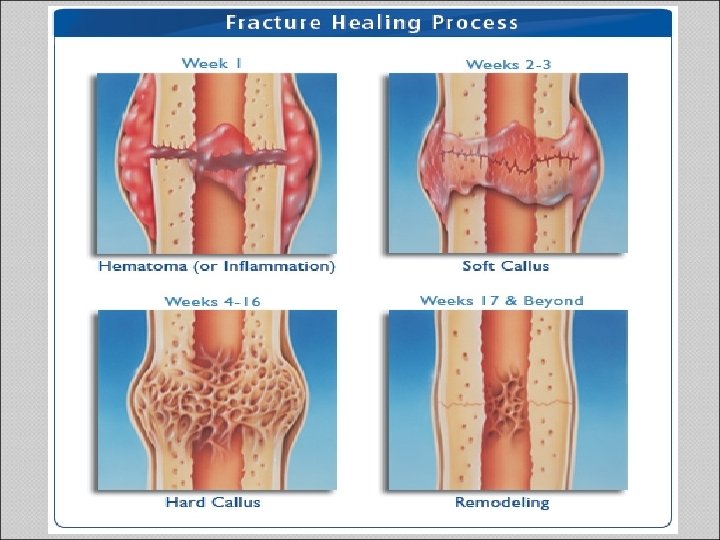
TISSUE DISTRUCTION AND HEMATOMA FORMATION How Fracture Heal? INFLAMMATIO N AND CELLULAR FORMATION CALLUS FORMATION REMODELLING
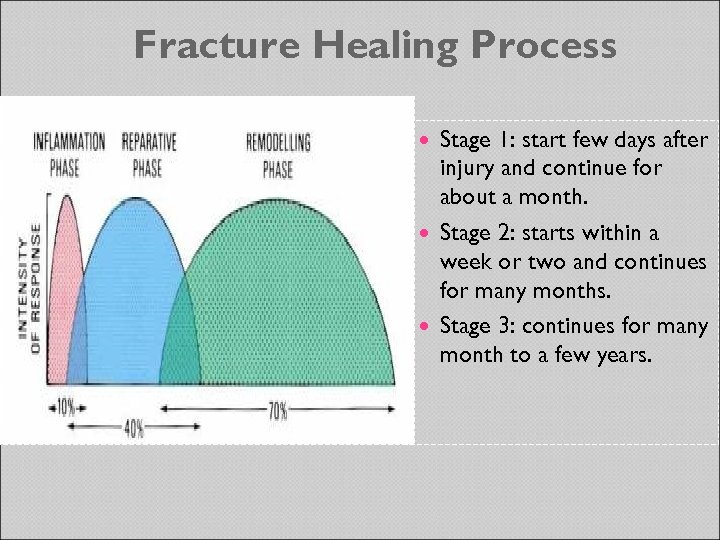
Fracture Healing Process Stage 1: start few days after injury and continue for about a month. Stage 2: starts within a week or two and continues for many months. Stage 3: continues for many month to a few years.
Late Complications of Fracture
Local Complication Deformity Osteoarthritis of adjacent / distant joint Aseptic necrosis Traumatic Chondomalacia Reflex sympathetic dystrophy
Local Complication (cont’) Contractures Myositis ossificans Avascular necrosis Algodystrophy (or Sudeck's atrophy) Osteomyelitis
Systemic Complication Gangrene Tetanus Septicemia Fear of mobilizing Osteoarthritis
Non Union Fracture – Definition, Classification and Management
What is mobility to the fracture site but painless? A sign of non-union (pseudoarthorsis)
Non- Union The fracture will never unites without intervention Clinical features: Movement can be elicited at the fracture site Pain diminishes
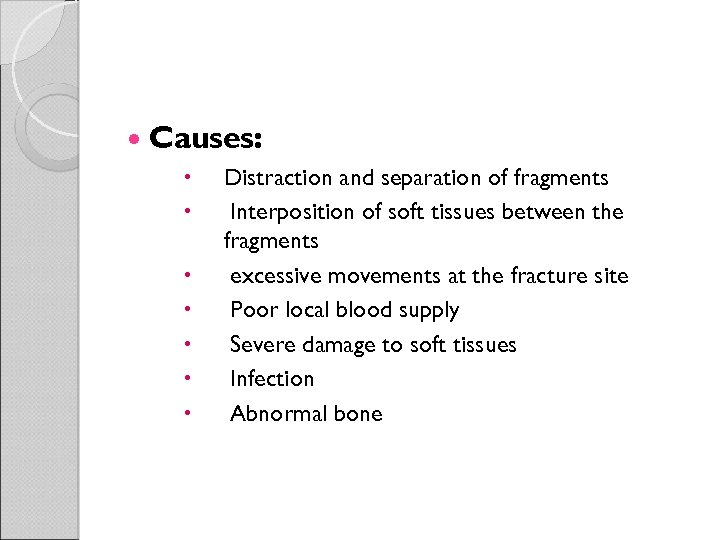
Causes: Distraction and separation of fragments Interposition of soft tissues between the fragments excessive movements at the fracture site Poor local blood supply Severe damage to soft tissues Infection Abnormal bone
Classification: Hypertrophic (hypervascular) Oligotrophic Atrophic (avascular)
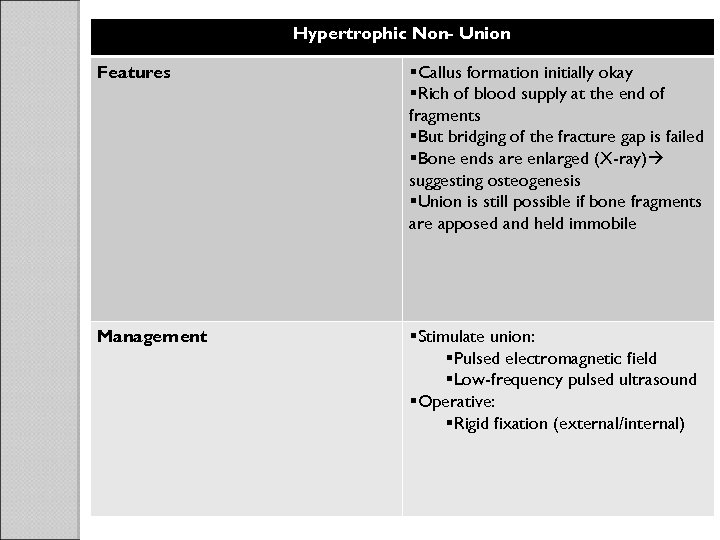
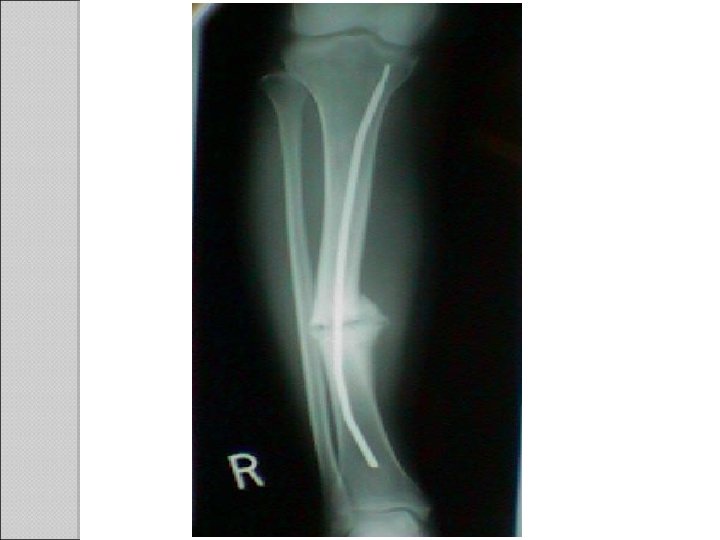
Hypertrophic Non- Union Features §Callus formation initially okay §Rich of blood supply at the end of fragments §But bridging of the fracture gap is failed §Bone ends are enlarged (X-ray) suggesting osteogenesis §Union is still possible if bone fragments are apposed and held immobile Management §Stimulate union: §Pulsed electromagnetic field §Low-frequency pulsed ultrasound §Operative: §Rigid fixation (external/internal)
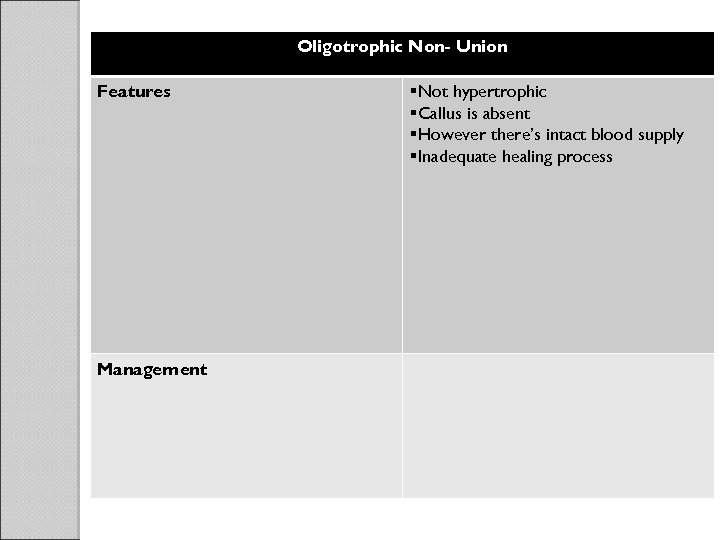
Oligotrophic Non- Union Features Management §Not hypertrophic §Callus is absent §However there’s intact blood supply §Inadequate healing process
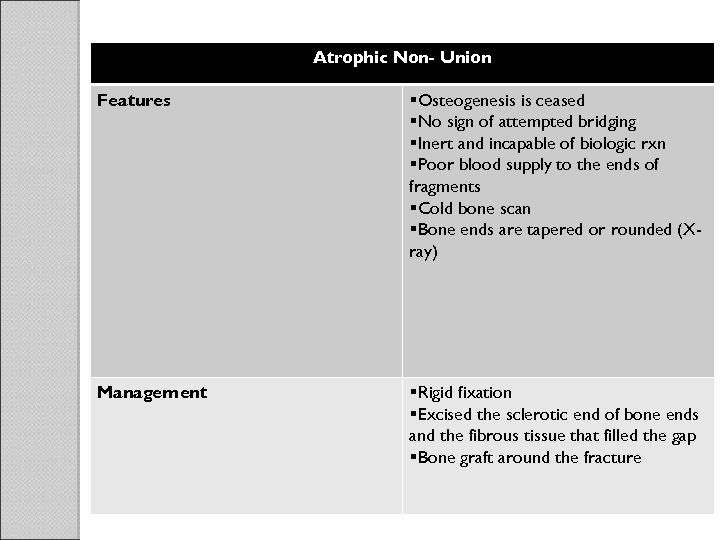
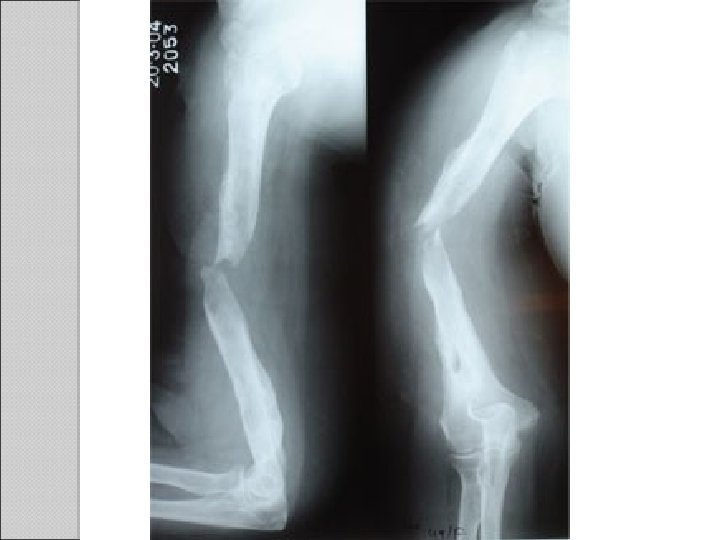
Atrophic Non- Union Features §Osteogenesis is ceased §No sign of attempted bridging §Inert and incapable of biologic rxn §Poor blood supply to the ends of fragments §Cold bone scan §Bone ends are tapered or rounded (Xray) Management §Rigid fixation §Excised the sclerotic end of bone ends and the fibrous tissue that filled the gap §Bone graft around the fracture
Delayed Union The period in which the fracture is expected to unite and consolidate is prolonged Causes (as non-union) Clinical features: Tenderness persists Mobilization at the fracture site
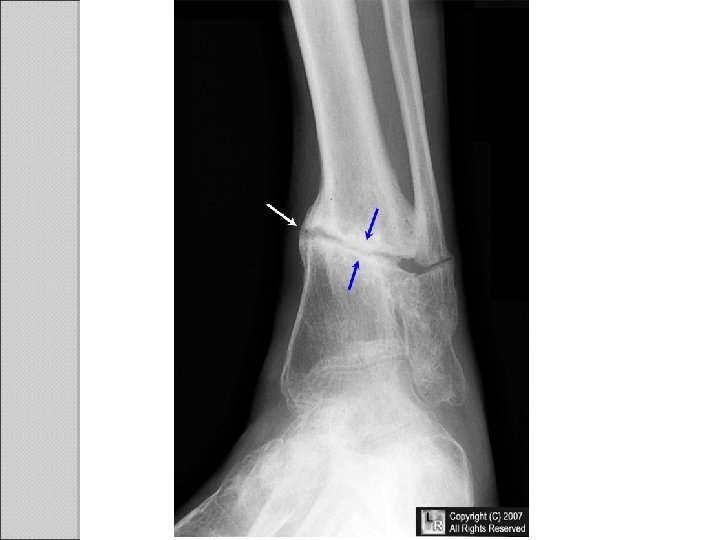
X-ray: Fracture line visible Little callus formation Bone ends not sclerosed or atrophic The appearance suggests the fracture has not united but eventually will
Treatment: ◦ Conservatives Eliminate possible causes of delayed union Promote healing i. e. immobilization ◦ Operative Internal fixator & bone grafting are indicated when there is delayed > 6 months & no sign of callus formation
Take Home Message! Read up the Anatomy! • Fracture – Types and Patterns • Reduce! Hold! Exercise! • Acute and Late Complications • Process of Fracture healing • Non Union Fracture – Classification, Clinical features and Management •
Скачать презентацию TBL 1 Orthopedic Trauma Husna Izzati Ili Safia
541b8f59bfc309c27f894107fa4f23ae.ppt