 Скачать презентацию TBA 23 GE Corporate R D Niskayuna NY lorensen crd
9b5bbc6e2220b92e9219339f97fa6f35.ppt
- Количество слайдов: 57



TBA #23 GE Corporate R&D Niskayuna, NY lorensen@crd. ge. com
Unification of Vision, Geometry and Graphics Through Toolkits Bill Lorensen GE Corporate R&D Niskayuna, NY lorensen@crd. ge. com
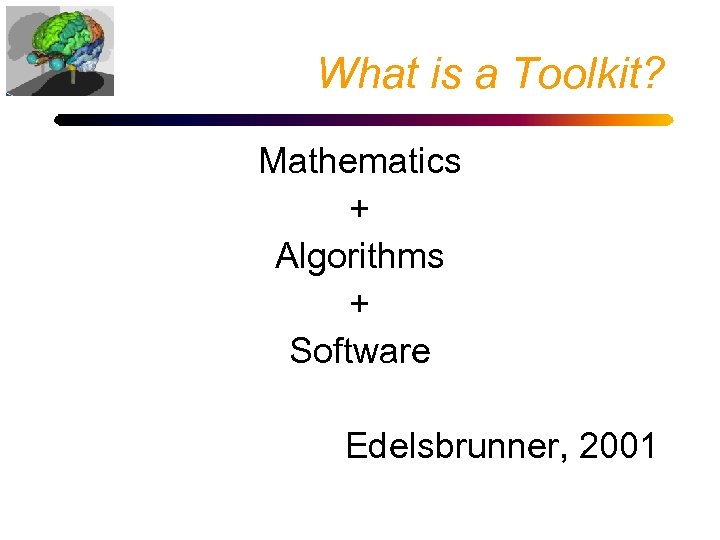
What is a Toolkit? Mathematics + Algorithms + Software Edelsbrunner, 2001
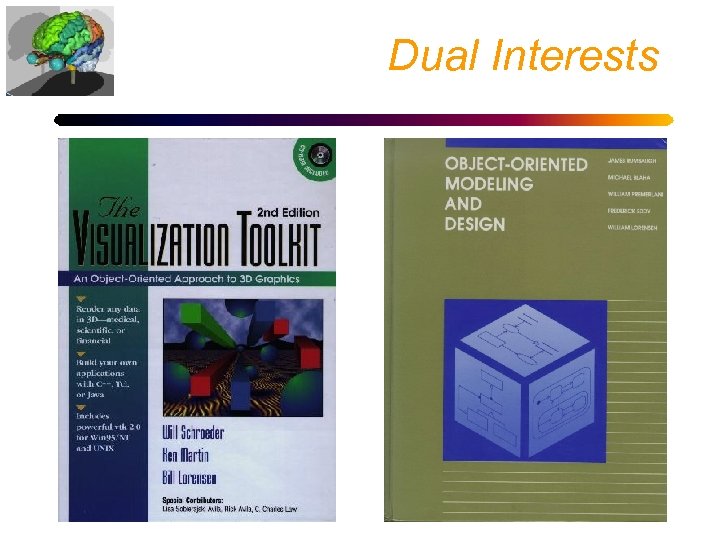
Dual Interests
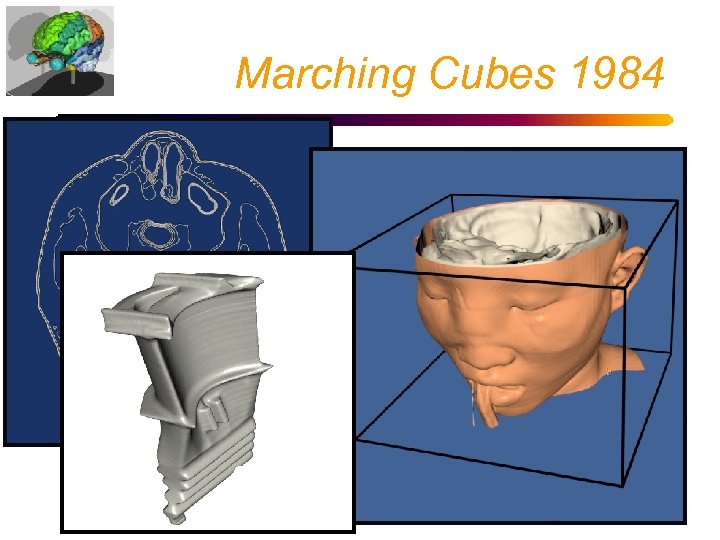
Marching Cubes 1984
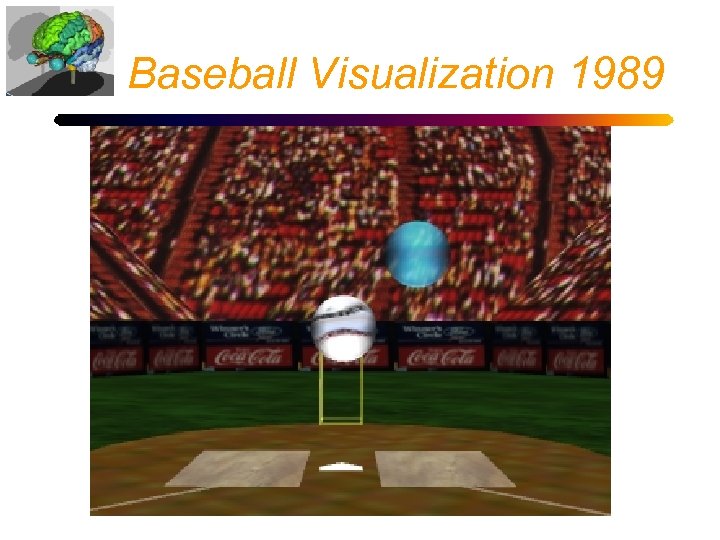
Baseball Visualization 1989
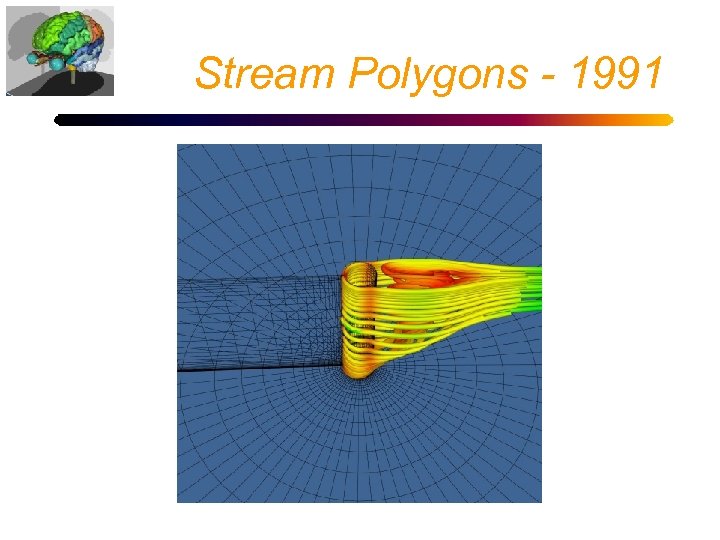
Stream Polygons - 1991
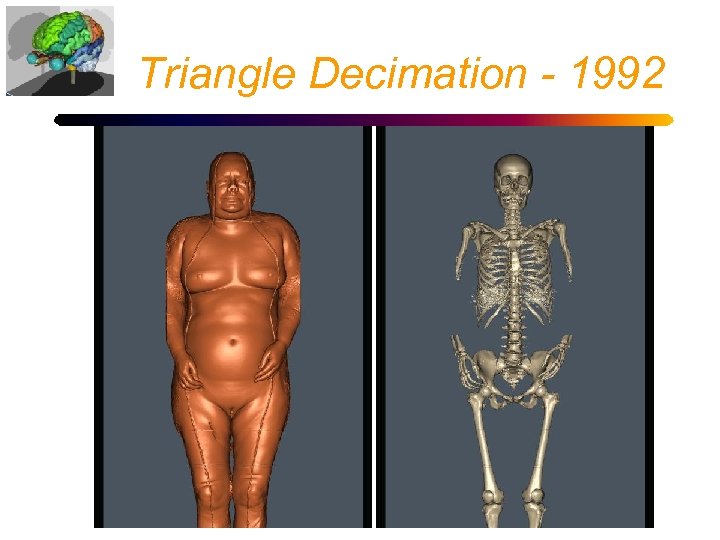
Triangle Decimation - 1992
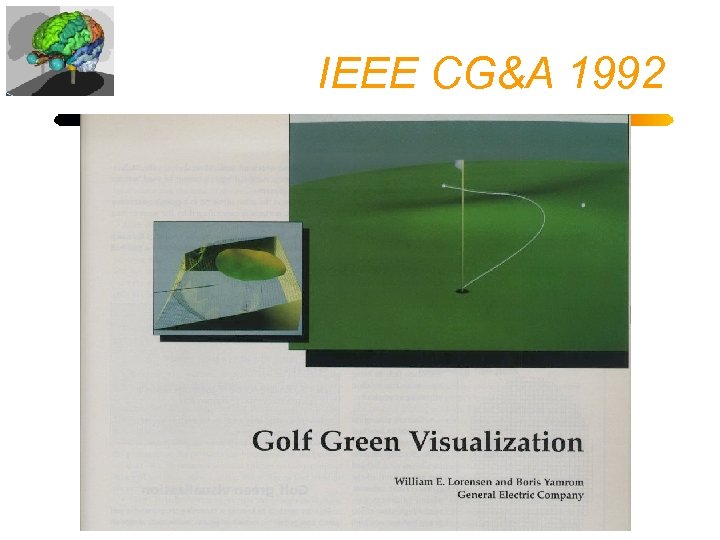
IEEE CG&A 1992
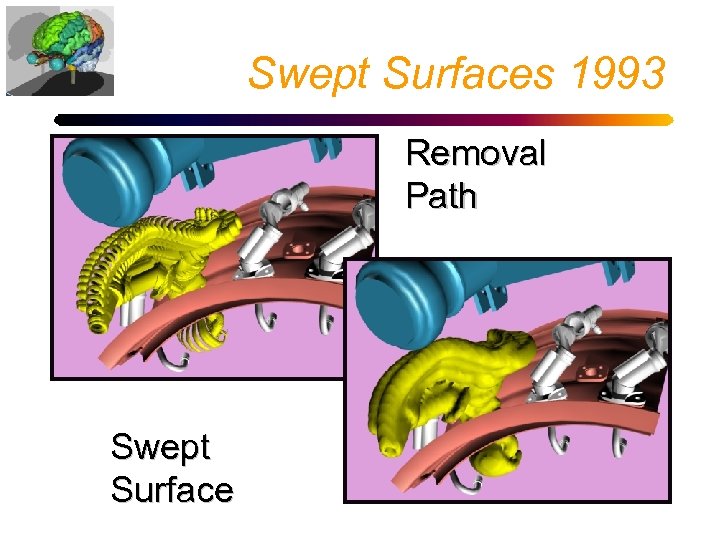
Swept Surfaces 1993 Removal Path Swept Surface
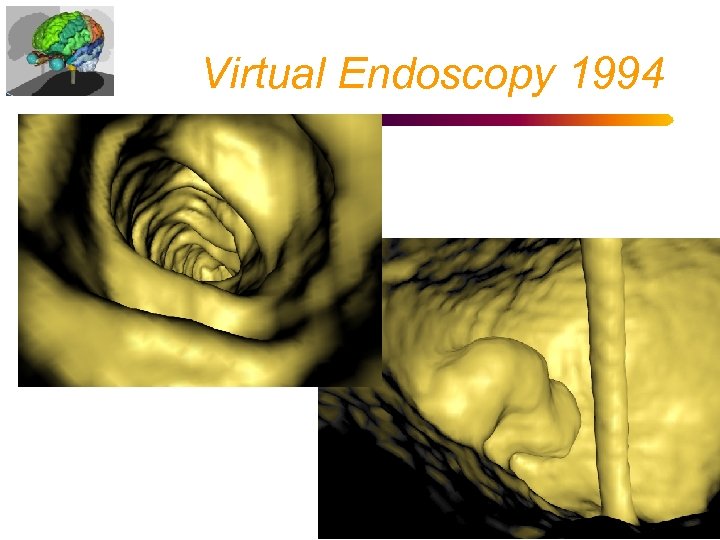
Virtual Endoscopy 1994
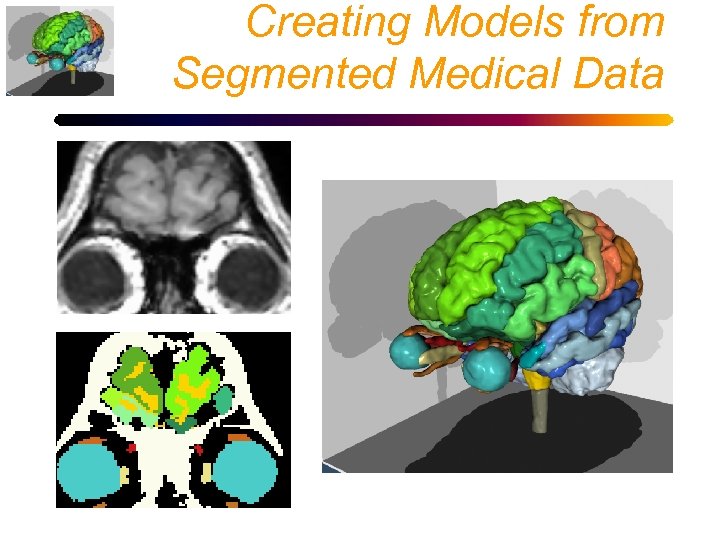
Creating Models from Segmented Medical Data
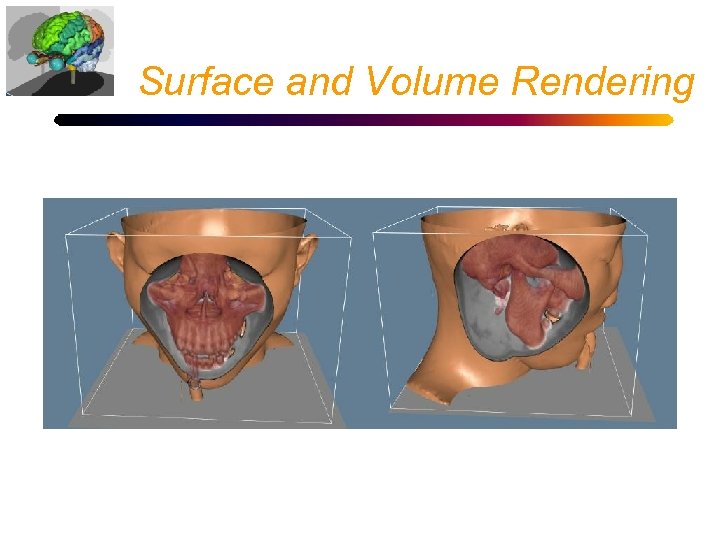
Surface and Volume Rendering
Hypothesis Many real world problems cannot be solved by a single discipline
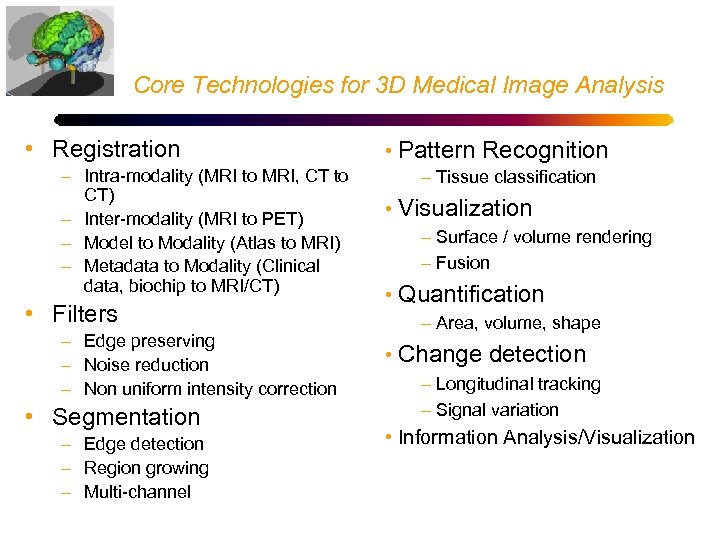
Core Technologies for 3 D Medical Image Analysis • Registration – Intra-modality (MRI to MRI, CT to CT) – Inter-modality (MRI to PET) – Model to Modality (Atlas to MRI) – Metadata to Modality (Clinical data, biochip to MRI/CT) • Filters – Edge preserving – Noise reduction – Non uniform intensity correction • Segmentation – Edge detection – Region growing – Multi-channel • Pattern Recognition – Tissue classification • Visualization – Surface / volume rendering – Fusion • Quantification – Area, volume, shape • Change detection – Longitudinal tracking – Signal variation • Information Analysis/Visualization
Discipline-specific Toolkits • Use “best of breed” algorithms implemented by domain experts – – – Point matching Voronoi diagram computation Registration Pose estimation Isosurface extraction Mathematical morphology Skeletonization Subdivision surfaces Similarity measures Surface simplification Geometric compression
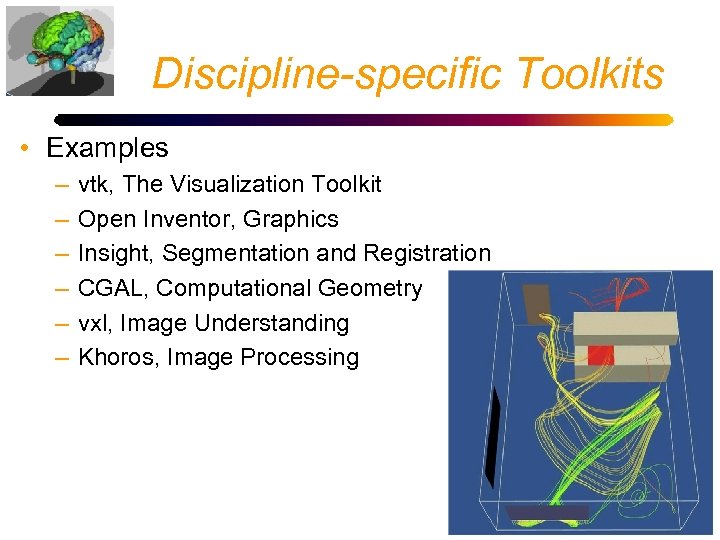
Discipline-specific Toolkits • Examples – – – vtk, The Visualization Toolkit Open Inventor, Graphics Insight, Segmentation and Registration CGAL, Computational Geometry vxl, Image Understanding Khoros, Image Processing
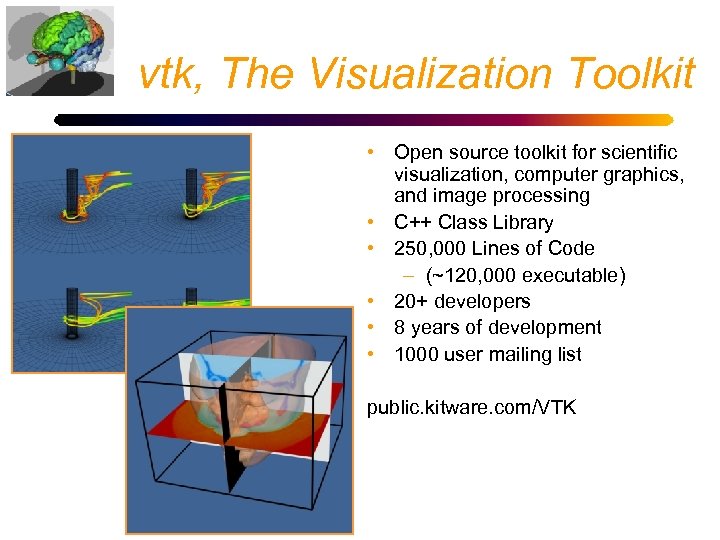
vtk, The Visualization Toolkit • Open source toolkit for scientific visualization, computer graphics, and image processing • C++ Class Library • 250, 000 Lines of Code – (~120, 000 executable) • 20+ developers • 8 years of development • 1000 user mailing list public. kitware. com/VTK
Insight Segmentation and Registration Toolkit
What is it? • A common Application Programmers Interface (API). – A framework for software development – A toolkit for registration and segmentation – An Open Source resource for future research • A validation model for segmentation and registration. – A framework for validation development – Assistance for algorithm designers – A seed repository for validated segmentations
Who’s sponsoring it? $7. 5 million, 3 year contract The National Institute for Dental and Craniofacial Research The National Institute of Neurological Disorders and Stroke The National Science Foundation
Who’s creating it?
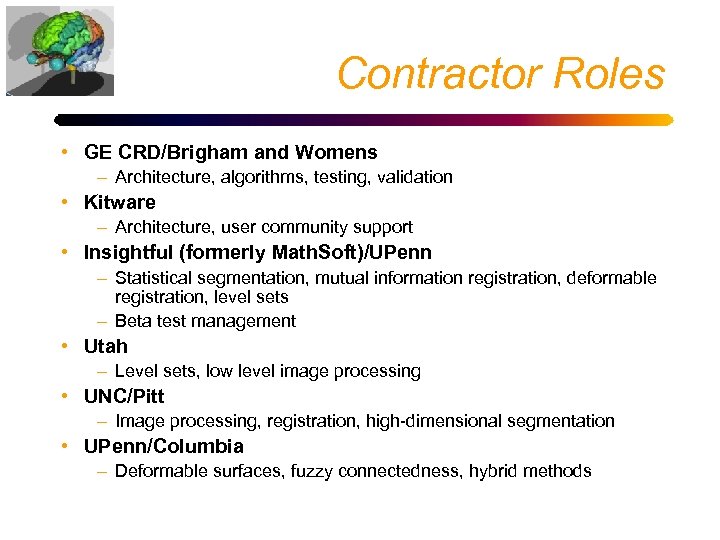
Contractor Roles • GE CRD/Brigham and Womens – Architecture, algorithms, testing, validation • Kitware – Architecture, user community support • Insightful (formerly Math. Soft)/UPenn – Statistical segmentation, mutual information registration, deformable registration, level sets – Beta test management • Utah – Level sets, low level image processing • UNC/Pitt – Image processing, registration, high-dimensional segmentation • UPenn/Columbia – Deformable surfaces, fuzzy connectedness, hybrid methods
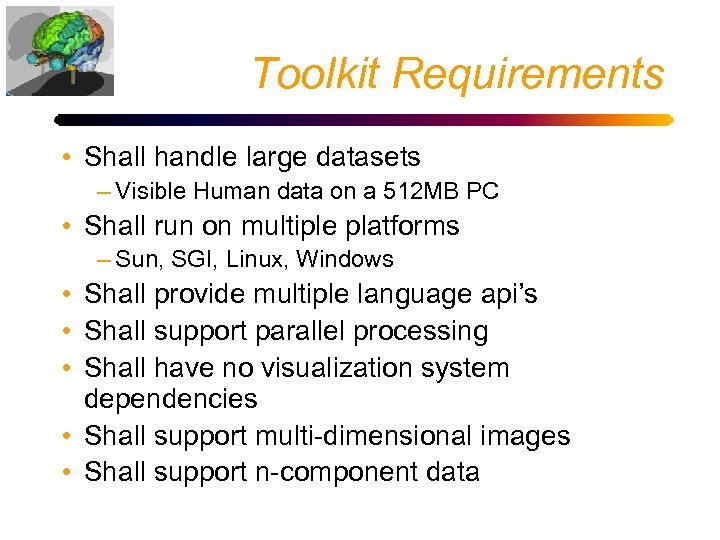
Toolkit Requirements • Shall handle large datasets – Visible Human data on a 512 MB PC • Shall run on multiple platforms – Sun, SGI, Linux, Windows • Shall provide multiple language api’s • Shall support parallel processing • Shall have no visualization system dependencies • Shall support multi-dimensional images • Shall support n-component data
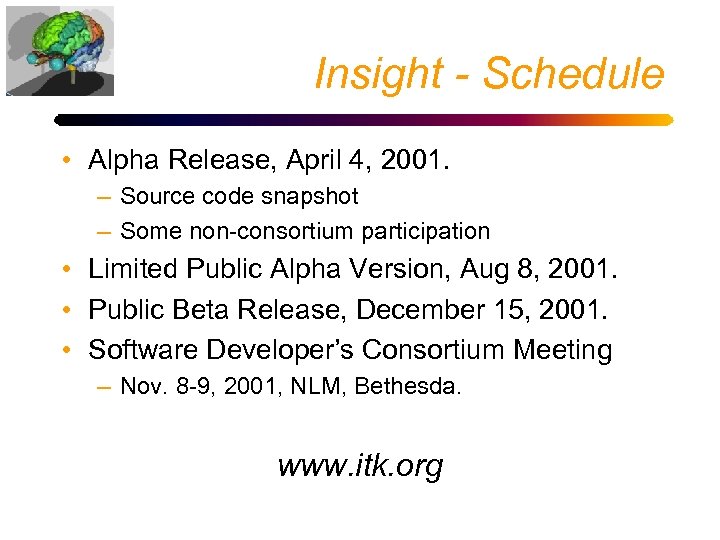
Insight - Schedule • Alpha Release, April 4, 2001. – Source code snapshot – Some non-consortium participation • Limited Public Alpha Version, Aug 8, 2001. • Public Beta Release, December 15, 2001. • Software Developer’s Consortium Meeting – Nov. 8 -9, 2001, NLM, Bethesda. www. itk. org
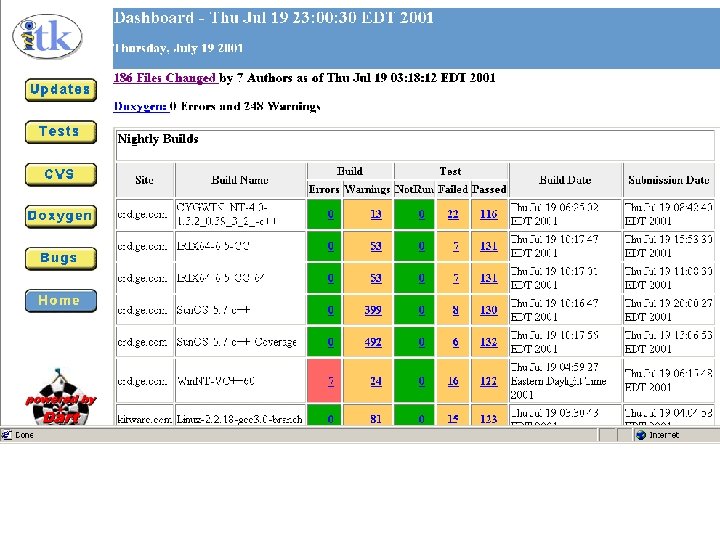
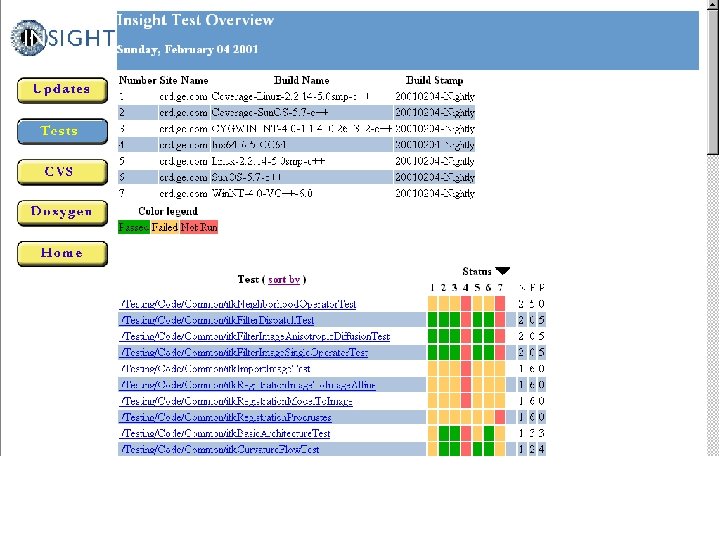
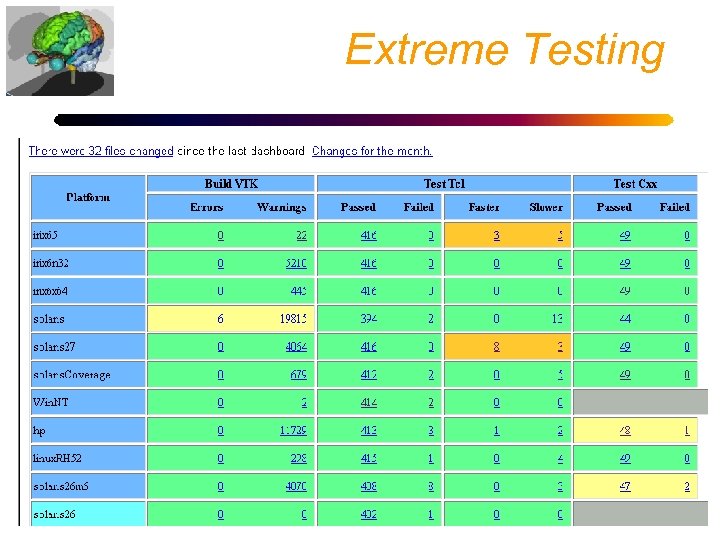
Testing Design • Distributed testing – Developers and users must be able to easily contribute testing results – Pulled together in a central dashboard • Separate data from presentation • Cross-platform solution • Strive to have the same code tested in all locations
Using vtk and Insight Registration of Volumetric Medical Data
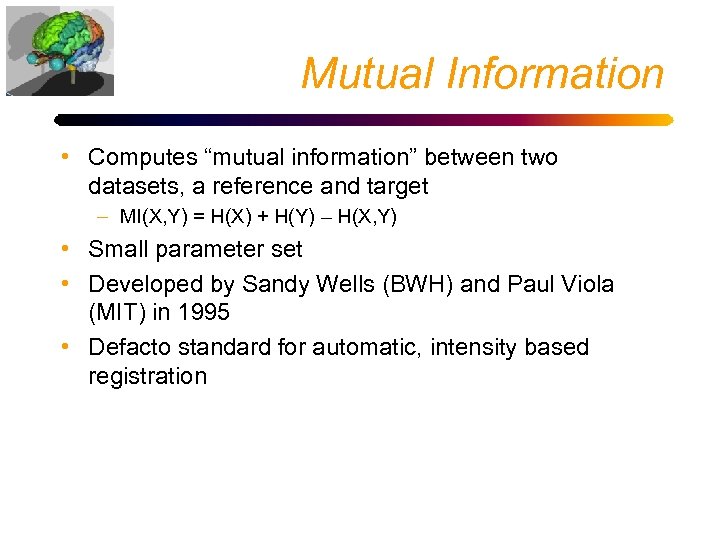
Mutual Information • Computes “mutual information” between two datasets, a reference and target – MI(X, Y) = H(X) + H(Y) – H(X, Y) • Small parameter set • Developed by Sandy Wells (BWH) and Paul Viola (MIT) in 1995 • Defacto standard for automatic, intensity based registration
Insight Mutual Information Registration • There is no MI open source implementation • The Insight Registration and Segmentation Toolkit has an implementation • GE and Brigham as Insight contractors have early access to the code • Code was developed at Math. Soft (now called Insightful) • GE was able to “guide” development with input from Sandy Wells
Longitudinal MRI Study • Register multiple volumetric MRI datasets of a patient taken over an extended time • Create a batch processing facility to process dozens of datasets • Resample the datasets
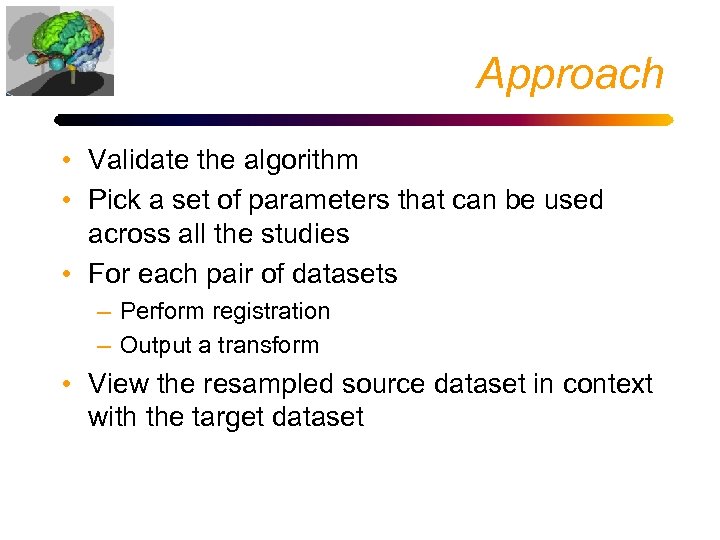
Approach • Validate the algorithm • Pick a set of parameters that can be used across all the studies • For each pair of datasets – Perform registration – Output a transform • View the resampled source dataset in context with the target dataset
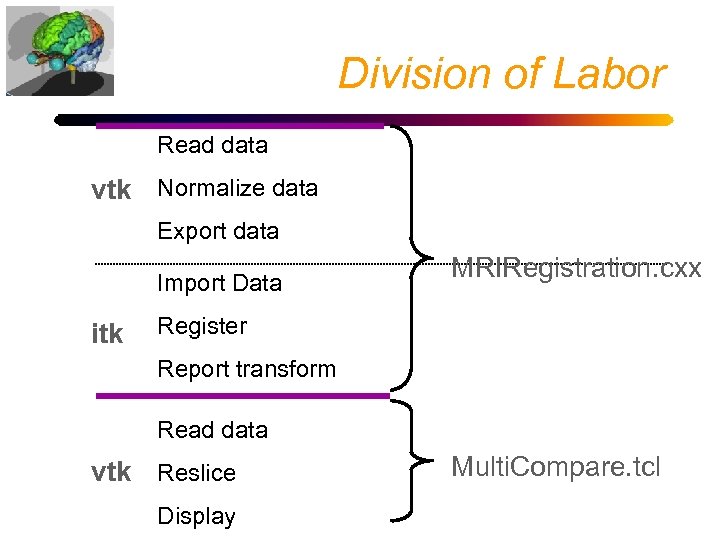
Division of Labor Read data vtk Normalize data Export data Import Data itk MRIRegistration. cxx Register Report transform Read data vtk Reslice Display Multi. Compare. tcl
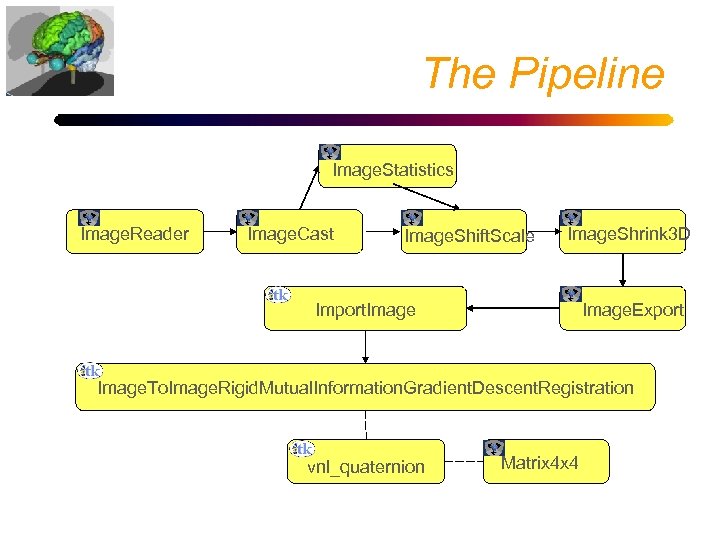
The Pipeline Image. Statistics Image. Reader Image. Cast Image. Shift. Scale Image. Shrink 3 D Image. Export Import. Image. To. Image. Rigid. Mutual. Information. Gradient. Descent. Registration vnl_quaternion Matrix 4 x 4
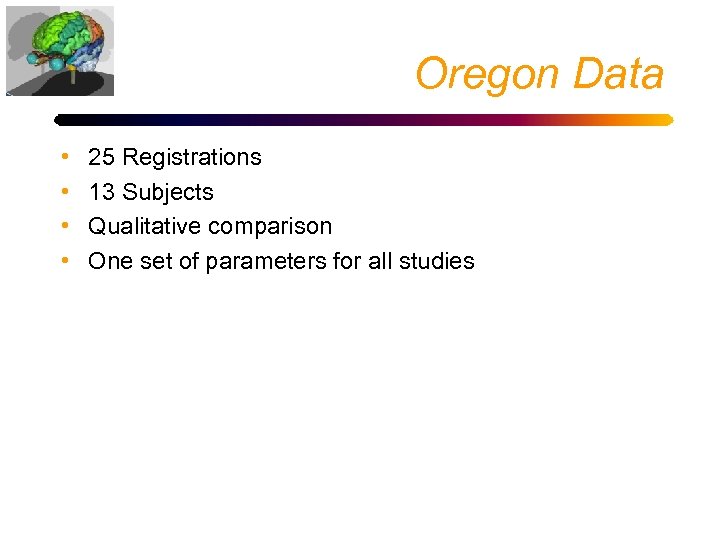
Oregon Data • • 25 Registrations 13 Subjects Qualitative comparison One set of parameters for all studies
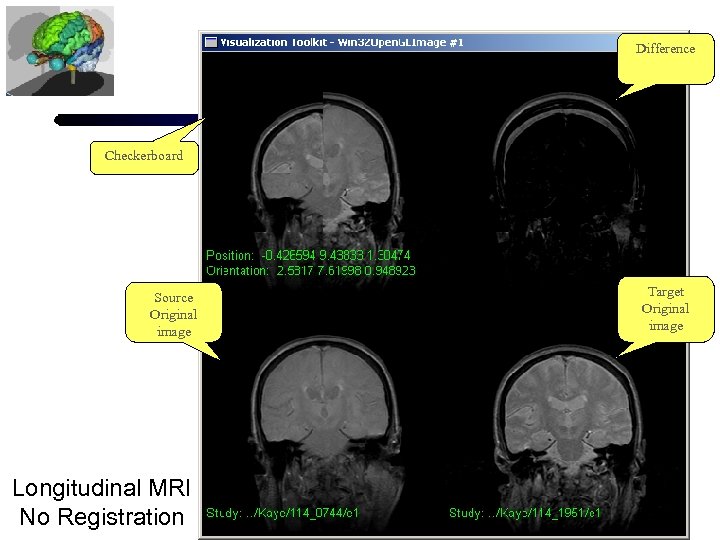
Difference Checkerboard Source Original image Longitudinal MRI No Registration Target Original image
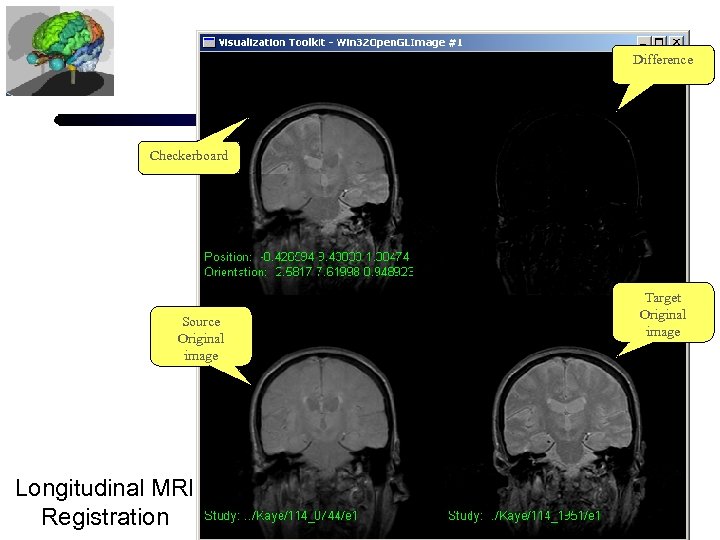
Difference Checkerboard Source Original image Longitudinal MRI Registration Target Original image
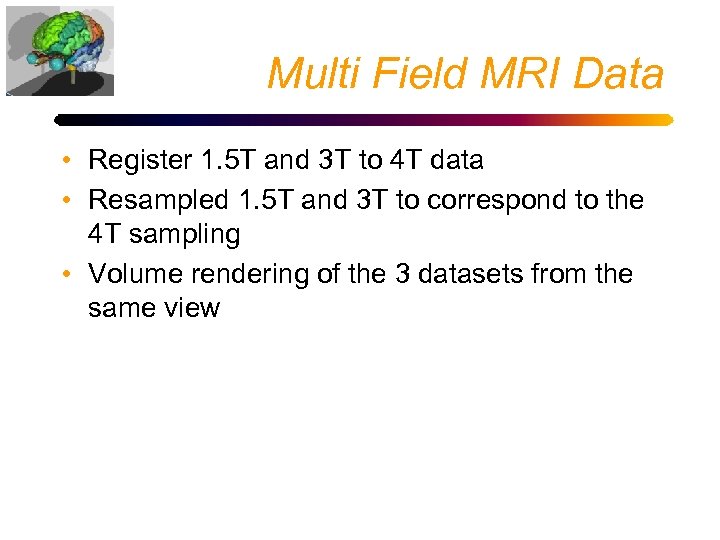
Multi Field MRI Data • Register 1. 5 T and 3 T to 4 T data • Resampled 1. 5 T and 3 T to correspond to the 4 T sampling • Volume rendering of the 3 datasets from the same view
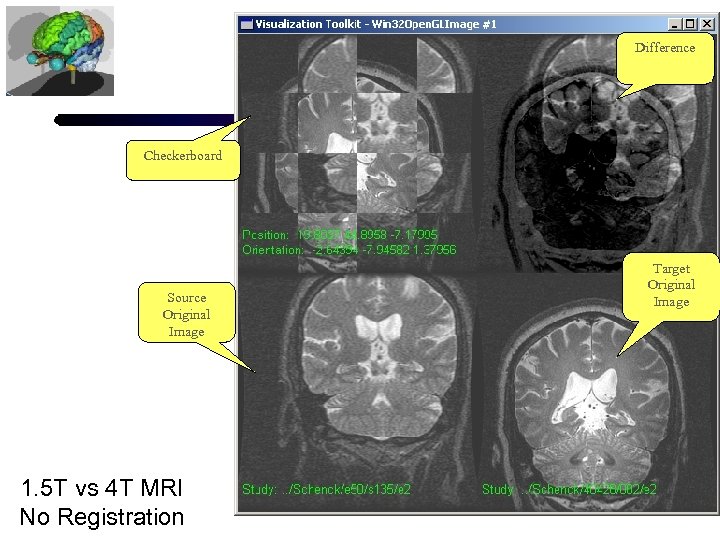
Difference Checkerboard Source Original Image 1. 5 T vs 4 T MRI No Registration Target Original Image
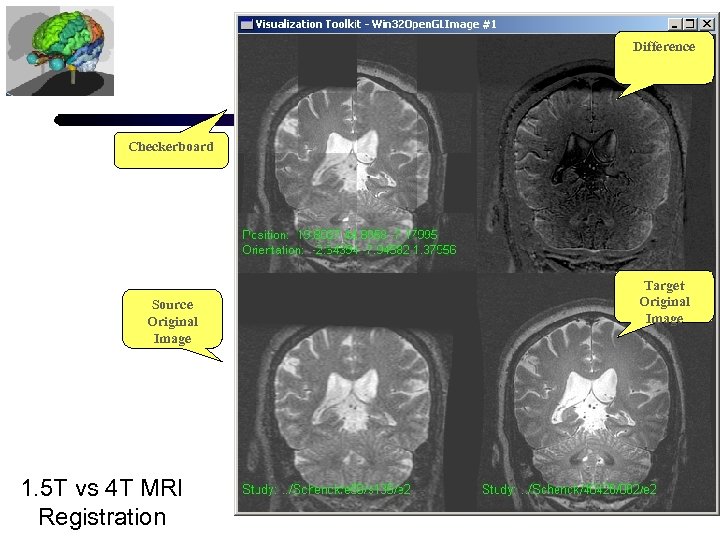
Difference Checkerboard Source Original Image 1. 5 T vs 4 T MRI Registration Target Original Image
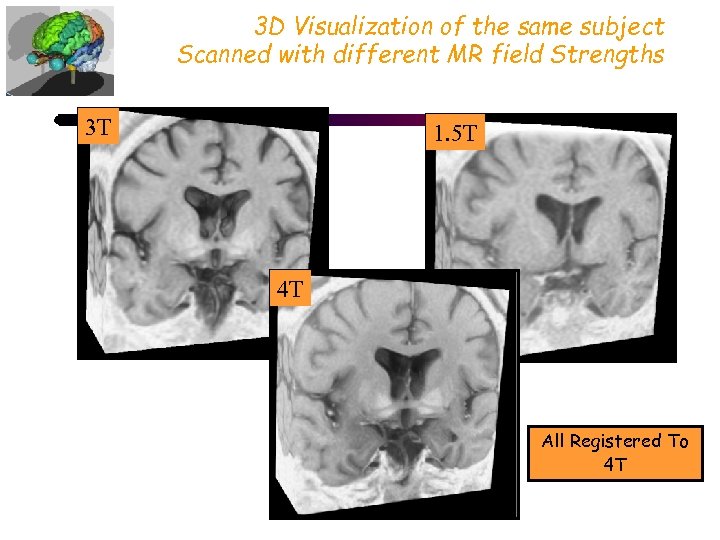
3 D Visualization of the same subject Scanned with different MR field Strengths 3 T 1. 5 T 4 T All Registered To 4 T
CT Lung Longitudinal Study • Register two CT exams of the same patient taken at two different times • Side-by-side synchronized view for visual comparison
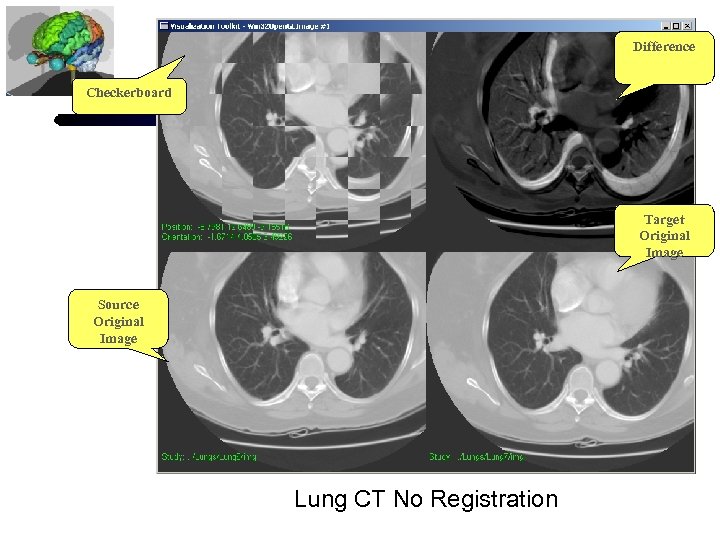
Difference Checkerboard Target Original Image Source Original Image Lung CT No Registration
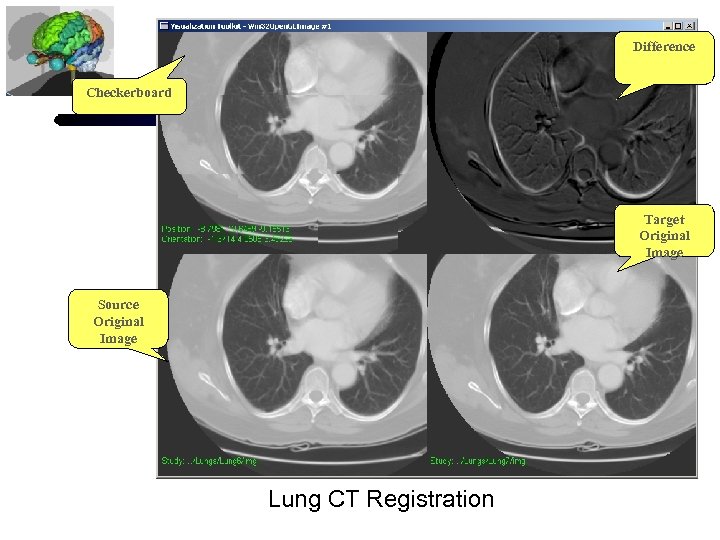
Difference Checkerboard Target Original Image Source Original Image Lung CT Registration
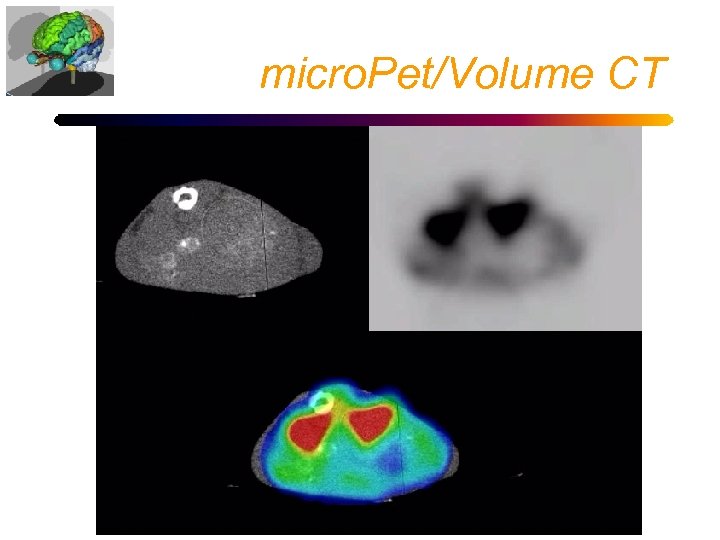
micro. Pet/Volume CT
Back to the Software
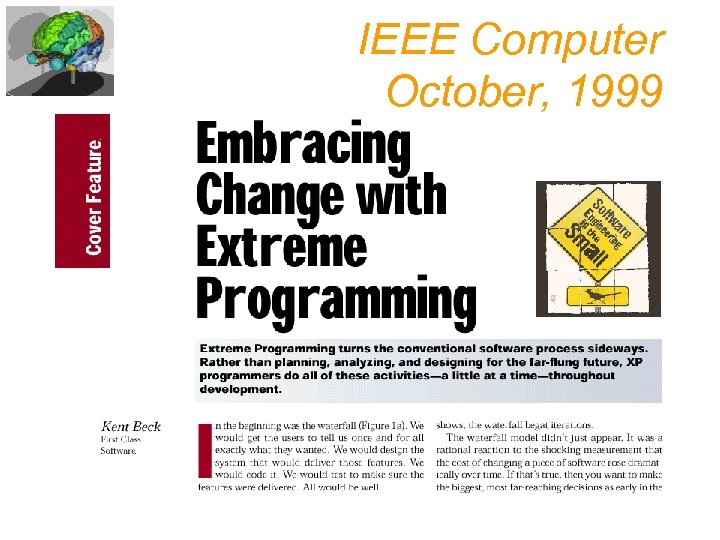
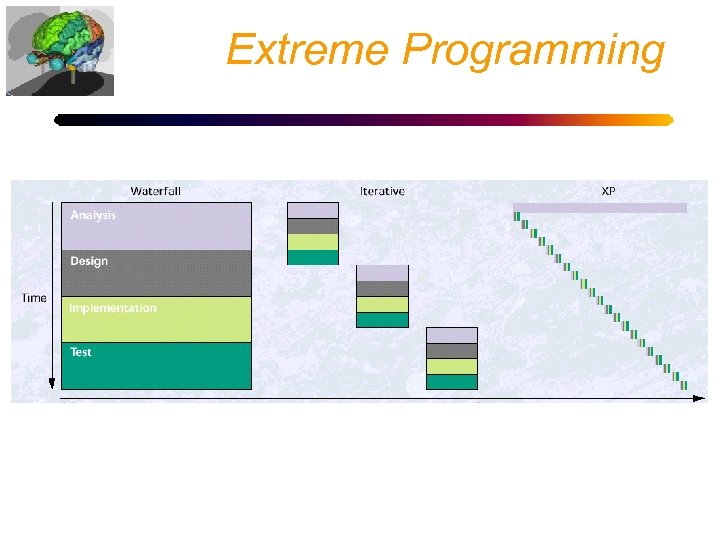
Why Now? • Internet enables distributed software development • There are some successful Open Source projects • A basic set of algorithms (and sometimes mathematics) exist • Light weight software engineering processes exist – Low investment to support software development – Minimally invasive
Software Trends Lightweight Software Engineering Processes
IEEE Computer October, 1999
Extreme Programming
Extreme Testing
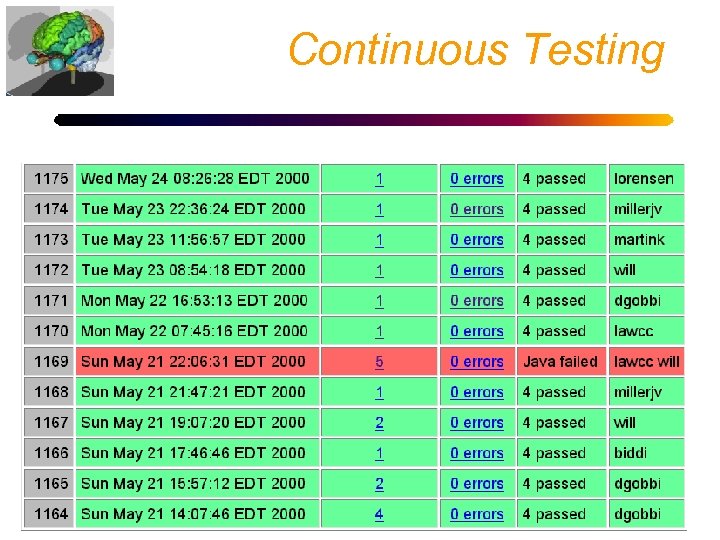
Continuous Testing
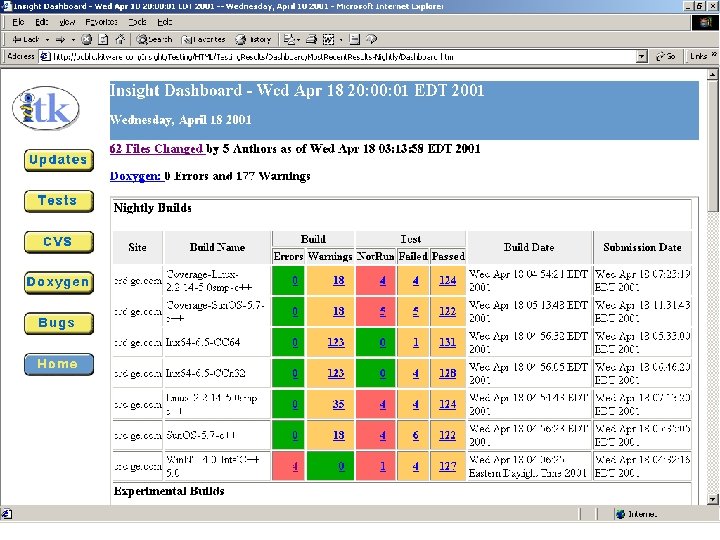
Insight Project Management • • • Robust code repository (cvs) Active mailing list (mailman) Automated documentation (doxygen) Stable, cross platform build environment (cmake) Weekly t-cons Stable nightly build and test (300 builds) Continuous build Stable nightly dashboard (dart) Quarterly face-to-face developer meetings Semi-annual project meetings
Recipe for Success • • • Vision Openness Community Strong core team Core Architecture Funding
Unification of Vision, Geometry and Graphics Through Toolkits Bill Lorensen GE Corporate R&D Niskayuna, NY lorensen@crd. ge. com
Скачать презентацию TBA 23 GE Corporate R D Niskayuna NY lorensen crd
9b5bbc6e2220b92e9219339f97fa6f35.ppt