 Скачать презентацию Taxonomy Strategies Tutorial Dublin Core Metadata and Growing
7750b7a8ee7b4fee330935197a49c393.ppt
- Количество слайдов: 43



Taxonomy Strategies Tutorial: Dublin Core, Metadata, and Growing the Semantic Web Ron Daniel & Joseph Busch Taxonomy Strategies March 7, 2005 Copyright 2005, Taxonomy Strategies. All rights reserved.
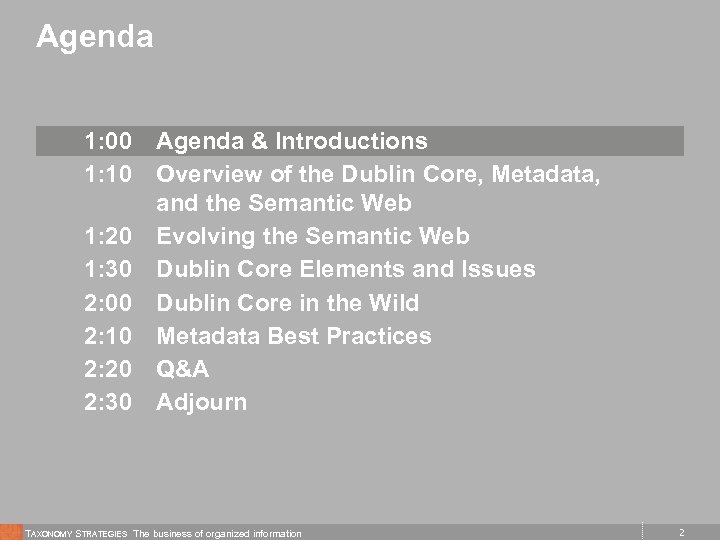
Agenda 1: 00 1: 10 1: 20 1: 30 2: 00 2: 10 2: 20 2: 30 Agenda & Introductions Overview of the Dublin Core, Metadata, and the Semantic Web Evolving the Semantic Web Dublin Core Elements and Issues Dublin Core in the Wild Metadata Best Practices Q&A Adjourn TAXONOMY STRATEGIES The business of organized information 2
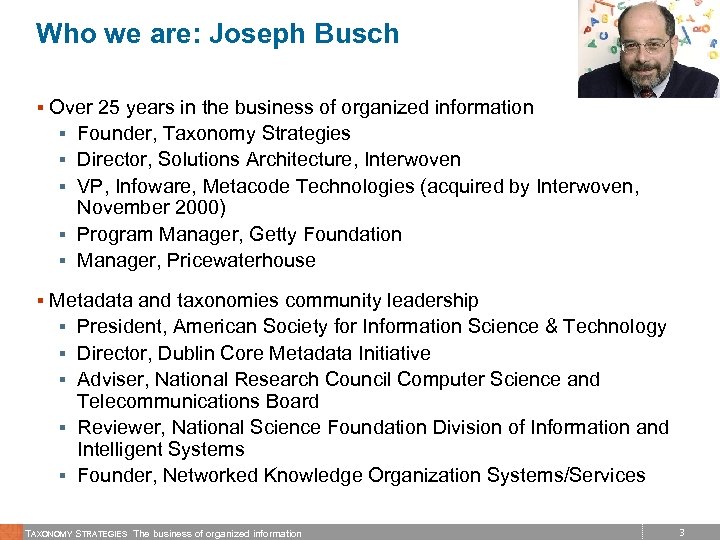
Who we are: Joseph Busch § Over 25 years in the business of organized information § Founder, Taxonomy Strategies § Director, Solutions Architecture, Interwoven § VP, Infoware, Metacode Technologies (acquired by Interwoven, November 2000) § Program Manager, Getty Foundation § Manager, Pricewaterhouse § Metadata and taxonomies community leadership § President, American Society for Information Science & Technology § Director, Dublin Core Metadata Initiative § Adviser, National Research Council Computer Science and Telecommunications Board § Reviewer, National Science Foundation Division of Information and Intelligent Systems § Founder, Networked Knowledge Organization Systems/Services TAXONOMY STRATEGIES The business of organized information 3
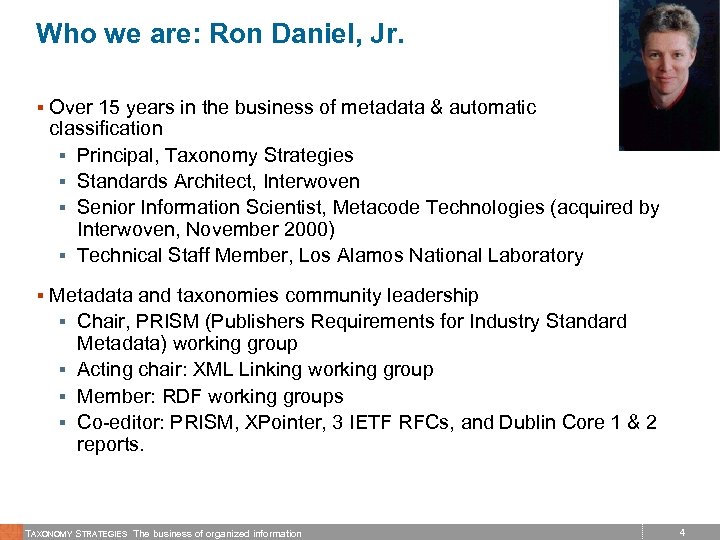
Who we are: Ron Daniel, Jr. § Over 15 years in the business of metadata & automatic classification § Principal, Taxonomy Strategies § Standards Architect, Interwoven § Senior Information Scientist, Metacode Technologies (acquired by Interwoven, November 2000) § Technical Staff Member, Los Alamos National Laboratory § Metadata and taxonomies community leadership § Chair, PRISM (Publishers Requirements for Industry Standard Metadata) working group § Acting chair: XML Linking working group § Member: RDF working groups § Co-editor: PRISM, XPointer, 3 IETF RFCs, and Dublin Core 1 & 2 reports. TAXONOMY STRATEGIES The business of organized information 4
Agenda 1: 00 1: 10 1: 20 1: 30 2: 00 2: 10 2: 20 2: 30 Agenda & Introductions Overview of the Dublin Core, Metadata, and the Semantic Web Evolving the Semantic Web Dublin Core Elements and Issues Dublin Core in the Wild Metadata Best Practices Q&A Adjourn TAXONOMY STRATEGIES The business of organized information 5
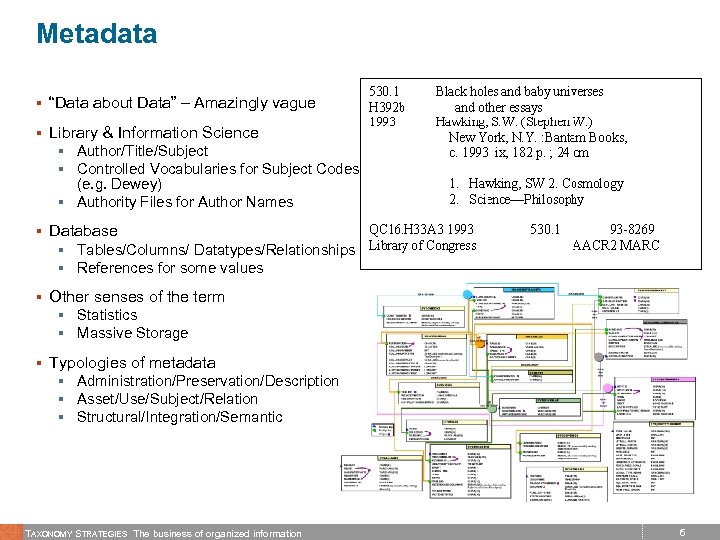
Metadata § “Data about Data” – Amazingly vague § Library & Information Science § Author/Title/Subject § Controlled Vocabularies for Subject Codes (e. g. Dewey) § Authority Files for Author Names § Database § Tables/Columns/ Datatypes/Relationships § References for some values § Other senses of the term § Statistics § Massive Storage § Typologies of metadata § Administration/Preservation/Description § Asset/Use/Subject/Relation § Structural/Integration/Semantic TAXONOMY STRATEGIES The business of organized information 6
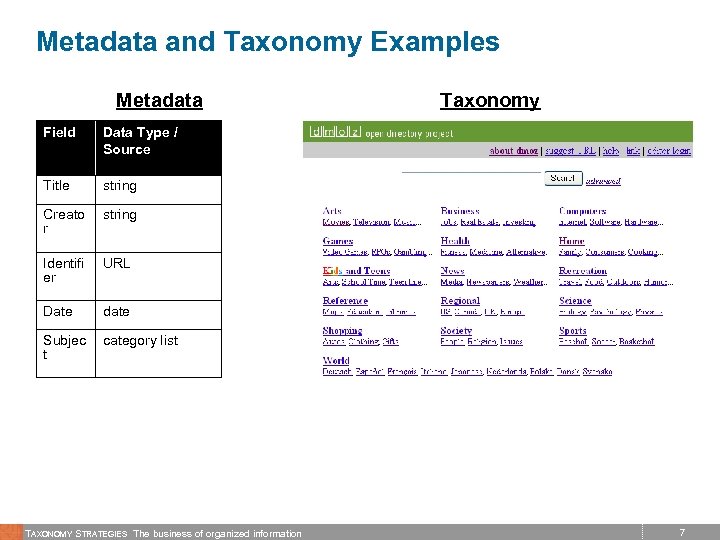
Metadata and Taxonomy Examples Metadata Field Data Type / Source Title string Creato r string Identifi er URL Date date Subjec t Taxonomy category list TAXONOMY STRATEGIES The business of organized information 7
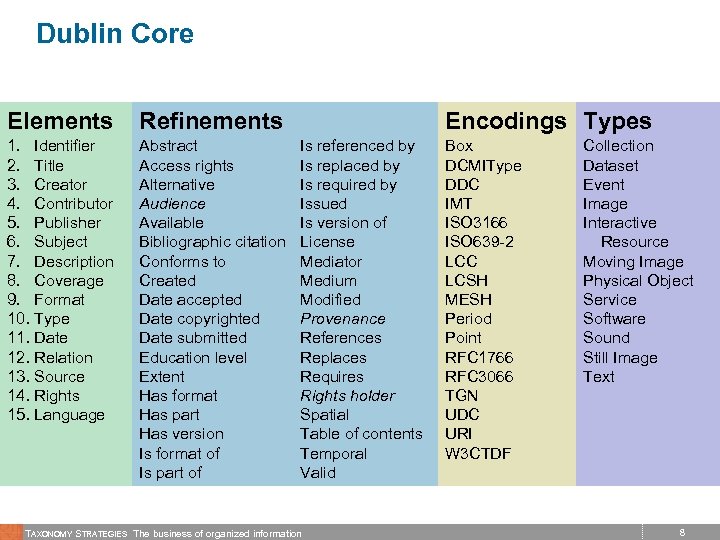
Dublin Core Elements Refinements 1. Identifier 2. Title 3. Creator 4. Contributor 5. Publisher 6. Subject 7. Description 8. Coverage 9. Format 10. Type 11. Date 12. Relation 13. Source 14. Rights 15. Language Abstract Access rights Alternative Audience Available Bibliographic citation Conforms to Created Date accepted Date copyrighted Date submitted Education level Extent Has format Has part Has version Is format of Is part of Encodings Types Is referenced by Is replaced by Is required by Issued Is version of License Mediator Medium Modified Provenance References Replaces Requires Rights holder Spatial Table of contents Temporal Valid TAXONOMY STRATEGIES The business of organized information Box DCMIType DDC IMT ISO 3166 ISO 639 -2 LCC LCSH MESH Period Point RFC 1766 RFC 3066 TGN UDC URI W 3 CTDF Collection Dataset Event Image Interactive Resource Moving Image Physical Object Service Software Sound Still Image Text 8
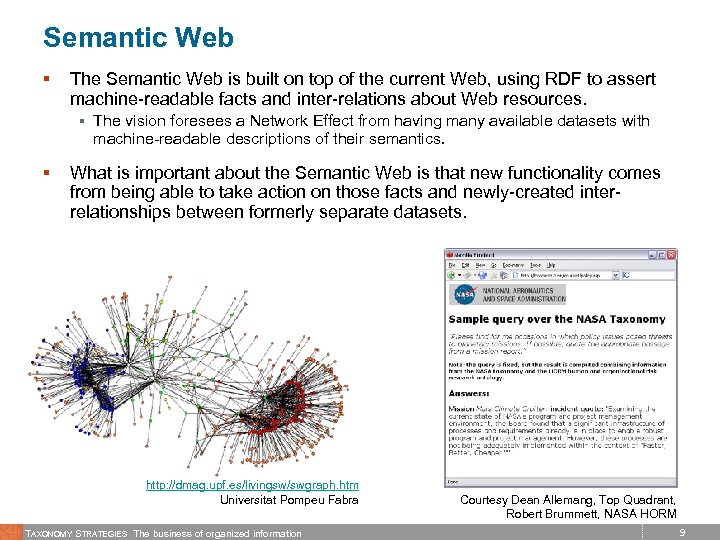
Semantic Web § The Semantic Web is built on top of the current Web, using RDF to assert machine-readable facts and inter-relations about Web resources. § The vision foresees a Network Effect from having many available datasets with machine-readable descriptions of their semantics. § What is important about the Semantic Web is that new functionality comes from being able to take action on those facts and newly-created interrelationships between formerly separate datasets. http: //dmag. upf. es/livingsw/swgraph. htm Universitat Pompeu Fabra TAXONOMY STRATEGIES The business of organized information Courtesy Dean Allemang, Top Quadrant, Robert Brummett, NASA HORM 9
Agenda 1: 00 1: 10 1: 20 1: 30 2: 00 2: 10 2: 20 2: 30 Agenda & Introductions Overview of the Dublin Core, Metadata, and the Semantic Web Evolving the Semantic Web Dublin Core Elements and Issues Dublin Core in the Wild Metadata Best Practices Q&A Adjourn TAXONOMY STRATEGIES The business of organized information 10
Semantic Web example § “Did any baseball teams play yesterday in a place where the temperature was 22° C? ” - (“Weaving the Web” p. 180) § Good point - Illustrates merging multiple sources of information which were not initially intended to work together. § Weather info at places and times § Baseball facts including locations § Parsing to get a time specification § Bad Point – Practical considerations. Permissions, cost recovery for data providers, ROI, usability, reliability, performance, motivation, … § Dynamic composition of dynamically discovered sources? Unlikely. § Faster composition of known sources, tested and deployed to meet a goal of cutting costs or growing revenues? Sure. § Implies much of the growth of the Semantic Web will be inside the firewall, and invisible to outsiders. § Implies large-scale ontologies will have limited roles. TAXONOMY STRATEGIES The business of organized information 11
Our assumptions on how the Semantic Web will evolve 1. We believe the Semantic Web will grow slowly, as the byproduct of integrating multiple datasets using their existing metadata to achieve goals that justify the cost of developing and testing an application. 2. Much of that current metadata is (or can be viewed as) Dublin Core. 3. Some metadata hygiene practices will make integration easier § Metadata hygiene will only be practiced if it offers benefits in the short term, or at least does not increase costs in the short term and the architects are aware of the long term. 4. Cyc-like description, mapping, and integration is a neat trick, but common fields and common controlled vocabularies are a lot more pragmatic. TAXONOMY STRATEGIES The business of organized information 12
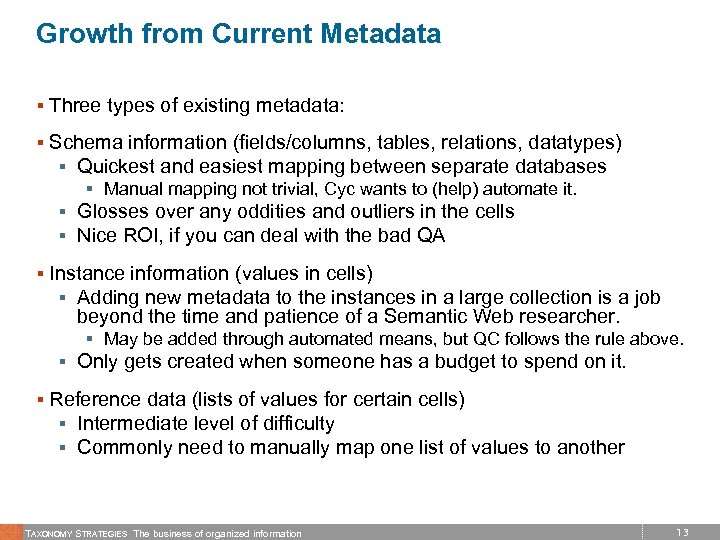
Growth from Current Metadata § Three types of existing metadata: § Schema information (fields/columns, tables, relations, datatypes) § Quickest and easiest mapping between separate databases § Manual mapping not trivial, Cyc wants to (help) automate it. § Glosses over any oddities and outliers in the cells § Nice ROI, if you can deal with the bad QA § Instance information (values in cells) § Adding new metadata to the instances in a large collection is a job beyond the time and patience of a Semantic Web researcher. § May be added through automated means, but QC follows the rule above. § Only gets created when someone has a budget to spend on it. § Reference data (lists of values for certain cells) § Intermediate level of difficulty § Commonly need to manually map one list of values to another TAXONOMY STRATEGIES The business of organized information 13
Agenda 1: 00 1: 10 1: 20 1: 30 2: 00 2: 10 2: 20 2: 30 Agenda & Introductions Overview of the Dublin Core, Metadata, and the Semantic Web Evolving the Semantic Web Dublin Core Elements and Issues Dublin Core in the Wild Metadata Best Practices Q&A Adjourn TAXONOMY STRATEGIES The business of organized information 14
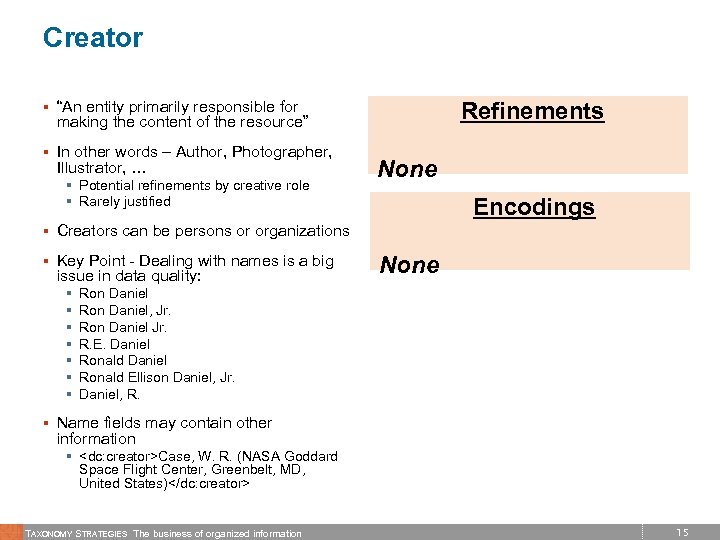
Creator § “An entity primarily responsible for Refinements making the content of the resource” § In other words – Author, Photographer, Illustrator, … § Potential refinements by creative role § Rarely justified None Encodings § Creators can be persons or organizations § Key Point - Dealing with names is a big issue in data quality: § § § § None Ron Daniel, Jr. Ron Daniel Jr. R. E. Daniel Ronald Ellison Daniel, Jr. Daniel, R. § Name fields may contain other information § <dc: creator>Case, W. R. (NASA Goddard Space Flight Center, Greenbelt, MD, United States)</dc: creator> TAXONOMY STRATEGIES The business of organized information 15
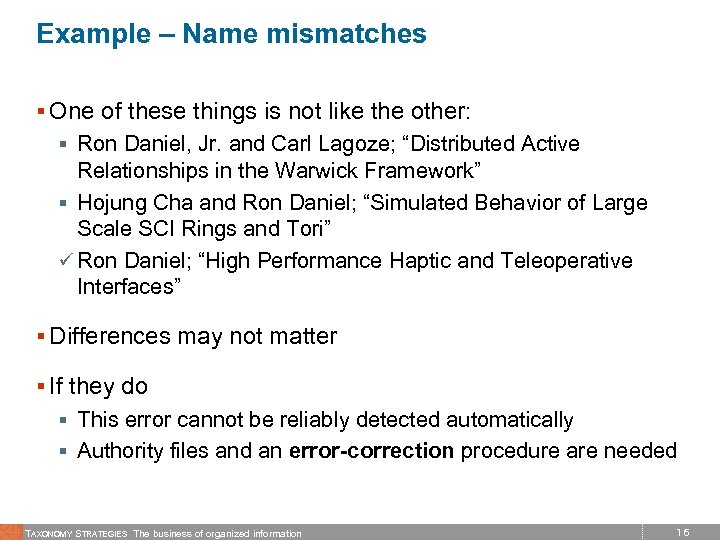
Example – Name mismatches § One of these things is not like the other: § Ron Daniel, Jr. and Carl Lagoze; “Distributed Active Relationships in the Warwick Framework” § Hojung Cha and Ron Daniel; “Simulated Behavior of Large Scale SCI Rings and Tori” ü Ron Daniel; “High Performance Haptic and Teleoperative Interfaces” § Differences may not matter § If they do § This error cannot be reliably detected automatically § Authority files and an error-correction procedure are needed TAXONOMY STRATEGIES The business of organized information 16
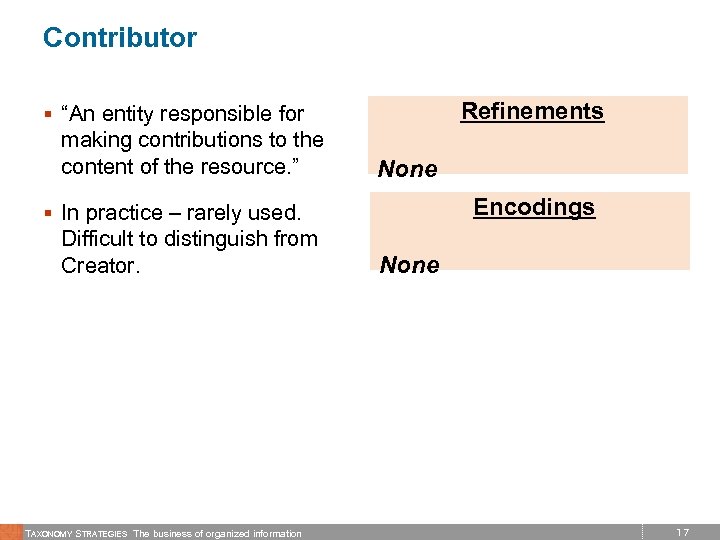
Contributor Refinements § “An entity responsible for making contributions to the content of the resource. ” None Encodings § In practice – rarely used. Difficult to distinguish from Creator. TAXONOMY STRATEGIES The business of organized information None 17
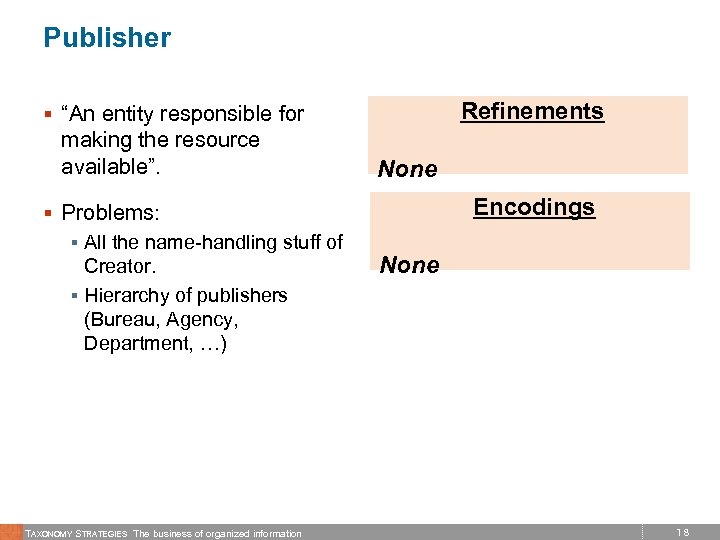
Publisher Refinements § “An entity responsible for making the resource available”. § Problems: § All the name-handling stuff of Creator. § Hierarchy of publishers (Bureau, Agency, Department, …) TAXONOMY STRATEGIES The business of organized information None Encodings None 18
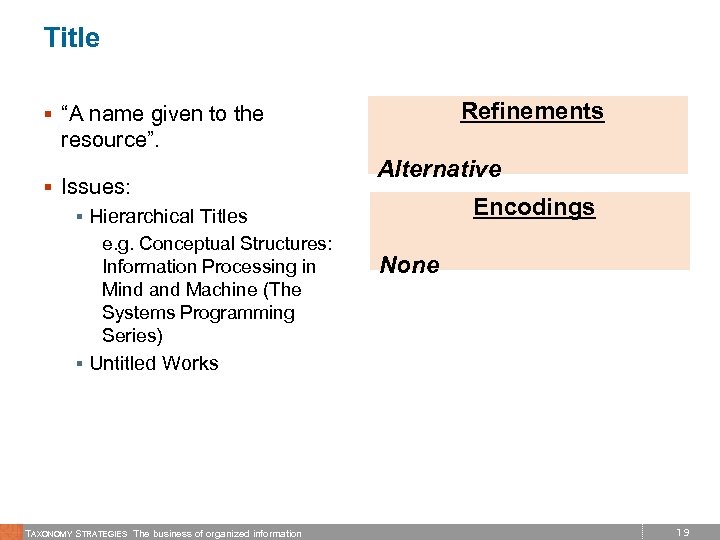
Title Refinements § “A name given to the resource”. § Issues: § Hierarchical Titles e. g. Conceptual Structures: Information Processing in Mind and Machine (The Systems Programming Series) Alternative Encodings None § Untitled Works TAXONOMY STRATEGIES The business of organized information 19
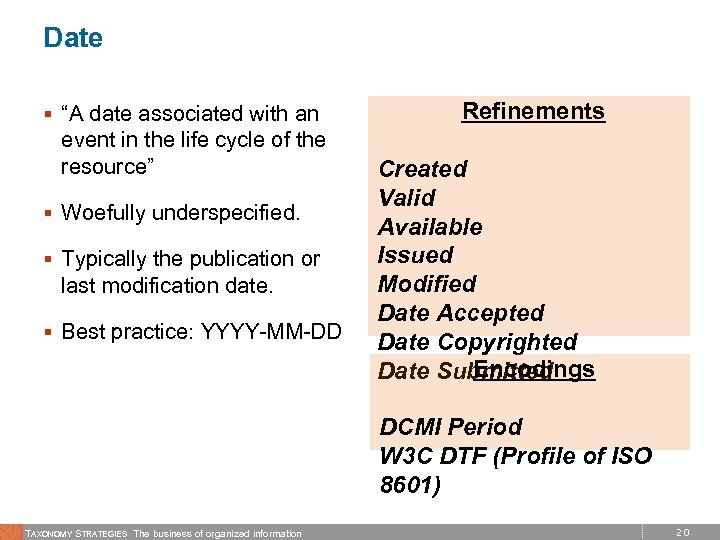
Date § “A date associated with an event in the life cycle of the resource” § Woefully underspecified. § Typically the publication or last modification date. § Best practice: YYYY-MM-DD Refinements Created Valid Available Issued Modified Date Accepted Date Copyrighted Encodings Date Submitted DCMI Period W 3 C DTF (Profile of ISO 8601) TAXONOMY STRATEGIES The business of organized information 20
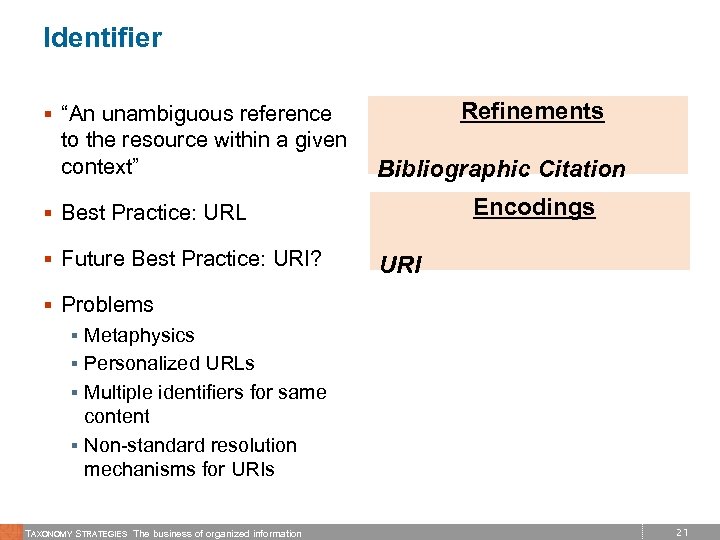
Identifier Refinements § “An unambiguous reference to the resource within a given context” Bibliographic Citation Encodings § Best Practice: URL § Future Best Practice: URI? URI § Problems § Metaphysics § Personalized URLs § Multiple identifiers for same content § Non-standard resolution mechanisms for URIs TAXONOMY STRATEGIES The business of organized information 21
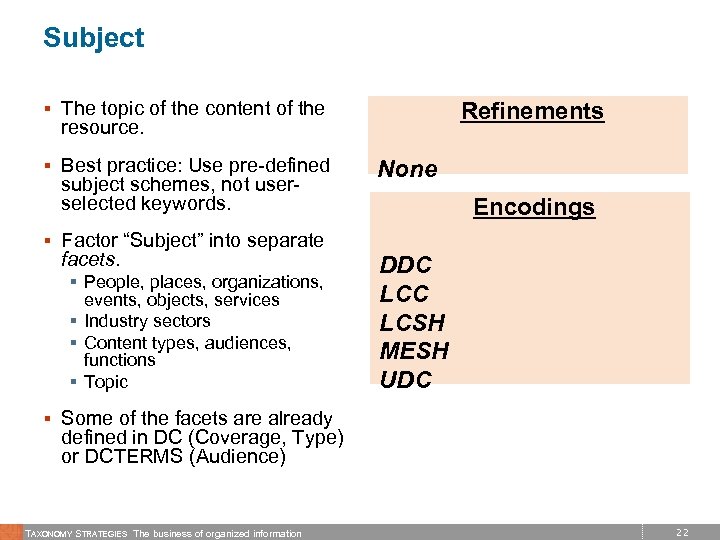
Subject § The topic of the content of the Refinements resource. § Best practice: Use pre-defined subject schemes, not userselected keywords. § Factor “Subject” into separate facets. § People, places, organizations, events, objects, services § Industry sectors § Content types, audiences, functions § Topic None Encodings DDC LCSH MESH UDC § Some of the facets are already defined in DC (Coverage, Type) or DCTERMS (Audience) TAXONOMY STRATEGIES The business of organized information 22
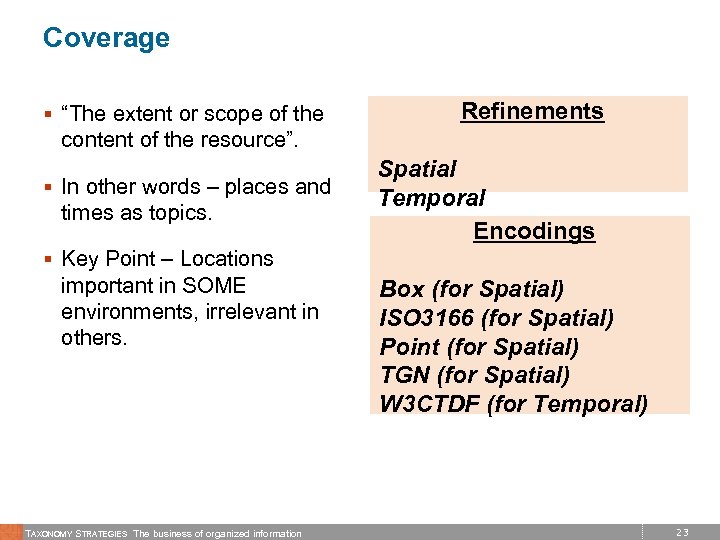
Coverage § “The extent or scope of the Refinements content of the resource”. § In other words – places and times as topics. Spatial Temporal Encodings § Key Point – Locations important in SOME environments, irrelevant in others. TAXONOMY STRATEGIES The business of organized information Box (for Spatial) ISO 3166 (for Spatial) Point (for Spatial) TGN (for Spatial) W 3 CTDF (for Temporal) 23
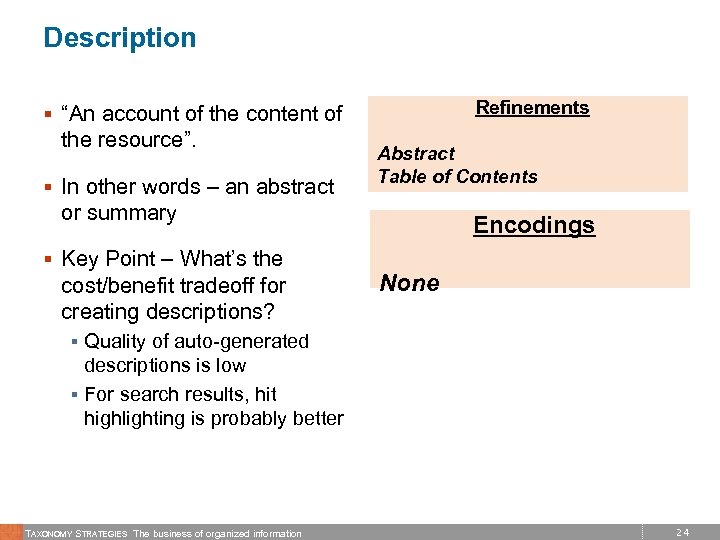
Description Refinements § “An account of the content of the resource”. § In other words – an abstract Abstract Table of Contents or summary § Key Point – What’s the cost/benefit tradeoff for creating descriptions? Encodings None § Quality of auto-generated descriptions is low § For search results, hit highlighting is probably better TAXONOMY STRATEGIES The business of organized information 24
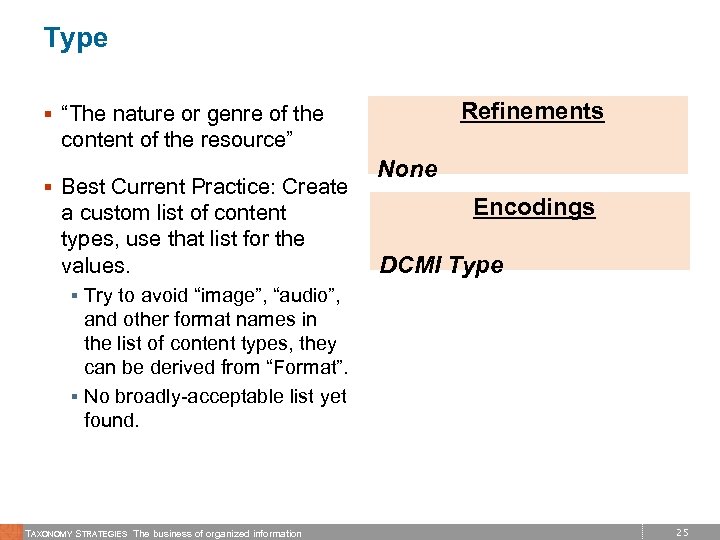
Type Refinements § “The nature or genre of the content of the resource” § Best Current Practice: Create a custom list of content types, use that list for the values. None Encodings DCMI Type § Try to avoid “image”, “audio”, and other format names in the list of content types, they can be derived from “Format”. § No broadly-acceptable list yet found. TAXONOMY STRATEGIES The business of organized information 25
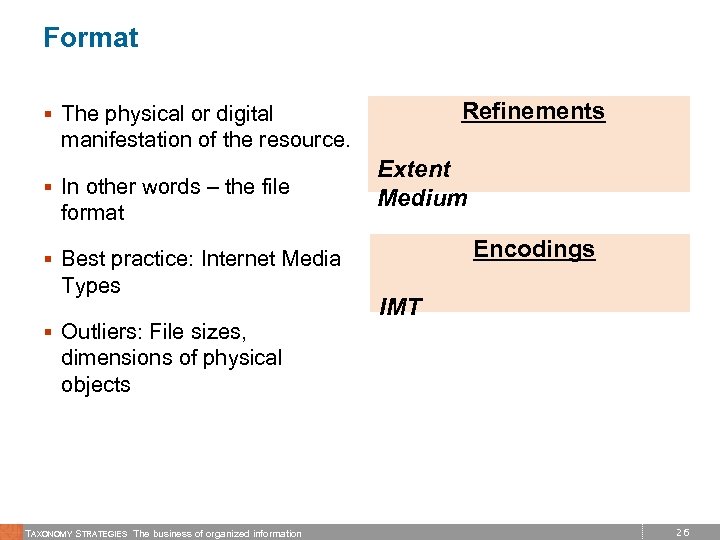
Format Refinements § The physical or digital manifestation of the resource. § In other words – the file format Extent Medium Encodings § Best practice: Internet Media Types § Outliers: File sizes, IMT dimensions of physical objects TAXONOMY STRATEGIES The business of organized information 26
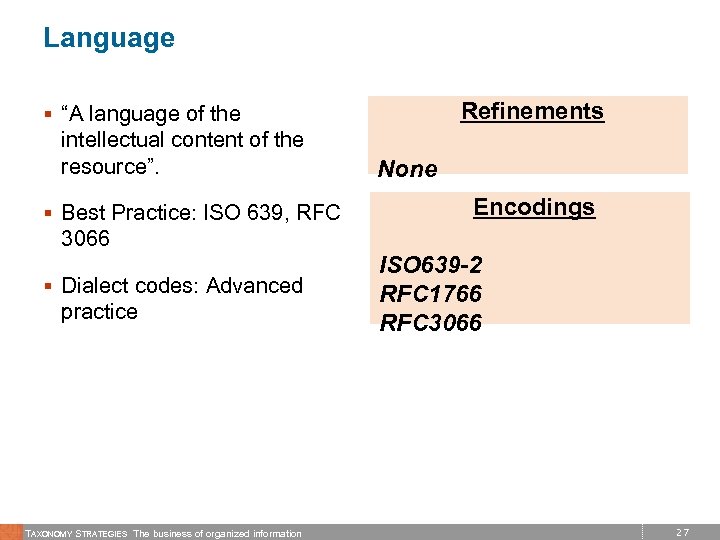
Language Refinements § “A language of the intellectual content of the resource”. § Best Practice: ISO 639, RFC None Encodings 3066 § Dialect codes: Advanced practice TAXONOMY STRATEGIES The business of organized information ISO 639 -2 RFC 1766 RFC 3066 27
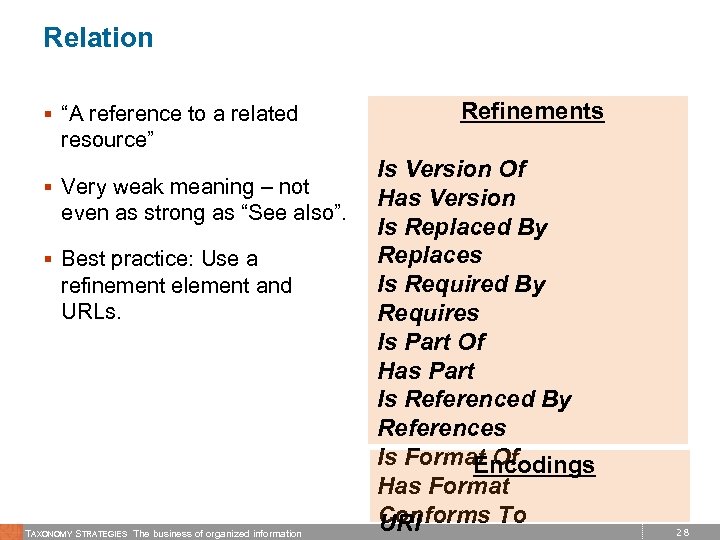
Relation § “A reference to a related Refinements resource” § Very weak meaning – not even as strong as “See also”. § Best practice: Use a refinement element and URLs. TAXONOMY STRATEGIES The business of organized information Is Version Of Has Version Is Replaced By Replaces Is Required By Requires Is Part Of Has Part Is Referenced By References Is Format Of Encodings Has Format Conforms To URI 28
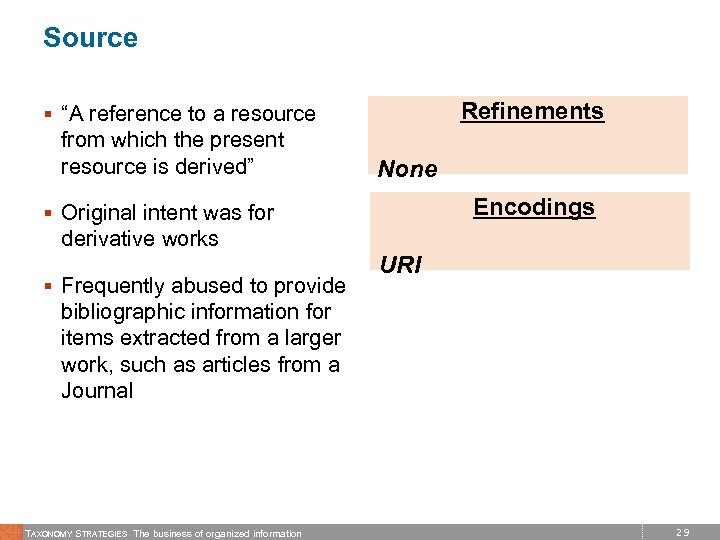
Source Refinements § “A reference to a resource from which the present resource is derived” None Encodings § Original intent was for derivative works § Frequently abused to provide URI bibliographic information for items extracted from a larger work, such as articles from a Journal TAXONOMY STRATEGIES The business of organized information 29
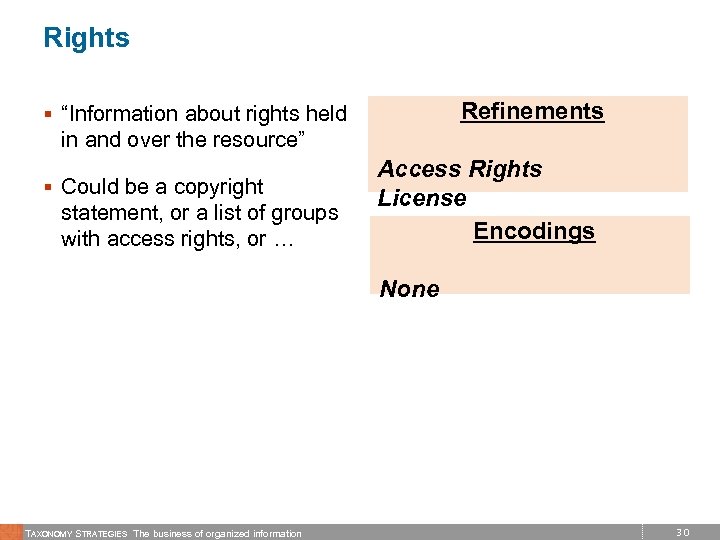
Rights Refinements § “Information about rights held in and over the resource” § Could be a copyright statement, or a list of groups with access rights, or … Access Rights License Encodings None TAXONOMY STRATEGIES The business of organized information 30
Agenda 1: 00 1: 10 1: 20 1: 30 2: 00 2: 10 2: 20 2: 30 Agenda & Introductions Overview of the Dublin Core, Metadata, and the Semantic Web Evolving the Semantic Web Dublin Core Elements and Issues Dublin Core in the Wild Sources Common Extensions and Restrictions Metadata Best Practices Q&A Adjourn TAXONOMY STRATEGIES The business of organized information 31
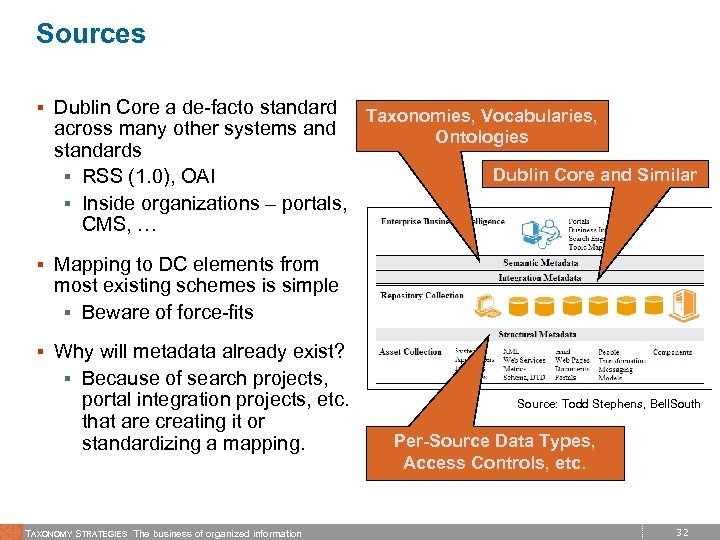
Sources § Dublin Core a de-facto standard across many other systems and standards § RSS (1. 0), OAI § Inside organizations – portals, CMS, … Taxonomies, Vocabularies, Ontologies Dublin Core and Similar § Mapping to DC elements from most existing schemes is simple § Beware of force-fits § Why will metadata already exist? § Because of search projects, portal integration projects, etc. that are creating it or standardizing a mapping. TAXONOMY STRATEGIES The business of organized information Source: Todd Stephens, Bell. South Per-Source Data Types, Access Controls, etc. 32
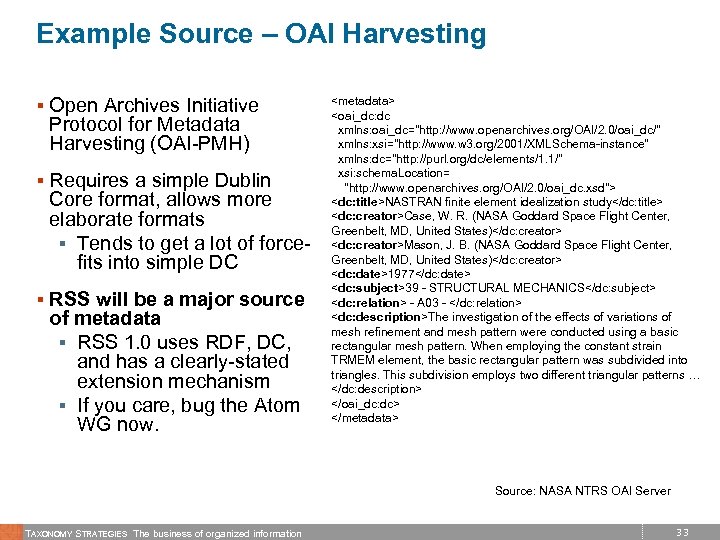
Example Source – OAI Harvesting § Open Archives Initiative Protocol for Metadata Harvesting (OAI-PMH) § Requires a simple Dublin Core format, allows more elaborate formats § Tends to get a lot of forcefits into simple DC § RSS will be a major source of metadata § RSS 1. 0 uses RDF, DC, and has a clearly-stated extension mechanism § If you care, bug the Atom WG now. <metadata> <oai_dc: dc xmlns: oai_dc="http: //www. openarchives. org/OAI/2. 0/oai_dc/" xmlns: xsi="http: //www. w 3. org/2001/XMLSchema-instance" xmlns: dc="http: //purl. org/dc/elements/1. 1/" xsi: schema. Location= "http: //www. openarchives. org/OAI/2. 0/oai_dc. xsd"> <dc: title>NASTRAN finite element idealization study</dc: title> <dc: creator>Case, W. R. (NASA Goddard Space Flight Center, Greenbelt, MD, United States)</dc: creator> <dc: creator>Mason, J. B. (NASA Goddard Space Flight Center, Greenbelt, MD, United States)</dc: creator> <dc: date>1977</dc: date> <dc: subject>39 - STRUCTURAL MECHANICS</dc: subject> <dc: relation> - A 03 - </dc: relation> <dc: description>The investigation of the effects of variations of mesh refinement and mesh pattern were conducted using a basic rectangular mesh pattern. When employing the constant strain TRMEM element, the basic rectangular pattern was subdivided into triangles. This subdivision employs two different triangular patterns … </dc: description> </oai_dc: dc> </metadata> Source: NASA NTRS OAI Server TAXONOMY STRATEGIES The business of organized information 33
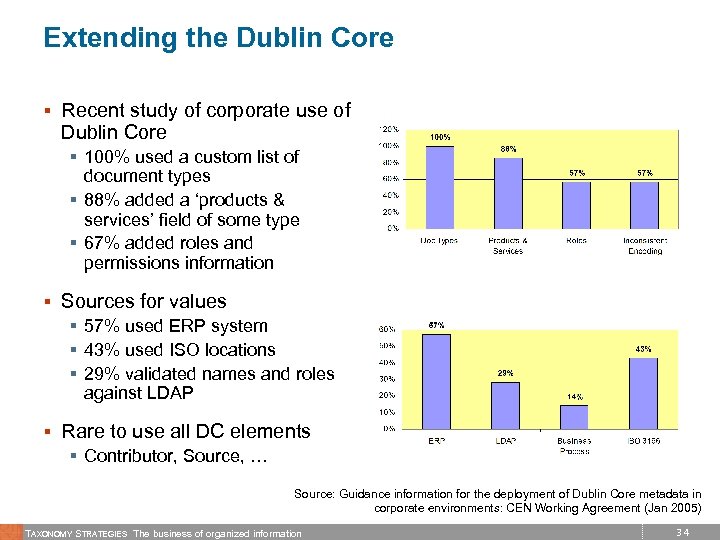
Extending the Dublin Core § Recent study of corporate use of Dublin Core § 100% used a custom list of document types § 88% added a ‘products & services’ field of some type § 67% added roles and permissions information § Sources for values § 57% used ERP system § 43% used ISO locations § 29% validated names and roles against LDAP § Rare to use all DC elements § Contributor, Source, … Source: Guidance information for the deployment of Dublin Core metadata in corporate environments: CEN Working Agreement (Jan 2005) TAXONOMY STRATEGIES The business of organized information 34
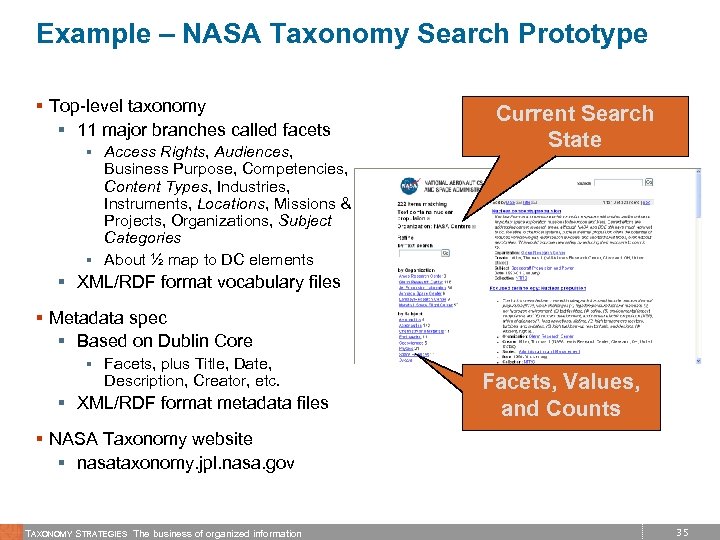
Example – NASA Taxonomy Search Prototype § Top-level taxonomy § 11 major branches called facets § Access Rights, Audiences, Business Purpose, Competencies, Content Types, Industries, Instruments, Locations, Missions & Projects, Organizations, Subject Categories § About ½ map to DC elements § XML/RDF format vocabulary files § Metadata spec § Based on Dublin Core § Facets, plus Title, Date, Description, Creator, etc. § XML/RDF format metadata files Current Search State Facets, Values, and Counts § NASA Taxonomy website § nasataxonomy. jpl. nasa. gov TAXONOMY STRATEGIES The business of organized information 35
Agenda 1: 00 1: 10 1: 20 1: 30 2: 00 2: 10 2: 20 2: 30 Agenda & Introductions Overview of the Dublin Core, Metadata, and the Semantic Web Evolving the Semantic Web Dublin Core Elements and Issues Dublin Core in the Wild Metadata Best Practices Q&A Adjourn TAXONOMY STRATEGIES The business of organized information 36
Overview of metadata practices § Use Dublin Core for basic information § Extend with custom elements for specific facts § Use pre-existing, standard, vocabularies as much as possible § ISO country codes for locations § Product & service info from ERP system § Validate author names with LDAP directory § Design a QC Process § Start with an error-correction process, then get more formal on error detection § Large-scale ontologies may be valuable in automated error detection TAXONOMY STRATEGIES The business of organized information 37
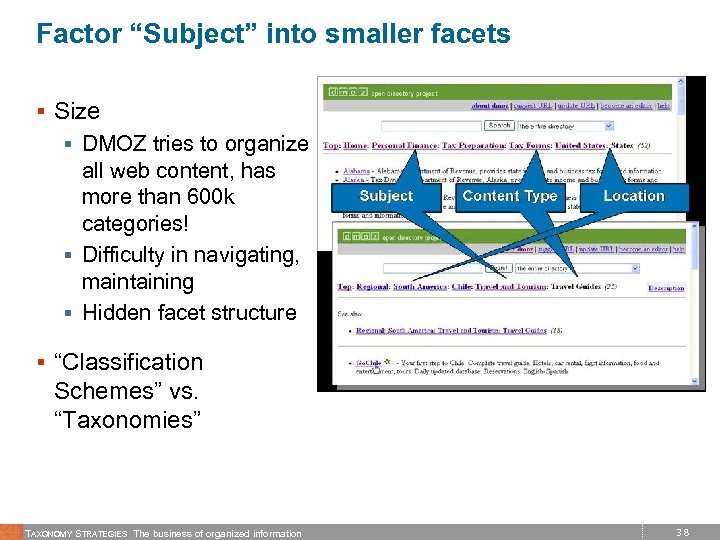
Factor “Subject” into smaller facets § Size § DMOZ tries to organize all web content, has more than 600 k categories! § Difficulty in navigating, maintaining § Hidden facet structure § “Classification Schemes” vs. “Taxonomies” TAXONOMY STRATEGIES The business of organized information 38
Cheap and Easy Metadata § Some fields will be constant across a collection. § In the context of a single collection those kinds of elements add no value, but they add tremendous value when many collections are brought together into one place, and they are cheap to create and validate. TAXONOMY STRATEGIES The business of organized information 39
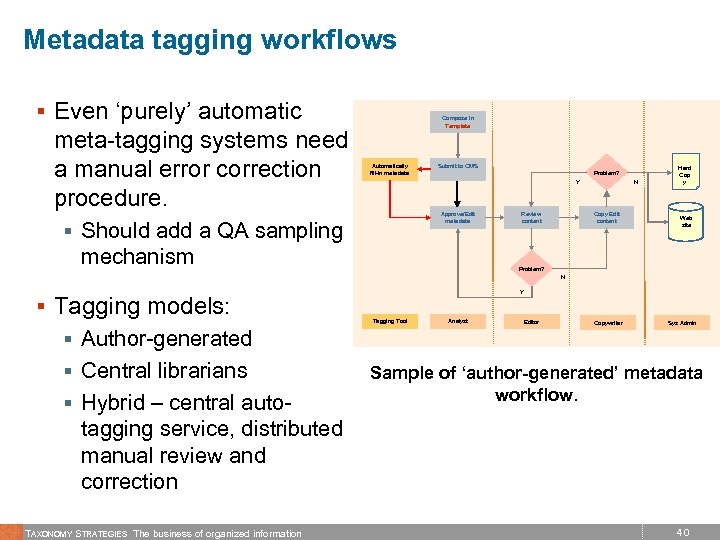
Metadata tagging workflows § Even ‘purely’ automatic meta-tagging systems need a manual error correction procedure. Compose in Template Automatically fill-in metadata Submit to CMS Problem? Y Approve/Edit metadata § Should add a QA sampling mechanism Review content N Copy Edit content Hard Cop y Web site Problem? N § Tagging models: § Author-generated § Central librarians § Hybrid – central autotagging service, distributed manual review and correction TAXONOMY STRATEGIES The business of organized information Y Tagging Tool Analyst Editor Copywriter Sys Admin Sample of ‘author-generated’ metadata workflow. 40
Principles § Basic facets with identified items – people, places, projects, instruments, missions, organizations, … Note that these are not subjective “subjects”, they are objective “objects”. § Objective views can be laid on top of the objective facts, but should be in a different namespace so they are clearly distinguishable. § For example, labels like “Anarchist” or “Prime Minister” can be applied to the same person at different times (e. g. Nelson Mandela). TAXONOMY STRATEGIES The business of organized information 41
Agenda 1: 00 1: 10 1: 20 1: 30 2: 00 2: 10 2: 20 2: 30 Agenda & Introductions Overview of the Dublin Core, Metadata, and the Semantic Web Evolving the Semantic Web Dublin Core Elements and Issues Dublin Core in the Wild Metadata Best Practices Q&A Adjourn TAXONOMY STRATEGIES The business of organized information 42
Thank You Contact Information Joseph A. Busch jbusch@taxonomystrategies. com Ron Daniel, Jr. rdaniel@taxonomystrategies. com TAXONOMY STRATEGIES The business of organized information 43
Скачать презентацию Taxonomy Strategies Tutorial Dublin Core Metadata and Growing
7750b7a8ee7b4fee330935197a49c393.ppt