


 Скачать презентацию Taxonomy Development Case Studies Tom Reamy Chief Knowledge
d57bac556f2e8afc4cf13a40bebe2be8.ppt
- Количество слайдов: 21
 Taxonomy Development Case Studies Tom Reamy Chief Knowledge Architect KAPS Group Knowledge Architecture Professional Services http: //www. kapsgroup. com
 Agenda § Introduction § Development Process – Examples § Tale of Two Taxonomies – Best of Times and Worst of Times § Conclusion 2
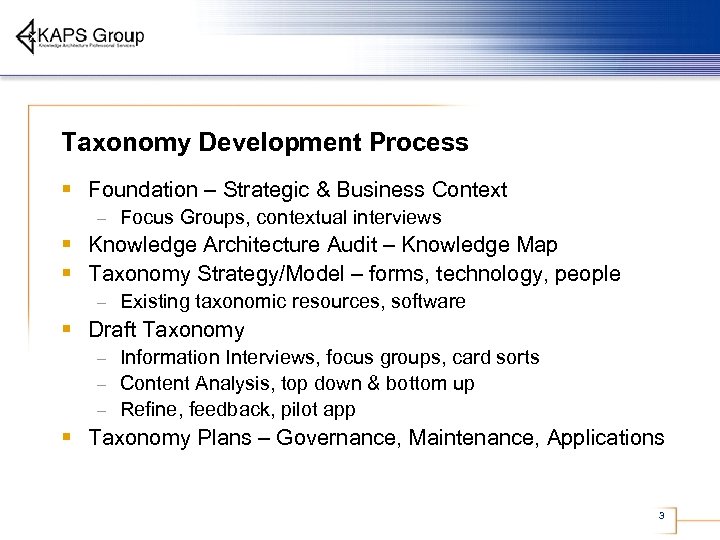 Taxonomy Development Process § Foundation – Strategic & Business Context – Focus Groups, contextual interviews § Knowledge Architecture Audit – Knowledge Map § Taxonomy Strategy/Model – forms, technology, people – Existing taxonomic resources, software § Draft Taxonomy Information Interviews, focus groups, card sorts – Content Analysis, top down & bottom up – Refine, feedback, pilot app – § Taxonomy Plans – Governance, Maintenance, Applications 3
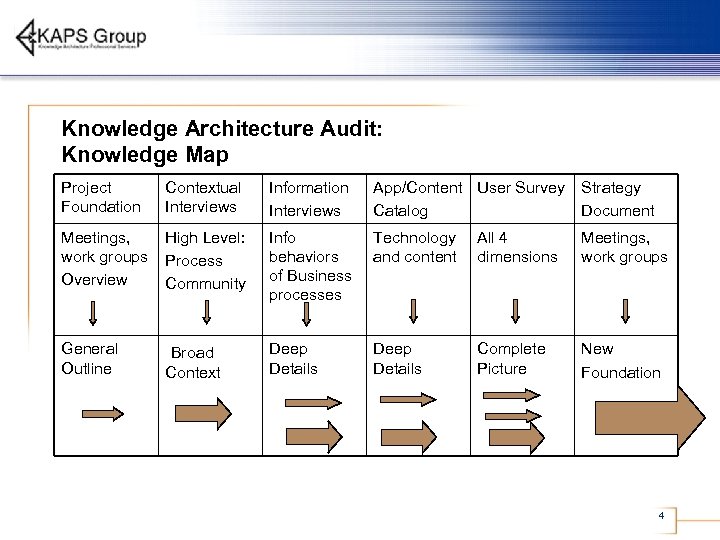 Knowledge Architecture Audit: Knowledge Map Project Foundation Contextual Interviews Information Interviews App/Content User Survey Catalog Strategy Document Meetings, work groups Overview High Level: Process Community Info behaviors of Business processes Technology and content All 4 dimensions Meetings, work groups General Outline Broad Context Deep Details Complete Picture New Foundation 4
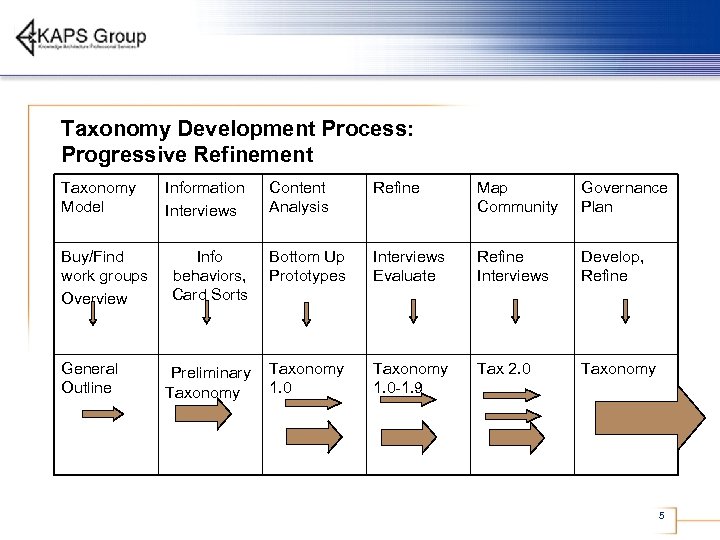 Taxonomy Development Process: Progressive Refinement Taxonomy Model Buy/Find work groups Overview General Outline Information Interviews Content Analysis Refine Map Community Governance Plan Info behaviors, Card Sorts Bottom Up Prototypes Interviews Evaluate Refine Interviews Develop, Refine Preliminary Taxonomy 1. 0 -1. 9 Tax 2. 0 Taxonomy 5
 Taxonomy Development: Tips and Techniques Foundation § Strategic Foundation Info Problems – what, how severe – Political environment – support, special interests – § Knowledge Architecture Audit – Self Knowledge – Size, Major Org, Info environment § Strategic Questions – why, what value from the taxonomy, how are you going to use it § Technology Environment – ECM, Enterprise Search 6
 Taxonomy Development: Tips and Techniques Taxonomy Foundation § Variety of taxonomies – important to know the differences, when to use what. § People: Get a good taxonomist! (Assign resources, learn) – Library Science+ Cognitive Science + Cognitive Anthropology § Technology Taxonomy Management, Visulaization – Entity Extraction – § Content Structures: Get a good taxonomy! Glossary, Index, Pull from multiple sources – Get a good document collection – 7
 Infrastructure Solutions: Taxonomy Development Taxonomy Model § Enterprise Taxonomy No single subject matter taxonomy – Need an ontology of facets or domains – § Standards and Customization Balance of corporate communication and departmental specifics – At what level are differences represented? – Customize pre-defined taxonomy – additional structure, add synonyms and acronyms and vocabulary – § Enterprise Facet Model: Actors, Events, Functions, Locations, Objects, Information Resources – Combine and map to subject domains – 8
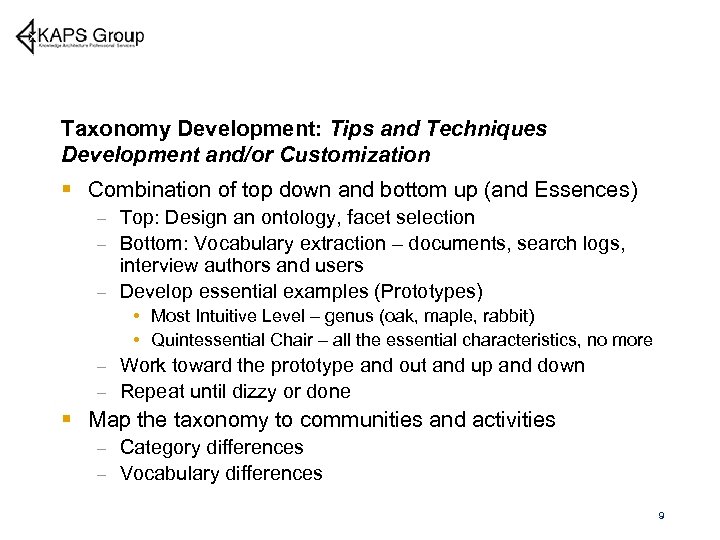 Taxonomy Development: Tips and Techniques Development and/or Customization § Combination of top down and bottom up (and Essences) Top: Design an ontology, facet selection – Bottom: Vocabulary extraction – documents, search logs, interview authors and users – Develop essential examples (Prototypes) – • Most Intuitive Level – genus (oak, maple, rabbit) • Quintessential Chair – all the essential characteristics, no more Work toward the prototype and out and up and down – Repeat until dizzy or done – § Map the taxonomy to communities and activities Category differences – Vocabulary differences – 9
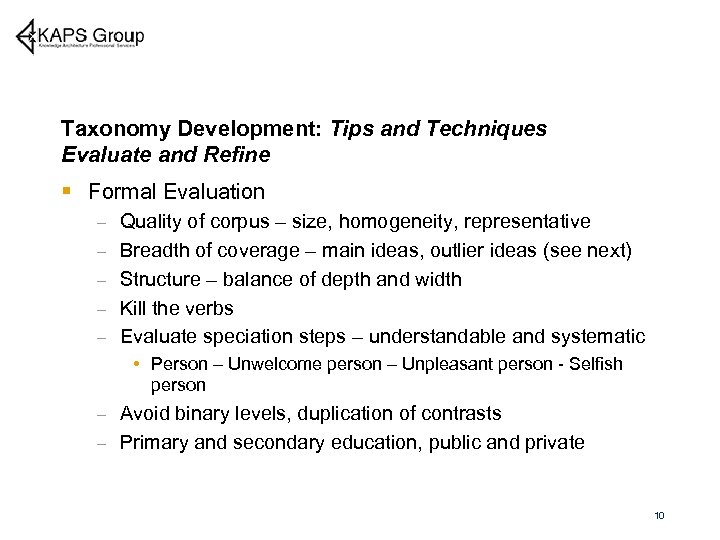 Taxonomy Development: Tips and Techniques Evaluate and Refine § Formal Evaluation – – – Quality of corpus – size, homogeneity, representative Breadth of coverage – main ideas, outlier ideas (see next) Structure – balance of depth and width Kill the verbs Evaluate speciation steps – understandable and systematic • Person – Unwelcome person – Unpleasant person - Selfish person Avoid binary levels, duplication of contrasts – Primary and secondary education, public and private – 10
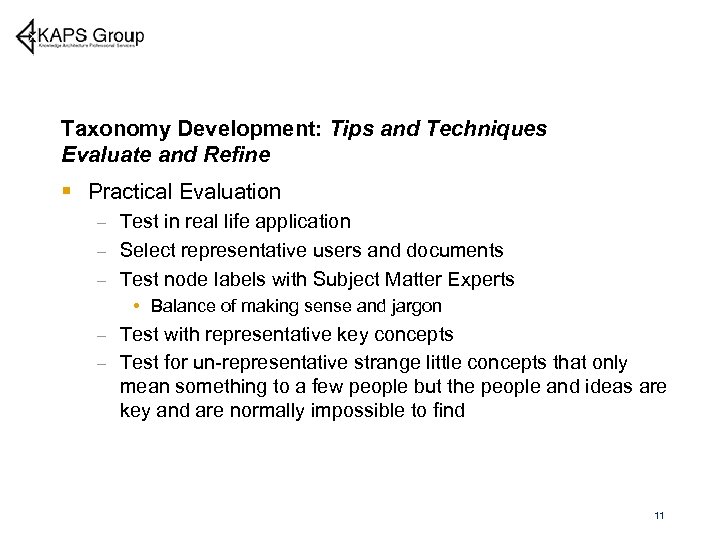 Taxonomy Development: Tips and Techniques Evaluate and Refine § Practical Evaluation Test in real life application – Select representative users and documents – Test node labels with Subject Matter Experts – • Balance of making sense and jargon Test with representative key concepts – Test for un-representative strange little concepts that only mean something to a few people but the people and ideas are key and are normally impossible to find – 11
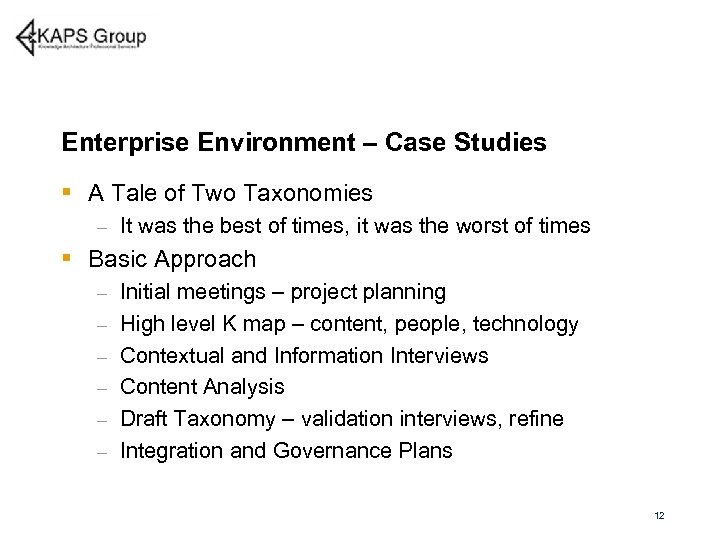 Enterprise Environment – Case Studies § A Tale of Two Taxonomies – It was the best of times, it was the worst of times § Basic Approach – – – Initial meetings – project planning High level K map – content, people, technology Contextual and Information Interviews Content Analysis Draft Taxonomy – validation interviews, refine Integration and Governance Plans 12
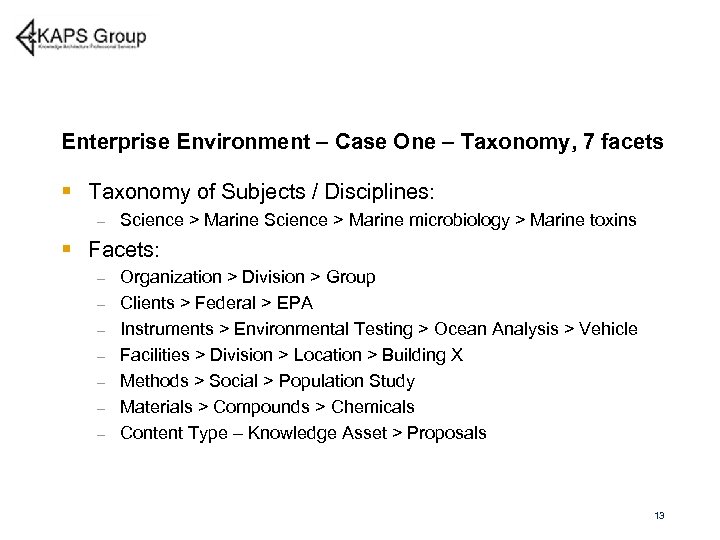 Enterprise Environment – Case One – Taxonomy, 7 facets § Taxonomy of Subjects / Disciplines: – Science > Marine microbiology > Marine toxins § Facets: – – – – Organization > Division > Group Clients > Federal > EPA Instruments > Environmental Testing > Ocean Analysis > Vehicle Facilities > Division > Location > Building X Methods > Social > Population Study Materials > Compounds > Chemicals Content Type – Knowledge Asset > Proposals 13
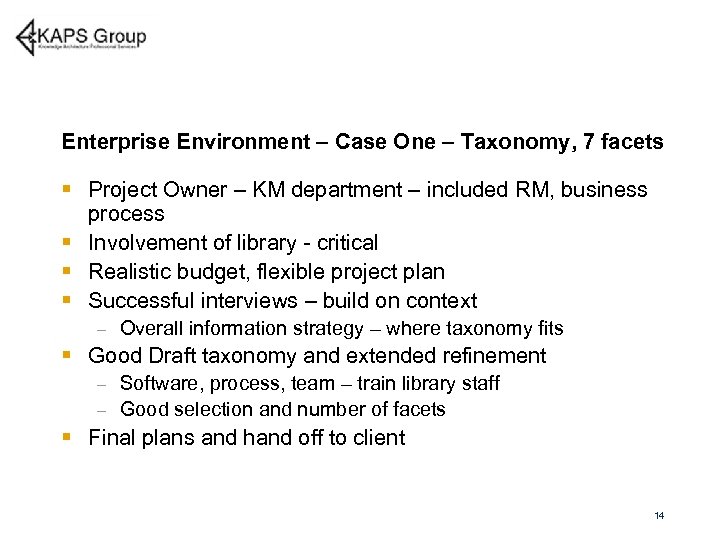 Enterprise Environment – Case One – Taxonomy, 7 facets § Project Owner – KM department – included RM, business process § Involvement of library - critical § Realistic budget, flexible project plan § Successful interviews – build on context – Overall information strategy – where taxonomy fits § Good Draft taxonomy and extended refinement Software, process, team – train library staff – Good selection and number of facets – § Final plans and hand off to client 14
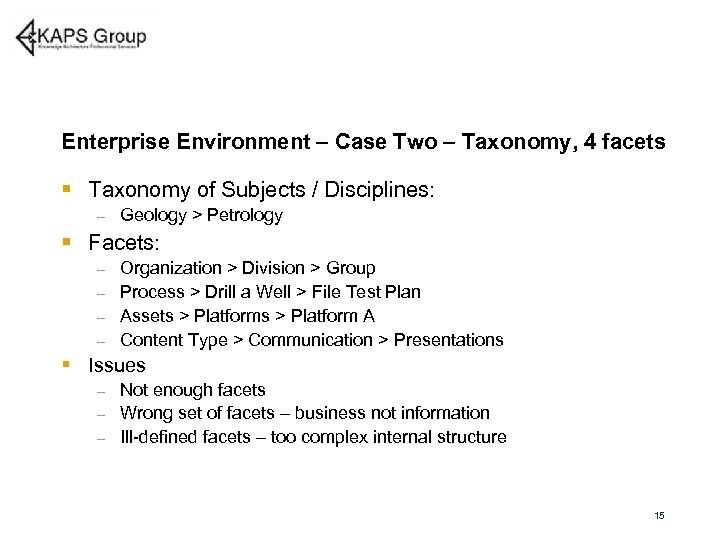 Enterprise Environment – Case Two – Taxonomy, 4 facets § Taxonomy of Subjects / Disciplines: – Geology > Petrology § Facets: Organization > Division > Group – Process > Drill a Well > File Test Plan – Assets > Platform A – Content Type > Communication > Presentations – § Issues Not enough facets – Wrong set of facets – business not information – Ill-defined facets – too complex internal structure – 15
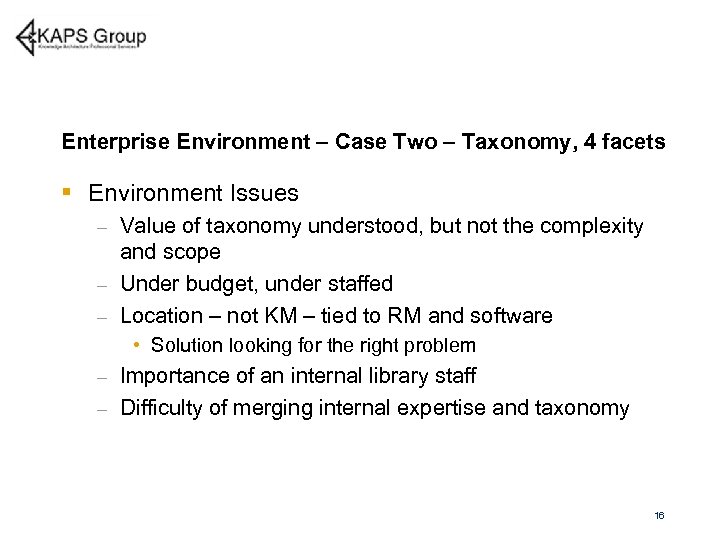 Enterprise Environment – Case Two – Taxonomy, 4 facets § Environment Issues Value of taxonomy understood, but not the complexity and scope – Under budget, under staffed – Location – not KM – tied to RM and software – • Solution looking for the right problem Importance of an internal library staff – Difficulty of merging internal expertise and taxonomy – 16
 Enterprise Environment – Case Two – Taxonomy, 4 facets § Project Issues Project mind set – not infrastructure – Wrong kind of project management – • Special needs of a taxonomy project • Importance of integration – with team, company – Project plan more important than results • Rushing to meet deadlines doesn’t work with semantics as well as software 17
 Enterprise Environment – Case Two – Taxonomy, 4 facets § Research Issues Not enough research – and wrong people – Interference of non-taxonomy – communication – Misunderstanding of research – wanted tinker toy connections – • Interview 1 implies conclusion A § Design Issues Not enough facets – Wrong set of facets – business not information – Ill-defined facets – too complex internal structure – 18
 Taxonomy Development Conclusion: Risk Factors § Political-Cultural-Semantic Environment – Not simple resistance - more subtle • – re-interpretation of specific conclusions and sequence of conclusions / Relative importance of specific recommendations § Understanding project scope § Access to content and people – Enthusiastic access § Importance of a unified project team – Working communication as well as weekly meetings 19
 Conclusion § Enterprise Context – strategic, self knowledge § Importance of a good foundation Taxonomy Model – Be Smart – beg, borrow, steal resources – § Importance of Taxonomy Vision Infrastructure resource, not a project – Evolving – processes to direct the evolution – Importance of Taxonomy – § Balance of expertise and local knowledge 20
 Questions? Tom Reamy tomr@kapsgroup. com KAPS Group Knowledge Architecture Professional Services http: //www. kapsgroup. com