


 Скачать презентацию Taxation for Health Promotion Chonlathan Visaruthvong Ph D
6fbd7eb1fc5b37a6cd39eb872d0bae56.ppt
- Количество слайдов: 33
 Taxation for Health Promotion Chonlathan Visaruthvong, Ph. D The excise department of Thailand chon 996@yahoo. com 1
 Topics Rationale for the use of taxation for health promotion Lesson learn from Tobacco tax and Alcohol tax Food and Drinks taxes Soft drinks ‘price and tax’ : Thailand experience Challenges 2
 Rationale for the use of taxation for health promotion • Promote public health • Correct market failure -Cover the external costs (economic costs resulting from NCDs) that result from less healthy consumption • Raise tax revenue Sugar, rum and tobacco are commodities which are no where necessaries of life, which are become objects of almost universal consumption, and which are therefore extremely proper subjects of taxation” (Adam Smith, Wealth of Nations, 1776) 3
 Mandate of WHO Under Objective 3 of the Global Action Plan for the Prevention and Treatment of Non-Communicable Diseases (NCDs), 2013 -2020, one of the policy options for Member States is to “consider economic tools that are justified by evidence, and may include taxes and subsidies, that create incentives for behaviours associated with improved health outcomes, improve the affordability and encourage consumption of healthier food products and discourage the consumption of less healthy options”. Under Action 3 of Comprehensive Implementation Plan on Maternal, Infant and Young Child Nutrition 2012, as part of the action to stimulate development policies outside the health sector Trade measures, taxes and subsidies are an important means of guaranteeing access and enabling healthy dietary choices. They can be powerful tools when associated with adequate information for consumers through nutrition labelling and responsible food marketing, and with social marketing and promotion of healthy diets and healthy lifestyles. ”
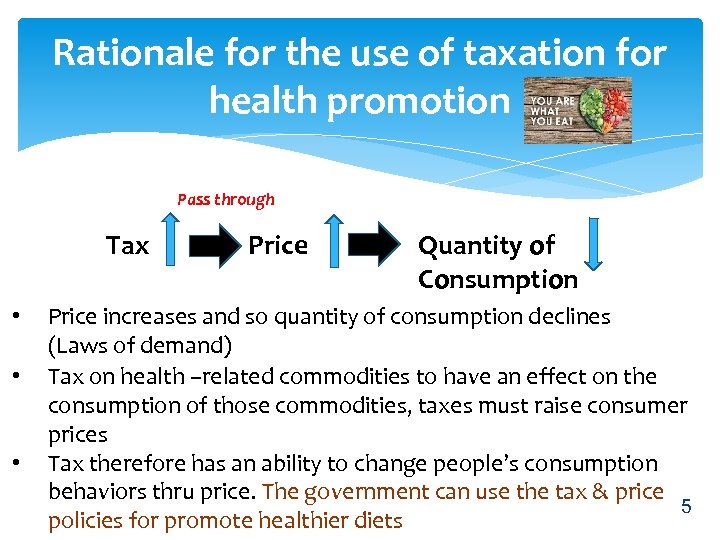 Rationale for the use of taxation for health promotion Pass through Tax • • • Price Quantity of Consumption Price increases and so quantity of consumption declines (Laws of demand) Tax on health –related commodities to have an effect on the consumption of those commodities, taxes must raise consumer prices Tax therefore has an ability to change people’s consumption behaviors thru price. The government can use the tax & price 5 policies for promote healthier diets
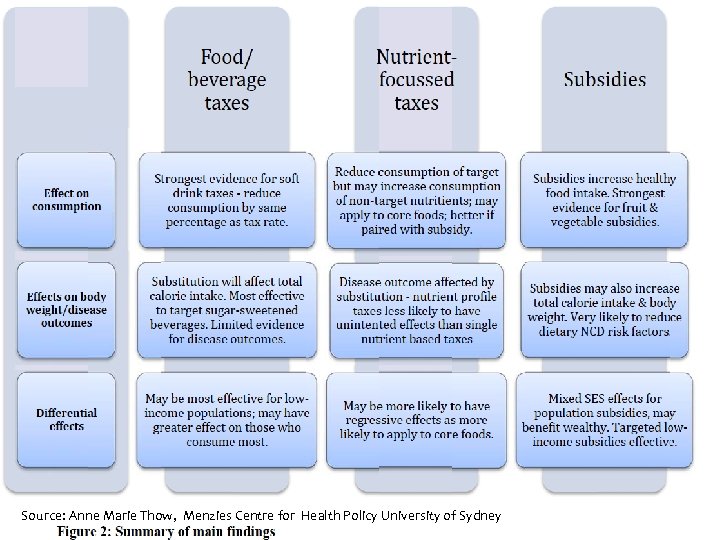
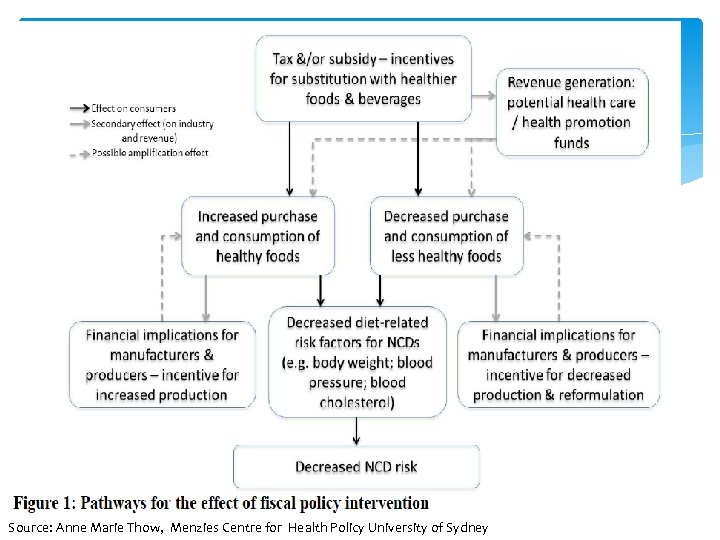 Source: Anne Marie Thow, Menzies Centre for Health Policy University of Sydney
 Lesson learn from Tobacco tax and Alcohol tax 7
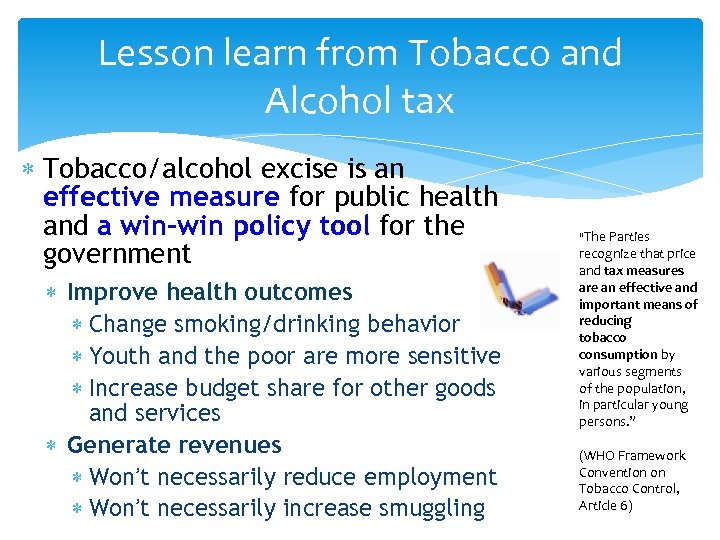 Lesson learn from Tobacco and Alcohol tax Tobacco/alcohol excise is an effective measure for public health and a win-win policy tool for the government Improve health outcomes Change smoking/drinking behavior Youth and the poor are more sensitive Increase budget share for other goods and services Generate revenues Won’t necessarily reduce employment Won’t necessarily increase smuggling "The Parties recognize that price and tax measures are an effective and important means of reducing tobacco consumption by various segments of the population, in particular young persons. ” (WHO Framework Convention on Tobacco Control, Article 6)
 Best practices in tobacco taxation Move away from complicated tax systems (different rates for different characteristics of the same product)-discriminatory: they make it harder for countries to raise tobacco product prices efficiently Recommended to implement specific excise (or mixed system that relies more on the specific component): has clear public health advantages: leads to higher prices and reduce price gaps within products, simpler to administer, But has to be automatically adjusted to inflation (to avoid price erosion) and ideally income (to reduce affordability).
 Food and drink taxes 10
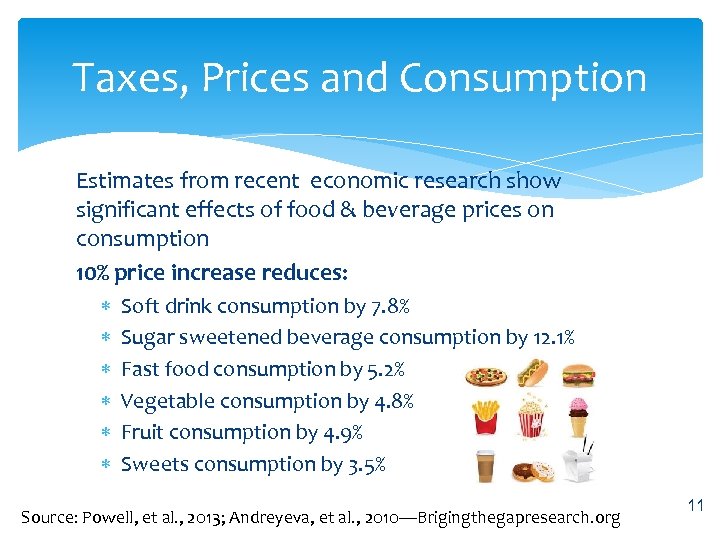 Taxes, Prices and Consumption Estimates from recent economic research show significant effects of food & beverage prices on consumption 10% price increase reduces: Soft drink consumption by 7. 8% Sugar sweetened beverage consumption by 12. 1% Fast food consumption by 5. 2% Vegetable consumption by 4. 8% Fruit consumption by 4. 9% Sweets consumption by 3. 5% Source: Powell, et al. , 2013; Andreyeva, et al. , 2010—Brigingthegapresearch. org 11
 Prices and Weight Outcomes Growing body of research with increasingly strong findings to date on impact of food and beverage prices and weight outcomes: 10% higher fast food prices would reduce prevalence of adolescent obesity by almost 6% (Powell, et al. , 2007) Higher soda sales taxes associated with reduced weight gain, particularly for overweight kids (Sturm, et al. , 2010) Higher carbonated beverage prices significantly related to lower BMI in children (Wendt and Todd, 2011) The weight of the evidence increasingly indicates that changes in relative prices for healthier and less healthy foods will affect weight outcomes, with greater impact on: § Lower income, less educated populations § Younger populations § Populations at greater risk for obesity Source: Powell et al. , 2013—Brigingthegapresearch. org 12
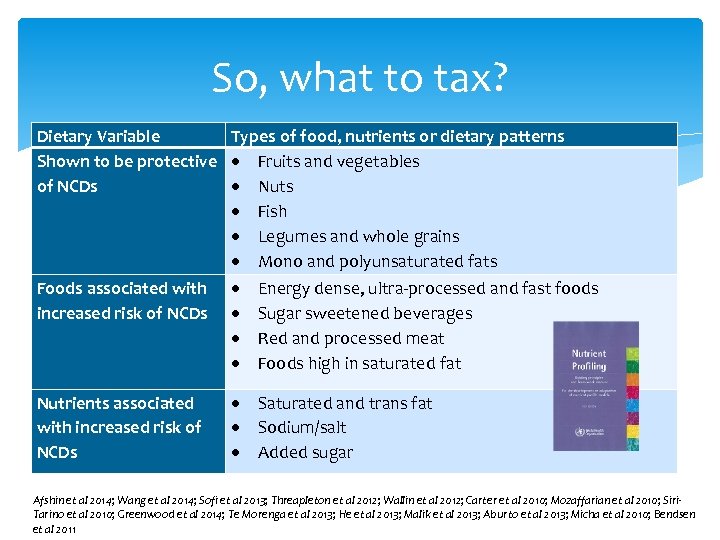 So, what to tax? Dietary Variable Shown to be protective of NCDs Types of food, nutrients or dietary patterns Fruits and vegetables Nuts Fish Legumes and whole grains Mono and polyunsaturated fats Foods associated with increased risk of NCDs Energy dense, ultra-processed and fast foods Sugar sweetened beverages Red and processed meat Foods high in saturated fat Nutrients associated with increased risk of NCDs Saturated and trans fat Sodium/salt Added sugar Afshin et al 2014; Wang et al 2014; Sofi et al 2013; Threapleton et al 2012; Wallin et al 2012; Carter et al 2010; Mozaffarian et al 2010; Siri. Tarino et al 2010; Greenwood et al 2014; Te Morenga et al 2013; He et al 2013; Malik et al 2013; Aburto et al 2013; Micha et al 2010; Bendsen et al 2011
 Source: Anne Marie Thow, Menzies Centre for Health Policy University of Sydney
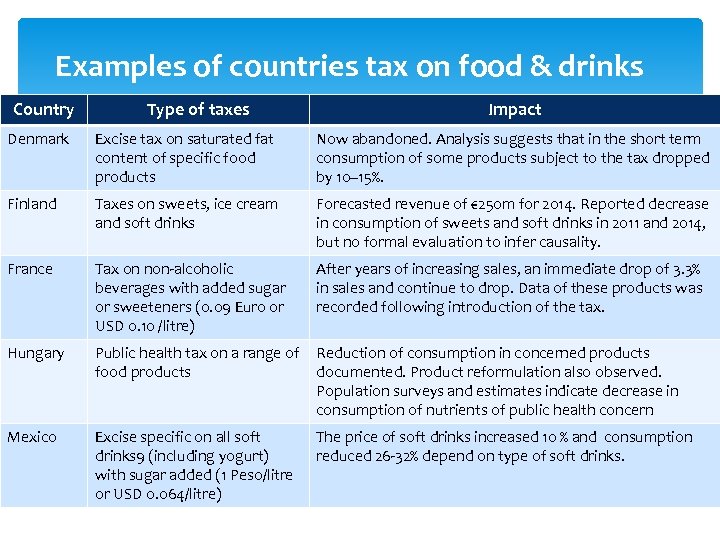 Examples of countries tax on food & drinks Country Type of taxes Impact Denmark Excise tax on saturated fat content of specific food products Now abandoned. Analysis suggests that in the short term consumption of some products subject to the tax dropped by 10– 15%. Finland Taxes on sweets, ice cream and soft drinks Forecasted revenue of € 250 m for 2014. Reported decrease in consumption of sweets and soft drinks in 2011 and 2014, but no formal evaluation to infer causality. France Tax on non-alcoholic beverages with added sugar or sweeteners (0. 09 Euro or USD 0. 10 /litre) After years of increasing sales, an immediate drop of 3. 3% in sales and continue to drop. Data of these products was recorded following introduction of the tax. Hungary Public health tax on a range of food products Reduction of consumption in concerned products documented. Product reformulation also observed. Population surveys and estimates indicate decrease in consumption of nutrients of public health concern Mexico Excise specific on all soft drinks 9 (including yogurt) with sugar added (1 Peso/litre or USD 0. 064/litre) The price of soft drinks increased 10 % and consumption reduced 26 -32% depend on type of soft drinks.
 Soft drinks ‘price and tax’ : evidence and Thailand experience 16
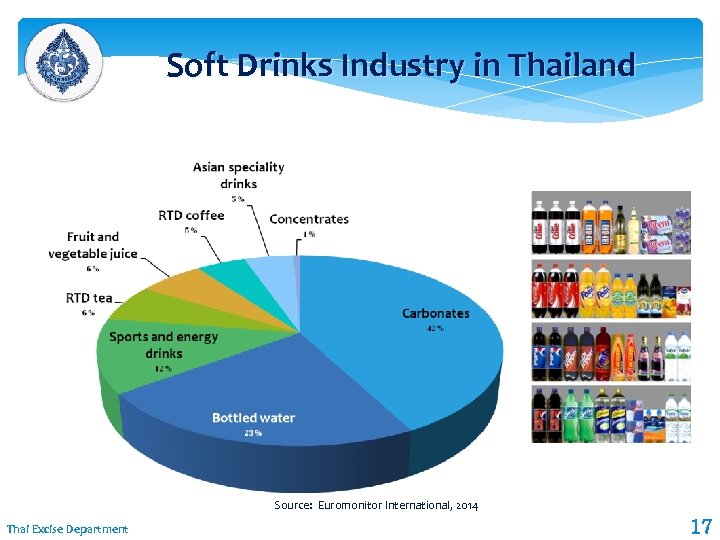 Soft Drinks Industry in Thailand Source: Euromonitor International, 2014 Thai Excise Department 17
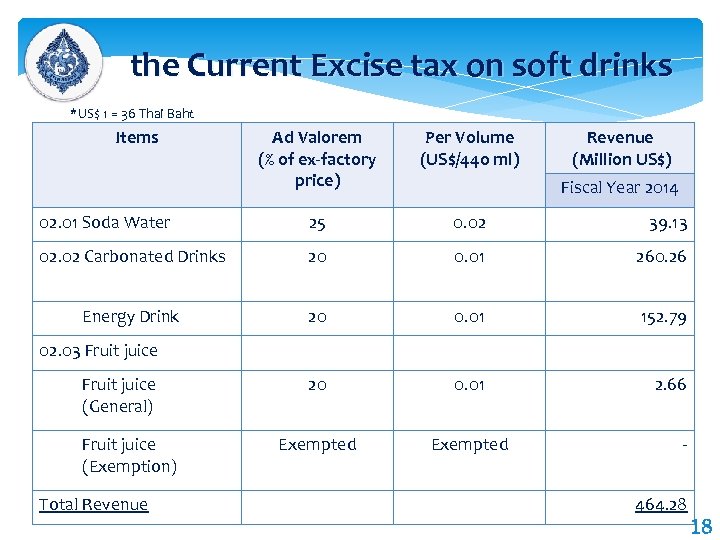 the Current Excise tax on soft drinks *US$ 1 = 36 Thai Baht Items Ad Valorem (% of ex-factory price) Per Volume (US$/440 ml) Revenue (Million US$) 02. 01 Soda Water 25 0. 02 39. 13 02. 02 Carbonated Drinks 20 0. 01 260. 26 Energy Drink 20 0. 01 152. 79 20 0. 01 2. 66 Exempted Fiscal Year 2014 02. 03 Fruit juice (General) Fruit juice (Exemption) Total Revenue 464. 28 18
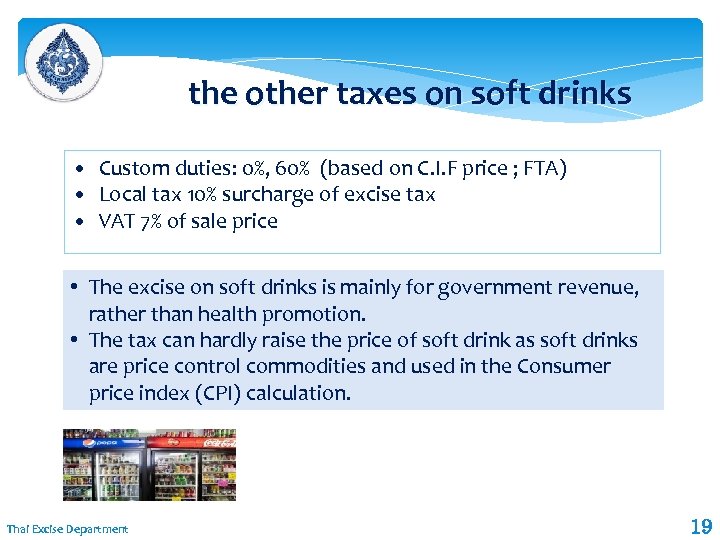 the other taxes on soft drinks • Custom duties: 0%, 60% (based on C. I. F price ; FTA) • Local tax 10% surcharge of excise tax • VAT 7% of sale price • The excise on soft drinks is mainly for government revenue, rather than health promotion. • The tax can hardly raise the price of soft drink as soft drinks are price control commodities and used in the Consumer price index (CPI) calculation. Thai Excise Department 19
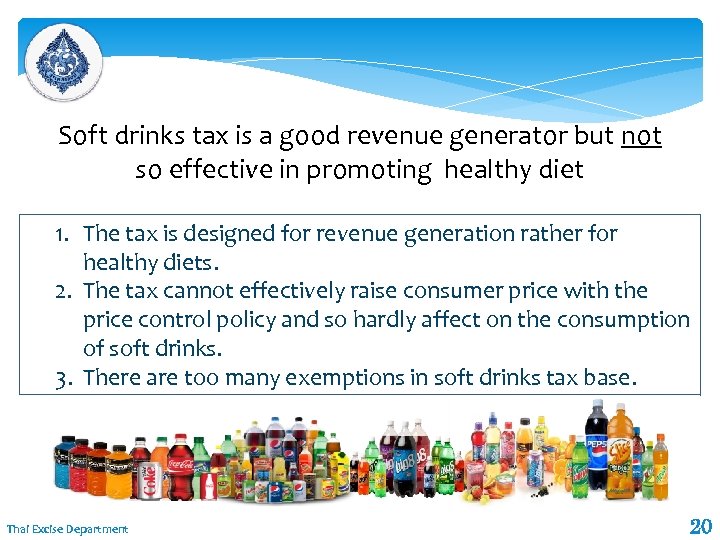 Soft drinks tax is a good revenue generator but not so effective in promoting healthy diet 1. The tax is designed for revenue generation rather for healthy diets. 2. The tax cannot effectively raise consumer price with the price control policy and so hardly affect on the consumption of soft drinks. 3. There are too many exemptions in soft drinks tax base. Thai Excise Department 20
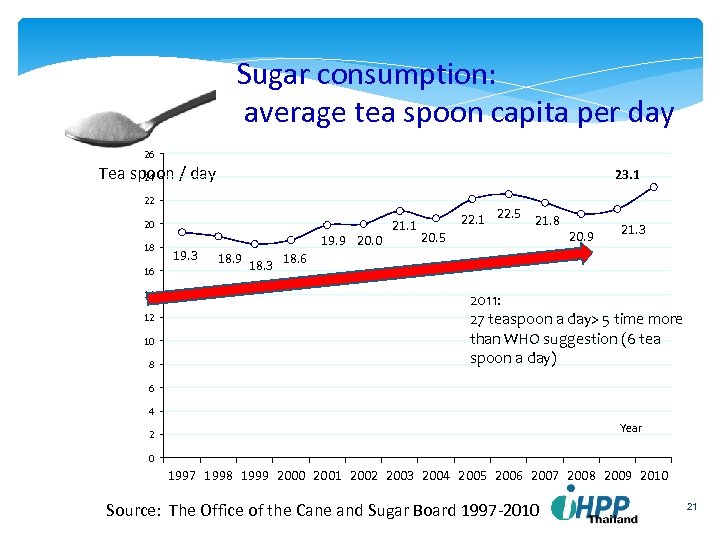 Sugar consumption: average tea spoon capita per day 26 Tea spoon / day 24 23. 1 22 20 18 16 14 12 10 8 19. 3 19. 9 20. 0 18. 9 18. 3 21. 1 22. 5 21. 8 20. 5 20. 9 21. 3 18. 6 2011: 27 teaspoon a day> 5 time more than WHO suggestion (6 tea spoon a day) 6 4 Year 2 0 1997 1998 1999 2000 2001 2002 2003 2004 2005 2006 2007 2008 2009 2010 Source: The Office of the Cane and Sugar Board 1997 -2010 21
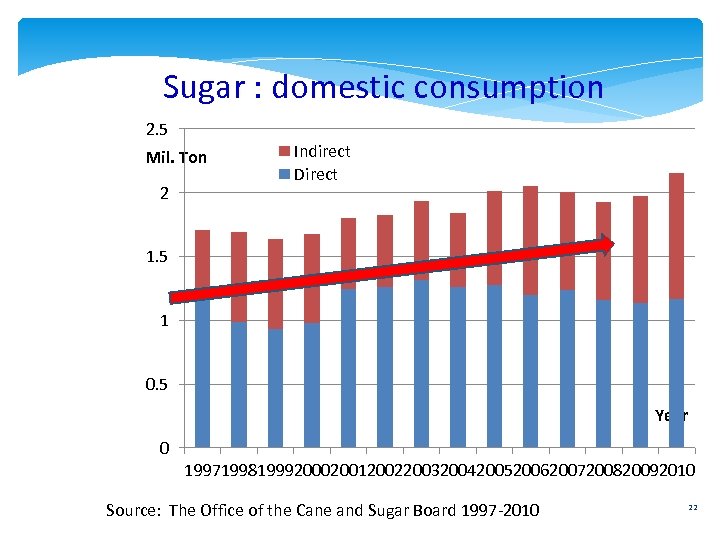 Sugar : domestic consumption 2. 5 Mil. Ton 2 Indirect Direct 1. 5 1 0. 5 Year 0 19971998199920002001200220032004200520062007200820092010 Source: The Office of the Cane and Sugar Board 1997 -2010 22
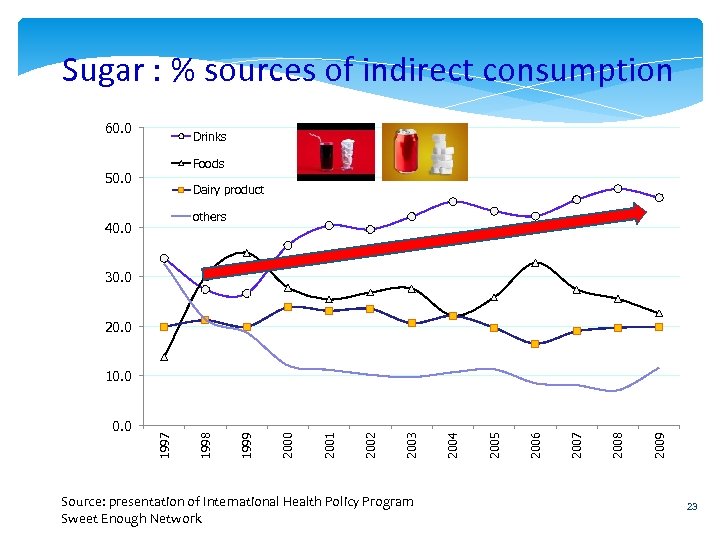 Sugar : % sources of indirect consumption 60. 0 Drinks Foods 50. 0 Dairy product others 40. 0 30. 0 20. 0 Source: presentation of International Health Policy Program Sweet Enough Network 2009 2008 2007 2006 2005 2004 2003 2002 2001 2000 1999 1998 0. 0 1997 10. 0 23
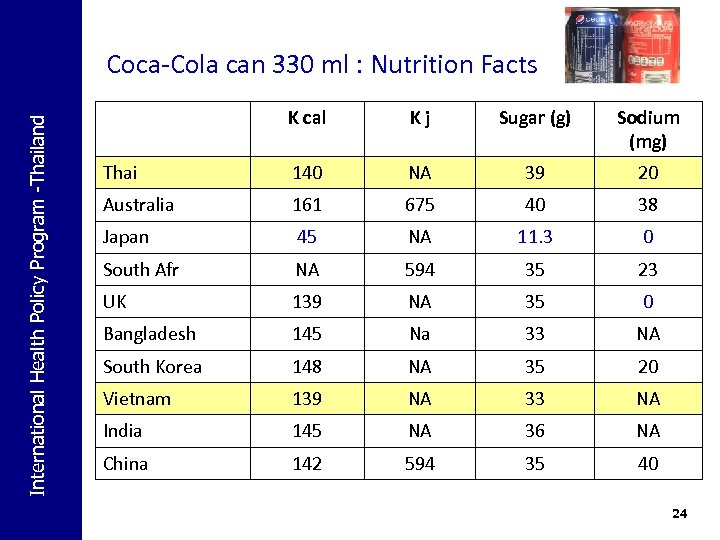 International Health Policy Program -Thailand Coca-Cola can 330 ml : Nutrition Facts K cal Kj Sugar (g) Sodium (mg) Thai 140 NA 39 20 Australia 161 675 40 38 Japan 45 NA 11. 3 0 South Afr NA 594 35 23 UK 139 NA 35 0 Bangladesh 145 Na 33 NA South Korea 148 NA 35 20 Vietnam 139 NA 33 NA India 145 NA 36 NA China 142 594 35 40 24
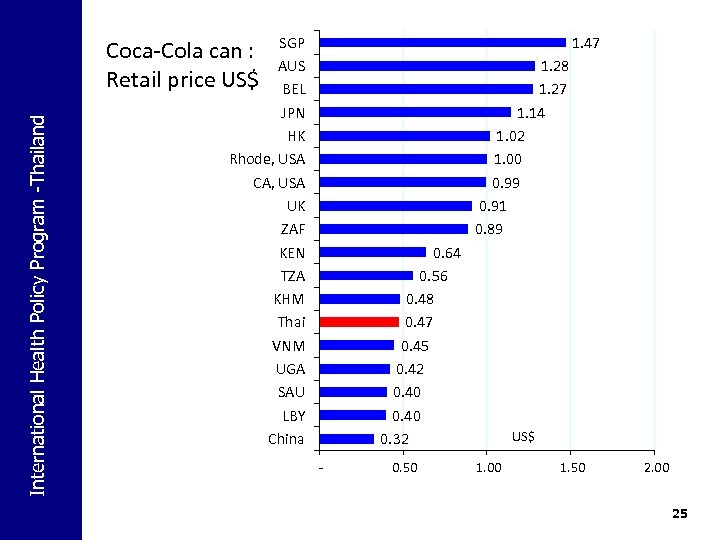 SGP AUS BEL JPN HK Rhode, USA CA, USA UK ZAF KEN TZA KHM Thai VNM UGA SAU LBY China 1. 47 International Health Policy Program -Thailand Coca-Cola can : Retail price US$ 1. 28 1. 27 1. 14 1. 02 1. 00 0. 99 0. 91 0. 89 0. 64 0. 56 0. 48 0. 47 0. 45 0. 42 0. 40 0. 32 - 0. 50 US$ 1. 00 1. 50 2. 00 25
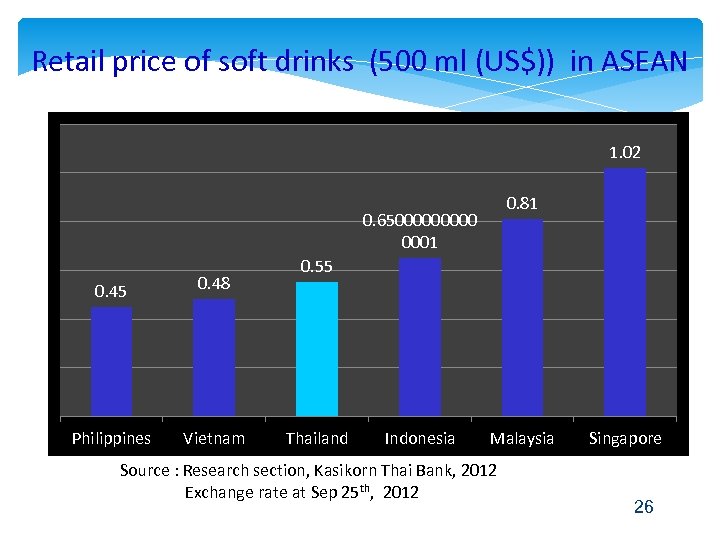 Retail price of soft drinks (500 ml (US$)) in ASEAN 1. 02 0. 81 0. 6500000 0001 0. 45 0. 48 Philippines Vietnam 0. 55 Thailand Indonesia Malaysia Source : Research section, Kasikorn Thai Bank, 2012 Exchange rate at Sep 25 th, 2012 Singapore 26
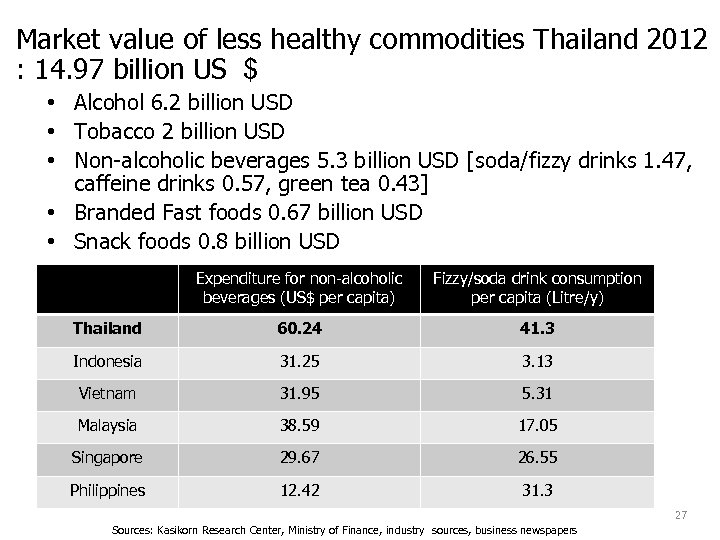 Market value of less healthy commodities Thailand 2012 : 14. 97 billion US $ • Alcohol 6. 2 billion USD • Tobacco 2 billion USD • Non-alcoholic beverages 5. 3 billion USD [soda/fizzy drinks 1. 47, caffeine drinks 0. 57, green tea 0. 43] • Branded Fast foods 0. 67 billion USD • Snack foods 0. 8 billion USD Expenditure for non-alcoholic beverages (US$ per capita) Fizzy/soda drink consumption per capita (Litre/y) Thailand 60. 24 41. 3 Indonesia 31. 25 3. 13 Vietnam 31. 95 5. 31 Malaysia 38. 59 17. 05 Singapore 29. 67 26. 55 Philippines 12. 42 31. 3 27 Sources: Kasikorn Research Center, Ministry of Finance, industry sources, business newspapers
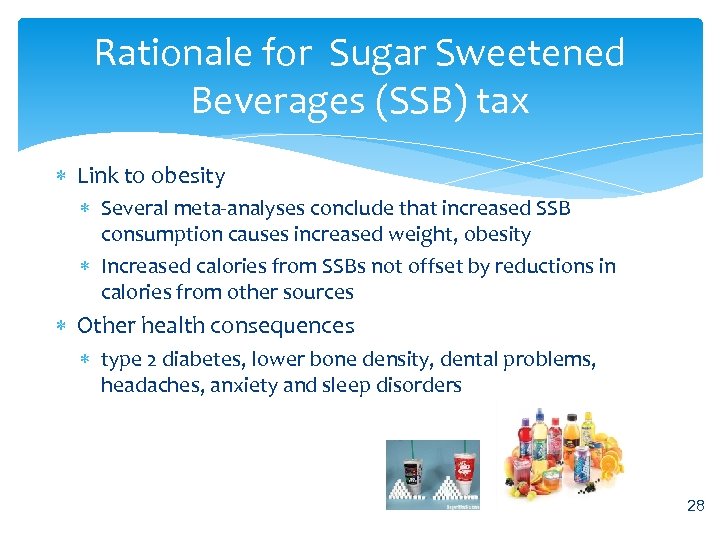 Rationale for Sugar Sweetened Beverages (SSB) tax Link to obesity Several meta-analyses conclude that increased SSB consumption causes increased weight, obesity Increased calories from SSBs not offset by reductions in calories from other sources Other health consequences type 2 diabetes, lower bone density, dental problems, headaches, anxiety and sleep disorders 28
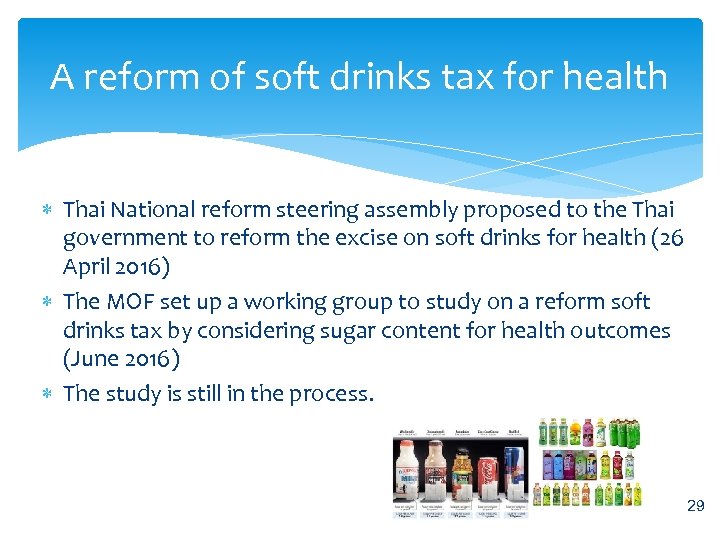 A reform of soft drinks tax for health Thai National reform steering assembly proposed to the Thai government to reform the excise on soft drinks for health (26 April 2016) The MOF set up a working group to study on a reform soft drinks tax by considering sugar content for health outcomes (June 2016) The study is still in the process. 29
 Proposed tax structure 1. Define what is soft drinks in the tax base (including RTD tea and coffee, etc. ) 2. Set up a tier- tax rate according to sugar content 3. Change to a Mix System (Ad Valorem (RSP) + Specific) 4. Re- evaluate/Increase the Juice content specified by the Excise Decree to receive the tax exemption Thai Excise Department 30
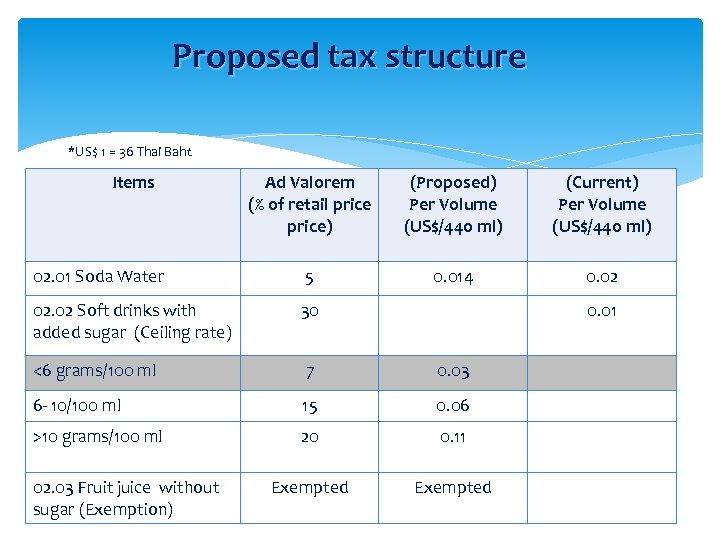 Proposed tax structure *US$ 1 = 36 Thai Baht Items Ad Valorem (% of retail price) (Proposed) Per Volume (US$/440 ml) (Current) Per Volume (US$/440 ml) 02. 01 Soda Water 5 0. 014 0. 02 02. 02 Soft drinks with added sugar (Ceiling rate) 30 <6 grams/100 ml 7 0. 03 6 - 10/100 ml 15 0. 06 >10 grams/100 ml 20 0. 11 Exempted 02. 03 Fruit juice without sugar (Exemption) 0. 01
 Challenges • Opposition from sugar industry and soft drink companies • How about non- manufacturing sugary soft drinks and other sugary products • Need to be adjusted tax rate over time to prevent tax erosion by inflation and reduction of affordability • Regressivity of tax 32
 33
33