 Скачать презентацию Tax Management Permanent Establishment Head of the Group
TM01G01-last.pptx
- Количество слайдов: 19



Tax Management Permanent Establishment Head of the Group: Group Members: Ekaterina Paramonova Evgeniya Avvakumova Sergey Ermakov Artem Zvenigorodskiy Daria Chulkova Igor Solomakha Daria Sokoluk Sofya Matvienko Khachatrian Angelika Moscow 2013
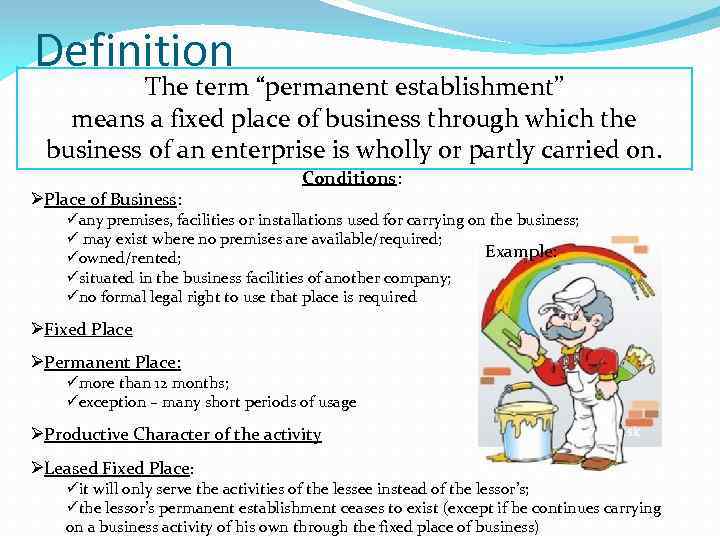
Definition The term “permanent establishment” means a fixed place of business through which the business of an enterprise is wholly or partly carried on. ØPlace of Business: Conditions: üany premises, facilities or installations used for carrying on the business; ü may exist where no premises are available/required; Example: üowned/rented; üsituated in the business facilities of another company; üno formal legal right to use that place is required ØFixed Place ØPermanent Place: ümore than 12 months; üexception – many short periods of usage ØProductive Character of the activity ØLeased Fixed Place: üit will only serve the activities of the lessee instead of the lessor’s; üthe lessor’s permanent establishment ceases to exist (except if he continues carrying on a business activity of his own through the fixed place of business)
The term “permanent establishment” includes especially a) a place of management; b) a branch; c) an office; d) a factory; e) a workshop, and f) a mine, an oil or gas well, a quarry or any other place of extraction of natural resources.
Building site or construction/installation project Ø“Building site or construction project” – not only buildings, but also construction or renovation of roads, canals, the laying of pipe-lines, etc. Ø“Installation project “ – apart from installation related to a construction project, includes installation of new equipment in an excising building or outdoors.
Building site or construction/installation project Ø Project constitutes a permanent establishment only if lasts more than 12 months. Ø Temporary discontinuity is NOT excluded (seasonal interruption, bad weather, lack of material or labor). Ø Building site should be regarded as a single unit, even if it is based on several contracts, or represents a project, which reallocates over time within a country (pipe-line laying, road, canal construction).
“Permanent Establishment does not include facilities and maintenance for: Display or delivery of goods. Purchasing goods or merchandise or of collecting information, for the enterprise; Carrying on any other activity of a preparatory or auxiliary character Any combinations of mentioned above
An enterprise should be treated as having a permanent establishment in a State if there is under certain conditions a person acting for it => which gives that State the right to tax in such cases
Conditions of having a Permanent Establishment The general rule sounds as follows: If a person is acting on behalf of an enterprise and has, and habitually exercises, in a Contracting State an authority to conclude contracts in the name of the enterprise, that enterprise shall be deemed to have a permanent establishment in that State in respect of any activities which that person undertakes for the enterprise, unless the activities of such person are limited to those mentioned before.
Dependent agents • persons whose activities may create a permanent establishment for the enterprise • either individuals or companies • need not be residents of, nor have a place of business in, the State in which they act for the enterprise • only persons having the authority to conclude contracts can lead to a permanent establishment for the enterprise maintaining them
Notes to the rule • the rule applies equally to an agent who concludes contracts which are binding on the enterprise even if those contracts are not actually in the name of the enterprise • the authority to conclude contracts must cover contracts relating to operations which constitute the business proper of the enterprise • the authority has to be habitually exercised in the other State (the presence which an enterprise maintains in a Contracting State should be more than merely transitory)
An enterprise should not have a permanent establishment in a Contracting State, because:
It acting in the ordinary business course and carries on business in the State through: - a broker - general commission agent of an independent status - any other agent
Comment 1: This enterprise cannot be taxed in the other Contracting State and constitute a PE of a foreign enterprise + will not institute PE: a) independent legally and economically b) acts in ordinary business course
Comment 2: Person’s commercial activities for company are subject to detailed institutions or to comprehensive control Entrepreneurial risk has to be borne by person or by enterprise
Comment 3: Insurance company of one State may be taxed in the other State on its insurance business It has a fixed place If profits arise: a) Deemed PE in other State b) Insure risks situated in that terrotory
Acceptance: the existence of a subsidiary company does not, of itself, constitute that subsidiary company a permanent establishment of its parent company Principle: subsidiary company constitutes an independent legal entity
Principles of a parent company: have a permanent establishment in a State where a subsidiary has a place of business any space or premises belonging to the subsidiary that is at the disposal of the parent company and that constitutes a fixed place of business through which the parent carries on its own business will constitute a permanent establishment of the parent a parent will be deemed to have a permanent establishment in a State in respect of any activities that its subsidiary undertakes for it if the subsidiary has, and habitually exercises, in that State an authority to conclude contracts in the name of the parent, unless these activities are limited
Principles for any company forming part of a multinational group: such a company may be found to have a permanent establishment in a State where it has at its disposal and uses premises belonging to another company of the group, or if the former company is deemed to have a Permanent Establishment the determination of the existence of a permanent establishment must, however, be done separately for each company of the group the existence in one State of a permanent establishment of one company of the group will not have any relevance as to whether another company of the group has itself a permanent establishment in that State.
Premises belonging to a parent company: can be put at the disposal of another company of the group it is important to distinguish company that is a member of a multinational group from another company of the group as part of its own business carried on in premises that are not those of that other company and using its own personnel that place cannot be considered to be a permanent establishment of the company to which the services are provided
Скачать презентацию Tax Management Permanent Establishment Head of the Group
TM01G01-last.pptx