 Скачать презентацию Tax Implications of Inbound Investments into Russia Boris
e1221d5c8f3e8915a6a2d2204ec4ab55.ppt
- Количество слайдов: 28



Tax Implications of Inbound Investments into Russia Boris Bruk, Of Counsel, Salans Moscow 24 February 2011
Key questions § Form of presence: branch vs. subsidiary § How to finance your activities in Russia § Repatriation of profits § Divestment (exit from the project) 2
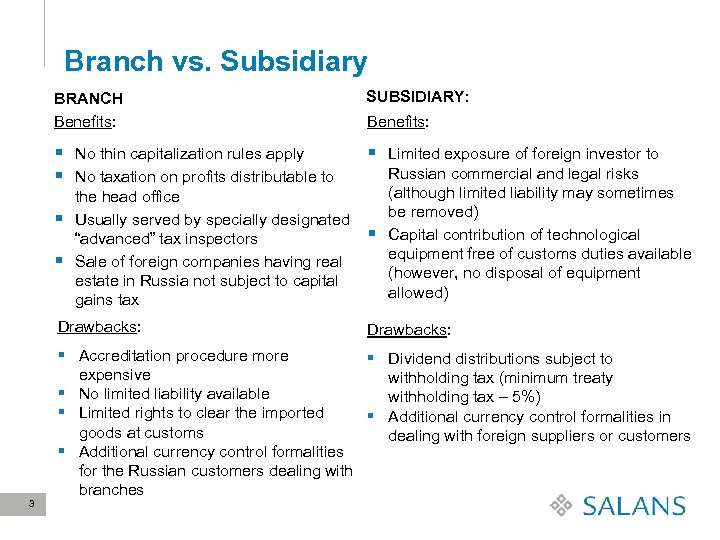
Branch vs. Subsidiary BRANCH Benefits: SUBSIDIARY: § No thin capitalization rules apply § No taxation on profits distributable to § Limited exposure of foreign investor to § § the head office Usually served by specially designated “advanced” tax inspectors Sale of foreign companies having real estate in Russia not subject to capital gains tax Drawbacks: 3 Benefits: § Russian commercial and legal risks (although limited liability may sometimes be removed) Capital contribution of technological equipment free of customs duties available (however, no disposal of equipment allowed) Drawbacks: § Accreditation procedure more § Dividend distributions subject to expensive withholding tax (minimum treaty § No limited liability available withholding tax – 5%) § Limited rights to clear the imported § Additional currency control formalities in goods at customs dealing with foreign suppliers or customers § Additional currency control formalities for the Russian customers dealing with branches
How to finance your activities § Capital contribution (including share premium) § Contribution to assets § Debt financing 4
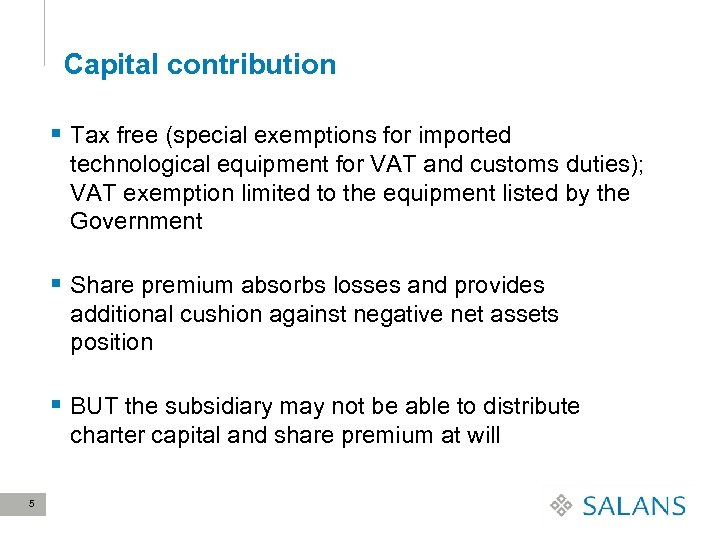
Capital contribution § Tax free (special exemptions for imported technological equipment for VAT and customs duties); VAT exemption limited to the equipment listed by the Government § Share premium absorbs losses and provides additional cushion against negative net assets position § BUT the subsidiary may not be able to distribute charter capital and share premium at will 5
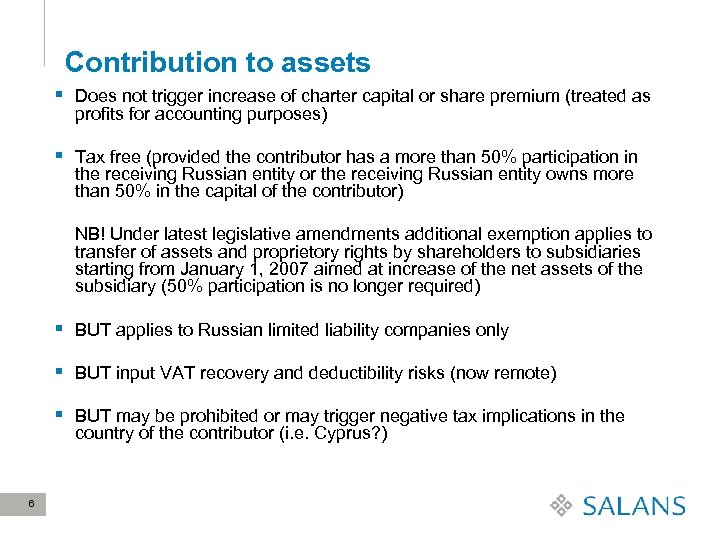
Contribution to assets § Does not trigger increase of charter capital or share premium (treated as profits for accounting purposes) § Tax free (provided the contributor has a more than 50% participation in the receiving Russian entity or the receiving Russian entity owns more than 50% in the capital of the contributor) NB! Under latest legislative amendments additional exemption applies to transfer of assets and proprietory rights by shareholders to subsidiaries starting from January 1, 2007 aimed at increase of the net assets of the subsidiary (50% participation is no longer required) § BUT applies to Russian limited liability companies only § BUT input VAT recovery and deductibility risks (now remote) § BUT may be prohibited or may trigger negative tax implications in the country of the contributor (i. e. Cyprus? ) 6
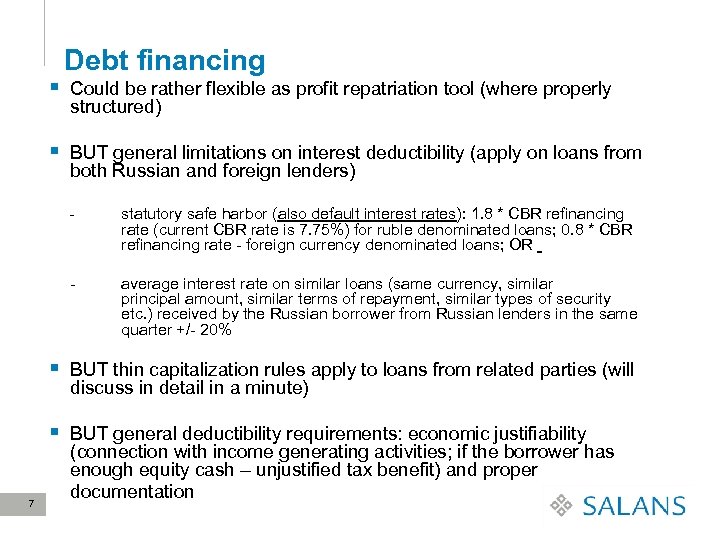
Debt financing § Could be rather flexible as profit repatriation tool (where properly structured) § BUT general limitations on interest deductibility (apply on loans from both Russian and foreign lenders) - statutory safe harbor (also default interest rates): 1. 8 * CBR refinancing rate (current CBR rate is 7. 75%) for ruble denominated loans; 0. 8 * CBR refinancing rate - foreign currency denominated loans; OR - average interest rate on similar loans (same currency, similar principal amount, similar terms of repayment, similar types of security etc. ) received by the Russian borrower from Russian lenders in the same quarter +/- 20% § BUT thin capitalization rules apply to loans from related parties (will discuss in detail in a minute) § BUT general deductibility requirements: economic justifiability 7 (connection with income generating activities; if the borrower has enough equity cash – unjustified tax benefit) and proper documentation
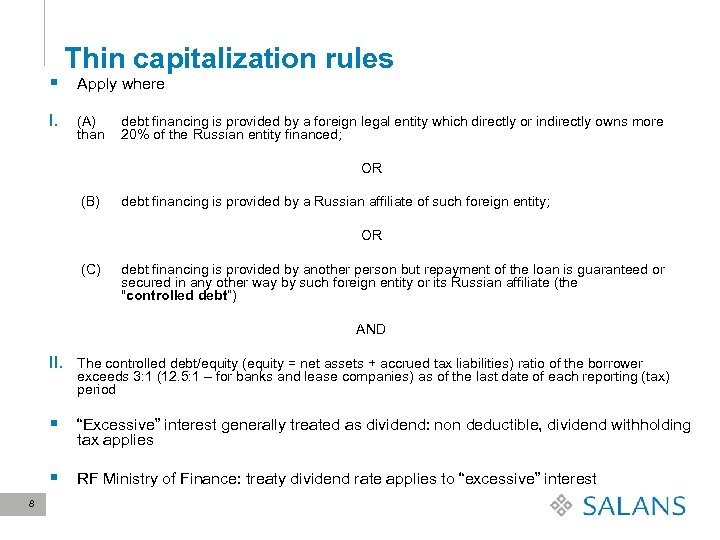
Thin capitalization rules § Apply where I. (A) than debt financing is provided by a foreign legal entity which directly or indirectly owns more 20% of the Russian entity financed; OR (B) debt financing is provided by a Russian affiliate of such foreign entity; OR (C) debt financing is provided by another person but repayment of the loan is guaranteed or secured in any other way by such foreign entity or its Russian affiliate (the "controlled debt“) AND II. The controlled debt/equity (equity = net assets + accrued tax liabilities) ratio of the borrower exceeds 3: 1 (12. 5: 1 – for banks and lease companies) as of the last date of each reporting (tax) period § “Excessive” interest generally treated as dividend: non deductible, dividend withholding tax applies § RF Ministry of Finance: treaty dividend rate applies to “excessive” interest 8
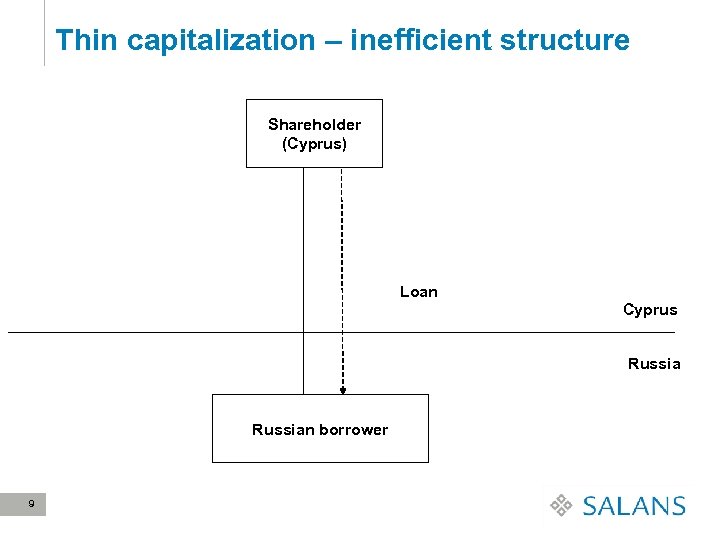
Thin capitalization – inefficient structure Shareholder (Cyprus) Loan Cyprus Russian borrower 9
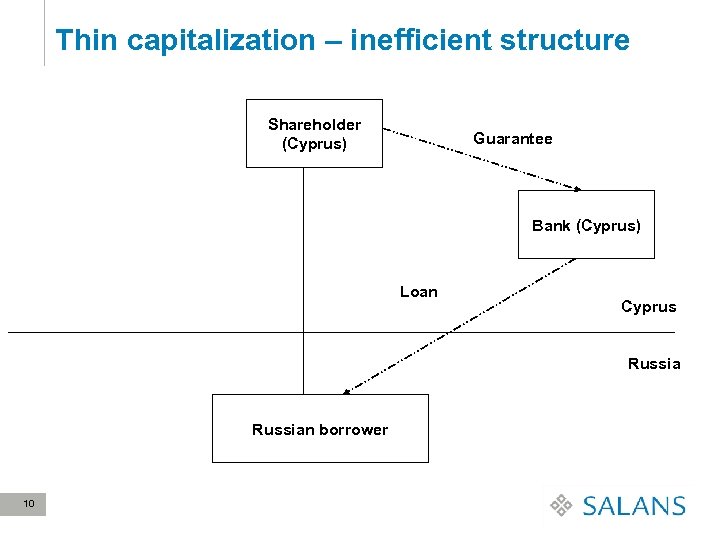
Thin capitalization – inefficient structure Shareholder (Cyprus) Guarantee Bank (Cyprus) Loan Cyprus Russian borrower 10
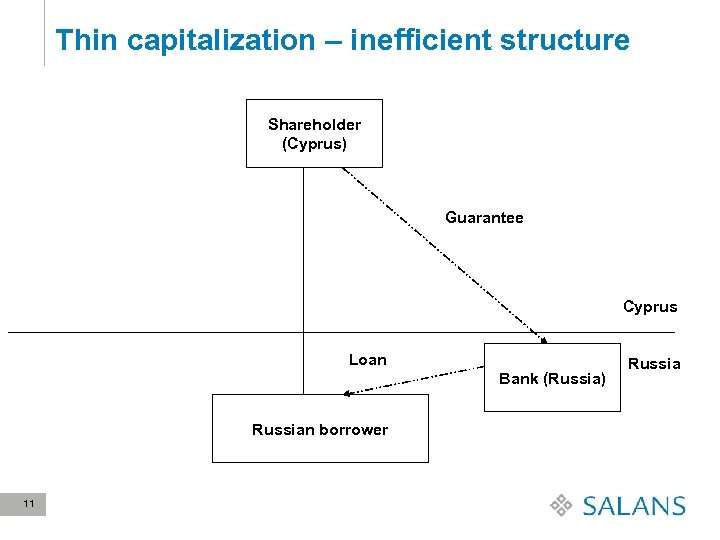
Thin capitalization – inefficient structure Shareholder (Cyprus) Guarantee Cyprus Loan Bank (Russia) Russian borrower 11 Russia
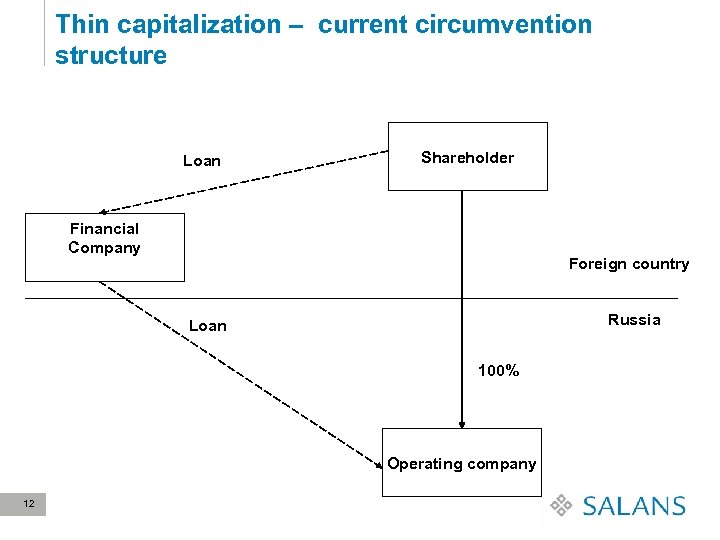
Thin capitalization – current circumvention structure Loan Shareholder Financial Company Foreign country Russia Loan 100% Operating company 12
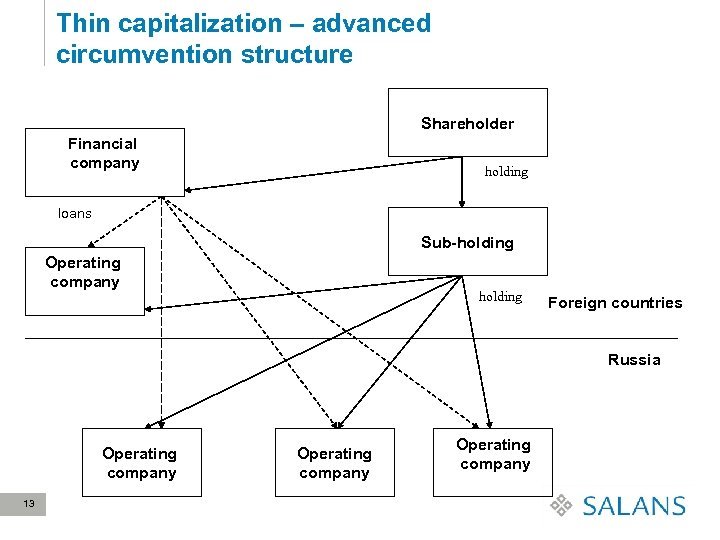
Thin capitalization – advanced circumvention structure Shareholder Financial company holding loans Sub-holding Operating company holding Foreign countries Russia Operating company 13 Operating company
Thin capitalization – fresh view § Positive court practice developed: - interest paid to a German resident lender (Federal Moscow District Arbitration Court, 2005) interest paid to a Dutch resident lender (Federal North Western District Arbitration Court, 2007) interest paid to a Finnish resident lender (Federal North Western District Arbitration Court, 2009) interest paid to a Cyprus resident lender (Federal Moscow District Arbitration Court, 2009 and 2010) interest paid to a Cyprus and a Hundarian resident lender (Federal Moscow District Arbitration Court, 2010) Courts denied application of thin capitalization rules: - reclassification of interest as dividend income for treaty purposes impossible as the treaties contain autonomous definitions of “dividends” and “interest”; reclassification of interest as dividend income and denial of deductibility of “excessive interest” does not comply with the treaty non-discrimination rules (should be deductible as if paid to or guaranteed by a Russian parent or an affiliate of a Russian parent) § Special circumstances: both Russia – Germany tax treaty and Russia – Netherlands tax treaty contain special “unlimited deductibility” clause § The tax authorities still try to argue with the above position of the courts § No “unlimited deductibility" clauses in Russia – Cyprus double tax treaty § Protocol to the Russia – Cyprus double tax treaty: interest reclassified into dividend income to be treated as dividend income for treaty purposes; non-discrimination rules will not change 14
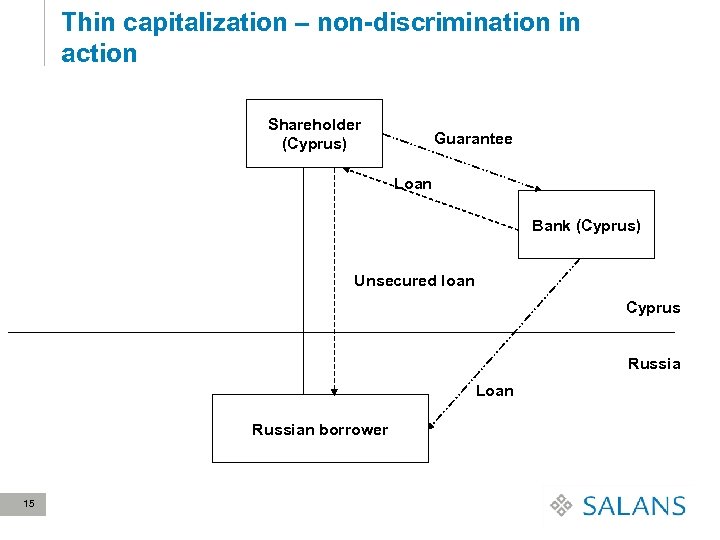
Thin capitalization – non-discrimination in action Shareholder (Cyprus) Guarantee Loan Bank (Cyprus) Unsecured loan Cyprus Russia Loan Russian borrower 15
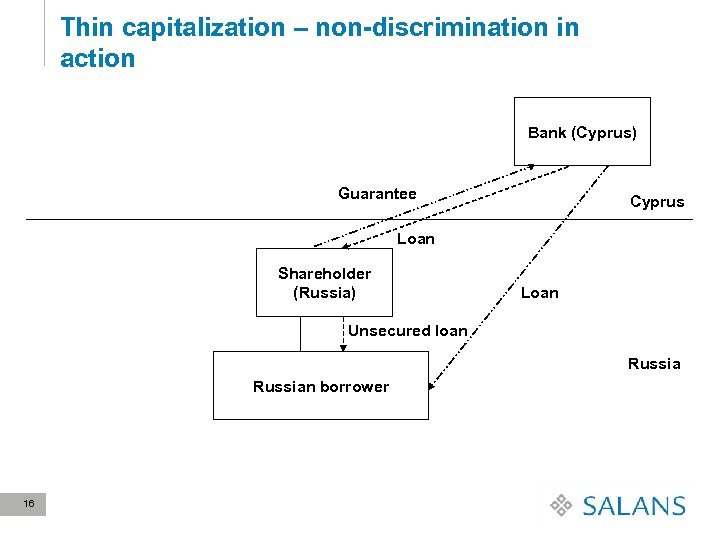
Thin capitalization – non-discrimination in action Bank (Cyprus) Guarantee Cyprus Loan Shareholder (Russia) Loan Unsecured loan Russian borrower 16
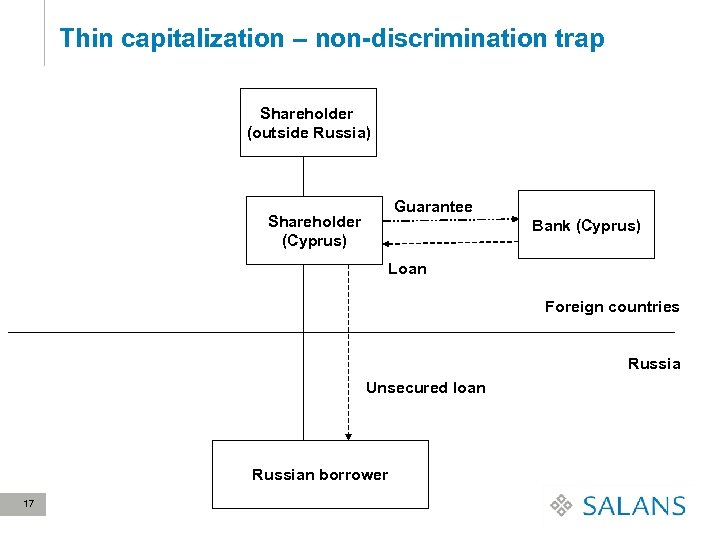
Thin capitalization – non-discrimination trap Shareholder (outside Russia) Guarantee Shareholder (Cyprus) Bank (Cyprus) Loan Foreign countries Russia Unsecured loan Russian borrower 17
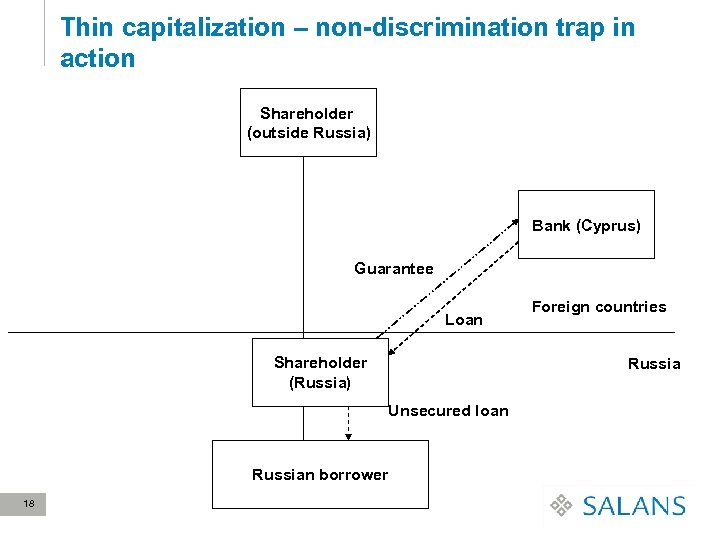
Thin capitalization – non-discrimination trap in action Shareholder (outside Russia) Bank (Cyprus) Guarantee Loan Shareholder (Russia) Russia Unsecured loan Russian borrower 18 Foreign countries
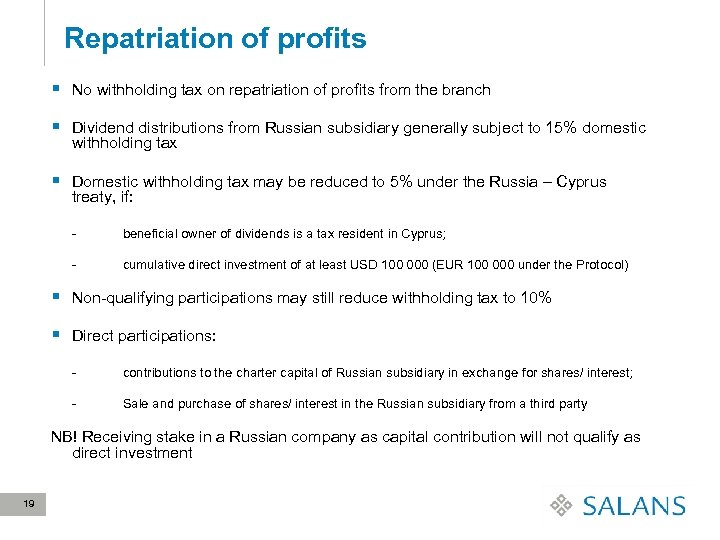
Repatriation of profits § No withholding tax on repatriation of profits from the branch § Dividend distributions from Russian subsidiary generally subject to 15% domestic withholding tax § Domestic withholding tax may be reduced to 5% under the Russia – Cyprus treaty, if: - beneficial owner of dividends is a tax resident in Cyprus; - cumulative direct investment of at least USD 100 000 (EUR 100 000 under the Protocol) § Non-qualifying participations may still reduce withholding tax to 10% § Direct participations: - contributions to the charter capital of Russian subsidiary in exchange for shares/ interest; - Sale and purchase of shares/ interest in the Russian subsidiary from a third party NB! Receiving stake in a Russian company as capital contribution will not qualify as direct investment 19
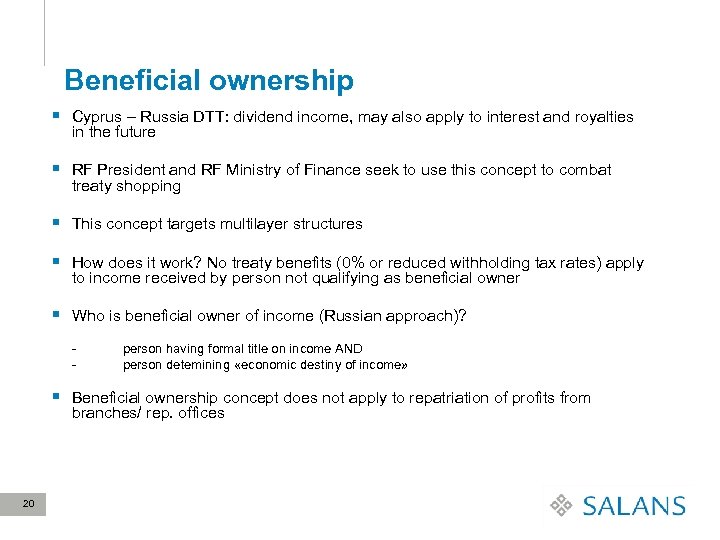
Beneficial ownership § Cyprus – Russia DTT: dividend income, may also apply to interest and royalties in the future § RF President and RF Ministry of Finance seek to use this concept to combat treaty shopping § This concept targets multilayer structures § How does it work? No treaty benefits (0% or reduced withholding tax rates) apply to income received by person not qualifying as beneficial owner § Who is beneficial owner of income (Russian approach)? - person having formal title on income AND person detemining «economic destiny of income» § Beneficial ownership concept does not apply to repatriation of profits from branches/ rep. offices 20
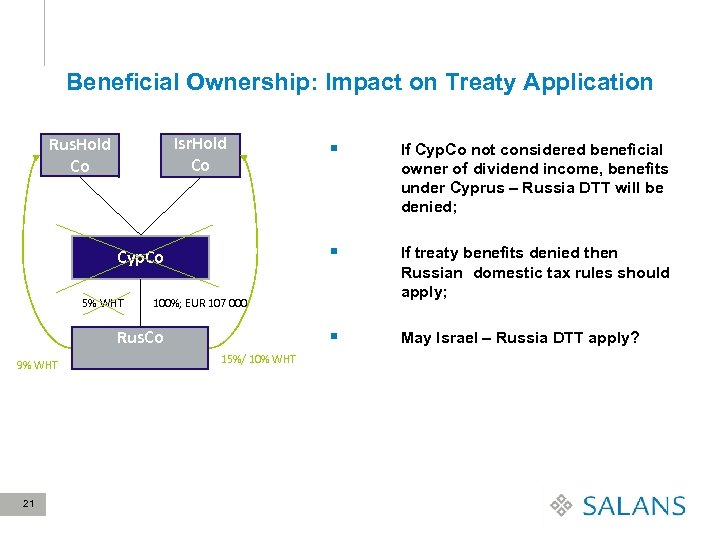
Beneficial Ownership: Impact on Treaty Application Isr. Hold Co Rus. Hold Co 5% WHT 21 If treaty benefits denied then Russian domestic tax rules should apply; § May Israel – Russia DTT apply? 100%; EUR 107 000 Rus. Co 9% WHT If Cyp. Co not considered beneficial owner of dividend income, benefits under Cyprus – Russia DTT will be denied; § Cyp. Co § 15%/ 10% WHT
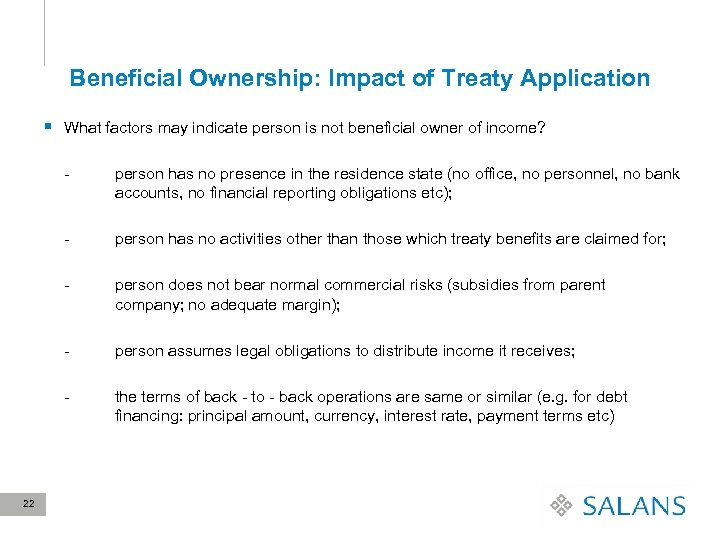
Beneficial Ownership: Impact of Treaty Application § What factors may indicate person is not beneficial owner of income? - - person has no activities other than those which treaty benefits are claimed for; - person does not bear normal commercial risks (subsidies from parent company; no adequate margin); - person assumes legal obligations to distribute income it receives; - 22 person has no presence in the residence state (no office, no personnel, no bank accounts, no financial reporting obligations etc); the terms of back - to - back operations are same or similar (e. g. for debt financing: principal amount, currency, interest rate, payment terms etc)
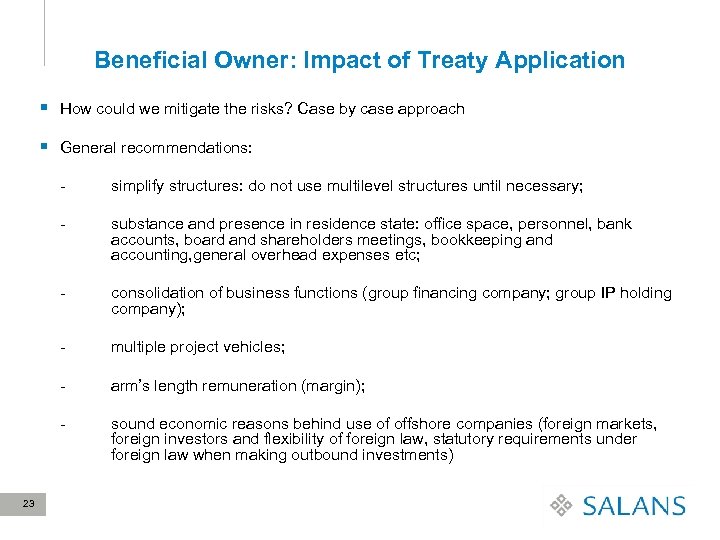
Beneficial Owner: Impact of Treaty Application § How could we mitigate the risks? Case by case approach § General recommendations: - substance and presence in residence state: office space, personnel, bank accounts, board and shareholders meetings, bookkeeping and accounting, general overhead expenses etc; - consolidation of business functions (group financing company; group IP holding company); - multiple project vehicles; - arm’s length remuneration (margin); - 23 simplify structures: do not use multilevel structures until necessary; sound economic reasons behind use of offshore companies (foreign markets, foreign investors and flexibility of foreign law, statutory requirements under foreign law when making outbound investments)
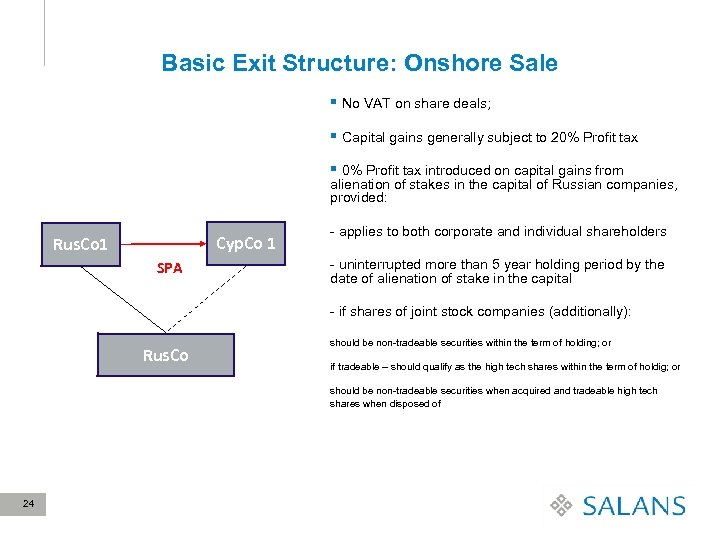
Basic Exit Structure: Onshore Sale § No VAT on share deals; § Capital gains generally subject to 20% Profit tax § 0% Profit tax introduced on capital gains from alienation of stakes in the capital of Russian companies, provided: Cyp. Co 1 Rus. Co 1 SPA - applies to both corporate and individual shareholders - uninterrupted more than 5 year holding period by the date of alienation of stake in the capital - if shares of joint stock companies (additionally): Rus. Co should be non-tradeable securities within the term of holding; or if tradeable – should qualify as the high tech shares within the term of holdig; or should be non-tradeable securities when acquired and tradeable high tech shares when disposed of 24
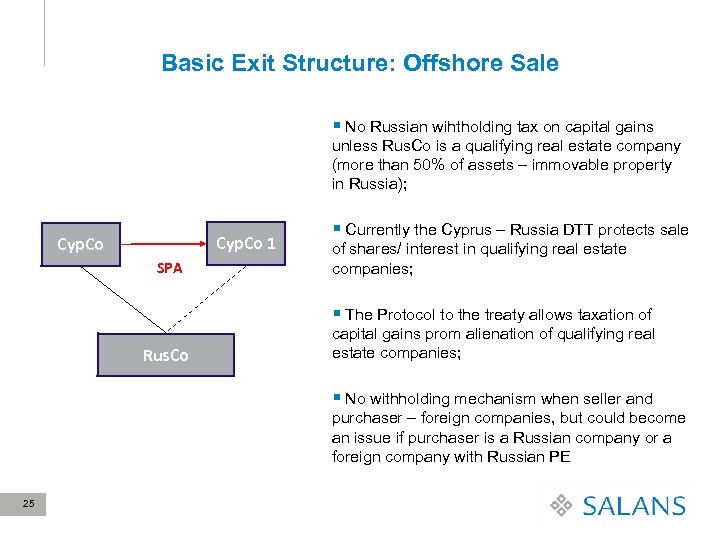
Basic Exit Structure: Offshore Sale § No Russian wihtholding tax on capital gains unless Rus. Co is a qualifying real estate company (more than 50% of assets – immovable property in Russia); Cyp. Co 1 Cyp. Co SPA § Currently the Cyprus – Russia DTT protects sale of shares/ interest in qualifying real estate companies; § The Protocol to the treaty allows taxation of Rus. Co capital gains prom alienation of qualifying real estate companies; § No withholding mechanism when seller and purchaser – foreign companies, but could become an issue if purchaser is a Russian company or a foreign company with Russian PE 25
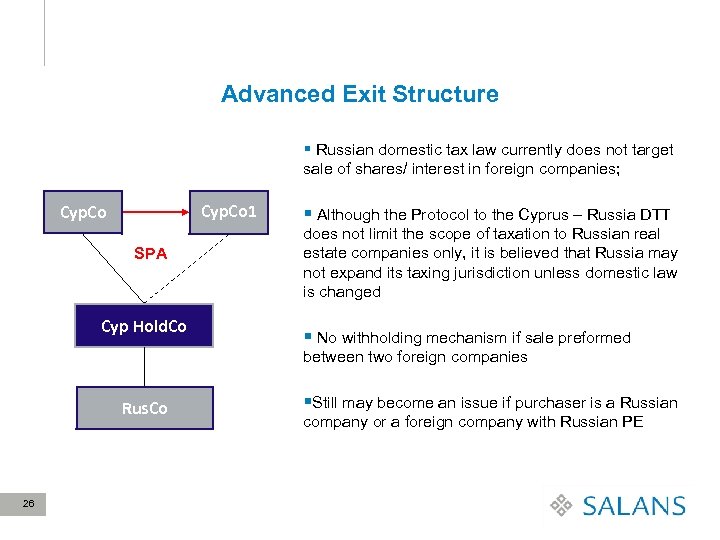
Advanced Exit Structure § Russian domestic tax law currently does not target sale of shares/ interest in foreign companies; Cyp. Co 1 Cyp. Co SPA Cyp Hold. Co § Although the Protocol to the Cyprus – Russia DTT does not limit the scope of taxation to Russian real estate companies only, it is believed that Russia may not expand its taxing jurisdiction unless domestic law is changed § No withholding mechanism if sale preformed between two foreign companies Rus. Co 26 §Still may become an issue if purchaser is a Russian company or a foreign company with Russian PE
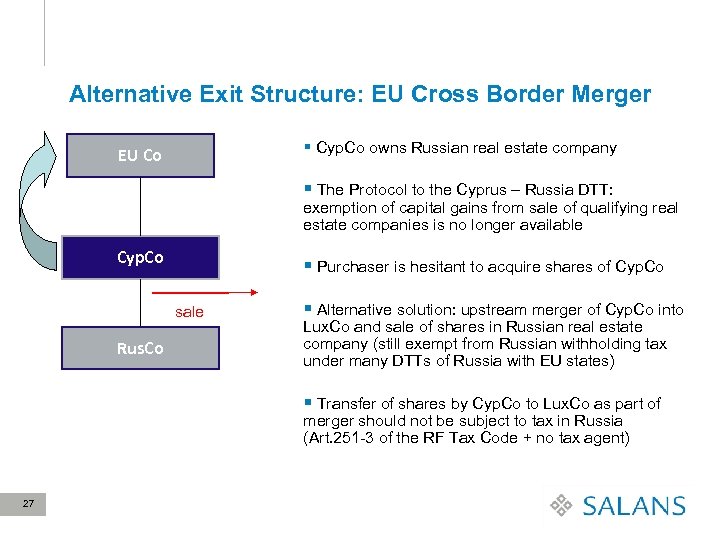
Alternative Exit Structure: EU Cross Border Merger § Cyp. Co owns Russian real estate company EU Co § The Protocol to the Cyprus – Russia DTT: exemption of capital gains from sale of qualifying real estate companies is no longer available Cyp. Co § Purchaser is hesitant to acquire shares of Cyp. Co sale Rus. Co § Alternative solution: upstream merger of Cyp. Co into Lux. Co and sale of shares in Russian real estate company (still exempt from Russian withholding tax under many DTTs of Russia with EU states) § Transfer of shares by Cyp. Co to Lux. Co as part of merger should not be subject to tax in Russia (Art. 251 -3 of the RF Tax Code + no tax agent) 27
Contact Boris Bruk, Of Counsel Tax Practice, Salans Moscow bbruk@salans. com Salans Balchug Plaza, Ul. Balchug, 7 115035 Moscow, Russia Tel. : + 7 (495) 644 0500 (ext. 4534) Fax: + 7 (495) 644 0599 28
Скачать презентацию Tax Implications of Inbound Investments into Russia Boris
e1221d5c8f3e8915a6a2d2204ec4ab55.ppt