


 Скачать презентацию Tax-Free Exchanges The Fischer Article Text p 957
59224b3fdef4df8a43896056d58ea091.ppt
- Количество слайдов: 94
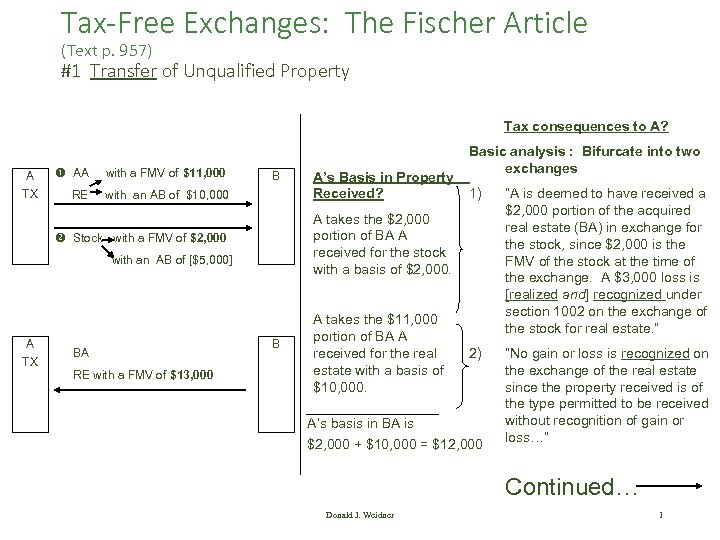 Tax-Free Exchanges: The Fischer Article (Text p. 957) #1 Transfer of Unqualified Property Tax consequences to A? A TX AA with a FMV of $11, 000 RE with an AB of $10, 000 B with an AB of [$5, 000] BA RE with a FMV of $13, 000 1) “A is deemed to have received a $2, 000 portion of the acquired real estate (BA) in exchange for the stock, since $2, 000 is the FMV of the stock at the time of the exchange. A $3, 000 loss is [realized and] recognized under section 1002 on the exchange of the stock for real estate. ” 2) “No gain or loss is recognized on the exchange of the real estate since the property received is of the type permitted to be received without recognition of gain or loss…” A takes the $2, 000 portion of BA A received for the stock with a basis of $2, 000. v Stock with a FMV of $2, 000 A TX A’s Basis in Property Received? Basic analysis : Bifurcate into two exchanges B A takes the $11, 000 portion of BA A received for the real estate with a basis of $10, 000. A’s basis in BA is $2, 000 + $10, 000 = $12, 000 Continued… Donald J. Weidner 1
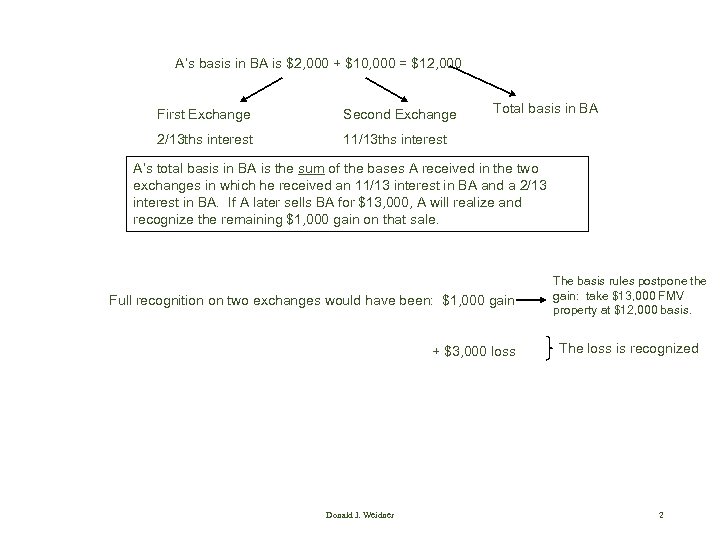 A’s basis in BA is $2, 000 + $10, 000 = $12, 000 First Exchange Second Exchange 2/13 ths interest Total basis in BA 11/13 ths interest A’s total basis in BA is the sum of the bases A received in the two exchanges in which he received an 11/13 interest in BA and a 2/13 interest in BA. If A later sells BA for $13, 000, A will realize and recognize the remaining $1, 000 gain on that sale. Full recognition on two exchanges would have been: $1, 000 gain + $3, 000 loss Donald J. Weidner The basis rules postpone the gain: take $13, 000 FMV property at $12, 000 basis. The loss is recognized 2
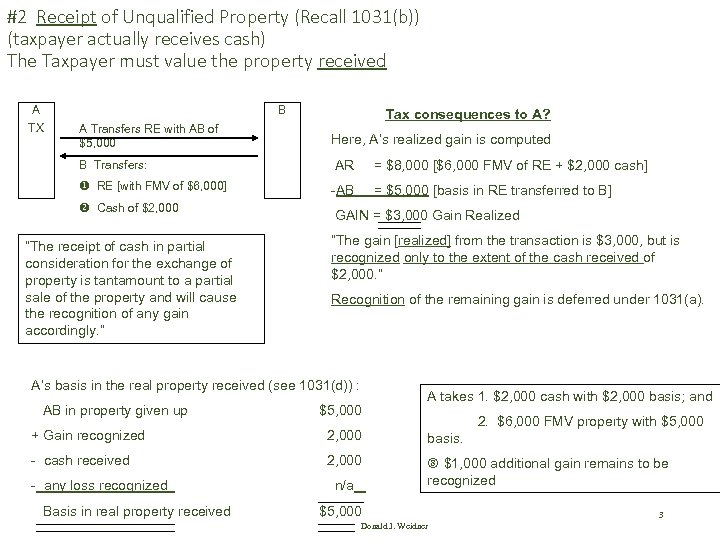 #2 Receipt of Unqualified Property (Recall 1031(b)) (taxpayer actually receives cash) The Taxpayer must value the property received A TX B A Transfers RE with AB of $5, 000 B Transfers: RE [with FMV of $6, 000] v Cash of $2, 000 “The receipt of cash in partial consideration for the exchange of property is tantamount to a partial sale of the property and will cause the recognition of any gain accordingly. ” Tax consequences to A? Here, A’s realized gain is computed AR = $8, 000 [$6, 000 FMV of RE + $2, 000 cash] -AB = $5, 000 [basis in RE transferred to B] GAIN = $3, 000 Gain Realized “The gain [realized] from the transaction is $3, 000, but is recognized only to the extent of the cash received of $2, 000. ” Recognition of the remaining gain is deferred under 1031(a). A’s basis in the real property received (see 1031(d)) : AB in property given up $5, 000 A takes 1. $2, 000 cash with $2, 000 basis; and 2. $6, 000 FMV property with $5, 000 + Gain recognized 2, 000 basis. - cash received 2, 000 $1, 000 additional gain remains to be recognized - any loss recognized Basis in real property received n/a $5, 000 Donald J. Weidner 3
 Transfer of Property Subject to a Liability and 1031 (taxpayer is deemed to receive cash) ØSee 1031(d): “For purposes of this section. . . where as part of the consideration to the taxpayer another party to the exchange assumed a liability of the taxpayer or acquired from the taxpayer property subject to a liability, such assumption or acquisition (in the amount of the liability) shall be considered as money received by the taxpayer on the exchange. ” ØWhen one transfers property subject to a liability, the shifting of that liability to another is treated as a receipt of “other property or money” by the transferor under 1031(b)—even if the transferee only takes “subject to” the liability. Donald J. Weidner 4
 Transfer of Property Subject to a Liability and § 1031 (deemed receipt of cash) (cont’d) ØRecall Tufts: one who transfers property subject to a mortgage is deemed to receive (“constructively receives”) cash in the amount of the unpaid balance of the mortgage. ØThe amount of the mortgage is treated either as an “amount realized” or as “discharge of indebtedness income, ” depending upon the circumstances. ØThe following example shows an exchange of property subject to a mortgage and is from Treas. Reg. 1. 1031(d)-2, Example (1). Donald J. Weidner 5
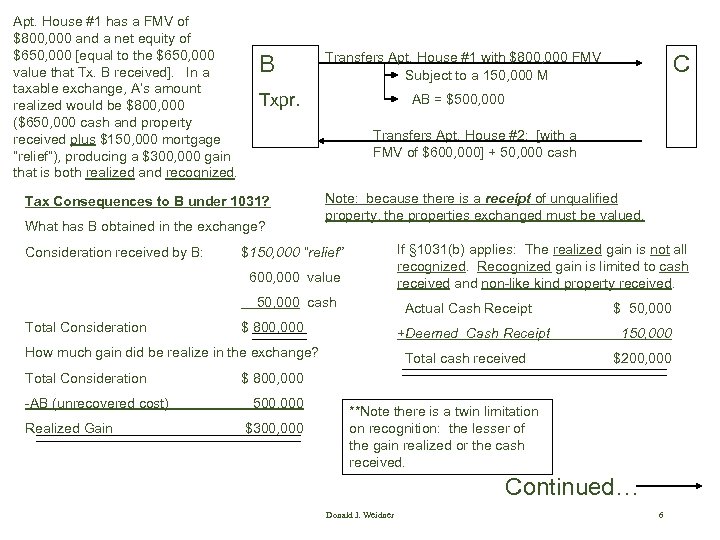 Apt. House #1 has a FMV of $800, 000 and a net equity of $650, 000 [equal to the $650, 000 value that Tx. B received]. In a taxable exchange, A’s amount realized would be $800, 000 ($650, 000 cash and property received plus $150, 000 mortgage “relief”), producing a $300, 000 gain that is both realized and recognized. B Txpr. What has B obtained in the exchange? AB = $500, 000 Note: because there is a receipt of unqualified property, the properties exchanged must be valued. If § 1031(b) applies: The realized gain is not all recognized. Recognized gain is limited to cash received and non-like kind property received. $150, 000 “relief” 600, 000 value 50, 000 cash Total Consideration Actual Cash Receipt $ 800, 000 +Deemed Cash Receipt How much gain did be realize in the exchange? Total Consideration -AB (unrecovered cost) Realized Gain C Transfers Apt. House #2: [with a FMV of $600, 000] + 50, 000 cash Tax Consequences to B under 1031? Consideration received by B: Transfers Apt. House #1 with $800, 000 FMV Subject to a 150, 000 M Total cash received $ 50, 000 150, 000 $200, 000 $ 800, 000 500, 000 $300, 000 **Note there is a twin limitation on recognition: the lesser of the gain realized or the cash received. Continued… Donald J. Weidner 6
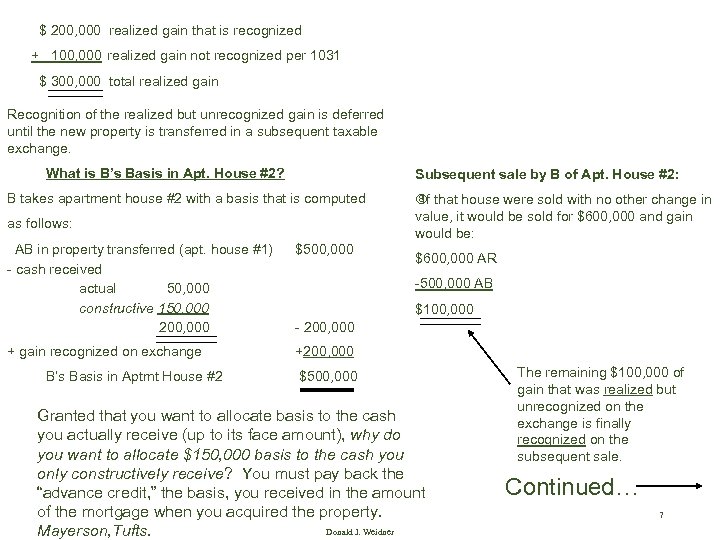 $ 200, 000 realized gain that is recognized + 100, 000 realized gain not recognized per 1031 $ 300, 000 total realized gain Recognition of the realized but unrecognized gain is deferred until the new property is transferred in a subsequent taxable exchange. What is B’s Basis in Apt. House #2? Subsequent sale by B of Apt. House #2: B takes apartment house #2 with a basis that is computed as follows: AB in property transferred (apt. house #1) - cash received actual 50, 000 constructive 150, 000 200, 000 $500, 000 + gain recognized on exchange that house were sold with no other change in If value, it would be sold for $600, 000 and gain would be: +200, 000 B’s Basis in Aptmt House #2 $600, 000 AR -500, 000 AB $100, 000 - 200, 000 $500, 000 Granted that you want to allocate basis to the cash you actually receive (up to its face amount), why do you want to allocate $150, 000 basis to the cash you only constructively receive? You must pay back the “advance credit, ” the basis, you received in the amount of the mortgage when you acquired the property. Donald J. Weidner Mayerson, Tufts. The remaining $100, 000 of gain that was realized but unrecognized on the exchange is finally recognized on the subsequent sale. Continued… 7
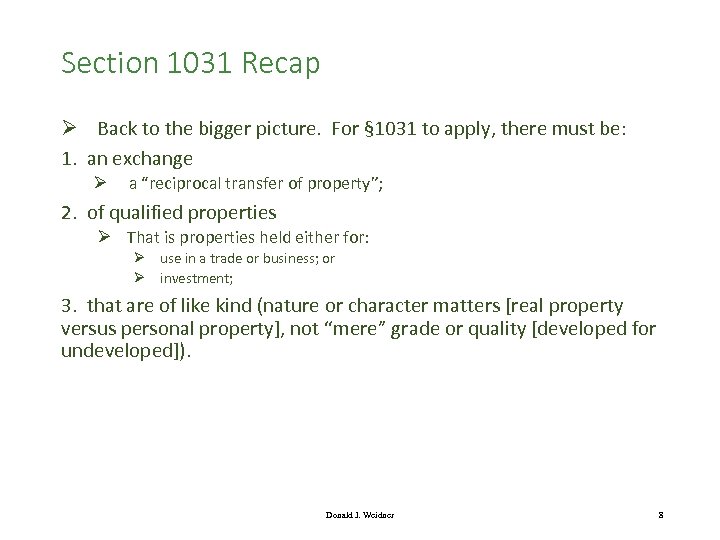 Section 1031 Recap Ø Back to the bigger picture. For § 1031 to apply, there must be: 1. an exchange Ø a “reciprocal transfer of property”; 2. of qualified properties Ø That is properties held either for: Ø use in a trade or business; or Ø investment; 3. that are of like kind (nature or character matters [real property versus personal property], not “mere” grade or quality [developed for undeveloped]). Donald J. Weidner 8
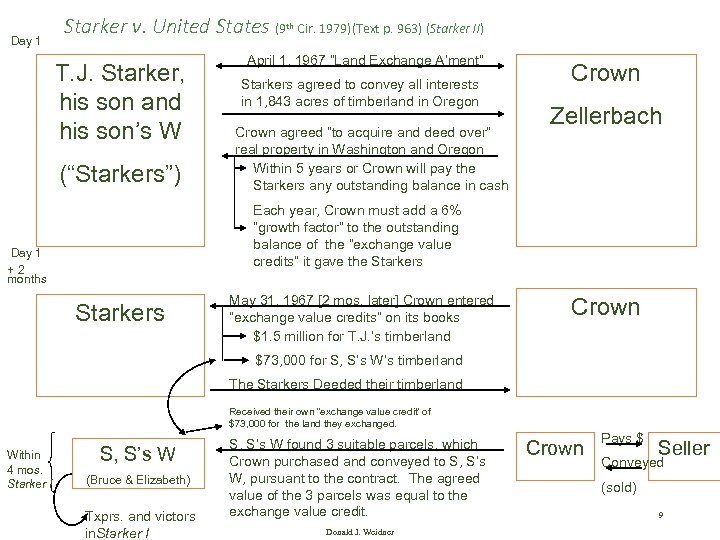 Day 1 Starker v. United States (9 th Cir. 1979)(Text p. 963) (Starker II) T. J. Starker, his son and his son’s W (“Starkers”) April 1, 1967 “Land Exchange A’ment” Starkers agreed to convey all interests in 1, 843 acres of timberland in Oregon Crown agreed “to acquire and deed over” real property in Washington and Oregon Within 5 years or Crown will pay the Starkers any outstanding balance in cash Crown Zellerbach Each year, Crown must add a 6% “growth factor” to the outstanding balance of the “exchange value credits” it gave the Starkers Day 1 +2 months Starkers May 31, 1967 [2 mos. later] Crown entered “exchange value credits” on its books $1. 5 million for T. J. ’s timberland Crown $73, 000 for S, S’s W’s timberland The Starkers Deeded their timberland Received their own “exchange value credit’ of $73, 000 for the land they exchanged. Within 4 mos. Starker I S, S’s W (Bruce & Elizabeth) Txprs. and victors in. Starker I S, S’s W found 3 suitable parcels, which Crown purchased and conveyed to S, S’s W, pursuant to the contract. The agreed value of the 3 parcels was equal to the exchange value credit. Donald J. Weidner Crown Pays $ Seller Conveyed (sold) 9
 Starker I and Starker II: The Nonsimultaneous Transfers ØThe son and his wife were the taxpayers in Starker I—they defeated an IRS attempt to deny them 1031 treatment. ØHaving lost against the son and his wife, the IRS went after the father in Starker II. ØThe 9 th Circuit concluded that Starker I collaterally estopped the IRS from attacking the portion of the exchange dealing with 9 parcels that Crown purchased and conveyed to the father. ØWhich left with only 3 parcels to discuss in Starker II. ØNone of the 3 parcels discussed in Starker II was deeded to the father, T. J. (or to his daughter), at or near the time T. J. conveyed his timberland to Crown. ØThat is, the common issue as to all three parcels is that the reciprocal transfers were not simultaneous. Donald J. Weidner 10
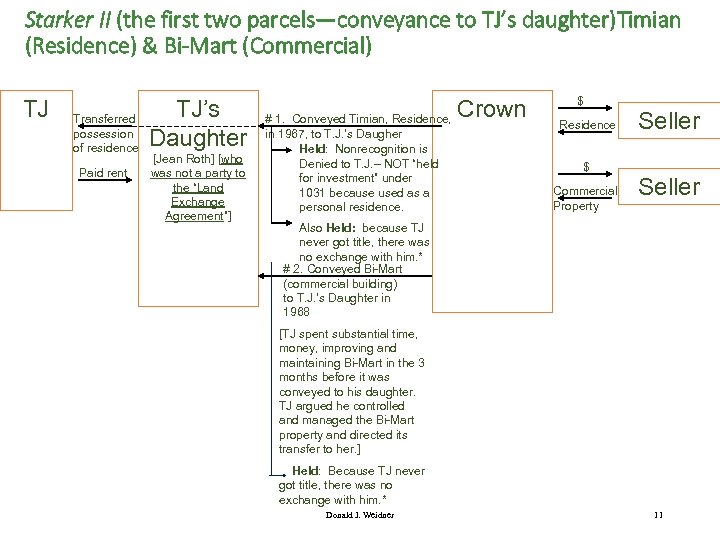 Starker II (the first two parcels—conveyance to TJ’s daughter)Timian (Residence) & Bi-Mart (Commercial) TJ Transferred possession of residence Paid rent TJ’s Daughter [Jean Roth] [who was not a party to the “Land Exchange Agreement”] Crown # 1. Conveyed Timian, Residence, in 1967, to T. J. ’s Daugher Held: Nonrecognition is Denied to T. J. – NOT “held for investment” under 1031 because used as a personal residence. $ Residence $ Commercial Property Seller Also Held: because TJ never got title, there was no exchange with him. * # 2. Conveyed Bi-Mart (commercial building) to T. J. ’s Daughter in 1968 [TJ spent substantial time, money, improving and maintaining Bi-Mart in the 3 months before it was conveyed to his daughter. TJ argued he controlled and managed the Bi-Mart property and directed its transfer to her. ] Held: Because TJ never got title, there was no exchange with him. * Donald J. Weidner 11
 Starker II— IRS Arguments about the Timian (residence) Property Conveyed to T. J. ’s Daughter 1. First, There was no “exchange” of property with T. J. because there was no transfer to TJ-- title to the Timian property never went to T. J. ØBecause there was no identity of economic interests between T. J. and his daughter, a transfer to her did not constitute a transfer to him. Ø The court accepted this argument 2. Second, even if there were transfers of property to TJ, they were not “reciprocal” because they were not simultaneous (recall, IRS Regs. define an exchange as a “reciprocal transfer of property”) ØInstead, there was a sale on credit rather than an exchange. Ø Note, this is a plausible argument against all three transfers involved in “Starker II” Donald J. Weidner 12
 Starker II: IRS Arguments About the Timian (residence) property conveyed to T. J. ’s Daughter (cont’d) 3. TJ did not receive any 1031 qualified property because he did not receive any “trade or business” or “investment” property. • Rather, he received personal residence property. 4. And so the personal residence property TJ received was not of “like kind” with the investment property he gave up. Note: The court rejected T. J. ’s “substance over form” argument that this was, in economic substance, a transfer of title to him followed by a gift from him to his daughter. The court was similarly formalistic as to the Bi-Mart (commercial) property transferred to T. J. ’s daughter: Ø it concluded that T. J. never received title to the Bi-Mart properties because Crown transferred them to his daughter. Donald J. Weidner 13
 Starker II: Timing of Recognition as to Timian and Bi-Mart ØBecause the Timian and Bi-Mart transfers did not qualify for nonrecognition under 1031, T. J. was required to recognize the gain he realized on the exchanges. ØWhen? ØCourt: “treat T. J. Starker’s rights in his contract with Crown, insofar as they resulted in the receipt of the Timian and Bi-Mart properties, as ‘boot, ’ received in 1967 when the contract was made. ” ØNote the problem: how does you report in an initial year (1967) the value of property not identified or transferred to you until a later year (1968) qualifying? Donald J. Weidner 14
 Starker II: Timing of Recognition as to Timian and Bi-Mart (cont’d) ØThe apparent answer: wait until the later year, say, year 2, to decide whethere was a qualifying LKE. If there was no qualifying LKE, go back to year 1 and treat yourself as having received boot to the extent of the value of the nonqualifying property you received in year 2. ØWhat if the future year is year 5? Does the statute of limitations run on year 1? Ø“We realize that this decision leaves the treatment of an alleged exchange open until the eventual receipt of consideration by the taxpayer. * * * If our holding today adds a degree of uncertainty to this area, Congress can clarify its meaning. ” Donald J. Weidner 15
 Starker II and Section 1031(a)(3) ØCongress added § 1031(a)(3) in direct response to Starker II. ØThe “identification” requirement. Property will not be treated as like kind unless it is “identified as property to be received in the exchange” (unless the taxpayer picks it out) within 45 days after the taxpayer has transferred his property. ØThe “exchange” requirement. Property will not be treated as like kind unless it is received (by the taxpayer) within 180 days after the transfer Ø(or after the due date for the tax return for the year of the transfer). ØThe modified § 1031 also impacts the Starker II holding with respect to the Booth property (the third, commercial parcel) Øas to timing, not as to the philosophy that contract rights to acquire real property can be a fee equivalent Donald J. Weidner 16
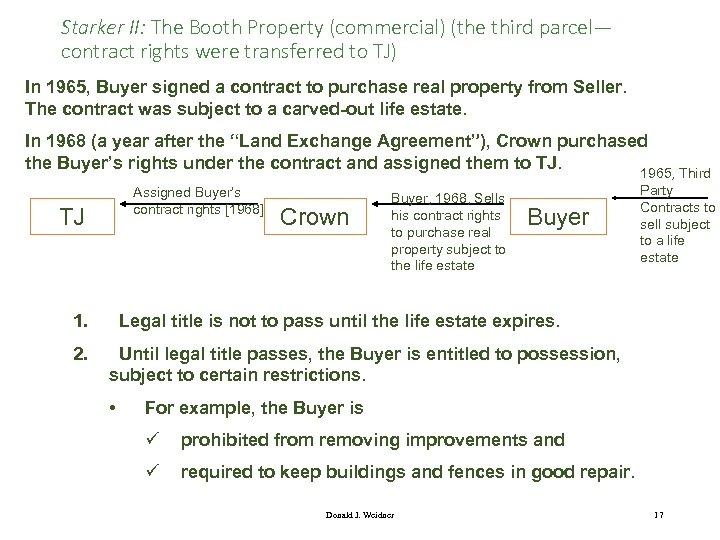 Starker II: The Booth Property (commercial) (the third parcel— contract rights were transferred to TJ) In 1965, Buyer signed a contract to purchase real property from Seller. The contract was subject to a carved-out life estate. In 1968 (a year after the “Land Exchange Agreement”), Crown purchased the Buyer’s rights under the contract and assigned them to TJ. Assigned Buyer’s contract rights [1968] TJ 1. 2. Crown Buyer, 1968, Sells his contract rights to purchase real property subject to the life estate Buyer 1965, Third Party Contracts to sell subject to a life estate Legal title is not to pass until the life estate expires. Until legal title passes, the Buyer is entitled to possession, subject to certain restrictions. • For example, the Buyer is ü prohibited from removing improvements and ü required to keep buildings and fences in good repair. Donald J. Weidner 17
 Starker II: The Booth Property ØIRS argued: There was no exchange. ØNot only was there a lack of simultaneity to the conveyances between T. J. and Crown; Øthere was no conveyance at all to T. J. (there was a “total lack of deed transfer”) ØEven after the expiration of 10 years ØStated differently, the IRS argued that, because T. J. never received a conveyance of land, he never received property that was of a “like kind” with the land he transferred. Donald J. Weidner 18
 Starker II: The Booth Property ØThe Court rejected the IRS argument and held instead that T. J. had been transferred the equivalent of a fee: ØIRS Regulations say that a lease with 30 years or more to run is the equivalent of a fee; ØT. J. ’s rights are at least as great as those of a long-term lessee; and Øthe fact that his interest will ripen into a fee prior to the expiration of 30 years, if the life tenant dies, only makes the equivalence with a fee stronger. ØOnce the court said that contract rights are of “like kind” with a fee, it was brought to the basic question: is the exchange disqualified because the transfers were not simultaneous (and hence not “reciprocal”). Donald J. Weidner 19
 Nonsimultaneous Transfers ØRecall the basic justifications of 1031 ØDo non-simultaneous transfers fall within them? ØLiquidity rationale. Doesn’t fully explain 1031. ØIf you sell, then immediately reinvest the proceeds, the benefits of 1031 are not available even though the reinvestment leaves the taxpayer illiquid. ØConversely, the benefits of 1031 seem to be available even if the taxpayer has no liquidity problems. ØValuation rationale. Doesn’t fully explain 1031. ØWhenever the taxpayer receives any cash or non-qualifying property in an exchange that otherwise qualifies, the property received must be valued to compute the realized gain, a part of which must be recognized. Donald J. Weidner 20
 Nonsimultaneous Transfers (cont’d) ØThree aspects of the case make the IRS position appealing (9 th Circuit focused only on the last two): Øthe “exchange agreement” gave the Starkers the equivalent of a deposit into a checking account, not on a bank but on a major corporation; Øit also gave them the possibility that they might ultimately simply receive cash; and Øthe agreement could remain open for a long time. Donald J. Weidner 21
 Final Thoughts on Starker II Ø 9 th Circuit said: 1. if the parties intended to effect a swap of property, 1031 treatment is not denied simply because cash was to be transferred if a swap could not be arranged Ø Recall Rev. Rul. 90 -34 (Supp. p. 247) 2. elsewhere, in an attempt to deny taxpayers a loss, the IRS has argued that 1031 applies even if there is no strict simultaneity. Donald J. Weidner 22
 Final Thoughts on Starker II (cont’d) ØIRC 1031(a)(2)(F) says that 1031 does not apply to an exchange of “choses in action. ” ØAs to the argument that these contract rights were mere choses in action and not equal to a fee, the 9 th Circuit stated: 1. “[T]itle to real property is nothing more than a bundle of potential causes of action: for trespass, to quiet title, for interference with quiet enjoyment, and so on; ” and 2. “The bundle of rights associated with ownership is obviously not excluded from section 1031; a contractual right to assume the rights of ownership should not. . . be treated as any different than the ownership rights themselves. ” Ø Analyzing the bundle of rights and liabilities that make up an interest is also done in the analysis of leasing arrangements, including sale/leasebacks. Donald J. Weidner 23
 The Sale-Leaseback: Advantages to “Buyer” ØStarker’s “bundle of rights” discussion is evocative of Justice Scalia’s observation in Bollinger: “The problem we face here is that two different taxpayers can plausibly be regarded as the owner. ” ØThis is also often the case in the sale-leaseback area. ØFor years, most life insurance company investments involved saleleasebacks with creditworthy corporations. ØThey received statutory authority in the late 1940 s to make direct investments in income-producing real property ØA life insurance company typically received rent for the property it purchased sufficient to enable it, over the initial term of the lease, Øto recover its entire investment, Øplus a satisfactory rate of return on that investment. Donald J. Weidner 24
 The Sale-Leaseback: Advantages to “Buyer” (cont’d) ØThe lease provided that the life insurance company would be made whole by the tenant, even in the event of total condemnation or destruction of the property. ØRecall Bolger, in which the tenant’s obligation to pay rent continued even if the property were destroyed ØAlthough the insurance company/buyer must include the rent in income, it gets to take depreciation deductions on its investment in the building Øassuming the form of the transaction is respected for federal income tax purposes ØAs in Leslie (where the seller also claimed a loss on the sale) Donald J. Weidner 25
 The Sale-Leaseback: Benefits and Burdens of “Tenant” ØSmith & Lubell, Reflections on the Sale-Leaseback, 7 Real Estate Review 11 -13 (Winter 1978) states: “This lease imposes on the lessee virtually all of the obligations, and gives the lessee substantially all of the benefits, of ownership, subject of course to the lessor’s reversionary rights in the fee. ” ØRecall, for example, Bolger. Allocating virtually all the burdens and benefits of ownership to the tenant during the life of the lease, creates the risk that the lessee might be seen as the substantive owner-mortgagor. Donald J. Weidner 26
 The Sale-Leaseback: Benefits and Burdens of “Tenant” (cont’d) ØSmith & Lubell state the burdens that fall on the tenant: As in “any ground lease or other absolutely net lease, ” “the lessee is obligated to pay rent without off-set or deduction and also to pay ØReal estate taxes; ØFire, liability and other insurance premiums; ØAll costs of operating, maintaining, repairing, and restoring the premises; and ØAll other costs relating to the premises that an owner would normally bear. ” Donald J. Weidner 27
 The Sale-Leaseback: Other Advantages to “Seller-Tenant” Ø Some of the tenant benefits under the lease: 1. Seller-tenant retains the use of the property. 2. Seller-tenant may minimize its equity investment in a property. Ø Greater financing may be available to a developer who sells and then leases back than under “conventional mortgage financing. ” Ø Some corporate tenants may obtain 100% financing. Donald J. Weidner 28
 The Sale-Leaseback: Other Advantages to “Seller. Tenant” (cont’d) (and one disadvantage) 3. Seller-tenant may achieve “off-balance sheet” financing Ø If the Financial Accounting Standards Board (FASB) classifies the lease as an “operating lease” rather than as a “capital lease. ” Ø Until ASU 2016 -2 takes effect and every lease for more than year must be capitalized and recorded on the balance sheet as a “lease liability” 4. Seller-tenant gets the right to deduct all rent (while losing the depreciation deduction on its investment in the building) Ø including the rent for the land, thereby effectively writing off the land cost. Ø The loss of the property at the end of the lease term is a disadvantage—a benefit that passes to the buyer-lessor Ø unless there are options to renew or to purchase Ø but that remote “price” may have a low present value. Donald J. Weidner 29
 Some Recent Developments ØMany other institutional and foreign investors have been providing financing through sale-leasebacks. ØAs other forms of 100% financing became available, such as through real estate subsidiaries, large creditworthy corporations entered into fewer direct sale-leaseback transactions with insurance company investors. ØAccounting rules have for years made it much more difficult for sale leasebacks to be used to take debt off balance sheets. ØThere has been more room in the case of leases of property the tenant did not previously own ØAfter ASU 2016 -2, all leases for more than a year must be recorded on the balance sheet as representing both a “right of use” asset and a “lease liability” ØThe Liability that is listed is the present value of the future lease payments. ØToday, many creditworthy corporations obtain financing through special purpose entities that issue securities ØRecall Bolger Donald J. Weidner 30
 Sale-Leasebacks as Equitable Mortgages Ø FASB has long limited the use of the sale-leaseback to take financing off the “tenant’s” balance sheet. Ø Saying that many leases, especially those arising from sale/leasebacks, are “capital leases” that must be reported as mortgages on the tenant’s books. Ø The latest FASB rules being phased in require the present value of all lease payments (if the lease is for more than a year) to be recorded on the balance sheet as a “lease liability” Ø The off-balance sheet issue has most commonly arisen when the sellerlessee is unwilling to give up the reversionary interest in the property. Ø There can be “significant exposure” because the transaction may be treated, either for state law purposes or federal income tax purposes, say Smith and Lubell, as “an equitable mortgage, rather than a true conveyance and a true lease. ” Donald J. Weidner 31
 Consequences if Substance Trumps Form ØIf the form of a sale-leaseback is disregarded and it is treated as, in substance, a mortgage: 1. The lessee will be seen as having an equity of redemption such that, if the lessee defaults, the lessor will not be permitted to evict by summary proceedings but will be required to foreclose the lessee’s equity of redemption; 2. If the lessee becomes bankrupt or insolvent, the lessor will have the rights of a secured creditor rather than the rights of a landlord; 3. A deemed mortgage may be subject to substantial mortgage and intangible taxes that were not anticipated; Donald J. Weidner 32
 Consequences if Substance Trumps Form 4. The resulting mortgage may be found to be usurious; and 5. The tax consequences of the transaction will change: 1. There will be no gain or loss on the sale; 2. The rent will be treated as debt service (with only interest deductible by the tenant and included by the landord); 3. The tenant, and not the landlord, will be entitled to depreciation deductions. Donald J. Weidner 33
 Bankruptcy or Insolvency of Tenant Ø In general, in bankruptcy, a lease is an executory contract and, as such, is subject to special rules. Ø An executory contract is both an asset and a liability because there is still substantial performance required on both sides of the contract. 1. If the lease characterization is upheld: Ø In the event of a lessee’s bankruptcy (Ch. 11 reorganization), the Debtor (in the bankruptcy sense) In Possession (“DIP”) has a choice to affirm or reject the lease. Ø If the lessee’s DIP affirms the lease, it must start making current payments. Ø If the lessee’s DIP rejects the lease, the rejection will be treated as an anticipatory breach of the lease and the landlord will have an unsecured claim for damages. Donald J. Weidner 34
 Bankruptcy or Insolvency of Tenant (cont’d) 2. If the lease is recharacterized as a mortgage: ØThe “Lessor’s” claim against the tenant is treated as a secured claim (rather than a landlord’s claim for breach of a lease) and the tenant’s Debtor In Possession will be excused from paying debt service during the bankruptcy proceeding. ØThen, if a “plan” is confirmed, debt service payments from the tenant to the lessor will resume (although the plan may restructure the loan agreement). Donald J. Weidner 35
 Bankruptcy or Insolvency of Tenant (cont’d) ØG. Nelson and D. Whitman Real Estate Finance Law 73 (5 th ed. 2007): Ø“[I]f the lessee-seller goes into bankruptcy, he or she usually finds it much more advantageous to be a mortgagee than a lessee. ØThis is because a lessee who files a bankruptcy petition must either assume or reject the lease within a short period of time or the lease will be deemed rejected. In the latter situation, the lessee will be required to surrender the property immediately to the lessor. ØOn the other hand, if the transaction is characterized as a mortgage, the seller-mortgagor often will be able to retain possession of the real estate and restructure the mortgage obligation as part of a bankruptcy reorganization plan. Ø Finally, on rare occasions, a lessor-purchaser rather than the lesseeseller will seek to recharacterize a sale-leaseback transaction as an equitable mortgage. ” Donald J. Weidner 36
 Frank Lyon Company v. United States (Text p. 981) ØWorthen Bank owned a parcel of land was constructing a building on it. ØThere was an office building construction race in downtown Little Rock ØThe Bank wanted to hold title to the building and finance it through a wholly-owned real estate subsidiary. ØBank regulators would not approve this approach, saying the building was too expensive. ØFrank Lyon Company (“Lyon”) was a distributor of home appliances. ØThe Chairman of the Board of Lyon, Frank Lyon, was also on Worthen Bank’s Board of Directors. ØThe regulators would let Lyon lease the building. ØThe construction lender and the permanent lender approved Lyon as an acceptable borrower. Donald J. Weidner 37
 Frank Lyon (cont’d) ØWorthen Bank: ØRetained title to the land; ØNet leased the land to Lyon for 76 years; ØSold the building, piece by piece, as it was constructed, to Lyon; and ØLeased back the building from Lyon for 66 years. ØIn short, Worthen conveyed to Lyon the right to possess the land for 10 years longer than Worthen retained the right to possess the building. ØLyon owned the reversion in the building, which would become possessory after Worthen’s 66 -year lease ended. That is, during Lyon’s last 10 years as tenant under the ground lease, Worthen no longer had the right to be a tenant of the building. Lyon could occupy the building itself or lease it to someone else. ØPresumably, after that 10 -year period, Lyon would have to remove its building from Worthen’s land or take out a new lease. ØWas this transaction ever expected to go to term? Donald J. Weidner 38
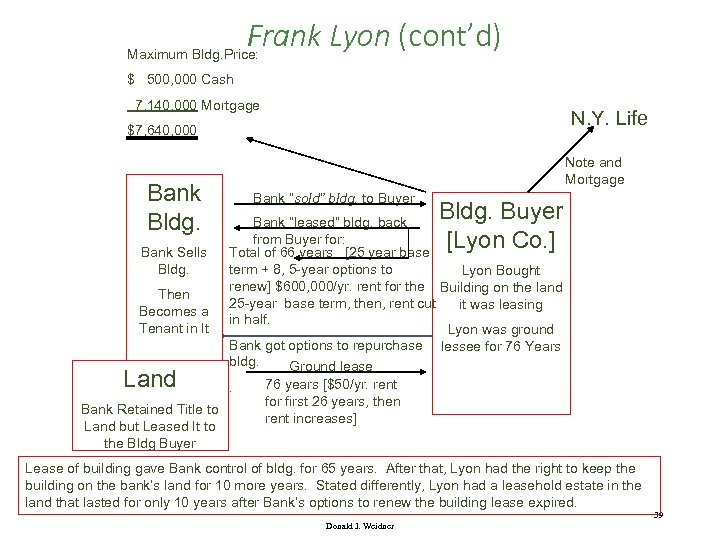 Frank Lyon (cont’d) Maximum Bldg. Price: $ 500, 000 Cash 7, 140, 000 Mortgage N. Y. Life $7, 640, 000 Bank Bldg. Note and Mortgage Bank “sold” bldg. to Buyer Bldg. Buyer [Lyon Co. ] Bank “leased” bldg. back from Buyer for: Total of 66 years [25 year base Bank Sells term + 8, 5 -year options to Bldg. Lyon Bought renew] $600, 000/yr. rent for the Building on the land Then 25 -year base term, then, rent cut it was leasing Becomes a in half. Tenant in It Lyon was ground Bank got options to repurchase lessee for 76 Years bldg. Ground lease 76 years [$50/yr. rent. for first 26 years, then Bank Retained Title to rent increases] Land but Leased It to the Bldg Buyer Land Lease of building gave Bank control of bldg. for 65 years. After that, Lyon had the right to keep the building on the bank’s land for 10 more years. Stated differently, Lyon had a leasehold estate in the land that lasted for only 10 years after Bank’s options to renew the building lease expired. 39 Donald J. Weidner
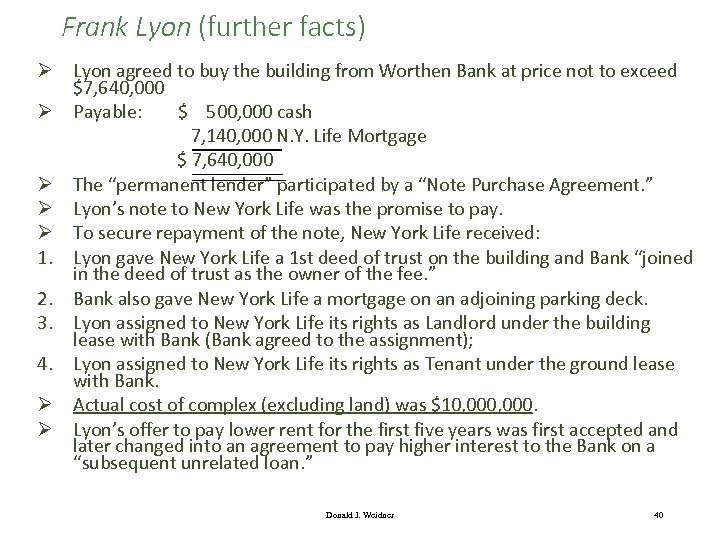 Frank Lyon (further facts) Ø Lyon agreed to buy the building from Worthen Bank at price not to exceed $7, 640, 000 Ø Payable: $ 500, 000 cash 7, 140, 000 N. Y. Life Mortgage $ 7, 640, 000 Ø The “permanent lender” participated by a “Note Purchase Agreement. ” Ø Lyon’s note to New York Life was the promise to pay. Ø To secure repayment of the note, New York Life received: 1. Lyon gave New York Life a 1 st deed of trust on the building and Bank “joined in the deed of trust as the owner of the fee. ” 2. Bank also gave New York Life a mortgage on an adjoining parking deck. 3. Lyon assigned to New York Life its rights as Landlord under the building lease with Bank (Bank agreed to the assignment); 4. Lyon assigned to New York Life its rights as Tenant under the ground lease with Bank. Ø Actual cost of complex (excluding land) was $10, 000. Ø Lyon’s offer to pay lower rent for the first five years was first accepted and later changed into an agreement to pay higher interest to the Bank on a “subsequent unrelated loan. ” Donald J. Weidner 40
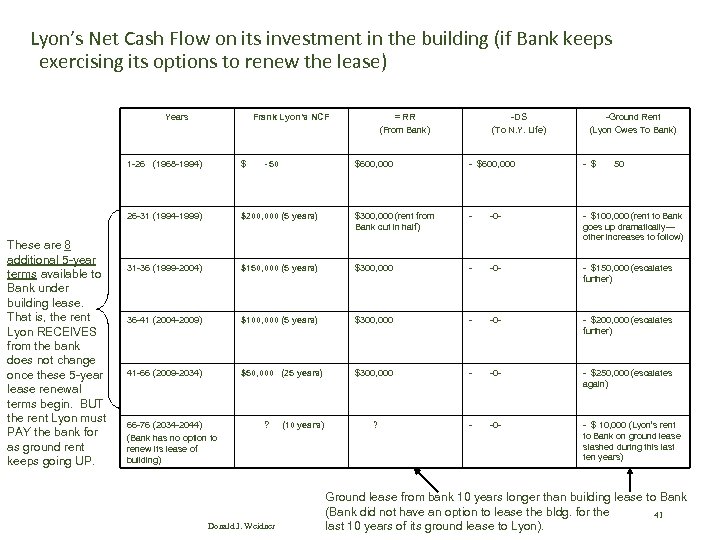 Lyon’s Net Cash Flow on its investment in the building (if Bank keeps exercising its options to renew the lease) Years Frank Lyon’s NCF 1 -26 (1968 -1994) 26 -31 (1994 -1999) These are 8 additional 5 -year terms available to Bank under building lease. That is, the rent Lyon RECEIVES from the bank does not change once these 5 -year lease renewal terms begin. BUT the rent Lyon must PAY the bank for as ground rent keeps going UP. $ -Ground Rent (Lyon Owes To Bank) $600, 000 - $ $200, 000 (5 years) $300, 000 (rent from Bank cut in half) - -0 - - $100, 000 (rent to Bank goes up dramatically— other increases to follow) 31 -36 (1999 -2004) $150, 000 (5 years) $300, 000 - -0 - - $150, 000 (escalates further) 36 -41 (2004 -2009) $100, 000 (5 years) $300, 000 - -0 - - $200, 000 (escalates further) 41 -66 (2009 -2034) $50, 000 (25 years) $300, 000 - -0 - - $250, 000 (escalates again) ? - -0 - - $ 10, 000 (Lyon’s rent to Bank on ground lease slashed during this last ten years) 66 -76 (2034 -2044) (Bank has no option to renew its lease of building) - 50 -DS (To N. Y. Life) = RR (From Bank) ? Donald J. Weidner (10 years) 50 Ground lease from bank 10 years longer than building lease to Bank (Bank did not have an option to lease the bldg. for the 41 last 10 years of its ground lease to Lyon).
 Condemnation or Destruction Ø Bank’s obligation to pay rent to Lyon was not affected by any damage or destruction to the building. Ø That is, Bank had greater obligations than those of a normal tenant Ø But not greater obligations than those of tenants in sale-leasebacks. Ø Any (a) condemnation award, and (b) any insurance proceeds resulting from a total destruction of the building, would be applied in the following order: 1. to New York Life in an amount sufficient to fully prepay the mortgage; 2. the next tranche to Lyon up to the amount of Lyon’s $500, 000 down payment plus 6%; then 3. any excess to Bank. Ø Thus: condemnation awards were allocated as if Bank was the owner and New York Life and Lyon were both lenders. Ø Bank had the option to either replace the building or to purchase it in the event of a partial condemnation or total destruction on or after December 1, 1980 (after about 12 years). Ø Here again, Bank had more of the bundle of sticks than is usually in the hands of a “mere” tenant. Donald J. Weidner 42
 Bank Had Four Options to “repurchase” the building Ø After 11 years for $6, 325, 169 Ø in fact, Worthen purchased at this point, when its tax shelter would have collapsed Ø After 15 years for $5, 432, 607 Ø After 20 years for $4, 187, 328 Ø After 25 years for $2, 145, 935 The option price at each date equaled: 1. The unpaid balance of the N. Y. Life Note; plus 2. Lyon’s $500, 000 down payment plus 6% compound interest Donald J. Weidner 43
 Bank’s options to “repurchase” the building (cont’d) The prices on the options to purchase were the same as if Lyon had a 6% passbook account with the Bank. However, the District Court said that the option price: “also represents the negotiated estimate of [Lyon] and [Bank] as to the fair market value of the building on the option dates, which the court finds to be reasonable. The [IRS] produced no witnesses to contest the reasonableness of the option prices. ” Was the District Court too credulous? Donald J. Weidner 44
 Bank’s Options to Repurchase the Building (cont’d) Ø The District Court concluded that the Bank was unlikely to exercise these options to purchase, given: Ø The Bank’s future capital requirements; Ø The substantial amount of the option price; and Ø The reasonableness of the net rent the Bank would pay if it remained a Tenant. Ø Bank also had a right to purchase the building at fair market value if Ø Lyon became insolvent or Ø control of Lyon changed hands Ø Presumably, the value of Bank’s right to purchase at fair market value was limited by the price of Bank’s Options to Repurchase Donald J. Weidner 45
 Possibilities if Bank Does Not Exercise Its Options 1. If Bank does not exercise its options to renew the building lease: 1. Lyon would remain liable for the substantial rents required by the ground lease; and 2. Lyon would still control the building. Ø “This possibility brings into very sharp focus the fact that Lyon, in a very practical sense, is at least the ultimate owner of the building. If [Bank] does not extend, the building lease expires and Lyon may do with the building as it chooses. ” Ø That is, in this situation, there is no promise that Lyon will be repaid its $500, 000, with or without interest. 2. If Bank extends the building lease by exercising all the lease renewal options: says the IRS, “the net amounts payable. . . would approximate the amount required to repay Lyon’s $500, 000 investment at 6% compound interest. ” Donald J. Weidner 46
 Basic Possibilities Summarized 1. Bank Exercises Its Options to Renew Its Lease of Bldg. • Lyon gets a return of its investment, plus approximately 6%, no more 2. Bank Walks Away at the End of the Base Lease Term • At that point, Lyon has not gotten back any of its investment, much less a 6% return, and could get less or more 3. Bank Exercises one of its Options to Purchase • Lyon gets a return of its investment plus 6%, no more 4. Bank Exercises its Right to Purchase if Lyon becomes insolvent or has a change of control • Although formally at fair market value, the price presumably is informed by Bank’s Options to Purchase, in which event Lyon gets a return of its investment plus 6%, no more 5. The Property Is Condemned • Lyon gets return of investment plus 6%, no more Donald J. Weidner 47
 District Court Permitted Lyon to Claim Depreciation Deductions ØDistrict Court rejected the argument that Bank was acquiring an equity through its rental payments ØEven though the rent payments reduced the balance owed to N. Y. Life and hence the cost of the Bank’s option to purchase ØConcluded that rents were unchallenged and reasonable throughout the period (fair value for possession and not to purchase an equity). ØConcluded that the option prices, negotiated at arms-length, represented fair estimates of fair market value on the option exercise dates Ørejecting any negative inference from the fact the option prices were the amounts needed to (a) pay off N. Y. Life Loan + (b) pay $500, 000 + 6%. ØConcluded that Bank would acquire an equity only if it exercised an option to purchase Øwhich it found highly unlikely. ØConcluded that Lyon had mixed motives, including the desire for the benefits of a “tax shelter. ” Donald J. Weidner 48
 Eighth Circuit Reversed the District Court Ø Eight Circuit held: Lyon was not the true owner Ø Therefore, Lyon was not entitled to depreciation deductions. Ø Property rights are analogous to a “bundle of sticks, ” and “Lyon ‘totes an empty bundle’ of ownership sticks: ” 1. Lyon’s right to profit from its investment was circumscribed by Bank’s option to purchase at a price equal to Lyon’s investment, plus 6% thereon, plus the unpaid balance on the N. Y. Life mortgage; Ø That is, Bank had the option to get title to the building back by treating Lyon as a second mortgagee @ 6% 2. The prices of Bank’s options to purchase did not take into account any appreciation in the value of the building, even from inflation; Ø Hence, Lyon had fewer rights than the normal owner of a commercial building Donald J. Weidner 49
 Eighth Circuit Reversal (cont’d) ØLyon’s “empty bundle” (cont’d) 3. Any amount realized from destruction or condemnation in excess of the NY Life mortgage and return of Lyon’s $500, 000 plus 6% would go to Bank rather than to Lyon; and ØThat is, Bank got all of any equity through amortization and/or appreciation 4. The building rent during the base term was equal to debt service and hence gave Lyon zero cash flow; and 5. Bank retained control over the building through its: Øa) options to purchase the building, Øb) options to renew its lease of the building, and Øc) ownership of the site. ØIn summary, Bank had virtually all of the benefits and burdens of ownership of the building and Lyon merely got a tax shelter for 11 years. Donald J. Weidner 50
 Supreme Court reversed Eighth Circuit and Allowed Lyon the Depreciation Deductions Consider the significance of each of the following points made by the Supreme Court: ØSupreme Court distinguished Lazarus (which treated a sale-leaseback as a mortgage, which is what the IRS wanted done in Lyon) by saying it involved only two parties: Ø“The present case, in contrast, involves three parties, [Bank], Lyon and the finance agency. ” ØThe Court also noted that the transaction was compelled: Ø“Despite Frank Lyon’s presence on [Bank’s] board of directors, the transaction, as it ultimately developed, was not a familial one arranged by [Bank], but one compelled by the realities of the restrictions imposed upon the bank. Had Lyon not appeared, another interested investor would have been selected. ” ØThis last part is what troubles the IRS—someone was going to get a pretty naked tax shelter, at least for the first 11 years. Donald J. Weidner 51
 Supreme Court’s Points to Reverse the Eighth Circuit Ø Lyon had more risk than the typical second mortgagee. 1. Lyon alone was liable on the New York Life Loan: Ø “Here. . . most significantly, it was Lyon alone, and not [Bank], who was liable on the notes, first to City Bank, and then to New York Life. ” Ø However, Bank was obligated to pay “rent” equal to the debt service on the notes 2. Lyon was an ongoing business entity that placed the rest of its business at risk by undertaking this liability Ø “Lyon, an ongoing enterprise, exposed its very business well-being to this real and substantial risk. ” Donald J. Weidner 52
 Supreme Court Emphasized Risk ØLyon’s Risk beyond that of a second mortgagee (cont’d): 3. “The effect of this liability on Lyon is not just the abstract possibility that something will go wrong and that [Bank] will not be able to make its payments. Lyon has disclosed this liability on its balance sheet for all the world to see. Its financial position is affected substantially by the presence of this long-term debt, despite the offsetting presence of the building as an asset. ” Ø“To the extent that Lyon has used its capital in this transaction, it is less able to obtain financing for other business needs. ” Donald J. Weidner 53
![Some Other Factors Ø“[T]he characterization of a transaction for financial accounting purposes, on the](https://present5.com/presentation/59224b3fdef4df8a43896056d58ea091/image-54.jpg "Some Other Factors Ø“[T]he characterization of a transaction for financial accounting purposes, on the") Some Other Factors Ø“[T]he characterization of a transaction for financial accounting purposes, on the one hand, and for tax purposes, on the other, need not necessarily be the same. ” ØRecall Leslie said the same thing ØHere, the regulators would not permit the bank to own the property and mortgage it. ØCan Lyon’s tolerance be limited to transactions that are compelled? ØCould Bank also be attempting a Leslie? ØAnd claiming a tax loss on the “sale” of the building? Donald J. Weidner 54
Some Other Factors Ø“[T]he characterization of a transaction for financial accounting purposes, on the one hand, and for tax purposes, on the other, need not necessarily be the same. ” ØRecall Leslie said the same thing ØHere, the regulators would not permit the bank to own the property and mortgage it. ØCan Lyon’s tolerance be limited to transactions that are compelled? ØCould Bank also be attempting a Leslie? ØAnd claiming a tax loss on the “sale” of the building? Donald J. Weidner 54
 Blackmun on 2 d Mortgages and Ownership ØBlackmun says there was no second mortgage from Lyon to Bank because Bank did not promise to repay Lyon: Ø“There is no legal obligation between Lyon and [Bank] representing the $500, 000 ‘loan’ extended under the Government’s theory. ” Ø“And the assumed 6% return on this putative loan. . . will be realized only when and if [Bank] exercises its options. ” ØThe rents alone, due after the primary term of the lease (Lyon had negative NCF during the primary term), do not provide Lyon the simple 6% return the IRS alleges. Ø“Thus, if [Bank] chooses not to exercise its options [to purchase], Lyon is gambling that the rental value of the building during the last 10 years of the ground lease, during which the ground rent is minimal, will be sufficient to recoup its investment. ” ØRecall, Lyon’s annual rent under the ground lease during this final 10 years is only $10, 000. Donald J. Weidner 55
 More Blackmun Points Ø“It is not inappropriate to note that the Government is likely to loose little revenue, if any, as a result of the shape given the transaction by the parties. ” ØSuch language is not often seen in tax cases Ø“Lyon is not a corporation with no purpose other than to hold title to the bank building. It was not created by [Bank] or even financed to any degree by [Bank]. ” ØThis can be an important limiting factor in the case Ø“[N]one of the parties to this sale-and-leaseback was the owner of the building in any simple sense. ” ØRecall Scalia in Bollinger said that more than one person could reasonably be regarded as the owner. ØRecall the “bundle of potential causes of action” that was the equivalent of a fee in Starker. ØYou don’t have to have title to be considered the owner. Donald J. Weidner 56
 More Blackmun Ø “But it is equally clear that the facts focus upon Lyon as the one whose capital was committed to the building and as the party, therefore, that was entitled to claim depreciation for the consumption of that capital. ” Ø Did Bank make a greater commitment of capital than Lyon? Bank: 1. Promised to pay rent equal to the debt service for the first 25 years and in the process repay the debt. 2. Also promised to pay all operating expenses for those 25 years 3. Also paid the difference between the purchase price and the $10 million actual cost 4. Also mortgaged the adjoining parking garage Ø In a footnote, Justice Blackmun cited World Publishing. Donald J. Weidner 57
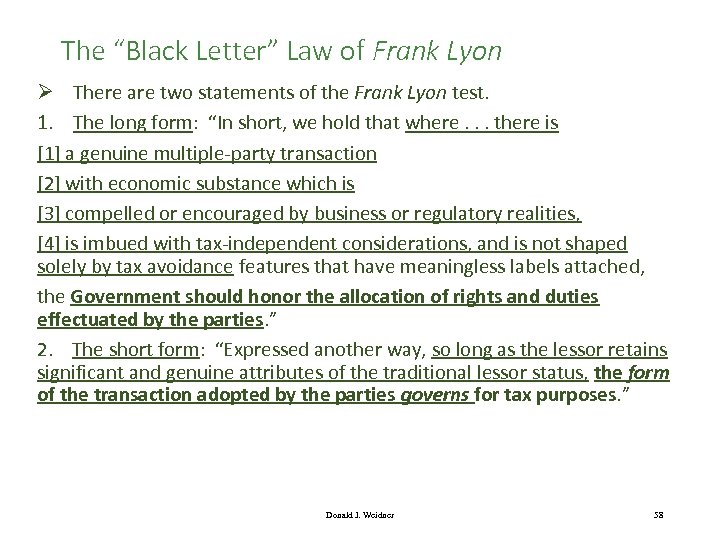 The “Black Letter” Law of Frank Lyon Ø There are two statements of the Frank Lyon test. 1. The long form: “In short, we hold that where. . . there is [1] a genuine multiple-party transaction [2] with economic substance which is [3] compelled or encouraged by business or regulatory realities, [4] is imbued with tax-independent considerations, and is not shaped solely by tax avoidance features that have meaningless labels attached, the Government should honor the allocation of rights and duties effectuated by the parties. ” 2. The short form: “Expressed another way, so long as the lessor retains significant and genuine attributes of the traditional lessor status, the form of the transaction adopted by the parties governs for tax purposes. ” Donald J. Weidner 58
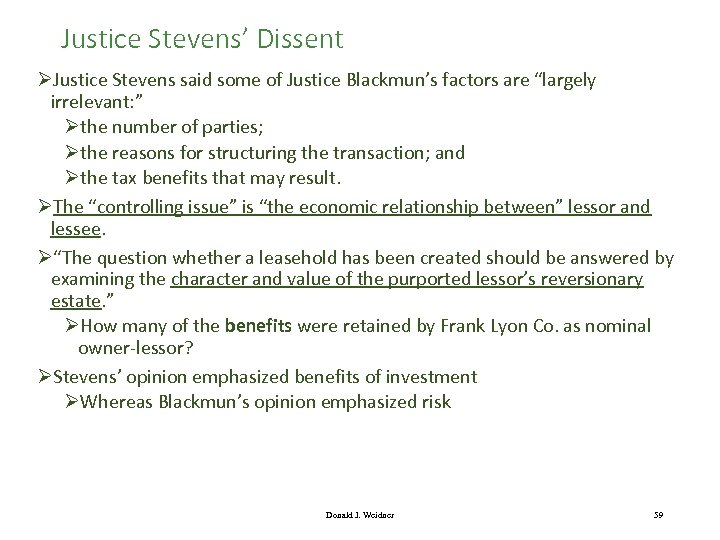 Justice Stevens’ Dissent ØJustice Stevens said some of Justice Blackmun’s factors are “largely irrelevant: ” Øthe number of parties; Øthe reasons for structuring the transaction; and Øthe tax benefits that may result. ØThe “controlling issue” is “the economic relationship between” lessor and lessee. Ø“The question whether a leasehold has been created should be answered by examining the character and value of the purported lessor’s reversionary estate. ” ØHow many of the benefits were retained by Frank Lyon Co. as nominal owner-lessor? ØStevens’ opinion emphasized benefits of investment ØWhereas Blackmun’s opinion emphasized risk Donald J. Weidner 59
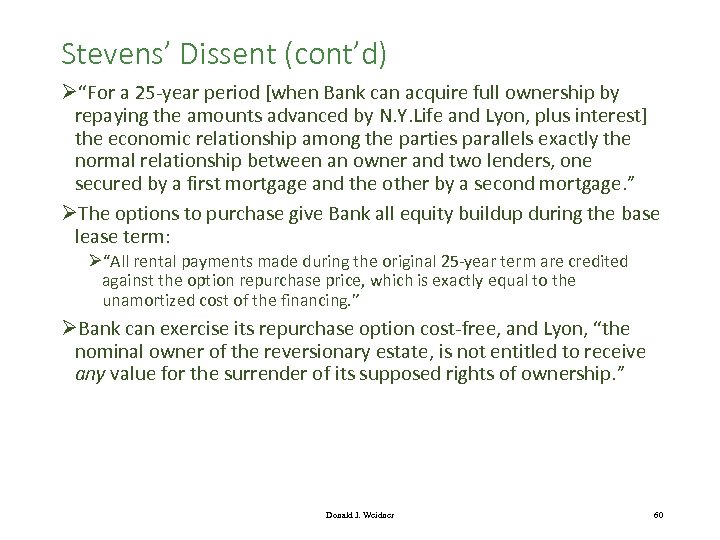 Stevens’ Dissent (cont’d) Ø“For a 25 -year period [when Bank can acquire full ownership by repaying the amounts advanced by N. Y. Life and Lyon, plus interest] the economic relationship among the parties parallels exactly the normal relationship between an owner and two lenders, one secured by a first mortgage and the other by a second mortgage. ” ØThe options to purchase give Bank all equity buildup during the base lease term: Ø“All rental payments made during the original 25 -year term are credited against the option repurchase price, which is exactly equal to the unamortized cost of the financing. ” ØBank can exercise its repurchase option cost-free, and Lyon, “the nominal owner of the reversionary estate, is not entitled to receive any value for the surrender of its supposed rights of ownership. ” Donald J. Weidner 60
![Stevens’ Dissent (cont’d) Ø Justices Stevens quoted Estate of Franklin: 1. “’[D]epreciation is not](https://present5.com/presentation/59224b3fdef4df8a43896056d58ea091/image-61.jpg "Stevens’ Dissent (cont’d) Ø Justices Stevens quoted Estate of Franklin: 1. “’[D]epreciation is not") Stevens’ Dissent (cont’d) Ø Justices Stevens quoted Estate of Franklin: 1. “’[D]epreciation is not predicated upon ownership of property but rather upon an investment in property. ’” 2. “No such investment exists when payments of the purchase price in accordance with the design of the parties yield no equity to the purchaser. ” Ø But Franklin involved nonrecourse financing. Ø Stevens would apparently extend the Franklin analysis to a recourse financing situation. Ø More Justice Stevens: “Here, [Lyon] has, in effect, been guaranteed that it will receive its original $500, 000 plus accrued interest. But that is all. It incurs neither the risk of depreciation nor the benefit of possible appreciation. ” Ø “[Bank], on the other hand, does bear the risk of depreciation, since its opportunity to make a profit from the exercise of its repurchase option hinges on the value of the building at the time. ” Donald J. Weidner 61
Stevens’ Dissent (cont’d) Ø Justices Stevens quoted Estate of Franklin: 1. “’[D]epreciation is not predicated upon ownership of property but rather upon an investment in property. ’” 2. “No such investment exists when payments of the purchase price in accordance with the design of the parties yield no equity to the purchaser. ” Ø But Franklin involved nonrecourse financing. Ø Stevens would apparently extend the Franklin analysis to a recourse financing situation. Ø More Justice Stevens: “Here, [Lyon] has, in effect, been guaranteed that it will receive its original $500, 000 plus accrued interest. But that is all. It incurs neither the risk of depreciation nor the benefit of possible appreciation. ” Ø “[Bank], on the other hand, does bear the risk of depreciation, since its opportunity to make a profit from the exercise of its repurchase option hinges on the value of the building at the time. ” Donald J. Weidner 61
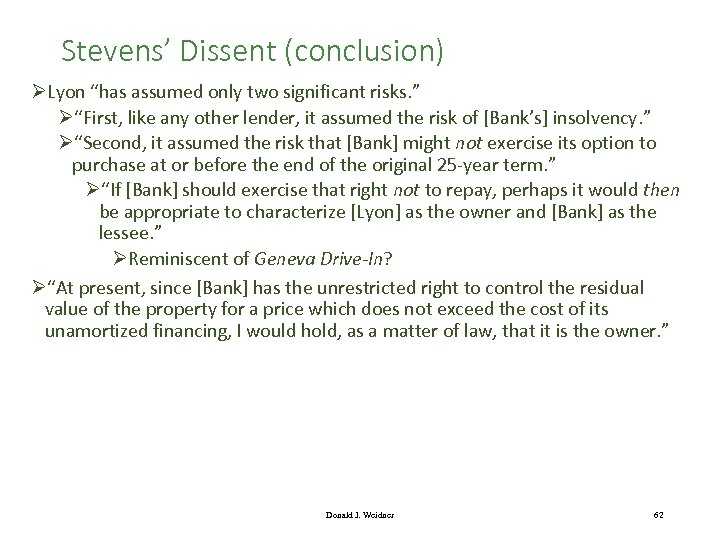 Stevens’ Dissent (conclusion) ØLyon “has assumed only two significant risks. ” Ø“First, like any other lender, it assumed the risk of [Bank’s] insolvency. ” Ø“Second, it assumed the risk that [Bank] might not exercise its option to purchase at or before the end of the original 25 -year term. ” Ø“If [Bank] should exercise that right not to repay, perhaps it would then be appropriate to characterize [Lyon] as the owner and [Bank] as the lessee. ” ØReminiscent of Geneva Drive-In? Ø“At present, since [Bank] has the unrestricted right to control the residual value of the property for a price which does not exceed the cost of its unamortized financing, I would hold, as a matter of law, that it is the owner. ” Donald J. Weidner 62
 Idiosyncratic Facts Ø Text at 993 states that Frank Lyon offers little guide to planning because it is idiosyncratic in several ways: 1. 2. 3. 4. The barriers imposed by regulators are rarely present. A limited partnership is the modal investment vehicle. The limited partnership typically uses nonrecourse financing such that there will not be any personal liability to the institutional lender. The limited partnership is likely to be a thinly-capitalized, single-purpose entity, with no business apart from the transaction at issue. ØCompare Hilton, next slide, which involves limited partnerships that receive a conveyance from a nominally capitalized single-purpose entity that obtained financing that was nonrecourse as to the partnerships. Donald J. Weidner 63
![5 Insurance Companies [agreed to lend (purchase notes) on completion of construction] Se wi](https://present5.com/presentation/59224b3fdef4df8a43896056d58ea091/image-64.jpg "5 Insurance Companies [agreed to lend (purchase notes) on completion of construction] Se wi") 5 Insurance Companies [agreed to lend (purchase notes) on completion of construction] Se wi lls i of th 1 ts 3 30 0% 0 -y ye ba r. M ar s lloo no n a te $ te s D/ nd T As pl lea sign us se me an nt d r of en tal s Formed as the shopping center store was being completed =D di S 30 rec Pa tl y Pa yea y to able rs In b ar id. s. y no ran the Co Bro te gin co m ad s. g m pa w th m ni ay e itm es sa e fo le nt r of fe th es e M Hilton (Part I) (Supp. p. 248) Fourth Cavendish [single purpose financing Cp. ] owned by investment firm that “served as the intermediary in negotiating the transaction between Broadway and the insurance companies”. Capitalization: $1, 000 Re nt Sold land bldg. Paid $ purchase price ($3. 15 M: building cost, not land cost) with proceeds from sale of Fourth Cavendish M notes. Leased back land bldg. (net lease) Broadway intended to build new store, to internally finance construction but get external “take-out. ” The Bakersfield land cost $198, 000. Total land construction cost $3. 3 million. Broadway’s annual rent for 30 -yr. base term = DS on the 30 -yr. M notes (not fully SAM: 10% balloon at end of 30 yrs. ) @ 6. 33% of $ purchase price [Interest @ 5. 5% Fourth Cavendish conveyed land year was determined by Broadway’s credit rating. ] and bldg. “subject to” D Options to Broadway to renew lease for additional 68 E a) The lease years E b) The mortgage indenture @ 1. 5% of purchase price for first 23 -year renewal D term [rent slashed 75% after notes are paid ]. c) The assignment of lease d) Encumbrances of record @ 1% of purchase price for 2 nd and 3 rd renewal No consideration or terms (23 yrs. and 22 yrs. ) Original Ps in Medway were assumption of M 14 th P. A. LPP (49% int. ) (TXs were Ps) Medway (GPP) Mac. Gill (1% int. ) (P in Inv. firm) Donald J. Weidner 64 Formed to receive the interest Cushman (50% int. ) (P in Inv. firm) from Fourth Cavendish
5 Insurance Companies [agreed to lend (purchase notes) on completion of construction] Se wi lls i of th 1 ts 3 30 0% 0 -y ye ba r. M ar s lloo no n a te $ te s D/ nd T As pl lea sign us se me an nt d r of en tal s Formed as the shopping center store was being completed =D di S 30 rec Pa tl y Pa yea y to able rs In b ar id. s. y no ran the Co Bro te gin co m ad s. g m pa w th m ni ay e itm es sa e fo le nt r of fe th es e M Hilton (Part I) (Supp. p. 248) Fourth Cavendish [single purpose financing Cp. ] owned by investment firm that “served as the intermediary in negotiating the transaction between Broadway and the insurance companies”. Capitalization: $1, 000 Re nt Sold land bldg. Paid $ purchase price ($3. 15 M: building cost, not land cost) with proceeds from sale of Fourth Cavendish M notes. Leased back land bldg. (net lease) Broadway intended to build new store, to internally finance construction but get external “take-out. ” The Bakersfield land cost $198, 000. Total land construction cost $3. 3 million. Broadway’s annual rent for 30 -yr. base term = DS on the 30 -yr. M notes (not fully SAM: 10% balloon at end of 30 yrs. ) @ 6. 33% of $ purchase price [Interest @ 5. 5% Fourth Cavendish conveyed land year was determined by Broadway’s credit rating. ] and bldg. “subject to” D Options to Broadway to renew lease for additional 68 E a) The lease years E b) The mortgage indenture @ 1. 5% of purchase price for first 23 -year renewal D term [rent slashed 75% after notes are paid ]. c) The assignment of lease d) Encumbrances of record @ 1% of purchase price for 2 nd and 3 rd renewal No consideration or terms (23 yrs. and 22 yrs. ) Original Ps in Medway were assumption of M 14 th P. A. LPP (49% int. ) (TXs were Ps) Medway (GPP) Mac. Gill (1% int. ) (P in Inv. firm) Donald J. Weidner 64 Formed to receive the interest Cushman (50% int. ) (P in Inv. firm) from Fourth Cavendish
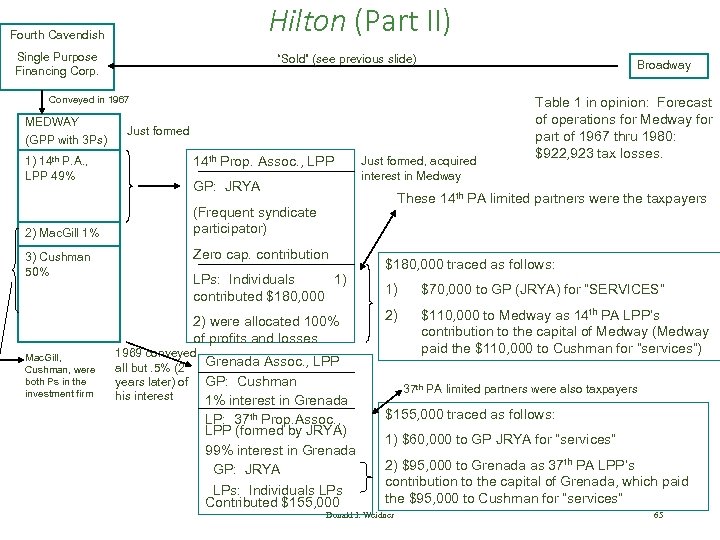 Hilton (Part II) Fourth Cavendish Single Purpose Financing Corp. “Sold” (see previous slide) Broadway Conveyed in 1967 MEDWAY (GPP with 3 Ps) 1) 14 th P. A. , LPP 49% 2) Mac. Gill 1% 3) Cushman 50% Just formed 14 th Prop. Assoc. , LPP GP: JRYA These 14 th PA limited partners were the taxpayers (Frequent syndicate participator) Zero cap. contribution LPs: Individuals 1) contributed $180, 000 2) were allocated 100% of profits and losses Mac. Gill, Cushman, were both Ps in the investment firm Just formed, acquired interest in Medway Table 1 in opinion: Forecast of operations for Medway for part of 1967 thru 1980: $922, 923 tax losses. 1969 conveyed Grenada Assoc. , LPP all but. 5% (2 years later) of GP: Cushman his interest 1% interest in Grenada LP: 37 th Prop. Assoc. , LPP (formed by JRYA) 99% interest in Grenada GP: JRYA LPs: Individuals LPs Contributed $155, 000 $180, 000 traced as follows: 1) $70, 000 to GP (JRYA) for “SERVICES” 2) $110, 000 to Medway as 14 th PA LPP’s contribution to the capital of Medway (Medway paid the $110, 000 to Cushman for “services”) 37 th PA limited partners were also taxpayers $155, 000 traced as follows: 1) $60, 000 to GP JRYA for “services” 2) $95, 000 to Grenada as 37 th PA LPP’s contribution to the capital of Grenada, which paid the $95, 000 to Cushman for “services” Donald J. Weidner 65
 Hilton (cont’d) Ø Principal issue: are the partners “entitled to deduct their distributive shares of partnership losses. ” Ø Notwithstanding the “tiered partnership labyrinth, the central issue. . . is the bona fides of the sale-leaseback. This is essentially an exercise in substance versus form. ” Ø “The terms of this sale and leaseback transaction are fairly traditional. ” Ø IRS made 3 basic arguments: 1. The transactions were “sham” transactions, contrived for tax purposes, and 2. 3. should be disregarded. Tax consequences should be determined by substance, not form, and, in substance, this was not a sale but a financing transaction with a note and a mortgage by Broadway. The partnerships were not engaged in purposive economic activity and therefore are not entitled to deductions that are premised on purposive economic activity. Donald J. Weidner 66
 Hilton and Frank Lyon ØOn the “financing transaction” challenge, the transaction must be tested, under Frank Lyon, to determine whether it is: 1. Genuinely multi-party; 2. With economic substance; 3. Compelled or encouraged by business or regulatory realities Ø[business but not “regulatory” realities are claimed here]; and 4. Imbued with tax-independent considerations that are not shaped solely by tax-avoidance features. Frank Lyon says, if these factors are present, the IRS should defer to the taxpayer’s choice of form. Donald J. Weidner 67
 Hilton and Frank Lyon ØHowever, Judge Nims says that Frank Lyon’s lesson is not “that we are to accept every putative sale-leaseback transaction at face value. ” ØAlthough “the seller-lessee’s financing requirements may be a valid business purpose to support a sale-leaseback transaction for tax purposes, ” Øthe transaction “will not stand or fall merely because it involved a sale-leaseback mandated by Broadway’s financing requirements. ” ØTo Emphasize: Even if the transaction was economically compelled, its form can still be disregarded Øas has always been the case under the state law of mortgages Donald J. Weidner 68
 Genuinely Multi-Party? 1. From Broadway’s point of view, “the transaction had economic substance and was encouraged by business realities: ” Ø conventional financing from insurance companies would have been only 75% of value (vs. the 100% of building cost obtained through this sale/leaseback); Ø Broadway had limitations in its loan and credit agreements with banks that put Ø a ceiling on the total debt it could incur; and Ø limits on the total value of its property that could be mortgaged. Ø Also, Broadway, in effect, got to deduct 90% of principal and 100% of interest. Donald J. Weidner 69
 Genuinely Multi-Party? (cont’d) 2. From the point of view of the insurance companies, “the transaction had economic substance and was encouraged by business realities: ” Ø the insurance companies had limits on the amounts and proportions of their funds that could be committed to direct real estate “mortgages”; and Ø the note purchase, secured by a lease with a well-rated tenant, allowed the insurance companies to avoid other lending restrictions. Donald J. Weidner 70
![Genuinely Multi-Party? (cont’d) Ø“In this context, we do not deem the existence of [1]](https://present5.com/presentation/59224b3fdef4df8a43896056d58ea091/image-71.jpg "Genuinely Multi-Party? (cont’d) Ø“In this context, we do not deem the existence of [1]") Genuinely Multi-Party? (cont’d) Ø“In this context, we do not deem the existence of [1] a net lease, [2] a nonrecourse mortgage or [3] rent during the initial lease term geared to the cost of interest and mortgage amortization to be, in and of themselves, much more than neutral commercial realities. ” Ø“Furthermore, the fact that the transaction was put together by an ‘orchestrator’. . . would not alone prove fatal to the buyer-lessor’s cause Øprovided the result is economically meaningful on both sides of the equation. ” Donald J. Weidner 71
Genuinely Multi-Party? (cont’d) Ø“In this context, we do not deem the existence of [1] a net lease, [2] a nonrecourse mortgage or [3] rent during the initial lease term geared to the cost of interest and mortgage amortization to be, in and of themselves, much more than neutral commercial realities. ” Ø“Furthermore, the fact that the transaction was put together by an ‘orchestrator’. . . would not alone prove fatal to the buyer-lessor’s cause Øprovided the result is economically meaningful on both sides of the equation. ” Donald J. Weidner 71
 Genuinely Multi-Party? (cont’d) ØJudge Nims said: Frank Lyon looked at the substance of the interest of both seller-lessee and the buyer-lessor and the legal and economic substance of the contractual relationship between the two. ØThe focus here must be on the buyer-lessor: “[D]oes the buyer-lessor’s interest have substantial legal and economic significance aside from tax considerations, or is that interest simply the purchased tax byproduct of Broadway’s economically impelled arrangement with the insurance companies? ” --Nice statement Donald J. Weidner 72
 With Economic Substance? ØThe facts are like the “paradigmatic facts” of Bolger, however, here, the Commissioner “does not so blithely abandon ship and it is the efficaciousness of the lease, itself, which he now frontally attacks. ” ØFrank Lyon says that the taxpayers “must show not only that their participation in the sale-leaseback was [1] not motivated or shaped solely by tax avoidance features that have meaningless labels attached, but also [2] that there is economic substance to the transaction independent of the apparent tax shelter potential. ” ØIs that the lesson you got from Frank Lyon? Donald J. Weidner 73
 With Economic Substance? ØRecall: Depreciation is predicated upon investment, not ownership. Mayerson. ØHilton says that another way of stating the Frank Lyon test “is suggested by” Estate of Franklin, to wit: “Could the buyer-lessor’s method of payment for the property be expected at the outset to rather quickly yield an equity which the buyer-lessor could not prudently abandon? ” ØIf it can not be expected to yield an equity, the buyer-lessor has not made an investment in property. ØThis sounds like Stevens’ dissent in Frank Lyon rather than Blackmun’s majority opinion. Donald J. Weidner 74
 The “Fatally Defective” Analysis of the Taxpayer’s Expert on Economic Substance ØTaxpayer’s expert based most of his analysis on assumptions about the value of the property. ØHe assumed that, on whatever date that Broadway decided not to exercise its options to renew its lease (whether at year 30, 53 or 76), the value of the property would be equal to its purchase price Øthis is known as the “ 100% residual value theory” Øwhich he conceded might be “slightly positive” ØHe also made certain assumptions about how much it would cost to refinance the balloon ØHe did not consider many of the factors that would be considered by a qualified appraiser. Donald J. Weidner 75
 The Taxpayer’s Defective Expert on Economic Substance (cont’d) ØEven based on the Taxpayer’s assumptions, “the present value of the property determined on a conservative actuarial basis would not be indicative of economic substance. ” (see FN. 23) ØThose Taxpayer assumptions were: 1. for the first 30 years, there was no pre-tax cash flow. 2. beginning at the end of 30 years and ending 23 years thereafter, the pre -tax net income will be $23, 000 per year (net cash flow after estimated debt service to refinance the balloon @ 5 1/8% interest); 3. the property could always be sold for its original cost: $3. 15 million; and 4. the property will be free and clear of financing at the end of 53 years. Donald J. Weidner 76
 The Taxpayers’ Expert on Economic Substance (cont’d) Ø In short, the court in FN. 23 calculated the present value of the interest the SPE purchased by adding: 1. the $49, 271 Present Value of the $23, 000 per year NCF that begins in year 31 with the start of the first lease renewal term and continues through year 53 (rent from Broadway minus estimated DS to refinance the balloon) ; and 2. the $143, 640 Present Value of the right to receive property worth $3. 15 million at the end of 53 years; for a Ø Total Present Value of $192, 911 Ø Roughly 6% of the sale price Ø The court then found a “deficit” between this total Present Value of $192, 911 and the $334, 000 cost of the partners’ interests. Donald J. Weidner 77
 The “Generally Persuasive” IRS Expert Ø The IRS Expert: 1. Made a thorough investigation of Ø the property (including the neighborhood) and Ø the details of the transaction. 2. Determined that the life expectancy of the housing stock followed the “general rule” and would have a life span somewhere between 50 -60 years with little change in the characteristics of the inhabitants. See FN 24. 3. Determined that Broadway would expect to occupy for more than 30 years and, hence, was likely to exercise “its right to extend the lease through the first option period of 23 years. ” Donald J. Weidner 78
 The “Generally Persuasive” IRS Expert (cont’d) ØBeyond 50 -60 years, properties tend to become, “if not physically deteriorated, at least marked by obsolescence and, therefore, are no longer attractive to the persons who originally inhabited them. ” ØTherefore, no prediction can be made that Broadway would renew the lease past the first 23 -year renewal option period. ØAlso, the cost of removing the store would have to be a factor (noting a single-purpose structure designed to serve the needs of a specific type of tenant). ØReturns in years after the first lease renewal term, in addition to being too speculative, would also have to be deeply discounted, so were not counted. Donald J. Weidner 79
 IRS Expert on Sources of Profit to the Partners Ø The IRS expert summarized the “potential sources of economic gain” (the benefits in the bundle of sticks) of the partnership-owners under the following categories: 1. net income or loss; 2. net proceeds from sale; 3. net proceeds from condemnation; and 4. net proceeds from mortgage refinancing. Donald J. Weidner 80
 Sources of Profit to the Partners (cont’d) 1. Net income or loss (net cash flow): Ø There will be no net cash flow for the 30 -year base term of the lease because all the rent is dedicated to debt service; Ø The net cash flow during the first 23 lease renewal term is quite low. Ø First, because the rent is substantially reduced during the lease renewal periods. Ø Second, the rent receipts from Broadway will be reduced by the debt service the partnerships must pay to refinance the balloon due at the end of the 30 -year base term. Ø to pay the balloon, the partners must either Ø make new capital contributions to pay off the balloon or Ø refinance the balloon. Donald J. Weidner 81
 Sources of Profit to the Partners (cont’d) 2. Net Proceeds from Sale: Ø Net proceeds from sale will be significantly limited by the lease and lease renewal options. Ø More specifically, the partners’ opportunity for gain on sale “will be limited to any then-present value of the rental income flow and the residual, the combined total of which. . . is minimal and in any event less than [the partners’] investment. ” Ø “The reason. . . is that. . . the lease. . . gives Broadway carte blanche to sublet the property or assign its leasehold interest after the original term of the lease. ” Donald J. Weidner 82
 Sources of Profit to the Partners (cont’d) 2. Net Proceeds from Sale (cont’d) Ø“Since Broadway will continue to have virtually total control of the property for an additional 68 -plus years after the expiration of the original term, and since [the partners’] interests will be strictly limited for all those years, Broadway, and not [the partners], will be in a position to realize the true economic value of the property by the simple expedient of using the property, itself, at nominal cost or subletting or assigning it to another for then-going rate” ØThus, Broadway had the economic equivalent of an option to repurchase Donald J. Weidner 83
 Sources of Profit to Partners (cont’d) 3. Net Proceeds from Condemnation: Ø In one situation, a total taking, there is a potential for gain by the partners: Ø If there is a total (or substantial) taking such that Broadway considers the property unsuitable for use or not feasible to rebuild, “the lease will terminate and the lessee must. . . offer to purchase the property at a price equal to the unpaid principal of the notes outstanding together with unpaid interest thereon. ” Ø If the lessor rejects the lessee’s offer to purchase, the lessor keeps the condemnation proceeds Ø That is, the Lessor has the right to “put” the property to the lessee for the amount needed to pay the mortgage Ø The lessor would decline to exercise the put (reject the lessee’s offer to purchase) if there were equity in the property. Donald J. Weidner 84
 Sources of Profit to Partners (cont’d) 3. Net Proceeds from Condemnation (cont’d) Ø However, a prospective investor would not ordinarily look to condemnation as a likely source of economic gain: Ø the act of condemnation is beyond the control of either lessor or lessee; and Ø the amounts of the award cannot be speculated in advance. Ø Not even “incorrigible gamblers” would be attracted to this chance. Donald J. Weidner 85
 Sources of Profit to Partners (cont’d) 4. Net Proceeds from Mortgage Refinancing: Ø The considerations that limit the proceeds on sale from being a source of significant economic return also apply to the possibility of significant proceeds from mortgage refinancing. Ø In light of “the premium to be paid for prepayment and the fixed rental terms which generate no net cash flow during the initial lease term, the only opportunity for economic gain [from mortgage refinancing] would occur in the event of a substantial decrease in interest rates below the 5 1/8 percent provided for in the financing. ” Ø Given the interest on the notes was below prevailing rates, and given that there was evidence of upward pressure on rates, “the likelihood of a substantial reduction in interest payments which would lead to an economic gain through mortgage refinancing was quite remote. ” Donald J. Weidner 86
![Tax Court Wrap-up Ø“Finally, in considering whether [the partners] made an investment in the](https://present5.com/presentation/59224b3fdef4df8a43896056d58ea091/image-87.jpg "Tax Court Wrap-up Ø“Finally, in considering whether [the partners] made an investment in the") Tax Court Wrap-up Ø“Finally, in considering whether [the partners] made an investment in the property, we consider it to be significant that none of the [partners’] cash outlays went to Broadway. ” ØSound like Estate of Franklin? Ø“Furthermore, Broadway made substantial expenditures related to the property prior to its transfer to Medway which were not reimbursed. ” ØSound like Estate of Franklin? ØBut the same could have been said of the Bank in Frank Lyon Ø“Broadway dealt with the transaction in this respect in the same manner as it would have done as the true owner of the property; Øit financed as much of the cost as possible and Øpaid the balance from its own funds. ” Donald J. Weidner 87
Tax Court Wrap-up Ø“Finally, in considering whether [the partners] made an investment in the property, we consider it to be significant that none of the [partners’] cash outlays went to Broadway. ” ØSound like Estate of Franklin? Ø“Furthermore, Broadway made substantial expenditures related to the property prior to its transfer to Medway which were not reimbursed. ” ØSound like Estate of Franklin? ØBut the same could have been said of the Bank in Frank Lyon Ø“Broadway dealt with the transaction in this respect in the same manner as it would have done as the true owner of the property; Øit financed as much of the cost as possible and Øpaid the balance from its own funds. ” Donald J. Weidner 87
![Tax Court Wrap-up (cont’d) Ø“[A]part from tax benefits, the value of the interest acquired](https://present5.com/presentation/59224b3fdef4df8a43896056d58ea091/image-88.jpg "Tax Court Wrap-up (cont’d) Ø“[A]part from tax benefits, the value of the interest acquired") Tax Court Wrap-up (cont’d) Ø“[A]part from tax benefits, the value of the interest acquired by the [partners] is substantially less than the amount they paid for it. . . [T]he buyer-lessor would not at any time find it imprudent to abandon the property. ” ØImprudent abandonment is from Estate of Franklin ØIs it not appropriate to consider tax benefits in pricing an investment? Donald J. Weidner 88
Tax Court Wrap-up (cont’d) Ø“[A]part from tax benefits, the value of the interest acquired by the [partners] is substantially less than the amount they paid for it. . . [T]he buyer-lessor would not at any time find it imprudent to abandon the property. ” ØImprudent abandonment is from Estate of Franklin ØIs it not appropriate to consider tax benefits in pricing an investment? Donald J. Weidner 88
 Tax Court Wrap-up (cont’d) ØTax Court distinguished Lyon on the ground that the buyer in Lyon was a substantial corporate entity that negotiated the transaction and became personally liable on the mortgage: Ø “Frank Lyon, the purchaser, was a substantial corporate entity which participated actively in negotiating the terms and conditions of the sale and leaseback, was personally liable for the payment of the principal and paid, in addition to the mortgage financing, $500, 000 out of its own funds to Worthen. ” ØIs Lyon’s basic lesson that risk matters? Donald J. Weidner 89
 9 th Circuit Affirms Tax Court with “Two specific caveats” Begins by agreeing that Estate of Franklin applies. Then, the two caveats: 1. As To The Suggestion That There Must Be A Minimum Rate of Return FN 23: “Using a six percent rate of return, the court calculated that the taxpayers were facing a net loss from the transaction. We deem the six percent rate to be for illustrative purposes only. No suggestion of a minimum required rate of return is made. Taxpayers are allowed to make speculative investments without forfeiting the normal tax applications to their actions. ” Donald J. Weidner 90
 9 th Circuit Affirms with “Two specific caveats” (cont’d) 2. As To The Suggestion That The Balloon Was Problematic “Balloon payments have a legitimate place in many kinds of financial arrangements. Simply because one was used in this sham transaction should not reflect negatively on the practice as a whole. ” Ø Is the transaction a “sham” simply because the substance of the transaction was different from its form? Ø Or because it was designed to strip away the depreciation deductions to compensate the orchestrator? Ø Or simply because the “owner” was not building up an equity? Donald J. Weidner 91
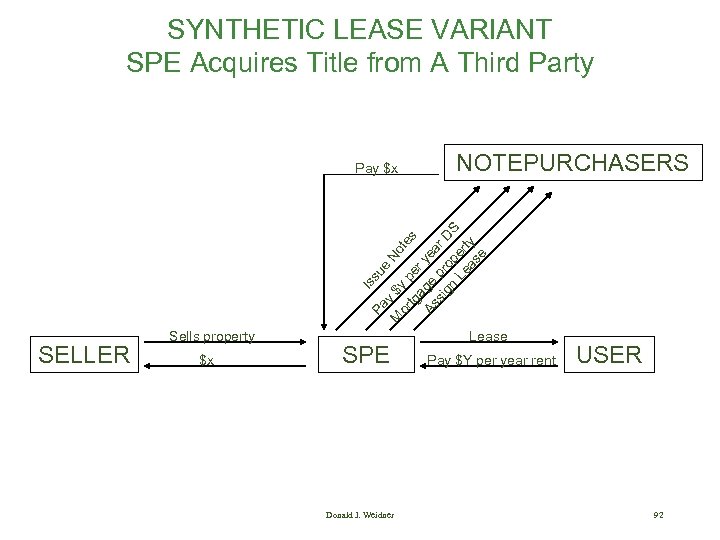 SYNTHETIC LEASE VARIANT SPE Acquires Title from A Third Party NOTEPURCHASERS I Pa ssu e No M y $y or te tg pe s ag r y As e e sig pr ar D n ope S Le r as ty e Pay $x SELLER Sells property $x SPE Donald J. Weidner Lease Pay $Y per year rent USER 92
 FASB Traditional Approach 1. Require that some leases be treated as mortgages for financial accounting purposes. • As “capital” leases rather than “operating” leases • Operating leases need not be recoded on balance sheet 2. Declare sale-leasebacks as especially vulnerable to being treated as mortgages. 3. Require some lessees to file consolidated financial statements with their SPE/lessors • Indirectly bringing an SPE’s assets, and the debts that encumber them, on to the Lessee’s books. Donald J. Weidner 93
 FASB New Approach: Accounting Standards Update No. 2016 -2 ØASU 2016 -2 contains extensive new rules that represent a major change in approach. ØIn short, the new rules require most business leases for more than a year to be recorded on the lessee’s balance sheet as reflecting both an asset and a liability. ØFor income statement purposes, the rules continue a modified version of the distinction between operating leases and financing leases. Donald J. Weidner 94