 Скачать презентацию Tax-Exempt Bonds and 4 Tax Credits Mary Nash
46e498fed3fc563d737ba39b30538f01.ppt
- Количество слайдов: 20



Tax-Exempt Bonds and 4% Tax Credits Mary Nash K. Rusher Hunton & Williams LLP (919) 899 -3066 mnrusher@hunton. com Mark Shelburne Novogradac & Company LLP (919) 889 -2596 mark. shelburne@novoco. com 2015 North Carolina Affordable Housing Conference October 29, 2015
What are multifamily housing revenue bonds? • Bond (debt) issued by a governmental entity (state, regional or local housing authority, county or city - the “Issuer”) • Proceeds are loaned to private entity (typically a partnership or LLC - the “Borrower”) • Borrower uses those dollars to acquire, construct and/or rehab and equip “multifamily residential rental housing” • Bonds are “private activity bonds” or “exempt facility bonds” under Section 142 of the Code 2
Tax-exempt bonds issued under IRC Section 142 combined with the 4% tax credits under Section 42 are an alternative to traditional 9% tax credits • Section 42 provides an “automatic” 4% tax credit • 50% or more of the project’s eligible costs must be financed with tax-exempt private activity bonds • Developer must submit an application to NCHFA for allocation of “volume cap” (i. e. permission to issue) • If NCHFA approves, the project sponsor/developer is not required to compete separately for tax credits 3
• Each state is permitted to issue a limited amount of private activity bonds in each year (“volume cap”) • Volume cap is divided among industrial development, student loan, single family, waste disposal and multifamily housing • Currently far more supply than demand • In NC, 2015 volume cap is more than $944 million • Volume cap for housing allocated by the NC Federal Tax Reform Allocation Committee (“TRAC”) • Use for multifamily housing is based on NCHFA recommendation 4
Benefits of tax-exempt bonds & 4% LIHTCs • No competition; resource goes largely unused • Tremendous need across the state • NC has extensive developer capacity – more than 60 groups involved in the 9% process annually • Difficult but certainly not impossible to make the numbers work • Developers all understand LIHTCs, which is the most difficult part 5
Bond/4% Affordability Requirements Bonds and tax credit rules require that at least 40% of the units be rented to households at <60% of AMI • As a practical matte most are 100% restricted • Tax rules permit as few as 20% to be leased to HHs at <50% AMI, with the remaining at 80% at market • Only one such project in N. C. (Charlotte) • An 80/20 project could be an option anywhere a market rate complex works 6
Portfolio Transactions • Portfolio transactions are a very specialized activity • Involve combining several properties in different locations under one owner • Challenging, lots of moving parts • Very efficient outcome as compared to submitting many 9% applications • NCHFA rather than a local authority is the issuer since it has statewide jurisdiction 7
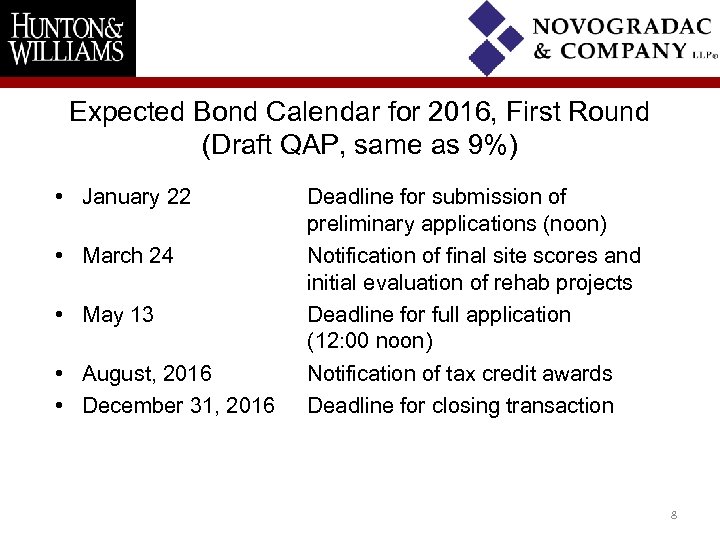
Expected Bond Calendar for 2016, First Round (Draft QAP, same as 9%) • January 22 • March 24 • May 13 • August, 2016 • December 31, 2016 Deadline for submission of preliminary applications (noon) Notification of final site scores and initial evaluation of rehab projects Deadline for full application (12: 00 noon) Notification of tax credit awards Deadline for closing transaction 8
NCHFA Review Criteria for Bond/4% Deals Requirements essentially the same as the 9% pre-app – site score, although no competition – site thresholds still apply – market study is the same – need an option or contract on the real property Other than the last item, a fairly small investment 9
NCHFA Requirements • • Meet all QAP standards unless indicated otherwise Inducement resolution with the full application All projects will carry out DHHS targeting Rehabilitation applications must: – Be placed in service date or before December 31, 1999 – Require at least $10, 000 per unit of rehabilitation – Not have an acquisition cost >60% of the total cost • Qualify for experience with an out-of-state bond deal • Operating reserve must be the greater of $1, 500/unit or four months’ debt and operating • Developer fee same as for 9% other than max of $1, 900, 000 10
Summary of initial steps for approval • Apply to NCHFA for approval of volume cap • Identify an issuer – local housing authority (best choice), regional housing authority, city or county • Issuer adopts preliminary (also called “inducement” or “reimbursement”) resolution • Issuer agrees that it will issue bonds if all approvals are obtained • Receive approval from NCHFA and allocation of volume cap 11
Summary of remaining steps • Public hearing (“TEFRA” hearing) after 14 days’ published notice before Issuer or city/county • Followed by approval resolution from city/county in which project is located • If debt outstanding >5 years, Issuer adopts findings resolution to satisfy Local Government Commission (Treasurer); meets once a month • Approval by town/city if a county or regional housing authority exercising jurisdiction there • Final approval by Issuer 12
Why does someone want to buy these bonds? • Interest received is exempt from income tax • In NC, the LGC requires bonds must have credit enhancement, be sold to a financial institution, or have an investment grade rating • HUD insured mortgage with Ginnie Mae Certificates • Can be privately placed • May be purchased by a single institutional investor, which may also be the tax credit investor • Banks get Community Reinvestment Act credit 13
Two Primary Structures: Long-Term Bonds • Remain in place at least for the full tax credit period • Rents must cover the debt service • Often require some sort of credit enhancement (i. e. Fannie Mae, HUD guaranty) or • A number of banks now will do privately placed long term debt (Sun. Trust, Bank of America, Citi. Bank) or • Freddie Mac also has a long term product 14
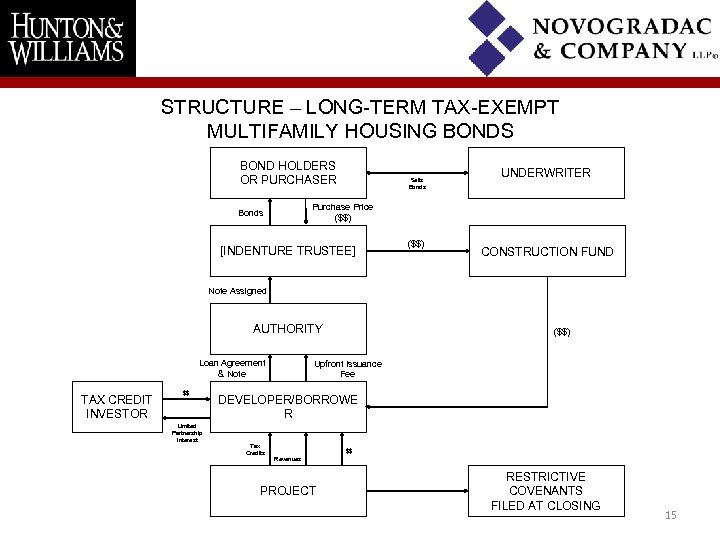
STRUCTURE – LONG-TERM TAX-EXEMPT MULTIFAMILY HOUSING BONDS BOND HOLDERS OR PURCHASER Sells Bonds UNDERWRITER Purchase Price ($$) Bonds [INDENTURE TRUSTEE] ($$) CONSTRUCTION FUND Note Assigned AUTHORITY Loan Agreement & Note TAX CREDIT INVESTOR $$ Limited Partnership Interest ($$) Upfront Issuance Fee DEVELOPER/BORROWE R Tax Credits $$ Revenues PROJECT RESTRICTIVE COVENANTS FILED AT CLOSING 15
Two Primary Structures: Short Bonds • Bonds are outstanding only during construction • Bonds and HUD 221(d)(4)/223(f)/Fannie Mae loan are outstanding simultaneously • Construction draws on HUD or Fannie Mae loan deposited to a cash collateral account; corresponding amount of bonds used to pay actual costs • Result is >50% of basis is constructed with bond proceeds • Bondholders have no interest in the Project but are 100% cash secured; result is lower rate for short-term debt • Bondholders have cash collateral; almost no risk 16
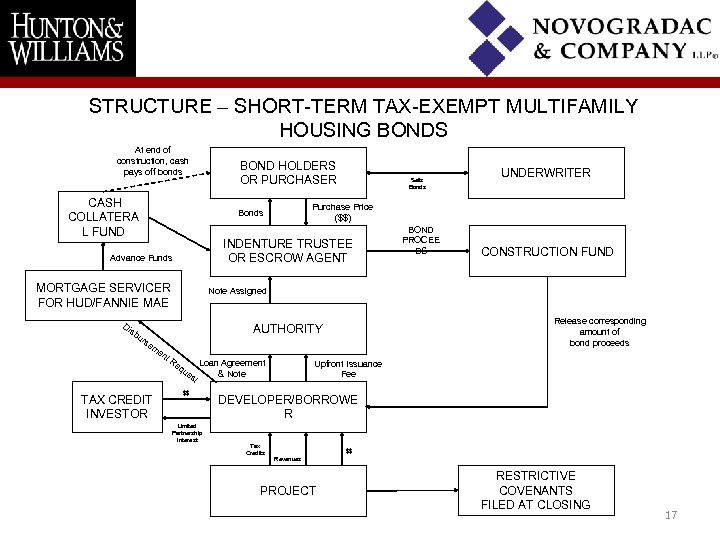
STRUCTURE – SHORT-TERM TAX-EXEMPT MULTIFAMILY HOUSING BONDS At end of construction, cash pays off bonds BOND HOLDERS OR PURCHASER CASH COLLATERA L FUND INDENTURE TRUSTEE OR ESCROW AGENT MORTGAGE SERVICER FOR HUD/FANNIE MAE ur se TAX CREDIT INVESTOR eq CONSTRUCTION FUND Release corresponding amount of bond proceeds m t R BOND PROCEE DS Note Assigned AUTHORITY en UNDERWRITER Purchase Price ($$) Bonds Advance Funds Di sb Sells Bonds ue st Loan Agreement & Note $$ Limited Partnership Interest Upfront Issuance Fee DEVELOPER/BORROWE R Tax Credits $$ Revenues PROJECT RESTRICTIVE COVENANTS FILED AT CLOSING 17
Who are the players in a bond deal? • Issuer – governmental unit that issues bonds • Very important to identify issuer early in the process • In NC the local housing authority is the first choice; cities and counties can also act as housing authorities • Purchaser – institution that purchases bonds • Underwriter – for publicly offered bonds, the investment banking firm that structures the deal and finds buyers • Trustee – bonds are issued under a trust indenture; the trustee holds proceeds pending disbursement for construction and collects payments for bondholders • Credit Enhancer – provides financial guarantee for bonds/project; makes bonds ratable/marketable 18
Who are the players in a bond deal? (cont’d) • Bond Counsel – oversees entire process and issues opinion that bonds are tax-exempt • Underwriter’s Counsel – prepares disclosure document to sell bonds to the market place – “Official Statement” • Borrower’s Counsel – looks out for Borrower’s interest; generally does real estate, tax credits, and opinion (sometimes roles split between >1 firm) • Issuer’s Counsel – represents the bond issuer • Rating Agency – will issue ratings for the bonds based on credit enhancement; makes bonds more marketable 19
QUESTIONS? Mary Nash K. Rusher Hunton & Williams LLP (919) 899 -3066 mnrusher@hunton. com Mark Shelburne Novogradac & Company LLP (919) 889 -2596 mark. shelburne@novoco. com 20
Скачать презентацию Tax-Exempt Bonds and 4 Tax Credits Mary Nash
46e498fed3fc563d737ba39b30538f01.ppt