 Скачать презентацию Tax Audit u s 44 AB A study on
cac2c5ca74fd6e2f7312f7a6002f4501.ppt
- Количество слайдов: 32



Tax Audit u/s 44 AB A study on the application of Relevant Accounting Standards Presentation at National Conference on Direct Taxes and Allied Laws Direct Taxes Committee of ICAI and hosted by Mangalore Branch of SIRC of ICAI on 21. 08. 2010 organised by the Chinnsamy Ganesan FCA DISA(ICA)
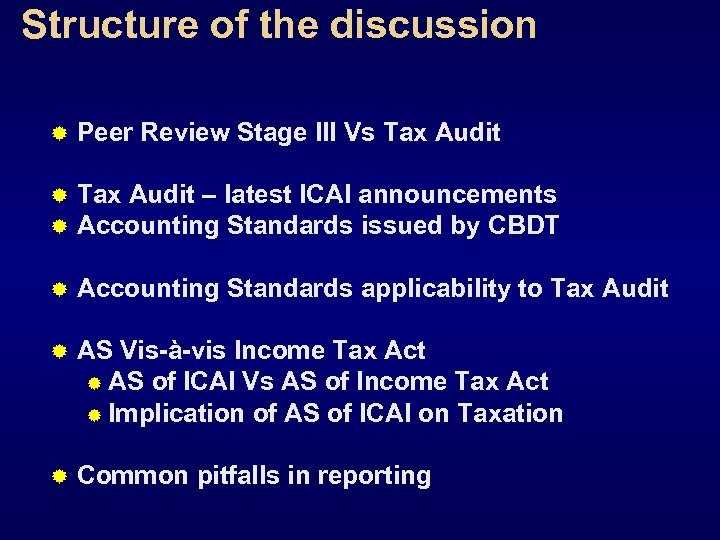
Structure of the discussion ® Peer Review Stage III Vs Tax Audit ® ® Tax Audit – latest ICAI announcements Accounting Standards issued by CBDT ® Accounting Standards applicability to Tax Audit ® AS Vis-à-vis Income Tax Act ® AS of ICAI Vs AS of Income Tax Act ® Implication of AS of ICAI on Taxation ® Common pitfalls in reporting
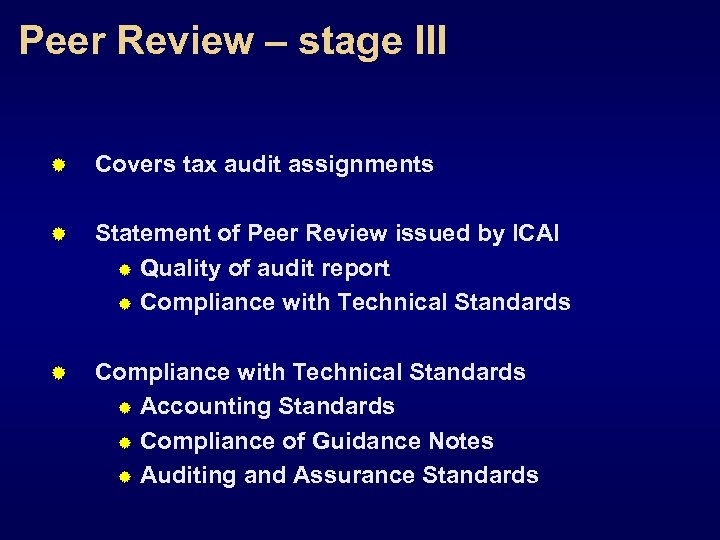
Peer Review – stage III ® Covers tax audit assignments ® Statement of Peer Review issued by ICAI ® Quality of audit report ® Compliance with Technical Standards ® Accounting Standards ® Compliance of Guidance Notes ® Auditing and Assurance Standards
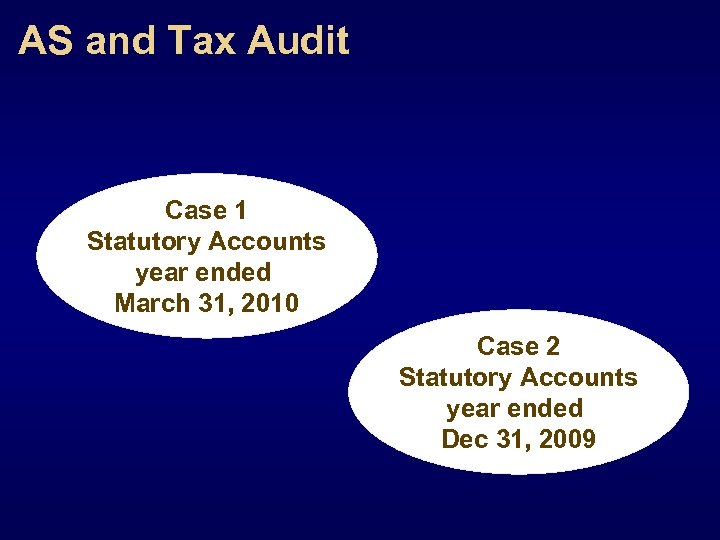
AS and Tax Audit Case 1 Statutory Accounts year ended March 31, 2010 Case 2 Statutory Accounts year ended Dec 31, 2009
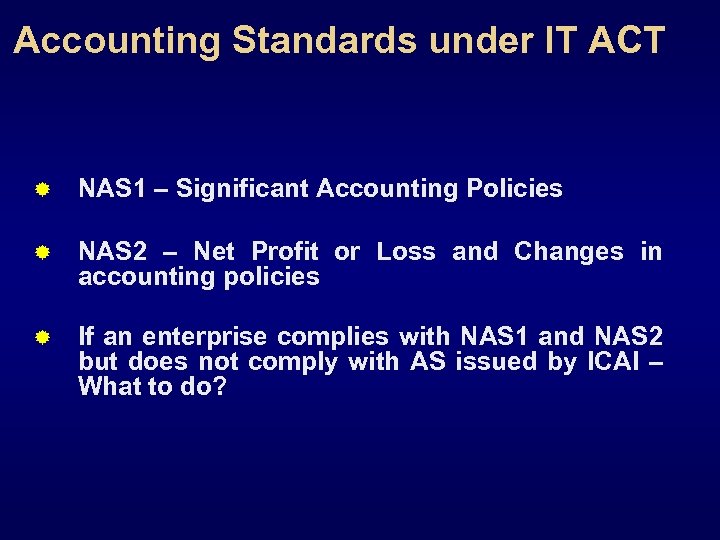
Accounting Standards under IT ACT ® NAS 1 – Significant Accounting Policies ® NAS 2 – Net Profit or Loss and Changes in accounting policies ® If an enterprise complies with NAS 1 and NAS 2 but does not comply with AS issued by ICAI – What to do?
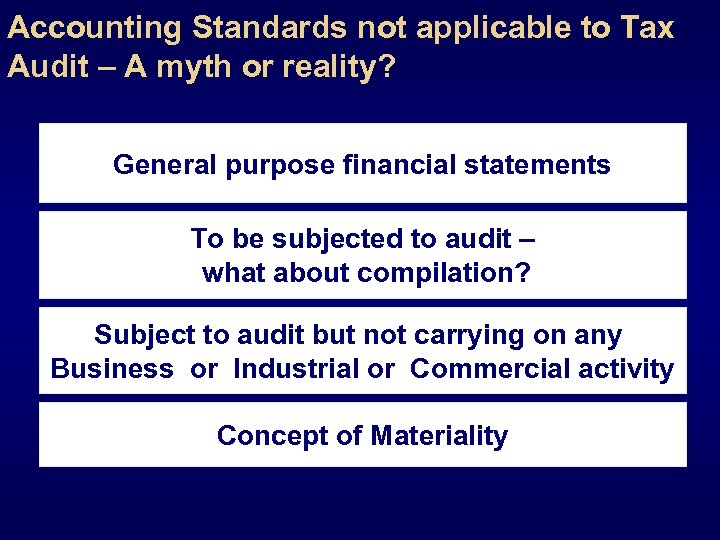
Accounting Standards not applicable to Tax Audit – A myth or reality? General purpose financial statements To be subjected to audit – what about compilation? Subject to audit but not carrying on any Business or Industrial or Commercial activity Concept of Materiality
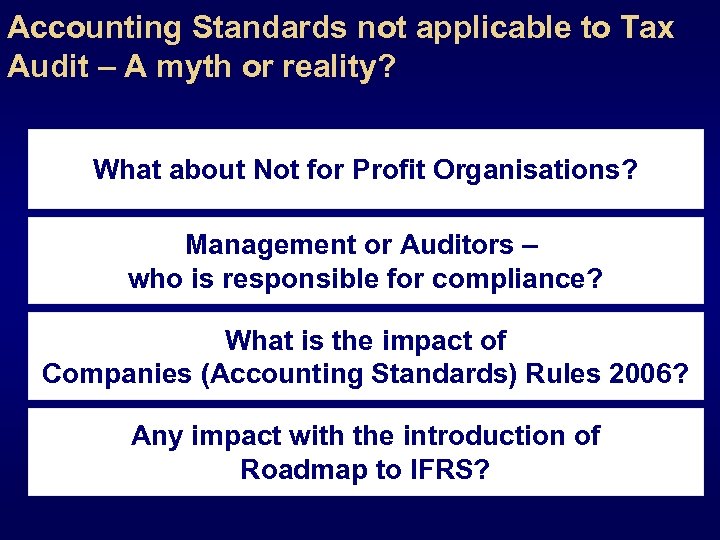
Accounting Standards not applicable to Tax Audit – A myth or reality? What about Not for Profit Organisations? Management or Auditors – who is responsible for compliance? What is the impact of Companies (Accounting Standards) Rules 2006? Any impact with the introduction of Roadmap to IFRS?
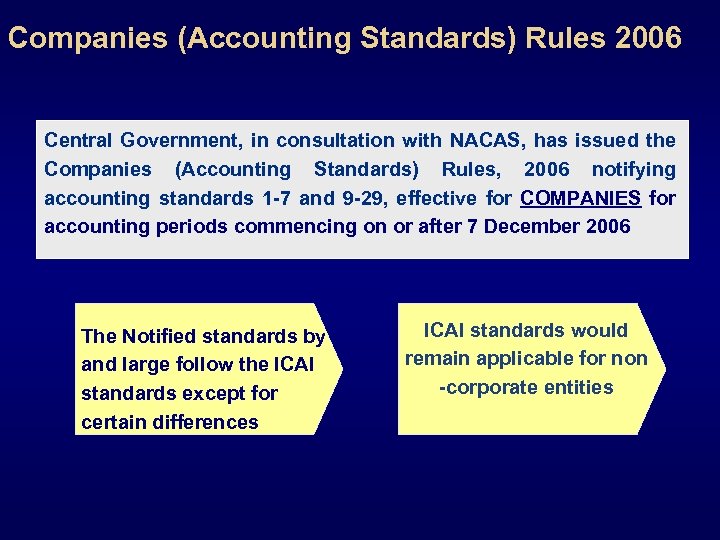
Companies (Accounting Standards) Rules 2006 Central Government, in consultation with NACAS, has issued the Companies (Accounting Standards) Rules, 2006 notifying accounting standards 1 -7 and 9 -29, effective for COMPANIES for accounting periods commencing on or after 7 December 2006 The Notified standards by and large follow the ICAI standards except for certain differences ICAI standards would remain applicable for non -corporate entities
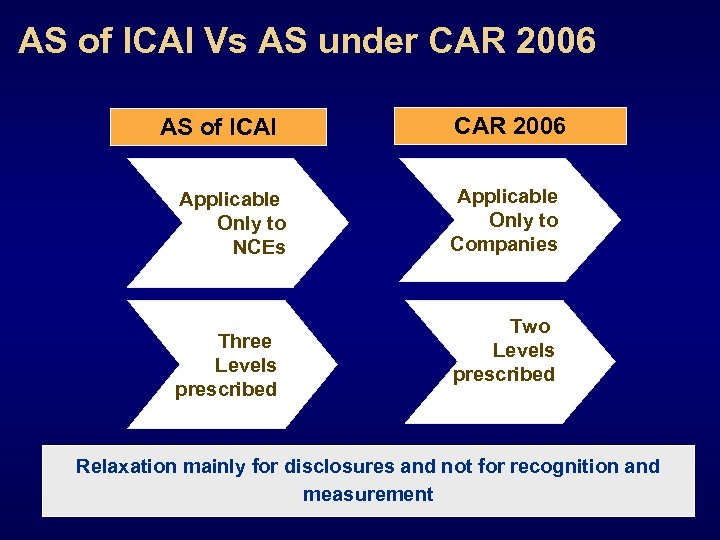
AS of ICAI Vs AS under CAR 2006 AS of ICAI Applicable Only to NCEs Three Levels prescribed CAR 2006 Applicable Only to Companies Two Levels prescribed Relaxation mainly for disclosures and not for recognition and measurement
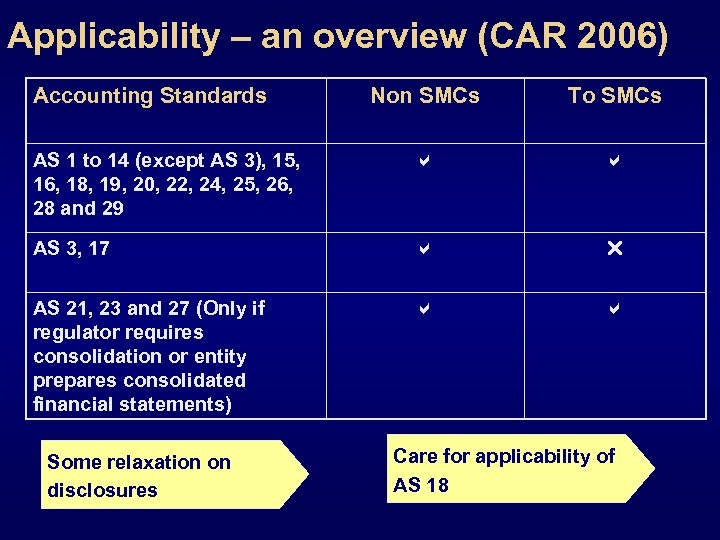
Applicability – an overview (CAR 2006) Accounting Standards Non SMCs To SMCs AS 1 to 14 (except AS 3), 15, 16, 18, 19, 20, 22, 24, 25, 26, 28 and 29 a a AS 3, 17 a r AS 21, 23 and 27 (Only if regulator requires consolidation or entity prepares consolidated financial statements) a a Some relaxation on disclosures Care for applicability of AS 18
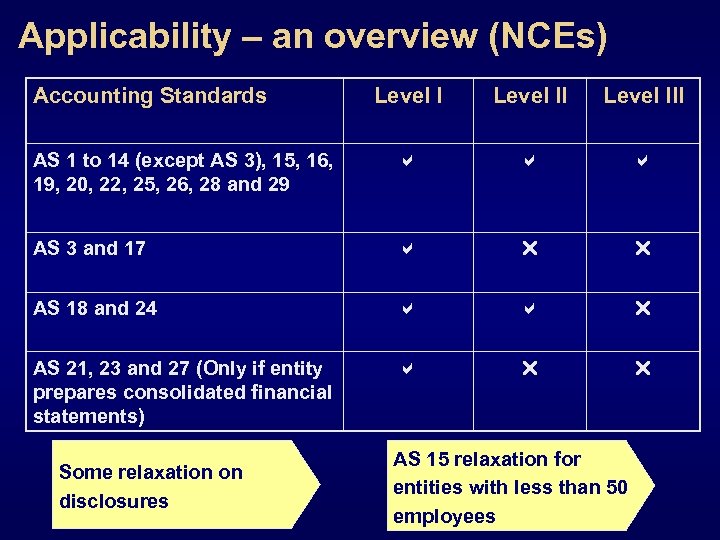
Applicability – an overview (NCEs) Accounting Standards Level III AS 1 to 14 (except AS 3), 15, 16, 19, 20, 22, 25, 26, 28 and 29 a a a AS 3 and 17 a r r AS 18 and 24 a a r AS 21, 23 and 27 (Only if entity prepares consolidated financial statements) a r r Some relaxation on disclosures AS 15 relaxation for entities with less than 50 employees
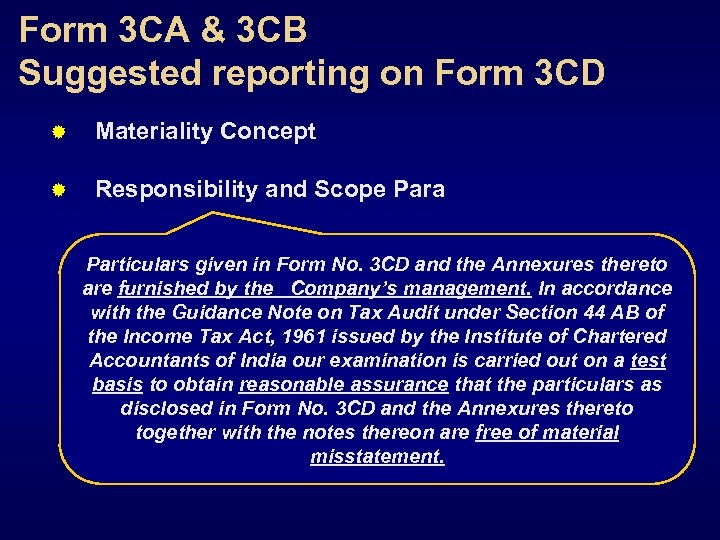
Form 3 CA & 3 CB Suggested reporting on Form 3 CD ® Materiality Concept ® Responsibility and Scope Para Particulars given in Form No. 3 CD and the Annexures thereto are furnished by the Company’s management. In accordance with the Guidance Note on Tax Audit under Section 44 AB of the Income Tax Act, 1961 issued by the Institute of Chartered Accountants of India our examination is carried out on a test basis to obtain reasonable assurance that the particulars as disclosed in Form No. 3 CD and the Annexures thereto together with the notes thereon are free of material misstatement.
AS 1 vis-à-vis Tax Audit ® AS 1 “Disclosure of Accounting Policies” ® Concept of considered ® Certain prudence is not fully provisions/ write off not allowed as expenditure
AS 2 vis-à-vis Tax Audit ® AS 2 “Valuation of Inventories” ® Market value Vs Net realisable value ® AS 2 does not prescribe valuation method for inventory of shares, debenture etc ® Section 145 A of the IT Act ® Inclusive method under the IT Act ® Exclusive method under AS 2
AS 7 vis-à-vis Tax Audit ® AS 7 “Accounting for Construction Contracts” ® % completion method contract method Vs completed ® Accounting foreseeable future loss ® Presumptive taxation u/s 44 AD ® Present limit Vs limit proposed by DTC
AS 10 vis-à-vis Tax Audit ® AS 10 (Revised) “Property, Plant and Equipment” ® Ready for the intended use Vs put to use ® Whether depreciation claim is optional? ® Idle machinery under AS 10 ® Recognition expenditure criteria for Subsequent
AS 11 vis-à-vis Tax Audit ® AS 11 “The effect of changes in foreign exchange rates” ® AS 11 controversy still continues even after the introduction of Companies Accounting Standards Rule 2006 ® Treatment of unrealised forex loss adjusted in the carrying value for Income Tax Depreciation
AS 12 vis-à-vis Tax Audit ® AS 12 “Accounting for Government Grants” ® If condition attached subsidy can not be fully reduced from the cost as per AS 12 ® To be reduced from Cost of asset for IT depreciation computation
AS 13 vis-à-vis Tax Audit ® AS 13 “Accounting for Investments” ® Current Investments to be written down to market value if it is lower ® Permanent diminution in value of Long. Term Investments to be provided for ® If so provided not allowable under IT Act l Only on disposal
AS 15 vis-à-vis Tax Audit ® AS 15 “Accounting for Retirement Benefits” ® Provision for Gratuity – Sec 40 A (7)/ 43 B ® Provision for Compensated Absence – 43 B ® Bonus Vs performance incentives
AS 16 vis-à-vis Tax Audit ® AS 16 “Borrowing Costs” ® Concept of Qualifying Assets ® Suspension of borrowing cost whether admissible under the Income Tax Act ® Capitalisation of borrowing Costs Vs 36 (1) (iii)
AS 18 vis-à-vis Tax Audit ® AS 18 “Related Party Transactions” ® Divided position of definition of related party ® Reconciling and considering the impact of disclosures ® ® AS 18 Vs 40 (A) (2)(b) Loans to Directors and their relatives
AS 19 vis-à-vis Tax Audit ® AS 19 “Accounting for Leases” ® Depreciation allowability on finance leases ® ® Lessor under the Income Tax Act Lessee under AS 19
AS 22 vis-à-vis Tax Audit ® AS 22 “Taxes on Income” ® No concept of deferred tax under the IT Act ® Reversal of DTA for MAT computation – recent judicial pronouncement
AS 26 vis-à-vis Tax Audit ® AS 26 “Intangible Assets” ® Amortisation over useful economic life ® Retirement of intangibles to be fully charged off ® Depreciation rate specifically mentioned under IT Act ® Distinction between Intangible Asset and Computer Software
AS 28 vis-à-vis Tax Audit ® AS 28 “Impairment of Assets” ® Impairment to be tested at every balance sheet date and loss to be accounted as an expense ® Not allowable till the asset is disposed ® Reversal of Impairment Loss will not have any impact in IT Computation ® Impact on MAT Computation – a grey area
AS 29 vis-à-vis Tax Audit ® AS 29 “Provisions, Contingent Liabilities and Contingent Assets” ® Legal Vs Constructive obligation ® Provision Obligation towards Asset Retirement
AS 30, 31 and 32 vis-à-vis Tax Audit ® Financial Instruments Standards ® Fair valuation ® Mark to Market Losses
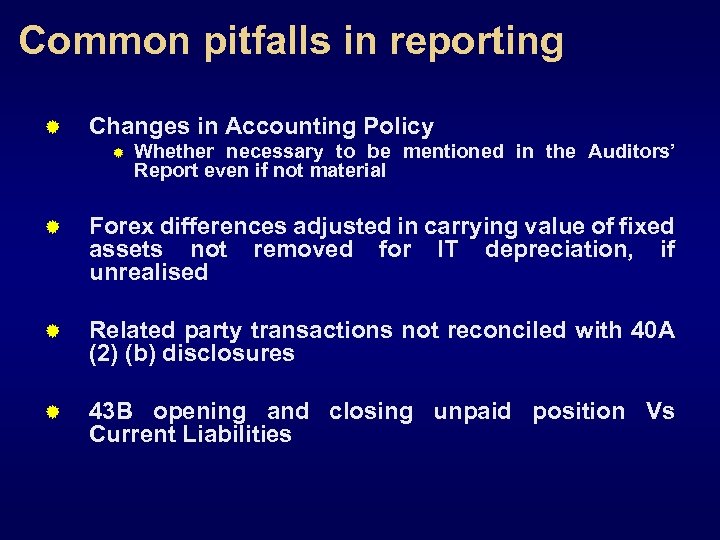
Common pitfalls in reporting ® Changes in Accounting Policy ® Whether necessary to be mentioned in the Auditors’ Report even if not material ® Forex differences adjusted in carrying value of fixed assets not removed for IT depreciation, if unrealised ® Related party transactions not reconciled with 40 A (2) (b) disclosures ® 43 B opening and closing unpaid position Vs Current Liabilities
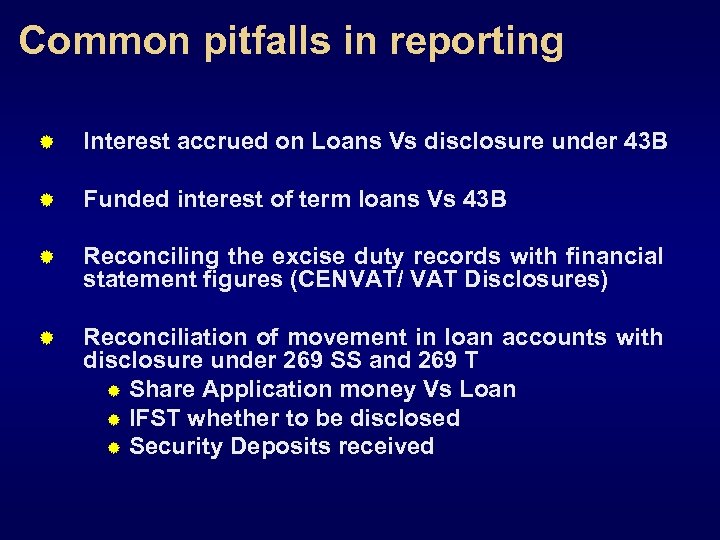
Common pitfalls in reporting ® Interest accrued on Loans Vs disclosure under 43 B ® Funded interest of term loans Vs 43 B ® Reconciling the excise duty records with financial statement figures (CENVAT/ VAT Disclosures) ® Reconciliation of movement in loan accounts with disclosure under 269 SS and 269 T ® Share Application money Vs Loan ® IFST whether to be disclosed ® Security Deposits received
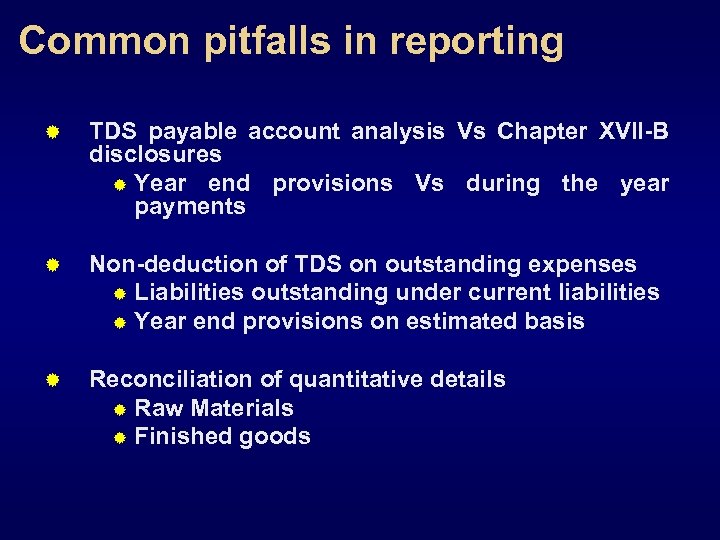
Common pitfalls in reporting ® TDS payable account analysis Vs Chapter XVII-B disclosures ® Year end provisions Vs during the year payments ® Non-deduction of TDS on outstanding expenses ® Liabilities outstanding under current liabilities ® Year end provisions on estimated basis ® Reconciliation of quantitative details ® Raw Materials ® Finished goods

Thank you ganesanca@yahoo. com 99401 30403
Скачать презентацию Tax Audit u s 44 AB A study on
cac2c5ca74fd6e2f7312f7a6002f4501.ppt