


 Скачать презентацию TASER Electronic Control Devices ECDs — Legal Update
62c7ec983fc7c33c7de6735f6f992faf.ppt
- Количество слайдов: 91
 TASER® Electronic Control Devices (ECDs) -- Legal Update Michael Brave, Esq. , M. S. , C. L. S. 3, C. L. E. T. , C. P. S. , C. S. T. National/International Litigation Counsel, TASER International, Inc. President, LAAW International, Inc. Email – brave@laaw. com Telephone – (651) 248 -2809 E-fax – (480) 275 -3291 ECD Legal Resources Website – www. ecdlaw. info ICD Resources – www. incustodydeath. com
 Basics • TASER International, Inc. (TASER) does not create, recommend, or endorse policy or set standards of care. • Importance of keeping up to date: – Era of information and mis-information overload: • Importance of ignorance eradication • Learn the “science” and “medicine” not the “myths” • Need to put everything into perspective (risk/benefit) • Need to understand the basics and foundations • Reference Sheets and Reference Packets • www. ecdlaw. info (owned by LAAW International, Inc. ) • www. ipicd. com or www. incustodydeath. com • Understand actual legal standards (and their bases) • 2005 to present ECD hysteria not scientifically based
 Electronic Control Devices • • • Basics (of force) Basic ECD deployment numbers Basic selected death numbers (US) Physiologically compromised persons - elevated risks of death Force standards paradigms ECD basic concepts ECDs studied more than other force options ECDs usually more effective than other force options ECDs usually safer than other force options ECDs more accountability features than other force options ECDs only force options maintaining effectiveness while increasing safety margins
 Basics (of force): (US) Societal problems influencing force response increases): • Drug abuse increasing annually: – (2004) 19, 100, 000 current illicit drug abusers (7. 9% of population) – (2006) 20, 357, 000 current illicit drug abusers – (2004) 1, 997, 993 drug caused emergency room visits • People in serious psychological distress (SPD) increasing annually (2004) 21, 400, 000 SPD (9. 9% of adults) • Alcohol abuse - (2004) 10, 200, 000 operating vehicles under the influence • Criminals resisting seizure attempts increasing • Criminals fleeing apprehension increasing
 Basics (of force): • Any force option can be abused • It is the person who abuses the force option - not the force option • “Almost every use of force, however minute, poses some risk of death. ” Garrett v. Athens-Clarke County, 378 F. 3 d 1274, 1280, n. 12 (11 th Cir. 2004). • “Fourth Amendment jurisprudence has long recognized that the right to make an arrest or investigatory stop necessarily carries with it the right to use some degree of physical coercion or threat thereof to effect it. ” Graham v. Conner, 490 U. S. 386, 396 (1989).
 ECD basic concepts: (General Statements; Peer-Reviewed Medical and/or Scientific Research) • No evidence that other law enforcement force option is safer than a normal use of an ECD • ECDs are more effective in facilitating capture, control, and restraint than other force options • ECDs are generally safe per se and are usually safer than other force options • Courts have held that ECDs are not excessive force per se • ECDs are saving lives, reducing injuries to officers and suspects, and reducing excessive force claims
 ECDs studied more than other force options: • ECD delivers a small electrical charge to accomplish neuro-muscular incapacitation (NMI) objective • Delivery of electrical charge to humans has been widely studied for over 200 years • ECDs specifically have been widely studied in over 200 studies (many human studies) • No other force option has even 1/10 th the peer-reviewed published studies of ECDs
 ECDs usually more effective than other force options: • Every other force option uses pain/discomfort volitional compliance or traumatic injury to facilitate capture, control, or restraint • ECD is designed to induce motor-nerve mediated NMI to facilitate capture, control, and restraint • No other force option is as effective at deterrent presence of ECDs (LASER painting or arcing gains volitional compliance in from 1 to 4 out of 5 uses)
 ECDs usually safer than other force options: • Peer-reviewed literature generally finds ECDs safer than other force options • Peer-reviewed literature finding that ECDs are less injurious to suspects and officers - (2009) Mac. Donald: – "Given the findings from this study, as well as those from previously published research, law enforcement agencies should encourage the use of OC spray or CEDs in place of impact weapons and should consider authorizing their use as a replacement for hands-on force tactics against physically resistant suspects. " – "Injuries from police use-of-force incidents continue to be a public health problem affecting tens of thousands of civilians and police officers in the United States each year. Our findings suggest that the incidence of these injuries can be reduced substantially when police officers use CEDs and OC spray responsibly and in lieu of physical force to control physically resistant suspects…. a replacement for hands-on force tactics against physically resistant suspects. ”
 ECDs usually safer than other force options: Peer-reviewed literature finding that ECDs are less injurious to suspects and officers: control physically resistant suspects… a replacement for hands-on force tactics against physically resistant suspects. “ (2009) Bozeman: – "Conducted electrical weapons were used against 1, 201 subjects during 36 months. One thousand one hundred twenty-five subjects (94%) were men; the median age was 30 years (range 13 to 80 years). Mild or no injuries were observed after conducted electrical weapon use in 1, 198 subjects (99. 75%; 95% confidence interval 99. 3% to 99. 9%). Of mild injuries, 83% were superficial puncture wounds from conducted electrical weapon probes. Significant injuries occurred in 3 subjects (0. 25%; 95% confidence interval 0. 07% to 0. 7%), including 2 intracranial injuries from falls and 1 case of rhabdomyolysis. Two subjects died in police custody; medical examiners did not find conducted electrical weapon use to be causal or contributory in either case. " – In a "combined experience of 4, 058 consecutively monitored conducted electrical weapon uses with an electrical shock delivered. 2 -4 Serious injuries are clearly rare, and there are no cases in any of the reports suggesting sudden cardiac death related to the [TASER ECD]. ”
 ECDs usually safer than other force options: Peer-reviewed literature finding that ECDs can reduce use of deadly force: • (2008) Eastman - "In 5. 4% [23 of 426] of deployments (n=23), CED use was deemed to have clearly prevented the use of lethal force by police. "
 ECDs have more accountability features than other force options: • 1999 (M 26 ECD) - Number of 5 second ECD discharges (not delivered) with time stamp (has clock drift) • 2003 (X 26 ECD): – Number of seconds of ECD discharges (cannot determine whether charge was delivered) – Time of discharge (has clock drift) – Internal ECD temperature and calculated percentage of battery life remaining • 2005 (TASER Cam™) - black/white ECD incorporated incident audio/video recording
 ECDs have more accountability features than other force options: • 2009 (X 3™ ECD) - Trilogy Logs: – Records every safety activation, trigger pull, arc, etc. – Pulse-by-pulse determination of electrical discharges (distinguishing drive stun and probe) delivered – Accurate to the second - synced to world atomic clock through EVIDENCE. com • 2010 (AXON): – On-officer DVD quality video/audio digital recording from officer's perspective – Highly secure evidence capture, upload, retrieval, and audit systems
 ECDs increasing safety margins: • No other force option is increasing safety margin while working to maintain effectiveness • Other force options increase pain or injury potential to increase effectiveness: – Pepper sprays have increased Scoville heat unit ratings. – Batons have gone from primarily wood to polymer and metal. – (Firearms) Bullets have increased to cause greater traumatic injuries. • ECD waveform, force strategies, etc. refined to maintain (or increase) effectiveness while lowering risk of serious injury or death (increasing safety margins)
 TASER International, Inc. • No better training program for any other force option – Training program updated and improved • Providing greater levels of accountability features • Encouraging "Smart Use" Force Guidelines
 Where are We: Putting Things Into Perspective
 Where are we? (for all – Law Enforcement EMS, MEs, Coroners, Lawyers) 20/20 Hindsight Perfection Standards • Through Who’s Perceptual Lens? • Perfectly informed (on all issues/possibilities) • Perfect decisions (in 20/20 hindsight) • Perfect investigations (need knowledge) • Perfect (complete, accurate, unassailable) reporting • Perfect oversight analyses and decisions • Perfect judicial action defense
 Costs of Failing to be Perfect? • • • Federal criminal prosecution State criminal prosecution Career destruction Civil lawsuits (increased risk of loss) Negative community relations Loss of tools, resources, money
 What level of risk will you accept? • • What are your objectives? What will you accept? What level of criticism will you accept? What will you do to make a difference? What is your definition of professionalism? What do you want of your department? How much training is enough? How close to “perfection” is your agency?
 Where are we today – headed? • Through who’s perceptual lens? • What are outsiders’ expectations of us? – Perfection standards – Absolute fore knowledge – Guarantor of “perfect” outcome – Force recipient is the “victim” – Perfect, exhaustive, complete, accurate investigation of every incident • “Straw that broke the camel’s back” is enough
 ECD Smart Use Guidelines: Putting Things Into Perspective
 Force standards paradigms: • Self (or third-party defense) standards • United Nations Force Standard: Minimum force necessary to accomplish lawful objectives standards • Risk/benefit standards: “[I]n judging whether [officer’s] actions were reasonable, we must consider the risk of bodily harm that [officer’s] actions posed to [suspect] in light of the threat to the public that [officer] was trying to eliminate. ” (Scott v. Harris, 550 U. S. 372, 383 (2008)). • Abuse of authority standards: “[T]he Fourth Amendment addresses ‘misuse of power, ’ not the accidental effects of otherwise lawful conduct. ” Brower v. County of Inyo, 489 U. S. 593, 596 (1989); Milstead v. Kibler, 243 F. 3 d 157 (4 th Cir. 2001).
 Force standards paradigms: Smart Use Guidelines (of force): • Changing initial officer default focus from all people being perceived as an intentional immediate threat to officer • Minimizing force by making better (more informed) decisions – Appropriately gauge risk/benefit and need for haste • Maximizing accountability evidentiary audio/video recording of the full incident from the officer’s perspective • Maximizing unassailable evidence availability, collection, storage, retrieval • Preparing better force reports/incident documentation • Performing better force/death investigations • Accurately analyzing force use to appropriate standards of care
 ECD “Smart Use” Guidelines Basics ECD “Smart Use” Guidelines are NOT a Constitutional or legal force standard. ECD “Smart Use” Guidelines are ECD force considerations presented for discussion in an effort to maintain officer safety while minimizing ECD force and negative consequences of ECD force.
 Standards Purposes • • • Constitutional rights purpose State statutes purpose Recommendations purposes Department policy purpose “Smart Use” Guidelines purpose
 ECD “Smart Use” Guidelines Basics Department: • Clearly delineate (understand) force standards • Delineate accountability standards and should • Support officers’ appropriate force decisions • Train “Smart Use” Guidelines Force Basics • Train force alternatives and options • Monitor force and remedial training • Provide optimal equipment and training
 ECD “Smart Use” Guidelines Basics Officer: • Make good decisions: – Risk management approach to force – Force minimization • Write excellent reports – Bolded timeline paragraph headers • Record incident – avoid he said/she said • Appropriately gauge risk and need for haste • Listen
 ECD “Smart Use” Guidelines Basics • Use no more force than necessary to accomplish lawful objectives – the minimum (least amount of) force goal • Use lowest possible number of applications • Use probe rather than drive-stun (DS) – DS is not necessarily less force than probe – Avoid DS (less probability of effectiveness) – Especially avoid cartridge removed or X 3 DS • Greater injury probability/potential
 ECD “Smart Use” Guidelines Basics • • Force in Presence of Immediate Threat Force to Restrain or Control Force to Restrain or Capture Force to Prevent/Stop Fleeing Coercive Force to Overcome Obstruction Distraction Force for Community Caretaker Beware force when no force is necessary: – Listen – Patience, alternatives
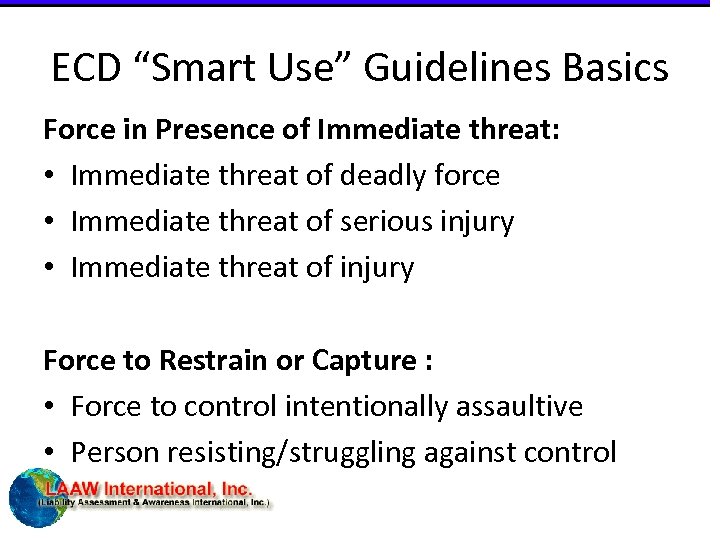 ECD “Smart Use” Guidelines Basics Force in Presence of Immediate threat: • Immediate threat of deadly force • Immediate threat of serious injury • Immediate threat of injury Force to Restrain or Capture : • Force to control intentionally assaultive • Person resisting/struggling against control
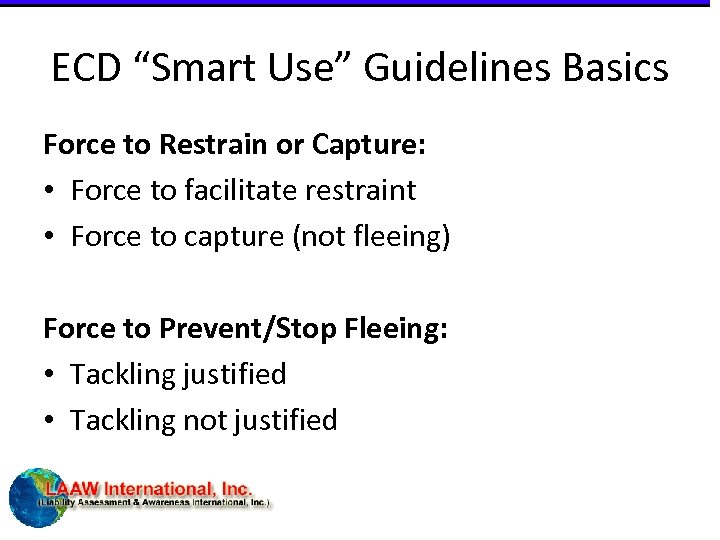 ECD “Smart Use” Guidelines Basics Force to Restrain or Capture: • Force to facilitate restraint • Force to capture (not fleeing) Force to Prevent/Stop Fleeing: • Tackling justified • Tackling not justified
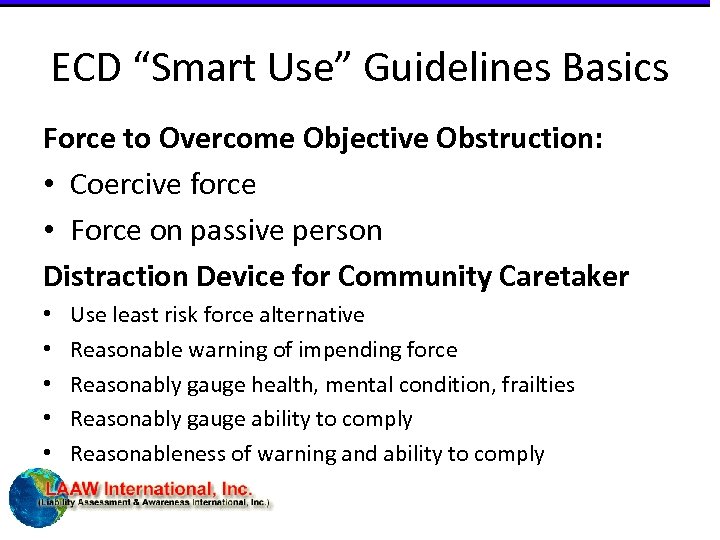 ECD “Smart Use” Guidelines Basics Force to Overcome Objective Obstruction: • Coercive force • Force on passive person Distraction Device for Community Caretaker • • • Use least risk force alternative Reasonable warning of impending force Reasonably gauge health, mental condition, frailties Reasonably gauge ability to comply Reasonableness of warning and ability to comply
 Numbers: Putting Things Into Perspective
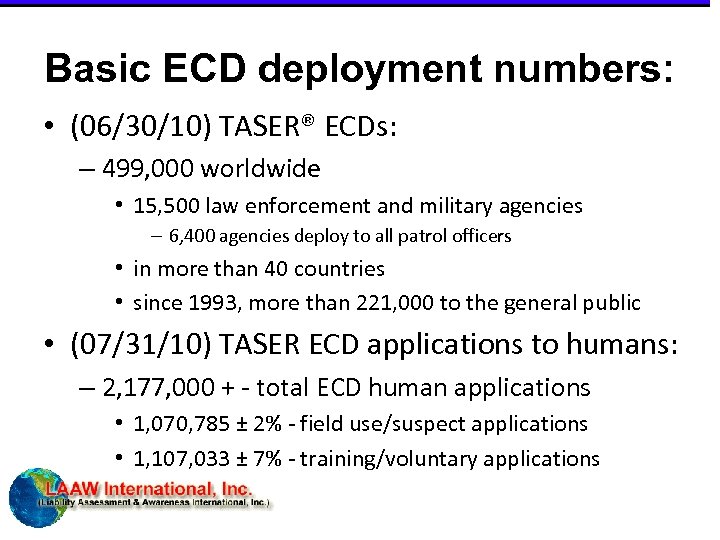 Basic ECD deployment numbers: • (06/30/10) TASER® ECDs: – 499, 000 worldwide • 15, 500 law enforcement and military agencies – 6, 400 agencies deploy to all patrol officers • in more than 40 countries • since 1993, more than 221, 000 to the general public • (07/31/10) TASER ECD applications to humans: – 2, 177, 000 + - total ECD human applications • 1, 070, 785 ± 2% - field use/suspect applications • 1, 107, 033 ± 7% - training/voluntary applications
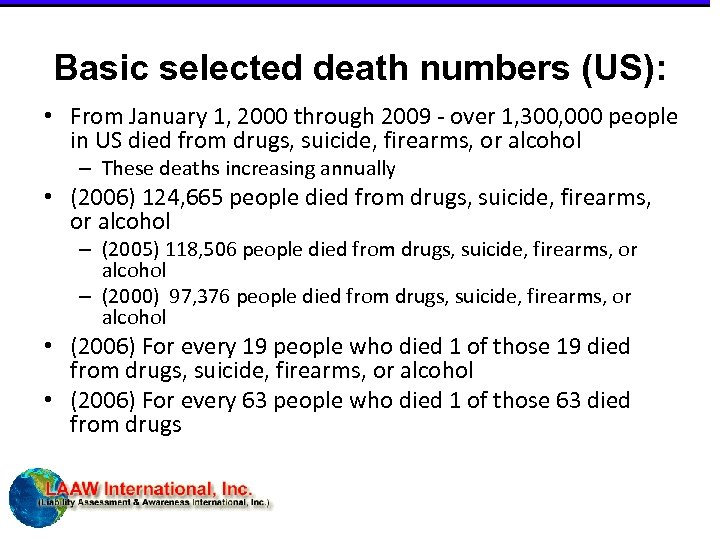 Basic selected death numbers (US): • From January 1, 2000 through 2009 - over 1, 300, 000 people in US died from drugs, suicide, firearms, or alcohol – These deaths increasing annually • (2006) 124, 665 people died from drugs, suicide, firearms, or alcohol – (2005) 118, 506 people died from drugs, suicide, firearms, or alcohol – (2000) 97, 376 people died from drugs, suicide, firearms, or alcohol • (2006) For every 19 people who died 1 of those 19 died from drugs, suicide, firearms, or alcohol • (2006) For every 63 people who died 1 of those 63 died from drugs
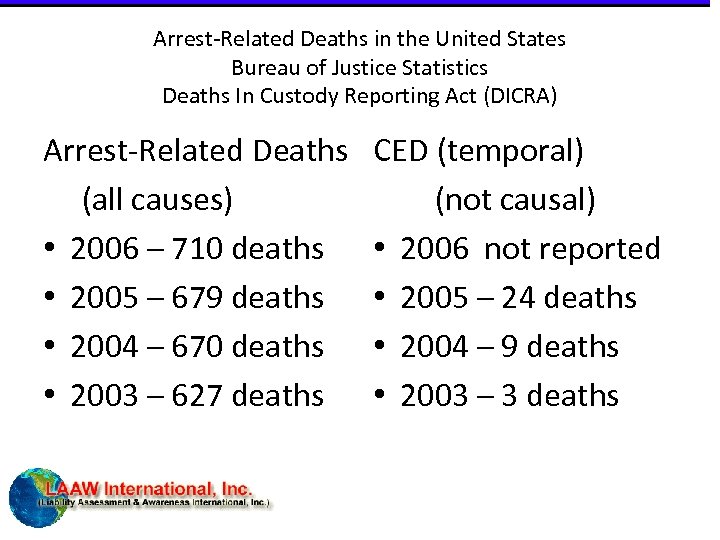 Arrest-Related Deaths in the United States Bureau of Justice Statistics Deaths In Custody Reporting Act (DICRA) Arrest-Related Deaths (all causes) • 2006 – 710 deaths • 2005 – 679 deaths • 2004 – 670 deaths • 2003 – 627 deaths CED (temporal) (not causal) • 2006 not reported • 2005 – 24 deaths • 2004 – 9 deaths • 2003 – 3 deaths
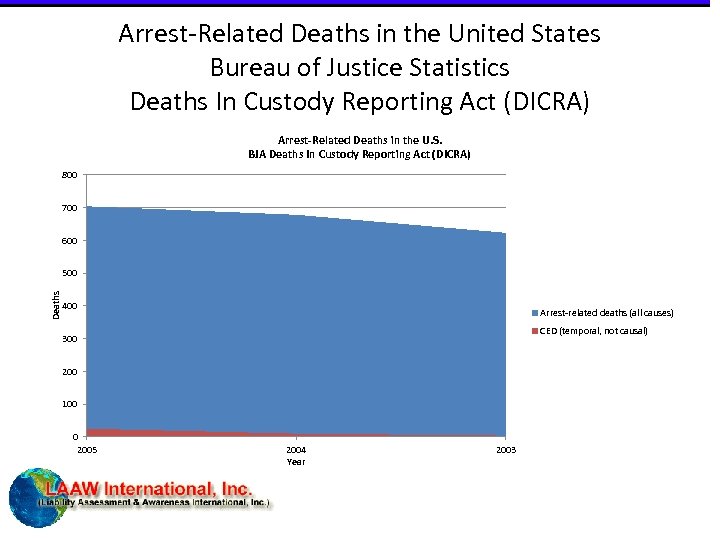 Arrest-Related Deaths in the United States Bureau of Justice Statistics Deaths In Custody Reporting Act (DICRA) Arrest-Related Deaths in the U. S. BJA Deaths In Custody Reporting Act (DICRA) 800 700 600 Deaths 500 400 Arrest-related deaths (all causes) CED (temporal, not causal) 300 200 100 0 2005 2004 Year 2003
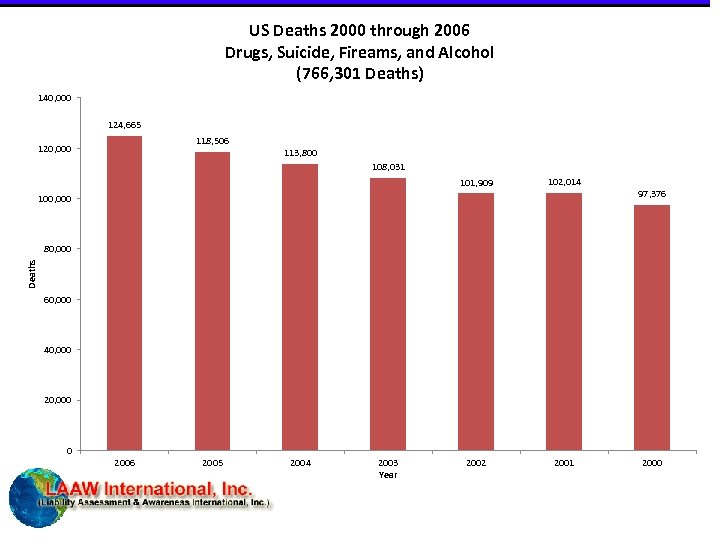 US Deaths 2000 through 2006 Drugs, Suicide, Fireams, and Alcohol (766, 301 Deaths) 140, 000 124, 665 118, 506 120, 000 113, 800 108, 031 101, 909 102, 014 2002 2001 100, 000 97, 376 Deaths 80, 000 60, 000 40, 000 20, 000 0 2006 2005 2004 2003 Year 2000
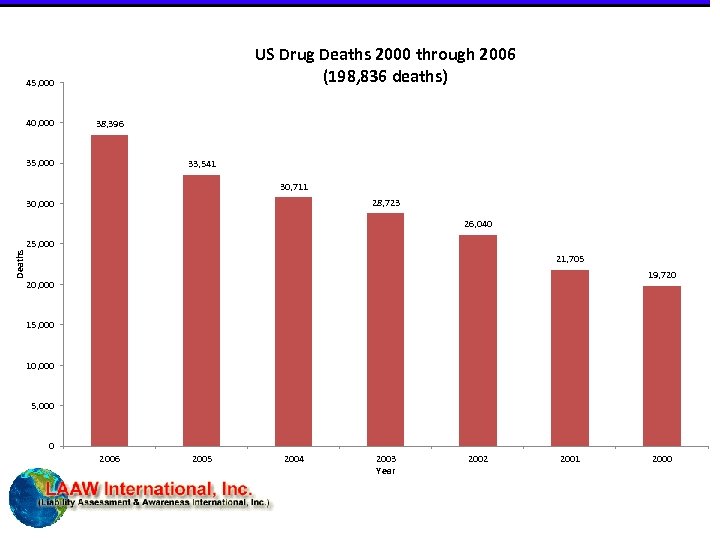 US Drug Deaths 2000 through 2006 (198, 836 deaths) 45, 000 40, 000 38, 396 35, 000 33, 541 30, 711 28, 723 30, 000 Deaths 26, 040 25, 000 21, 705 19, 720 20, 000 15, 000 10, 000 5, 000 0 2006 2005 2004 2003 Year 2002 2001 2000
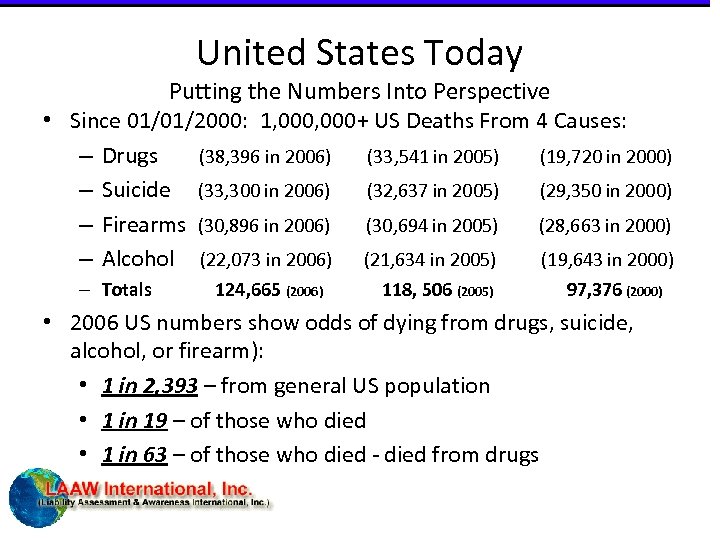 United States Today Putting the Numbers Into Perspective • Since 01/01/2000: 1, 000+ US Deaths From 4 Causes: – Drugs (38, 396 in 2006) (33, 541 in 2005) (19, 720 in 2000) – Suicide (33, 300 in 2006) (32, 637 in 2005) (29, 350 in 2000) – Firearms (30, 896 in 2006) (30, 694 in 2005) (28, 663 in 2000) – Alcohol (22, 073 in 2006) (21, 634 in 2005) (19, 643 in 2000) – Totals 124, 665 (2006) 118, 506 (2005) 97, 376 (2000) • 2006 US numbers show odds of dying from drugs, suicide, alcohol, or firearm): • 1 in 2, 393 – from general US population • 1 in 19 – of those who died • 1 in 63 – of those who died - died from drugs
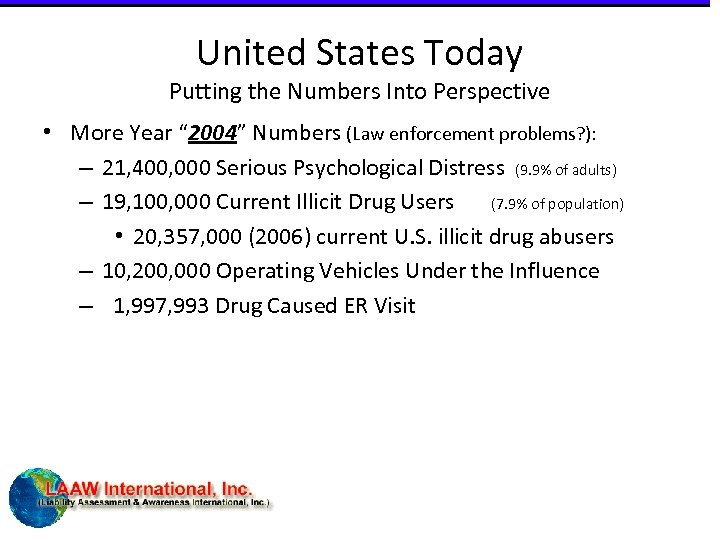 United States Today Putting the Numbers Into Perspective • More Year “ 2004” Numbers (Law enforcement problems? ): – 21, 400, 000 Serious Psychological Distress (9. 9% of adults) – 19, 100, 000 Current Illicit Drug Users (7. 9% of population) • 20, 357, 000 (2006) current U. S. illicit drug abusers – 10, 200, 000 Operating Vehicles Under the Influence – 1, 997, 993 Drug Caused ER Visit
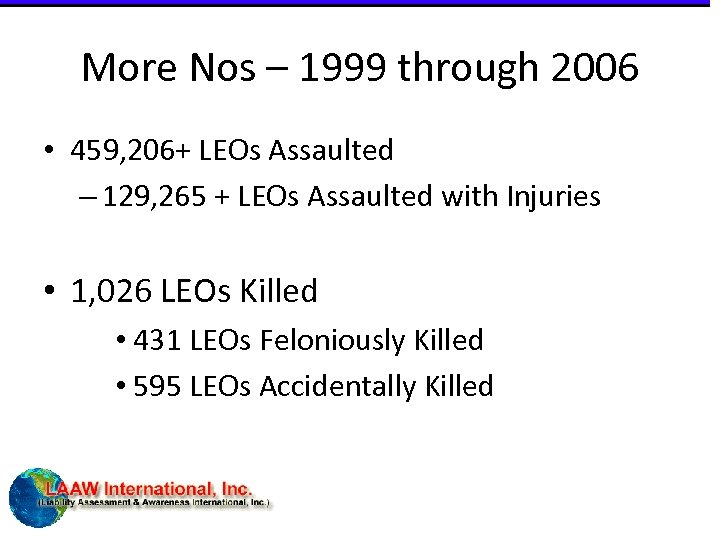 More Nos – 1999 through 2006 • 459, 206+ LEOs Assaulted – 129, 265 + LEOs Assaulted with Injuries • 1, 026 LEOs Killed • 431 LEOs Feloniously Killed • 595 LEOs Accidentally Killed
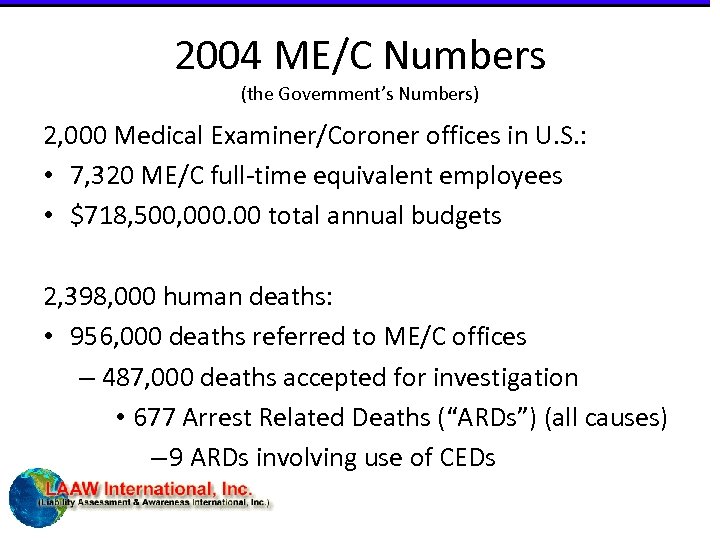 2004 ME/C Numbers (the Government’s Numbers) 2, 000 Medical Examiner/Coroner offices in U. S. : • 7, 320 ME/C full-time equivalent employees • $718, 500, 000. 00 total annual budgets 2, 398, 000 human deaths: • 956, 000 deaths referred to ME/C offices – 487, 000 deaths accepted for investigation • 677 Arrest Related Deaths (“ARDs”) (all causes) – 9 ARDs involving use of CEDs
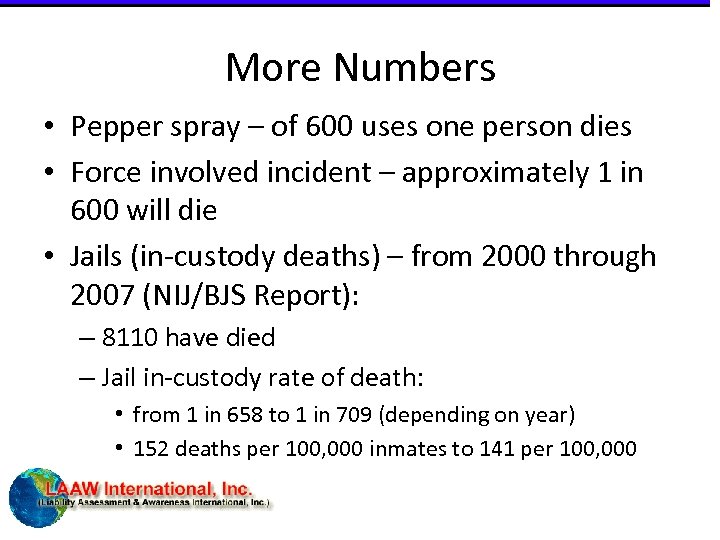 More Numbers • Pepper spray – of 600 uses one person dies • Force involved incident – approximately 1 in 600 will die • Jails (in-custody deaths) – from 2000 through 2007 (NIJ/BJS Report): – 8110 have died – Jail in-custody rate of death: • from 1 in 658 to 1 in 709 (depending on year) • 152 deaths per 100, 000 inmates to 141 per 100, 000
 Physiologically compromised persons elevated risks of death
 Physiologically compromised persons - elevated risks of death: • In approximately every 600 force uses 1 person will die (serious uses of force and rough statistics) • Root causes of most physiologically compromised persons’ condition are drugs, mental illness, serious psychological distress
 Physiologically compromised persons - elevated risks of death: There is a risk of serious injury or death from any law enforcement (LE) incident with a physiologically compromised person no matter how the encounter is handled, even the person continuing his exertion. – LE incidents with physiologically compromised persons should be treated as medical emergencies. Focus should be getting these persons captured, controlled, and restrained as quickly and safely as possible in order to prevent further injury and to expedite medical care. – ECDs are a safer means to capture, control, or restrain physiologically compromised persons since biggest threat to life is the self destructive exertion and ECD has less negative physiologic impact and is more effective in capturing, controlling, and facilitating restraint, and shortening this period of continued self-destructive exertion.
 Physiologically compromised persons - elevated risks of death: LE and emergency medical services (EMS) need better guidance on safest, most effective methods to handle these incidents and avoid bad force-option choices – Guidelines for LE to capture, control, and facilitate and maintain restraint – Guidelines for EMS to treat – Guidelines for Medical to treat
 Basic Legal Concepts
 Basic Legal Concepts • Plaintiffs can allege (almost) anything • Burden of proof in a civil case: – by a preponderance of the evidence – more likely than not • Summary judgment motion (MSJ): – court “MUST” take the facts as offered by the MSJ opposing party – UNLESS incident recording trumps party’s stated facts (Scott v. Harris, USSC)
 Basic Legal Concepts • Constitutional standard purpose – do not intentionally abuse your government endowed authority • Qualified immunity – Protection from suit – Two part test: • Constitutional right was violated • Law had put officer on notice that what he did was in violation of the constitution (excellent example is Bryan v. Mac. Pherson (June 18, 2010)
 Do “NOT” confuse or substitute Constitutional force threshold standards with selected usually more restrictive judicial case extracted force considerations or policy restrictions!!!!! - “Shall” versus “Should”
 Force Standards (Do NOT confuse legal force thresholds with “perfection” practices) • Federal Constitutional Standards: – Do not intentionally misuse government endowed authority (4 th, 5 th, 8 th, 14 th Amendments, state law, etc. ) • Restrictive force court case considerations: – Minimum application of force to reasonably safely accomplish lawful objectives – Coupled with well written accurate descriptive force reporting and documentation (preferably video/audio from the LEO’s perspective)
 What is Your Force Management Objective? Consider encouraging/training – “perfection standards” full knowledge possible minimum injury force practices? (Not to be confused with, or substituted for, Constitutional force standards or threshold(s). ) Some legal case based “perfection standards” considerations likely do not reflect federal Constitutional force standards or thresholds in numerous jurisdictions. Meaning, these “perfection” considerations are (in many circumstances) considerably more restrictive than applicable federal Constitutional rights standards. And, be cautious to NOT create elevated force standards above the Constitutional force standards thresholds.
 What is Your Force Management Objective? Consider if officers actions could be perfectly scripted in the 20/20 vision of hindsight – the “Perfection Standard” … which is a “should” paradigm – NOT a Constitutional standard. How would you use it? (if at all …. ? ) Force Decisions and Reporting: Court Decisions Lessons Learned Approaching the Hollywood Scripted 20/20 Hindsight – “Perfection Standard” in training and guidance.
 Dominos Falling Enhancers • Department’s policies and training standards – Setting inappropriately escalated force standards • He said/she said (recording incident from officer’s perspective) • Death case - medical examiner errors • ECD experts – sufficiently knowledgeable experts? – “TASER ECD Instructor” ≠ “Knowledgeable Expert” • Court’s Mis-Understandings: – – (OH) Michaels – “drive stun” ≠ “NMI” (FL) Buckley (dissent) -- “drive stun” ≠ ‘”NMI” (MI) Keiser (6 th Circuit (10/21/08)) – “drive stun ≠ ‘”NMI” Misunderstood - “ 50, 000 Volts!!!!!!” (Oh My God!!!!!)
 Medical Examiners • • Mis-perceived statements Mis-perceived standards of proof Failure to explain and eliminate ambiguities Do not undertstand: – Basic important incident concepts – Mechanisms of injury – The research (cannot be expected to) • Refuse assistance – appearance of influence
 Medical Examiners • Logical fallacies – Causation: • Temporal ≠ Causal • Association ≠ Causation • Correlation ≠ Causation – Causal oversimplification • Poor choices of words • Failure to put statements into perspective • Chicken or the egg (which came first? )
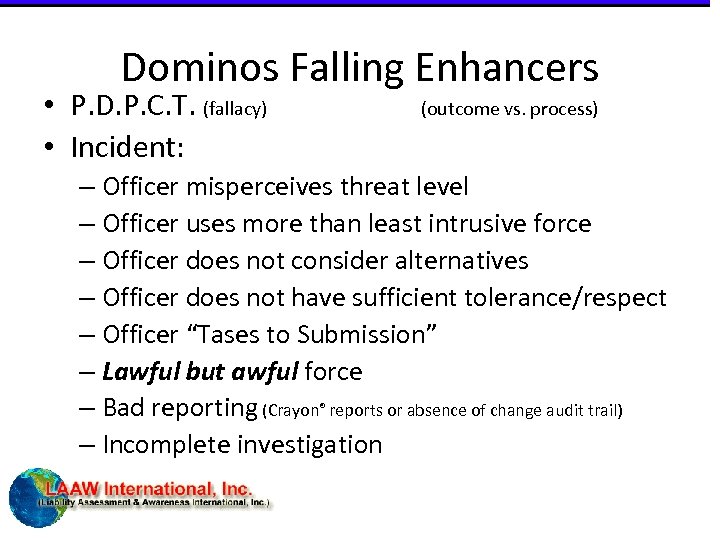 Dominos Falling Enhancers • P. D. P. C. T. (fallacy) • Incident: (outcome vs. process) – Officer misperceives threat level – Officer uses more than least intrusive force – Officer does not consider alternatives – Officer does not have sufficient tolerance/respect – Officer “Tases to Submission” – Lawful but awful force – Bad reporting (Crayon® reports or absence of change audit trail) – Incomplete investigation
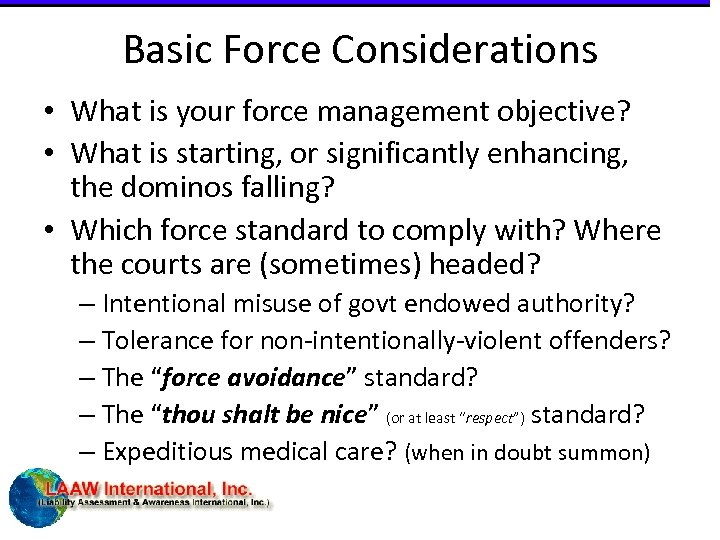 Basic Force Considerations • What is your force management objective? • What is starting, or significantly enhancing, the dominos falling? • Which force standard to comply with? Where the courts are (sometimes) headed? – Intentional misuse of govt endowed authority? – Tolerance for non-intentionally-violent offenders? – The “force avoidance” standard? – The “thou shalt be nice” (or at least “respect”) standard? – Expeditious medical care? (when in doubt summon)
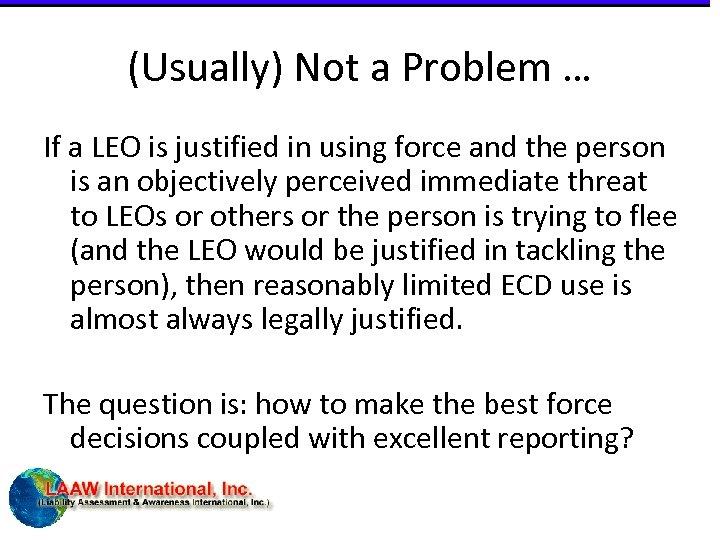 (Usually) Not a Problem … If a LEO is justified in using force and the person is an objectively perceived immediate threat to LEOs or others or the person is trying to flee (and the LEO would be justified in tackling the person), then reasonably limited ECD use is almost always legally justified. The question is: how to make the best force decisions coupled with excellent reporting?
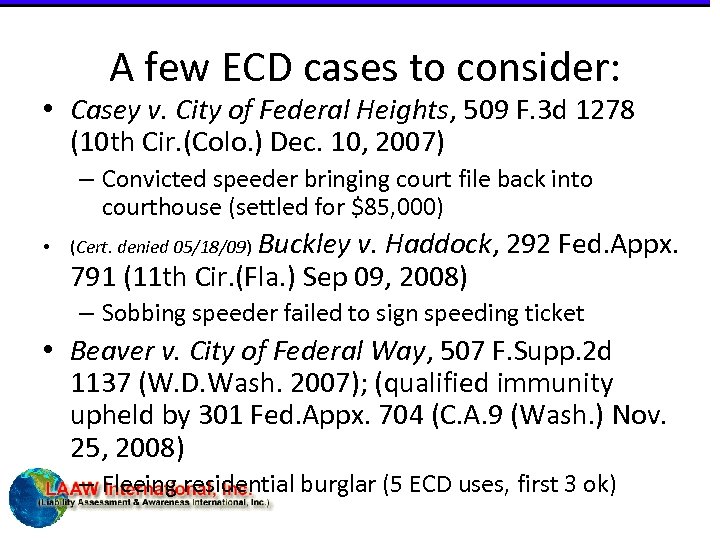 A few ECD cases to consider: • Casey v. City of Federal Heights, 509 F. 3 d 1278 (10 th Cir. (Colo. ) Dec. 10, 2007) – Convicted speeder bringing court file back into courthouse (settled for $85, 000) • Buckley v. Haddock, 292 Fed. Appx. 791 (11 th Cir. (Fla. ) Sep 09, 2008) (Cert. denied 05/18/09) – Sobbing speeder failed to sign speeding ticket • Beaver v. City of Federal Way, 507 F. Supp. 2 d 1137 (W. D. Wash. 2007); (qualified immunity upheld by 301 Fed. Appx. 704 (C. A. 9 (Wash. ) Nov. 25, 2008) – Fleeing residential burglar (5 ECD uses, first 3 ok)
 A few ECD cases to consider: • Brooks v. City of Seattle, 599 F. 3 d 1018 (C. A. 9 (Wash. ), March 26, 2010) – Pregnant speeder who refused to sign ticket or get out of the car. – ECD used in drive stun. – Court’s analysis of drive stun versus probe ECD deployment.
 Bryan v. Mac. Pherson • Bryan v. Mac. Pherson, 608 F. 3 d 614 (9 th Cir. (Cal. ) June 18, 2010), superceding 590 F. 3 d 767 (9 th Cir. December 28, 2009) – Seat belt violation, failed to comply, clenched fists, profanities, acting out. – Probe deployment while standing on pavement. – Officer granted qualified immunity (Bryan v. Mac. Pherson, 608 F. 3 d 614 (9 th Cir. (Cal. ) June 18, 2010)).
 Bryan v. Mac. Pherson “We recognize the important role controlled electric devices like the Taser X 26 can play in law enforcement. The ability to defuse a dangerous situation from a distance can obviate the need for more severe, or even deadly, force and thus can help protect police officers, bystanders, and suspects alike. We hold only that the X 26 and similar devices constitute an intermediate, significant level of force that must be justified by “ ‘a strong government interest [that] compels the employment of such force. ’ ”
 A few ECD cases to consider: • Brown v. City of Golden Valley, 574 F. 3 d 491 (8 th Cir. (Minn) Jul 22, 2009) – Female car passenger, beer tankards at feet, husband (driver) arrested for OMVWI. – Settled for $200, 000. • Stych v. City of Muscatine, Iowa, 655 F. Supp. 2 d 928 (S. D. Iowa Sept. 18, 2009) – Fn 12 - “Plaintiff has presented testimony from two witnesses attesting to how important it is for police officers to listen. ”
 A few ECD cases to consider: • (02/25/09) (UR) Releford v. City of Tukwila, Slip Copy, 2009 WL 497131 (W. D. Wash. , 2009) – 6’ 5”, 280 pounds, simultaneous ECD discharge, and simultaneous ECD discharge while on ground. Arrested on warrant, not on recently committed crime. • Parker v. Gerrish, 547 F. 3 d 1 (1 st Cir. (Me. ) Nov. 5, 2008) – Parker v. City of South Portland, 2007 WL 1468658 (D. Me. May 18, 2007)
 Buckley v. Haddock, 292 Fed. Appx. 791 2008 WL 4140297 (11 th Cir. (Fla. ) Sep 09, 2008) (US Supreme Court Cert. denied on May 18, 2009) Officers are supposed to know if force is ok? • District Court (unpublished decision) – not objectively reasonable, no officer would, no qualified immunity (QI) • Circuit Court (unpublished decision): – Chief Judge: Objectively reasonable (OR) plus QI – Appellate Judge – 2 uses OR, 3 rd use not OR, QI – District Judge – not OR, no officer would, no QI
 Scott v. Harris, 550 U. S. 372 (2008) • While these are the most common considerations, they are not “a magical on/off switch that triggers rigid preconditions” to determine whether an officer’s conduct constituted excessive force. (at 383) • “Thus, in judging whether [officer’s] actions were reasonable, we must consider the risk of bodily harm that [officer’s] actions posed to [suspect] in light of the threat to the public that [officer] was trying to eliminate. ” (at 383)
 Basic 4 th Amendment Force (Key Graham Factors) • the severity of the crime at issue • whether the suspect poses an immediate threat to the safety of the officers or others • whether suspect is actively resisting arrest or attempting to evade arrest by flight • split-second judgments in circumstances that are tense, uncertain, and rapidly evolving about amount of force necessary in particular situation
 Analyzing Fourth Amendment Force
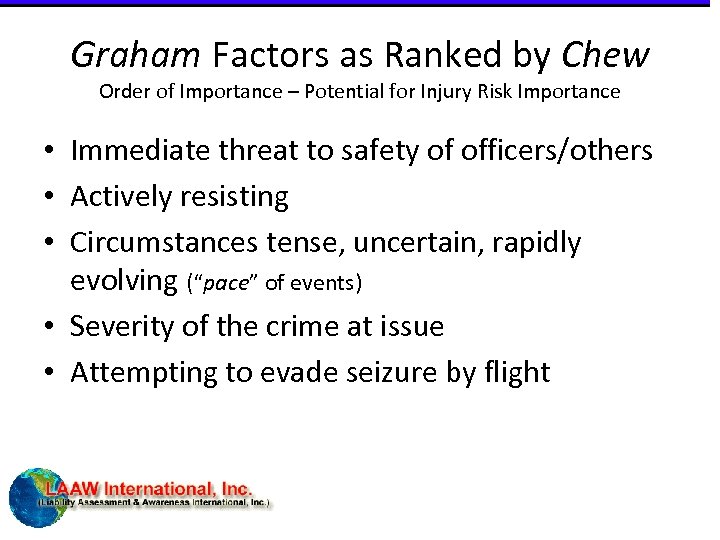 Graham Factors as Ranked by Chew Order of Importance – Potential for Injury Risk Importance • Immediate threat to safety of officers/others • Actively resisting • Circumstances tense, uncertain, rapidly evolving (“pace” of events) • Severity of the crime at issue • Attempting to evade seizure by flight
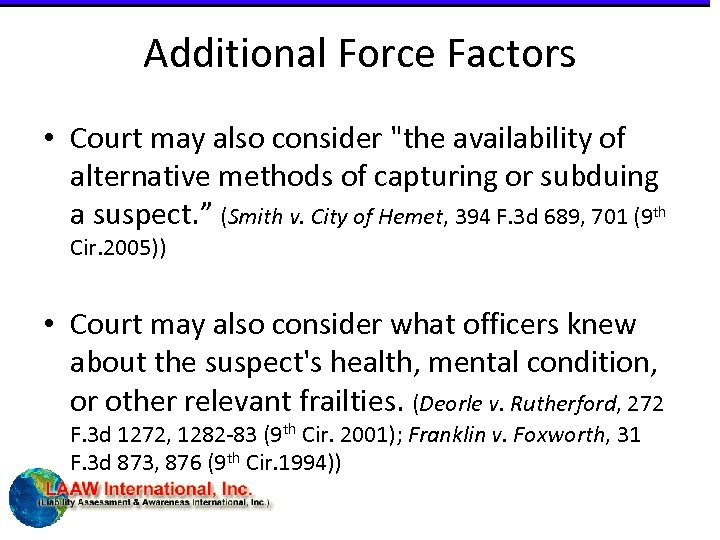 Additional Force Factors • Court may also consider "the availability of alternative methods of capturing or subduing a suspect. ” (Smith v. City of Hemet, 394 F. 3 d 689, 701 (9 th Cir. 2005)) • Court may also consider what officers knew about the suspect's health, mental condition, or other relevant frailties. (Deorle v. Rutherford, 272 F. 3 d 1272, 1282 -83 (9 th Cir. 2001); Franklin v. Foxworth, 31 F. 3 d 873, 876 (9 th Cir. 1994))
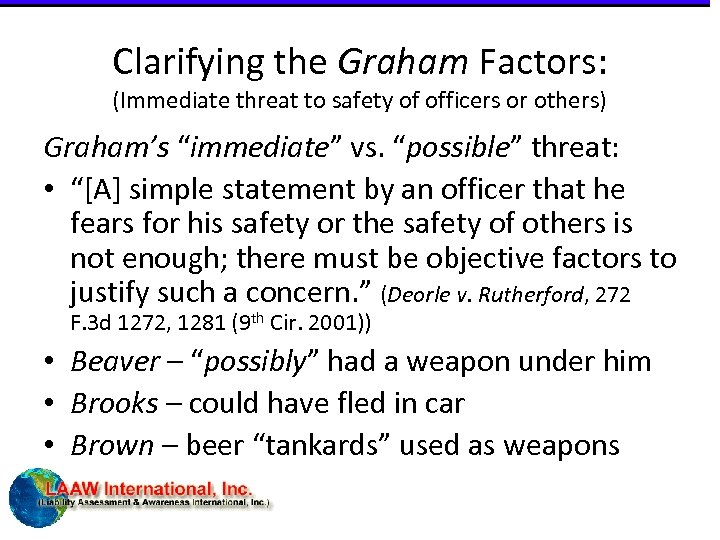 Clarifying the Graham Factors: (Immediate threat to safety of officers or others) Graham’s “immediate” vs. “possible” threat: • “[A] simple statement by an officer that he fears for his safety or the safety of others is not enough; there must be objective factors to justify such a concern. ” (Deorle v. Rutherford, 272 F. 3 d 1272, 1281 (9 th Cir. 2001)) • Beaver – “possibly” had a weapon under him • Brooks – could have fled in car • Brown – beer “tankards” used as weapons
 Clarifying the Graham Factors: (Immediate threat to safety of officers or others) Graham’s “immediate” vs. “possible” threat • “Releford – 2 friends, confusing commands, questioned arrest (delaying tactic? – no evidence) – weighed against the minimal need force, the simultaneous double-tasing of plaintiff was clearly excessive. Once plaintiff fell to the ground and rolled onto his stomach, the need force diminished even more and hence, the second double-tasing was also clearly excessive.
 Clarifying the Graham Factors: (Actively Resisting) Releford: • Fact that Releford stopped and raised his hands over his head, asked legitimate questions about why he was being arrested, and was likely confused by the officers’ conflicting commands to turn around – the Court cannot term plaintiff’s behavior “active resistance. ” Indeed, his behavior suggests at least a partial willingness to comply.
 Clarifying the Graham Factors: (Seriousness of the Offense) Buckley – failed to sign speeding ticket Brooks – failed to sign speeding ticket Bryan – traffic ticket Brown – open intoxicant M/V passenger Casey – took court file to parking lot Releford – not suspected of having just committed a crime (warrant arrest) • Beaver – fleeing residential burglar • • •
 Clarifying the Graham Factors: (Pacing – Tense, Uncertain, Rapidly Evolving) • Brooks – slow pacing • Brown – 4 officers present, husband in handcuffs in back of patrol car • Buckley (dissent) – should have waited for backup
 Less Intrusive Alternative Methods? • Releford: – Officers did not explain why options less intrusive than ECDs could not have been used. – Officers did not state that they even considered less intrusive options. • Brooks: – Alternative methods (to get her out of car) • Buckley (dissent): – Alternative methods (waiting for backup)
 ECD Force Must be Justified Beaver: • ECD use involves the application of force. • each ECD application involves an additional use of force.
 ECD Force that Must be Justified (Multiple ECD Applications) Multiple ECD Applications: • Is suspect an immediate threat? • Is suspect about to flee? • Suspect fails to comply with command? – Multiple ECD applications cannot be justified solely on the grounds suspect fails to comply with command, absent other indications: about to flee or poses immediate threat to officer – particularly true when more than one officer present to assist in controlling situation.
 ECD Force that Must be Justified (Multiple ECD Applications) Multiple ECD Applications: • Is the suspect capable of complying with command? – any decision to apply multiple ECD applications must consider whether suspect is capable of complying with commands. • • Physically? (Beaver) Mentally (intoxication, schizophrenic, etc. )? Emotionally? (Buckley, Brown) Conflicting commands? (Beaver, Releford)
 Officer’s Force Decision & Report? (especially where person is not active threat or attempting to flee) • Graham factors – as modified by Chew • Justification(s) for each use of force – Beware “possible” vs. “immediate” threat – Each application of force justified • Presence or absence of other officer(s) • Any factor used to justify escalated force must be explained – Releford – 2 persons (not explained why threat concern)
 Officer’s Force Decision & Report? (especially where person is not active threat or attempting to flee) • Consideration of suspect’s ability to comply with commands – Conflicting commands – Ability to comprehend commands – Physically able to comply with commands – Emotionally able to comply with commands – Mentally able to comply with commands – Inability to comply due to trauma • Absence of conflicting commands
 Officer’s Force Decision & Report? (especially where person is not active threat or attempting to flee) • Availability of alternative methods of capturing or subduing suspect. – Consideration of alternatives • What officers knew about the suspect's: – Health, – mental condition, or – other relevant frailties.
 Officer’s Force Decision & Report? (especially where person is not active threat or attempting to flee) • Warning of force to gain compliance – Giving warning(s) before force is used – Consider whether warning will be comprehended • Time between force applications to give time for voluntary compliance (tolerance factors) – Concern of too short a time between applications
 Officer’s Force Decision & Report? (especially where person is not active threat or attempting to flee) • If pain is going to be used to gain compliance – consideration whether person will perceive the pain and be able to comply with command(s) – Option – use of ECD as discomfort/pain to cause distraction to attempt to capture, control, restrain, and/or other lawful force objective • E. g. Lomax v. Las Vegas Metro Police Department
 Where Some Courts Are Going: Releford: • Brooks and Bryan suggest that where, as here (in Releford), where there is no immediate threat to anyone’s safety, clearly-established law prohibits the use of an ECD to gain compliance. This is contrary to numerous other court cases – including some ECD use while restrained cases.
 ICD - Where the Courts are Going 1. Known risk factors (Richman v. Sheaham, 512 F. 3 d 876 (7 th Cir. (IL) Jan. 7, 2008) - 489 lb man – “a reasonably trained police officer would know that compressing the lungs of a morbidly obese person can kill the person” 2. Necessity of haste – (Id. ) So the deputies had to use care in removing him from the courtroom, unless there was some compelling need for haste. But there was not. Court was over for the day. From the effort of the first 2 deputies to seize Richman to his death, only 7 minutes elapsed. There was no reason to endanger his life in order to remove him with such haste. A reasonable jury could find that the deputies used excessive force.
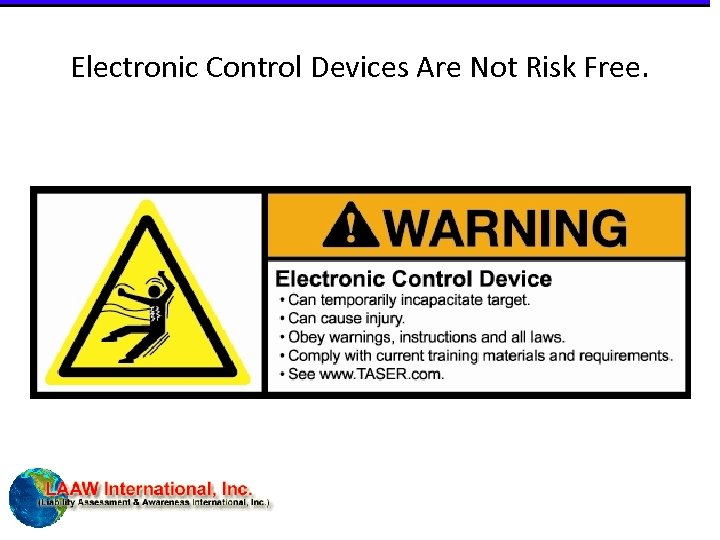 Electronic Control Devices Are Not Risk Free.
 Watch For • Two recent books – electrical, physiological, legal aspects of ECDs • TASER ECD Involved Litigation Program (continuing legal education program) • Check information websites often – www. ecdlaw. info – www. ipicd. com