 Скачать презентацию Target Marketing Dr B N F Warnakulasooriya M
92953cb7acce6ed753dabbca21226a8b.ppt
- Количество слайдов: 20



Target Marketing Dr. B. N. F. Warnakulasooriya M. Sc. in Management Programme University of Sri Jayewardenepura Dr. B. N. F. Warnakulasooriya 1
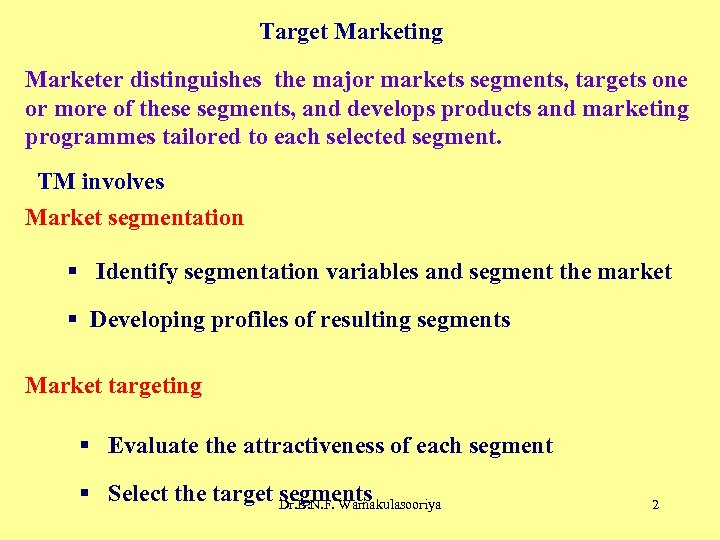
Target Marketing Marketer distinguishes the major markets segments, targets one or more of these segments, and develops products and marketing programmes tailored to each selected segment. TM involves Market segmentation § Identify segmentation variables and segment the market § Developing profiles of resulting segments Market targeting § Evaluate the attractiveness of each segment § Select the target Dr. B. N. F. Warnakulasooriya segments 2
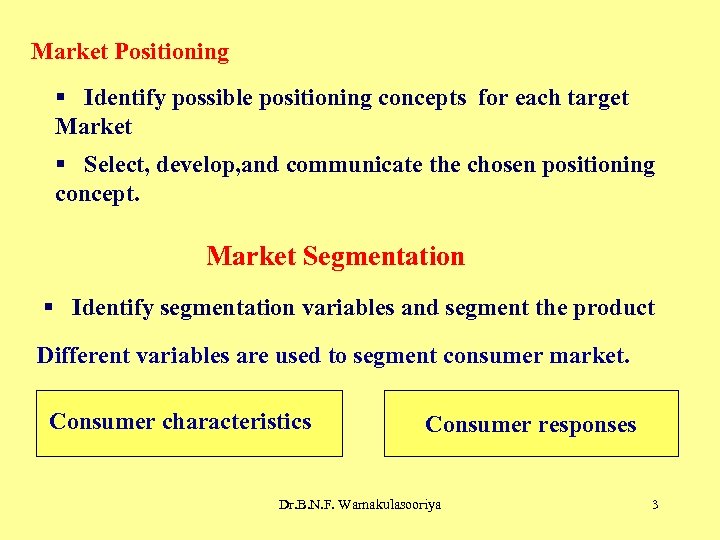
Market Positioning § Identify possible positioning concepts for each target Market § Select, develop, and communicate the chosen positioning concept. Market Segmentation § Identify segmentation variables and segment the product Different variables are used to segment consumer market. Consumer characteristics Consumer responses Dr. B. N. F. Warnakulasooriya 3
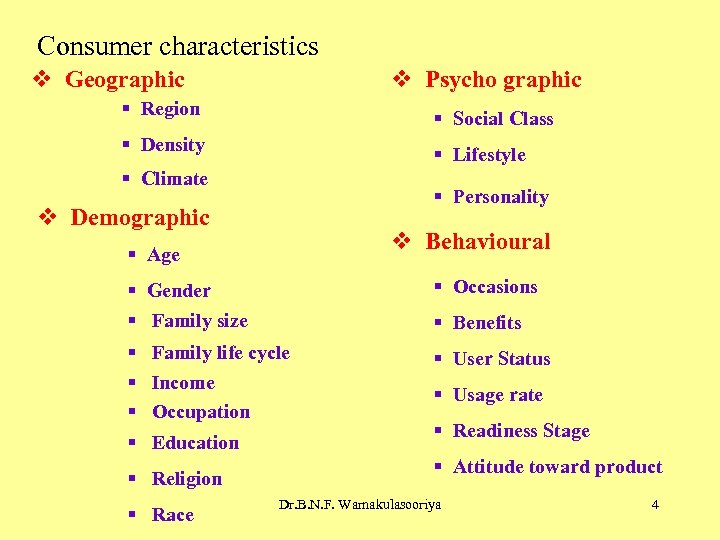
Consumer characteristics v Geographic v Psycho graphic § Region § Social Class § Density § Lifestyle § Climate § Personality v Demographic v Behavioural § Age § Gender § Family size § Occasions § Family life cycle § Income § Occupation § User Status § Education § Religion § Race § Benefits § Usage rate § Readiness Stage § Attitude toward product Dr. B. N. F. Warnakulasooriya 4
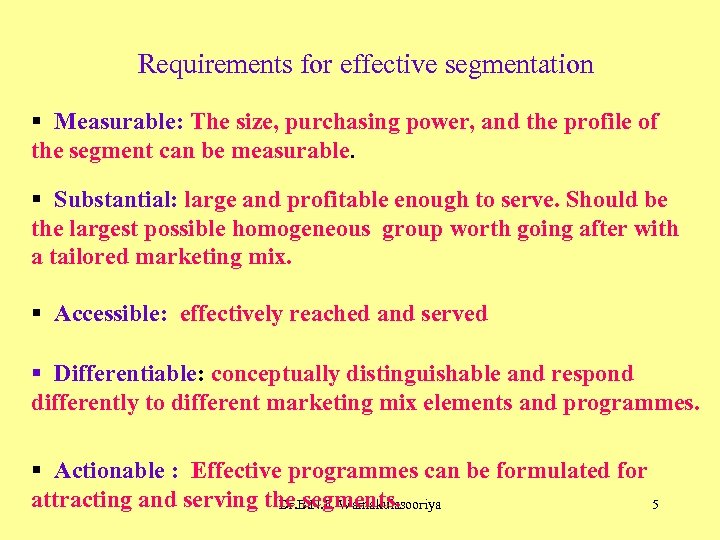
Requirements for effective segmentation § Measurable: The size, purchasing power, and the profile of the segment can be measurable. § Substantial: large and profitable enough to serve. Should be the largest possible homogeneous group worth going after with a tailored marketing mix. § Accessible: effectively reached and served § Differentiable: conceptually distinguishable and respond differently to different marketing mix elements and programmes. § Actionable : Effective programmes can be formulated for attracting and serving the segments. Dr. B. N. F. Warnakulasooriya 5
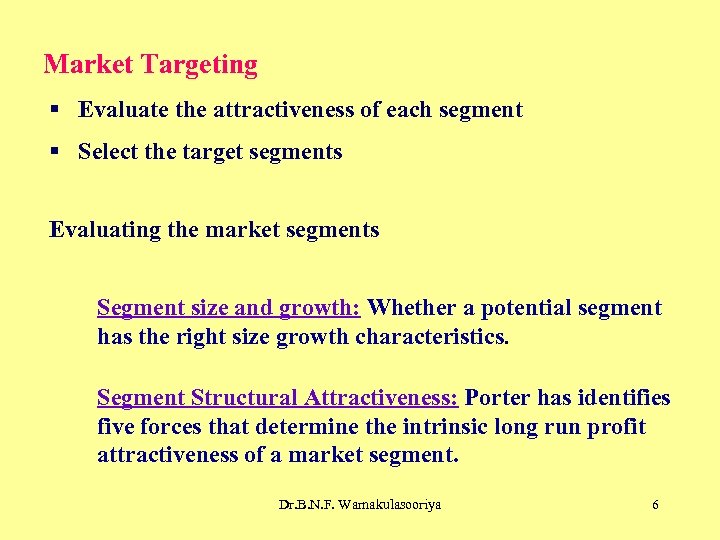
Market Targeting § Evaluate the attractiveness of each segment § Select the target segments Evaluating the market segments Segment size and growth: Whether a potential segment has the right size growth characteristics. Segment Structural Attractiveness: Porter has identifies five forces that determine the intrinsic long run profit attractiveness of a market segment. Dr. B. N. F. Warnakulasooriya 6
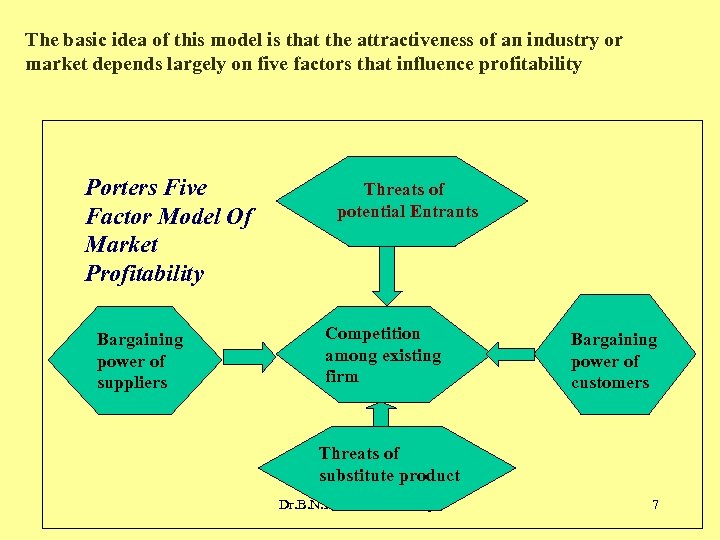
The basic idea of this model is that the attractiveness of an industry or market depends largely on five factors that influence profitability Porters Five Factor Model Of Market Profitability Bargaining power of suppliers Threats of potential Entrants Competition among existing firm Bargaining power of customers Threats of substitute product Dr. B. N. F. Warnakulasooriya 7
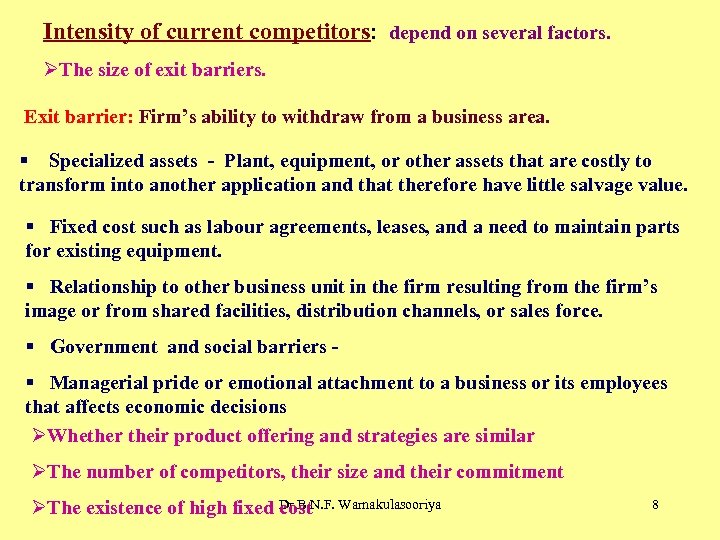
Intensity of current competitors: depend on several factors. ØThe size of exit barriers. Exit barrier: Firm’s ability to withdraw from a business area. § Specialized assets - Plant, equipment, or other assets that are costly to transform into another application and that therefore have little salvage value. § Fixed cost such as labour agreements, leases, and a need to maintain parts for existing equipment. § Relationship to other business unit in the firm resulting from the firm’s image or from shared facilities, distribution channels, or sales force. § Government and social barriers § Managerial pride or emotional attachment to a business or its employees that affects economic decisions ØWhether their product offering and strategies are similar ØThe number of competitors, their size and their commitment ØThe existence of high fixed Dr. B. N. F. Warnakulasooriya cost 8
Potential competitors: Whether potential competitors, identified or not, actually do enter depends in large part on the size & nature of barriers to entry. Various barriers to entry: Capital investment Required : Whether large or small investment is required Economies of scale: If scale economies exist in production, advertising, distribution , or other areas it becomes necessary to obtain a large volume quickly. Distribution channel: Gaining distribution in some market can be extremely difficult and costly. Product differentiation : Protected product features, a brand image, advertising and customer service are some of the attributes that can be used for differentiating product. If product differentiation barriers are high it may be difficult to enter into. Warnakulasooriya Dr. B. N. F. a market 9
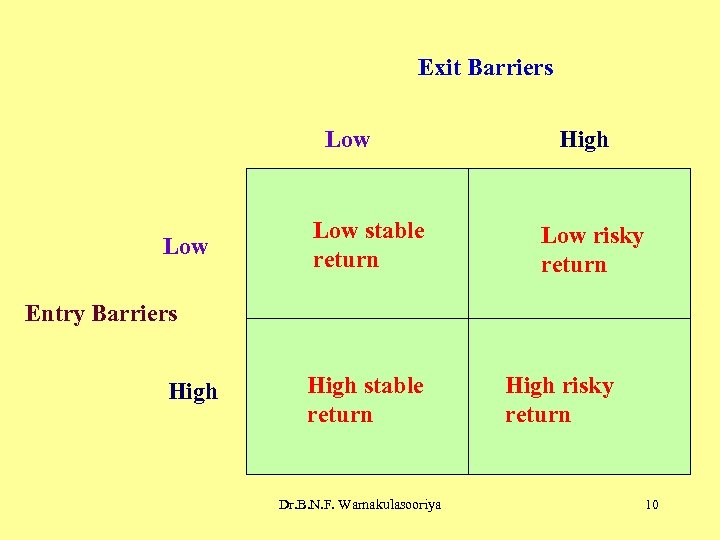
Exit Barriers Low Low stable return High Low risky return Entry Barriers High stable return Dr. B. N. F. Warnakulasooriya High risky return 10
Substitute product: Substitute products compete with less intensity than do the primary competitors. However they are still relevant Customer power : When customers have relatively more power than sellers, they can force prices down or demand more services, set the competitors against each other, thereby affecting profitability. A customer’s power will be greater when: § Its purchase size is a large proportion of the seller’s business § Alternative suppliers are available § The customer can integrate backward and make all or part of the product, § The buyers’ switching costs are low §The product are undifferentiated Dr. B. N. F. Warnakulasooriya 11
Suppler power|: Suppliers power will be enhanced when: § The supplier industry is concentrated and sells to a variety of customers in diverse market. § The cost s to customers of switching suppliers are high § There are few substitutes § The supplied product is an important input § The suppliers can integrate forward Company objectives and resources: § Consider whether segments mesh with the company’s long term objectives § Consider whether the company possesses the requisite skills and resources to succeed in Warnakulasooriya that segment. Dr. B. N. F. 12
Five Patterns of Target Market Selection; • Single Market Concentration The firm gains a strong Knowledge of the segment’s needs and achieves a strong market presence. The firm enjoys operating economies through specializing its production, distribution, and promotion. Dr. B. N. F. Warnakulasooriya 13
If it captures segment leadership, the firm can earn a high return. However, there are risks. A particular market segment can turn sour or a competitor may invade the segment. • Selective specialization A firm selects a number of segments, each objectively attractive and appropriate. There may be little or no synergy among segments, however diversifies the firm’s risk. Dr. B. N. F. Warnakulasooriya 14
• Product Specialization The firm makes a certain product that it sells to several different market segment. The firm can build a strong reputation in the specific product area • Market Specialization The firm concentrate on serving many needs of a particular customer group (assortment of products). Dr. B. N. F. Warnakulasooriya 15
The firm can build a strong reputation in serving this customer group and becomes a channel for additional products the customer group can use. • Full Market Coverage The firm attempts to serve all customer groups with all the products they might need. Need resources. A firm can cover a whole market in two broad ways: Undifferentiated marketing and Differentiated marketing Dr. B. N. F. Warnakulasooriya 16
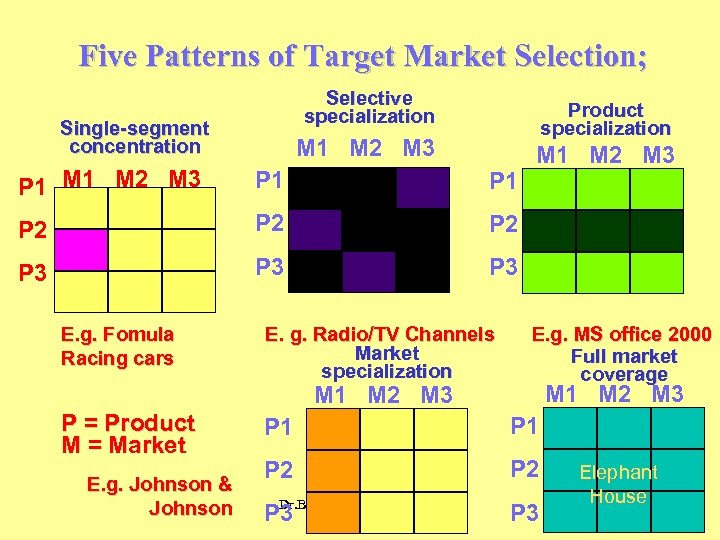
Five Patterns of Target Market Selection; Selective specialization Single-segment concentration Product specialization M 1 M 2 M 3 P 1 P 1 P 2 P 2 P 3 M 1 M 2 M 3 P 3 E. g. Fomula Racing cars E. g. Radio/TV Channels Market specialization M 1 M 2 M 3 P = Product M = Market E. g. Johnson & Johnson E. g. MS office 2000 Full market coverage M 1 M 2 M 3 P 1 P 2 Dr. B. N. F. Warnakulasooriya P 3 Elephant House 17
• Undifferentiated marketing: the firm ignores segment differences and goes after the whole market with one offer. It designs a product and other element of marketing mix that will endow the product with a superior image and appeal to the broader number of customers, and it relies on mass advertising and distribution. . Dr. B. N. F. Warnakulasooriya 18
The narrow product line keeps down the cost of research and development, production, inventory, transportation, advertising, marketing research and product management. The company can turn its lower costs into lower prices to win the price sensitive segment of the market. Dr. B. N. F. Warnakulasooriya 19
• Differentiated marketing: the firm operates in several market segments and design different product for each. Differentiated marketing typically creates more total sales than undifferentiated marketing. However, it also increases the cost of doing business. Because differentiated marketing leads to both higher sales and higher cost, impact of this strategy on profitability should be carefully analyzed. 20
Скачать презентацию Target Marketing Dr B N F Warnakulasooriya M
92953cb7acce6ed753dabbca21226a8b.ppt