 Скачать презентацию Tantalum-Niobium International Study Center T I C
b4c10b80f99c007445010ac5f6f5ea69.ppt
- Количество слайдов: 41



Tantalum-Niobium International Study Center (T. I. C. ) Ulric Schwela, T. I. C. Doug Chambers, SENES Transport of tantalum raw materials, other NORM and waste EAN-NORM 2 nd Workshop Dresden, 24 th-26 th November 2009
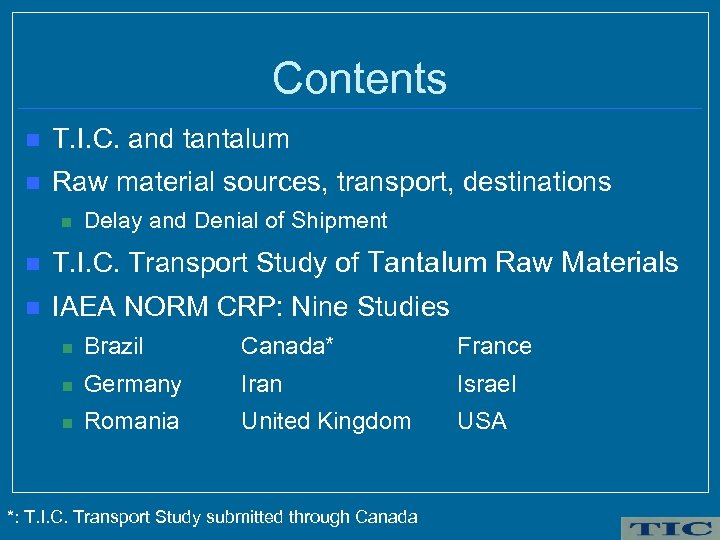
Contents n T. I. C. and tantalum n Raw material sources, transport, destinations n Delay and Denial of Shipment n T. I. C. Transport Study of Tantalum Raw Materials n IAEA NORM CRP: Nine Studies n Brazil Canada* France n Germany Iran Israel n Romania United Kingdom USA *: T. I. C. Transport Study submitted through Canada
Contents n T. I. C. and tantalum
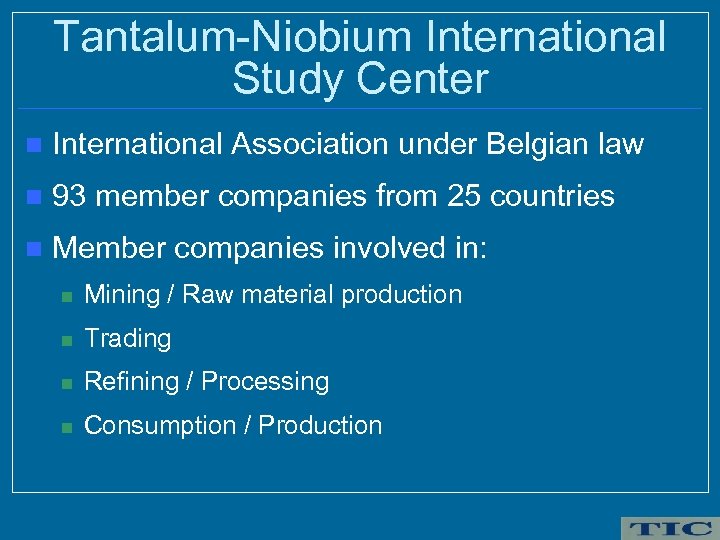
Tantalum-Niobium International Study Center n International Association under Belgian law n 93 member companies from 25 countries n Member companies involved in: n Mining / Raw material production n Trading n Refining / Processing n Consumption / Production
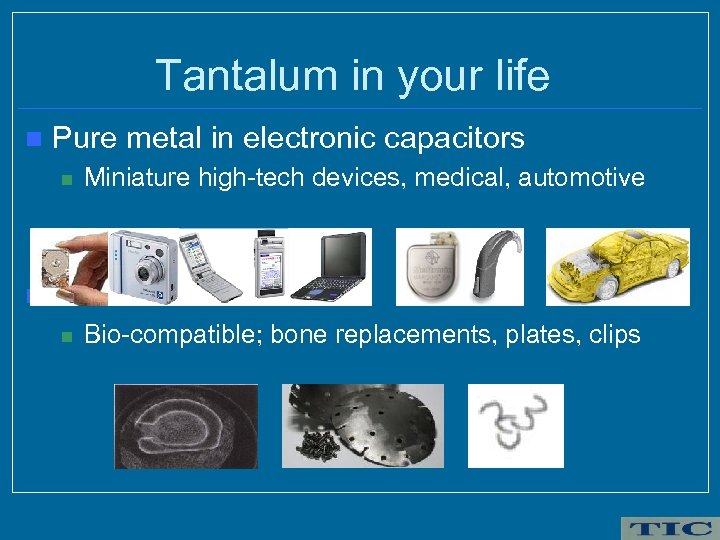
Tantalum in your life n Pure metal in electronic capacitors n n Miniature high-tech devices, medical, automotive Pure metal in medicine n Bio-compatible; bone replacements, plates, clips
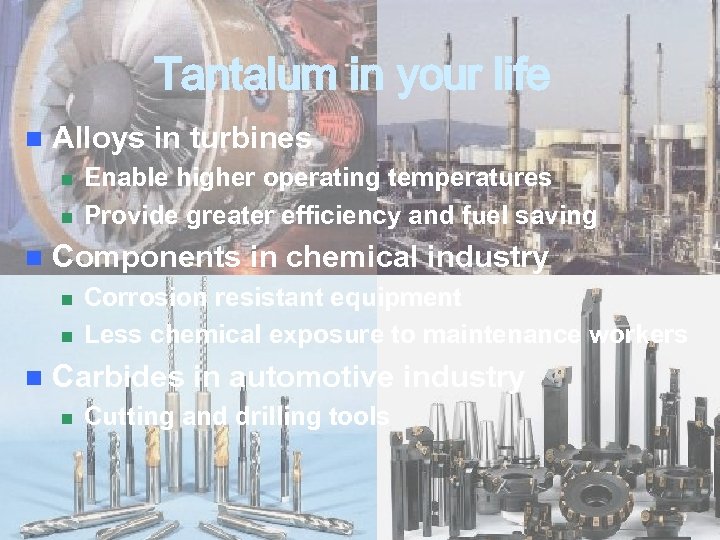
Tantalum in your life n Alloys in turbines n n n Components in chemical industry n n n Enable higher operating temperatures Provide greater efficiency and fuel saving Corrosion resistant equipment Less chemical exposure to maintenance workers Carbides in automotive industry n Cutting and drilling tools
Tantalum: a summary n Transition-group metal n Non-radioactive n Non-toxic, biocompatible n High corrosion resistance, equivalent to glass n High electrical capacitance, the most efficient
Contents n T. I. C. and tantalum n Raw material sources, transport, destinations
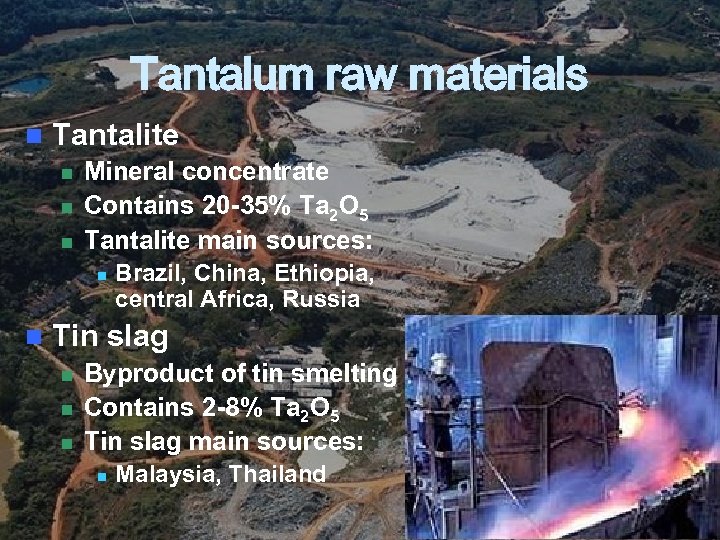
Tantalum raw materials n Tantalite n n n Mineral concentrate Contains 20 -35% Ta 2 O 5 Tantalite main sources: n n Brazil, China, Ethiopia, central Africa, Russia Tin slag n n n Byproduct of tin smelting Contains 2 -8% Ta 2 O 5 Tin slag main sources: n Malaysia, Thailand
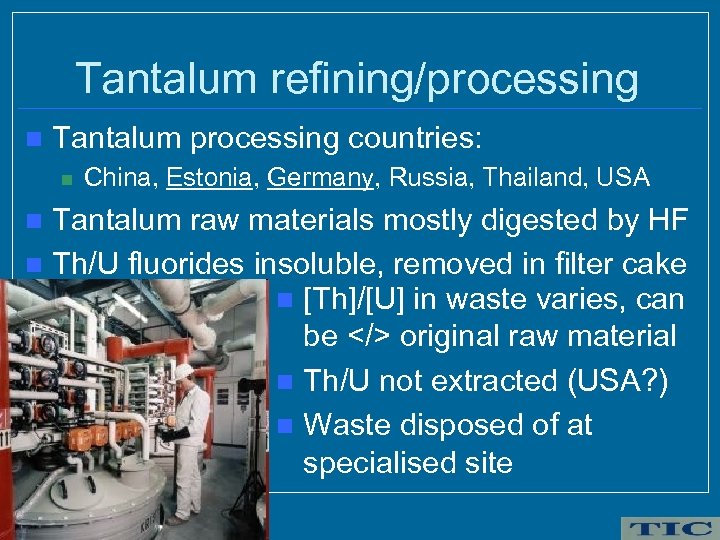
Tantalum refining/processing n Tantalum processing countries: n China, Estonia, Germany, Russia, Thailand, USA Tantalum raw materials mostly digested by HF n Th/U fluorides insoluble, removed in filter cake n [Th]/[U] in waste varies, can be </> original raw material n Th/U not extracted (USA? ) n Waste disposed of at specialised site n
Radioactivity n Natural Th and U present in materials n n Most activities are between 5 and 50 Bq/g In tantalite locked in mineral matrix In tin slag locked in glass-like matrix Tantalum raw materials are NORM n n Exemption value of 1 Bq/g for Th(nat), U(nat) Factor of 10 for NORM not extracted for use of Th/U; a balance between radiological protection and practical inconvenience of regulating large quantities of low activity materials
Naturally Occurring Radioactive Material (NORM) n “Radioactive material containing no significant amounts of radionuclides other than naturally occurring radionuclides. ”[1] n K-40, U-235, U-238, Th-232 n n radioactive decay products “Material in which the activity concentrations of the naturally occurring radionuclides have been changed by a process is included in naturally occurring radioactive material. ”[2] n No distinction for ‘TENORM’ (“Technologically Enhanced”) IAEA Safety Glossary (2007), Terminology Used in Nuclear Safety and Radiation Protection: [1] p. 126; [2] p. 161.
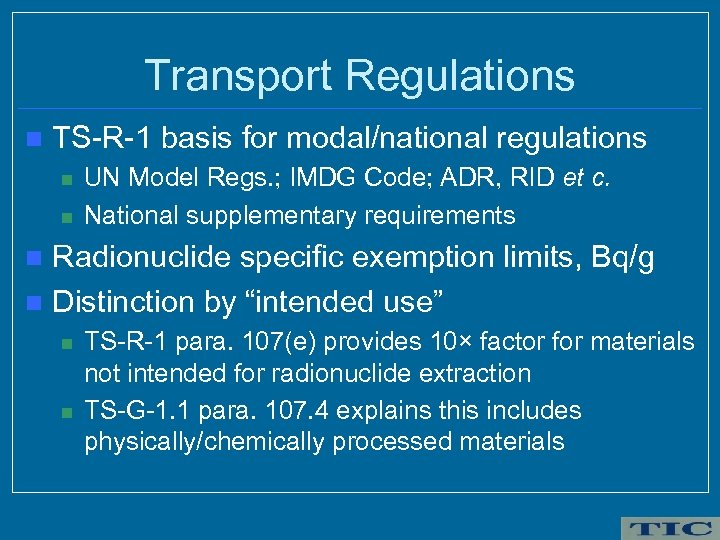
Transport Regulations n TS-R-1 basis for modal/national regulations n n UN Model Regs. ; IMDG Code; ADR, RID et c. National supplementary requirements Radionuclide specific exemption limits, Bq/g n Distinction by “intended use” n n n TS-R-1 para. 107(e) provides 10× factor for materials not intended for radionuclide extraction TS-G-1. 1 para. 107. 4 explains this includes physically/chemically processed materials
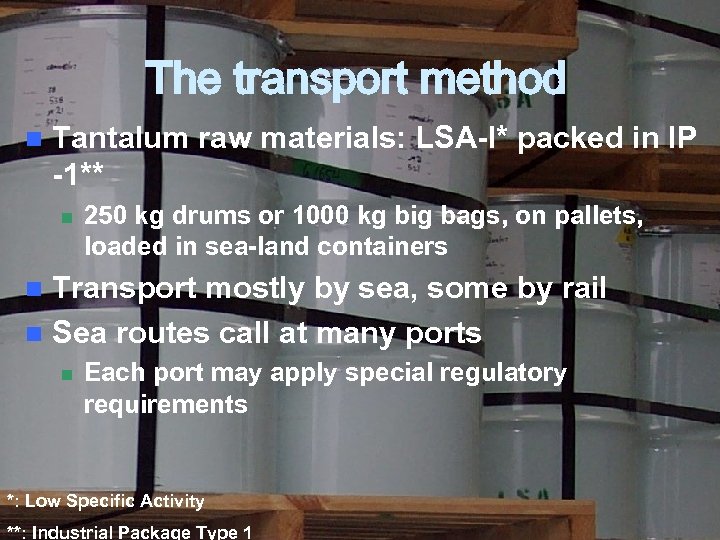
The transport method n Tantalum raw materials: LSA-I* packed in IP -1** n 250 kg drums or 1000 kg big bags, on pallets, loaded in sea-land containers Transport mostly by sea, some by rail n Sea routes call at many ports n n Each port may apply special regulatory requirements *: Low Specific Activity **: Industrial Package Type 1
Contents n T. I. C. and tantalum n Raw material sources, transport, destinations n Delay and Denial of Shipment
Delay and Denial of Shipment n Radioactivity gives rise to concerns: n Safety; security; regulatory burden Safety is addressed by UNDG compliance n Security is not relevant at such low levels n n n Customs sometimes seize exempt material Regulations perceived as excessive n Maritime carriers often deny shipment to Class 7 tantalum raw materials
Delay and Denial of Shipment n 2006 creation of International Steering Committee on Denial of Shipment (ISC-DOS) n Relies on commitment of states and organisations n n Database with delay/denial details: over 150 records 5 regional networks: En/Fr Afr, Asia, Med/Eur, SAm National Focal Point: over 75 appointed Dedicated website http: //www-ns. iaea. org/tech-areas/radiation-safety/denial-of-shipment. htm n n e-learning package, available from IMO Fact sheets, transport mapping et c.
Contents n T. I. C. and tantalum n Raw material sources, transport, destinations n n Delay and Denial of Shipment T. I. C. Transport Study of Tantalum Raw Materials
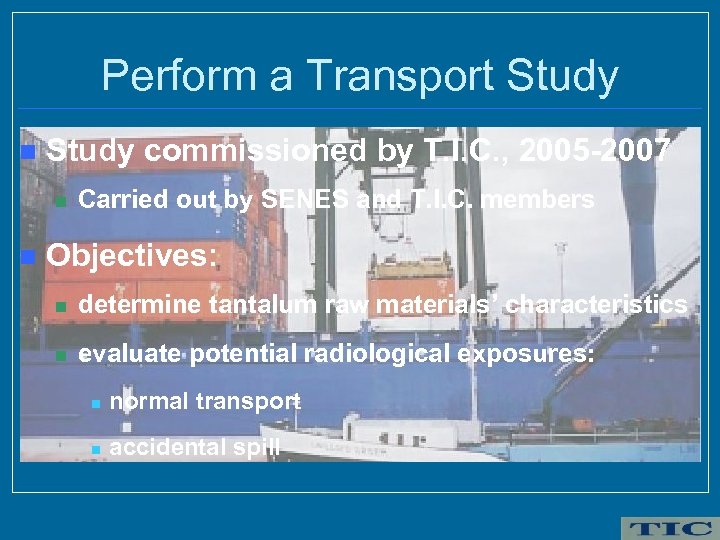
Perform a Transport Study n Study commissioned by T. I. C. , 2005 -2007 n n Carried out by SENES and T. I. C. members Objectives: n determine tantalum raw materials’ characteristics n evaluate potential radiological exposures: n normal transport n accidental spill
Transport Study Work Distribution n Radiation measurement protocol: SENES n Sampling protocol: Alfred H. Knight (AHK) n Field measurements: AHK / T. I. C. members n Physical and chemical analyses: AHK n Radiological analyses: independent laboratory n Measurement data interpretation and risk assessment: SENES
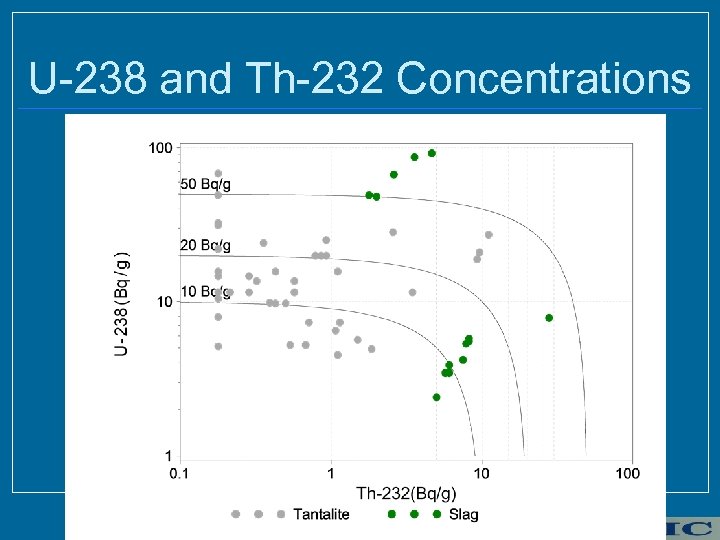
U-238 and Th-232 Concentrations
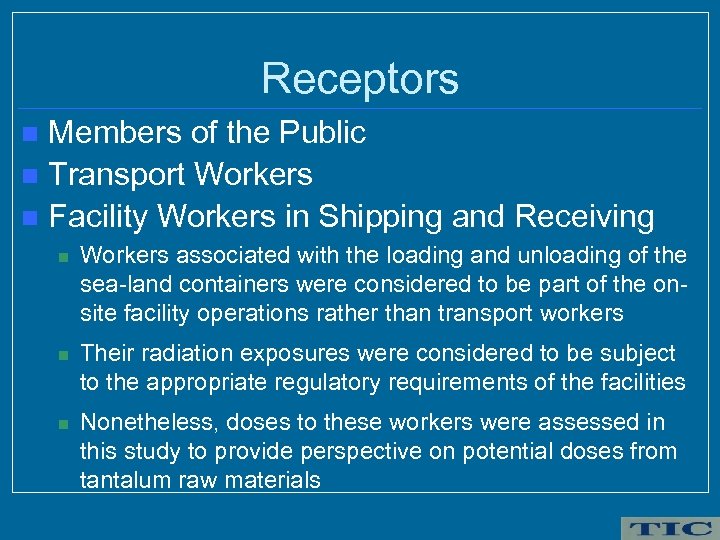
Receptors Members of the Public n Transport Workers n Facility Workers in Shipping and Receiving n n Workers associated with the loading and unloading of the sea-land containers were considered to be part of the onsite facility operations rather than transport workers n Their radiation exposures were considered to be subject to the appropriate regulatory requirements of the facilities n Nonetheless, doses to these workers were assessed in this study to provide perspective on potential doses from tantalum raw materials
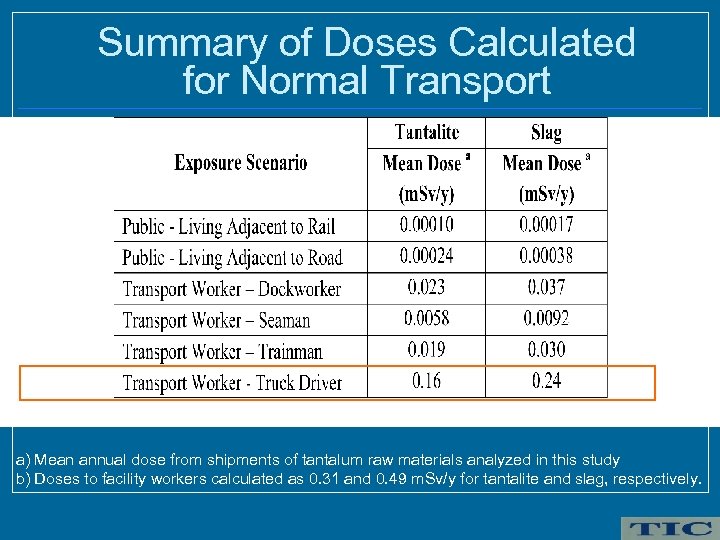
Summary of Doses Calculated for Normal Transport a) Mean annual dose from shipments of tantalum raw materials analyzed in this study b) Doses to facility workers calculated as 0. 31 and 0. 49 m. Sv/y for tantalite and slag, respectively.
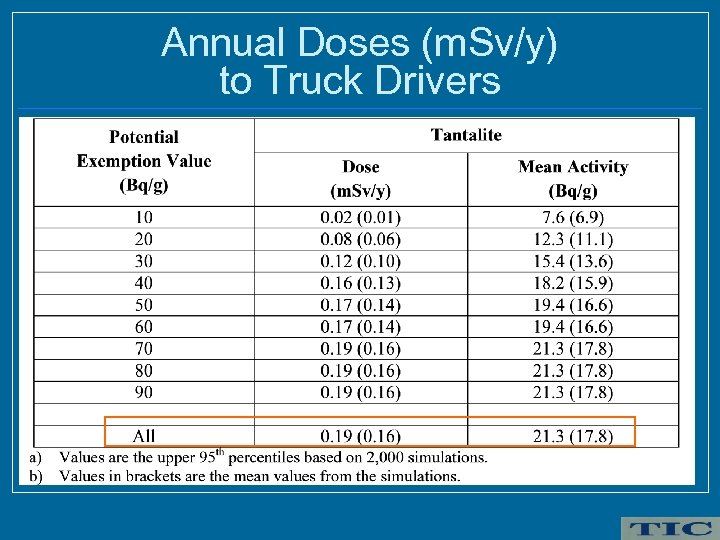
Annual Doses (m. Sv/y) to Truck Drivers
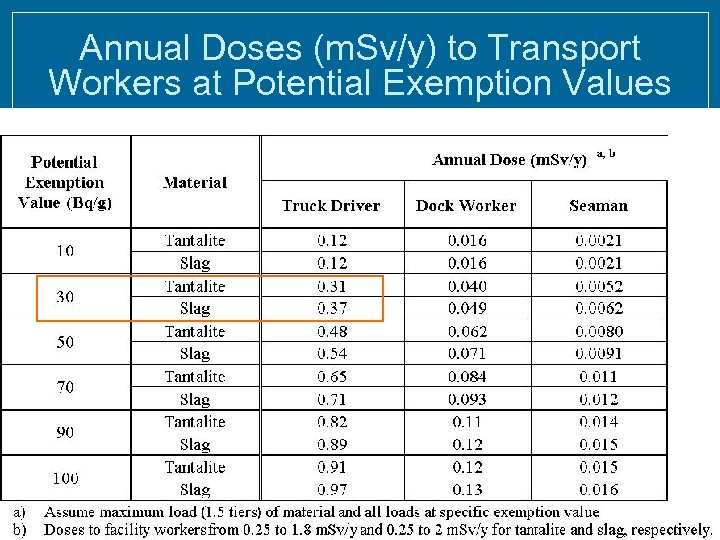
Annual Doses (m. Sv/y) to Transport Workers at Potential Exemption Values
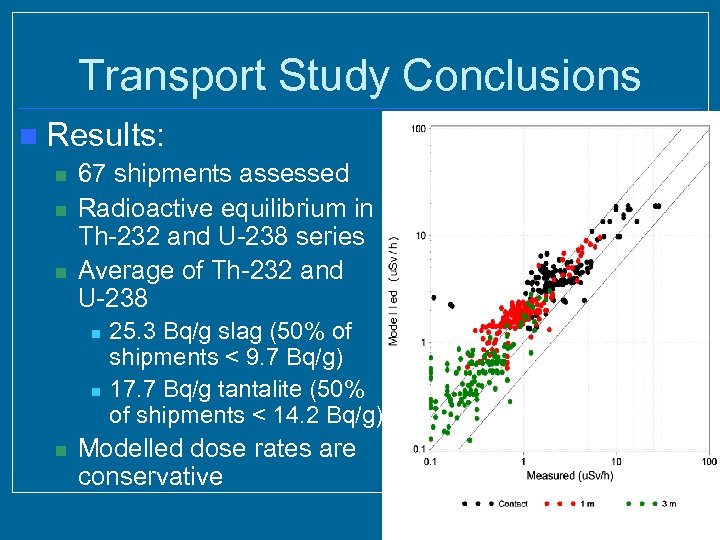
Transport Study Conclusions n Results: n n n 67 shipments assessed Radioactive equilibrium in Th-232 and U-238 series Average of Th-232 and U-238 n n n 25. 3 Bq/g slag (50% of shipments < 9. 7 Bq/g) 17. 7 Bq/g tantalite (50% of shipments < 14. 2 Bq/g) Modelled dose rates are conservative
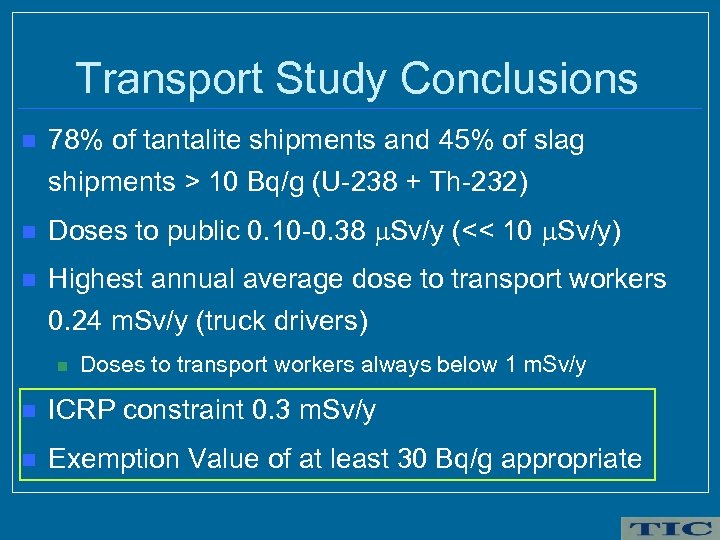
Transport Study Conclusions n 78% of tantalite shipments and 45% of slag shipments > 10 Bq/g (U-238 + Th-232) n Doses to public 0. 10 -0. 38 m. Sv/y (<< 10 m. Sv/y) n Highest annual average dose to transport workers 0. 24 m. Sv/y (truck drivers) n Doses to transport workers always below 1 m. Sv/y n ICRP constraint 0. 3 m. Sv/y n Exemption Value of at least 30 Bq/g appropriate
Contents n T. I. C. and tantalum n Raw material sources, transport, destinations n Delay and Denial of Shipment n T. I. C. Transport Study of Tantalum Raw Materials n IAEA NORM CRP: Nine Studies n Brazil Canada* France n Germany Iran Israel n Romania United Kingdom USA *: T. I. C. Transport Study submitted through Canada
Transport Safety Standards Committee (TRANSSC) n Standing body of the IAEA n Advises on review of transport regulations n Recommended in 2005 to examine the adequacy of safety standards related to transport of NORM n Creation of ‘NORM CRP’
‘NORM CRP’ n Coordinated Research Programme on the “Appropriate Level of Regulatory Control for the Safe Transport of Naturally Occurring Radioactive Material (NORM)” n Study proposals submitted by nine countries n Preparatory meeting in Nov-2006 n RCMs in Apr-2007, Feb-2008, Nov-2009
Materials studied by the CRP coal ash (France) n ores containing thorium and uranium (Brazil) n pipe scale (France, Germany, United Kingdom) n phosphates (Iran, Israel) n potash and phosphatic fertilisers (Israel) n tantalum raw materials (Canada) n uranium ores (Brazil, Iran) n uranium ore tailings (Romania) n zircon (Iran, United Kingdom) n
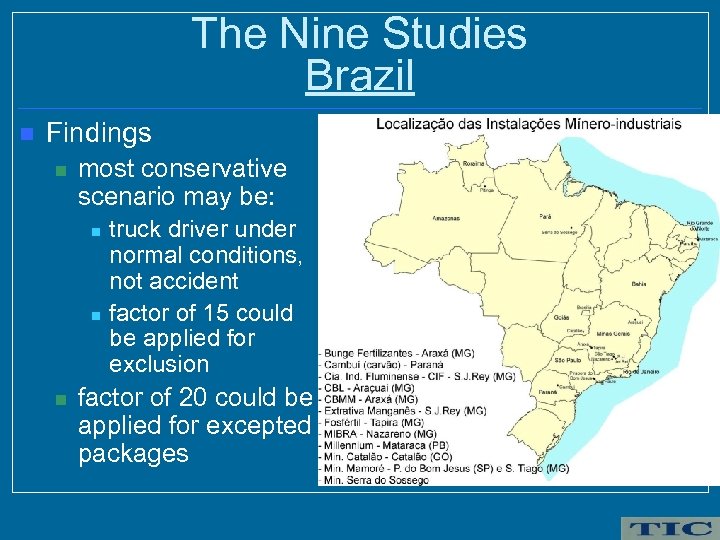
The Nine Studies Brazil n Findings n most conservative scenario may be: n n n truck driver under normal conditions, not accident factor of 15 could be applied for exclusion factor of 20 could be applied for excepted packages
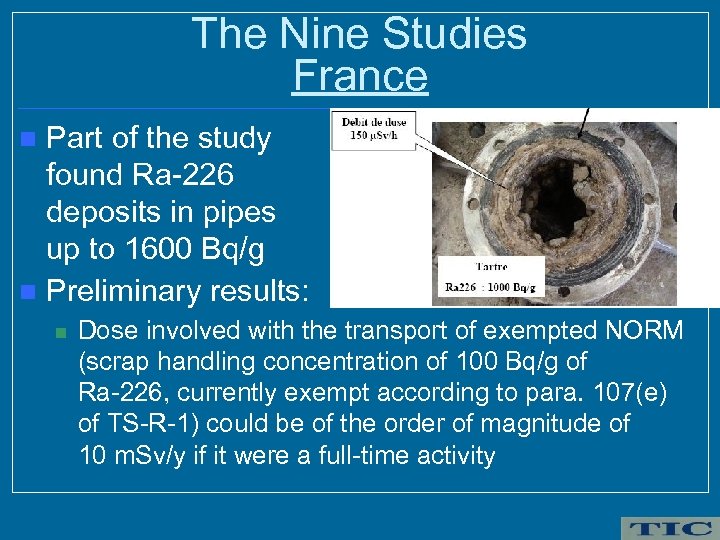
The Nine Studies France Part of the study found Ra-226 deposits in pipes up to 1600 Bq/g n Preliminary results: n n Dose involved with the transport of exempted NORM (scrap handling concentration of 100 Bq/g of Ra-226, currently exempt according to para. 107(e) of TS-R-1) could be of the order of magnitude of 10 m. Sv/y if it were a full-time activity
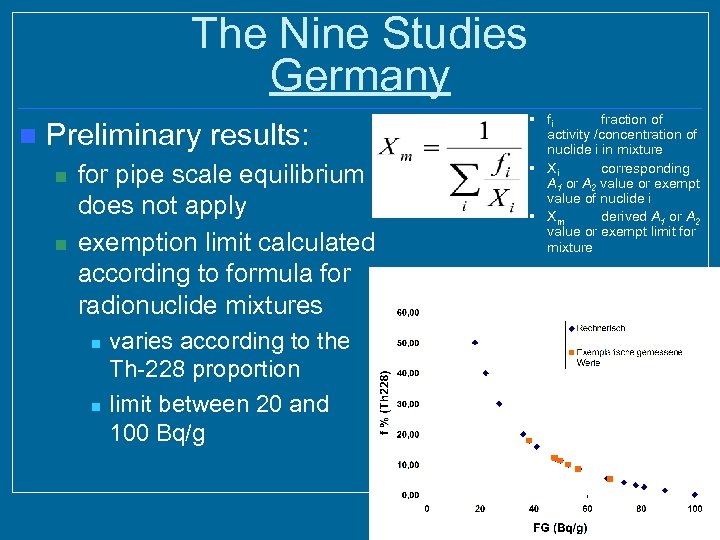
The Nine Studies Germany n Preliminary results: n n for pipe scale equilibrium does not apply exemption limit calculated according to formula for radionuclide mixtures n n varies according to the Th-228 proportion limit between 20 and 100 Bq/g § fi fraction of activity /concentration of nuclide i in mixture § Xi corresponding A 1 or A 2 value or exempt value of nuclide i § Xm derived A 1 or A 2 value or exempt limit for mixture
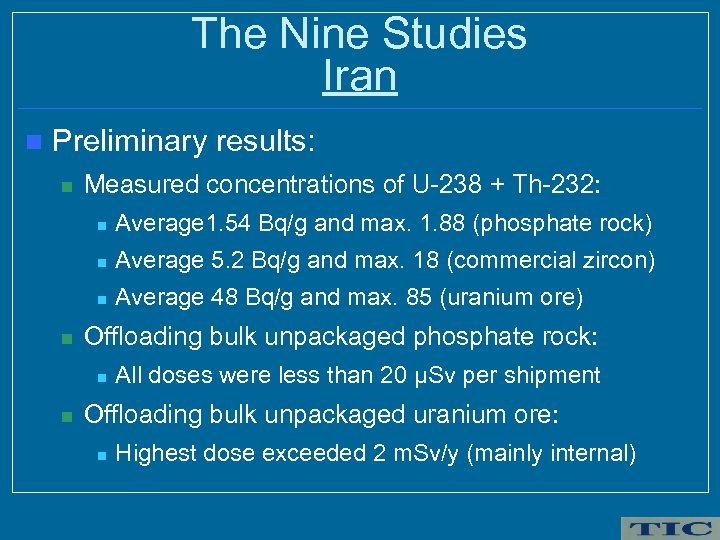
The Nine Studies Iran n Preliminary results: n Measured concentrations of U-238 + Th-232: n n Average 5. 2 Bq/g and max. 18 (commercial zircon) n n Average 1. 54 Bq/g and max. 1. 88 (phosphate rock) Average 48 Bq/g and max. 85 (uranium ore) Offloading bulk unpackaged phosphate rock: n n All doses were less than 20 µSv per shipment Offloading bulk unpackaged uranium ore: n Highest dose exceeded 2 m. Sv/y (mainly internal)
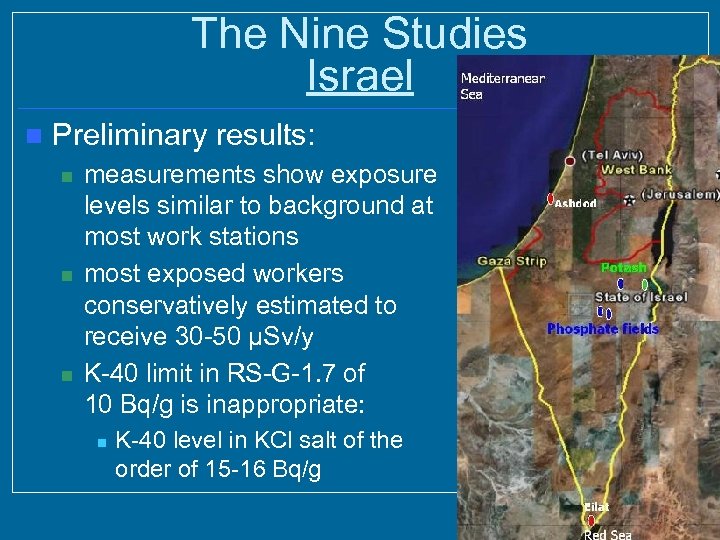
The Nine Studies Israel n Preliminary results: n n n measurements show exposure levels similar to background at most work stations most exposed workers conservatively estimated to receive 30 -50 µSv/y K-40 limit in RS-G-1. 7 of 10 Bq/g is inappropriate: n K-40 level in KCl salt of the order of 15 -16 Bq/g
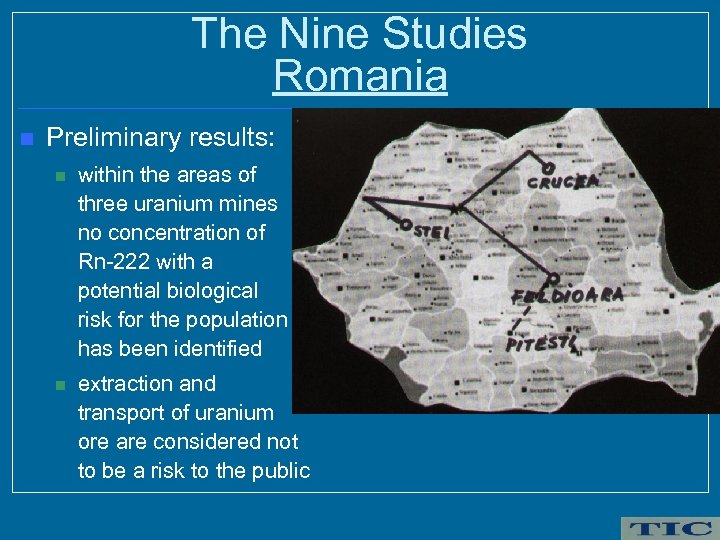
The Nine Studies Romania n Preliminary results: n within the areas of three uranium mines no concentration of Rn-222 with a potential biological risk for the population has been identified n extraction and transport of uranium ore are considered not to be a risk to the public
The Nine Studies United Kingdom n Preliminary results: n n no large scale transport of higher activity materials large quantities of materials with activity concentrations 1 -10 times the exemption level n n a generic assessment for zircon flour found that the highest dose to a truck driver is less than 0. 2 m. Sv/y equipment from offshore oil platforms and from sites where China Clay is extracted is contaminated with scale containing radium n a truck driver carrying contaminated pipes would receive a dose of less than 0. 1 m. Sv/y
The Nine Studies United States of America n Preliminary results: n analysis of various studies supported the exemption values n n NORM have the same limiting doses regardless of the previous or intended uses of the material (e. g. same dose rates from loaded trucks) restriction of 10× factor given in TS-R-1 para. 107(e) to materials “not intended to be processed for use of these radionuclides” does not appear to have a valid radiation protection basis
Draft CRP Conclusions n Basis for 10× factor in TS-R-1 para. 107(e) for NORM is still valid n “intended use” restriction not warranted (EXC: Fra) Possible (upward) revision to the 10× factor n Radium pipe scales require special consideration; must apply rule for mixtures n Doses to public < 10 μSv/y n n n Debate on who is public or worker Draft report ready for January 2010
n Tantalum-Niobium International Study Center n Chaussée de Louvain 490 n 1380 Lasne, Belgium n Tel : +32 2 649 51 58 n Fax : +32 2 649 64 47 n E-mail : info@tanb. org tech@tanb. org n Web : www. tanb. org
Скачать презентацию Tantalum-Niobium International Study Center T I C
b4c10b80f99c007445010ac5f6f5ea69.ppt