


 Скачать презентацию TAMPERE UNIVERSITY OF TECHNOLOGY FINLAND A MODEL FOR
29d5c4eba3fbddd3e20be1af8e687150.ppt
- Количество слайдов: 45
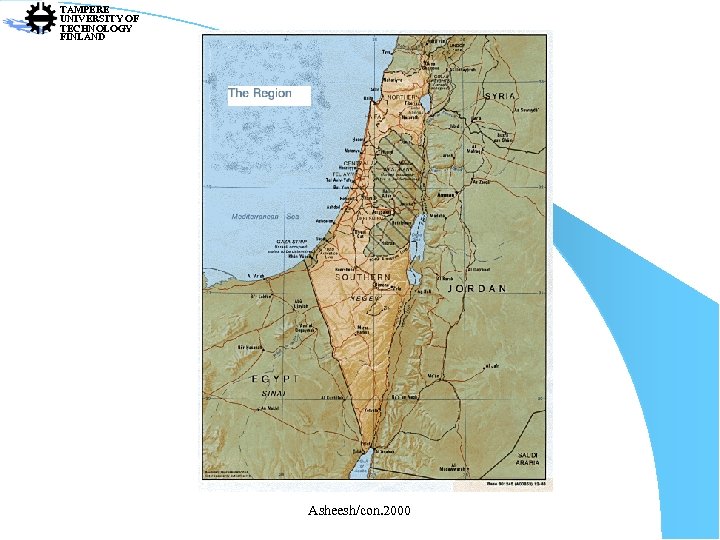
 TAMPERE UNIVERSITY OF TECHNOLOGY FINLAND A MODEL FOR MANAGEMENT OF MIDDLE EAST WATER RESOURCES AND SERVICES CROSSBOUNDARY WATER RESOURCES JORDAN ISRAEL PALESTINE Asheesh/con. 2000
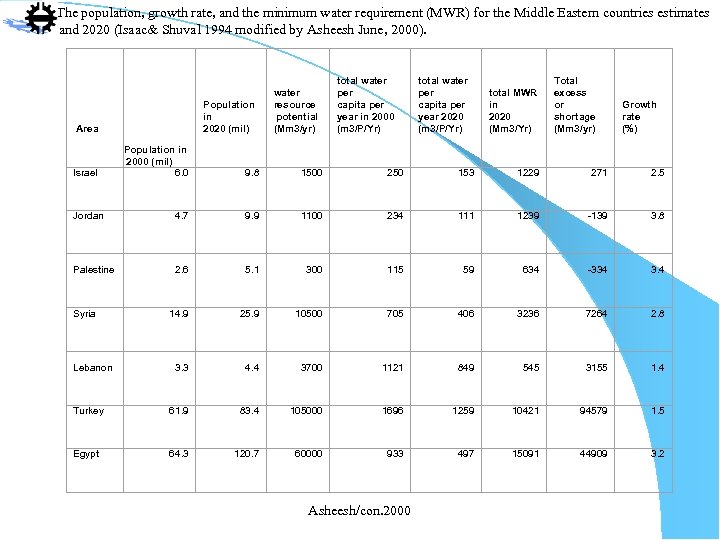 Table 2. The population, growth rate, and the minimum water requirement (MWR) for the Middle Eastern countries estimates for 2000 and 2020 (Isaac& Shuval 1994 modified by Asheesh June, 2000). total water per capita per year in 2000 (m 3/P/Yr) total water per capita per year 2020 (m 3/P/Yr) Population in 2020 (mil) Population in 2000 (mil) 6. 0 9. 8 1500 250 153 1229 271 2. 5 Jordan 4. 7 9. 9 1100 234 111 1239 -139 3. 8 Palestine 2. 6 5. 1 300 115 59 634 -334 3. 4 14. 9 25. 9 10500 705 406 3236 7264 2. 8 3. 3 4. 4 3700 1121 849 545 3155 1. 4 Turkey 61. 9 83. 4 105000 1696 1259 10421 94579 1. 5 Egypt 64. 3 120. 7 60000 933 497 15091 44909 3. 2 Area Israel Syria Lebanon Asheesh/con. 2000 total MWR in 2020 (Mm 3/Yr) Total excess or shortage (Mm 3/yr) water resource potential (Mm 3/yr) Growth rate (%)
 The Nature of International River basin Problems • The ecological and developmental threats to the world's rivers are rapidly transforming the perspective of natural resource problems from national to international concern. • There approximately 214 river basins in the world which are shared by two or more countries. • Moreover, nearly fifty countries have seventy-five percent or more of their total land area falling within shared river basins, • Estimated thirty-five to forty percent of the world's population lives in these basins. • As it becomes increasingly clear that environmental problems do not respect national boundaries, • Nations are searching for the legal and institutional mechanisms which are needed to protect and manage resources which traverse their boundary lines. Asheesh/con. 2000
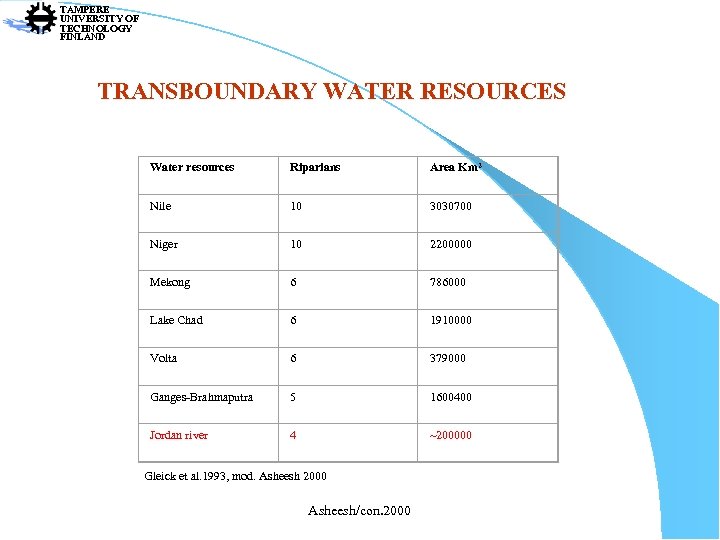 TAMPERE UNIVERSITY OF TECHNOLOGY FINLAND TRANSBOUNDARY WATER RESOURCES Water resources Riparians Area Km 2 Nile 10 3030700 Niger 10 2200000 Mekong 6 786000 Lake Chad 6 1910000 Volta 6 379000 Ganges-Brahmaputra 5 1600400 Jordan river 4 ~200000 Gleick et al. 1993, mod. Asheesh 2000 Asheesh/con. 2000
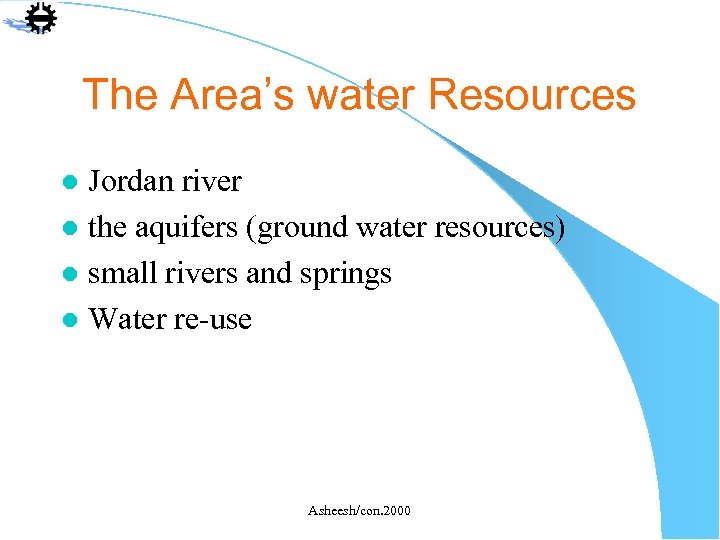 The Area’s water Resources Jordan river l the aquifers (ground water resources) l small rivers and springs l Water re-use l Asheesh/con. 2000
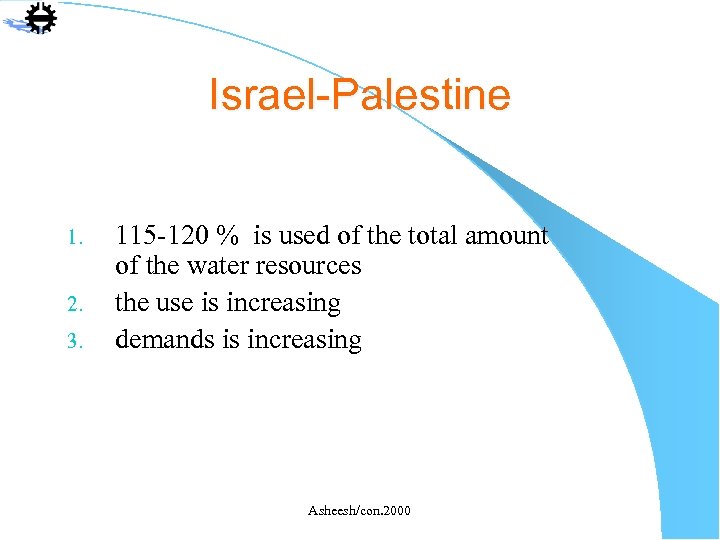 Israel-Palestine 1. 2. 3. 115 -120 % is used of the total amount of the water resources the use is increasing demands is increasing Asheesh/con. 2000
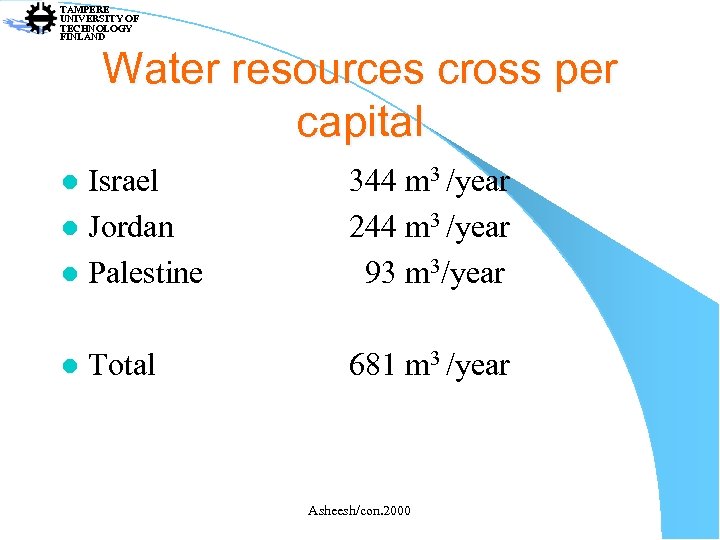 TAMPERE UNIVERSITY OF TECHNOLOGY FINLAND Water resources cross per capital Israel l Jordan l Palestine l l Total 344 m 3 /year 244 m 3 /year 93 m 3/year 681 m 3 /year Asheesh/con. 2000
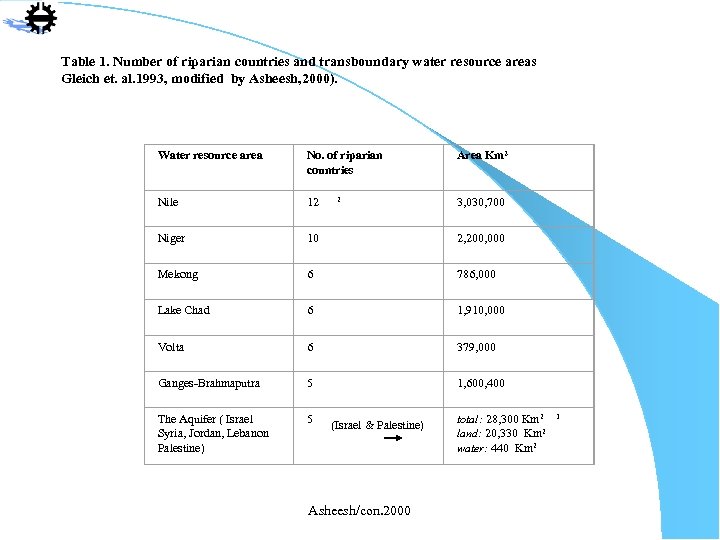 Table 1. Number of riparian countries and transboundary water resource areas Gleich et. al. 1993, modified by Asheesh, 2000). Water resource area No. of riparian countries Area Km 2 Nile 12 2 3, 030, 700 Niger 10 2, 200, 000 Mekong 6 786, 000 Lake Chad 6 1, 910, 000 Volta 6 379, 000 Ganges-Brahmaputra 5 1, 600, 400 The Aquifer ( Israel Syria, Jordan, Lebanon Palestine) 5 (Israel & Palestine) Asheesh/con. 2000 total: 28, 300 Km 2 1 land: 20, 330 Km 2 water: 440 Km 2
 PRINCIPLE OF SHARING Water Sharing Principles: • Everybody should have access to their basic entitlement to clean water which is a human right • Water has a many values: cultural, environmental, economical and aesthetic. • Water management involves ethical and social as well as technical questions • User pays, polluter pays • Water demand management • There must be always an acceptance of and respect for cultural diversity • Stoke holder participation in water management decision and action is essential • Information sharing and transparency • To remember always that water is a limited sources • Water must always be used efficiently • Irreversible contamination depletion and destruction of watercourses, particularly ground waters must be absolutely avoided. Asheesh/con. 2000
 the cooperation moddle for mechansm Asheesh/con. 2000
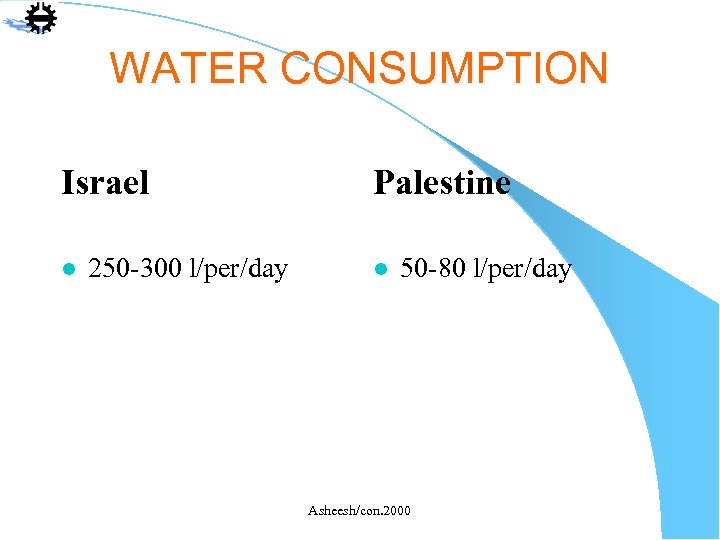 WATER CONSUMPTION Israel l 250 -300 l/per/day Palestine l 50 -80 l/per/day Asheesh/con. 2000
 The Problem inequality in distribution of the water resources l excessive use l high water usage for food production l growth of tension l the crossboundary water resources l the drylands aspects -the development of the drylands -water and environmental issues of the drylands -the economics and political aspects of the development of drylands. l Asheesh/con. 2000
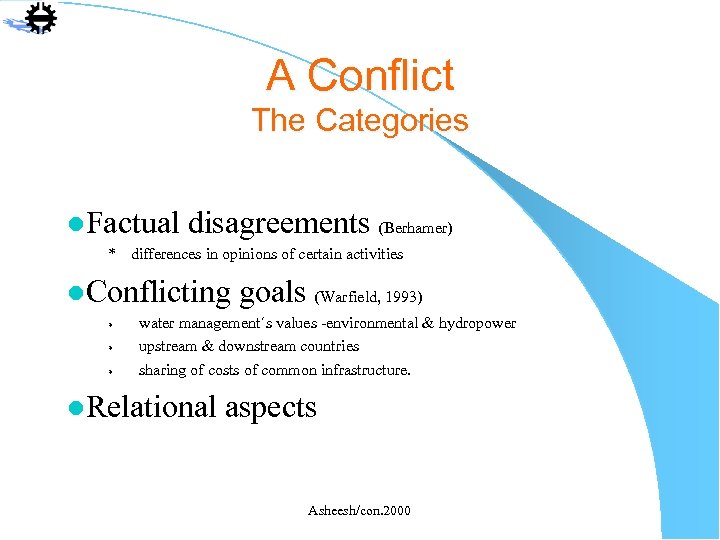 A Conflict The Categories l. Factual disagreements (Berhamer) * differences in opinions of certain activities l. Conflicting goals (Warfield, 1993) * * * water management´s values -environmental & hydropower upstream & downstream countries sharing of costs of common infrastructure. l. Relational aspects Asheesh/con. 2000
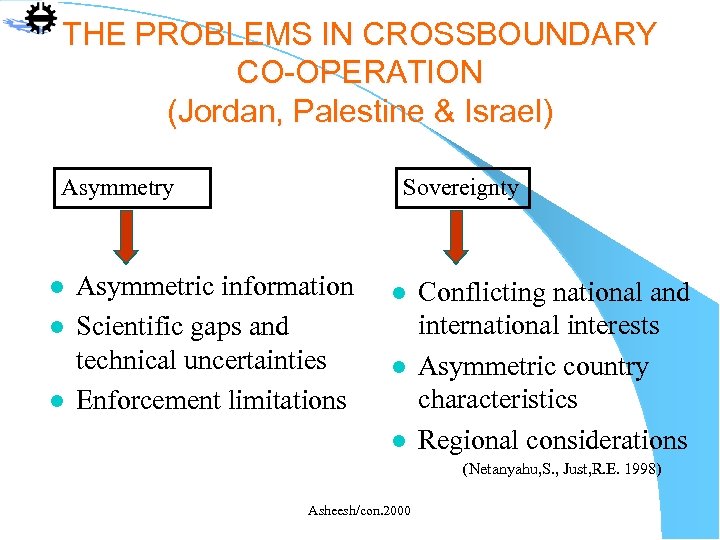 THE PROBLEMS IN CROSSBOUNDARY CO-OPERATION (Jordan, Palestine & Israel) Asymmetry l l l Sovereignty Asymmetric information Scientific gaps and technical uncertainties Enforcement limitations l Conflicting national and international interests Asymmetric country characteristics Regional considerations (Netanyahu, S. , Just, R. E. 1998) l l Asheesh/con. 2000
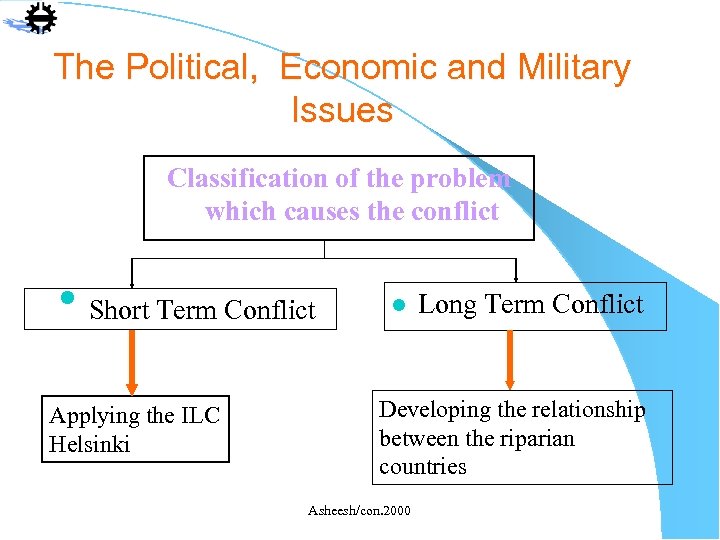 The Political, Economic and Military Issues Classification of the problem which causes the conflict h. Short Term Conflict Applying the ILC Helsinki l Long Term Conflict Developing the relationship between the riparian countries Asheesh/con. 2000
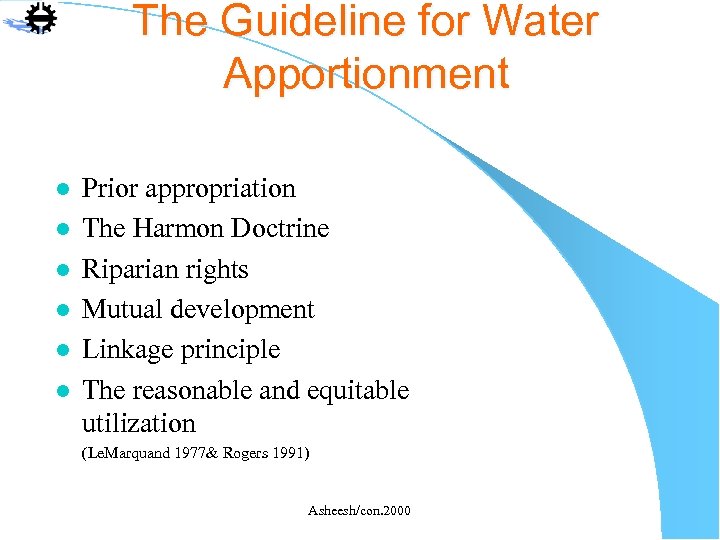 The Guideline for Water Apportionment l l l Prior appropriation The Harmon Doctrine Riparian rights Mutual development Linkage principle The reasonable and equitable utilization (Le. Marquand 1977& Rogers 1991) Asheesh/con. 2000
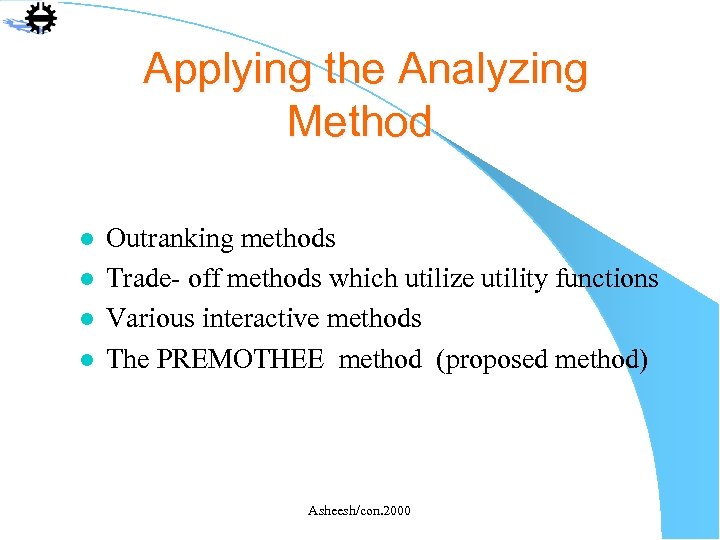 Applying the Analyzing Method l l Outranking methods Trade- off methods which utilize utility functions Various interactive methods The PREMOTHEE method (proposed method) Asheesh/con. 2000
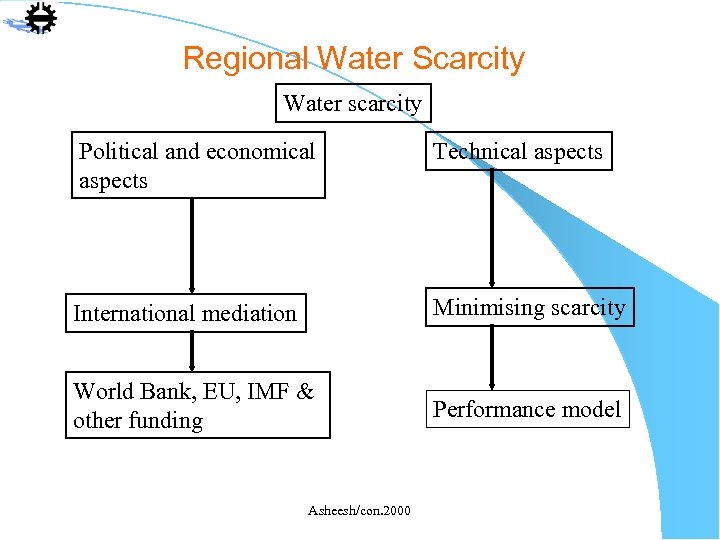 Regional Water Scarcity Water scarcity Political and economical aspects Technical aspects International mediation Minimising scarcity World Bank, EU, IMF & other funding Performance model Asheesh/con. 2000
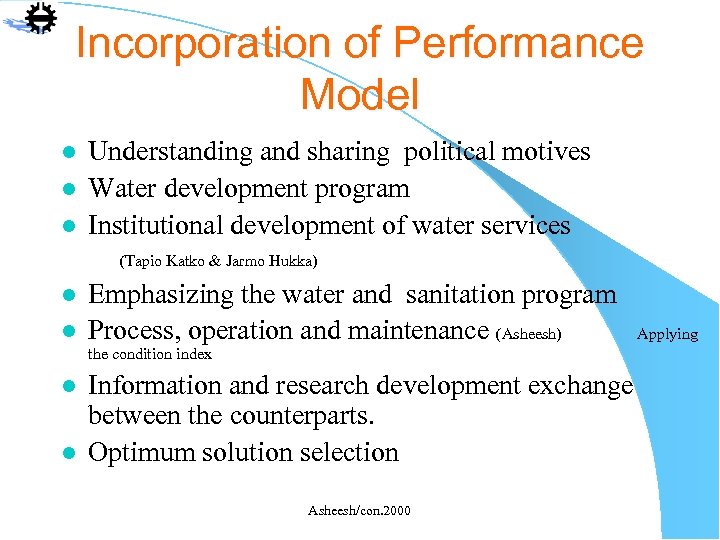 Incorporation of Performance Model l Understanding and sharing political motives Water development program Institutional development of water services (Tapio Katko & Jarmo Hukka) l l Emphasizing the water and sanitation program Process, operation and maintenance (Asheesh) Applying the condition index l l Information and research development exchange between the counterparts. Optimum solution selection Asheesh/con. 2000
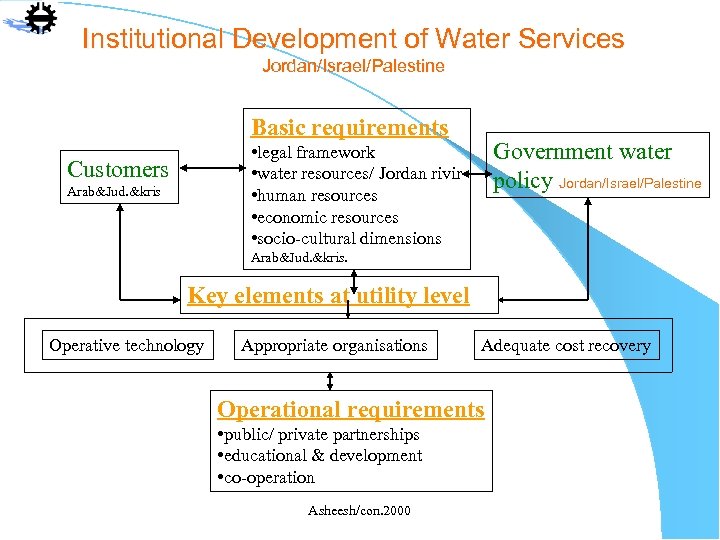 Institutional Development of Water Services Jordan/Israel/Palestine Basic requirements Government water policy Jordan/Israel/Palestine • legal framework • water resources/ Jordan rivir • human resources • economic resources • socio-cultural dimensions Customers Arab&Jud. &kris. Key elements at utility level Operative technology Appropriate organisations Adequate cost recovery Operational requirements • public/ private partnerships • educational & development • co-operation Asheesh/con. 2000
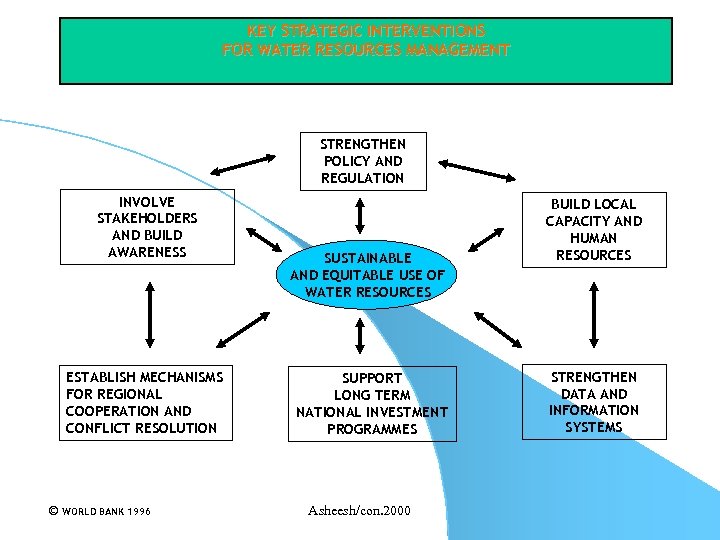 KEY STRATEGIC INTERVENTIONS FOR WATER RESOURCES MANAGEMENT STRENGTHEN POLICY AND REGULATION INVOLVE STAKEHOLDERS AND BUILD AWARENESS ESTABLISH MECHANISMS FOR REGIONAL COOPERATION AND CONFLICT RESOLUTION © WORLD BANK 1996 SUSTAINABLE AND EQUITABLE USE OF WATER RESOURCES SUPPORT LONG TERM NATIONAL INVESTMENT PROGRAMMES Asheesh/con. 2000 BUILD LOCAL CAPACITY AND HUMAN RESOURCES STRENGTHEN DATA AND INFORMATION SYSTEMS
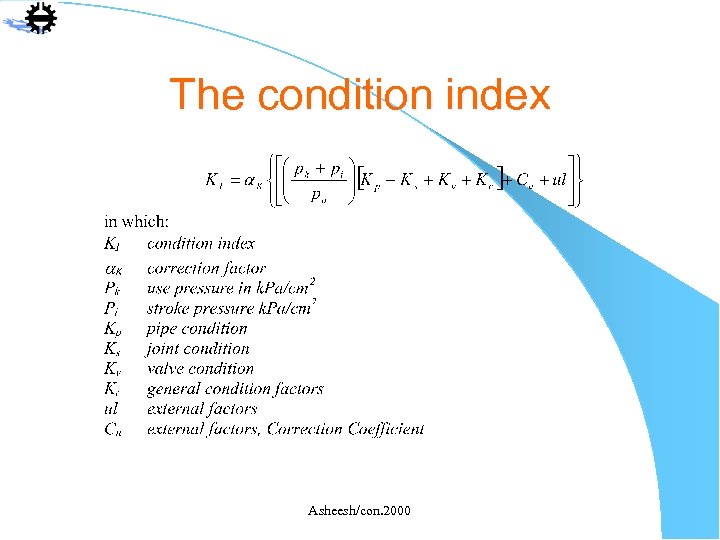 The condition index Asheesh/con. 2000
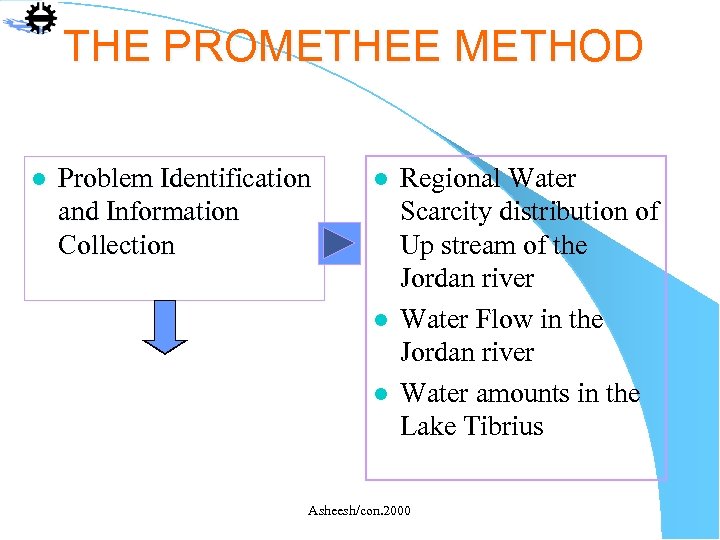 THE PROMETHEE METHOD l Problem Identification and Information Collection l l l Regional Water Scarcity distribution of Up stream of the Jordan river Water Flow in the Jordan river Water amounts in the Lake Tibrius Asheesh/con. 2000
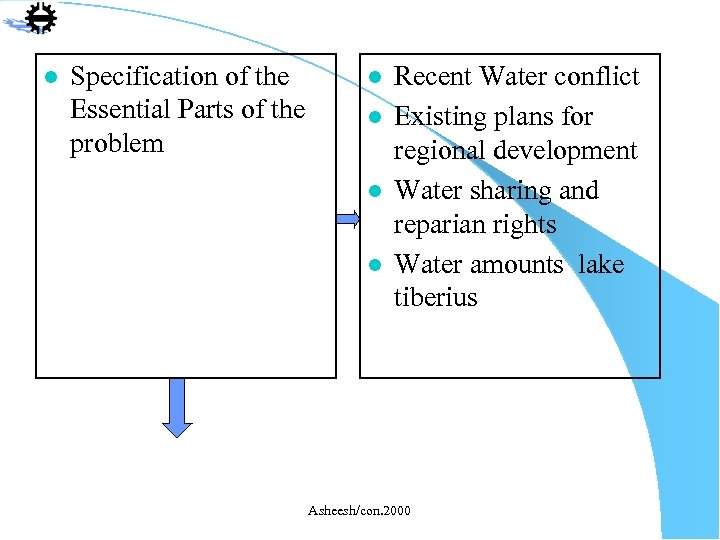 l Specification of the Essential Parts of the problem l l Recent Water conflict Existing plans for regional development Water sharing and reparian rights Water amounts lake tiberius Asheesh/con. 2000
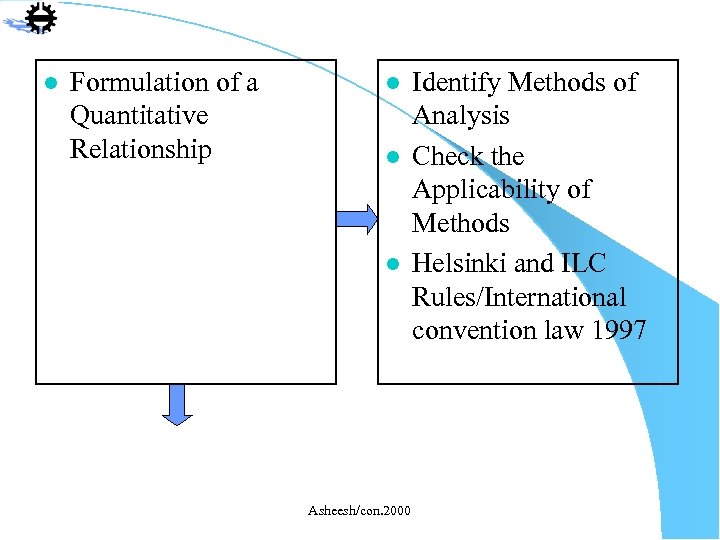 l Formulation of a Quantitative Relationship l l l Asheesh/con. 2000 Identify Methods of Analysis Check the Applicability of Methods Helsinki and ILC Rules/International convention law 1997
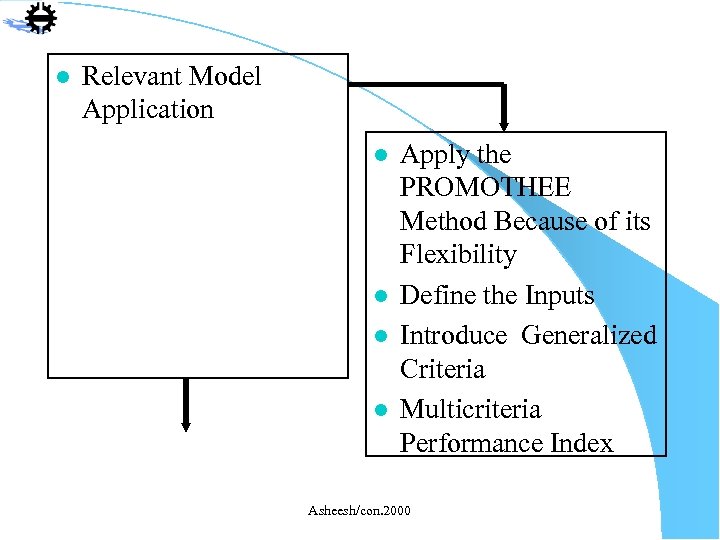 l Relevant Model Application l l Apply the PROMOTHEE Method Because of its Flexibility Define the Inputs Introduce Generalized Criteria Multicriteria Performance Index Asheesh/con. 2000
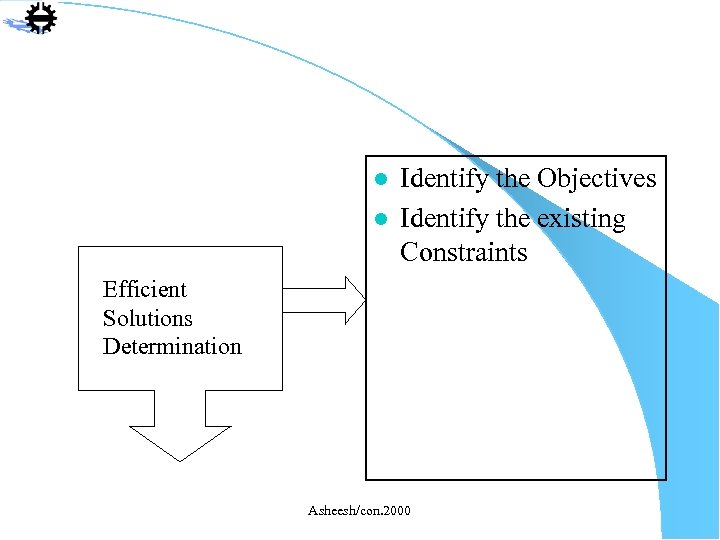 l l Identify the Objectives Identify the existing Constraints Efficient Solutions Determination Asheesh/con. 2000
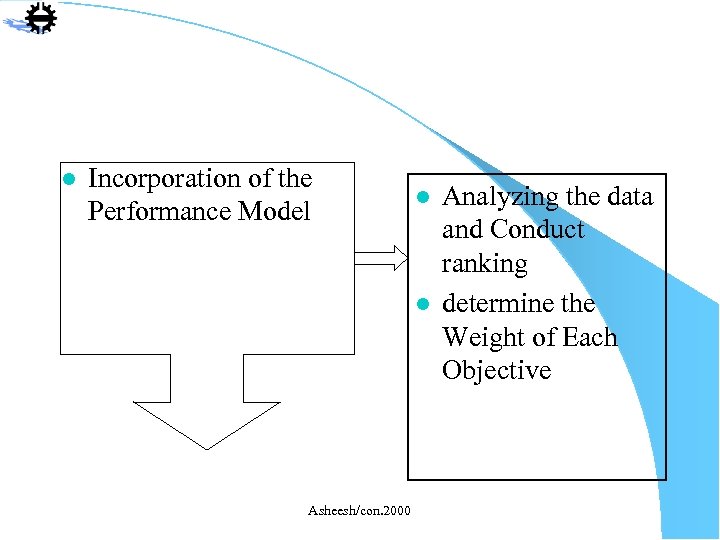 l Incorporation of the Performance Model l l Asheesh/con. 2000 Analyzing the data and Conduct ranking determine the Weight of Each Objective
 l Optimum Solution Selection Asheesh/con. 2000
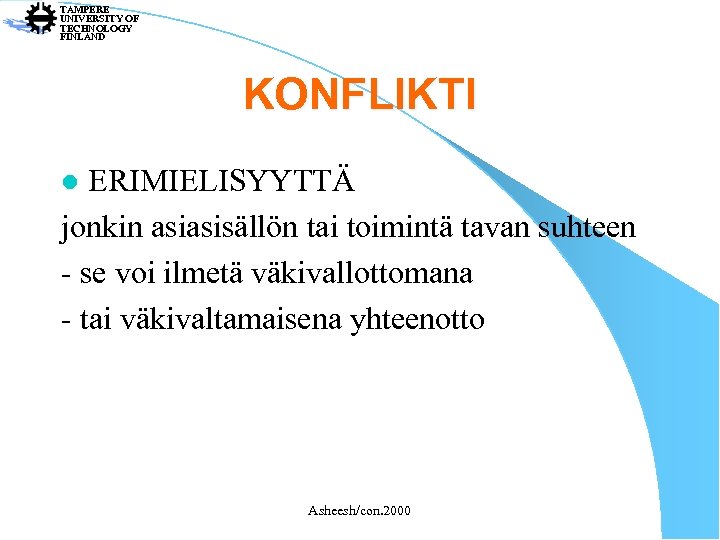 TAMPERE UNIVERSITY OF TECHNOLOGY FINLAND KONFLIKTI ERIMIELISYYTTÄ jonkin asiasisällön tai toimintä tavan suhteen - se voi ilmetä väkivallottomana - tai väkivaltamaisena yhteenotto l Asheesh/con. 2000
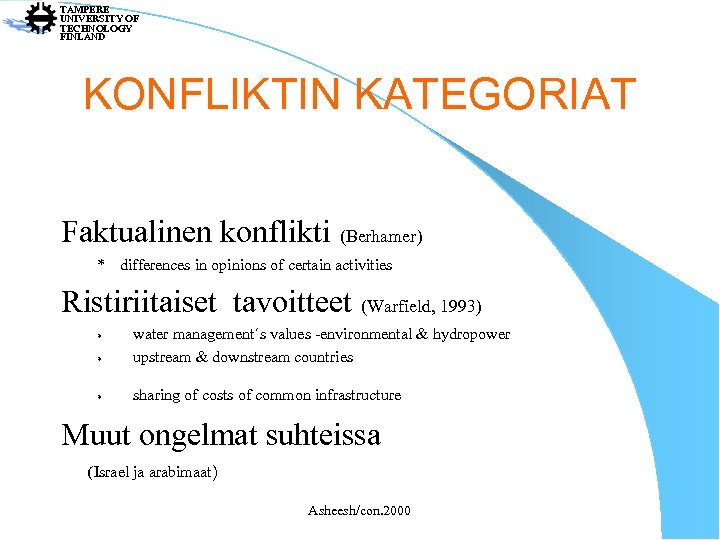 TAMPERE UNIVERSITY OF TECHNOLOGY FINLAND KONFLIKTIN KATEGORIAT Faktualinen konflikti (Berhamer) * differences in opinions of certain activities Ristiriitaiset tavoitteet (Warfield, 1993) * water management´s values -environmental & hydropower upstream & downstream countries * sharing of costs of common infrastructure * Muut ongelmat suhteissa (Israel ja arabimaat) Asheesh/con. 2000
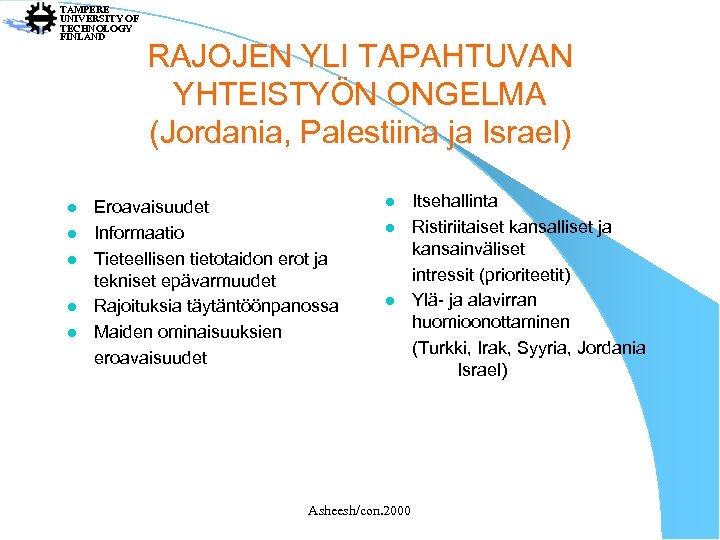 TAMPERE UNIVERSITY OF TECHNOLOGY FINLAND l l l RAJOJEN YLI TAPAHTUVAN YHTEISTYÖN ONGELMA (Jordania, Palestiina ja Israel) Eroavaisuudet Informaatio Tieteellisen tietotaidon erot ja tekniset epävarmuudet Rajoituksia täytäntöönpanossa Maiden ominaisuuksien eroavaisuudet l l l Asheesh/con. 2000 Itsehallinta Ristiriitaiset kansalliset ja kansainväliset intressit (prioriteetit) Ylä- ja alavirran huomioonottaminen (Turkki, Irak, Syyria, Jordania Israel)
 TAMPERE UNIVERSITY OF TECHNOLOGY FINLAND MALLI LÄHI-IDÄN VESIVAROJEN JA PALVELUJEN HALLINTAAN Rajojen yli ulottuvat vesivarat Jordania, Israel ja Palestiina Asheesh/con. 2000
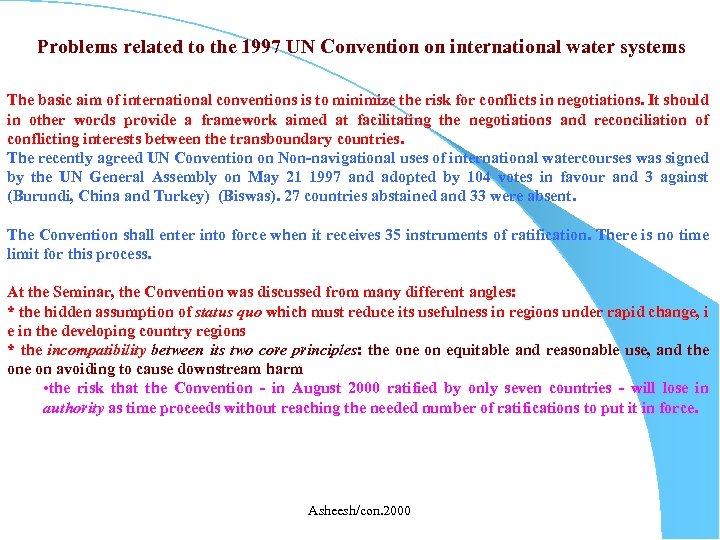 Problems related to the 1997 UN Convention on international water systems The basic aim of international conventions is to minimize the risk for conflicts in negotiations. It should in other words provide a framework aimed at facilitating the negotiations and reconciliation of conflicting interests between the transboundary countries. The recently agreed UN Convention on Non-navigational uses of international watercourses was signed by the UN General Assembly on May 21 1997 and adopted by 104 votes in favour and 3 against (Burundi, China and Turkey) (Biswas). 27 countries abstained and 33 were absent. The Convention shall enter into force when it receives 35 instruments of ratification. There is no time limit for this process. At the Seminar, the Convention was discussed from many different angles: * the hidden assumption of status quo which must reduce its usefulness in regions under rapid change, i e in the developing country regions * the incompatibility between its two core principles: the on equitable and reasonable use, and the on avoiding to cause downstream harm • the risk that the Convention - in August 2000 ratified by only seven countries - will lose in authority as time proceeds without reaching the needed number of ratifications to put it in force. Asheesh/con. 2000
 TAMPERE UNIVERSITY OF TECHNOLOGY FINLAND Asheesh/con. 2000
 TAMPERE UNIVERSITY OF TECHNOLOGY FINLAND ALUEEN VESILÄHTEET JORDAN-VIRTA VESISTÖINEEN l AKVIFERIT ELI POHJAVESIALTAAT l PIKKUJOET l VEDEN UUDELLEEN KÄYTTÖ l TIBRIUS l Asheesh/con. 2000
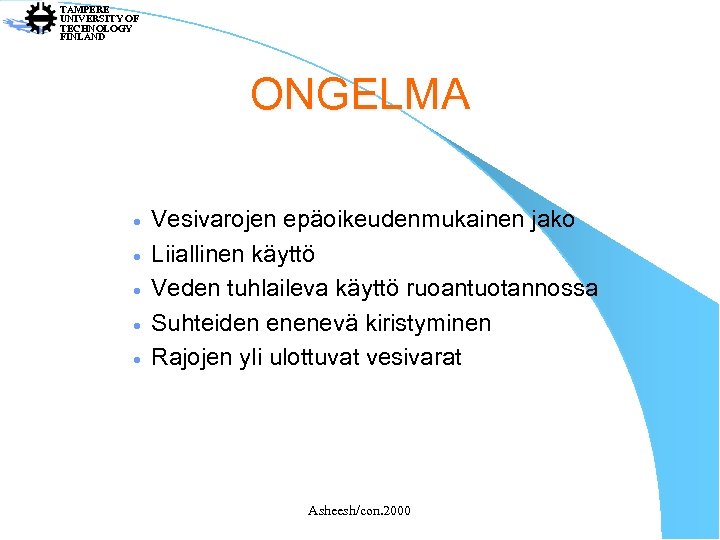 TAMPERE UNIVERSITY OF TECHNOLOGY FINLAND ONGELMA · · · Vesivarojen epäoikeudenmukainen jako Liiallinen käyttö Veden tuhlaileva käyttö ruoantuotannossa Suhteiden enenevä kiristyminen Rajojen yli ulottuvat vesivarat Asheesh/con. 2000
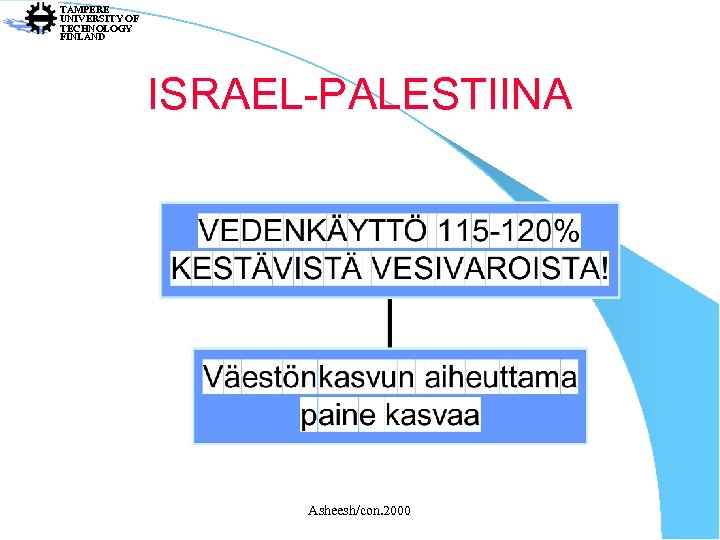 TAMPERE UNIVERSITY OF TECHNOLOGY FINLAND ISRAEL-PALESTIINA Asheesh/con. 2000
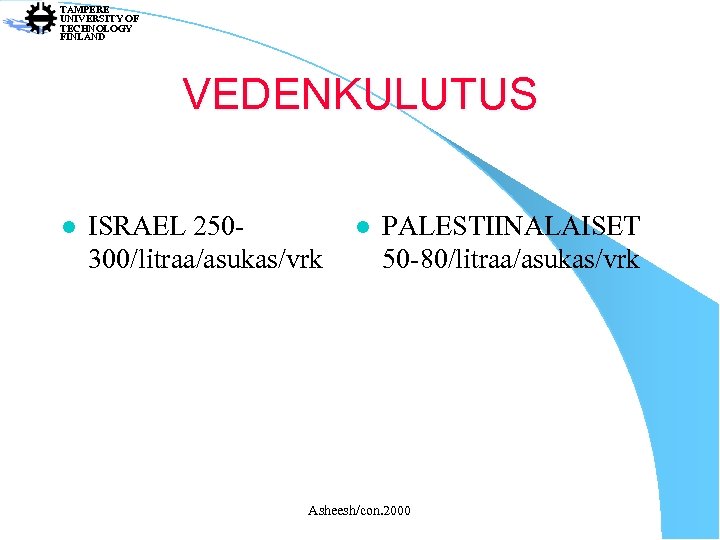 TAMPERE UNIVERSITY OF TECHNOLOGY FINLAND VEDENKULUTUS l ISRAEL 250300/litraa/asukas/vrk l PALESTIINALAISET 50 -80/litraa/asukas/vrk Asheesh/con. 2000
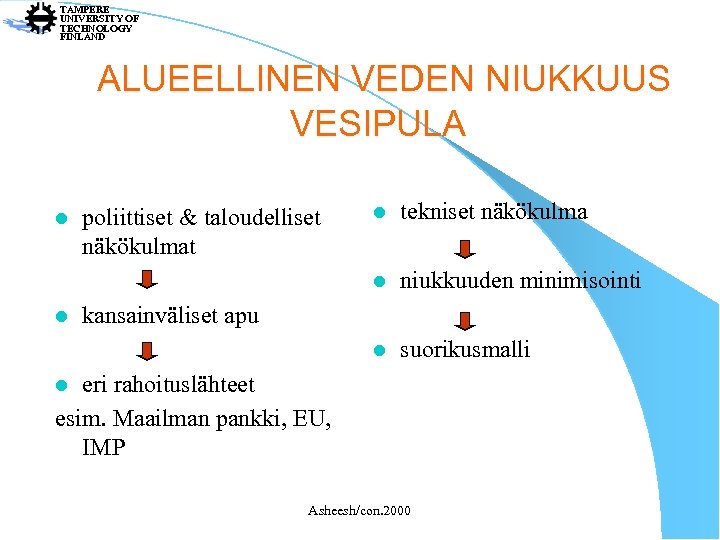 TAMPERE UNIVERSITY OF TECHNOLOGY FINLAND ALUEELLINEN VEDEN NIUKKUUS VESIPULA tekniset näkökulma niukkuuden minimisointi l l poliittiset & taloudelliset näkökulmat l l l suorikusmalli kansainväliset apu eri rahoituslähteet esim. Maailman pankki, EU, IMP l Asheesh/con. 2000
 TAMPERE UNIVERSITY OF TECHNOLOGY FINLAND POLIITTISET, TALOUDELLISET, SOTILAALLISET, JA TEKNILLEST Konfliktin aiheuttavan ongelman luokittelu: l Lyhyen aikavälin konflikti Pitkän aikavälin ongelma l ILC Helsinki-sopimuksen Maiden välisten käyttökehittäminen suhteiden • MALLI Asheesh/con. 2000
 TAMPERE UNIVERSITY OF TECHNOLOGY FINLAND VEDENJAKELUN JÄRJESTÄMISEN OHJEITA l l l Aikaisempi jakelu Harmon-doktriini Naapurimaiden oikeudet Yhteinen kehitys Liittoutumisen periaate Kohtuullinen ja oikeudenmukainen käyttö Asheesh/con. 2000
 TAMPERE UNIVERSITY OF TECHNOLOGY FINLAND PERFORMANCE-MALLIN KÄYTTÖÖNOTTO 1. Optimiratkaisun valitseminen 2. Poliittisten motiivien ymmärtäminen ja jakaminen 3. Vedenkehitysohjelma 4. Vesipalvelujen institutionaalinen kehittäminen 5. Vesi- ja sanitaatio-ongelman korostaminen 6. Prosessi, toiminta ja ylläpito 7. Informaation ja tutkimustulosten vaihto osapuolten välillä Asheesh/con. 2000
 TAMPERE UNIVERSITY OF TECHNOLOGY FINLAND ANALYYSIMENETELMÄN KÄYTTÖ l l Erilaisia interaktiivisia menetelmiä Outranking menetelmä Trade- off menetelmä PREMOTHEE-menetelmä Asheesh/con. 2000
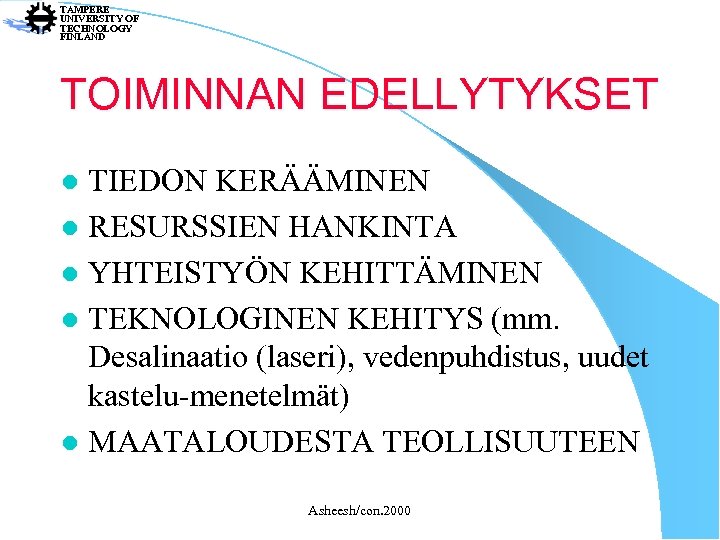 TAMPERE UNIVERSITY OF TECHNOLOGY FINLAND TOIMINNAN EDELLYTYKSET TIEDON KERÄÄMINEN l RESURSSIEN HANKINTA l YHTEISTYÖN KEHITTÄMINEN l TEKNOLOGINEN KEHITYS (mm. Desalinaatio (laseri), vedenpuhdistus, uudet kastelu-menetelmät) l MAATALOUDESTA TEOLLISUUTEEN l Asheesh/con. 2000