 Скачать презентацию Taming BGP An incremental approach to improving the
f439c38f11cce8e504168804da7363db.ppt
- Количество слайдов: 50



Taming BGP An incremental approach to improving the dynamic properties of BGP Geoff Huston CAIA Seminar – 18 August 2007 – http: //caia. swin. edu. au
BGP is … n n The inter-domain routing protocol for the Internet An instance of a Distance Vector Protocol with explicit Path Vector attributes CAIA Seminar – 18 August 2007 – http: //caia. swin. edu. au
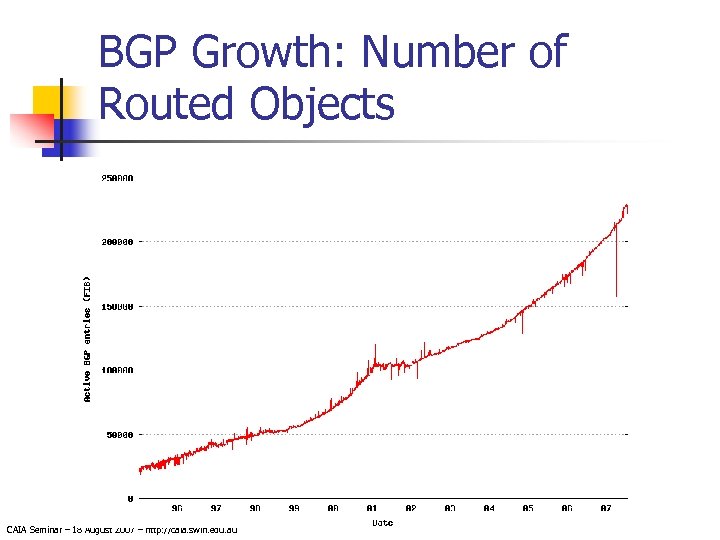
BGP Growth: Number of Routed Objects CAIA Seminar – 18 August 2007 – http: //caia. swin. edu. au
BGP Questions n Are there practical limits to the size of the routed network ? n n n routing database size ? routing update processing load ? Time to reach “converged” routing states ? CAIA Seminar – 18 August 2007 – http: //caia. swin. edu. au
Current Understandings n The protocol message peak rate is increasing faster than the number of routed entries n n n BGP is a “chatty” protocol Dense interconnection implies higher levels of path exploration to stabilize on best available paths Some concern that BGP in its current form has some practical limits in terms of size and practical convergence times CAIA Seminar – 18 August 2007 – http: //caia. swin. edu. au
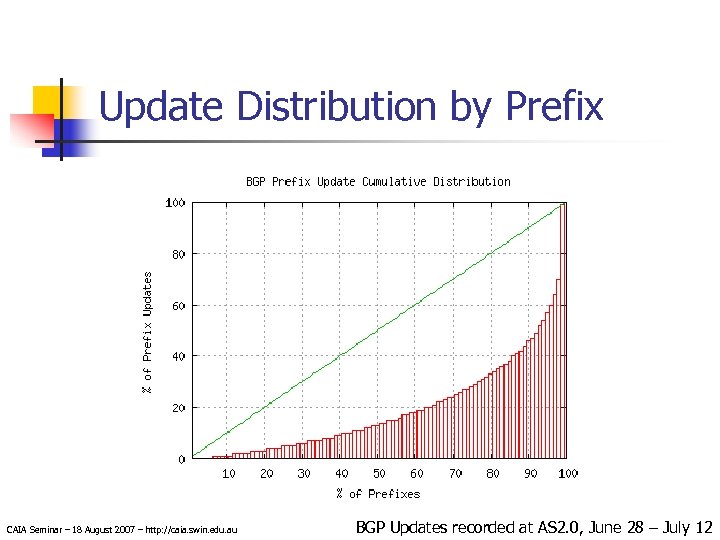
Update Distribution by Prefix CAIA Seminar – 18 August 2007 – http: //caia. swin. edu. au BGP Updates recorded at AS 2. 0, June 28 – July 12
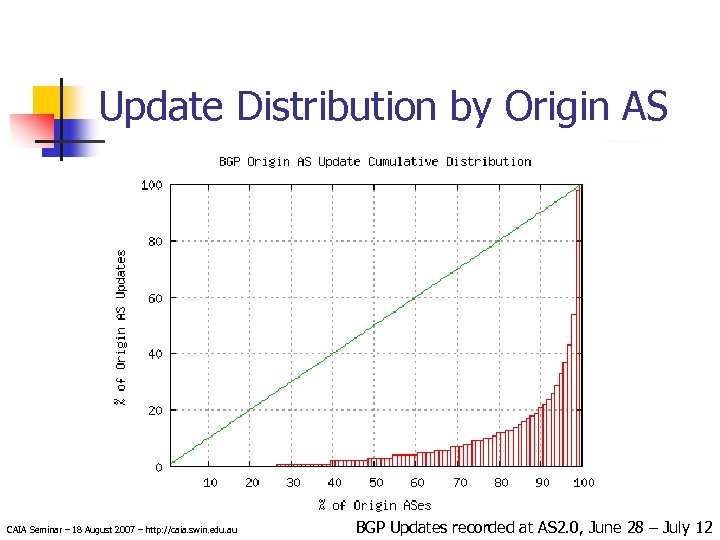
Update Distribution by Origin AS CAIA Seminar – 18 August 2007 – http: //caia. swin. edu. au BGP Updates recorded at AS 2. 0, June 28 – July 12
Previous Work n n The BGP load profile is heavily skewed, with a small number of route objects contributing a disproportionate amount of routing update load If we could identify this skewed load component within the BGP protocol engine then there is the potential for remote BGP speakers to significantly reduce the total BGP processing load profile CAIA Seminar – 18 August 2007 – http: //caia. swin. edu. au
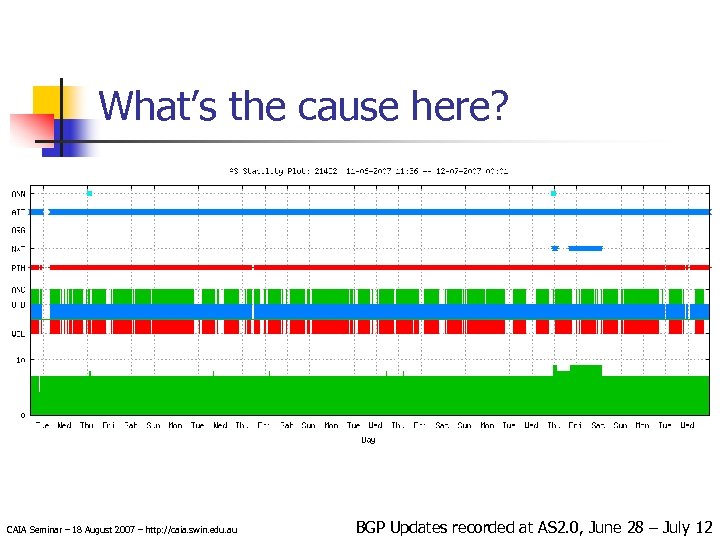
What’s the cause here? CAIA Seminar – 18 August 2007 – http: //caia. swin. edu. au BGP Updates recorded at AS 2. 0, June 28 – July 12
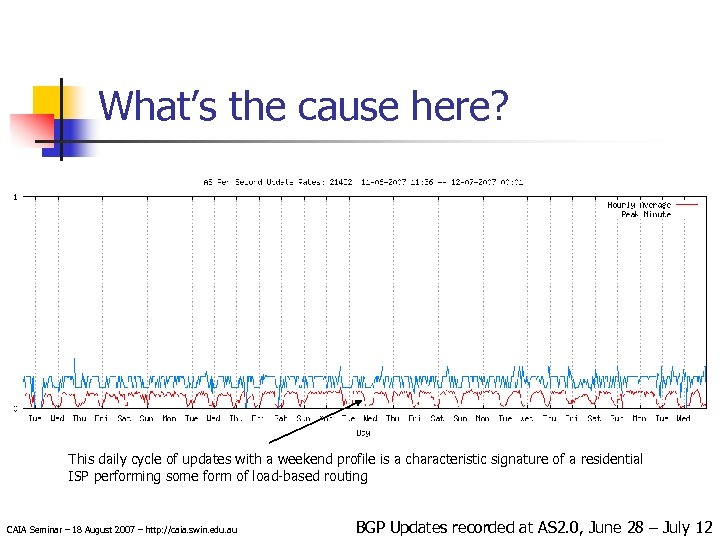
What’s the cause here? This daily cycle of updates with a weekend profile is a characteristic signature of a residential ISP performing some form of load-based routing CAIA Seminar – 18 August 2007 – http: //caia. swin. edu. au BGP Updates recorded at AS 2. 0, June 28 – July 12
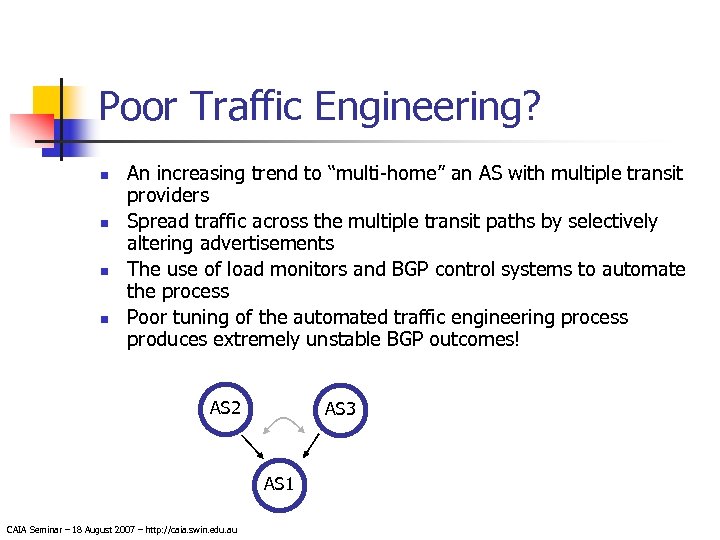
Poor Traffic Engineering? n n An increasing trend to “multi-home” an AS with multiple transit providers Spread traffic across the multiple transit paths by selectively altering advertisements The use of load monitors and BGP control systems to automate the process Poor tuning of the automated traffic engineering process produces extremely unstable BGP outcomes! AS 2 AS 3 AS 1 CAIA Seminar – 18 August 2007 – http: //caia. swin. edu. au
BGP Update Load Profile n n n It appears that the majority of the BGP load is caused by a very small number of unstable origination configurations, possibly driven by automated systems with limited or no feedback control This problem is getting larger over time The related protocol update load consumes routing resources, but does not change the base information state – its generally oscillations across a smaller set of states CAIA Seminar – 18 August 2007 – http: //caia. swin. edu. au
BGP “Beacons” n Act as control points in the BGP environment, as they operate according to a known periodic schedule of announcements n n Typical profile: 2 hours “up” then 2 hours “down” at origin Analyse update behaviour at a BGP observation point CAIA Seminar – 18 August 2007 – http: //caia. swin. edu. au
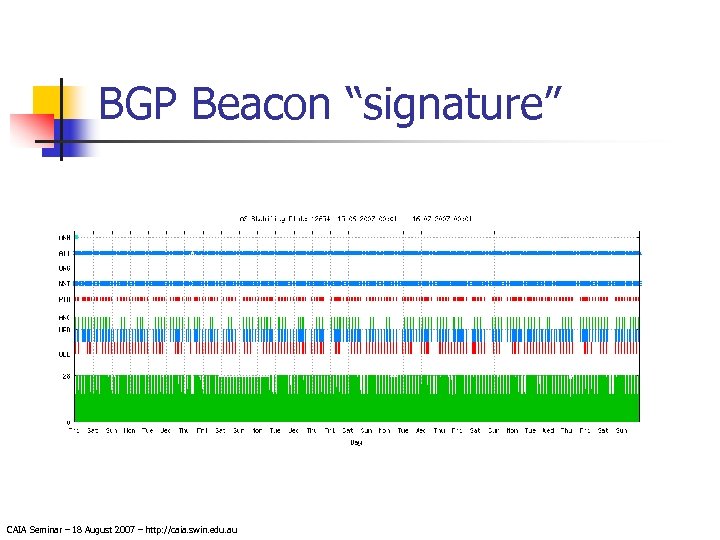
BGP Beacon “signature” CAIA Seminar – 18 August 2007 – http: //caia. swin. edu. au
BGP “Beacons” n n Each withdrawal at the beacon source can generate up to 10 updates at a remote observation point! Hypothesis: BGP Path exploration on withdrawal appears to be a major factor in overall BGP update load CAIA Seminar – 18 August 2007 – http: //caia. swin. edu. au
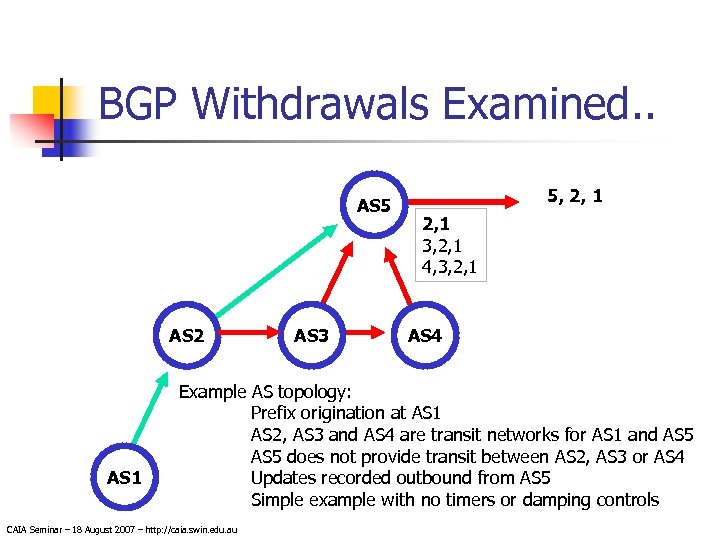
BGP Withdrawals Examined. . AS 5 AS 2 AS 1 AS 3 5, 2, 1 3, 2, 1 4, 3, 2, 1 AS 4 Example AS topology: Prefix origination at AS 1 AS 2, AS 3 and AS 4 are transit networks for AS 1 and AS 5 does not provide transit between AS 2, AS 3 or AS 4 Updates recorded outbound from AS 5 Simple example with no timers or damping controls CAIA Seminar – 18 August 2007 – http: //caia. swin. edu. au
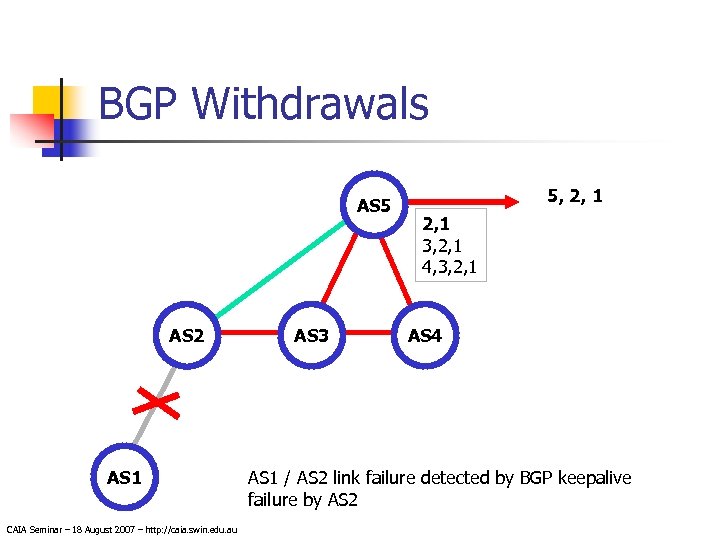
BGP Withdrawals AS 5 AS 2 AS 1 CAIA Seminar – 18 August 2007 – http: //caia. swin. edu. au AS 3 5, 2, 1 3, 2, 1 4, 3, 2, 1 AS 4 AS 1 / AS 2 link failure detected by BGP keepalive failure by AS 2
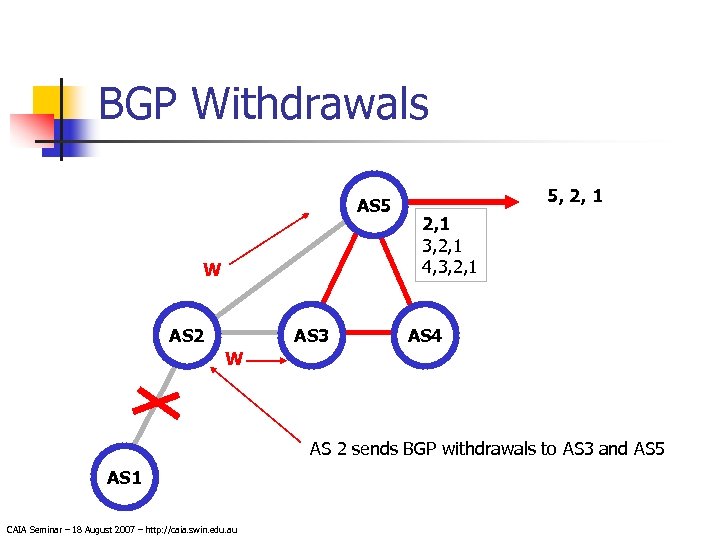
BGP Withdrawals AS 5 W AS 3 AS 2 5, 2, 1 3, 2, 1 4, 3, 2, 1 AS 4 W AS 2 sends BGP withdrawals to AS 3 and AS 5 AS 1 CAIA Seminar – 18 August 2007 – http: //caia. swin. edu. au
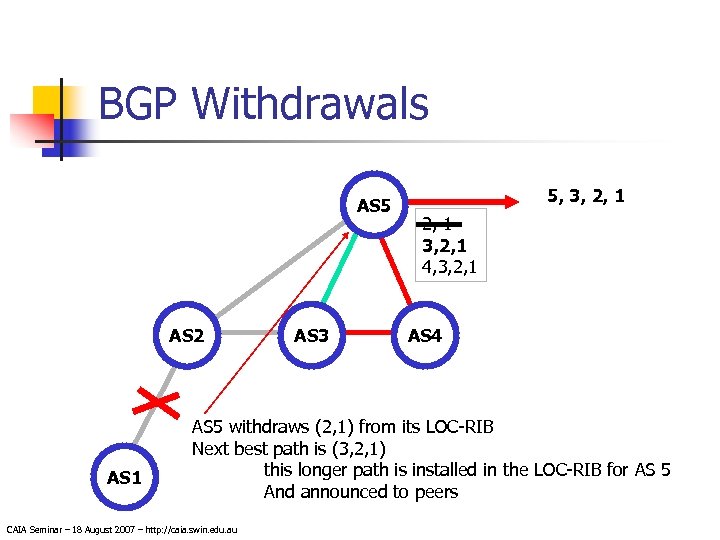
BGP Withdrawals AS 5 AS 2 AS 1 AS 3 5, 3, 2, 1 4, 3, 2, 1 AS 4 AS 5 withdraws (2, 1) from its LOC-RIB Next best path is (3, 2, 1) this longer path is installed in the LOC-RIB for AS 5 And announced to peers CAIA Seminar – 18 August 2007 – http: //caia. swin. edu. au
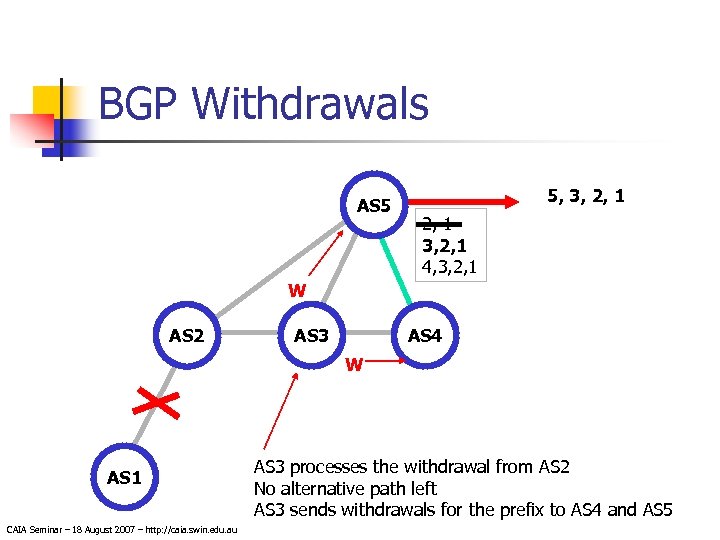
BGP Withdrawals AS 5 5, 3, 2, 1 4, 3, 2, 1 W AS 2 AS 3 AS 4 W AS 1 CAIA Seminar – 18 August 2007 – http: //caia. swin. edu. au AS 3 processes the withdrawal from AS 2 No alternative path left AS 3 sends withdrawals for the prefix to AS 4 and AS 5
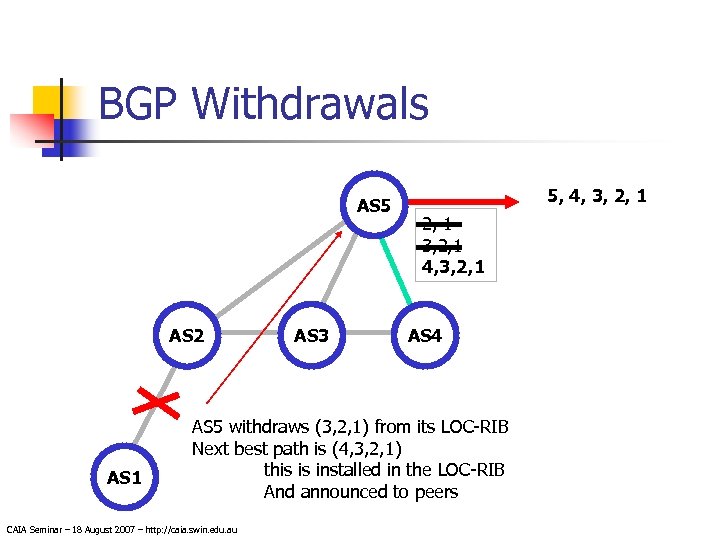
BGP Withdrawals AS 5 AS 2 AS 1 AS 3 5, 4, 3, 2, 1 4, 3, 2, 1 AS 4 AS 5 withdraws (3, 2, 1) from its LOC-RIB Next best path is (4, 3, 2, 1) this is installed in the LOC-RIB And announced to peers CAIA Seminar – 18 August 2007 – http: //caia. swin. edu. au
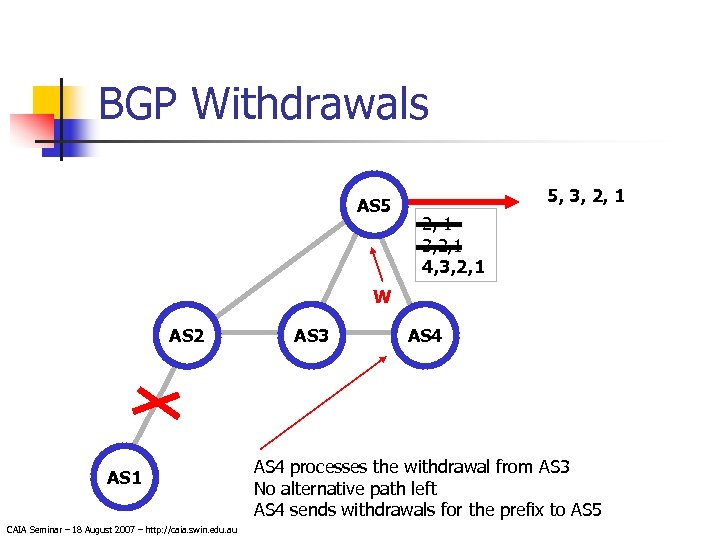
BGP Withdrawals AS 5 5, 3, 2, 1 4, 3, 2, 1 W AS 2 AS 1 CAIA Seminar – 18 August 2007 – http: //caia. swin. edu. au AS 3 AS 4 processes the withdrawal from AS 3 No alternative path left AS 4 sends withdrawals for the prefix to AS 5
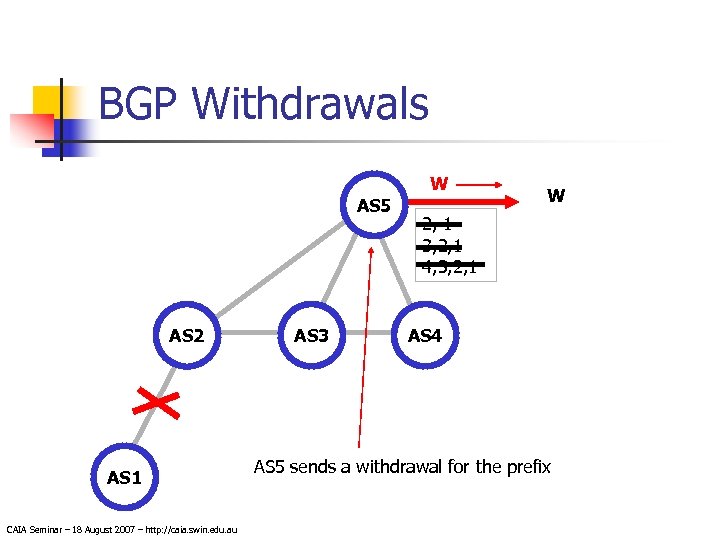
BGP Withdrawals W AS 5 AS 2 AS 1 CAIA Seminar – 18 August 2007 – http: //caia. swin. edu. au AS 3 W 2, 1 3, 2, 1 4, 3, 2, 1 AS 4 AS 5 sends a withdrawal for the prefix
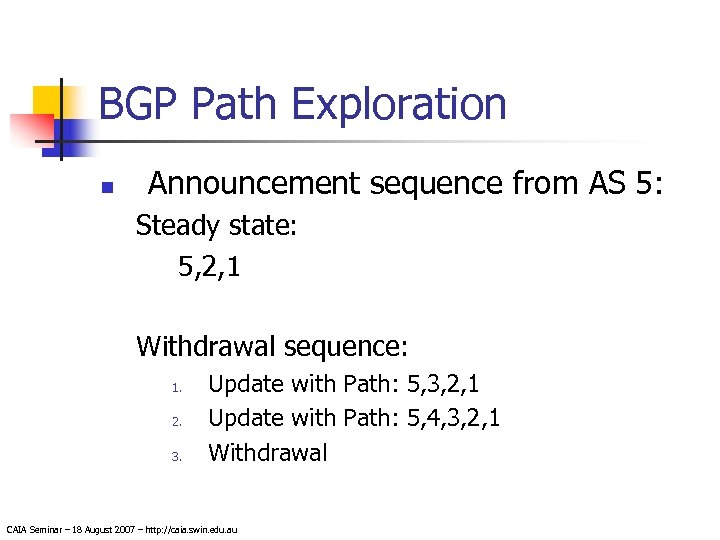
BGP Path Exploration n Announcement sequence from AS 5: Steady state: 5, 2, 1 Withdrawal sequence: 1. 2. 3. Update with Path: 5, 3, 2, 1 Update with Path: 5, 4, 3, 2, 1 Withdrawal CAIA Seminar – 18 August 2007 – http: //caia. swin. edu. au
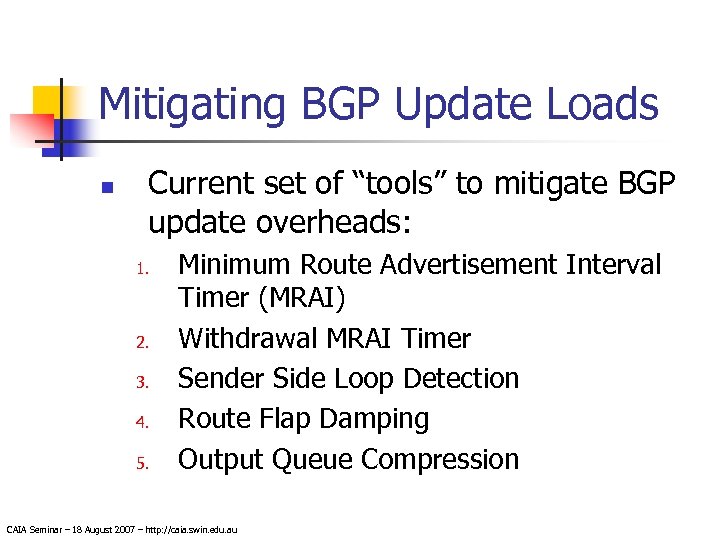
Mitigating BGP Update Loads n Current set of “tools” to mitigate BGP update overheads: 1. 2. 3. 4. 5. Minimum Route Advertisement Interval Timer (MRAI) Withdrawal MRAI Timer Sender Side Loop Detection Route Flap Damping Output Queue Compression CAIA Seminar – 18 August 2007 – http: //caia. swin. edu. au
1. MRAI Timer n Optional timer in BGP n n n ON in ciscos (30 seconds) OFF in Junipers (0 secconds) Suppress the advertisement of successive updates to a peer for a given prefix until the timer expires Commonly implemented as suppress ALL updates to a peer until the per-peer MRAI timer expires Output Queue (adj-rib-out) process CAIA Seminar – 18 August 2007 – http: //caia. swin. edu. au
2. Withdrawal MRAI TIMER n n Variant on MRAI where withdrawals are also time limited in the same way as updates Output Queue (adj-rib-out) process CAIA Seminar – 18 August 2007 – http: //caia. swin. edu. au
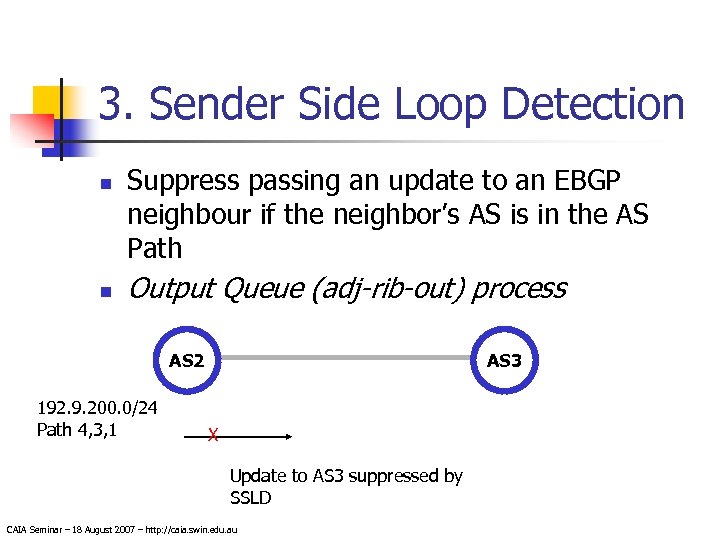
3. Sender Side Loop Detection n n Suppress passing an update to an EBGP neighbour if the neighbor’s AS is in the AS Path Output Queue (adj-rib-out) process AS 3 AS 2 192. 9. 200. 0/24 Path 4, 3, 1 X Update to AS 3 suppressed by SSLD CAIA Seminar – 18 August 2007 – http: //caia. swin. edu. au
4. Route Flap Damping n n RFD attempts to apply a heuristic to identify noisy prefixes and apply a longer term suppression to update propagation Uses the concept of a “penalty” score applied to a prefix learned from a peer n n n Each update and withdrawal adds to the score The score decays exponentially over time If the score exceeds a suppress threshold the route is damped Damping remains in place until the score drops below the release threshold Damping is applied to the adj-rib-in Input Queue (adj-rib-in) process CAIA Seminar – 18 August 2007 – http: //caia. swin. edu. au
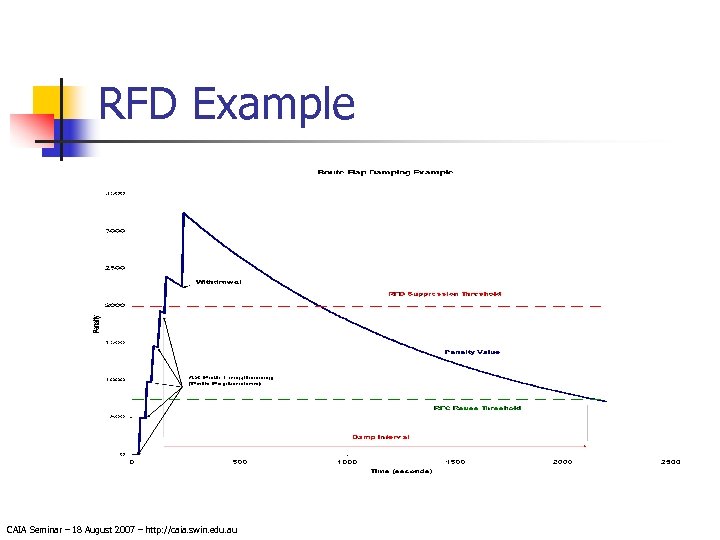
RFD Example CAIA Seminar – 18 August 2007 – http: //caia. swin. edu. au
RFD and Network Operators n n n RFD does not appear to be effective It causes the routing system to take extended intervals of hours rather than minutes to reach convergence It has done little to reduce the total routing update load It causes operational outages Edge link flapping is not prevalent in the routing system today, and Route Flap Damping exacerbates poor performance characteristics of BGP CAIA Seminar – 18 August 2007 – http: //caia. swin. edu. au
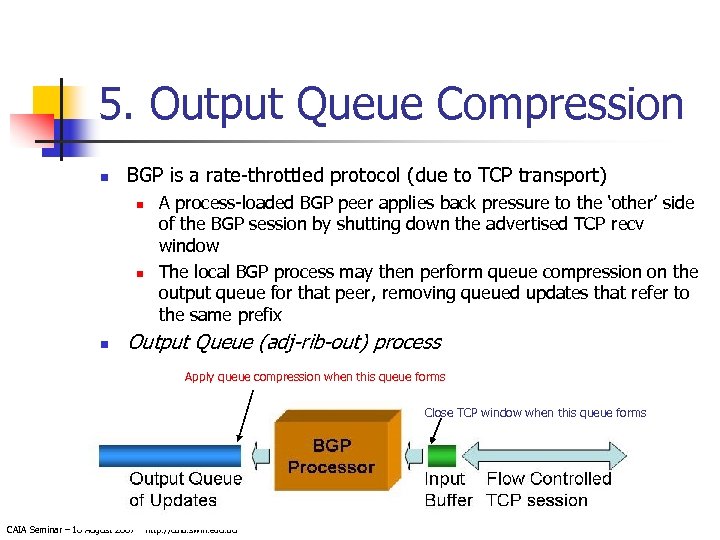
5. Output Queue Compression n BGP is a rate-throttled protocol (due to TCP transport) n n n A process-loaded BGP peer applies back pressure to the ‘other’ side of the BGP session by shutting down the advertised TCP recv window The local BGP process may then perform queue compression on the output queue for that peer, removing queued updates that refer to the same prefix Output Queue (adj-rib-out) process Apply queue compression when this queue forms Close TCP window when this queue forms CAIA Seminar – 18 August 2007 – http: //caia. swin. edu. au
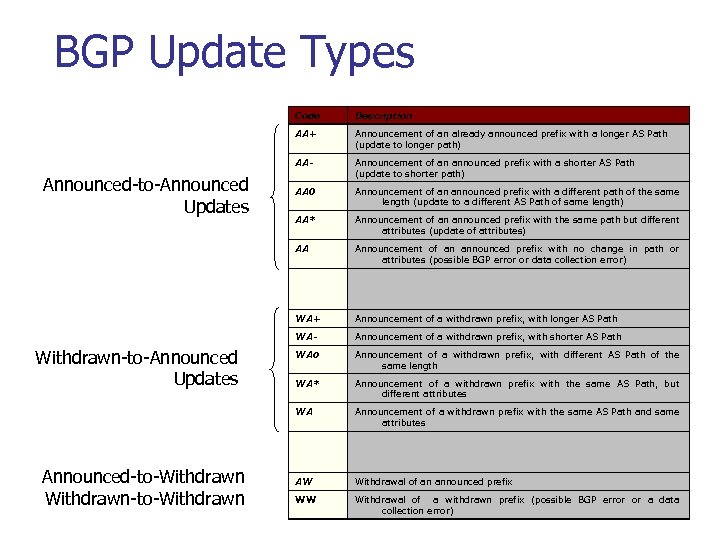
BGP Update Types Code AA+ AA 0 Announcement of an announced prefix with a different path of the same length (update to a different AS Path of same length) AA* Announcement of an announced prefix with the same path but different attributes (update of attributes) Announcement of an announced prefix with no change in path or attributes (possible BGP error or data collection error) WA+ Announcement of a withdrawn prefix, with longer AS Path WA- Announcement of a withdrawn prefix, with shorter AS Path WA 0 Announcement of a withdrawn prefix, with different AS Path of the same length WA* Announcement of a withdrawn prefix with the same AS Path, but different attributes WA Announced-to-Withdrawn-to-Withdrawn Announcement of an announced prefix with a shorter AS Path (update to shorter path) AA Withdrawn-to-Announced Updates Announcement of an already announced prefix with a longer AS Path (update to longer path) AA- Announced-to-Announced Updates Description Announcement of a withdrawn prefix with the same AS Path and same attributes AW Withdrawal of an announced prefix WW Withdrawal of a withdrawn prefix (possible BGP error or a data collection error)
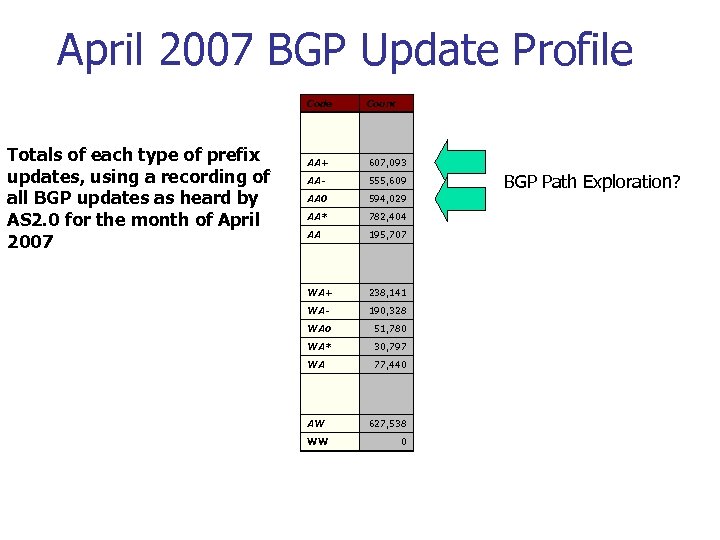
April 2007 BGP Update Profile Code Totals of each type of prefix updates, using a recording of all BGP updates as heard by AS 2. 0 for the month of April 2007 Count AA+ 607, 093 AA- 555, 609 AA 0 594, 029 AA* 782, 404 AA 195, 707 WA+ 238, 141 WA- 190, 328 WA 0 51, 780 WA* 30, 797 WA 77, 440 AW 627, 538 WW 0 BGP Path Exploration?
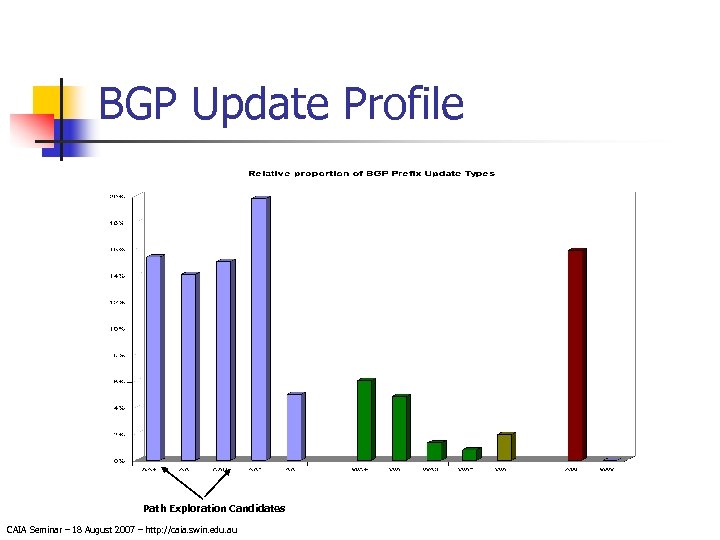
BGP Update Profile Path Exploration Candidates CAIA Seminar – 18 August 2007 – http: //caia. swin. edu. au
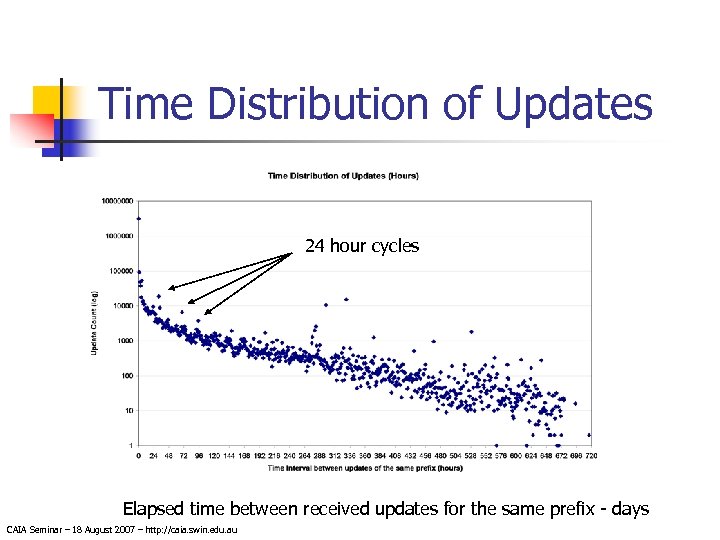
Time Distribution of Updates 24 hour cycles Elapsed time between received updates for the same prefix - days CAIA Seminar – 18 August 2007 – http: //caia. swin. edu. au
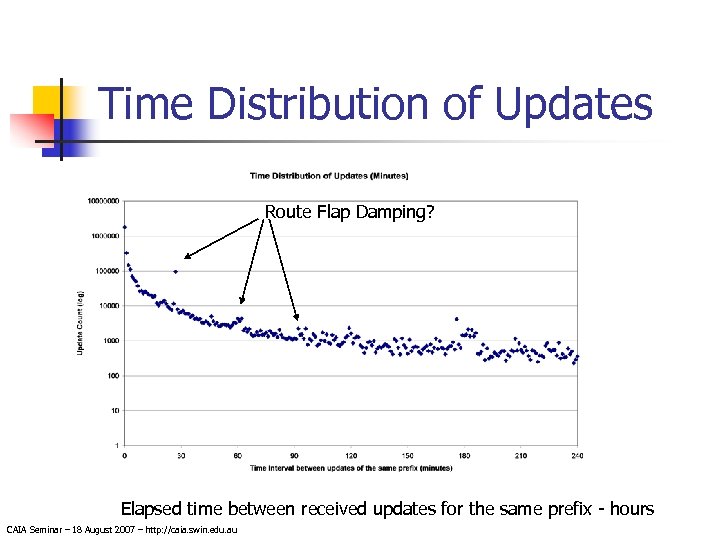
Time Distribution of Updates Route Flap Damping? Elapsed time between received updates for the same prefix - hours CAIA Seminar – 18 August 2007 – http: //caia. swin. edu. au
Time Distribution of Updates MRAI Timer Elapsed time between received updates for the same prefix - seconds CAIA Seminar – 18 August 2007 – http: //caia. swin. edu. au
Update Sequence Length Distribution A “sequence” is a set of updates for the same prefix that are separated by an interval <= the sequence timer (35 seconds) CAIA Seminar – 18 August 2007 – http: //caia. swin. edu. au
Some Observations n RFD – long term suppression n n MRAI – short term suppression n Route Flap damping extends convergence times by hours with no real benefit offset MRAI variations in the network make path exploration noisier Even with piecemeal MRAI deployment we still have a significant routing load attributable to Path Exploration Output Queue Compression n Rarely triggered in today’s network! CAIA Seminar – 18 August 2007 – http: //caia. swin. edu. au
An alternate approach: Path Exploration Damping (PED) n A prevalent form of path hunting is the update sequence of increasing AS path followed by a withdrawal, closely coupled in time {AA+ } *, AW The AA+ updates are intermediate noise updates in this case that are not valid routing states. Could a variation of Output Queue Compression be applicable here? i. e. Can these updates be locally suppressed for a short interval to see if they are path of a BGP Path Exploration activity? . The suppression would hold the update in the local output queue for a fixed time interval (in which case the update is released) or the update is further updated by queuing a subsequent update (or withdrawal) for the same prefix CAIA Seminar – 18 August 2007 – http: //caia. swin. edu. au
PED Algorithm n n Apply a 35 second MRAI timer to AA+, AA 0 and AA updates queued to e. BGP peers No MRAI timer applied to all other updates and all withdrawals 35 seconds is used to compensate for MRAI-filtered update sequences that use 30 second interval Algorithm: n n If an update extends the AS path length then suppress its re -advertisement for 35 seconds, or until a further update for this prefix is queued for re-advertisement Immediately re-advertise withdrawals and updates that reduce the AS Path length CAIA Seminar – 18 August 2007 – http: //caia. swin. edu. au
PED Results on BGP data CAIA Seminar – 18 August 2007 – http: //caia. swin. edu. au
PED Results on BGP data CAIA Seminar – 18 August 2007 – http: //caia. swin. edu. au
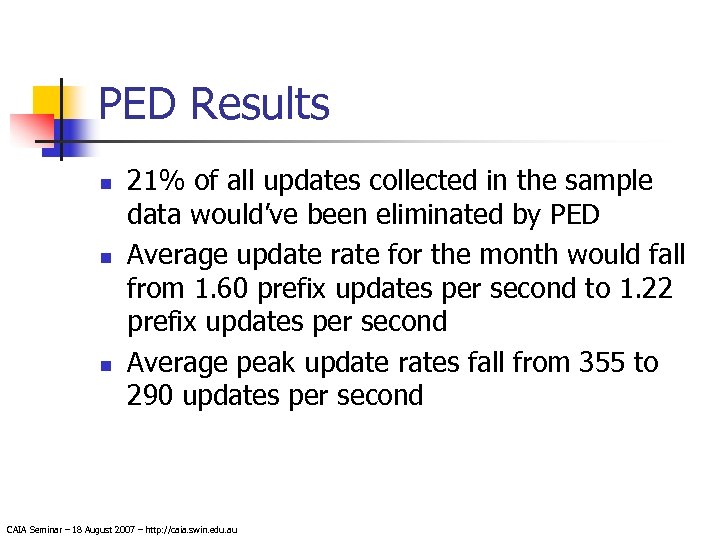
PED Results n n n 21% of all updates collected in the sample data would’ve been eliminated by PED Average update rate for the month would fall from 1. 60 prefix updates per second to 1. 22 prefix updates per second Average peak update rates fall from 355 to 290 updates per second CAIA Seminar – 18 August 2007 – http: //caia. swin. edu. au
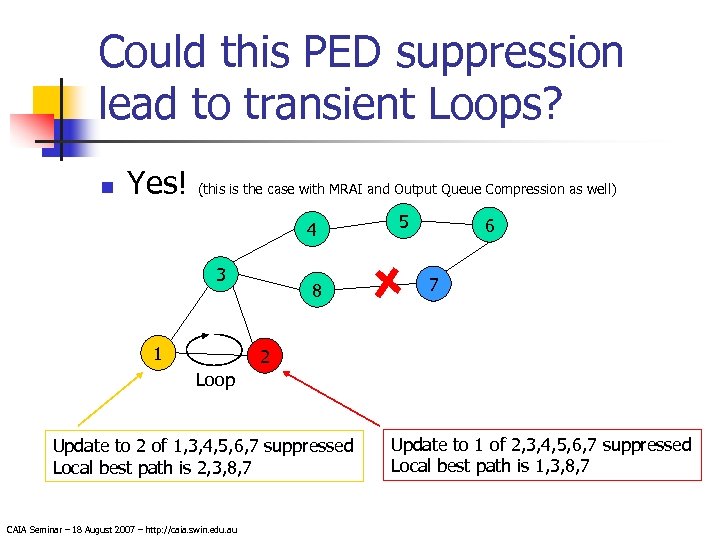
Could this PED suppression lead to transient Loops? n Yes! (this is the case with MRAI and Output Queue Compression as well) 4 3 1 8 5 6 7 2 Loop Update to 2 of 1, 3, 4, 5, 6, 7 suppressed Local best path is 2, 3, 8, 7 CAIA Seminar – 18 August 2007 – http: //caia. swin. edu. au Update to 1 of 2, 3, 4, 5, 6, 7 suppressed Local best path is 1, 3, 8, 7
PED Tweaking n n Do not suppress the longer path advertisement to the best path e. BGP peer This should prevent the formation of transient loops during the suppression interval CAIA Seminar – 18 August 2007 – http: //caia. swin. edu. au
Conclusions n n n Much of the background load in BGP is in processing non-informative intermediate states caused by BGP Path Exploration Existing approaches to suppress this processing load are too coarse to be completely effective Some significant leverage in further reducing BGP peak load rates can be obtained by applying a more selective algorithm to the MRAI approach in BGP, attempting to isolate Path Exploration updates by use of local heuristics CAIA Seminar – 18 August 2007 – http: //caia. swin. edu. au
Potential Next Steps n n More data gathering Simulation of PED Code Development Field Testing and Measurements CAIA Seminar – 18 August 2007 – http: //caia. swin. edu. au
Thank You n CAIA Seminar – 18 August 2007 – http: //caia. swin. edu. au Questions?
Скачать презентацию Taming BGP An incremental approach to improving the
f439c38f11cce8e504168804da7363db.ppt