 Скачать презентацию Tales from New Zealand Enabling access to rich
a6f74abe58598d37db9e506bc7978bae.ppt
- Количество слайдов: 12



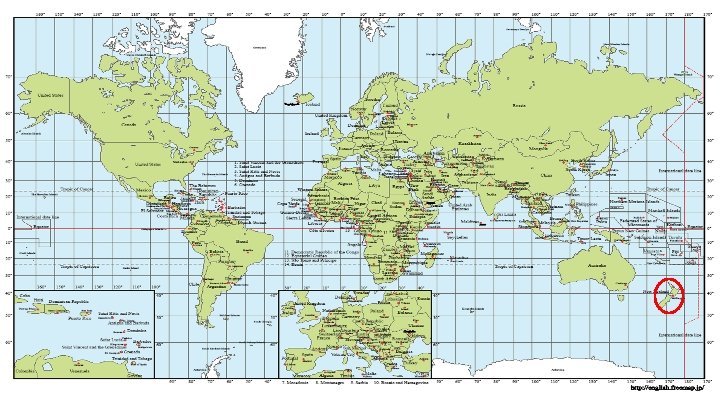
Tales from New Zealand. Enabling access to rich standardised clinical data across models of care. Interoperability with the inter. RAI assessment and care planning methodology. Canadian ehealth conference June 2015 Andrew Downes National inter. RAI Software Manager (Healthshare Ltd) 1
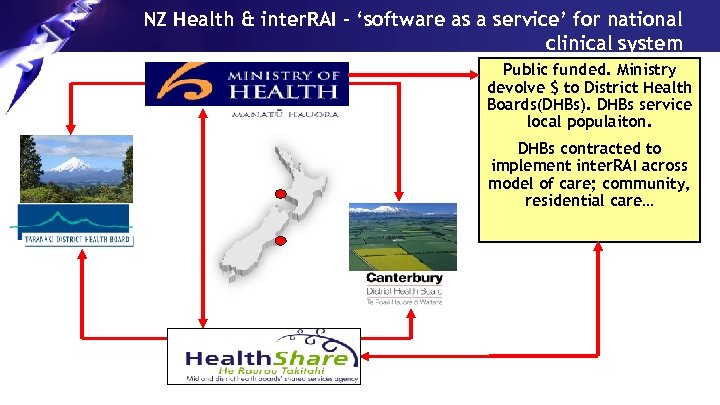
NZ Health & inter. RAI - ‘software as a service’ for national clinical system Public funded. Ministry devolve $ to District Health Boards(DHBs). DHBs service local populaiton. DHBs contracted to implement inter. RAI across model of care; community, residential care…
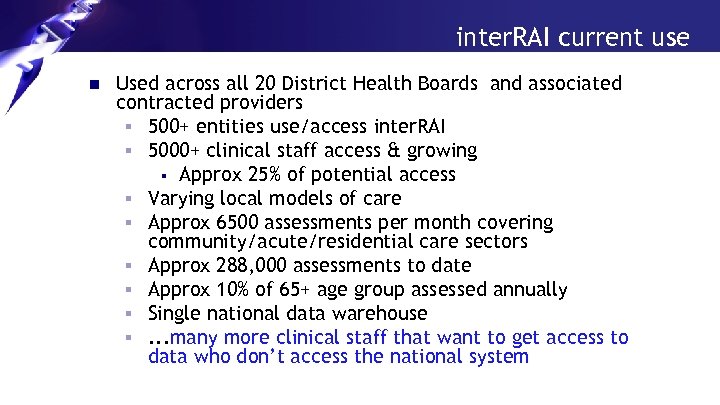
inter. RAI current use n Used across all 20 District Health Boards and associated contracted providers § 500+ entities use/access inter. RAI § 5000+ clinical staff access & growing § Approx 25% of potential access § Varying local models of care § Approx 6500 assessments per month covering community/acute/residential care sectors § Approx 288, 000 assessments to date § Approx 10% of 65+ age group assessed annually § Single national data warehouse §. . . many more clinical staff that want to get access to data who don’t access the national system
The Problem to be solved Making clinically rich data, (that also happens to be standardised, evidence based and comprehensive), available to clinical staff at the time they need it in their local system in a way that is least disruptive to their workflow n …doing this in a simple way n
The solution in New Zealand n n Enabled local clinical systems to pull inter. RAI assessment data from the national inter. RAI system using web services Calls based on client unique National Health Index number (NHI). Two services available: § PDF reports returned for assessments, care plans, other misc reports § HL 7 -CDA returned for assessment data
Focus on HL 7 - CDA n n inter. RAI assessment data is structured and standardised HL 7 CDA is a standard and allows for structured data to be made available, is xml based so very amenable for web services …. did some stars just align…? Yup! § A New Zealand implementation of the HL 7 CDA standard for inter. RAI has been developed with approval by NZ Standards body (Health Informatics Standards Organisation) with endorsement from inter. RAI and supported with a set of LOINC codes http: //healthitboard. health. govt. nz/our-programmes/common-clinicalinformation/comprehensive-clinical-assessment-aged-care-interrai Key advantage of HL 7 CDA is more flexibility to produce reports and analysis in local system that suit variety of clinical needs
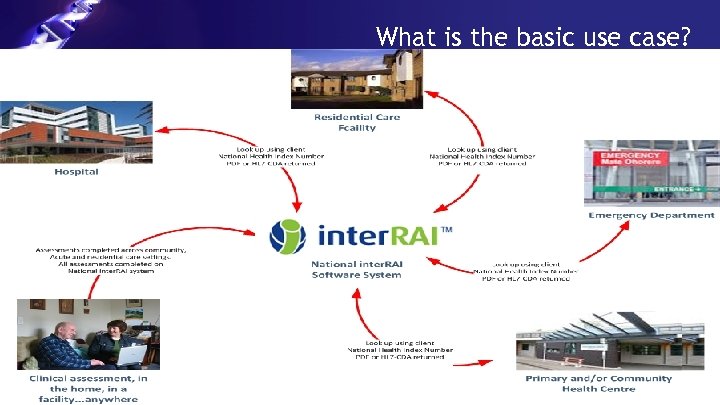
What is the basic use case?
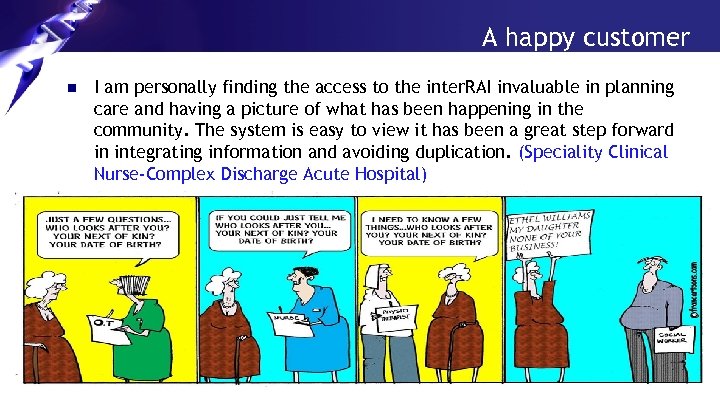
A happy customer n I am personally finding the access to the inter. RAI invaluable in planning care and having a picture of what has been happening in the community. The system is easy to view it has been a great step forward in integrating information and avoiding duplication. (Speciality Clinical Nurse-Complex Discharge Acute Hospital)
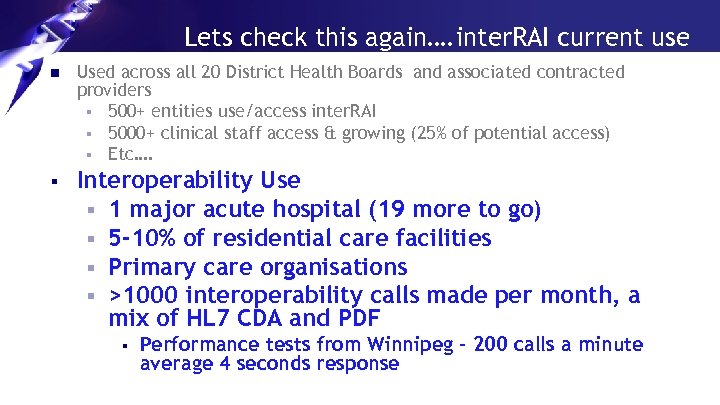
Lets check this again…. inter. RAI current use n Used across all 20 District Health Boards and associated contracted providers § 500+ entities use/access inter. RAI § 5000+ clinical staff access & growing (25% of potential access) § Etc…. § Interoperability Use § 1 major acute hospital (19 more to go) § 5 -10% of residential care facilities § Primary care organisations § >1000 interoperability calls made per month, a mix of HL 7 CDA and PDF § Performance tests from Winnipeg – 200 calls a minute average 4 seconds response
Your take home messages… n n HL 7 CDA standard and inter. RAI made this very straightforward Technology is the least of your concerns. Technically this was easy Working with clinical staff on what they need to see should be uppermost § inter. RAI methodology orientation New Zealand is not Australia
Acknowledgements n n Dr Kanaka Ramyasiri - Clinical Architect Healthshare Ltd Alastair Kenworthy - Principal Sector Architect Ministry of Health (NZ)
Скачать презентацию Tales from New Zealand Enabling access to rich
a6f74abe58598d37db9e506bc7978bae.ppt