


 Скачать презентацию Taking Your Product to the U S Market
184b933a9c45c669f2a6a1ad8ec487e9.ppt
- Количество слайдов: 63
 Taking Your Product to the U. S. Market: Health Regulatory Primer for Drugs and Devices Lynn Shapiro Snyder, Esq. Epstein Becker & Green, P. C. Washington, D. C. lsnyder@ebglaw. com 11 May 2009 Marcia Nusgart, R. Ph. Nusgart Consulting LLC Bethesda, MD marcia@nusgartconsulting. com
 Agenda Basic Concepts for Commercialization of Drugs and Devices in the United States – Coverage – Coding – Payment 2
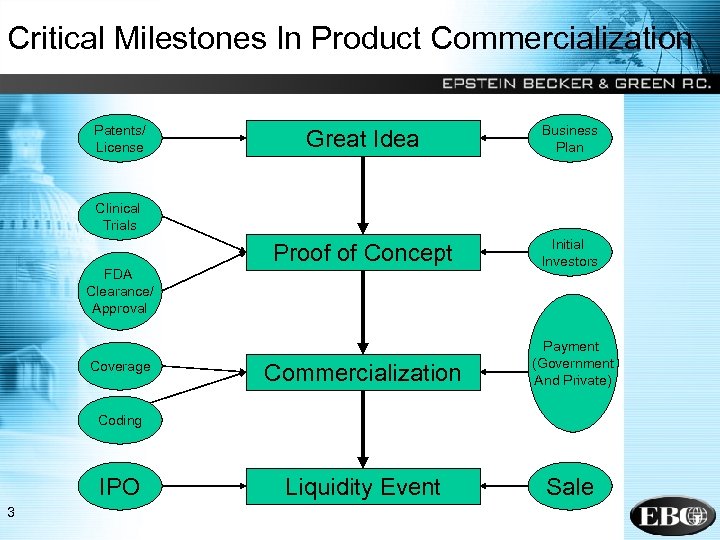 Critical Milestones In Product Commercialization Patents/ License Great Idea Business Plan Proof of Concept Initial Investors Commercialization Payment (Government And Private) Liquidity Event Sale Clinical Trials FDA Clearance/ Approval Coverage Coding IPO 3
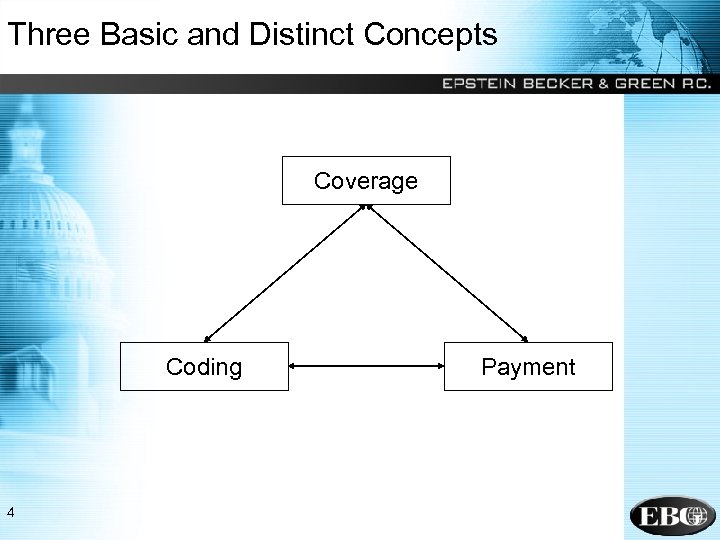 Three Basic and Distinct Concepts Coverage Coding 4 Payment
 Three Basic and Distinct Concepts • Coverage: Terms and conditions for payment • Coding: Unique identifiers for diagnoses, procedures, devices & diagnostics, inpatient services, and outpatient services • Payment: Remuneration by health insurance plans, governmentfunded programs 5
 How Are These Concepts Different? Coverage – – – Is not guaranteed when you receive FDA approval/clearance Does not guarantee a new or favorable billing code Does not guarantee favorable reimbursement Coding – – – Links coverage and payment Does not guarantee coverage Does not guarantee favorable reimbursement Payment – – 6 Function of coverage and coding May be subject to limits May be stand-alone or bundled May be driven by breakthrough or existing technologies
 Who Are The U. S. Payers? Private Payers Employers – self-funded or not Unions Health Plans -Blue Cross/Blue Shield Plans -United Healthcare -Aetna US Healthcare -Anthem Wellpoint -Others 7 Public Payers Medicare –federal –seniors, disabled, ESRD Medicaid – federal/state – indigent, women, children, indigent seniors, chronically ill Tri. Care – federal – military dependants SCHIP – federal/state – children Others
 In Practice, Things Can Be Different “We do not see why the Secretary [of Health and Human Services] would be bound. . . by any earlier acceptance of MRI by the Food and Drug Administration” Goodman v. Sullivan, 891 F. 2 d 449, 451 (2 d Cir. 1989) 8
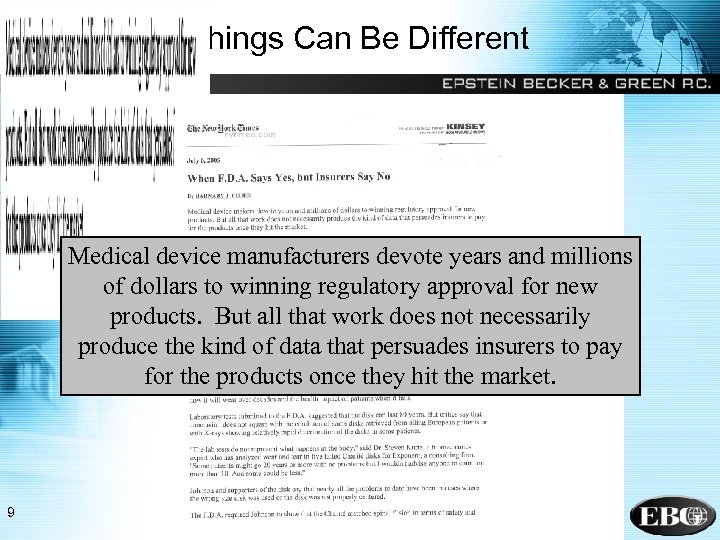 In Practice, Things Can Be Different Medical device manufacturers devote years and millions of dollars to winning regulatory approval for new products. But all that work does not necessarily produce the kind of data that persuades insurers to pay for the products once they hit the market. 9
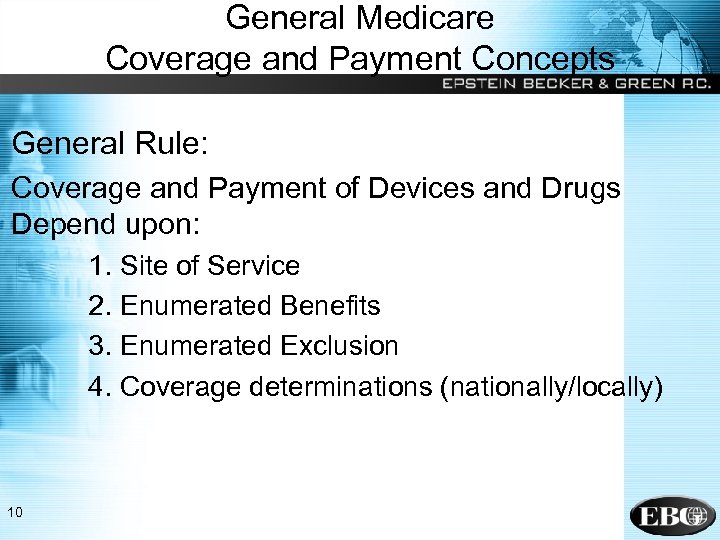 General Medicare Coverage and Payment Concepts General Rule: Coverage and Payment of Devices and Drugs Depend upon: 1. Site of Service 2. Enumerated Benefits 3. Enumerated Exclusion 4. Coverage determinations (nationally/locally) 10
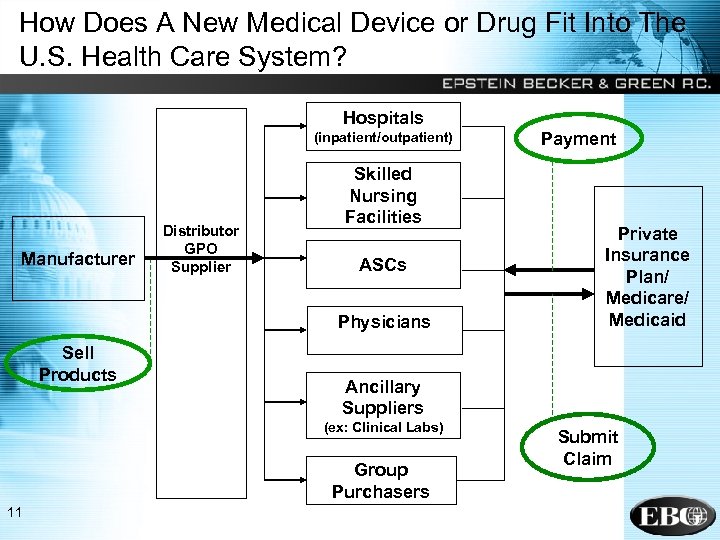 How Does A New Medical Device or Drug Fit Into The U. S. Health Care System? Hospitals (inpatient/outpatient) Manufacturer Distributor GPO Supplier Skilled Nursing Facilities ASCs Physicians Sell Products Private Insurance Plan/ Medicare/ Medicaid Ancillary Suppliers (ex: Clinical Labs) Group Purchasers 11 Payment Submit Claim
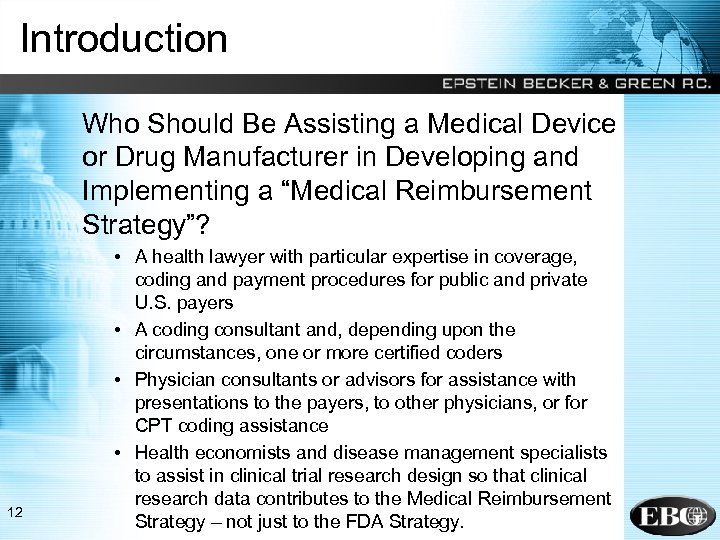 Introduction Who Should Be Assisting a Medical Device or Drug Manufacturer in Developing and Implementing a “Medical Reimbursement Strategy”? 12 • A health lawyer with particular expertise in coverage, coding and payment procedures for public and private U. S. payers • A coding consultant and, depending upon the circumstances, one or more certified coders • Physician consultants or advisors for assistance with presentations to the payers, to other physicians, or for CPT coding assistance • Health economists and disease management specialists to assist in clinical trial research design so that clinical research data contributes to the Medical Reimbursement Strategy – not just to the FDA Strategy.
 Coverage Strategy • Process starts well in advance of product launch – Thinking about coverage and payment at all times beginning with the earliest product R & D discussions as well as when designing clinical trials • Understanding realistic timeframes is critical 13
 Coverage Strategy Key Coverage Issues • Who will benefit most? seniors, children, women, others? • Where will the benefit be delivered? institutions, outpatient, home care • What are the expected clinical outcomes? • Are there services that are comparable, but inferior or superior? • How much is the expected financial impact for the payer/consumer? • Immediate v. long-term benefits? 14
 Coverage Strategy • Coverage process can range from six months to several years 15 – Coverage is distinct from FDA approval/clearance – Must take into account the various coverage standards established for government and private players in the U. S. health system – Must address indications for “medical necessity” – May also address coverage limits, such as required site of service as a condition of coverage or frequency of tests (may have a payment impact as well)
 Coverage Strategy • Specific Controls for New Drugs or Medical Devices – Limit coverage • Certain locations, people, prior actions • Limit payment – In whole, in part • Payers employ Medical Directors who oversee a staff of health professionals and others – both employees and consultants – to help with these decisions. • Medical Directors have diverse backgrounds 16
 Coverage Strategy • Coverage issues should be initiated with major stakeholders – Professional organizations • ex: ACC for cardiovascular, AAOS for orthopedic – Physician-advocates and thought leaders • Scientific advisory boards – Hospitals, hospital systems, physicians • End-users of the devices • Build familiarity with the device 17 – Consult payers during the process – Cultivate strong physician advocates, institutional and organizational support
 Private Health Benefit Plans: Coverage Issues • Private health benefit plans conduct technology assessments that focus on: – impact on current options – potential for overutilization – financial impact – technology assessment (“TEC” criteria) 18
 Coverage Strategy Recent Developments • Comparative Effectiveness • Coverage with Evidence Development • CMS – Medicare Evidence Development and Coverage Advisory Committee (“MED CAC”) • Agency for Healthcare Research and Quality (“AHRQ”) conducts health technology assessments (“HTAs”) 19
 Integrating Coverage Issues Into Clinical Trial Design • Coverage is driven by evidence of improved outcomes, clinical efficiency, and cost effectiveness • Clinical trial design should incorporate these factors • Study design should include gathering data comparing study device to existing treatments or technologies 20
 Avoid Pitfalls In The Coverage Process • • • FDA 510(k) language may make it difficult to prove a significant difference from the predicate drug or device, unless specific indications justify otherwise Get articles published in U. S. peer-reviewed journals Don’t argue that coverage is needed to get higher reimbursement – base argument on: – Technological improvement – Clinical improvement – Higher and more complex resources • Don’t go it alone – Link arms with interested parties 21
 Special Coverage Challenges for Diagnostic Tests Payers may classify tests as: • Innovative breakthrough for patient health – Fills a compelling need • Replacing an existing test/technology – Must have superior characteristics (ex: outcomes, speed, quality/quantity of data) – Is it less expensive? • Additive to existing test/technology 22 – Is it more cost effective when you look at the total cost of the patient’s treatment?
 Coding Basics • Coding is an identifier for a diagnosis, drug, device, or procedure • Coding connects coverage and payment • Codes allow for rapid claims processing and health policy research • Coding systems have different timetables for updates and revisions 23
 Coding Basics TYPES OF CODES • ICD-9 -CM*: Diagnoses & Inpatient Hospital Procedures • CPT: Procedures • HCPCS: Drugs and Devices *ICD-10 -CM is coming shortly 24
 Coding Basics Key Coding Issues for Billing Codes: Similar to coverage issues • • • 25 Site of service Financial implications Professional v. Technical Components CPT Codes versus HCPCS Codes Related procedure codes for devices
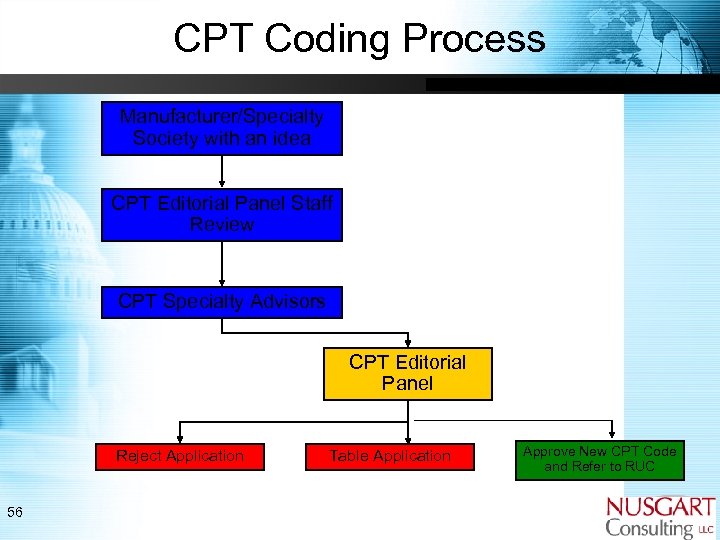
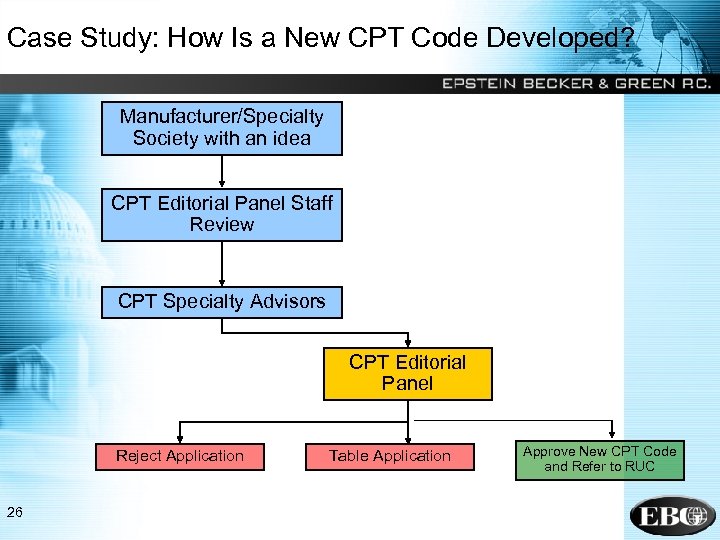 Case Study: How Is a New CPT Code Developed? Manufacturer/Specialty Society with an idea CPT Editorial Panel Staff Review CPT Specialty Advisors CPT Editorial Panel Reject Application 26 Table Application Approve New CPT Code and Refer to RUC
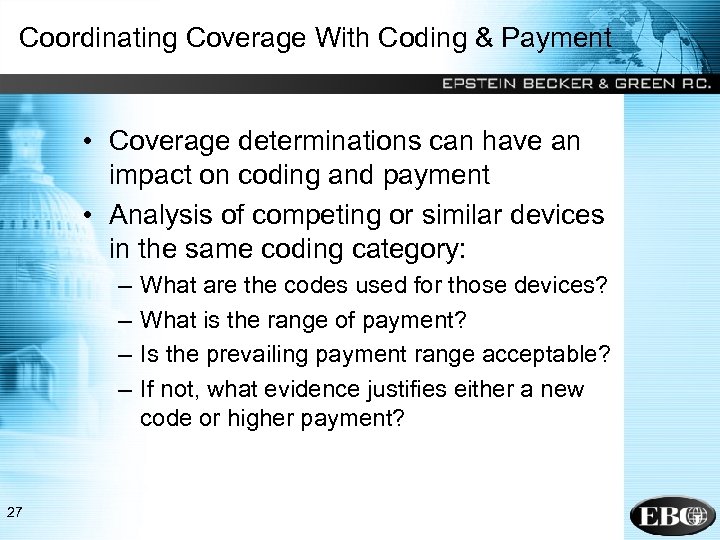 Coordinating Coverage With Coding & Payment • Coverage determinations can have an impact on coding and payment • Analysis of competing or similar devices in the same coding category: – – 27 What are the codes used for those devices? What is the range of payment? Is the prevailing payment range acceptable? If not, what evidence justifies either a new code or higher payment?
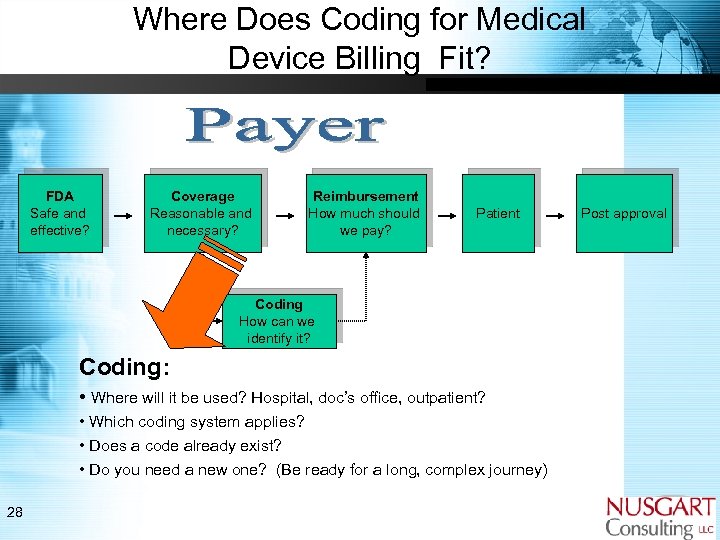 Where Does Coding for Medical Device Billing Fit? FDA Safe and effective? Coverage Reasonable and necessary? Reimbursement How much should we pay? Patient Coding How can we identify it? Coding: • Where will it be used? Hospital, doc’s office, outpatient? • Which coding system applies? • Does a code already exist? • Do you need a new one? (Be ready for a long, complex journey) 28 Post approval
 Where Does Coding for Medical Device Billing Fit? (cont. ) • Manufacturers LIVE AND DIE by BILLING CODING • By establishing appropriate code for billing a product/identify payment levels • If placed in code that does not include like products, the reimbursement could be inappropriate 29
 Coding Systems - HCPCS • Devices may be used in a variety of settings, such as hospitals, physician offices, and patient homes • CPT codes describe professional services • HCPCS codes describe the device used in connection with a professional service 30
 Coding Systems-HCPCS (cont. ) • Healthcare Common Procedure Coding System • Maintained by the American Medical Association and Centers for Medicare and Medicaid Services • Has Two Levels-CPT and HCPCS • Updated Annually and as Needed 31
 Coding Systems-HCPCS (cont. ) • Level I - CPT-4 Codes + Modifiers • Level II - National Codes + Modifiers – 1 Alpha (A through V) with 4 numeric digits (e. g. , A 4562) – Modifiers - AA through VP – Primarily used for items and services not included in CPT-4 32
 Level I - CPT-4 Codes • Current Procedural Terminology, 4 th edition • Identifies Procedures • Published by the AMA and copyrighted – AMA CPT Editorial Panel (16 members) – AMA CPT Advisory Committee • 5 digit numeric codes – E. g. , 29580 Unna boot 33
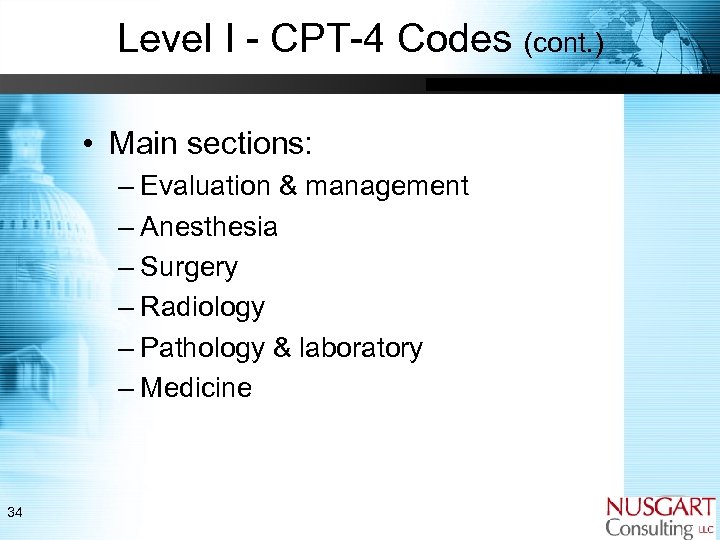 Level I - CPT-4 Codes (cont. ) • Main sections: – Evaluation & management – Anesthesia – Surgery – Radiology – Pathology & laboratory – Medicine 34
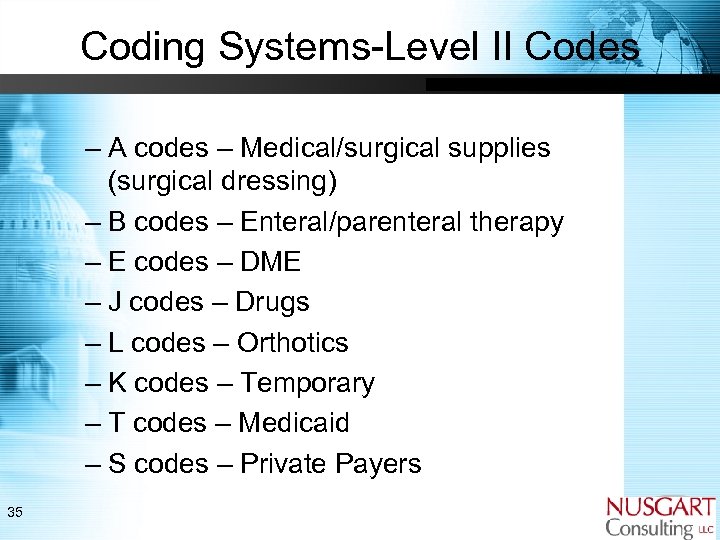 Coding Systems-Level II Codes – A codes – Medical/surgical supplies (surgical dressing) – B codes – Enteral/parenteral therapy – E codes – DME – J codes – Drugs – L codes – Orthotics – K codes – Temporary – T codes – Medicaid – S codes – Private Payers 35
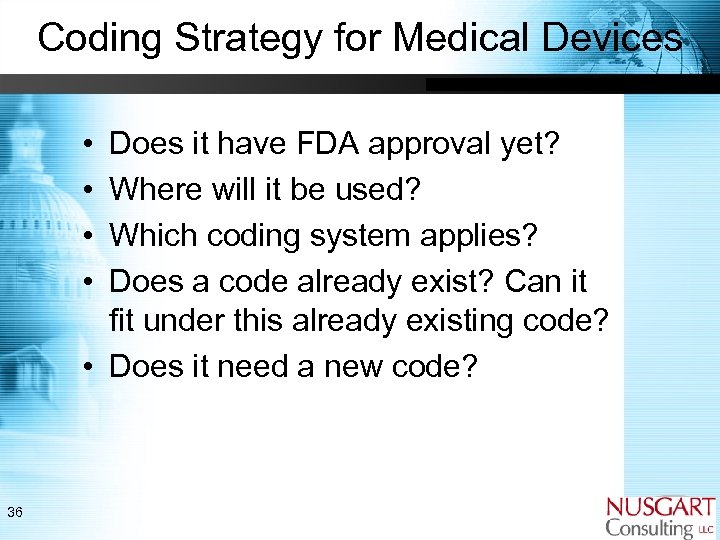 Coding Strategy for Medical Devices • • Does it have FDA approval yet? Where will it be used? Which coding system applies? Does a code already exist? Can it fit under this already existing code? • Does it need a new code? 36
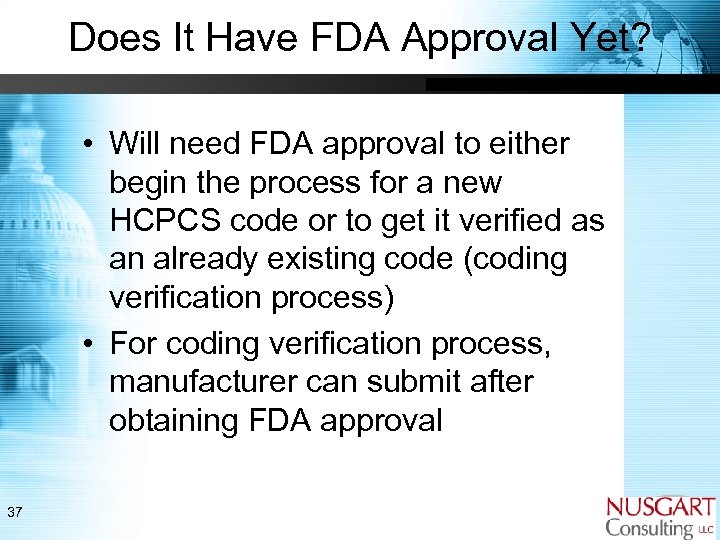 Does It Have FDA Approval Yet? • Will need FDA approval to either begin the process for a new HCPCS code or to get it verified as an already existing code (coding verification process) • For coding verification process, manufacturer can submit after obtaining FDA approval 37
 Where Will It Be Used? • • • 38 Hospital? Physician’s Office? Outpatient? Home Care? Long Term Care?
 Which Coding System Applies? • Where it is billed and who is using it will determine the coding and payment system • Example– some products will be included in a prospective payment systems in the hospital or outpatient and may not need a code; but if you decide to market them into the home area; a HCPCS code may be necessary 39
 Does A Code Already Exist? • CPT - Look in AMA books • HCPCS Level II: – Appropriate Durable Medical Equipment Medicare Administrative Contractor (DME MAC coverage policy) http: //www. cms. hhs. gov/center/dme. asp – PDAC DMEC website https: //www. dmepdac. com/dmecsapp/do/se arch – HCPCS code books (Ingenix 1 -800 -7656588) 40
 Strategy - Items to Consider • Even if a code exists, what criteria do you use to see if you want your product to fall under this code? – If you have a “me-too” product, this really does not apply since it probably fits in an existing code – Does the code descriptor accurately describe your product? – Is your competition already in this code? – Does the reimbursement rate meet your needs? 41
 Does It Need a New HCPCS Code? • If it does not fit under existing codes, does it meet these characteristics? – Significant technological differences (components, materials, structural features) – Significant clinical indications or uses distinct from existing codes – Different patient population that the product treats – Significant price differential from products in existing codes 42
 New HCPCS Code Strategy • Before you pursue a new code, be prepared to have the following: – If this is a device, you must have 3 months of marketing data to show that there is a need for a new code (Marketing data not required for drugs) – Clinical studies in a peer-reviewed journal (preferably U. S. ) 43
 Hurdles to Overcome to Obtain New HCPCS Code • Process still not transparent or predictable; decisionmakers not familiar with devices • Very few HCPCS code submissions actually do get new HCPCS codes; instead they are placed in an already existing HCPCS code category or miscellaneous code • HCPCS workgroup places increased emphasis on clinical outcomes to obtain new HCPCS code • Important – studies manufacturer does for FDA will want to take a step further and do them for both coverage and coding of product 44
 Example: Criteria that HCPCS Workgroup Uses to Evaluate Coding Requests • Performs significantly different function than other HCPCS codes • Operates differently • Significant therapeutic distinction or superior clinical outcome compared to existing coded treatments or products • Meet volume and marketing criteria • National program operating need for Medicare, Medicaid, Private Insurers • http: //www. cms. hhs. gov/Med. HCPCSGen Info/Downloads/decisiontree. pdf 45
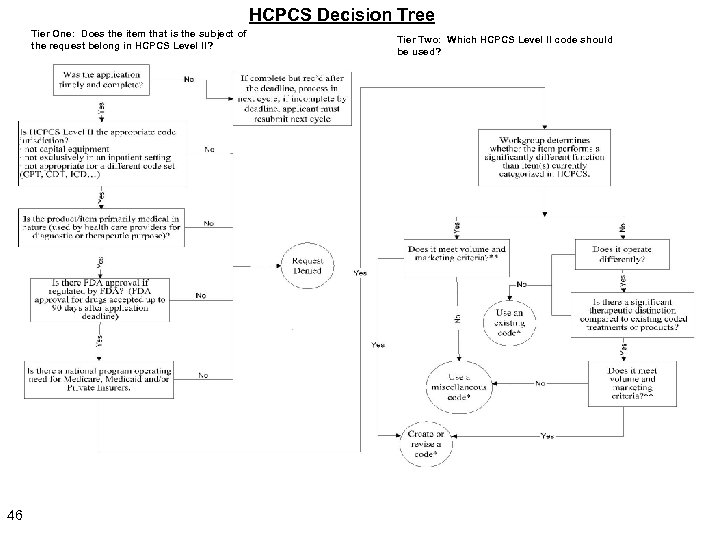 HCPCS Decision Tree Tier One: Does the item that is the subject of the request belong in HCPCS Level II? 46 Tier Two: Which HCPCS Level II code should be used?
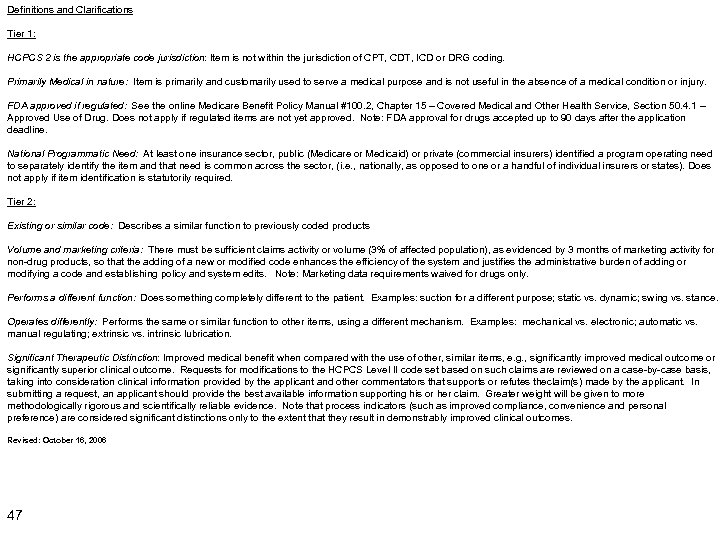 Definitions and Clarifications Tier 1: HCPCS 2 is the appropriate code jurisdiction: Item is not within the jurisdiction of CPT, CDT, ICD or DRG coding. Primarily Medical in nature: Item is primarily and customarily used to serve a medical purpose and is not useful in the absence of a medical condition or injury. FDA approved if regulated: See the online Medicare Benefit Policy Manual #100. 2, Chapter 15 – Covered Medical and Other Health Service, Section 50. 4. 1 – Approved Use of Drug. Does not apply if regulated items are not yet approved. Note: FDA approval for drugs accepted up to 90 days after the application deadline. National Programmatic Need: At least one insurance sector, public (Medicare or Medicaid) or private (commercial insurers) identified a program operating need to separately identify the item and that need is common across the sector, (i. e. , nationally, as opposed to one or a handful of individual insurers or states). Does not apply if item identification is statutorily required. Tier 2: Existing or similar code: Describes a similar function to previously coded products Volume and marketing criteria: There must be sufficient claims activity or volume (3% of affected population), as evidenced by 3 months of marketing activity for non-drug products, so that the adding of a new or modified code enhances the efficiency of the system and justifies the administrative burden of adding or modifying a code and establishing policy and system edits. Note: Marketing data requirements waived for drugs only. Performs a different function: Does something completely different to the patient. Examples: suction for a different purpose; static vs. dynamic; swing vs. stance. Operates differently: Performs the same or similar function to other items, using a different mechanism. Examples: mechanical vs. electronic; automatic vs. manual regulating; extrinsic vs. intrinsic lubrication. Significant Therapeutic Distinction: Improved medical benefit when compared with the use of other, similar items, e. g. , significantly improved medical outcome or significantly superior clinical outcome. Requests for modifications to the HCPCS Level II code set based on such claims are reviewed on a case-by-case basis, taking into consideration clinical information provided by the applicant and other commentators that supports or refutes theclaim(s) made by the applicant. In submitting a request, an applicant should provide the best available information supporting his or her claim. Greater weight will be given to more methodologically rigorous and scientifically reliable evidence. Note that process indicators (such as improved compliance, convenience and personal preference) are considered significant distinctions only to the extent that they result in demonstrably improved clinical outcomes. Revised: October 16, 2006 47
 HCPCS Coding Process/Timetable • Once decision made on whether you want to apply for an already existing code or new code, then you follow one of two pathways: – Products that fall under already existing HCPCS code - Submit coding verification application to Medicare Pricing Data Analysis and Coding “PDAC” – New technology - Submit new code request through Centers for Medicare and Medicaid Services “CMS” 48
 Coding Verification – Who is the PDAC? • Medicare Pricing Data Analysis and Coding • Used to be the SADMERC until 2008 • Located in Fargo, North Dakota • Part of Noridian Administrative Services • Offers guidance on proper use of HCPCS; advisor to HCPCS Workgroup for new coding decisions • Performs national pricing functions; assists CMS on fee schedules • Offers online Durable Medical Equipment Coding Center and call center for providers 49
 Why Do You Need Coding Verification For Your Product? • Marketing reasons - Products that are code verified will appear on PDAC website under Product Classification Lists • Payer reasons - Some Medicaids want to see PDAC letter to show that product falls under certain HCPCS code • Strategy for getting new code - if PDAC gives you miscellaneous codes, it shows that no other code describes your product 50
 Coding Verification Request • PDAC product specific application • 90 -day timeframe • Submit at any time • 877. 735. 1326 • Applications found at: https: //www. dmepdac. com/review/index. html 51
 New HCPCS Code Process/Timetable for 2009 -10 Coding Cycle • Application submitted to CMS before Jan. 5, 2009 (Jan. 4, 2010) • One year timeframe • Decisions in Nov. 2009 Implemented in Jan. 2010 • Decisions made by CMS HCPCS workgroup panel (composed of the Medicaid, CMS) The PDAC and Private Payor Representatives Act as Consultants 52
 New HCPCS Code Process/Timetable for 2009 -10 Coding Cycle (cont. ) • All applications placed on Public Meeting Agenda • Dates/agenda/preliminary decisions on CMS website • HCPCS Public Meeting in Spring to discuss preliminary decisions • No reconsideration process - just reapply 53
 New HCPCS Code Application • Application can be found at: http: //www. cms. hhs. gov/Med. HCPC SGen. Info/Downloads/2011 HCPCS Application. pdf • What can you ask for? – Establish a new code – Change code descriptor – Discontinue a code 54
 New HCPCS Code Application (cont. ) • Include cover letter outline code request/summary of why new code needed • Identify one code or group of similar code requests per submission packet • Include descriptive material helps understanding of medical benefits • Submit original plus 35 copies (all paper) • Enclose: cover letter, completed, signed and dated application, FDA (letter or explanation of exemption), supporting documentation, product brochures/booklets • 40 -page limit 55
 CPT Coding Process Manufacturer/Specialty Society with an idea CPT Editorial Panel Staff Review CPT Specialty Advisors CPT Editorial Panel Reject Application 56 Table Application Approve New CPT Code and Refer to RUC
 New CPT Code Process • Very political process • Needs a physician specialty association to submit application on your behalf • Application must be carefully written by someone who is knowledgeable on knowing how to present the important information – Needs cover letter along with application – Clinical vignette is most important since it forms the basis on how much the procedure will be reimbursed later in the CPT process 57
 New CPT Code Process (cont. ) • You and the physician specialty association will need to lobby other specialty associations who are part of the AMA CPT Advisory Committee to support your submission • Specialty association representative will present the request at AMA meeting • If code approved, then will undergo process to determine reimbursement – http: //www. ama-assn. org/ama/pub/physicianresources/solutions-managing-your-practice/coding -billing-insurance/cpt/applying-cpt-codes/requestform-category-ii. shtml 58
 Timetable for New CPT Code • For 2011 coding year - implemented January 1 • 2009 submission deadlines - March, July, November • Corresponding CPT meetings - June 2009, October 2009, February 2010 • RUC Meetings to determine payment October 2009, February 2010, April 2010 59
 How to Set the Stage for Successful CPT and HCPCS Coding Decisions • CPT – Education and Involvement/Endorsement of Professional Societies is the Key – Write an appropriate clinical vignette that addresses the complexity of work involved since that corresponds to payment • HCPCS – Make the CMS staff and DME MAC medical directors your NEW BEST FRIENDS – Go Visit Them! (before you submit application and after you have received your CMS coding letter in November) – HCPCS Application - Follow Directions, Submit Peer Reviewed Published Studies – If attend HCPCS Public Meeting - Bring Physicians or Clinicians as Advocates; It is not a sales presentation! – It is OK to Resubmit Application for the next year 60
 Medicare Payment Methodologies Generally – Hospitals –Part A – inpatient – reasonable costs MS-DRGs New Technology Add-On Payment –Part B – outpatient – reasonable costs APCs – Physicians – Part B –Reasonable charges RBRVS based on CPTs – Ambulatory Surgical Centers –Paid based on one of nine payment groups – Other Part B Services –Fee schedules –Average Wholesale Price “AWP” –Average Sales Price “ASP” 61
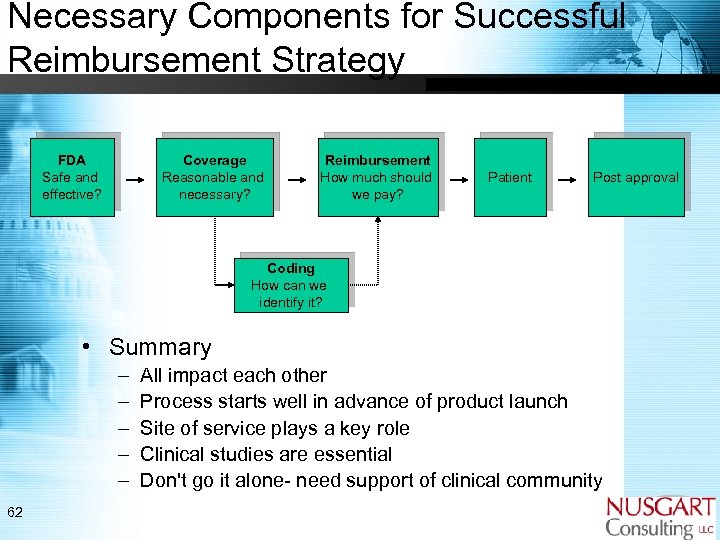 Necessary Components for Successful Reimbursement Strategy FDA Safe and effective? Coverage Reasonable and necessary? Reimbursement How much should we pay? Patient Post approval Coding How can we identify it? • Summary – – – 62 All impact each other Process starts well in advance of product launch Site of service plays a key role Clinical studies are essential Don't go it alone- need support of clinical community
 Discussion Lynn Shapiro Snyder, Esq. lsnyder@ebglaw. com Tel: (202) 861 -1806 Fax: (202) 861 -3506 63 Marcica Nusgart, R. Ph. marcia@nusgartconsulting. com Tel: (301) 530 -7846 Fax: (301) 530 -7946