


 Скачать презентацию Taking the Lead with Classroom Management in Order
d638f073b01e234f13175744c9c2fe3e.ppt
- Количество слайдов: 36
 Taking the Lead with Classroom Management in Order to Improve Instruction Hope Colle and Liz Crawford
 Agenda • • Introduction Research School-Wide Routines Classroom Routines Center Routines References and Resources Bringing it back to your teachers
 Research • “Transition times can be cut by over 50% when teachers systematically train students to transition. ” • (La. Fluer, Witt, Naquin, Harwell and Gilbertson, 1998) • “Classrooms with specific routines for getting assistance, working independently or lining up have fewer off-task and disruptive behaviors than classrooms without such procedures. ” • (Emmer and Evertson, 1981)
 Research • Two major findings of Cameron, C. E. , Connor, C. M. , & Morrison, F. J. (2005). Effects of variation in teacher organization on classroom functioning. – the more time the teachers spent on ‘orient-organize’ tasks in the fall, the less time the children spent in transitions between activities in the spring. – teachers who spent more time on organization instruction in the fall, coupled with less time on organization in the winter, had children spending more time in ‘childmanaged’ activities in the spring. • Check out the June Intervention Newsletter for more research on classroom management and its impact on intervention (www. fcrr. org)
 School Wide Routines • Culture of Respect and Responsibility • Consistency across grades and building • Proactive (teaching routines and expectations) vs. Reactive (consequences) • Mustangs, Bees, and PBS Examples
 Mustang R&R Ranch • • Faculty vision of the mission Faculty buy-in to the mission Faculty commitment to the mission Parent vision, buy-in and commitment
 Mustang R&R Ranch • School atmosphere and environment • School staff –principal, teachers, office staff and custodial staff • Motivational and Rewarding for all
 Mustang R&R Ranch • Respect: Looks, feels and sounds like • Disrespect: Looks, feels and sounds like • Responsibility: Looks, feels and sounds like • Lack of Responsibility: Looks, feels and sounds like
 Mustang R&R Ranch • Life Long Rewards of the Double R Ranch • Face Book- “W. T. Moore Kids” • Theme Song
 Bellview Bees • Bee Respectful to others • Bee Responsible for yourself • Bee Ready to Work
 PBS Examples- Kathleen Elementary Teachers • Respect yourself • Respect others • Respect property
 Classroom Routines • Do’s vs. Don’ts (Positive vs. Negative) • Routines and expectations – – – Lining Up Sharpening Pencils (Pencil Captain) Bathroom time Getting students’ attention (flick the lights) Handing back papers (assigning a # to students to match the number in ABC order – use mailboxes – maybe cardboard shoe boxes) • “Behavior Instruction” just like reading instruction
 Kathleen Elementary Classroom Examples • Kindergarten – Joy M. • 3 rd Grade – Heather C.
 How are you really spending your time? • BET observation for 20 minutes – • Are you spending your time on behavior, environment/materials or on teaching? • Taken from the book “Differentiated Instruction: Grouping for Success by Vicki Gibson, Ph. D. and Jan Hasbrouck, Ph. D. Behavior Environment Teaching
 Consider this… 90 Minute Reading Block -5 minutes to find a misplaced T. E. 85 -5 minutes to redirect after a fuss 80 -5 minutes for bathroom breaks or pencil sharpening 75 -5 minutes of interruptions during small group instruction 70 minutes of reading
 Protect your teaching time! If 20 minutes of reading time is lost every day… 20 min X 180 days =3, 600 min/yr FORTY 90 Minute Block periods of reading is lost each year! (2 months of school!!)
 Center Routines • Rotation or Self-Selection (Video)
 Center Management Systems Video
 Center Routines • Rotation or Self-Selection (Video) • Transition • Questions during small group instruction • Accountability for work in centers • Maximize classroom space (Video)
 Maximize your classroom space Video
 Center Routines • Rotation or Self-Selection (Video) • Transition • Questions during small group instruction • Accountability for work in centers • Maximize classroom space (Video) • “Train the Troops” (Video)
 “Train the Troops” Video
 BER Video Using Literacy Centers to Strengthen Your Reading and Writing Program: Grades K-3. • Video - BER (Bureau of Education and Research www. ber. org) • Use primarily for management and organization tips – FCRR Center activities may be used for center ideas
 Bringing it back to your teachers • Activities and handouts that can be delivered through professional development to teachers and staff at your school
 Classroom Management Tips to Improve Instruction
 TLC Show examples • Clean Sweep • Mission Organization • Trading Spaces
 “CLEAN SWEEP” • Keep, Toss, Sell – Divide classroom items into three piles -but in this case – • Keep, Toss, Swap – Instead of having a yard sale, get together with the other teachers in the building and swap some of your favorite things that you might not use any more
 “MISSION ORGANIZATION” *Everything must have a home *Define zones (the spaces) in your classroom
 “Trading Spaces” • Open up your classrooms and share your organizational tips with other teachers in your building • Highlight an original idea (e. g. dollar tree pointers, baskets for portable centers, home depot pvc piping chart holder, construction orange plastic netting to hang student work with clothes pins, etc. )
 Expectations, instruction and being proactive • List Expectations you have for your students. • Chunk the list into modeling activities that you will (must) model during the first days of school. • Begin with short whole class lessons and movement with in the class and around the school. • Don’t commit “assumination” or “assumicide” – Be sure to TEACH the procedure of behavior , MODEL it, and REVIEW it frequently
 What behaviors drive you NUTS? • Circumvent and prevent when possible. • Take corrective action NOW. • Share some ways that individual annoying behaviors and habits can be corrected. (humming, inattentiveness, lack of eye contact, yelling out, etc. ) • How have you dealt with the behaviors in positive ways, avoiding nagging, sarcasm, or alienation of the child?
 Considerations for “Training the Troops” • Begin your small group teacher station only after you have “walked the centers” to monitor proper procedures. • Keep your teacher group center out of the rotation so your selection of group members for different purposes can be flexible. • Address and model trouble-shooting procedures in advance.
 Take time to teach your students HOW to learn in your classroom. Complete your expectations chart and make every minute count this year!
 “All battles are won before they are fought. ” Sun Tzu
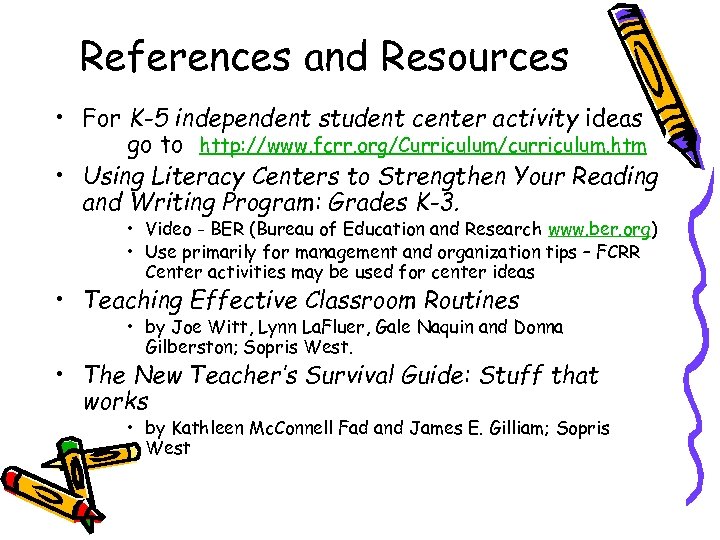 References and Resources • For K-5 independent student center activity ideas go to http: //www. fcrr. org/Curriculum/curriculum. htm • Using Literacy Centers to Strengthen Your Reading and Writing Program: Grades K-3. • Video - BER (Bureau of Education and Research www. ber. org) • Use primarily for management and organization tips – FCRR Center activities may be used for center ideas • Teaching Effective Classroom Routines • by Joe Witt, Lynn La. Fluer, Gale Naquin and Donna Gilberston; Sopris West. • The New Teacher’s Survival Guide: Stuff that works • by Kathleen Mc. Connell Fad and James E. Gilliam; Sopris West
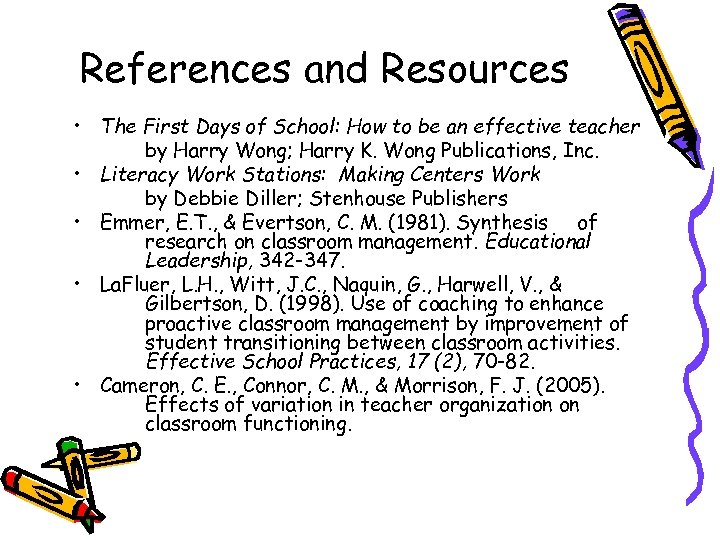 References and Resources • The First Days of School: How to be an effective teacher by Harry Wong; Harry K. Wong Publications, Inc. • Literacy Work Stations: Making Centers Work by Debbie Diller; Stenhouse Publishers • Emmer, E. T. , & Evertson, C. M. (1981). Synthesis of research on classroom management. Educational Leadership, 342 -347. • La. Fluer, L. H. , Witt, J. C. , Naquin, G. , Harwell, V. , & Gilbertson, D. (1998). Use of coaching to enhance proactive classroom management by improvement of student transitioning between classroom activities. Effective School Practices, 17 (2), 70 -82. • Cameron, C. E. , Connor, C. M. , & Morrison, F. J. (2005). Effects of variation in teacher organization on classroom functioning.